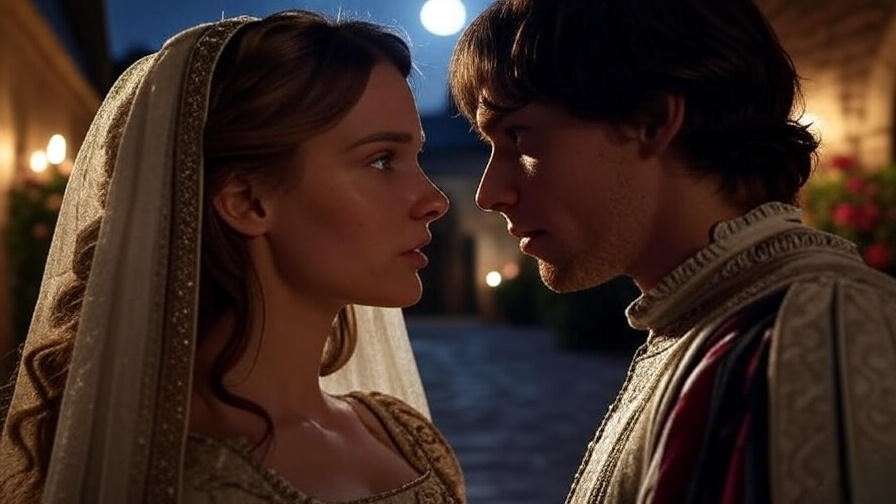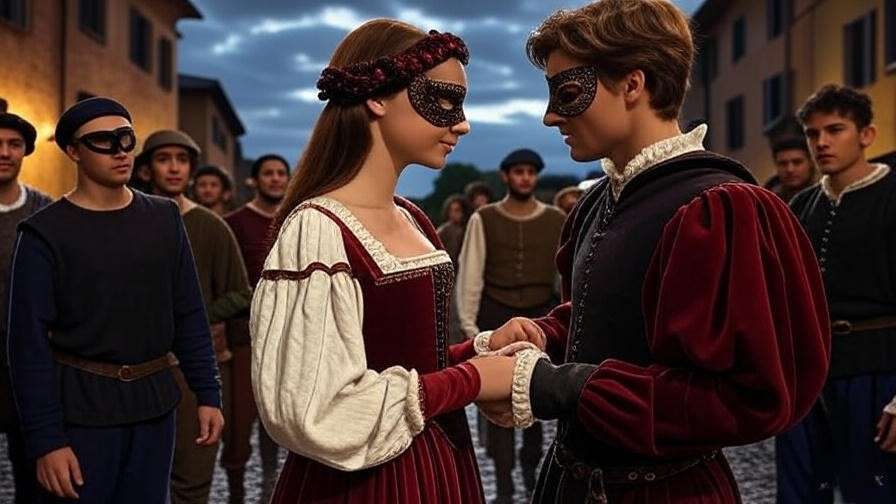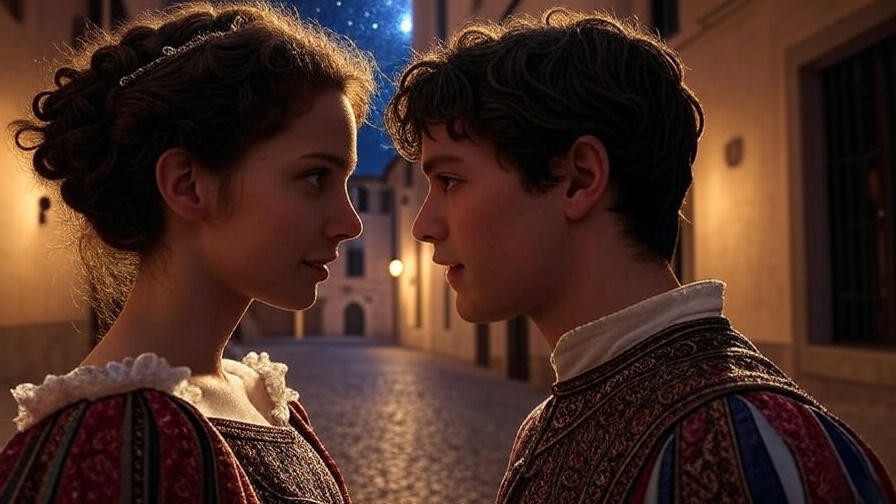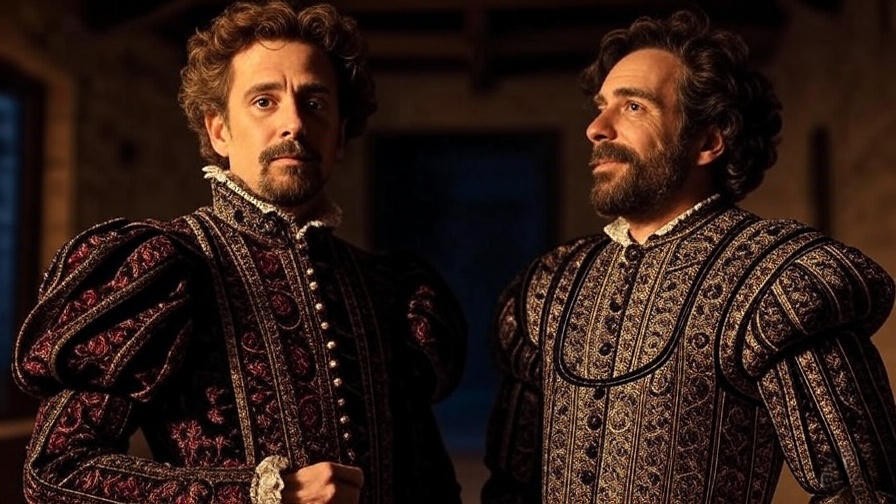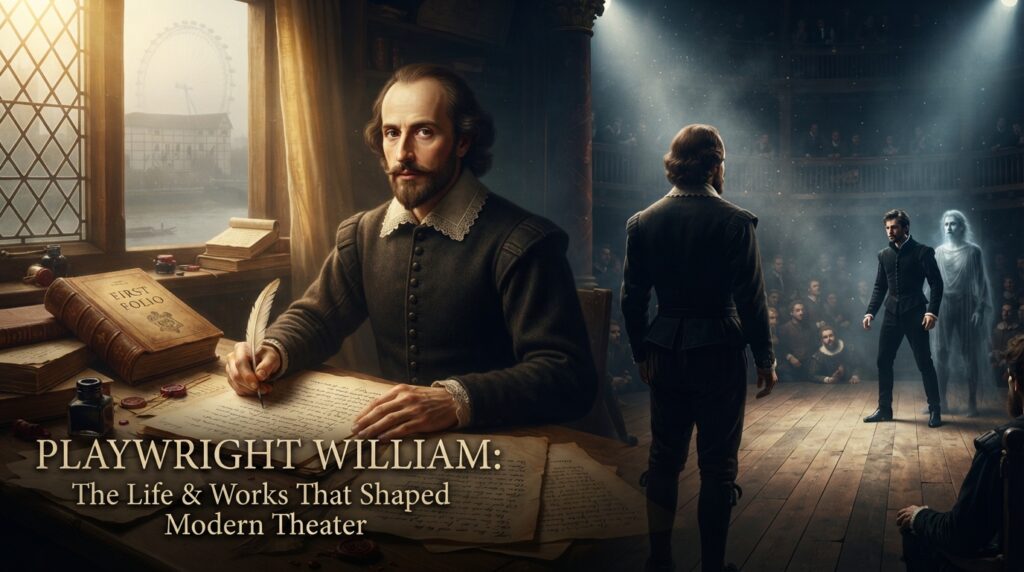
The ghost of a sixteenth-century glover’s son still dictates how we process grief, ambition, and romantic longing. When we speak of the quintessential playwright William Shakespeare, our cultural imagination often defaults to a marble bust or a dusty high school textbook syllabus. Yet, the historical reality is vastly more visceral: he was a working-class actor, a sharp-eyed shareholder in London’s most lucrative theatrical syndicates, and a commercial writer tailoring scripts for rowdy, plague-threatened crowds.
Moving past standard plot synopses reveals the true mechanics of how his work reshaped language, performance spaces, and human psychology. Understanding the monumental legacy of this iconic Elizabethan writer requires looking past the romantic myth to examine how his practical theater background, linguistic innovation, and mastery of universal human traits forged a permanent pillar of modern culture.
The Man Behind the Quill: Historical Reality vs. Myth
Stratford Roots and Early Influences
William Shakespeare’s early life is anchored by civic records rather than literary diary entries. Born in Stratford-upon-Avon in April 1564, he was the son of John Shakespeare, a successful glover, wool merchant, and local alderman whose political fortunes fluctuated wildly due to debt and suspected Catholic recusancy. This mercantile background deeply informed Shakespeare’s later plays, which display a startlingly accurate familiarity with legal jargon, accounting, and trade.
Education at the King Edward VI Grammar School provided a rigorous classical foundation. Under the strict tutelage of schoolmasters schooled in Renaissance humanism, Shakespeare translated Ovid, Plautus, and Cicero. This immersion in Latin rhetoric and classical mythology became the structural scaffolding for his plots.
The notorious “Lost Years” spanning from roughly 1585 to 1592 remain a historian’s puzzle box. Following his marriage to Anne Hathaway and the birth of their three children, Shakespeare vanishes from the documentary record before reappearing as a rising playwright and actor in London. Whether he spent those years working as a provincial schoolmaster, traveling with an acting troupe, or hiding out in Lancashire, this silent crucible preceded his explosive entry into the Elizabethan theater scene.
London’s Theatrical Ecosystem in the 1590s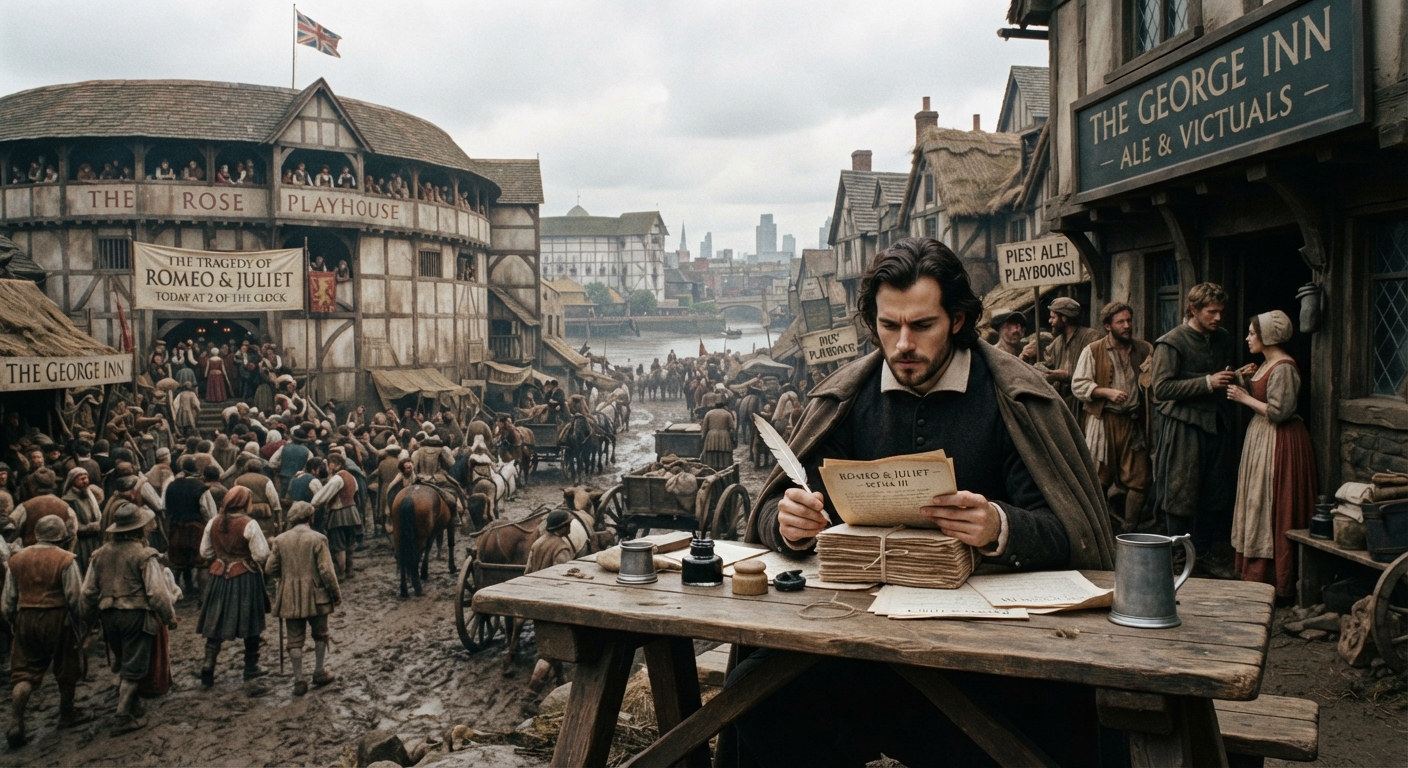
Entering London during an era of intense nationalistic fervor and rapid urbanization, Shakespeare found himself at the epicenter of a commercial boom. The city’s authorities deeply distrusted public playhouses, viewing them as dens of crime, political subversion, and plague contagion. Consequently, theaters like The Theatre, The Rose, and eventually The Globe were forced outside city limits into Southwark and the Liberties.
As a foundational member and eventual shareholder of the Lord Chamberlain’s Men (later renamed the King’s Men under James I), Shakespeare was not a starving bohemian artist; he was an industrious entrepreneur. He wrote for a specific physical space where groundlings stood shoulder-to-shoulder in the pit while nobles sat in covered galleries.
His entry into the literary scene occurred alongside brilliant university-educated rivals like Christopher Marlowe, Thomas Kyd, and Robert Greene. Greene’s infamous 1592 deathbed tract complaining of an “upstart crow, beautified with our feathers” provides the first concrete proof that Shakespeare had arrived as a theatrical force capable of outshining his academic peers.
Deconstructing the Masterpiece: Innovations in Form and Genre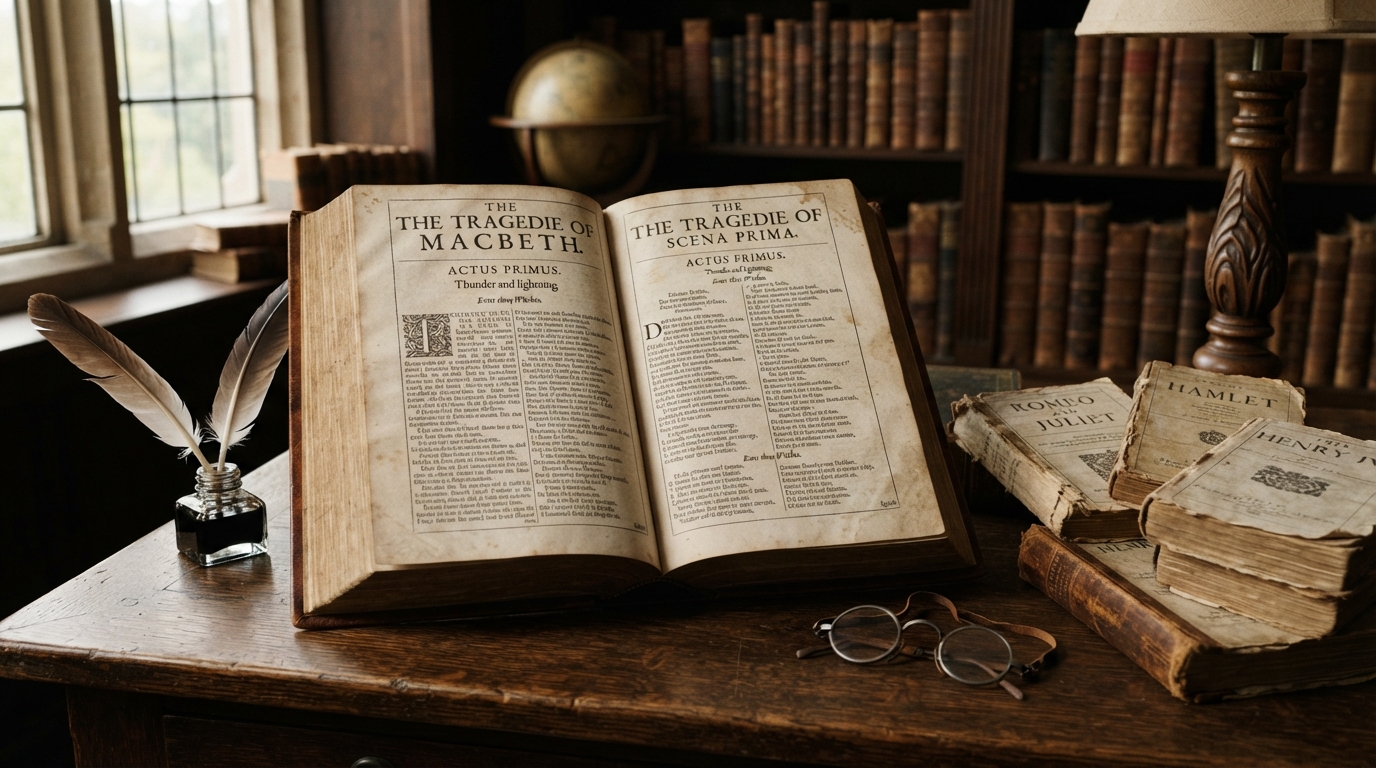
The Evolution of the Shakespearean Drama
Shakespeare did not merely write within existing genres; he aggressively fractured and rebuilt them. In his hands, the classical models of tragedy and comedy evolved into complex mirrors of human subjectivity.
Tragedies shifted away from the predictable Senecan revenge model toward deep internal psychological ruin. In Hamlet, Macbeth, King Lear, and Othello, external conflicts are merely catalysts for internal spiritual disintegration. Hamlet’s hesitation is not a plot device, but a profound philosophical crisis concerning mortality and action. Macbeth’s descent maps the erosion of human conscience under the weight of unbridled ambition.
Comedies subverted classical romance by injecting sharp gender dynamics, mistaken identities, and underlying melancholy. Works like Twelfth Night and As You Like It use cross-dressing and pastoral settings to interrogate the rigid social and patriarchal constraints of Elizabethan England. The humor is frequently balanced by an acute awareness of time, loss, and loneliness.
Histories transformed dry Tudor chronicles into gripping moral dramas. Far from writing simple propaganda for the reigning monarch, Shakespeare interrogated the ethics of statecraft, divine right, and rebellion. Through multi-part epics like Henry IV and Henry V, he charted the psychological price of political power, contrasting high-stakes battlefield rhetoric with the gritty realism of common soldiers and tavern rogues.
Structural and Narrative Techniques
The dramaturgical brilliance of these plays relies heavily on structural framing. Shakespeare mastered the use of subplots and thematic mirroring—a technique where a secondary plot reflects, distorts, or amplifies the central narrative. In King Lear, the parallel tragedy of Gloucester and his sons mirrors Lear’s catastrophic familial blindness, doubling the emotional resonance.
Furthermore, he revolutionized stage psychology through the strategic use of the soliloquy. By allowing characters to speak directly to the audience while alone on stage, he bypassed standard theatrical artifice. The audience is transformed from passive spectators into moral confidants, privy to the darkest anxieties and murderous plots of characters like Richard III and Iago.
The endings of his plays also defied neat categorization, paving the way for modern dramatic ambiguity. The late romances—such as The Tempest, The Winter’s Tale, and Cymbeline—refuse to offer simplistic happy resolutions. Instead, they present forgiveness that is haunted by past trauma, creating a bittersweet tone that reflects a mature artist meditating on reconciliation and age.
The Architect of Modern English: Language, Meter, and Coinage
Blank Verse and the Power of Iambic Pentameter
The auditory experience of Renaissance drama is inseparable from its metrical framework. Shakespeare elevated blank verse—unrhymed iambic pentameter—into a dynamic vehicle for human speech. Comprising five beats per line with an unstressed followed by a stressed syllable, iambic pentameter closely mimics the natural cadence of the human heartbeat and the physical limits of breath during emotional exertion.
By manipulating this rhythm, breaking lines mid-thought (caesura), or shifting into erratic prose, he communicated psychological states. Noble characters speak in soaring verse when composed, but slip into fragmented prose when descending into madness or mingling with commoners.
Lexical Legacy: Words and Idioms We Still Use Today
The linguistic footprint of the Elizabethan dramatist is woven into daily modern conversation. Historical lexicographers estimate that he coined or popularized hundreds of terms and enduring idioms.
Etymological deep-dives into early folios reveal the first written occurrences of words that feel entirely ordinary today, including bandit, lonely, swagger, accommodation, and fashionable. Beyond individual vocabulary words, standard idioms derive directly from memorable lines across his dramatic canon:
-
“Wild goose chase” (Romeo and Juliet)
-
“Heart of gold” (Henry V)
-
“Break the ice” (The Taming of the Shrew)
-
“Wear my heart upon my sleeve” (Othello)
This lexical expansion occurred because early modern English was fluid, porous, and rapidly evolving. Rather than adhering to rigid grammatical rules, Shakespeare treated the vernacular as a malleable artistic medium, borrowing freely from Latin, French, and regional dialects to capture exact emotional nuances.
The Textual Mystery: Quartos, Folios, and Surviving Works
The Printing Press and Pirated Texts
The survival of Shakespeare’s plays is an accidental miracle of early modern publishing. During his lifetime, theatrical scripts were viewed as company property rather than literature meant for bookstore shelves. Plays were printed cheaply in small pamphlets known as “quartos.”
Many early printings were “Bad Quartos”—unauthorized, pirated texts reconstructed from memory by actors who had memorized smaller supporting roles. These versions are often riddled with corrupted dialogue, missing scenes, and misremembered lines.
The definitive textual turning point occurred in 1623, seven years after his death, when his friends and theatrical colleagues John Heminges and Henry Condell compiled and published the First Folio. This monumental collection rescued nearly half of his plays—including Macbeth, The Tempest, and Twelfth Night—from potential historical oblivion.
The Authorship Question Debunked
Despite overwhelming historical documentation, archival tax records, and personal testimonials from his contemporaries, a persistent conspiracy theory questions whether William Shakespeare of Stratford-upon-Avon actually wrote the works attributed to him. Alternative candidates ranging from the Earl of Oxford to Sir Francis Bacon are frequently proposed by anti-Stratfordians.
Modern literary forensics, historical documentation, and stylistic analysis have thoroughly debunked these theories. Stylometric software, handwriting analysis of surviving signatures, and detailed records of his real estate investments, tax assessments, and theatrical partnerships confirm that the country actor from Stratford was indeed the singular literary genius who penned the world’s most enduring dramas.
Directorial and Cultural Legacy: Shakespeare in the 21st Century
From Globe Stage to Global Screen
The ultimate proof of the playwright’s enduring vitality is his seamless transition from wooden sixteenth-century playhouses to twenty-first-century global media. Film directors across different continents and eras have recognized that the plots function as universal blueprints adaptable to any culture or historical epoch.
Akira Kurosawa’s cinematic masterpieces Throne of Blood and Ran translate Macbeth and King Lear into feudal Japanese samurai epics. Meanwhile, modern cinematic retellings like Baz Luhrmann’s Romeo + Juliet prove that the high-stakes passion and family rivalries of Renaissance Verona resonate just as powerfully in a hyper-stylized, gun-toting modern metropolis.
Digital archives, global streaming of live theater productions, and ongoing educational initiatives ensure that the texts continue to inspire new generations of performers, directors, and scholars.
Expert Insights: What Modern Scholars Are Uncovering
Contemporary literary research relies on cutting-edge technological advancements to shed new light on the canon. Advanced multispectral imaging allows researchers to peer beneath centuries of ink corrosion, revealing authorial revisions, marginalia, and editorial changes made during the printing process.
Furthermore, digital linguistic attribution tools have confirmed what scholars long suspected: collaborative writing was standard practice in the Elizabethan theater. Works like The Two Noble Kinsmen and Henry VIII show clear evidence of co-authorship between Shakespeare and younger contemporaries like John Fletcher, highlighting a collaborative workplace culture that mirrors modern writers’ rooms.
Frequently Asked Questions
-
Why did Shakespeare write in iambic pentameter? Iambic pentameter mirrored the natural cadence of spoken English and the rhythm of a beating heart, making it easier for actors to memorize thousands of lines while keeping audiences emotionally engaged through a predictable yet flexible auditory pulse.
-
How many words did William Shakespeare actually invent? While popular legend credits him with thousands of inventions, lexicographers generally agree he coined or recorded the first known written use of roughly 1,700 words, many of which adapted existing nouns into verbs or combined prefixes and suffixes in novel ways.
-
What are the “lost years” in Shakespeare’s life? The term refers to the undocumented period between 1585 (following the baptism of his twins) and 1592 (when he is first mentioned as a rising playwright in London), leaving historians to debate his whereabouts and early career moves.
-
Why is the First Folio so important to modern literature? Published in 1623 by his theatrical colleagues, the First Folio preserved 36 plays. Without it, 18 of his masterpieces—including Macbeth and The Tempest—would have been permanently lost to history.
-
What is the difference between a Shakespearean quarto and a folio? A quarto was a smaller, cheaper pamphlet containing a single play, often printed without authorization. A folio was a large, expensive, and prestigious collected volume containing multiple plays intended for a permanent library.
Why the Playwright Still Speaks to Us Today
The enduring permanence of William Shakespeare’s canon does not stem from elitist preservation or academic gatekeeping, but from an unmatched psychological realism. Human nature has fundamentally remained unchanged since the Elizabethan era. We still grapple with ambition that outstrips our morality, the agonizing sting of jealousy, the weight of political corruption, and the fragile beauty of fleeting human connection.
By stripping away the myth and examining the mechanics of his verse, his historical environment, and his unmatched dramatic structure, we discover an artist who understood the human condition down to its bedrock. His lines remain carved into our cultural consciousness because whenever we look into his theatrical mirror, we are ultimately looking at ourselves.