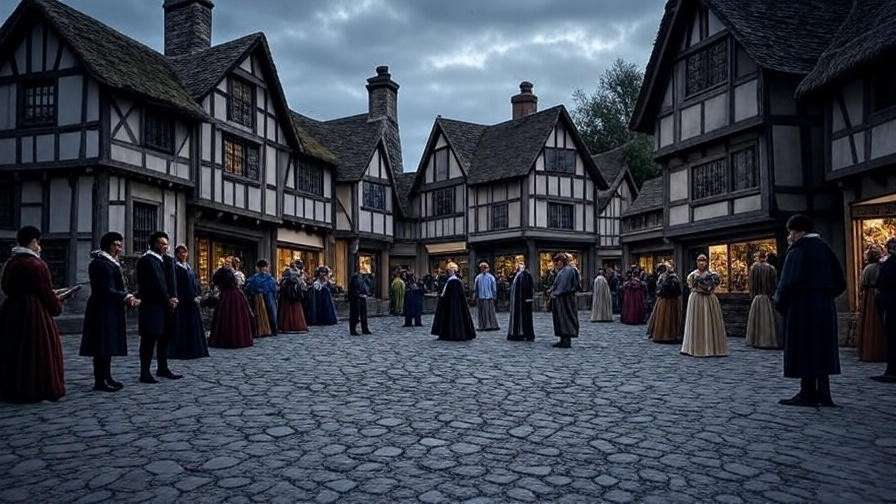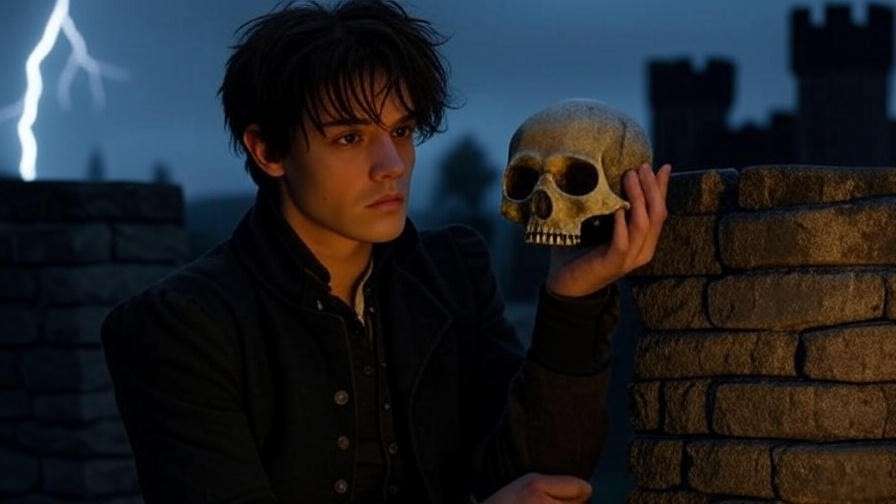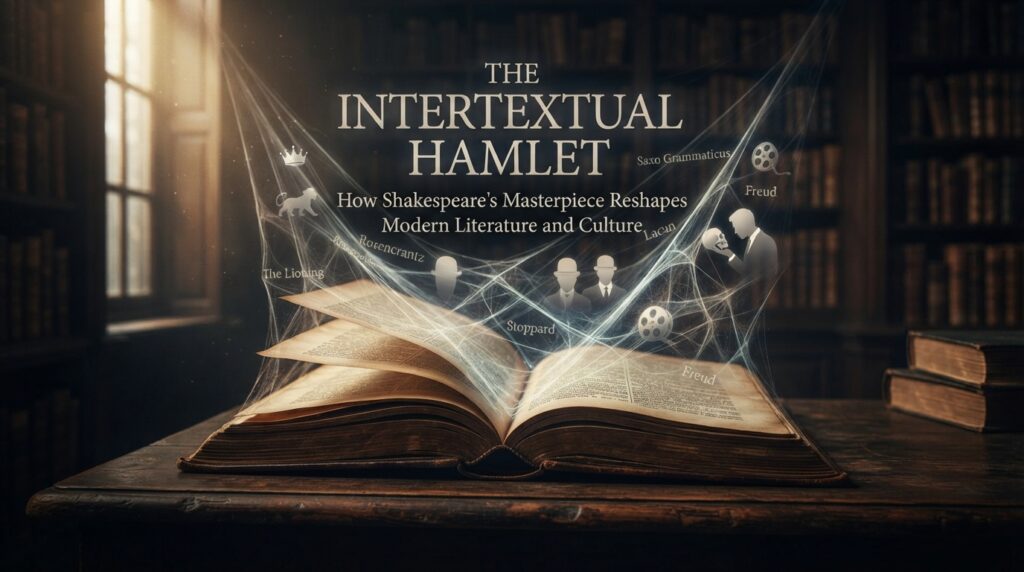
The skull in the graveyard is not just a prop; it is an open door. When William Shakespeare penned Hamlet around 1600, he did not simply write a play—he engineered a cultural nexus. Long before Julia Kristeva coined the term hamlet intertextuality, the Danish prince was already haunting a dense, interconnected web of older revenge traditions, classical mythology, and contemporary political anxiety. Today, Hamlet functions as the ultimate literary ghost, possessing everything from postmodern drama and animated cinema to feminist prequels and corporate thrillers.
Understanding this intertextual ecosystem is essential for writers, scholars, and culture-makers who want to decode how enduring stories survive. Texts do not exist in a vacuum. By exploring the sources that fed Shakespeare’s imagination and the modern adaptations that feed on him in return, we map the very DNA of Western storytelling.
The Architecture of Allusion: Sources and Pretexts
Every masterpiece is a mosaic, and Hamlet is built from centuries of recycled lore, political maneuvering, and classical philosophy. Shakespeare was an astute borrower, transforming raw historical legends and contemporary anxieties into high dramatic art.
Saxo Grammaticus and Historia Danica
The deepest roots of the tragedy stretch back to the twelfth-century Latin chronicle Historia Danica by Saxo Grammaticus. In this early version, the protagonist is Amleth, a prince who feigns madness (hence the linguistic root of his name) to survive his uncle Feng, who murdered his father and married his mother. Unlike Shakespeare’s brooding, philosophical intellectual, Saxo’s Amleth is a visceral, brutal trickster figure who slaughters an eavesdropping counselor and escapes to Britain to marry a princess before returning to exact bloody vengeance. Shakespeare inherited the skeleton of this revenge narrative, but he stripped away its crude folkloric edges, replacing physical survival tactics with existential paralysis.
Thomas Kyd and the Ur-Hamtlet
Closer to Shakespeare’s own timeline was the lost Elizabethan play known to scholars as the Ur-Hamlet, widely attributed to Thomas Kyd. Playing heavily into the Senecan revenge tradition popular on the sixteenth-century stage, the Ur-Hamlet likely featured a hyper-sensationalized ghost crying “Vengeance!” and a play-within-a-play structure. While the text is lost to history, its shadow proves that Hamlet was born into an active intertextual dialogue with the sensationalist box-office hits of its day. Shakespeare took Kyd’s commercial template and weaponized it, transforming a standard-issue blood-and-thunder melodrama into a profound meditation on human consciousness.
Classical Echoes: Seneca and Virgil
The intellectual weight of the play derives heavily from classical antiquity. The ghost of King Hamlet walks with the terrifying authority of Senecan tragedy, demanding retributive justice that transcends civil law. Furthermore, during the famous Player King sequence in Act 2, Scene 2, Hamlet and the First Player recite lines concerning the slaughter of Priam by Pyrrhus in Virgil’s Aeneid. This nested narrative is not decorative; it mirrors the bloody cycle of the Trojan War and the moral decay of Troy with the rot at the heart of Elsinore. Through this classical layering, Shakespeare aligns his Danish court with the epic weight of ancient empires.
Rewriting the Prince: Major Literary Adaptations and Retellings
Great literature invites rewriting, and Hamlet has inspired an entire shadow canon of literary responses that talk back to the original text, giving voice to the silenced, the marginalized, and the absurd.
Tom Stoppard’s Rosencrantz and Guildenstern Are Dead
Tom Stoppard’s 1966 absurdist tragicomedy shifts the spotlight from the center stage to the wings. By following two minor courtiers who have no idea why they are being summoned or where their narrative arc is heading, Stoppard uses intertextuality as a tool for existential philosophy. Rosencrantz and Guildenstern are trapped in a script written by someone else—both Shakespeare and the inexorable machinery of dramatic plot. Stoppard turns Shakespearean subtext into main-stage text, exposing the vulnerability of characters caught in a tragedy not of their own making.
John Updike’s Gertrude and Claudius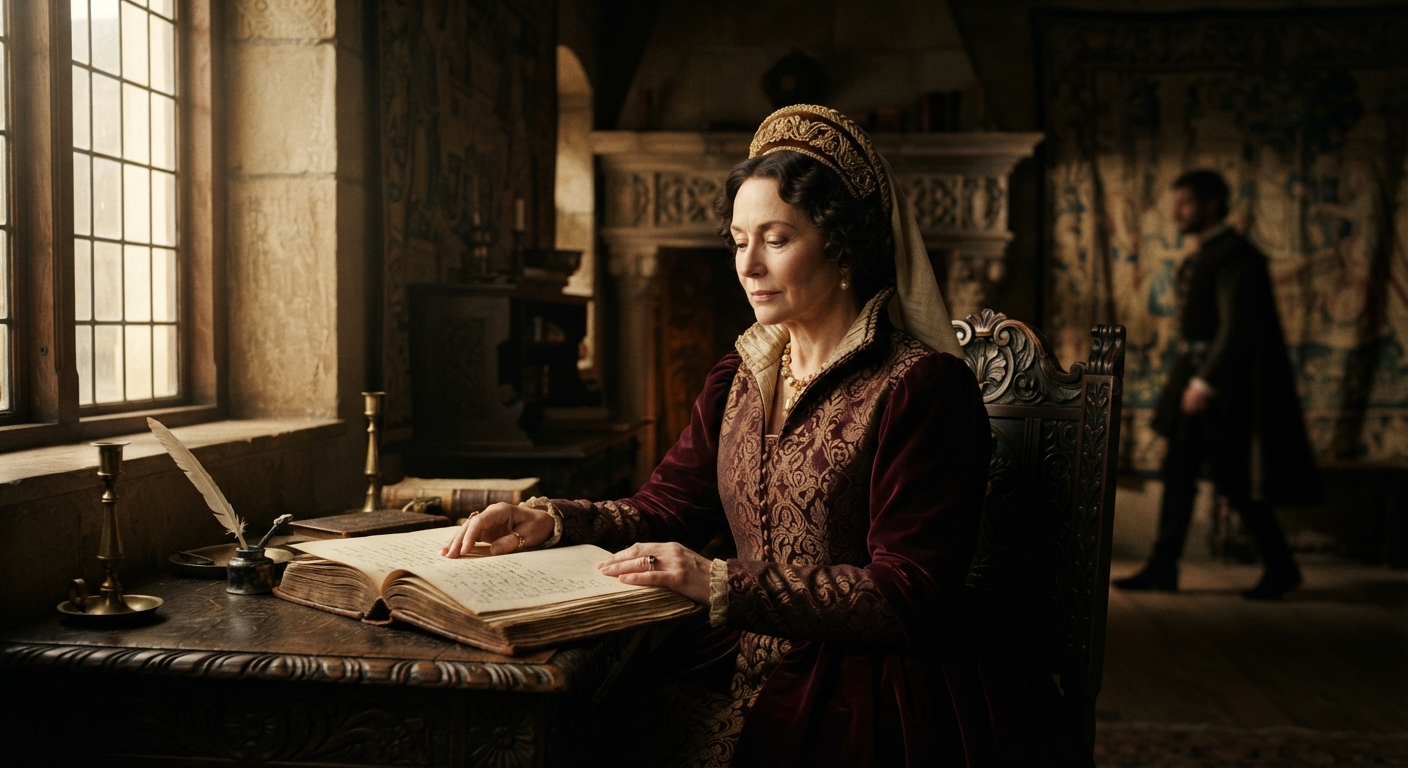
In his 2000 novel Gertrude and Claudius, John Updike constructs an intricate prequel that redeems Shakespeare’s most notoriously ambiguous characters. Updike explores Gertrude’s unhappy early marriage to the elder Hamlet and her genuine, intellectually stimulating romance with his brother, Feng (Claudius). By reframing the backstory, Updike challenges the simplistic moral binary of Shakespeare’s opening acts. The intertextual friction here lies in reader expectation: we know how the tragedy ends, but Updike forces us to sympathize with the adulterous conspirators before the ghost ever cries for revenge.
Margaret Atwood’s Hag-Seed
Margaret Atwood brings Hamlet into the twenty-first century through the lens of prison education and magical realism in her 2016 novel Hag-Seed (which weaves Shakespearean adaptation with The Tempest). Felix, a disgraced artistic director ousted from his theater festival, mounts an experimental production of Hamlet with inmates at a correctional facility. Atwood demonstrates how the play’s themes of grief, betrayal, and staged justice serve as a psychological mirror for incarcerated men. Here, Hamlet is not just read; it is lived, acted out as a therapeutic instrument of catharsis and revenge against corporate rivals.
Cinematic and Pop-Cultural Intertextuality
The intertextual web of Hamlet extends far beyond the printed page, anchoring itself deeply into visual media, global cinema, and modern mythology.
Disney’s The Lion King
Perhaps the most widespread modern adaptation of Hamlet is entirely animated. Released in 1994, Disney’s The Lion King maps the Elsinore power struggle onto the African savannah. Simba takes the place of the grieving prince; Mufasa plays the murdered ghost-father; Scar steps in as the treacherous uncle; and Timon and Pumbaa offer a cynical, nihilistic spin on Rosencrantz and Guildenstern’s existential wandering. The Oedipal undertones and the traumatic burden of dynastic succession are rendered universally accessible, proving that the structural bones of Shakespeare’s tragedy can transcend species, era, and medium.
Aki Kaurismäki’s Hamlet Goes Business
In his 1987 cult classic Hamlet Goes Business, Finnish auteur Aki Kaurismäki transports the royal tragedy into the cold, deadpan boardrooms of modern industrial Helsinki. Here, poisoned swords are replaced by corporate takeovers, and the ghost appears via a stock certificate. By stripping away Elizabethan verse and replacing it with minimalist, deadpan acting, Kaurismäki highlights the timelessness of greed, familial betrayal, and corporate inheritance.
The Ghost in the Machine: Sci-Fi and Cyberpunk
Contemporary science fiction frequently recasts the “revenant father” trope through artificial intelligence and digital consciousness. In cyberpunk narratives and speculative fiction, dead mentors return not as spectral kings walking castle battlements, but as corrupted data streams, holographic echoes, or neural implants whispering directives of vengeance to a tech-dependent protagonist. This digital haunting proves that Shakespeare’s exploration of inherited trauma maps seamlessly onto our modern technological anxieties.
Theoretical Frameworks: How Critics Read the Web
Literary theory has long treated Hamlet as a primary laboratory for decoding how texts speak to one another.
T.S. Eliot and the “Objective Correlative”
In his famous 1919 essay, T.S. Eliot dismissed Hamlet as an “artistic failure,” arguing that Shakespeare was unable to find an “objective correlative”—a set of objects, a situation, or a chain of events that would serve as the formula for the protagonist’s specific emotion. Eliot claimed Gertrude’s guilt was an emotion that exceeded Shakespeare’s linguistic control. While modern critics largely reject Eliot’s negative verdict, his critique initiated a vital intertextual conversation about the friction between a writer’s intention, emotional excess, and dramatic structure.
Jacques Lacan and Psychoanalysis
French psychoanalyst Jacques Lacan famously read Hamlet through the structuralist lens of desire and mourning. Lacan argued that Hamlet is paralyzed not simply by overthinking, but because he is caught in the symbolic debt of his father’s demand. To act, Hamlet must step outside of his own identity and assume the role of the instrument of vengeance. Lacan’s reading transforms the play into an intertextual junction point between Renaissance drama and twentieth-century psychoanalytic theory, demonstrating how the text anticipates modern understandings of the fractured self.
New Historicism and Cultural Poetics
New Historicist critics like Stephen Greenblatt read Hamlet as a product of Elizabethan anxieties surrounding purgatory, religious reformation, and state surveillance. During the Reformation, the Catholic concept of Purgatory—where souls suffered before entering heaven—was officially outlawed by the Church of England. Yet, Shakespeare introduces a ghost who explicitly claims to come from “sulfurous and tormenting flames.” This creates a profound intertextual dialogue between state religious policy and popular theatrical ghost lore, showing how the play absorbs and talks back to the ideological conflicts of its historical moment.
Pedagogical and Creator Section: Writing Through the Prince
For creators looking to harness the power of Shakespearean intertextuality, Hamlet offers a masterclass in structural engineering.
Actionable Writing Prompt: The Counter-Perspective
The Exercise: Take a pivotal scene from Hamlet—such as the closet scene (Act 3, Scene 4) or the graveyard scene (Act 5, Scene 1)—and rewrite it entirely from the point of view of a silent background observer (e.g., a servant, a gravedigger, or a passing guard). Focus on how their perception of the royal family’s madness alters the tone of the narrative.
Comparative Reading Matrix
| Shakespearean Element | Modern Counterpart / Retelling | Intertextual Function |
| The Murdered Father / Ghost | The Lion King (Mufasa’s apparition) | Transmits generational duty and moral imperative to the heir. |
| The Errant Courtiers | Rosencrantz and Guildenstern Are Dead | Highlights the absurdity of minor characters trapped in major plots. |
| The Corrupted Court | Hamlet Goes Business | Translates political royal rot into modern corporate corruption. |
| The Play Within the Play | Hag-Seed | Uses theatrical performance as a tool for psychological rehabilitation. |
Frequently Asked Questions
-
What is the primary difference between allusion and intertextuality in Hamlet?
Allusion is an intentional, conscious reference by an author to another text (such as Shakespeare referencing Virgil’s Aeneid). Intertextuality is a broader theoretical concept suggesting that all texts are woven out of prior cultural discourses, meaning Hamlet absorbs the language, myths, and social structures of its entire historical ecosystem whether the author consciously intended it or not.
-
How does Hamlet interact with older revenge tragedy traditions?
Shakespeare took the conventions of Senecan revenge drama—characterized by bloody ghosts, hesitation, madness, and carnage—and inverted them. Instead of focusing purely on action and spectacle, he prioritized psychological interiority, turning the external pursuit of revenge into an internal crisis of conscience.
-
Why is Hamlet considered the most adapted play in literary history?
The play’s thematic universality—grief, familial betrayal, generational trauma, political corruption, and the burden of consciousness—allows it to be endlessly translatable across different cultures, time periods, and artistic mediums without losing its core emotional resonance.
-
How can modern writers ethically use Shakespearean intertextuality in their work?
Writers can avoid superficial pastiche by digging into the gaps, silences, and subtexts of the original play. Instead of merely quoting lines, look at what characters are not saying, give voice to marginalized figures, or transpose the core structural conflicts into a completely unexpected modern genre.
The staying power of Hamlet does not lie in a rigid adherence to a single fixed meaning, but in its infinite mutability. It is a mirror that catches the light of every successive generation, reflecting our own deepest anxieties back at us from the edge of the grave.