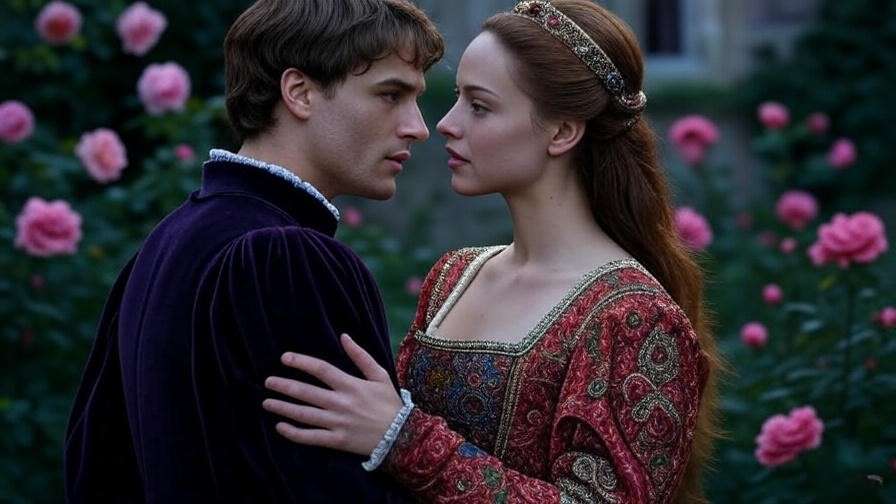
In William Shakespeare’s timeless tragedy Romeo and Juliet, the immortal line “Two households, both alike in dignity, / In fair Verona, where we lay our scene” sets the stage for one of literature’s most devastating conflicts. Yet for many readers—students tackling assignments, teachers preparing lessons, or enthusiasts revisiting the play—the intricate web of family ties, alliances, rivalries, and intermediaries can feel overwhelming. Who exactly is Tybalt to Juliet? How is Mercutio linked to Romeo? Why does Friar Lawrence become the pivotal bridge between the feuding sides? A clear Romeo and Juliet character map unravels these connections, revealing how Shakespeare’s masterful character relationships propel the plot toward its tragic end.
This ultimate guide delivers exactly that: a comprehensive, text-based character map with detailed breakdowns, thematic insights, and practical study tools. Far beyond basic family trees found on educational sites, it explores the psychological depth, social context, and dramatic function of each link—helping you truly understand why the lovers’ fate feels inevitable. Whether you’re analyzing themes of love versus hate, fate versus free will, or generational conflict, mastering these relationships unlocks Shakespeare’s genius.
Overview of the Feuding Families – The Montagues and Capulets
Shakespeare’s Verona is a powder keg of aristocratic pride, where family honor dictates behavior and ancient grudges fuel street brawls. The two central households embody this tension: the Montagues and Capulets, whose enmity has no clear origin but consumes everyone around them.
The House of Montague – Key Members and Their Roles
The Montagues represent a slightly more restrained nobility, though still entangled in the feud.
- Lord Montague — Romeo’s father and patriarch, concerned for his son’s melancholy but quick to clash with Capulets.
- Lady Montague — Romeo’s mother, who dies offstage from grief after her son’s banishment, highlighting the emotional toll of the feud.
- Romeo — The only son and heir, impulsive and passionate.
- Benvolio — Romeo’s cousin and close friend; a peacekeeper who urges restraint.
- Balthasar — Romeo’s loyal servant, who brings tragic news from Verona.
- Abram — A Montague servingman involved in early skirmishes.
These characters form a tight-knit unit, with Romeo’s friends extending the circle outward.
The House of Capulet – Key Members and Their Roles
The Capulets appear more authoritarian and socially ambitious, with Lord Capulet orchestrating Juliet’s future.
- Lord Capulet — Juliet’s father, authoritative yet affectionate toward his daughter at times; he hosts the fateful masque.
- Lady Capulet — Juliet’s distant mother, more focused on status and marriage alliances than maternal warmth.
- Juliet — The only daughter, on the cusp of 14, obedient yet defiant when love intervenes.
- Tybalt — Juliet’s cousin (nephew to Lady Capulet), hot-tempered enforcer of family honor.
- The Nurse — Juliet’s lifelong caretaker and confidante, providing comic relief and pragmatic advice.
- Peter — Servant to the Nurse and household.
- Sampson and Gregory — Capulet servants who spark the opening brawl.
The Ancient Grudge – Historical and Social Context in Verona
In Elizabethan England, Shakespeare drew on Italian novellas (notably Arthur Brooke’s The Tragical History of Romeus and Juliet) but infused them with contemporary concerns: family honor, arranged marriages, and civil disorder. Verona’s feud mirrors real Renaissance clan rivalries, where personal slights could escalate into violence. The Prince’s futile attempts to quell the strife underscore how deeply embedded these hatreds are in the social fabric. The absence of a stated cause for the grudge makes it universal—any irrational, inherited hatred can destroy lives.
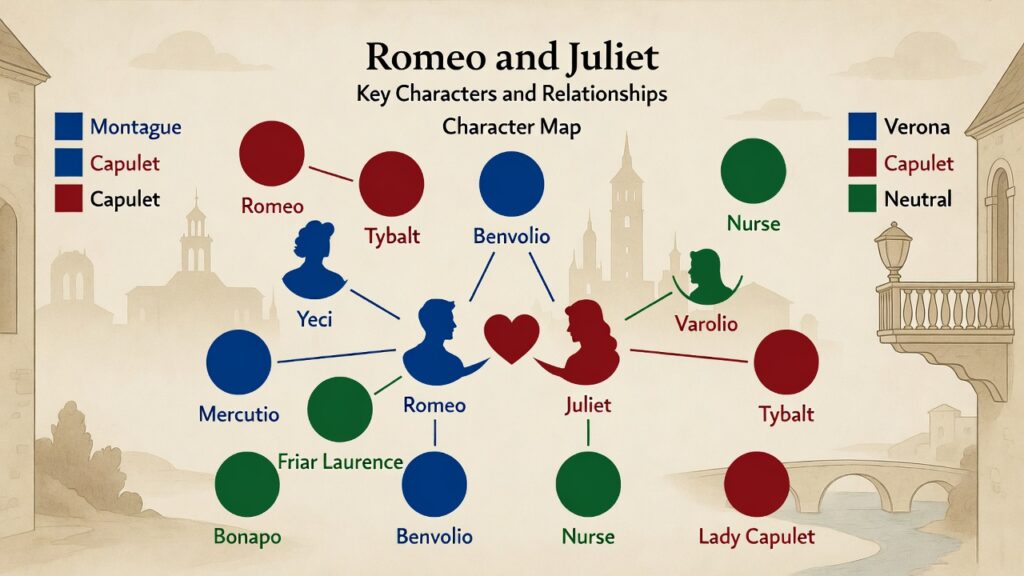
The Complete Romeo and Juliet Character Map – Visual Breakdown and Relationships
Picture a diagram with two vertical columns: Montagues on the left, Capulets on the right. At the center, a thick double-headed arrow connects Romeo and Juliet, symbolizing their star-crossed love. Solid lines indicate blood relations; dashed lines show alliances, friendships, or service; crossed swords mark enmity; small hearts denote romantic ties.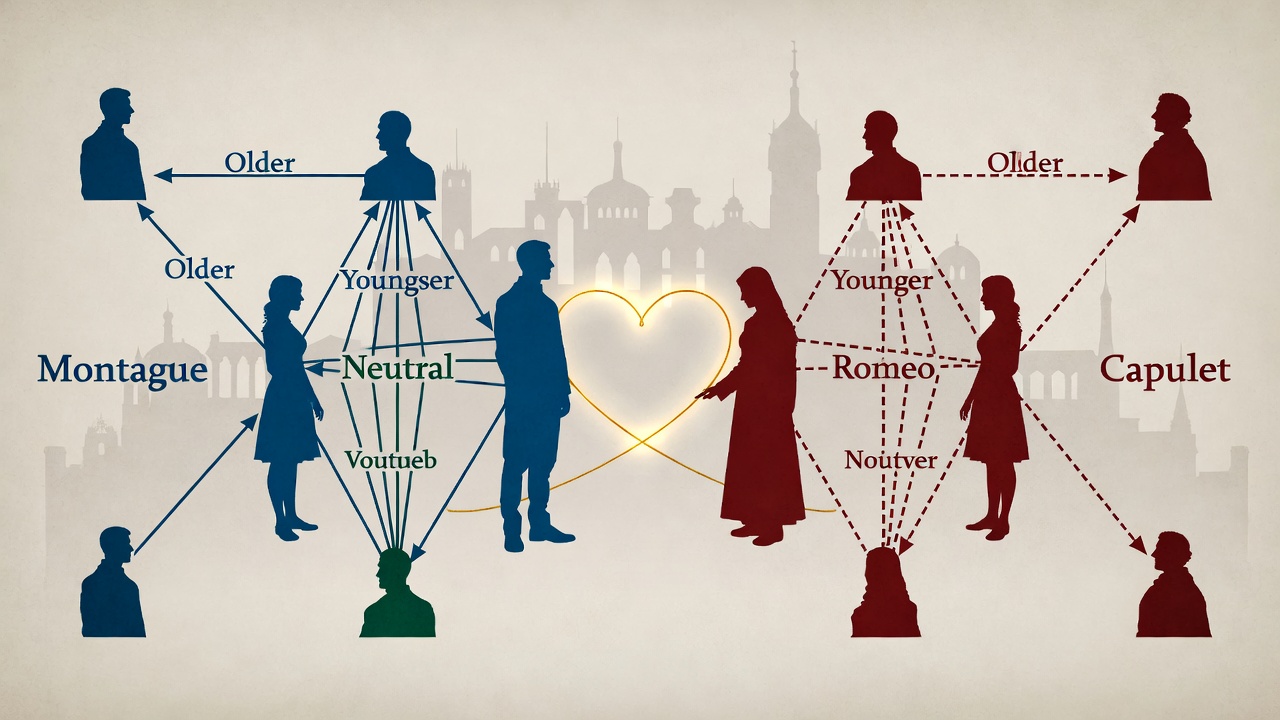
- Central Lovers Romeo (Montague heir) ↔ Juliet (Capulet daughter) — instant, passionate, secret marriage.
- Montague Side Lord Montague & Lady Montague → Romeo Benvolio (cousin and best friend to Romeo) Mercutio (close friend to Romeo; kinsman to the Prince) Balthasar (faithful servant to Romeo)
- Capulet Side Lord Capulet & Lady Capulet → Juliet Tybalt (cousin to Juliet; nephew to Lady Capulet) Nurse (surrogate mother and confidante to Juliet) Paris (count, suitor to Juliet; kinsman to the Prince)
- Neutral / Bridging Figures Friar Lawrence (confidant and secret marriage officiant to both Romeo and Juliet) Prince Escalus (ruler of Verona; kinsman to Mercutio and Paris) Apothecary (sells fatal poison to Romeo) Friar John (intended messenger who never delivers the letter)
Key dynamics shown with arrows:
- Nurse → Juliet (trust) → Romeo (messenger)
- Tybalt → Romeo & Mercutio (hostility)
- Friar Lawrence → Romeo & Juliet (counsel and risky plan)
- Prince Escalus → both houses (authority and punishment)
Printable / Downloadable Character Map Tips
To create your own map:
- Use free tools like Canva, Lucidchart, Google Drawings, or even pen and paper.
- Assign colors: blue for Montagues, red for Capulets, green for neutrals.
- Use symbols consistently: solid line = family, dashed = friendship/alliance, heart = love, sword = enmity.
- Add brief role notes beside each name (e.g., “peacekeeper” for Benvolio). This exercise not only clarifies relationships but also helps visualize how isolated Romeo and Juliet become within their own houses.
In-Depth Character Profiles – Major Players and Their Connections
Romeo – The Impulsive Romantic
Romeo begins lovesick over Rosaline (a fleeting, unrequited crush), then falls instantly for Juliet. His key connections:
- Son and heir to Lord & Lady Montague
- Cousin and confidant to Benvolio
- Best friend to Mercutio
- Secret husband to Juliet
- Enemy to Tybalt (after killing him in revenge)
Romeo’s impulsivity is amplified by his social circle: Mercutio’s wit pushes him toward the Capulet feast, Benvolio’s peace efforts fail to temper him, and Friar Lawrence’s counsel enables rash action. His connections reveal the theme of youthful passion overriding reason.
Juliet – Defiant Young Woman
Juliet is more isolated:
- Daughter to Lord & Lady Capulet
- Ward and emotional anchor to the Nurse
- Betrothed (against her will) to Paris
- Secret wife to Romeo
Unlike Romeo, Juliet has few peers; the Nurse is her closest ally, yet ultimately pragmatic rather than romantic. Juliet’s growth—from obedient child to defiant lover—occurs almost entirely in secret, making her one of Shakespeare’s most psychologically complex young female characters.
Supporting Characters as Foils and Catalysts
- Mercutio vs. Romeo: Cynical wit and Queen Mab speech contrast Romeo’s romantic idealism; his death escalates tragedy.
- Benvolio — The voice of reason; tries to prevent violence but is powerless against fate.
- Tybalt — Embodiment of unchecked honor; his aggression mirrors the feud itself.
- Nurse — Comic, earthy foil to Juliet’s idealism; her advice shifts from supportive to practical.
- Friar Lawrence — Well-intentioned mentor whose plans rely on timing and communication, both of which fail.
Minor but Pivotal Figures
- Prince Escalus — Represents law and order; his punishments (banishment) drive the plot.
- Paris — Symbol of societal expectation; his genuine affection for Juliet adds pathos.
- Apothecary — Marginal figure whose desperation enables Romeo’s suicide.
- Balthasar & Peter — Loyal servants whose small actions (or failures) have outsized consequences.
How Relationships Drive the Plot – Key Moments Illustrated
The genius of Shakespeare’s tragedy lies in how every major event springs directly from the characters’ interconnected relationships. The character map is not static; it evolves as alliances shift, betrayals occur, and intermediaries fail.
Act-by-Act Relationship Shifts
- Act 1: The Spark The opening street brawl (Sampson & Gregory vs. Abram & servants) reignites the feud. Romeo, depressed over Rosaline, is persuaded by Benvolio and Mercutio to crash the Capulet feast. There, he meets Juliet. Instant mutual attraction overrides family hatred. The Nurse becomes Juliet’s first confidante about the mysterious stranger.
- Act 2: Secret Union Romeo climbs the orchard wall to declare love. Juliet responds from the balcony. The Friar, seeing an opportunity to end the feud through marriage, agrees to marry them secretly. The Nurse acts as messenger and chaperone, facilitating their union. At this point, the central love line strengthens while the rest of the map remains hostile.
- Act 3: Turning Point – Violence and Banishment Tybalt challenges Romeo to a duel, seeking revenge for the feast intrusion. Mercutio intervenes, fights Tybalt, and is killed. Romeo, driven by loyalty to his dead friend, kills Tybalt in revenge. The Prince banishes Romeo, severing him from Juliet and Verona. Lady Montague dies of grief. The love connection is now physically broken.
- Act 4: Desperate Measures Lord Capulet accelerates Juliet’s marriage to Paris. Juliet refuses, leading to family rejection. The Nurse, previously supportive, advises bigamy for safety. Juliet turns to Friar Lawrence for help. He devises the sleeping potion plan, intending to send word to Romeo via Friar John.
- Act 5: Catastrophic Convergence Friar John is quarantined and never delivers the message. Balthasar informs Romeo that Juliet is “dead.” Romeo buys poison from the Apothecary and returns to Verona. Paris confronts him at the tomb and dies. Romeo poisons himself beside Juliet’s body. Juliet awakens, finds Romeo dead, and stabs herself. The families arrive too late; only the deaths of their children force reconciliation.
The Role of Intermediaries and Miscommunications
Shakespeare deliberately makes communication fragile:
- The Nurse carries messages but later abandons Juliet emotionally.
- Friar Lawrence relies on letters and messengers—both fail.
- Balthasar’s loyalty brings fatal news instead of waiting for clarification.
These failures are not random; they stem from the social barriers and divided loyalties shown in the character map.
Thematic Insights – What the Character Map Reveals
Love vs. Hate – How Family Ties Fuel Destruction
The central romance exists in defiance of the feud, yet the feud ultimately consumes it. Every loving bond (Romeo–Juliet, Romeo–Mercutio, Juliet–Nurse) is destroyed or tested by hatred (Montague–Capulet, Tybalt’s vendetta). The map visually shows love as the fragile bridge between two hostile camps.
Fate, Free Will, and Social Constraints
The “star-crossed lovers” are doomed partly by cosmic fate, but also by human choices shaped by rigid social structures: arranged marriages (Paris), family honor (Tybalt), parental authority (Lord Capulet), and civil law (Prince’s banishment). The map illustrates how individual agency is constrained by these larger forces.
Generational Conflict – Youth vs. Authority Figures
Romeo and Juliet rebel against their elders’ hatred and control. Parents and authority figures (Lord Capulet, Friar Lawrence, the Nurse, the Prince) either fail to understand youth or actively obstruct it. The map highlights the generational divide: older characters cluster on the edges, while the young lovers occupy the vulnerable center.
Shakespeare scholars often note that the play critiques both blind hatred and well-intentioned but flawed adult intervention—Friar Lawrence’s “medicine” and the Nurse’s pragmatism both contribute to disaster.
Study Tips and Classroom Applications
- Annotation Strategy While reading, color-code relationships in your text: underline family ties in one color, friendships in another, enmities in a third. Refer back to your character map frequently.
- Essay Support Use the map to structure arguments. Example thesis: “Shakespeare uses intermediary characters to demonstrate how fragile communication exacerbates the tragedy.” Support with specific links (Nurse → Friar John → failure).
- Classroom Activities
- Have students physically arrange themselves in a “living character map,” holding strings to show connections.
- Compare Shakespeare’s map to modern adaptations (West Side Story’s gangs, Baz Luhrmann’s 1996 film with guns instead of swords).
- Create alternative endings: What if one link changed (e.g., the Nurse stayed loyal, Friar John succeeded)?
- Modern Parallels The feud resonates today in gang violence, political polarization, and family estrangements over ideology. The Romeo and Juliet dynamic appears in countless stories of forbidden love across cultural or religious divides.
Frequently Asked Questions (FAQ)
Who are the main families in Romeo and Juliet? The Montagues and Capulets—two noble households locked in an “ancient grudge.”
Is Paris related to the Capulets? No direct blood relation, but he is a kinsman to Prince Escalus and a socially suitable match arranged by Lord Capulet.
How is Mercutio connected to Romeo? Mercutio is Romeo’s close friend and a kinsman to the Prince; he is not a Montague by blood.
What role does the Nurse play in the relationships? She is Juliet’s primary emotional support, messenger between the lovers, and comic relief—until she advises Juliet to marry Paris, causing a rift.
Why is Friar Lawrence important to both Romeo and Juliet? He marries them secretly, counsels them, and devises the potion plan in hopes of ending the feud.
Who is Tybalt related to? Tybalt is Juliet’s cousin (nephew of Lady Capulet) and a fierce defender of Capulet honor.
Does Benvolio have any romantic connections? No—he remains a loyal, rational friend and cousin to Romeo.
What happens to the servants in the character map? Servants like Balthasar, Peter, Sampson, Gregory, and Abram are loyal extensions of their households and often trigger or witness key events.
A thorough Romeo and Juliet character map does more than clarify who’s who—it exposes the tragic machinery of the play. Every arrow of love, loyalty, hatred, or counsel points toward the same devastating outcome. Shakespeare shows us that when families and societies are divided, even the purest love cannot survive.
By mastering these relationships, you gain deeper insight into the play’s enduring power: its warning against inherited hatred, its celebration of passionate youth, and its lament for missed chances at reconciliation. Revisit the text with your map in hand; the story will feel newly urgent and heartbreaking.