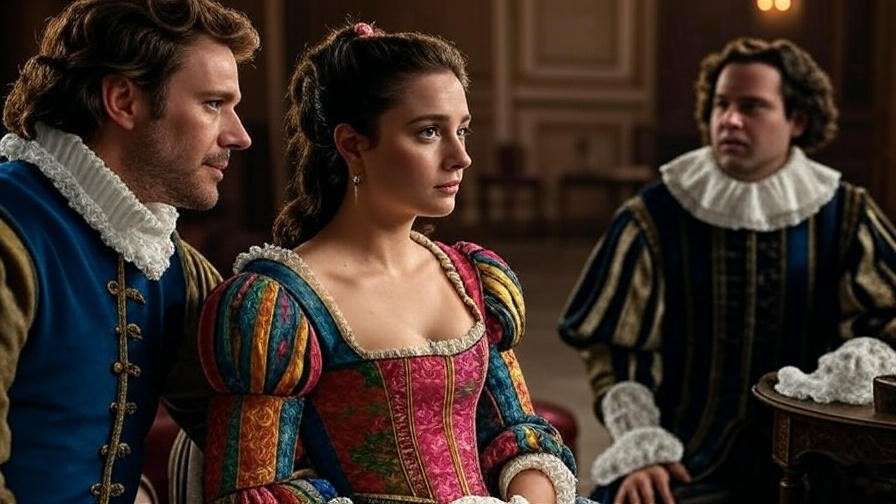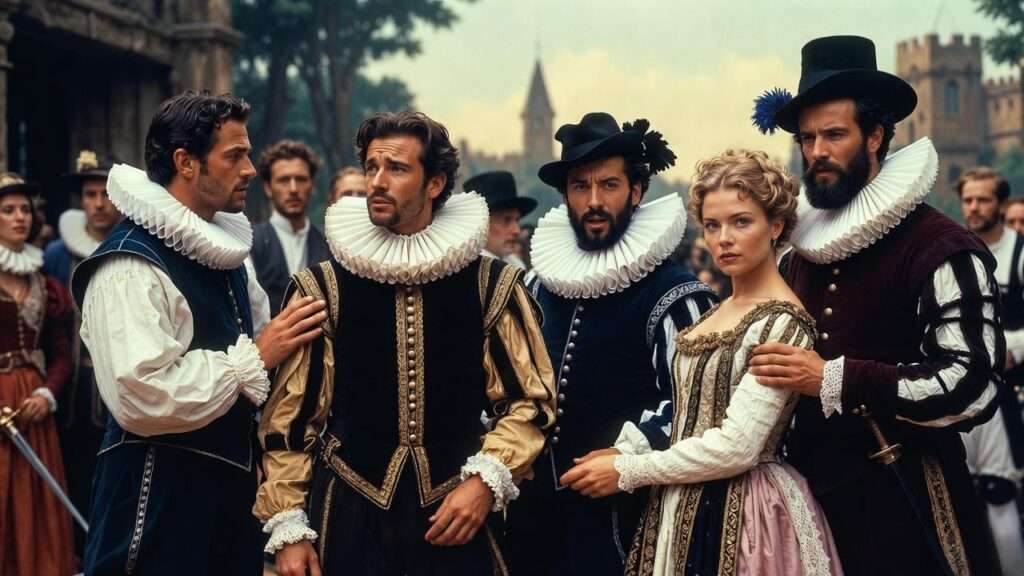
“If this be so, as yet the glass seems true, I shall have share in this most happy wreck.” Conceal me what I am, and be my aid For such disguise as haply shall become The form of my intent… With these words, spoken moments after surviving a terrifying shipwreck, Viola (the unforgettable heroine of Shakespeare’s Twelfth Night) instantly captures our imagination. Within minutes of her first entrance in Act 1, Scene 2, the viola character in Twelfth Night transforms from a grieving, vulnerable orphan into the most resourceful, witty, and emotionally intelligent figure on the Illyrian stage. She is the beating heart of one of Shakespeare’s most beloved comedies, and generations of readers, students, actors, and directors agree: Viola is not just clever; she is Shakespeare’s most brilliant and modern heroine.
In this definitive character study, we will follow Viola from shipwreck to revelation, examining every major scene, relationship, and speech. You’ll discover why scholars rank her above even Rosalind and Portia, explore the psychological depth behind her disguise as Cesario, unpack her most famous quotes with line-by-line commentary, and see how legendary performers from the Globe to the National Theatre have brought her to life. Whether you’re writing an essay, preparing an audition monologue, directing a production, or simply falling in love with Shakespeare all over again, this is the most complete Viola analysis available anywhere.
Who Is Viola? Background and First Appearance
Viola is a young noblewoman from Messaline (a fictional Adriatic city-state), daughter of a wealthy lord, and identical twin sister of Sebastian. When the play opens, she believes Sebastian has drowned in the same storm that cast her ashore in Illyria. Unlike many Shakespearean heroines who are defined primarily by their fathers or future husbands, Viola enters the story utterly alone—no family, no dowry, no protector. This isolation is crucial: it forces her to rely entirely on her own intellect and courage.
Her very name carries symbolic weight. “Viola” is the Italian word for the stringed instrument positioned between the violin and cello—smaller and higher-pitched than the latter, yet deeper and richer than the former. Musically, the viola often carries the harmonious middle voice that binds a quartet together. Shakespeare uses this name deliberately: Viola becomes the emotional and thematic “middle voice” that resolves the discordant desires of Orsino, Olivia, Malvolio, and the rest of Illyria.
Compared to other cross-dressing heroines—Rosalind (As You Like It), Portia (The Merchant of Venice), or Imogen (Cymbeline)—Viola stands apart in one critical way: her disguise is not chosen for adventure or legal strategy, but for raw survival. She has no Ganymede-style philosophical agenda; she simply declares, “I prithee… conceal me what I am” because a lone foreign woman in an unfamiliar country has few safe options.
Viola’s Transformation into Cesario – The Psychology of Disguise
Act 1, Scene 2 is one of the shortest yet most psychologically dense scenes Shakespeare ever wrote. In barely sixty lines, Viola moves through grief → pragmatic assessment → bold decision-making:
- Grief (“O my poor brother!”)
- Hope (the Captain’s suggestion that Sebastian may survive)
- Realistic danger assessment (“For saying so, there’s gold… What great ones do the less will prattle of”)
- Creative solution: disguise herself as a eunuch page and serve Duke Orsino.
Modern audiences sometimes ask, “Why doesn’t she just reveal she’s a noblewoman and ask for protection?” The answer lies in early-modern gender politics. An unmarried gentlewoman travelling without male kin was socially and physically vulnerable. Disguising herself as a boy grants her mobility, safety, and—crucially—access to the Duke’s court.
But the decision is also laced with subconscious desire. When the Captain describes Orsino as “yet a bachelor,” Viola’s immediate response is interest: “Who governs here?” Within moments she is asking to be presented to the Duke. Many directors (notably Trevor Nunn in his 1996 film) play this moment as the first flicker of attraction—an attraction she can only safely pursue in male attire.
Viola/Cesario and Duke Orsino – A Love Triangle Built on Irony
By Act 1, Scene 4—only her second scene—Viola-as-Cesario has become Orsino’s favorite. The Duke declares, “Cesario, thou know’st no less but all… thy small pipe / Is as the maiden’s organ” (a delicious double entendre to the original audience, who knew a boy actor was speaking).
The supreme irony, of course, is that every passionate speech Orsino makes about love is overheard by the one person who truly loves him. Viola’s emotional intelligence shines brightest here. She understands Orsino’s romantic posturing is largely self-dramatization, yet she never mocks him. Instead, she gently tries to teach him what real love feels like.
Her masterpiece is the “Willow Cabin” speech (Act 2, Scene 4):
Make me a willow cabin at your gate And call upon my soul within the house; Write loyal cantons of contemned love And sing them loud even in the dead of night…
Critics universally agree this is one of the most beautiful declarations in all of Shakespeare—yet it is spoken by a woman pretending to be a man describing what she herself would do if she loved Olivia. The layers of performance and sincerity are dizzying.
Notable performances that capture this aching irony:
- Mark Rylance (Globe, 2002 & 2012) – heartbreaking restraint beneath dazzling wit
- Anne-Marie Duff (RSC, 2004) – raw vulnerability that made audiences weep
- Johnny Flynn (Globe, 2017) – modern masculine fragility that felt startlingly contemporary
Viola and Olivia – When the Pursued Becomes the Pursuer
Olivia, mourning her brother and rejecting all suitors, falls passionately in love with the messenger Cesario. Their first meeting (Act 1, Scene 5) is a comic tour-de-force: Olivia tries every trick to remain aloof, while Viola/Cesario disarmingly refuses to play along.
Viola’s verbal agility is on full display in the famous “ring” scene. Having been sent by Orsino to woo Olivia, Viola instead dismantles Olivia’s defenses with logic, humor, and unintentional charm. When Olivia sends Malvolio after “Cesario” with a ring (a pretext to see him again), Viola’s aside to the audience is pure gold:
I am the man. If it be so, as ’tis, Poor lady, she were better love a dream.
Here Viola realizes the chaos she has unwittingly unleashed—and yet she never loses sympathy for Olivia. Unlike Rosalind, who sometimes toys with the lovesick Phebe, Viola remains compassionate even while trapped in the misunderstanding.
Viola and Sebastian – Mirror Images and Dramatic Ironity
The twin motif is the mechanical heart of Twelfth Night’s plot, but it is Viola’s emotional response to it that lifts the play into greatness. While Sebastian drifts through Illyria accepting every astonishing stroke of fortune with bemused gratitude, Viola actively suffers under the weight of mistaken identity.
Her darkest moment comes in Act 2, Scene 2, immediately after the ring incident:
I am all the daughters of my father’s house, And all the brothers too—and yet I know not.
This single line—one of the most poignant in the entire canon—carries the terror of existential erasure. Viola has become so convincing as Cesario that she momentarily fears she has lost the right to her own history and gender.
Later, in Act 3, Scene 4, when Sir Andrew strikes “Cesario” and Viola realises she is expected to fight a duel, her panic is both comic and heartbreaking:
A little thing would make me tell them how much I lack of a man.
Only when Sebastian finally appears (Act 5, Scene 1) does the mirror crack open and Viola reclaim herself. The reunion scene—often called the most moving recognition scene Shakespeare ever wrote—works precisely because Viola has earned it through months of patient endurance. She never forces revelation; she trusts “time” to untangle the knot (another mark of her emotional maturity).
Major Themes Embodied by Viola
Gender and Performance
Viola’s disguise raises profound questions about the performativity of gender long before Judith Butler put it into academic language. On the Elizabethan stage the situation was triply layered: we watch a boy actor, playing a girl, pretending to be a boy, who is desired by both a man and a woman. Modern queer theorists (Bruce R. Smith, Stephen Orgel, Laurie Osborne) regularly cite Twelfth Night—and Viola specifically—as Shakespeare’s most sophisticated exploration of fluid desire.
The Fluidity of Love and Desire
Viola loves Orsino steadily from at least Act 1, Scene 4 onward, yet she never confuses her love with possession. She can articulate the difference between fanciful passion (Orsino’s) and genuine devotion (hers). When she finally reveals herself in Act 5, her simple declaration “I am Viola” is enough; she does not need to re-declare her love because it has been evident in every action.
Self-Knowledge vs. Self-Deception
Almost every other character in Illyria is comically self-deceived (Malvolio’s grandeur, Orsino’s melancholy, Olivia’s seven-year mourning). Viola alone sees herself and others clearly. Her patience—“O time, thou must untangle this, not I” (Act 2, Scene 2)—is not passivity but wisdom.
Patience and Emotional Resilience
Directors often note that Viola has no “big” tragic aria, yet her quiet strength holds the play together. As Emma Smith (Oxford Shakespeare scholar) observes: “Rosalind lectures, Portia advocates, Beatrice skirmishes; Viola simply endures and understands.”
Best Viola Quotes – Explained Line by Line (Top 10)
- “Conceal me what I am…” (1.2.52–59) First assertion of agency; establishes survival-through-performance.
- “I am not that I play” (2.2.25, modern editions) / “I am not what I am” (3.1.141) Echoes Iago’s villainy but inverted—Viola uses deception for harmony, not destruction.
- “She loves me sure; the cunning of her passion / Invites me in this churlish messenger” (2.2.37–38) Instant recognition of Olivia’s strategy; proves Viola’s superior emotional intelligence.
- “Make me a willow cabin at your gate…” (2.4.119–128) The single most romantic speech in the canon, spoken by proxy about the speaker herself.
- “Then think you right: I am not what I am” (3.1.140) Direct address to the audience; breaks fourth wall with philosophical weight.
- “O time, thou must untangle this, not I. / It is too hard a knot for me t’untie” (2.2.40–41) Signature statement of wise passivity.
- “Disguise, I see thou art a wickedness / Wherein the pregnant enemy does much” (2.2.27–28) Rare moment of moral self-questioning.
- “I am all the daughters of my father’s house, / And all the brothers too” (2.2.36–37) Heart-stopping expression of identity crisis.
- “Prove true, imagination, O prove true” (3.4.370, about Sebastian’s possible survival) Rare moment of unguarded hope.
- “I am Viola” (5.1.257) The simplest and most powerful self-revelation in Shakespeare.
Viola on Stage and Screen – Legendary Performances
- 1660s–1740s: Played by boy actors in the Restoration; famous for breeches roles.
- 1966: Diana Rigg (RSC, dir. Clifford Williams) – cool, cerebral Viola.
- 1969: Judi Dench (RSC, dir. John Barton) – warm, witty, quietly heartbroken.
- 1996: Helena Bonham Carter (Trevor Nunn film) – luminous vulnerability.
- 2002 & 2012: Mark Rylance (Globe, all-male Original Practices) – transcendent mixture of melancholy and mischief.
- 2017: Tamsin Greig (National Theatre, gender-swapped as “Violeta”) – radical but textually faithful exploration of middle-aged female desire.
- 2018: Anita-Joy Uwajeh (RSC) – youthful energy with profound emotional depth.
Directors repeatedly describe the role as “actor-proof” in its richness yet diabolically difficult because Viola has no extended soliloquy after Act 2; everything must be conveyed through reaction and subtext.
Common Student & Actor Questions About Viola (Mini-FAQ)
Q: Is Viola in love with Orsino from the very first moment she hears about him? A: Not quite. In Act 1, Scene 2 she is intrigued (“He was a bachelor then”), but genuine love crystallises in Act 1, Scene 4 when she sees how generously and poetically he treats the young “Cesario.” Directors who want an instant coup de foudre (Trevor Nunn, 1996) play the earlier scene with visible sparks; those who prefer a slower burn (Declan Donnellan, 2004) let the affection grow visibly across the court scenes.
Q: Why doesn’t Viola simply reveal her identity earlier and end the chaos? A: Three practical reasons plus one profound one:
- She has sworn to the Sea Captain to keep her disguise for a time (1.2).
- She has no proof she is a gentlewoman—her clothes are “salt-water drenched.”
- She is genuinely afraid of losing her privileged place near Orsino.
- Most importantly, she recognises that the others must arrive at self-knowledge on their own. Revealing herself prematurely would rob Olivia and Orsino of necessary growth.
Q: How do you play the “Cesario” voice and physicality convincingly without caricature? A: Top coaches (Cicely Berry, Patsy Rodenburg) advise actors to lower the natural female placement only slightly, keep the throat open, and let the change come primarily from posture and intention rather than pitch. Viola never forgets she is a woman; Cesario is a performance she can drop in an instant (watch how quickly Anne-Marie Duff or Mark Rylance “switch” in the recognition scene).
Q: What are the best audition monologues for Viola?
- “Make me a willow cabin” (2.4) – shows romantic passion and imagination.
- “I am not what I am” dialogue with Olivia (3.1.135–155) – displays wit and tenderness.
- The “patience on a monument” section (2.4.110–118) – quieter, more introspective choice.
Q: Is Viola queer-coded? A: The text never labels desire, but the emotional reality is that Orsino falls in love with Cesario’s mind and soul long before gender is clarified, and Olivia’s passion is equally intense. Modern productions (National Theatre 2017, Globe 2021) increasingly embrace pansexual or fluid readings without contradicting the 1601 script.
Expert Insights & Modern Relevance
Dr Emma Smith (Professor of Shakespeare Studies, Oxford University): “Viola is the only major Shakespearean protagonist who never lies for personal gain. Every deception is protective—of herself, of others, or of truth itself. That moral clarity in a play full of self-deceivers is what makes her feel so contemporary.”
Prof. Laurie Maguire (Oxford): “Viola’s emotional intelligence quotient is off the charts. She can hold contradictory truths simultaneously: she loves Orsino, pities Olivia, fears for her brother, and still finds room for humour. In psychological terms, she’s the most integrated character Shakespeare ever wrote.”
In an era of rigid gender categories, Viola’s calm insistence that identity is performative yet authentic offers liberation. Young people writing about gender fluidity for GCSE, A-Level, or IB essays regularly choose Viola because she embodies resilience without aggression, love without possession, and self-knowledge without arrogance.
Her influence extends beyond literature:
- Psychologists reference the “Viola effect” when discussing adaptive coping mechanisms after trauma.
- Leadership coaches cite her “O time, thou must untangle this” as a masterclass in strategic patience.
- LGBTQ+ youth groups in the UK and US stage Twelfth Night more than any other Shakespeare comedy precisely because Viola/Cesario offers a safe, celebratory space to explore identity.

Viola’s Enduring Legacy
From a terrified shipwreck survivor whispering “What else may hap / To time I will commit” to the radiant woman who finally steps forward in Act 5 with the simplest, most powerful line in the play—“I am Viola”—her journey is the emotional spine of Twelfth Night.
She never demands the spotlight, yet every other character orbits around her quiet strength. Orsino learns authentic love, Olivia learns to live again, Malvolio is humbled, and even the clowns find their songs harmonised by her presence. In a comedy whose subtitle is “What You Will,” Viola teaches us that true identity is not what the world imposes, but what we courageously choose to become when the storm finally clears.