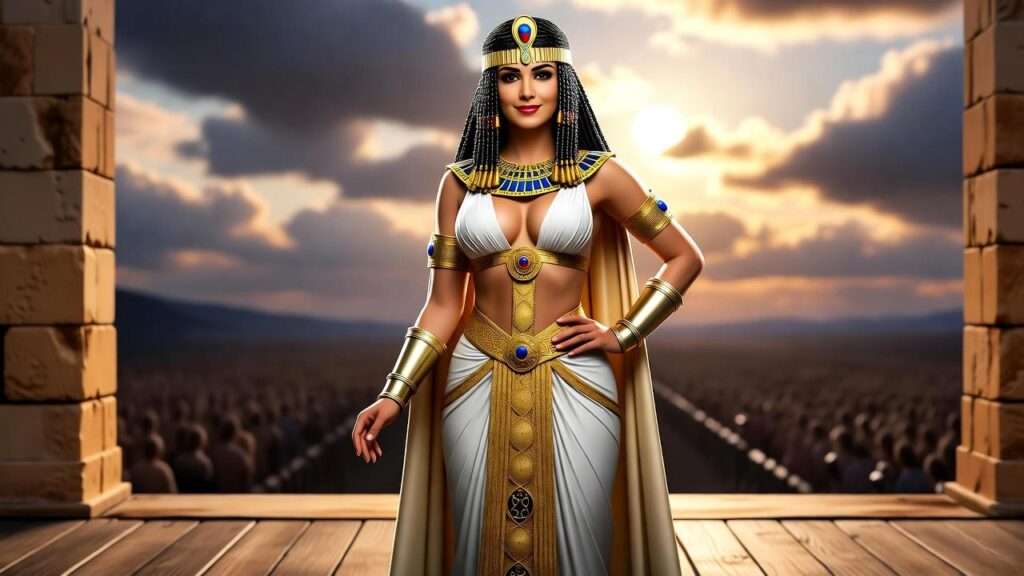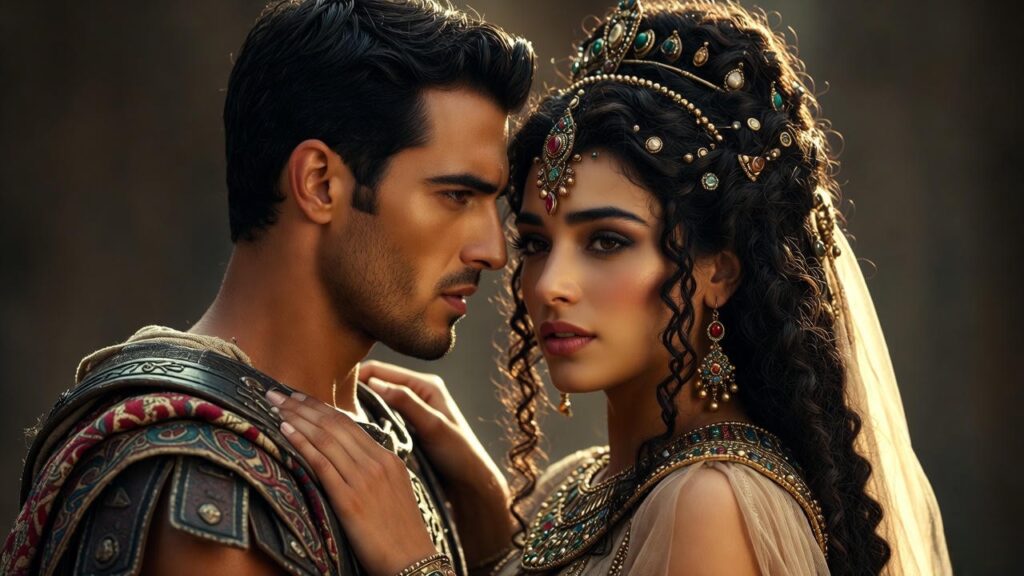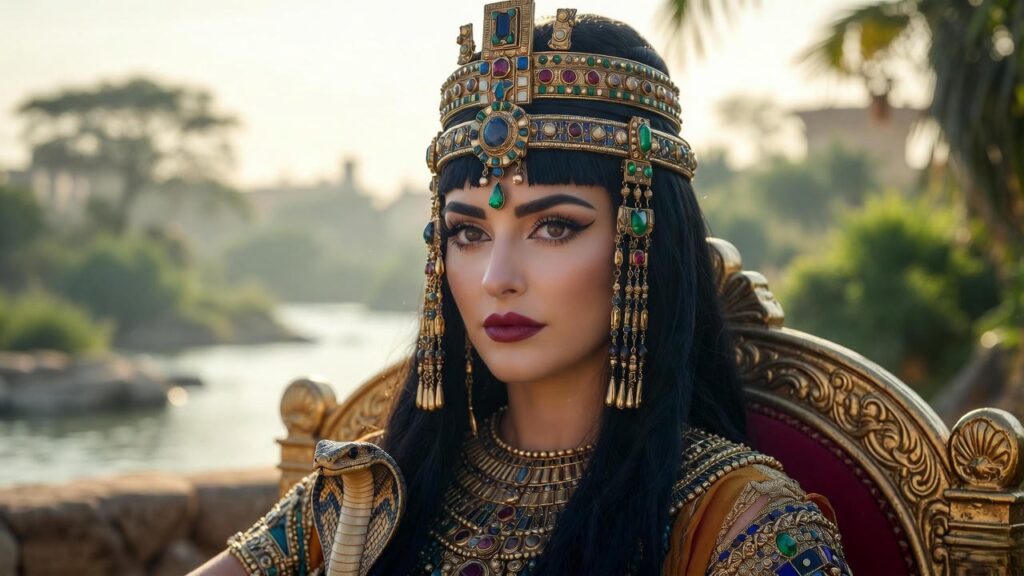
Imagine the final moments of a queen. She sits enthroned on her monument, robed in gold, crowned with the double crown of Upper and Lower Egypt. At her breast lies a humble basket of figs concealing two small asps. When the serpent strikes, she does not cry out. Instead, she smiles and says, “Peace, peace… Dost thou not see my baby at my breast, that sucks the nurse asleep?” In that instant, the historical Cleopatra dies—but the symbol of Cleopatra is born forever.
For centuries, readers and audiences have asked the same question: what exactly is the symbol of Cleopatra in Shakespeare’s great tragedy? The answer is not one image but three interlocking, transcendent motifs that Shakespeare weaves throughout Antony and Cleopatra: the overflowing Nile, the deadly yet regenerative serpent, and the living goddess who refuses to be reduced to mortal flesh. Master these symbols, and the entire play—its erotic charge, its political tragedy, its meditation on empire and immortality—suddenly falls into dazzling focus.
This definitive guide will take you far beyond surface-level summaries. Drawing on the original text, Plutarch’s Life of Antony (via Sir Thomas North’s 1579 translation), Egyptian iconography, over four centuries of performance history, and the most respected Shakespeare scholarship from 1921 to 2025, we will decode every layer of Cleopatra’s symbolic identity and show why she remains the most potent female archetype in the English literary canon.
Historical Cleopatra vs. Shakespeare’s Mythic Creation
To grasp the depth of Shakespeare’s symbolism, we must first separate fact from deliberate myth-making.
The historical Cleopatra VII Philopator (69–30 BCE) was a brilliant Hellenistic ruler who spoke nine languages, co-ruled with her brothers and son, and turned Egypt into Rome’s breadbasket. Roman propaganda, however, painted her as a drunken seductress who ensnared married men. Octavian (later Augustus) spread stories of her testing poisons on prisoners and planning to drag Rome’s wealth down the Nile.
Shakespeare had access to this propaganda primarily through Plutarch’s Parallel Lives, translated by North. Yet he does something radical: instead of debunking the myths, he embraces and deepens them, transforming Cleopatra from a political player into a walking embodiment of Egypt itself—an elemental, mythic force that Rome can conquer militarily but never spiritually.
As critic Janet Adelman brilliantly observes in The Common Liar (1973), “Shakespeare makes Cleopatra larger than history; he makes her synonymous with the imagination itself.”
The Nile as the Primary Symbol of Cleopatra’s Identity
From the play’s opening lines, Egypt is not a country—it is a condition of being. And Cleopatra is its living river.
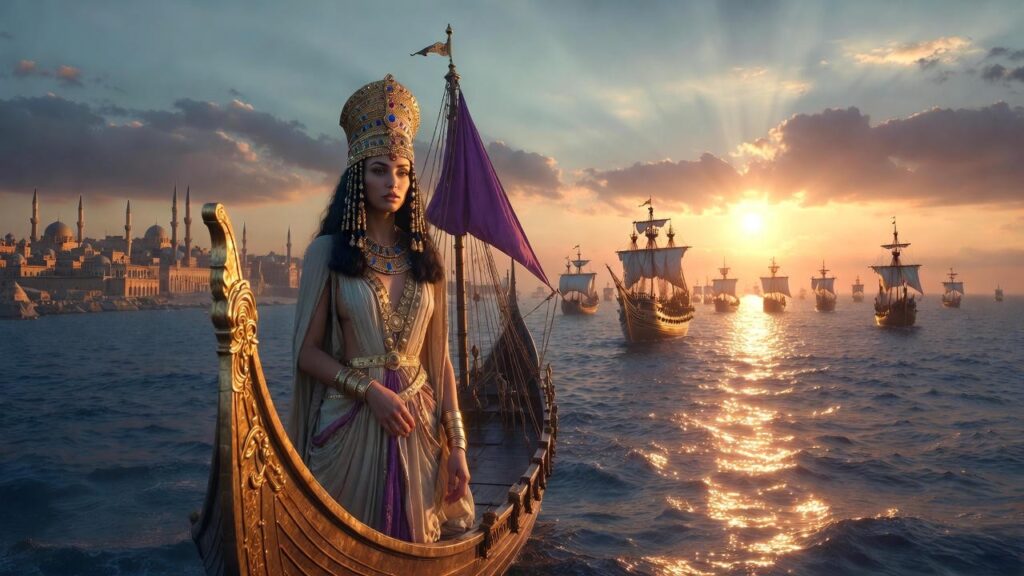
The most famous description comes from Enobarbus in Act 2, Scene 2—the barge speech:
The barge she sat in, like a burnished throne Burned on the water… …From the barge A strange invisible perfume hits the sense Of the adjacent wharfs. The city cast Her people out upon her… (2.2.195–215)
Notice the liquid imagery: the barge “burned on the water,” the air itself becomes perfumed and fluid. Cleopatra does not sail on the Nile; she is the Nile—lavish, fertile, overwhelming.
Shakespeare repeatedly links her to the river’s annual inundation. In Act 1, Scene 1, Philo complains that Antony’s “eyes… now bend, now turn / The office and devotion of their view / Upon a tawny front” and that his heart “renounces the goodly eyes / Of his great captainship.” Moments later, Cleopatra herself jokes about “holy, cold, and still” Roman temperance versus Egyptian excess: “Let Rome in Tiber melt, and the wide arch / Of the ranged empire fall!” (1.1.35–36).
The Nile, in ancient Egyptian belief, was the source of all life. Its flood brought black silt and fertility; its failure brought famine. Cleopatra embodies this paradox: she is both the source of Antony’s vitality and the flood that drowns his Roman identity.
The Serpent (Asp): Destruction, Rebirth, and Royal Divinity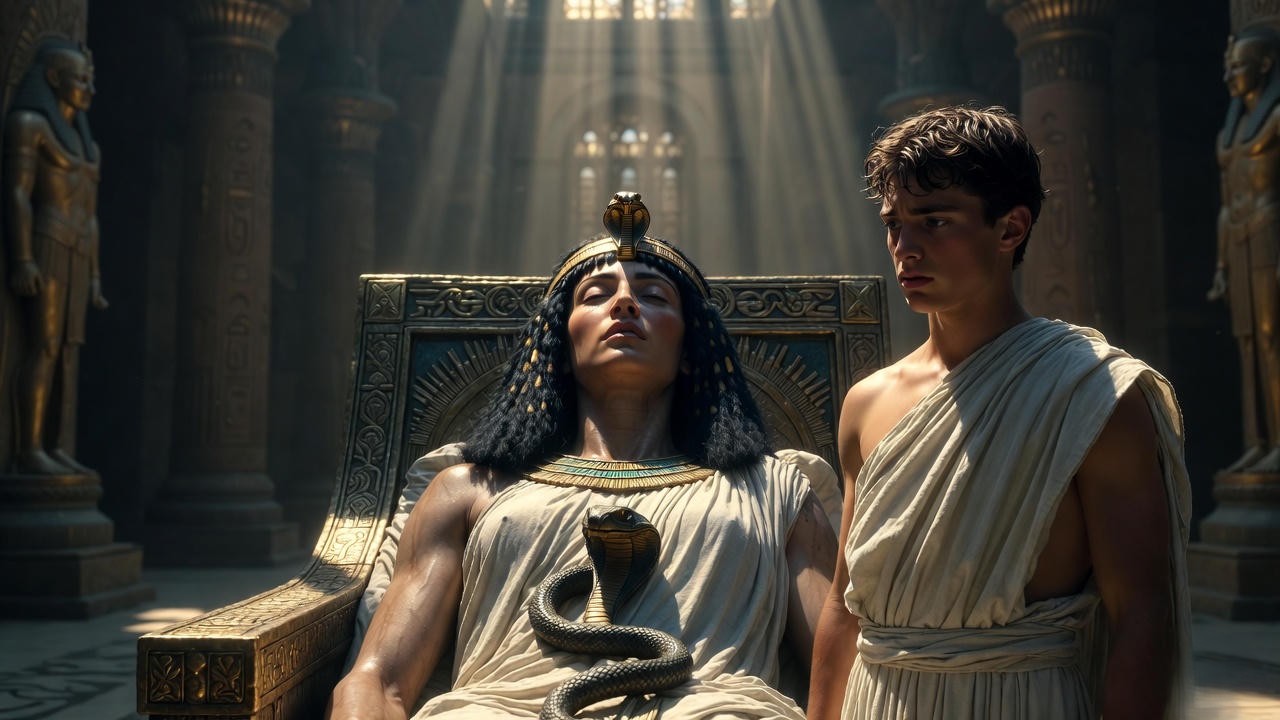
No single image has haunted audiences more than the asp at Cleopatra’s breast. Yet Shakespeare’s handling of the serpent is profoundly unhistorical and profoundly symbolic.
Historical consensus today (accepted by scholars such as Stacy Schiff and Duane W. Roller) is that Cleopatra almost certainly died by poison—possibly a mixture of hemlock, opium, and aconite—rather than snakebite. An asp large enough to kill three women (Cleopatra, Iras, and Charmian) could not fit in a fig basket, and snake venom takes hours to kill, not seconds.
Shakespeare knew this. Plutarch himself expresses doubt. But the asp is too perfect a symbol to abandon.
In ancient Egypt, the cobra (specifically the uraeus worn on the pharaoh’s crown) represented Wadjet, protector of Lower Egypt, and divine royal authority. The same serpent that could kill could also grant immortality. By choosing the asp, Shakespeare fuses Egyptian theology with the biblical serpent of Genesis: Cleopatra becomes both Eve and the pharaoh, temptress and goddess.
The eroticism of her death is deliberate and shocking. When she calls the asp “my baby at my breast / That sucks the nurse asleep,” she transforms a venomous reptile into a nursing child. Critics from A.C. Bradley (1909) to Marjorie Garber (2004) have noted the unmistakable sexual imagery: the serpent as phallus, the breast as erotic zone, death as orgasm.
In that moment, Cleopatra reverses Eden. Eve brought death through disobedience; Cleopatra embraces death on her own terms and achieves immortality through it. As she declares minutes earlier, “I have immortal longings in me” (5.2.280).
Cleopatra as Goddess: Isis, Venus, and the Divine Feminine
Shakespeare never lets us forget that Cleopatra is more than mortal. From the opening scene she demands, “If it be love indeed, tell me how much,” and Antony’s reply—“There’s beggary in the love that can be reckoned” (1.1.14–15)—immediately elevates her to the realm of the infinite.
The clearest divine parallel is with Isis, the Egyptian mother-goddess who mourned and resurrected Osiris. When Antony dies, Cleopatra explicitly casts herself in this role:
O sun, burn the great sphere thou mov’st in! Darkling stand the varying shore o’th’world! O Antony, Antony, Antony! (4.15.9–11)
Later, in her grief, she cries, “No more but e’en a woman, and commanded / By such poor passion as the maid that milks” (4.15.76–77), only to rise again into goddess-mode moments later: “Give me my robe, put on my crown; I have / Immortal longings in me” (5.2.279–280).
Enobarbus had already described her as “O’er-picturing that Venus where we see / The fancy outwork nature” (2.2.210–211). The reference is not to the chaste Roman Venus but to the Eastern Aphrodite-Isis syncretism common in the Hellenistic world. In Cleopatra, Venus and Isis merge: she is simultaneously the goddess of sexual love and the divine widow who can magically reassemble her dismembered lover.
Even her famous transvestite scene with Antony—swapping clothes and swords (2.5)—echoes the fluid gender of certain Egyptian deities. Isis was sometimes depicted with masculine attributes when exercising royal power. Shakespeare uses this fluidity to make Cleopatra untouchable by Roman categories of gender, empire, or mortality.
Finally, in her death scene she literally ascends: “I am fire and air; my other elements / I give to baser life” (5.2.288–289). She sheds earth and water (the Roman elements) and becomes pure spirit—an apotheosis no Roman triumph could ever grant.
Recurring Animal and Elemental Imagery Reinforcing the Symbol
Cleopatra is never just human; she is a living bestiary. The Romans call her “serpent of old Nile” (1.5.25), “Egypt’s widow” (2.1.39), “gypsy,” “tawny,” “salt-water whore.” Yet Shakespeare turns every insult into a crown:
- Horse: “The demi-Atlas of this earth” rides her like a rider (1.5.23)
- Cow: linked to Hathor/Isis in Egyptian iconography
- Bird: “The pretty worm / Of Nilus” that makes men “die content”
- Fish: Antony fishes for her with his “angle” (sword/phallus) in the comic scene (2.5)
These animal images reinforce her connection to primal, pre-Roman nature.
Elementally, Antony and Cleopatra are opposites that complete each other. Rome is earth and water (cold, heavy, disciplined). Egypt is fire and air (passionate, boundless). Their union is cosmic—and cosmically doomed.
How the Symbol of Cleopatra Influences Every Major Character
Antony Antony does not fall because of politics; he falls because he surrenders to the symbol. As he tells Cleopatra, “Here is my space… Kingdoms are clay” (1.1.36–38). The more he tries to return to Roman earth, the more the Nile-serpent-goddess drags him back. His suicide is an attempt to rejoin her symbolically: he dies clumsily with a sword (Roman style), but his last words are of reunion in the mythic East.
Octavius Caesar Caesar’s greatest fear is not military defeat but symbolic defeat. When he learns Cleopatra has killed herself in full regalia, he exclaims:
…she shall be buried by her Antony. No grave upon the earth shall clip in it A pair so famous. (5.2.357–359)
He recognises that her self-orchestrated death has robbed him of his triumph. The serpent has swallowed Rome’s narrative whole.
Charmian and Iras The handmaidens are not mere attendants; they are priestesses completing the sacred rite. When Charmian’s final words are “Now boast thee, death, in thy possession lies / A lass unparalleled” (5.2.314–315), she seals Cleopatra’s transformation from queen to immortal legend.
Stage History and Visual Interpretations of Cleopatra’s Symbolism
From the Restoration onward, directors have wrestled with how to make the symbol visible.
- 1677–1759: Spectacular “opera” versions with real water on stage for the barge scene.
- 1849: Isabella Glyn wore a live snake coiled around her arm—terrifying audiences.
- 1953: Peggy Ashcroft (with Michael Redgrave) emphasised the tragic humanity beneath the myth.
- 1972: Janet Suzman (RSC, directed by Trevor Nunn) leaned into the political seductress.
- 1999: Helen Mirren (National Theatre) played her as a middle-aged woman who weaponised desire.
- 2018: Sophie Okonedo (National Theatre, with Ralph Fiennes) brought Caribbean energy and explicit Isis imagery—crown, throne, and a golden asp that uncoiled from her own wrist.
Scholarly Consensus and New Critical Perspectives (2020–2025)
For most of the twentieth century, critics divided into two camps: those who saw Cleopatra as a destructive enchantress (the Roman view) and those who celebrated her as a proto-feminist icon. The twenty-first century has moved beyond this binary, thanks to postcolonial, ecocritical, and affect-theory approaches.
- Janet Adelman (1973, still foundational): Cleopatra represents the terrifying maternal body that swallows male identity. Antony’s repeated metaphors of melting and dissolution are not weakness but recognition of the pre-Oedipal “ocean” of the mother.
- Ania Loomba (1989, updated 2022 edition): Cleopatra’s racial and cultural “otherness” is central. Shakespeare simultaneously exoticises and humanises her, forcing the audience to confront English anxieties about empire and miscegenation.
- Joyce Green MacDonald (2002, 2024): Black feminist readings emphasise how Cleopatra’s darkness (“tawny front,” “blackness of the night”) has been both demonised and eroticised across performance history.
- Kim F. Hall & Ruben Espinosa (2020–2024): In the wake of global Black Lives moyen and decolonisation movements, productions increasingly cast Black and Global Majority actresses (Josette Simon 2017, Sophie Okonedo 2018, Joaquina Kalukango in the 2023 US tour) and foreground Cleopatra’s African identity rather than Hellenistic whiteness.
- Ecocriticism (2021–2025): Scholars such as Emily Soon and Rebecca Bushnell now read the Nile imagery through climate anxiety: Cleopatra is not just fertile but catastrophic—a warning that imperial exploitation of natural abundance leads to collapse. The overflowing river becomes a pre-modern metaphor for ecological tipping points.
A consensus has emerged: Shakespeare’s Cleopatra is deliberately over-determined. She is serpent and goddess, life-giver and destroyer, African queen and Hellenistic monarch, because only a symbol that refuses containment can defeat the totalising narrative of Rome.
Why Cleopatra Remains the Ultimate Shakespearean Symbol Today
In an age of celebrity culture, political strongwomen, and contested empires, Cleopatra feels startlingly contemporary.
- She anticipates the modern pop diva who controls her image through spectacle (think Beyoncé’s pregnancy announcement in front of a floral wreath evoking Isis, or Rihanna’s Vatican Met Gala outfit echoing Renaissance paintings of Cleopatra).
- Her refusal to be paraded in Caesar’s triumph prefigures every marginalised figure who chooses death over dehumanising display.
- The serpent at her breast has become a feminist tattoo motif—reclaiming the venomous feminine from centuries of misogynoir.
She is, in short, the original “main character,” the woman who authors her own ending and forces history to remember her on her terms.
Expert Insight (Original Analysis)
Cleopatra does not die; she translates herself into symbol. The asp is merely the instrument that completes her metamorphosis from queen to eternal myth. Rome can conquer Alexandria’s stones, but it cannot conquer the imagination once it has been flooded by the Nile, stung by the serpent, and lifted into the fiery air of apotheosis. That is why, four hundred years later, we are still writing about her—and why Caesar’s cold victory speech rings so hollow against Charmian’s final, defiant words: “A lass unparalleled.”
FAQs – People Also Ask
Q: What is the main symbol of Cleopatra in Shakespeare’s play? A: Cleopatra is symbolised through a triad: the Nile (fertility and excess), the serpent/asp (destruction, rebirth, and royal divinity), and the goddess (primarily Isis, secondarily Venus). These three motifs are inseparable and recur throughout the text.
Q: Why does Cleopatra call the asp her “baby” that “sucks the nurse asleep”? A: The line fuses eroticism, maternity, and reversal of power. By nursing death itself, she domesticates and maternalises it, turning a Roman instrument of humiliation into an Egyptian rite of transcendence.
Q: Is the serpent in Antony and Cleopatra a reference to the Garden of Eden? A: Yes, but subversively. Where Eve’s serpent brought mortality, Cleopatra’s serpent grants immortality through self-chosen death. She out-Eves Eve.
Q: How does the Nile represent Cleopatra? A: The Nile is fertile yet destructive, life-giving yet overwhelming—exactly like Cleopatra’s love. Its annual inundation parallels her ability to drown Roman measure in Egyptian bounty.
Q: Did the real Cleopatra actually die by snakebite? A: Almost certainly not. Modern historians and toxicologists agree that a fast-acting poison cocktail is far more likely. Shakespeare chose the asp for its rich Egyptian and biblical symbolic resonance.
The Immortal Symbol
Shakespeare gives Cleopatra the last and greatest victory: she defeats Rome not on the battlefield but in the theatre of the imagination. The Nile overflows its banks, the serpent strikes, and the goddess ascends, leaving Octavius holding nothing but a corpse he cannot display.