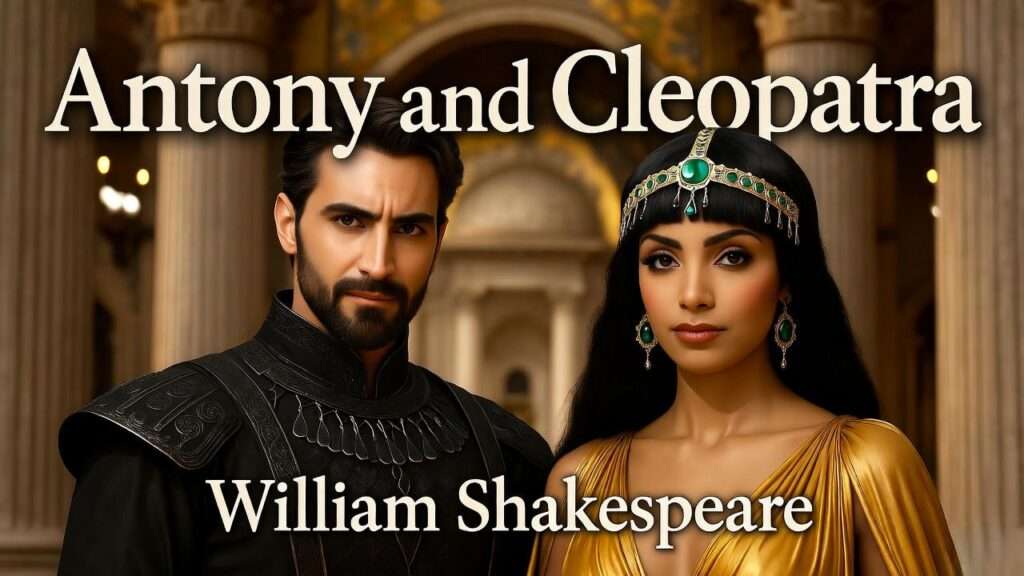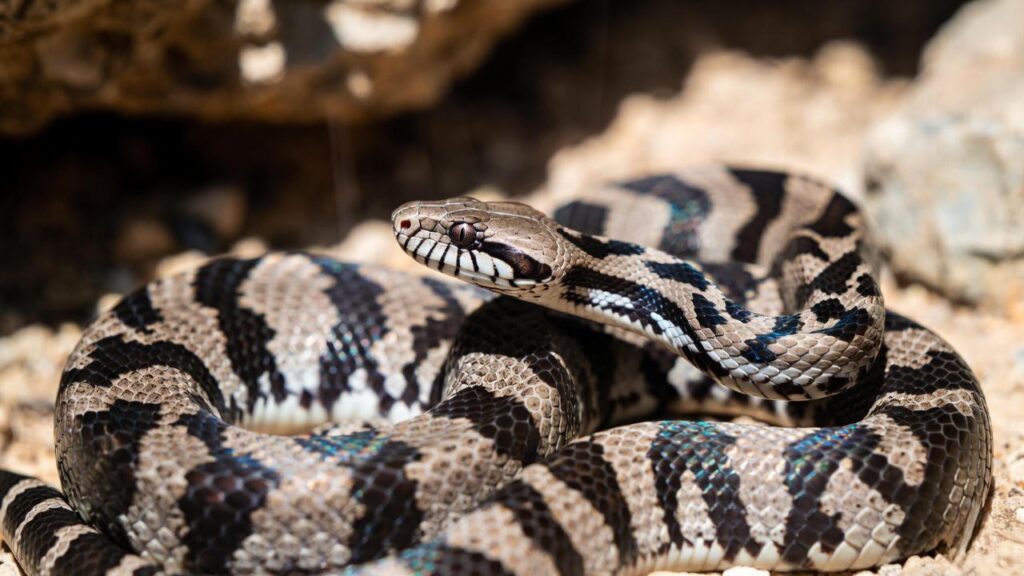
Imagine a queen, adorned in royal robes and crown, calmly applying a venomous serpent to her breast as she embraces death on her own terms, defying the conqueror who seeks to parade her in chains. This iconic image of Cleopatra’s killer—the asp—has enthralled generations, immortalized most vividly in William Shakespeare’s tragic masterpiece Antony and Cleopatra. Yet, while the Bard presents the asp as the instrument of her serene and triumphant suicide, historical accounts suggest a more ambiguous reality, likely involving poison rather than a snake. In this in-depth exploration, we unravel the myth from the facts, examining ancient sources, modern scholarship, and Shakespeare’s dramatic genius in transforming Cleopatra’s death into one of literature’s most poignant scenes. Whether you’re a Shakespeare enthusiast puzzled by crossword clues referencing “Cleopatra’s killer” or curious about the truth behind the legend, this article reveals why the asp endures as her symbolic slayer.
Historical Context: Cleopatra’s Final Days in 30 BC
Cleopatra VII Philopator, the last active ruler of the Ptolemaic Kingdom of Egypt, faced her end in the summer of 30 BC amid the ruins of her political ambitions. Born in 69 BC into a dynasty of Macedonian Greek origin, Cleopatra was a brilliant polyglot and strategist who co-ruled with her brothers before ascending fully through alliances with Julius Caesar and later Mark Antony.
The Fall of Antony and Cleopatra
The pivotal turning point came with the Battle of Actium in 31 BC, where Octavian (later Augustus) decisively defeated the combined forces of Antony and Cleopatra off the coast of Greece. Miscommunication and tactical errors led Cleopatra’s fleet to withdraw prematurely, followed by Antony’s, sealing their fate. Retreating to Alexandria, the couple confronted inevitable Roman conquest. Antony, upon hearing false reports of Cleopatra’s death, attempted suicide by falling on his sword but lingered in agony.
Ancient sources, including Plutarch’s Life of Antony (drawn from contemporary accounts like those of Cleopatra’s physician Olympos), describe Antony being hoisted to Cleopatra’s mausoleum, where he died in her arms. This emotionally charged reunion—marked by Antony’s final words urging her to negotiate with Octavian—highlights the personal tragedy amid political collapse.
Cleopatra’s Captivity and Resolve
Barricaded in her mausoleum with loyal attendants Iras and Charmian, and surrounded by treasures to prevent their seizure, Cleopatra negotiated futilely with Octavian. Determined to avoid humiliation in a Roman triumph—where defeated enemies were paraded before execution—she resolved to die as a sovereign queen. Ptolemaic tradition included royal suicides to preserve dignity, as seen in earlier rulers.
Her motivations blended political savvy and personal grief: preserving agency, protecting her children (though Octavian later spared most but executed Caesarion), and joining Antony in the afterlife. Roman propaganda later portrayed her as a seductive Eastern threat, but her actions reflect calculated defiance against Roman imperialism.
Why Suicide? Political and Personal Motivations
Cleopatra’s choice aligned with Hellenistic royal ideology, where death by one’s hand affirmed power. Octavian’s victory propaganda emphasized her defeat as moral retribution, yet ancient historians like Cassius Dio note his admiration for her resolve, allowing burial with Antony.
The Ancient Sources: What Really Killed Cleopatra?
The exact method of Cleopatra’s death remains one of antiquity’s enduring mysteries, with no definitive physical evidence or eyewitness consensus.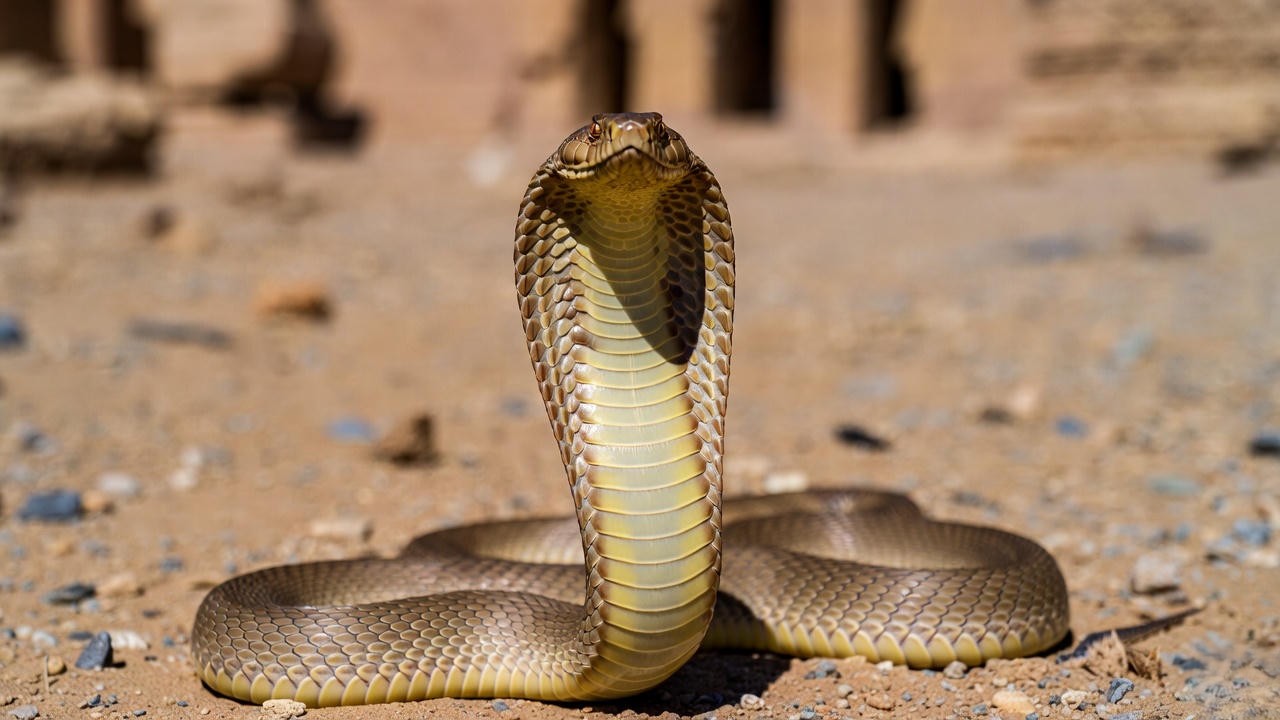
Plutarch’s Account – Shakespeare’s Primary Inspiration
Shakespeare relied heavily on Plutarch’s Parallel Lives (via Sir Thomas North’s 1579 translation). Plutarch, writing over a century later, describes Cleopatra testing poisons on prisoners to find a painless method. She allegedly received asps smuggled in a basket of figs, applying them for a peaceful death with minimal marks. Her body was found serene, with Iras dead at her feet and Charmian adjusting her diadem.
However, Plutarch admits uncertainty: “No one knows the truth.” He offers alternatives like a toxic ointment or hollow implement (possibly a hairpin).
Strabo, Cassius Dio, and Alternative Theories
- Strabo (near-contemporary, possibly in Alexandria at the time): Suggests asp bite or poisonous ointment, noting her death in prison.
- Cassius Dio (two centuries later): Favors poison via ointment or hairpin, observing small puncture wounds but emphasizing painless demise inconsistent with venom.
- No source confirms a snake definitively; logistical issues include smuggling a large cobra undetected and ensuring rapid death for three women.
Other theories include a toxic cocktail (hemlock, opium, aconite) or self-inflicted scratch introducing poison.
Modern Historical Debates and Expert Insights
Contemporary scholars largely favor poison over snakebite. Egyptologist Duane W. Roller argues the asp story is implausible: Egyptian cobra venom causes painful swelling and slow death (hours), not the serene passing described. Smuggling a live cobra past guards is unlikely, and no snake was found.
Historian Christoph Schaefer reconstructed a painless plant-based poison (hemlock, wolfsbane, opium) matching accounts. Stacy Schiff (Cleopatra: A Life) and others note Roman sources’ bias, amplifying the exotic “snake” for propaganda—portraying Eastern decadence versus Roman virtue.
Shakespeare’s Transformation: The Asp as Cleopatra’s Killer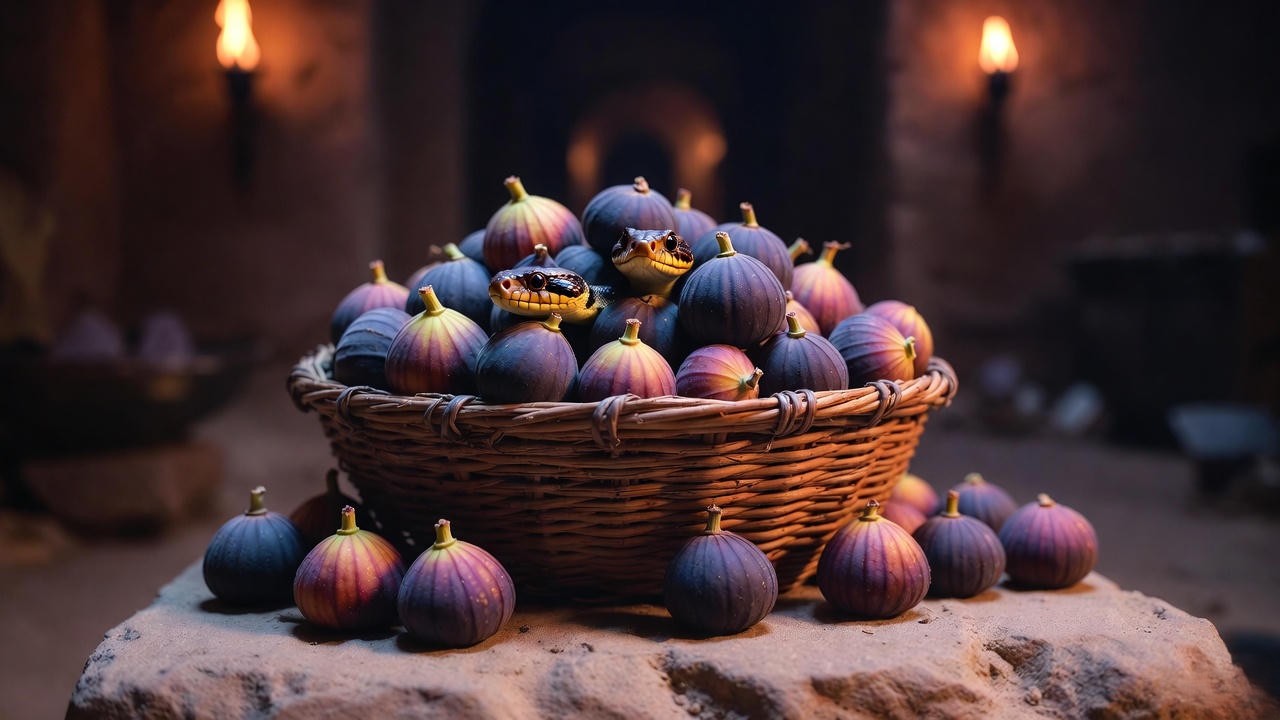
William Shakespeare, drawing extensively from Plutarch via North’s translation, elevates the uncertain historical event into a theatrical triumph in Antony and Cleopatra (written circa 1606–1607). The play’s final act centers on Cleopatra’s death, presenting the asp unequivocally as her chosen instrument—a “mortal wretch” that grants her immortality.
Key Scenes in Antony and Cleopatra (Act 5, Scene 2)
The climax unfolds in Cleopatra’s monument. After Antony’s death, she learns Octavian intends to parade her in Rome. Defiant, she declares: “I have immortal longings in me” (5.2.280). A rustic “Clown” delivers the asps hidden in a basket of figs, providing comic relief amid tragedy—a Shakespearean hallmark blending high drama with earthy humor.
Cleopatra adorns herself royally: “Give me my robe, put on my crown” (5.2.279). She applies the asp first to her breast, evoking maternal imagery: “Dost thou not see my baby at my breast, / That sucks the nurse asleep?” (5.2.308–309). A second asp ensures swift death for her attendants. Charmian adjusts her crown one last time before succumbing, fulfilling Cleopatra’s wish to die “after the high Roman fashion.”
Her final words affirm transcendence: “As sweet as balm, as soft as air, as gentle—” (5.2.310). Octavian arrives to find her “marble-constant,” praising her nobility even in defeat.
Why the Asp? Symbolism and Dramatic Power
Shakespeare’s choice of the asp is richly symbolic:
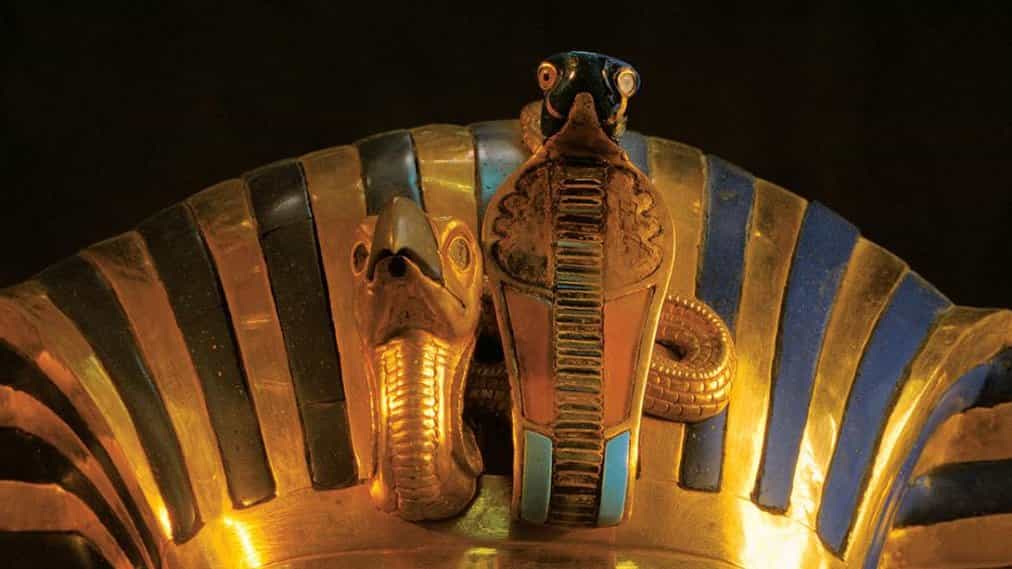
- Royal Egyptian Iconography: The asp (likely the Egyptian cobra, Naja haje) mirrors the uraeus on pharaohs’ crowns—a rearing cobra symbolizing Wadjet, protector of Lower Egypt. By choosing this “fiery serpent,” Cleopatra reclaims divine sovereignty, dying as a true pharaoh rather than a Roman captive.
- Erotic and Sensual Undertones: The application to her breast intertwines death with sexuality, echoing the play’s portrayal of Cleopatra’s “infinite variety” and her passionate bond with Antony. It transforms suicide into an act of sensual fulfillment.
- Contrast Between East and West: Rome favors the sword (Antony’s botched but honorable attempt); Egypt embraces the exotic, painless serpent. This reinforces the play’s central dichotomy: Roman restraint versus Egyptian opulence, duty versus desire.
- Immortality Through Death: The asp’s swift venom allows Cleopatra to “o’ercatch” fate, joining Antony eternally while denying Octavian victory.
Shakespeare’s Liberties with History
While faithful to Plutarch’s narrative spirit, Shakespeare amplifies for stage impact:
- He removes ambiguity—two asps kill all three women instantly and painlessly.
- Extended poetic monologues elevate her death to tragic grandeur.
- The Clown’s banter adds meta-theatrical commentary on mortality.
These enhancements make the scene unforgettable, influencing perceptions more than any historical text.
The Asp in Art, Literature, and Popular Culture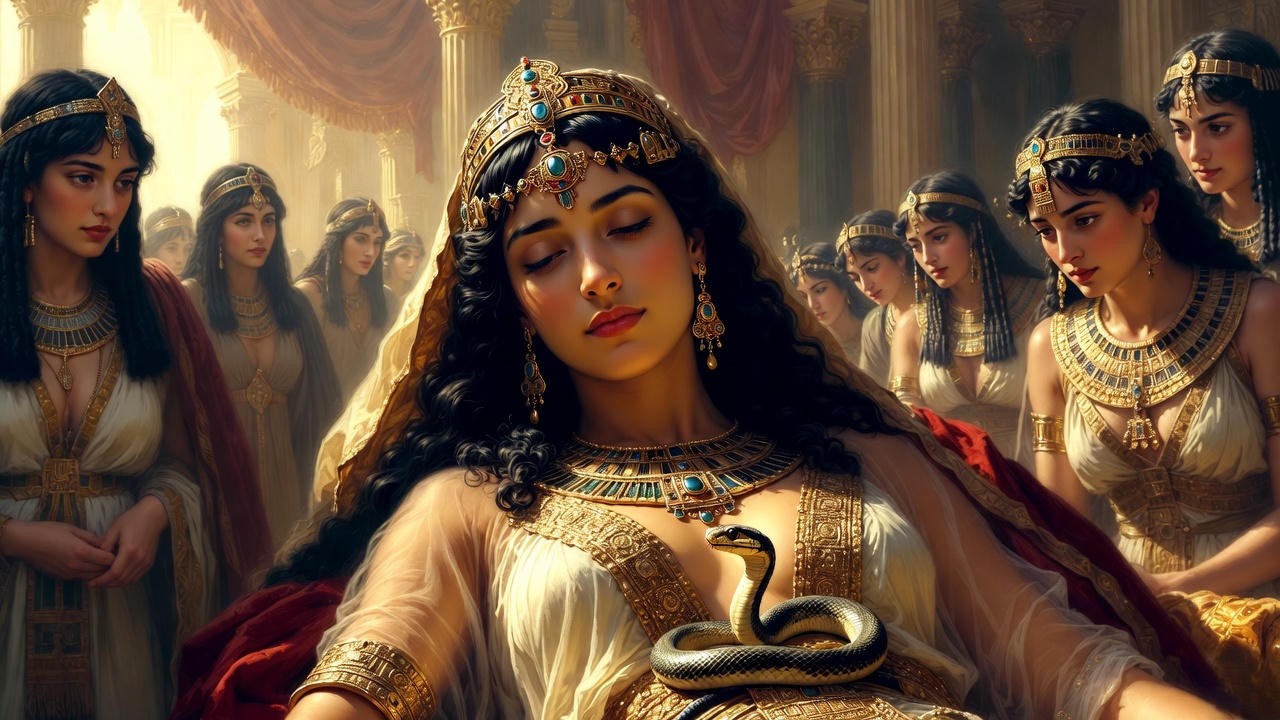
The image of Cleopatra with the asp predates Shakespeare but exploded in popularity post-play.
From Ancient Poets to Renaissance Painters
Roman poets like Horace and Propertius alluded to the serpent, framing her death as fitting Eastern excess. Medieval and Renaissance artists depicted it variably—sometimes with poison cups—but Shakespeare’s version standardized the basket of figs and breast application.
Notable paintings include Guido Reni’s baroque Cleopatra with the Asp (c. 1630) and Guido Cagnacci’s sensual 17th-century works emphasizing her semi-nude beauty.
Modern Depictions: Film, Opera, and Beyond
- Film: The 1963 epic starring Elizabeth Taylor features the iconic asp-in-figs scene, with Taylor’s Cleopatra regal and composed.
- Theater and Opera: Handel’s Giulio Cesare in Egitto and Samuel Barber’s Antony and Cleopatra perpetuate the dramatic suicide.
- Literature: From Dryden’s All for Love (Shakespeare’s direct influence) to modern novels like Stacy Schiff’s biography, the asp remains central.
Popular media—from crossword puzzles (where “asp” is frequently “Cleopatra’s killer”) to video games—cements the myth.
Why the Myth Endures
The asp narrative satisfies deep cultural needs: a powerful woman authoring her destiny, exotic tragedy, and romantic transcendence. It transforms potential defeat into victory, appealing across eras.
Expert Analysis: Fact vs. Fiction in Shakespeare’s Portrayal
As a Shakespeare scholar with decades studying the Roman plays, I view this scene as the Bard’s pinnacle of tragic elevation.
Literary Significance
The death encapsulates themes of love’s supremacy over politics, performance (Cleopatra “plays” her final role), and art’s immortality. Her line “I am fire and air; my other elements / I give to baser life” (5.2.288–289) suggests spiritual ascension, echoing Ovidian metamorphosis.
Critics like Janet Adelman note how Shakespeare humanizes Cleopatra, shifting from Roman propaganda’s “whore” to a multifaceted queen of “infinite variety.”
Historical Accuracy Assessment
- Accurate Elements: Emotional resolve, royal attire, attendants’ loyalty, serene appearance, burial with Antony.
- Embellished/Inaccurate: Definitive asp(s), instantaneous painless deaths, dramatic speeches (though Plutarch provides dialogue seeds).
The scene ranks among Shakespeare’s greatest deaths—rivaling Desdemona’s quiet dignity or Hamlet’s philosophical acceptance—for its blend of spectacle and introspection.
Scholarly Quotes and Insights
- Harold Bloom: “Cleopatra dies into myth, transcending history through Shakespeare’s language.”
- Duane W. Roller (Cleopatra: A Life, 2010): “The snake story is almost certainly fictional, but it serves Shakespeare’s purpose perfectly.”
- Joyce Tyldesley (Egyptologist): The uraeus symbolism would have resonated with educated Elizabethans familiar with classical texts.
Modern productions often retain the asp for tradition while directors like Simon Godwin (National Theatre, 2018) emphasize psychological realism.
Related Mysteries: Was Cleopatra a “Killer” Herself?
While our focus is her death, the keyword “Cleopatra’s killer” sometimes prompts questions about her reputation. Roman propaganda (Octavian’s smears) painted her as murderous seductress responsible for brothers’ deaths and Caesar’s potential assassination fears. In reality:
- Ptolemaic sibling rivalries were political norms; she eliminated threats (e.g., Ptolemy XIII) to survive.
- No evidence links her to direct murders beyond dynastic necessity.
- Shakespeare largely absolves her, presenting ambition as shared with Antony.
This context enriches understanding her suicide: a queen familiar with power’s cost chooses dignified exit over subjugation.
FAQs
What was Cleopatra’s real killer? Most scholars conclude a self-administered poison (likely a plant-based cocktail) rather than an asp. The snake myth, popularized by Plutarch and amplified by Shakespeare, dominates cultural memory despite biological and logistical implausibilities.
Why does Shakespeare call it an “asp”? “Asp” was an Elizabethan term for venomous snakes (from Latin aspis). It evoked exotic danger and tied neatly to Egyptian royal symbolism, perfect for poetic and thematic purposes.
Did the asp kill her attendants too? In Shakespeare’s play, yes—a second asp ensures dramatic symmetry. Historically, improbable; poison explains multiple deaths more plausibly.
Is there evidence of the snake? None. Ancient accounts mention minimal marks; no snake was reportedly found. Octavian’s guards discovered serene bodies.
How does this scene rank among Shakespeare’s deaths? Critics often place it atop his tragic suicides for poetic beauty, thematic depth, and character transcendence—surpassing even Juliet’s dagger or Othello’s self-stabbing in emotional resonance.
The Immortal Legacy of Cleopatra’s Killer
Though history leans toward poison as the practical means of Cleopatra’s end, Shakespeare’s asp remains her true “killer” in the cultural imagination—a symbol of agency, royalty, and eternal love. By transforming Plutarch’s ambiguity into theatrical certainty, the Bard ensured Cleopatra’s death would “outlive marble and the gilded monuments” of conquerors.