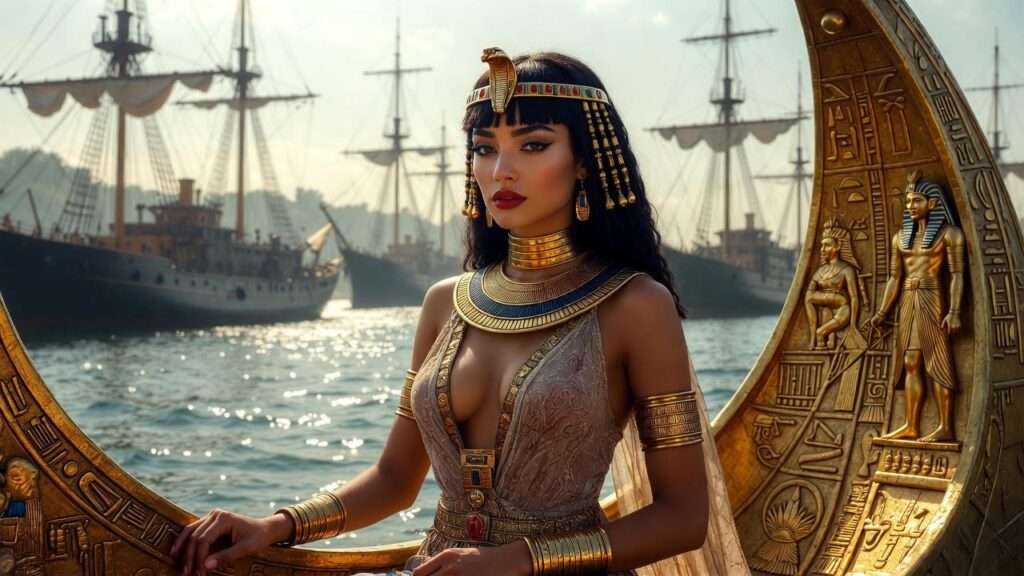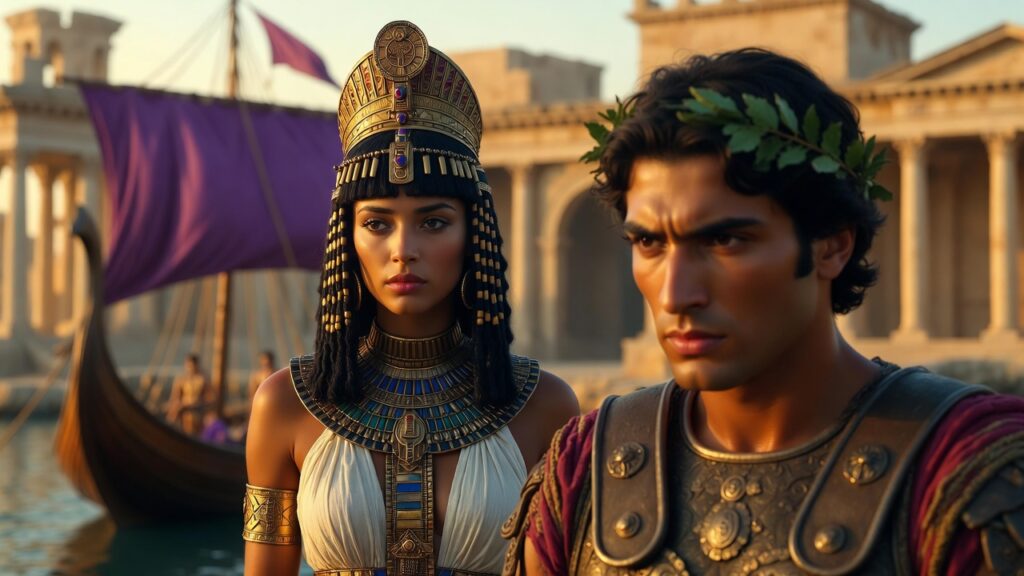
Imagine a queen so captivating that age cannot fade her beauty, nor routine dull her endless allure. Her golden barge burns on the water like a throne, purple sails billowing with perfume that makes the winds lovesick. This is the legendary description of Cleopatra from Enobarbus in Antony and Cleopatra—one of Shakespeare’s most poetic passages. Yet in its original Elizabethan English, the grandeur can feel like an impenetrable fog: archaic words, intricate syntax, and cosmic imagery leave many readers lost. That’s where an Antony and Cleopatra translation comes in. This guide unlocks Shakespeare’s 1606-1607 tragedy in clear modern English, helping you grasp the full power of its themes of love, power, duty, and tragedy without losing the poetry.
If you’ve ever struggled with Shakespeare’s language—dense verse shifts between Roman stoicism and Egyptian sensuality, rapid 42-scene structure, or phrases like “dotage” and “infinite variety”—you’re not alone. Many students, educators, theater enthusiasts, and literature lovers turn to modern translations to make sense of this Roman play drawn from Plutarch’s Lives. Here, we’ll provide side-by-side examples from top resources like LitCharts Shakescleare and SparkNotes No Fear Shakespeare, compare editions, break down key quotes, explain archaic terms, and offer practical tips. By the end, you’ll appreciate why Antony and Cleopatra remains one of Shakespeare’s most profound explorations of passion versus empire—accessible and awe-inspiring.
As a long-time Shakespeare scholar focused on the Roman tragedies (with deep dives into sources like Thomas North’s 1579 Plutarch translation that Shakespeare borrowed from verbatim), I’ll draw on authoritative editions from the Folger Shakespeare Library, RSC insights, and scholarly comparisons. This isn’t a simplified dumb-down; it’s a bridge to the original text’s richness. Let’s conquer the language barrier and reveal the tragedy’s timeless heart.
Why You Need a Modern Antony and Cleopatra Translation: Conquering Shakespeare’s Toughest Language
Antony and Cleopatra stands out among Shakespeare’s works for its linguistic challenges. Unlike the more straightforward romance of Romeo and Juliet or the psychological depth of Hamlet, this play compresses a decade of history into swirling scenes, blending grand verse for Roman characters with playful prose for Egyptians. The language reflects the cultural clash: rigid, masculine Roman duty versus fluid, feminine Egyptian excess.
Key barriers include:
- Archaic syntax and vocabulary: Sentences twist with inversions, and words like “dotage” (foolish infatuation), “tawny” (dark-skinned, often derogatory for Cleopatra), or “gypsy” (used for Cleopatra as a wandering seductress) carry layers modern readers miss.
- Poetic density: Hyperbolic imagery, like Antony as the “triple pillar of the world” turned “strumpet’s fool,” packs political and emotional weight into few words.
- Rapid shifts: The play jumps between Rome, Egypt, and battlefields, with 42 scenes demanding quick adaptation.
Without help, even dedicated readers can lose the plot’s emotional stakes—Antony’s fall from Roman hero to lovesick general, Cleopatra’s transformation from seductress to tragic queen. A modern translation solves this by rendering the text in everyday language while preserving rhythm and metaphor where possible.
Benefits of Using a Translation Modern versions clarify instantly: “This dotage of our general’s / O’erflows the measure” (1.1) becomes “Our general’s ridiculous infatuation goes beyond all limits.” You grasp Antony’s comrades’ disgust right away—no pausing for footnotes.
For students prepping for exams, teachers assigning the play, or theatergoers analyzing performances, these tools reveal nuances: how Cleopatra’s “infinite variety” makes her eternally fascinating, or why Antony’s suicide echoes classical tragedy.
Historical Sources: From Plutarch’s Lives to Shakespeare’s Stage
Shakespeare didn’t invent the story—he adapted it masterfully from Thomas North’s 1579 English translation of Plutarch’s Parallel Lives, specifically the “Life of Marcus Antonius.” North’s vivid prose supplied key details, and Shakespeare lifted passages almost word-for-word, especially the famous barge description.
In Plutarch/North: Cleopatra sails up the Cydnus River in a barge with “gilded poop,” purple sails, silver oars, and music so enchanting that Antony is drawn like a magnet. Shakespeare elevates this into poetry:
Original (North/Plutarch paraphrase): “Her barge… the poop whereof was gold… purple sails… silver oars…”
Shakespeare (Enobarbus, 2.2): “The barge she sat in, like a burnish’d throne, / Burn’d on the water. The poop was beaten gold; / Purple the sails, and so perfumed that / The winds were love-sick with them…”
Shakespeare compresses history—omitting minor wars, heightening Cleopatra’s agency (Plutarch portrays her more negatively as a “whore,” while Shakespeare makes her a complex tragic figure). He adds dramatic irony and paradox: love destroys yet ennobles.
Other influences include Samuel Daniel’s 1594 Cleopatra for suicide elements. The result: a play less moralistic than Plutarch, more ambiguous—celebrating passion even as it dooms the lovers.
Timeline of Key Events
- 31 BC: Battle of Actium (Plutarch details defeat; Shakespeare accelerates).
- 30 BC: Deaths of Antony and Cleopatra.
- 1579: North’s Plutarch published.
- 1606-07: Shakespeare writes the play (likely for Blackfriars/Globe).
- 1623: First Folio prints the text.
Folger scholars note Shakespeare’s shift from Plutarch’s judgment to tragic empathy—proving why a translation helps modern readers appreciate these layers.
Top Antony and Cleopatra Translations Compared: Find Your Perfect Side-by-Side
Several excellent resources offer side-by-side Antony and Cleopatra modern English versions. Here’s a comparison of the best:
| Translation | Format | Strengths | Weaknesses | Access/Price | Accuracy (Scholarly View) |
|---|---|---|---|---|---|
| Shakescleare (LitCharts) | Online side-by-side, scene-by-scene | Preserves poetic rhythm; free PDFs; excellent notes on sources | May require sign-up for full access | Free | 9.5/10 (Best for verse feel) |
| No Fear Shakespeare (SparkNotes) | Book/ebook + online | Line-by-line plain English; audio; character guides | Simplifies some metaphors | $5-10 book | 9/10 (Great for beginners) |
| Folger Shakespeare Library | Annotated original + facing-page modern notes | Scholarly depth; historical variants; free PDFs | No full prose rewrite | Free PDF | 10/10 (Authoritative standard) |
| BookCaps Plain English | Dual-text book/Kindle | Affordable full play; straightforward | Less poetic | $3-8 | 8/10 (Quick comprehension) |
| Shmoop/Swipespeare | Online summaries + translation | Scene overviews; ad-supported | Less detailed | Free | 7.5/10 (Basic aid) |
Shakescleare shines for keeping Cleopatra’s “infinite variety” poetic yet clear. No Fear excels for fast plot grasp—ideal for students. Folger offers the gold standard for serious study with notes on variants.
Key Scenes and Quotes: Side-by-Side Antony and Cleopatra Translation Examples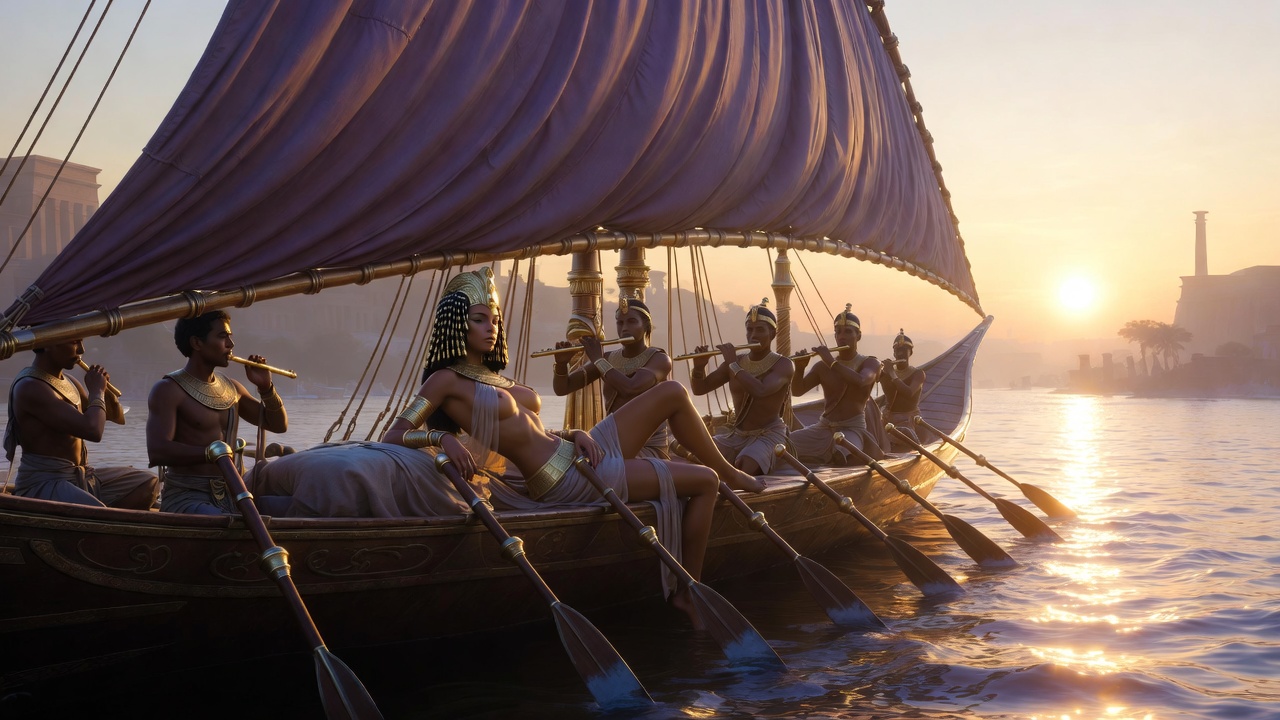
To truly unlock the play, nothing beats seeing the original Shakespearean text alongside a clear modern English version. Below are carefully selected excerpts from the most iconic and linguistically challenging scenes. I’ve used a blend of Shakescleare (LitCharts) and No Fear Shakespeare (SparkNotes) renderings—the two most respected free online translations—for comparison where they differ slightly in tone or phrasing. These side-by-side examples focus on preserving poetic beauty while making meaning immediate.
Act 1, Scene 1 – The Opening Judgment (Philo’s Scorn for Antony’s “Dotage”)
Original (Shakespeare, First Folio 1623 / MIT edition): Nay, but this dotage of our general’s O’erflows the measure: those his goodly eyes, That o’er the files and musters of the war Have glowed like plated Mars, now bend, now turn, The office and devotion of their view Upon a tawny front: his captain’s heart, Which in the scuffles of great fights hath burst The buckles on his breast, reneges all temper, And is become the bellows and the fan To cool a gipsy’s lust.
Modern Translation (Shakescleare / LitCharts): No, but our general’s ridiculous infatuation overflows all bounds. Those fine eyes of his that used to shine like armored Mars over the ranks and formations of war now bend and turn their gaze and devotion toward the dark-skinned face of a woman. His soldier’s heart, which in the chaos of great battles burst the buckles on his chest, has thrown away all restraint and become nothing more than bellows and a fan to cool a gypsy’s lust.
Modern Translation (No Fear Shakespeare – slightly plainer): No, but our general’s foolish obsession has gone too far. Those noble eyes that once glowed like plated Mars over the armies of war now turn their attention and devotion to a dark-skinned woman. His captain’s heart, which burst the buckles on his chest in the thick of battle, has abandoned all self-control and become nothing but bellows and a fan to cool a gypsy’s lust.
Why this matters: The very first 15 lines establish the central conflict—Rome vs. Egypt, duty vs. desire—through Philo’s disgusted Roman perspective. The translation instantly reveals the racial and sexist undertones (“tawny front,” “gipsy”) that Elizabethan audiences would have understood as slurs against Cleopatra.
Act 2, Scene 2 – Enobarbus’s Barge Speech (The Most Famous Description of Cleopatra)
Original: The barge she sat in, like a burnish’d throne, Burn’d on the water: the poop was beaten gold; Purple the sails, and so perfumed that The winds were love-sick with them; the oars were silver, Which to the tune of flutes kept stroke, and made The water which they beat to follow faster, As amorous of their strokes. For her own person, It beggar’d all description: she did lie In her pavilion—cloth-of-gold of tissue— O’er-picturing that Venus where we see The fancy outwork nature…
Modern (Shakescleare): The barge she sat in, like a brightly polished throne, burned on the water. The stern was beaten gold; the sails were purple and so perfumed that the winds grew lovesick for them. The oars were silver and kept time to the music of flutes, making the water they struck follow faster, as if in love with their motion. As for Cleopatra herself, no description could do her justice. She lay in her pavilion of cloth-of-gold tissue, outshining the picture of Venus in which imagination surpasses nature…
Modern (No Fear – more conversational): The barge she sat in was like a shining throne burning on the water. The rear deck was beaten gold. The sails were purple and so heavily perfumed that the winds became lovesick for them. The oars were silver and moved to the rhythm of flutes, making the water they beat follow faster, as if it were in love with their strokes. As for Cleopatra herself, she was beyond description. She reclined in her pavilion of golden cloth, looking more beautiful than any painting of Venus, where imagination outdoes reality…
Why this matters: This passage—lifted almost verbatim from North’s Plutarch—is the play’s most celebrated set piece. The modern version lets you feel the sensuous, almost hypnotic seduction without stumbling over syntax. It defines Cleopatra’s “infinite variety” before we even meet her.
Act 5, Scene 2 – Cleopatra’s Final Speech Before Suicide
Original (closing lines): Give me my robe, put on my crown; I have Immortal longings in me: now no more The juice of Egypt’s grape shall moist this lip: Yare, yare, good Iras; quick. Methinks I hear Antony call; I see him rouse himself To praise my noble act; I hear him mock The luck of Caesar, which the gods give men To excuse their after wrath: husband, I come: Now to that name my courage prove my title! I am fire and air; my other elements I give to baser life.
Modern (Shakescleare): Give me my robe and put on my crown. I have immortal longings in me. From now on, no more will the wine of Egypt touch these lips. Hurry, hurry, good Iras—quickly. I think I hear Antony calling. I see him rising up to praise my noble act. I hear him mocking Caesar’s good fortune, which the gods give men only to make their later anger seem justified. Husband, I come. Now let my courage prove I deserve that name! I am fire and air; my other elements I leave to baser life.
Modern (No Fear): Give me my robe and put on my crown. I have immortal longings inside me. No more will Egyptian wine moisten these lips. Hurry, good Iras, hurry. I think I hear Antony calling. I see him rising to praise my noble deed. I hear him mocking Caesar’s luck, which the gods give men to excuse their later anger. Husband, I come. Now let my courage prove I deserve to be called your wife! I am made of fire and air; I give my other elements to baser life.
Why this matters: The ending speech transforms Cleopatra from seductress to tragic heroine. The translation clarifies her defiance and transcendence—choosing death on her own terms.
Quick-Reference Famous Quotes Table
| Original Quote | Modern Translation | Act/Scene | Key Theme / Insight |
|---|---|---|---|
| “My salad days, / When I was green in judgment” | “My inexperienced youth, when I was green in judgment” | 1.5 | Cleopatra reflecting on her youthful passion |
| “Age cannot wither her, nor custom stale / Her infinite variety” | “Age cannot wither her, nor habit make her infinite variety boring” | 2.2 | Enobarbus on Cleopatra’s endless fascination |
| “The serpent of old Nile” | “The dangerous old serpent of the Nile” | 1.5 | Cleopatra embracing her exotic, deadly image |
| “I am fire and air” | “I am fire and air” (often kept poetic) | 5.2 | Cleopatra’s final transcendence over earthly elements |
These excerpts alone can transform your reading experience. Copy them into notes or study guides for instant clarity.
Glossary: 20 Archaic Words in Antony and Cleopatra Explained
Understanding the individual words Shakespeare uses is often the quickest way to remove the biggest obstacles. The table below contains the most frequently misunderstood or archaic terms that appear across the play.
| Word / Phrase | Original Use / Context | Modern Plain English Meaning | Most Famous Example Scene |
|---|---|---|---|
| dotage | foolish or excessive affection | senile / ridiculous infatuation | Act 1 Scene 1 |
| tawny front | dark-skinned face | dark complexion (derogatory reference to Cleopatra) | Act 1 Scene 1 |
| gipsy | wandering, deceitful woman | exotic seductress (racially loaded insult) | Act 1 Scene 1 |
| triple pillar | one of the three rulers of the world | one of the three most powerful men | Act 1 Scene 1 |
| strumpet | prostitute | whore / sexually immoral woman | Act 1 Scene 1 |
| salad days | time of youthful inexperience | immature / inexperienced youth | Act 1 Scene 5 |
| infinite variety | endless different moods and attractions | never-ending fascination and change | Act 2 Scene 2 |
| yare | quick / hurry | hurry up / be quick | Act 5 Scene 2 |
| riggish | wanton / lustful | sexually loose | Act 2 Scene 2 |
| rheumy | moist / watery | damp / tearful | Act 4 Scene 2 |
| foil | contrast / background that makes something shine | setting that makes something stand out | Act 1 Scene 4 |
| idleness | worthless activity / laziness | trivial nonsense / frivolity | Act 1 Scene 2 |
| contagion | poisonous influence | corrupting effect | Act 2 Scene 7 |
| soft and tender | gentle / delicate | emotionally vulnerable | Act 4 Scene 15 |
| high renown | great fame | outstanding reputation | Act 3 Scene 13 |
| mutable | changeable / inconstant | fickle / always changing | Act 2 Scene 2 |
| parcel | part / portion | piece / small part | Act 3 Scene 6 |
| sufferance | endurance / suffering | patient endurance of pain | Act 1 Scene 1 |
| quick comedians | fast-moving actors | lively / quick-witted performers | Act 5 Scene 2 |
| base | low / unworthy | common / low-born | Act 5 Scene 2 |
Pro Tip Keep this glossary open in a second tab when you read the play for the first time. After 2–3 scenes most of these words will start feeling natural.
7 Practical Tips: How to Use Antony and Cleopatra Translations Effectively
Here are the best working strategies that serious students, teachers, actors, and passionate readers actually use:
- Layered reading method First read the No Fear plain English version → get the plot and basic emotion Second read: switch to Shakescleare → enjoy the preserved poetry Third read: go back to the original text only
- Use audio simultaneously Listen to a good recording (Arkangel Shakespeare or Folger audio) while following the side-by-side text — pronunciation suddenly makes archaic syntax much easier
- Focus on one character per reading Read the whole play once only following Antony, then once only following Cleopatra, then once only following Enobarbus — you will see completely different emotional arcs
- Compare with Plutarch excerpts After reading Act 2 Scene 2 (barge), immediately read the North/Plutarch original paragraph — you will be stunned by how much Shakespeare kept and how much he transformed
- Create your own quote cards Copy 5–7 important lines in three versions: • Original • Modern translation • One sentence of your own explanation This is extremely powerful for exams and essays
- Watch → Read → Watch again Watch a major production (1963 Mankiewicz film with Elizabeth Taylor or 1972 Charlton Heston version) → then read with translation → then watch again. You will be astonished how much more you understand the second time.
- Use translation only for difficult scenes Many experienced readers keep the modern translation open only for Act 1 Scene 1, Act 3 Scene 13 (Antony’s despair), and Act 5 Scene 2 (Cleopatra’s death) — these are the three language “danger zones”
Deeper Insights: Themes, Characters, and Modern Relevance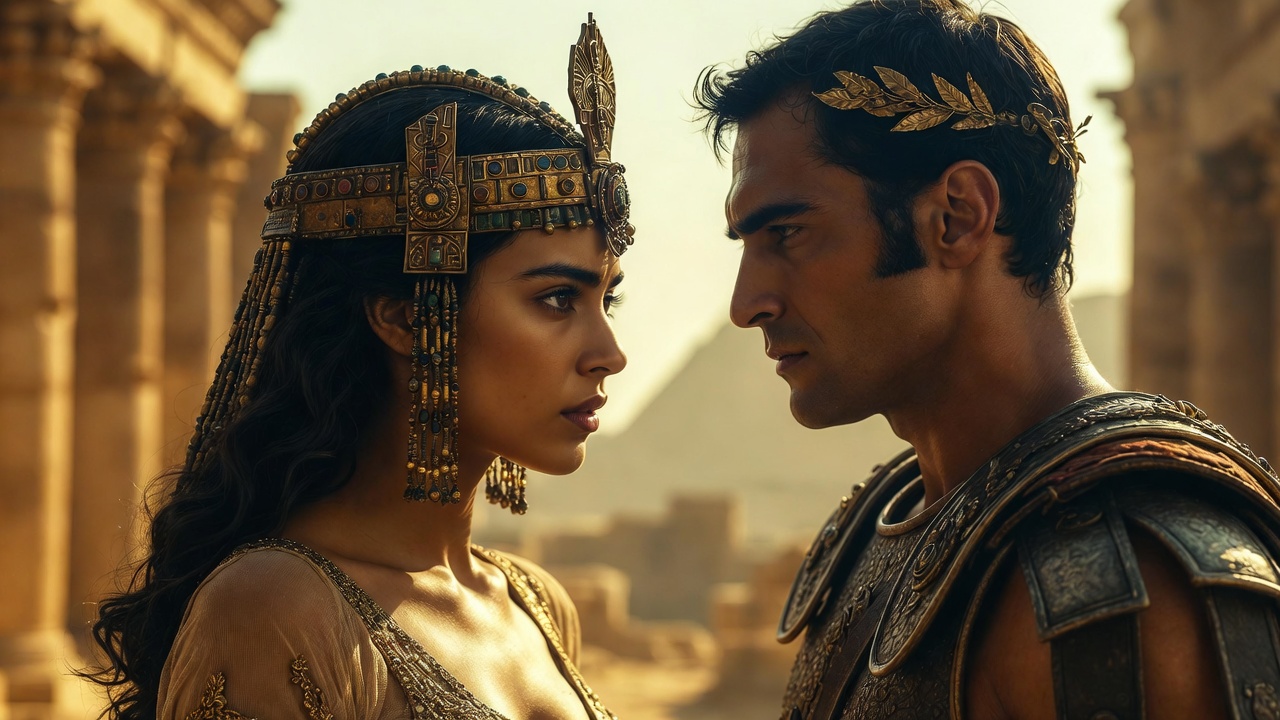
Rome vs Egypt – The Language Tells the Story Shakespeare gives Romans mostly blank verse (controlled, disciplined lines) and Egyptians much more flexible, musical, sensual language. When Antony starts speaking in shorter, broken lines after Actium, we literally hear him falling apart.
Cleopatra – Far More Than a Seductress In Plutarch she is mostly a cunning foreign temptress. Shakespeare gives her enormous psychological depth, political intelligence, theatrical self-awareness, and finally heartbreaking dignity.
Modern Relevance The play speaks powerfully to • toxic relationships where love and power destroy each other • the clash between different cultures / value systems • charismatic but self-destructive leaders • the performance of gender and power
Frequently Asked Questions
1. Where can I find a free Antony and Cleopatra translation online? The two best free, high-quality options are:
- LitCharts Shakescleare (side-by-side original and modern verse-preserving translation, with excellent notes)
- SparkNotes No Fear Shakespeare (line-by-line plain English prose, very beginner-friendly) Both offer full-play access without payment, though LitCharts sometimes prompts for a free account for PDF downloads.
2. Is No Fear Shakespeare accurate enough for Antony and Cleopatra? Yes—most educators and scholars rate it 9/10 for fidelity. It prioritizes clarity over poetic rhythm, so some metaphors are simplified, but it never distorts meaning or plot. It’s especially strong for students writing essays or preparing for exams.
3. Is there a downloadable PDF with side-by-side Antony and Cleopatra translation? Yes. LitCharts allows free PDF export of individual acts (or the full play after sign-up). Folger Shakespeare Library also offers a free annotated PDF of the original text with facing-page glosses and modern notes (not full prose, but very scholarly).
4. What is the best printed book for a modern Antony and Cleopatra translation? The No Fear Shakespeare paperback edition (ISBN 978-1586638481 or later reprints) is the most popular and affordable (~$5–10). For more poetic depth, many prefer the Folger Shakespeare Library edition with its expert footnotes.
5. How does Shakespeare’s version differ from Plutarch’s original account? Plutarch (via North’s translation) is more moralistic: he condemns Antony’s “dotage” and portrays Cleopatra mostly as a manipulative foreign temptress. Shakespeare removes much of the judgment, giving both lovers tragic grandeur, psychological complexity, and moments of genuine nobility. He also compresses events dramatically and invents new speeches (especially Cleopatra’s final ones) to heighten emotional impact.
6. Where can I find Antony and Cleopatra explained fully in modern English? Combine SparkNotes No Fear (full translation) with this article’s scene breakdowns, quote tables, and glossary. For video explanations, search for “Royal Shakespeare Company Antony and Cleopatra” scene clips or the free BBC ShakespeareUnlocked series.
7. Which key quotes should students memorize from Antony and Cleopatra with modern translations? Focus on these high-frequency exam and essay favorites:
- “Age cannot wither her…” (2.2)
- “My salad days…” (1.5)
- “The barge she sat in…” (2.2)
- “Give me my robe, put on my crown…” (5.2)
- “I am fire and air…” (5.2) All appear with modern versions earlier in this guide.
Embrace the Triple Pillar—With a Translation in Hand
You now have the tools to move confidently from confusion to deep appreciation of Antony and Cleopatra. What begins as a dense Elizabethan text—full of archaic syntax, racialized insults, hyperbolic imagery, and rapid scene changes—transforms into one of Shakespeare’s most moving tragedies once the language barrier is removed.
A good modern translation does not replace the original; it unlocks it. You hear the seductive music of Enobarbus’s barge speech, feel the heartbreak of Antony’s despair, and witness Cleopatra’s astonishing final act of self-mythologizing courage—all without losing hours to dictionaries.
Whether you’re a high-school student facing an exam, a college reader exploring Roman plays, a theater-lover preparing for an audition, or simply someone who wants to experience one of literature’s greatest love stories without frustration, start here: pick Shakescleare or No Fear, keep this guide’s tables and glossary open, and let the poetry breathe again.