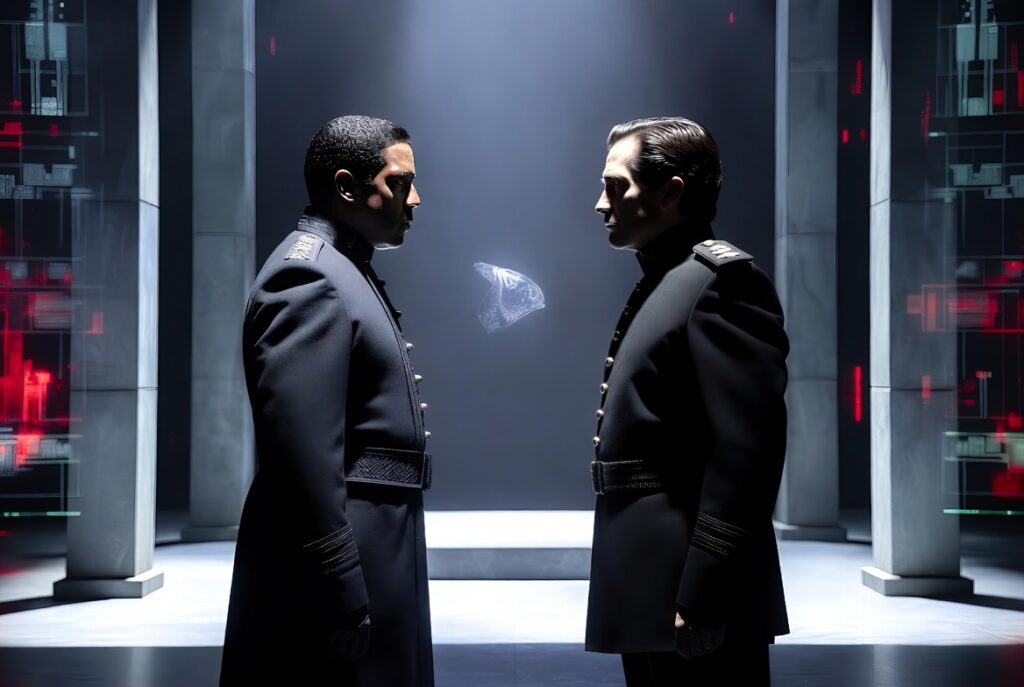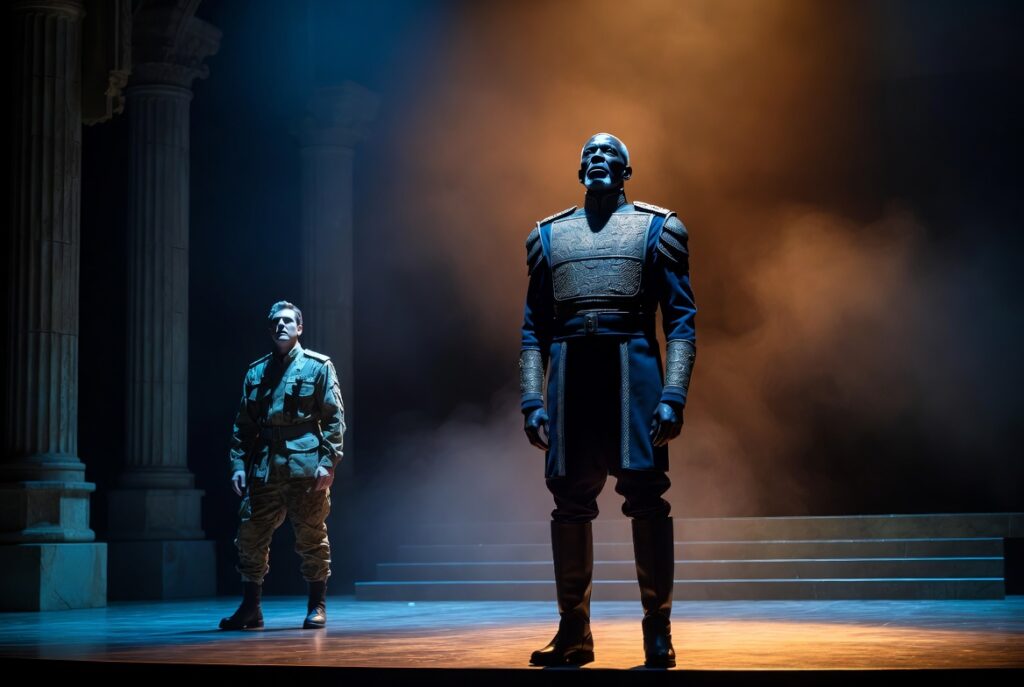
Imagine the lights dimming on a candlelit stage. A battle-hardened general, celebrated across Venice for his military brilliance, stands beside the woman he loves. Moments later, a trusted subordinate plants a single seed of doubt. Within hours, that doubt blooms into murderous rage. This is the visceral, heart-pounding experience audiences have felt for over 400 years whenever they encounter drama othello.
For centuries, drama othello has stood as one of William Shakespeare’s most gripping explorations of human frailty, jealousy, and the destructive power of deception. First performed around 1604, the play remains a cornerstone of English literature and one of the most frequently staged tragedies worldwide. Students preparing for exams, theater enthusiasts seeking deeper insight, teachers building lesson plans, and general readers craving more than a surface-level summary all turn to this drama for answers.
In this comprehensive guide—far more detailed than standard SparkNotes or basic plot overviews—you will find an act-by-act summary interwoven with dramatic analysis, in-depth character studies, exploration of major themes, symbolism, critical interpretations, performance history, and modern relevance. Whether you need to write an essay, understand the play’s psychological realism, or simply appreciate why Shakespeare’s drama Othello still feels urgently contemporary, this resource delivers everything you require. By the end, you’ll possess not just knowledge of the plot, but a nuanced grasp of why drama Othello continues to hold a mirror to our own society’s deepest fears and flaws.
To fully appreciate this masterpiece, we begin with the historical and literary world that gave it life.
Historical and Literary Context of Drama Othello
When Shakespeare Wrote Othello (1603–1604) and Its Place in the Canon
Shakespeare composed drama Othello during the early years of King James I’s reign, shortly after completing Hamlet (c. 1600–1601) and before embarking on King Lear (c. 1605). This places the play squarely in his mature tragic period, when he was at the height of his powers as a playwright for the King’s Men company. The first recorded performance occurred on November 1, 1604, at Whitehall Palace before the king himself—an indication of the play’s immediate courtly appeal.
Unlike the grand, supernatural scope of Macbeth or the cosmic despair of King Lear, drama Othello is an intimate domestic tragedy. Its action unfolds over just a few days, mostly in the confined settings of Venice and Cyprus, making it intensely theatrical and psychologically claustrophobic. This tightness of time and place heightens the sense of inevitability, a hallmark of Shakespearean tragedy.
Shakespeare’s Sources — From Cinthio’s Hecatommithi to Dramatic Innovation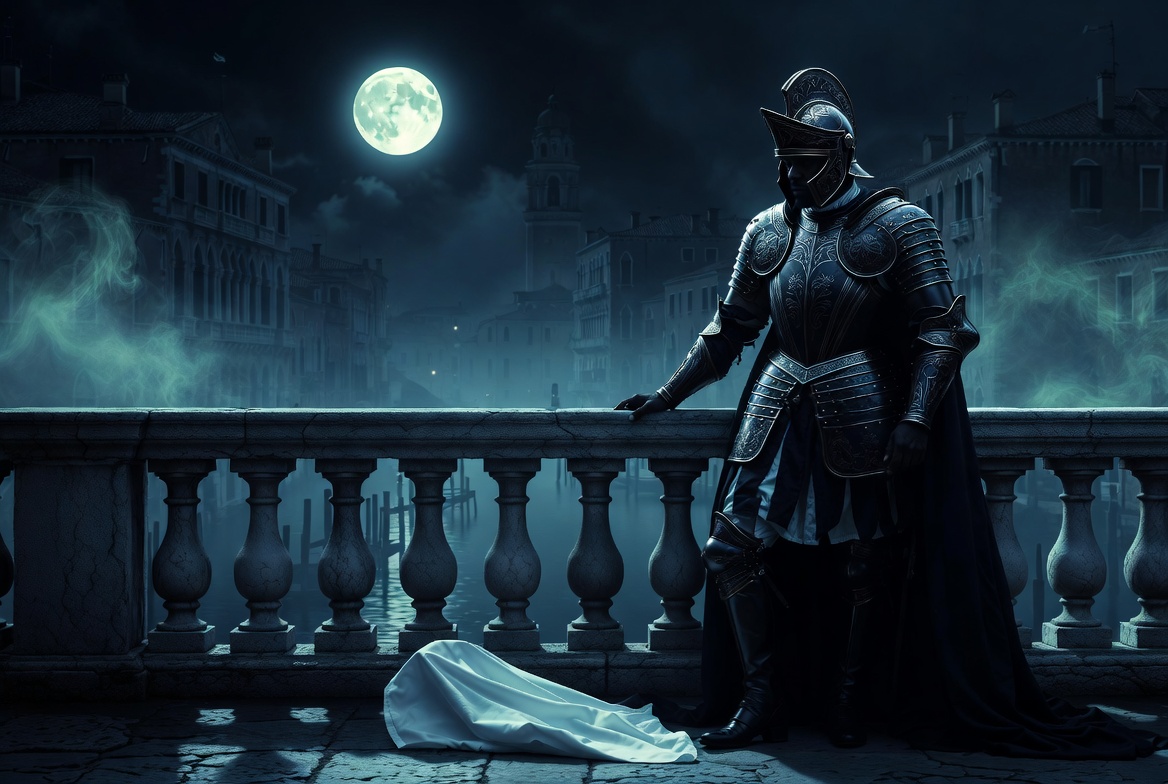
Shakespeare drew his primary source from Giovanni Battista Giraldi Cinthio’s 1565 Italian collection Hecatommithi (Story 3 of Decade 3), a prose tale of a Moorish captain betrayed by his ensign. In Cinthio’s version, the story is straightforward revenge with little psychological depth. Shakespeare transformed it dramatically: he added the noble, poetic Othello, the innocent Desdemona, the richly complex Iago, and the symbolic handkerchief. He also shifted the setting to include Venice’s cosmopolitan politics and Cyprus as a military outpost, adding layers of racial tension, military honor, and political intrigue absent in the original.
These innovations turned a simple morality tale into a profound study of human nature, elevating drama Othello far beyond its source material.
Elizabethan Theater and the Moor in Renaissance England
In Shakespeare’s England, a “Moor” referred broadly to a person of North African or Middle Eastern descent, often associated with Islam or paganism. Venice, a major trading power, employed foreign mercenaries, making Othello’s position as a respected general plausible yet precarious. Elizabethan audiences would have viewed the Moor through a lens colored by both fascination and prejudice—reflected in the play’s own language of “blackness” versus “whiteness.”
The play was written for the open-air Globe Theatre (and later the indoor Blackfriars), where groundlings and nobles alike witnessed the action. Its reliance on soliloquies, dramatic irony, and vivid imagery made it perfectly suited to the bare stage, forcing audiences to engage imaginatively with the characters’ inner turmoil.
This historical grounding explains why drama Othello feels both timeless and rooted in its era—Shakespeare took a foreign tale and made it speak directly to English anxieties about race, power, and betrayal.
Act-by-Act Plot Summary with Dramatic Analysis
Drama Othello unfolds in five acts with relentless pacing. Shakespeare compresses time so that the audience experiences the same whirlwind of emotion as the characters. Below is a detailed, spoiler-aware summary that integrates key dramatic techniques, making it ideal for study or theatrical preparation.
Act 1 – The Spark in Venice: Iago’s Resentment and the Secret Marriage
The play opens in the streets of Venice at night. Iago, Othello’s ensign, bitterly complains to Roderigo that Othello has promoted Cassio to lieutenant over him. Iago reveals his plan for revenge, declaring, “I follow him to serve my turn upon him.” Meanwhile, Brabantio, a Venetian senator, is roused by the news that his daughter Desdemona has secretly married Othello—the “Moor.”
Othello appears calm and commanding when confronted. He defends the marriage eloquently, recounting how he wooed Desdemona with tales of his military adventures. The Duke of Venice intervenes, needing Othello to lead forces against a Turkish invasion of Cyprus. Brabantio’s racist objections are overruled, but he warns Othello: “Look to her, Moor, if thou hast eyes to see: / She has deceived her father, and may thee.”
Dramatic analysis: Act 1 establishes Iago’s manipulative genius through two long soliloquies that break the fourth wall, drawing the audience into his confidence. The rapid nighttime scenes create urgency, while Othello’s dignified verse contrasts sharply with Iago’s prose cynicism. This act plants the seeds of jealousy and racial otherness that will dominate the rest of the play.
Act 2 – Cyprus and the Storm: Celebration Turns to Chaos
The action shifts to Cyprus, where a violent storm has destroyed the Turkish fleet—symbolically clearing the way for personal rather than military conflict. Othello arrives triumphant and reunites passionately with Desdemona. Cassio, left in charge during the storm, is tricked by Iago into a drunken brawl that costs him his lieutenancy.
Iago begins sowing subtle doubts, suggesting to Othello that Cassio and Desdemona share an improper relationship.
Dramatic analysis: The storm serves as a powerful metaphor for the emotional tempest to come. Shakespeare uses offstage action (the sea battle) to focus attention on interpersonal drama. Iago’s “motiveless malignity” (as Coleridge later called it) is on full display as he engineers chaos while appearing helpful.
Act 3 – The Turning Point: The Handkerchief and the Poisoning of Othello’s Mind
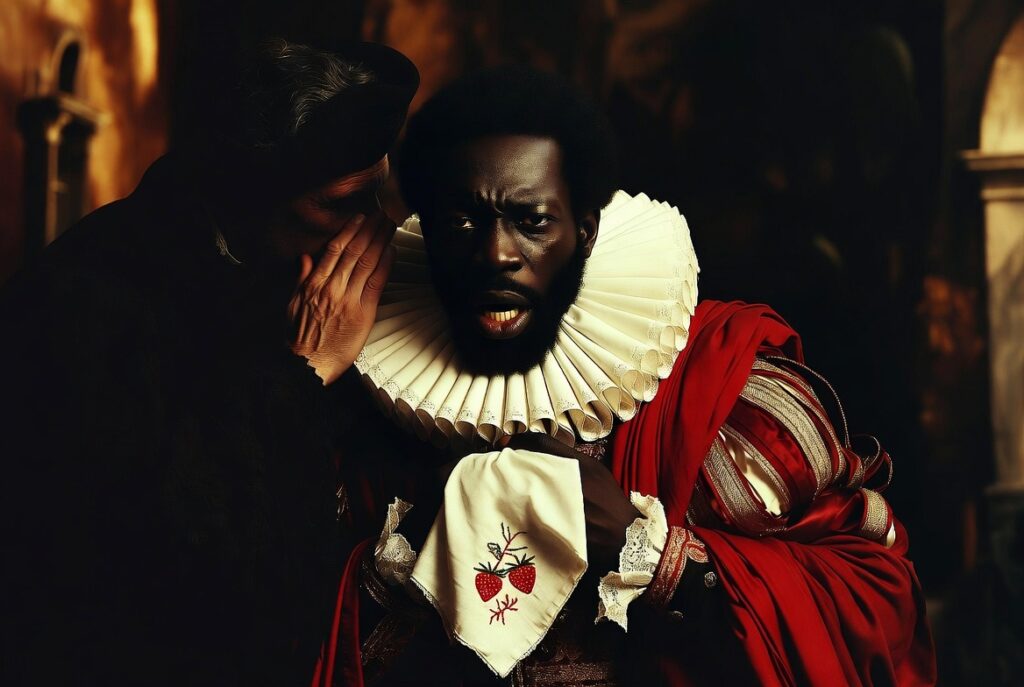
This is the longest and most pivotal act—the “temptation scene” that spans roughly 400 lines of pure psychological warfare. Iago carefully plants the idea of Desdemona’s infidelity, using the stolen handkerchief (a gift from Othello to Desdemona) as “proof.” Othello demands “ocular proof,” and Iago obliges with fabricated details and a staged conversation with Cassio.
By the act’s end, Othello is transformed. His once-poetic speech fractures into fragmented prose as he vows revenge: “Arise, black vengeance, from thy hollow cell!”
Dramatic analysis: Act 3 is a masterclass in dramatic irony. The audience knows Iago’s lies while Othello does not. Shakespeare slows the pace here, allowing every whispered insinuation to land with devastating weight. The handkerchief becomes the central prop, its loss triggering Othello’s complete psychological collapse.
Act 4 – Descent into Jealousy: Public Humiliation and Private Torment
Othello’s jealousy erupts publicly. He strikes Desdemona in front of Venetian dignitaries and accuses her of being a “whore.” In private, he interrogates her brutally. Meanwhile, Iago manipulates Roderigo into attacking Cassio, further entangling the plot.
Emilia, Iago’s wife and Desdemona’s attendant, begins to suspect foul play but remains unaware of her husband’s full role.
Dramatic analysis: Shakespeare shifts between public and private spheres to show how jealousy destroys both personal relationships and social order. Othello’s epileptic fit—staged in some productions—visually represents his mental breakdown.
Act 5 – The Tragic Climax and Resolution: Murder, Revelation, and Iago’s Silence
In the bedchamber, Othello smothers Desdemona, convinced of her guilt. Emilia’s discovery of the truth leads to a chaotic confrontation. Iago kills Emilia to silence her, but the full extent of his scheme is revealed. Othello, realizing his fatal error, delivers a final, heartbreaking speech before stabbing himself: “I kissed thee ere I killed thee. No way but this, / Killing myself, to die upon a kiss.”
Cassio is restored, and Iago is taken away for torture, refusing to explain his motives.
Dramatic analysis: The final scene is brutally intimate, often performed with minimal props to emphasize raw emotion. Shakespeare denies the audience a simple moral resolution—Iago’s silence leaves his evil disturbingly unexplained, forcing viewers to confront the banality of malice.
In-Depth Character Analysis — The Human Heart of the Drama
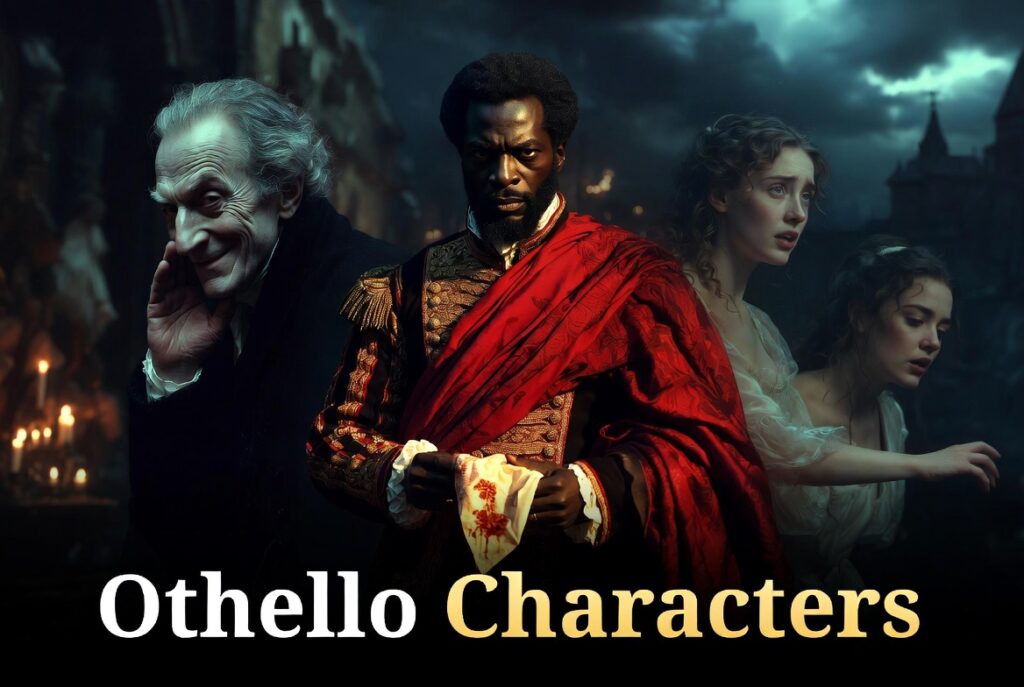
The enduring power of drama Othello lies not in grand battles or supernatural forces, but in its deeply human characters. Shakespeare crafts individuals so psychologically complex that they feel disturbingly real. Each major figure embodies specific facets of human nature, making the play a profound study of trust, manipulation, love, and self-destruction.
Othello — Noble General or Flawed Hero?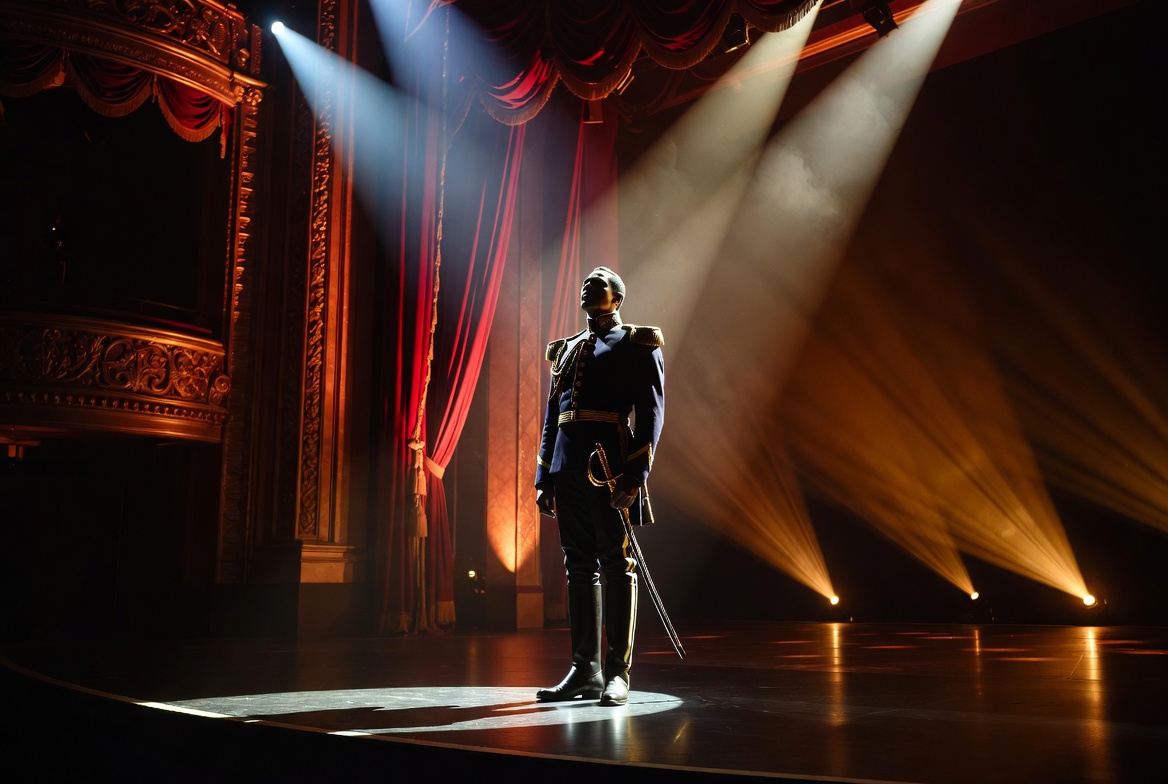
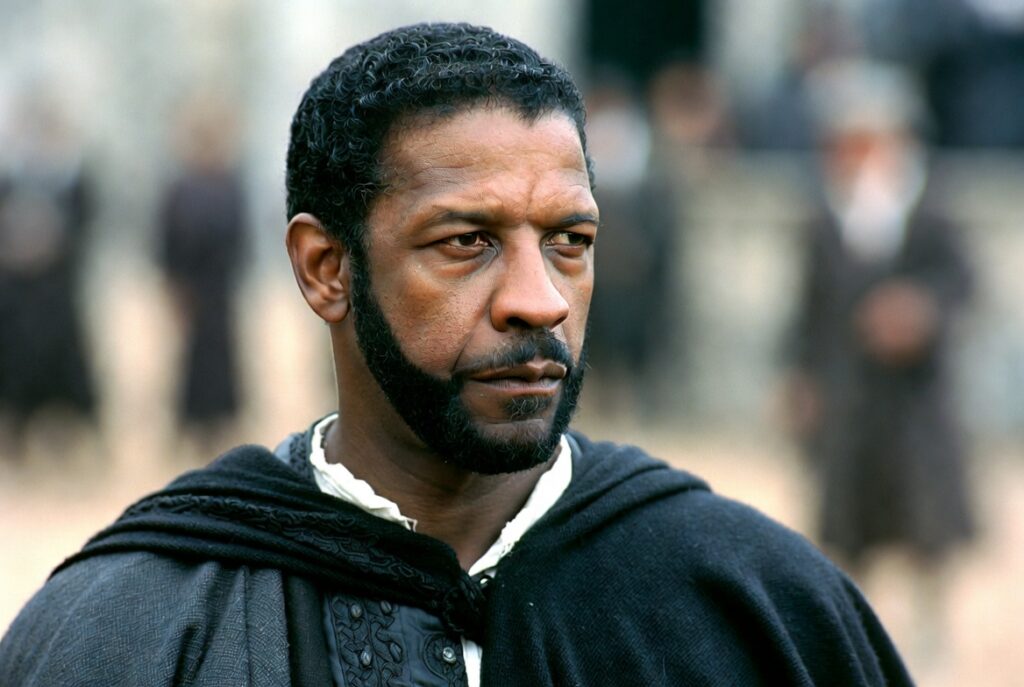
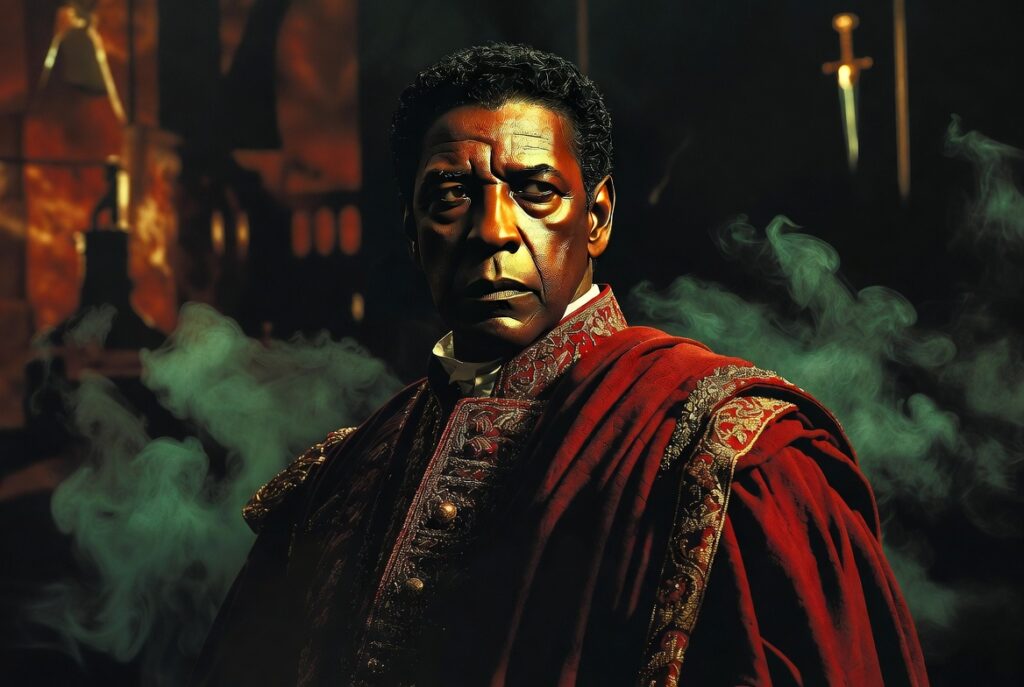
Othello, the Moor of Venice, enters the play as a figure of almost mythic stature: a battle-scarred general whose “services” to the state are invaluable. His speech is poetic and elevated, filled with exotic imagery drawn from his adventurous life. Yet Shakespeare quickly reveals his tragic flaw—not simple jealousy, but an idealistic trust that makes him vulnerable to manipulation.
As an outsider in Venetian society, Othello’s race and background set him apart. He is simultaneously celebrated and othered. His marriage to Desdemona represents an idealized union across cultural and racial lines, but it also exposes the fragility of his hard-won status. When Iago poisons his mind, Othello’s noble language collapses into animalistic rage and fragmented prose, visually and verbally dramatizing his psychological disintegration.
Modern readings often emphasize Othello’s internalized racism—his fear that his blackness makes him unworthy of Desdemona’s love. This self-doubt, skillfully exploited by Iago, turns his greatest strength (his capacity for deep love and loyalty) into his fatal weakness. Othello is not a simple jealous husband; he is a tragic hero whose downfall stems from the very qualities that make him admirable: honor, passion, and unwavering commitment once trust is given.
Iago — Shakespeare’s Most Diabolical Villain
If Othello represents flawed nobility, Iago embodies pure, calculating evil. Often called Shakespeare’s greatest villain, Iago has no redeeming qualities and few clear motives. He resents being passed over for promotion, suspects Othello of sleeping with his wife Emilia (without evidence), and seems to delight in destruction for its own sake.
Coleridge famously described Iago’s malice as “motiveless malignity”—evil that exists without sufficient external justification. Iago’s genius lies in his ability to appear honest and loyal (“honest Iago” becomes a bitterly ironic refrain) while orchestrating the ruin of everyone around him. His soliloquies reveal a chilling intellect: he observes human weaknesses with clinical precision and exploits them effortlessly.
Iago’s prose speech contrasts sharply with Othello’s verse, underscoring his earthbound cynicism against the Moor’s elevated idealism. He manipulates language itself, turning innocent actions into damning “proof.” In performance, Iago often feels like the true protagonist, directly addressing the audience and making us complicit in his schemes. This direct engagement heightens the horror: we watch evil unfold in real time, unable to intervene.
Desdemona — Innocent Victim or Active Agent?
Desdemona is far more than a passive victim. She defies her father to marry Othello, demonstrating courage and agency rare for women in Elizabethan drama. Her love is sincere and unwavering; even as Othello accuses and abuses her, she defends him and remains loyal until her final breath.
Critics debate her innocence. Some see her as naïvely trusting, others as a woman of quiet strength who chooses love over social convention. Her final words—“Nobody. I myself. Commend me to my kind lord”—are ambiguous and haunting, suggesting both forgiveness and self-blame. Emilia’s evolving relationship with Desdemona highlights class and gender dynamics, with Emilia ultimately becoming the moral voice of the play.
Desdemona’s tragedy lies in her goodness: in a world of deception, her honesty and purity make her the perfect target for Iago’s lies.
Supporting Players: Emilia’s Evolution, Cassio’s Honor, Roderigo’s Folly, and Brabantio’s Prejudice
Emilia grows from a seemingly compliant wife into the play’s moral center. Her final speech condemning jealous husbands and exposing Iago’s crimes provides one of the strongest feminist moments in Shakespeare. Cassio represents the honorable soldier undone by a single mistake, while Roderigo embodies foolish infatuation, easily exploited for money and ego.
Brabantio, Desdemona’s father, voices the play’s overt racism. His horror at the interracial marriage reflects Elizabethan anxieties and foreshadows the prejudice that undermines Othello’s confidence.
Together, these characters create a fully realized social world where personal flaws interact with societal pressures, making drama Othello a rich tapestry of human relationships.
Major Themes in Drama Othello — Timeless Lessons in Human Nature
Drama Othello explores universal human experiences with unmatched psychological depth. Each theme is woven tightly into the plot and characters, supported by rich textual evidence and striking imagery.
Jealousy as a Destructive Force — “The Green-Eyed Monster”
Iago famously warns Othello: “O, beware, my lord, of jealousy; / It is the green-eyed monster which doth mock / The meat it feeds on.” Jealousy is not merely an emotion here but a corrosive poison that destroys reason, love, and life itself. Shakespeare shows how quickly suspicion escalates into obsession, particularly when fed by external manipulation. The theme remains painfully relevant in today’s world of social media comparisons and instant doubt.
Race, Otherness, and Prejudice in Venetian Society
Othello’s race is central yet complex. Shakespeare neither fully condemns nor endorses the prejudice of his time. Characters repeatedly reference Othello’s “blackness” in both derogatory and admiring terms. The play examines how otherness—whether racial, cultural, or religious—makes a person vulnerable to exploitation. Postcolonial critics argue that drama Othello critiques rather than reinforces racism by showing how societal prejudice contributes to the hero’s downfall.
Appearance vs. Reality and the Power of Deception
“Nothing is but what is not,” might as well be Iago’s motto. The entire tragedy hinges on the gap between what seems true and what is true. Iago’s deceptions succeed because people trust appearances—honest words, friendly gestures, and circumstantial “evidence.” Shakespeare uses dramatic irony masterfully: the audience sees the truth while characters remain blind.
Gender, Patriarchy, and Female Voices
Desdemona and Emilia highlight the limited power of women in a patriarchal society. Men control their reputations, bodies, and fates. Yet both women demonstrate quiet resistance—Desdemona through unwavering love, Emilia through truth-telling. Feminist readings celebrate Emilia’s final defiance as a powerful critique of male jealousy and control.
Honor, Reputation, and the Fragility of Masculinity
Othello’s identity is tied to his military honor and reputation. Iago exploits this by suggesting Desdemona’s infidelity threatens Othello’s manhood. The play reveals how toxic ideals of masculine honor can lead to self-destruction.
Love and Trust in the Face of Manipulation
At its core, drama Othello is a love story destroyed by betrayal. Shakespeare contrasts pure, mutual love with possessive, jealous “love,” showing how easily the former can be poisoned when trust erodes.
Modern Parallels: Today’s audiences recognize these themes in online trolling, cancel culture fueled by rumors, racial microaggressions in professional settings, and toxic relationships amplified by digital surveillance. Drama Othello equips readers to recognize manipulation and protect healthy trust.
Symbolism, Motifs, and Dramatic Techniques That Make Othello a Masterpiece
Shakespeare’s dramatic craft elevates drama Othello to genius level through recurring symbols and techniques.
The Handkerchief — Central Prop and Symbol of Fidelity
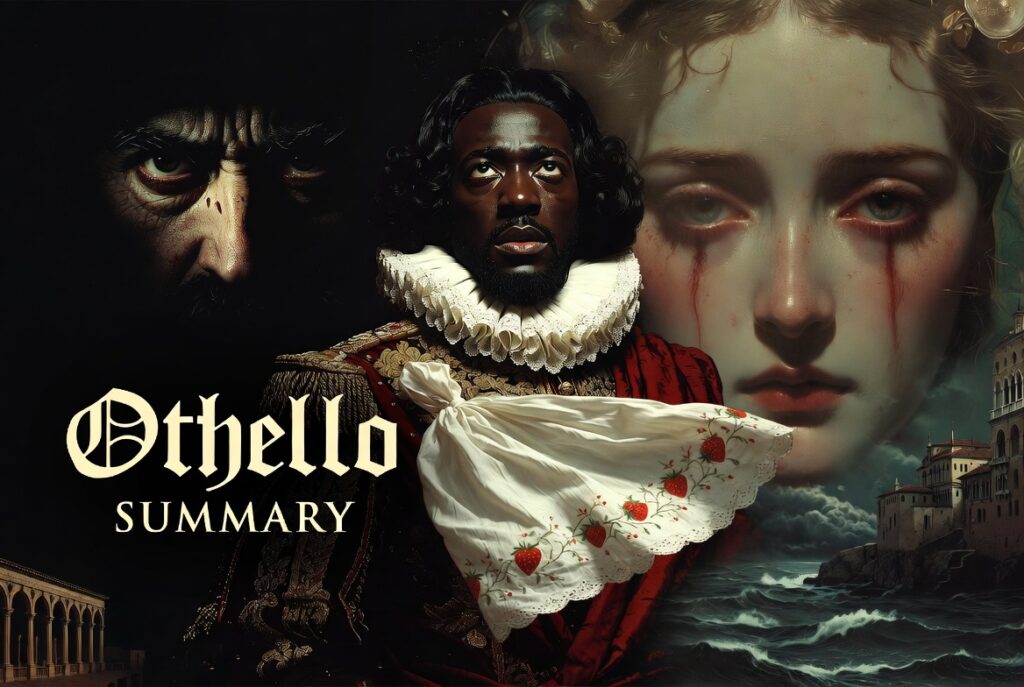
The strawberry-spotted handkerchief is the play’s most famous symbol. Given by Othello to Desdemona as a token of love and fidelity, its loss becomes “proof” of betrayal. It carries multiple layers: a family heirloom with magical associations, a symbol of chastity, and a physical object that drives the plot. Its movement from character to character mirrors the spread of jealousy.
Animal Imagery, Darkness/Light, and Bestial Language
Othello begins with elevated, celestial imagery but descends into animalistic references (“black ram,” “Barbary horse,” “goats and monkeys”). This linguistic shift mirrors his psychological fall from noble general to jealous beast. Light and darkness motifs reinforce racial and moral themes.
Dramatic Irony, Soliloquies, and Iago’s Direct Address to the Audience
Iago’s soliloquies create chilling intimacy with the audience, making us unwilling accomplices. Dramatic irony peaks in Act 3, where every reassurance Iago offers heightens the tragedy.
Language and Rhetoric — Othello’s Poetic Rise and Prose-Like Fall
Othello’s majestic blank verse disintegrates as jealousy overtakes him, a brilliant demonstration of how emotion affects language. Iago’s earthy prose contrasts with this, highlighting class and moral differences.
Critical Reception and Scholarly Interpretations Through the Ages
Drama Othello has provoked strong reactions and evolving interpretations since its earliest performances. Its exploration of jealousy, race, and deception has made it a lightning rod for critical debate, demonstrating Shakespeare’s genius in creating a text that speaks powerfully to each new generation.
Early Views — From Romantic Admiration to Victorian Discomfort
Early audiences and critics admired the play’s emotional intensity. In the 18th century, actors like David Garrick emphasized Othello’s nobility, portraying him as a heroic figure undone by passion. Samuel Taylor Coleridge praised Iago’s “motiveless malignity,” suggesting the villain’s evil was almost supernatural in its purity. However, Victorian critics often struggled with the play’s interracial marriage and graphic violence. Some editions even softened the language or altered staging to make the tragedy more “palatable.”
A.C. Bradley’s seminal 1904 work Shakespearean Tragedy offered one of the most influential readings, treating Othello as a classic tragic hero whose downfall stems from a single flaw—his susceptibility to jealousy—rather than societal forces. Bradley’s character-focused approach dominated for decades and remains essential for students today.
20th-Century Classics
The 20th century brought deeper psychological and societal scrutiny. F.R. Leavis challenged Bradley, arguing that Othello’s self-dramatizing tendencies made him partly responsible for his fate. Marxist and psychoanalytic critics explored power dynamics and repressed desires, while New Critics focused on the play’s intricate imagery and language patterns.
One enduring debate centers on Iago: is he a realistic human villain or a theatrical embodiment of evil? Many directors and scholars now view him as a sociopath whose lack of clear motive makes him even more terrifying.
Modern Critical Lenses: Feminist, Postcolonial, Psychoanalytic, and Queer Readings
Contemporary scholarship enriches our understanding through diverse perspectives:
- Feminist readings highlight the play’s critique of patriarchy. Emilia’s lines in Act 4 (“But I do think it is their husbands’ faults / If wives do fall”) offer a proto-feminist indictment of male double standards. Scholars like Karen Newman examine how Desdemona and Emilia navigate limited agency.
- Postcolonial interpretations focus on race and empire. Critics such as Edward Said and Ania Loomba argue that the play both reflects and interrogates Renaissance Orientalism. Othello’s “otherness” becomes a lens for examining how dominant societies marginalize outsiders, making drama Othello remarkably relevant to discussions of immigration, identity, and systemic bias today.
- Psychoanalytic approaches delve into jealousy as a projection of Othello’s insecurities and Iago’s possible repressed homosexuality or self-loathing. The handkerchief is sometimes read as a fetish object.
- Queer readings explore the intense male bonds (Othello-Iago, Othello-Cassio) and the homoerotic undertones in Iago’s manipulation.
Ongoing debates ask: Is Othello a racist play or an anti-racist one? Does it reinforce stereotypes of the “jealous Moor,” or does it expose the destructive consequences of prejudice? Most scholars today see the play as critical of racism while still embedded in its historical context—Shakespeare gives Othello dignity and eloquence that his Venetian detractors lack.
These layered interpretations prove why drama Othello remains a living text rather than a museum piece. It invites readers to bring their own experiences and cultural contexts to the tragedy.
Othello on Stage and Screen — From the Globe to Contemporary Productions
No other Shakespeare tragedy has inspired such diverse and frequent performances as drama Othello. Its intimate scale, powerful roles, and relevant themes make it a favorite for directors seeking emotional depth and social commentary.
Early Performances and the Play’s Theatrical Legacy
In Shakespeare’s time, the role of Othello was likely played by Richard Burbage, the leading tragedian of the King’s Men. The play transferred successfully from the Globe to the indoor Blackfriars Theatre. Early productions emphasized spectacle, with elaborate costumes for the Moor and dramatic storm effects in Act 2.
For centuries, Othello was performed in blackface, a practice that persisted until the mid-20th century and is now widely rejected. Notable early interpreters included Edmund Kean and Edwin Booth, who brought romantic intensity to the role.
Landmark 20th- and 21st-Century Stage Productions
The 20th century saw groundbreaking performances. Paul Robeson’s 1943 Broadway Othello broke barriers as the first major African American actor in the role in a leading U.S. production, bringing authentic dignity and highlighting racial themes. Laurence Olivier’s 1964 National Theatre performance was controversial for its heavy makeup and exaggerated mannerisms but demonstrated the role’s vocal and physical demands.
Modern productions often feature color-conscious or diverse casting. Notable examples include:
- Janet Suzman’s 1987 South African production during apartheid, which used the play to critique racial oppression.
- Productions with Black actors like David Harewood, Chiwetel Ejiofor, and John Douglas Thompson, who emphasize Othello’s humanity over exoticism.
- Recent revivals, such as those at the RSC and Globe, that experiment with gender-swapped roles or modern military settings.
Iconic Film Adaptations
Orson Welles’ 1952 film is a cinematic masterpiece, shot in striking black-and-white with expressionistic visuals that capture the play’s psychological turmoil. Laurence Fishburne and Kenneth Branagh starred in Oliver Parker’s 1995 version, which remains accessible for students.
More recent adaptations include the 2016 ITV television film with Eamonn Walker and the experimental “Othello” projects that reimagine the story in contemporary contexts, such as high-school settings or corporate environments.
Global and Experimental Interpretations
Drama Othello has been performed worldwide in dozens of languages and cultural adaptations—from Japanese Noh-inspired versions to Indian Kathakali dance-dramas and African reinterpretations that emphasize communal storytelling. Digital and immersive productions during the pandemic experimented with Zoom formats and virtual reality, proving the play’s adaptability.
Why Othello Remains One of Shakespeare’s Most Performed Tragedies: Its small cast, focused action, and explosive emotional core make it cost-effective yet dramatically powerful. More importantly, its themes of jealousy, race, and manipulation resonate strongly in our polarized, digitally connected world.
Why Drama Othello Still Matters Today — Relevance for Modern Audiences
In an era of instant communication, cancel culture, and rising awareness of racial and gender dynamics, drama Othello feels eerily prescient.
Lessons on Toxic Jealousy in the Age of Social Media
Today, a single misleading post or edited image can spark widespread suspicion, mirroring how Iago uses “proof” to destroy trust. The play warns against the dangers of unchecked jealousy and the importance of verifying information before acting.
Conversations on Race, Identity, and Belonging
Othello’s experience as a respected yet marginalized figure speaks directly to contemporary discussions about belonging, microaggressions, and the pressure minorities face to prove their worth. The tragedy illustrates how prejudice, both external and internalized, can corrode even the strongest individuals.
Insights into Healthy vs. Destructive Relationships
The play contrasts Desdemona and Othello’s genuine love with possessive, controlling dynamics. It offers valuable lessons on the importance of open communication, mutual respect, and recognizing manipulative behavior in personal relationships.
By studying drama Othello, readers gain tools to navigate real-life manipulation, foster healthier trust, and confront societal biases—making the play not just literature, but a practical guide to human nature.
Study Guide and Practical Resources for Students and Educators
This section provides high-value tools to help you engage deeply with the text.
Key Quotes with Analysis
- “O, beware, my lord, of jealousy; / It is the green-eyed monster…” (Iago, Act 3) — Introduces the central metaphor and foreshadows destruction.
- “I am not what I am.” (Iago, Act 1) — Reveals his deceptive nature.
- “She loved me for the dangers I had passed, / And I loved her that she did pity them.” (Othello, Act 1) — Defines their pure relationship.
- “But I will wear my heart upon my sleeve / For daws to peck at.” (Iago) — Highlights his cynicism.
- “I kissed thee ere I killed thee.” (Othello, Act 5) — Heartbreaking final line blending love and remorse.
Essay and Discussion Prompts
- To what extent is Othello responsible for his own downfall?
- How does Shakespeare use language to show Othello’s psychological collapse?
- Is Iago a realistic villain or a theatrical device?
- Discuss the role of race in the play. Does Shakespeare critique or reinforce prejudice?
- Compare the roles of Desdemona and Emilia as representations of female experience.
Common Misconceptions
- “Othello is primarily about race.” → Race is important but secondary to jealousy and manipulation.
- “Desdemona is weak.” → She shows remarkable courage and loyalty.
- “Iago has no motive.” → His motives are deliberately ambiguous, adding to his terror.
Tips for Writing an A+ Essay on Drama Othello
- Always support arguments with specific textual evidence and line references.
- Analyze dramatic techniques (irony, imagery, soliloquy) alongside themes.
- Consider multiple critical perspectives rather than a single reading.
- Connect historical context to modern relevance for deeper insight.
Frequently Asked Questions About Drama Othello
What is the main conflict in Othello? The central conflict is internal and interpersonal: Othello’s growing jealousy, engineered by Iago, versus his love for Desdemona and his own noble nature.
Why does Iago hate Othello so much? Iago cites being passed over for promotion and suspected infidelity, but his true motive remains ambiguous—Shakespeare deliberately leaves it open to emphasize the mystery of evil.
Is Othello a racist play? The play contains racist language and attitudes but ultimately portrays Othello with dignity and condemns the prejudice that contributes to his tragedy. Most modern scholars view it as critical of racism.
What does the handkerchief symbolize? It represents fidelity, love, and chastity. Its loss triggers the tragic chain of events and carries magical and cultural associations.
How does the play end? (Spoiler Warning) Othello kills Desdemona, learns the truth from Emilia, kills himself in remorse, and Iago is arrested for torture but refuses to explain his actions.
How does Othello compare to other Shakespeare tragedies like Hamlet or King Lear? Unlike Hamlet’s philosophical delay or Lear’s cosmic scope, Othello is more intimate and fast-paced, focusing on domestic jealousy and psychological realism. It is often considered Shakespeare’s most perfectly constructed tragedy.
Four centuries after its first performance, drama Othello continues to captivate, disturb, and enlighten audiences worldwide. Shakespeare’s masterful blend of intimate character study, explosive dramatic tension, rich symbolism, and profound insight into jealousy, trust, deception, and human frailty makes this tragedy one of his greatest achievements.
Through its complex characters—noble yet flawed Othello, diabolical Iago, courageous Desdemona—and its timeless themes, the play holds up a mirror to our own society. It warns against the destructive power of unchecked suspicion, the dangers of prejudice, and the fragility of love when poisoned by manipulation. At the same time, it celebrates the redemptive potential of truth, loyalty, and self-awareness.
Whether you are a student writing an essay, a teacher preparing lessons, an actor preparing for a role, or simply a reader seeking deeper understanding, drama Othello offers enduring value. It challenges us to examine our own capacity for trust and doubt, compassion and cruelty.
Shakespeare’s tragedy reminds us that the greatest dramas are those that reveal the human heart in all its complexity. As you close this guide, consider watching or rereading the play with fresh eyes. The storm in Cyprus still rages, the handkerchief still carries its fateful weight, and Iago’s whispers still echo in our modern world.