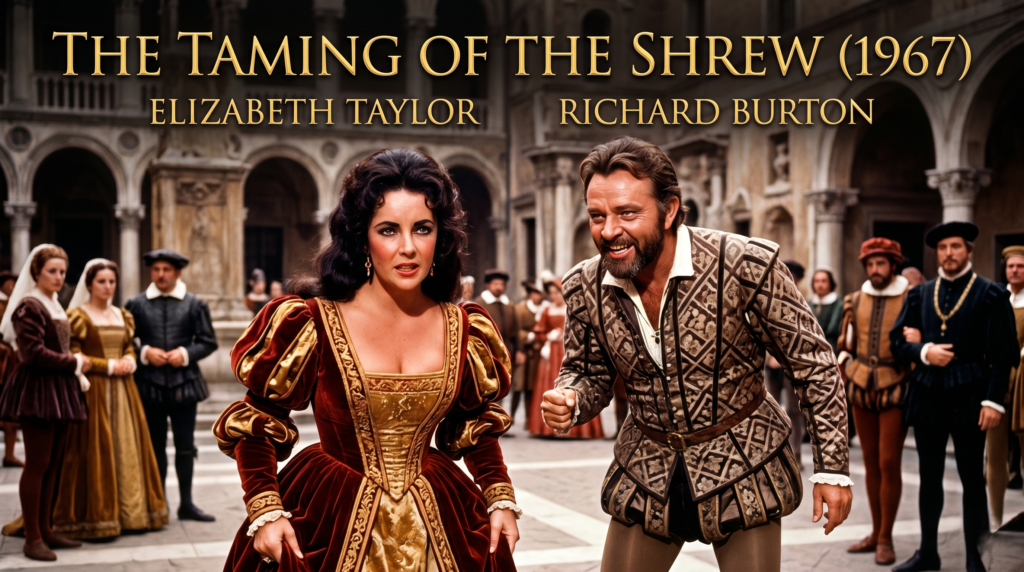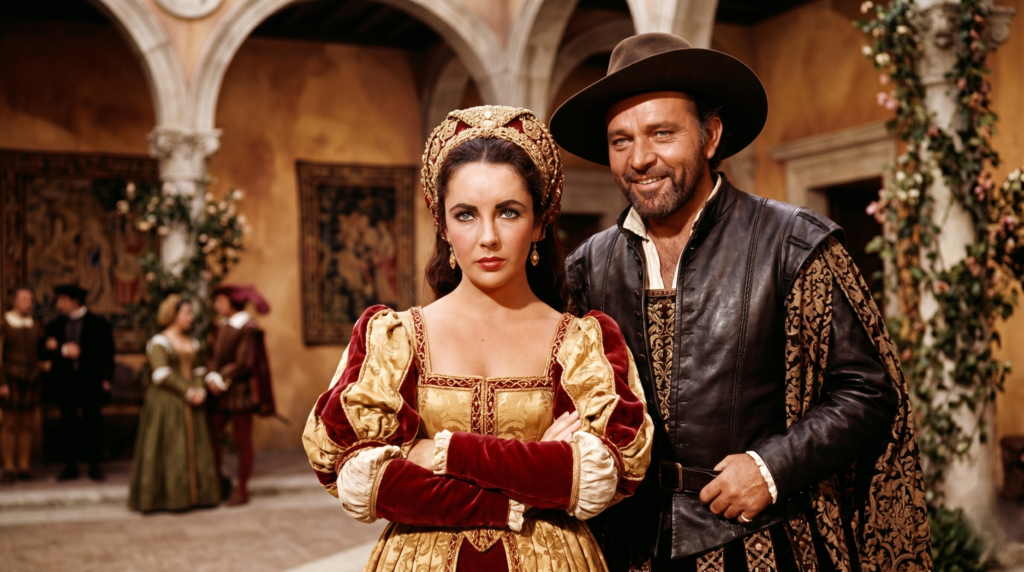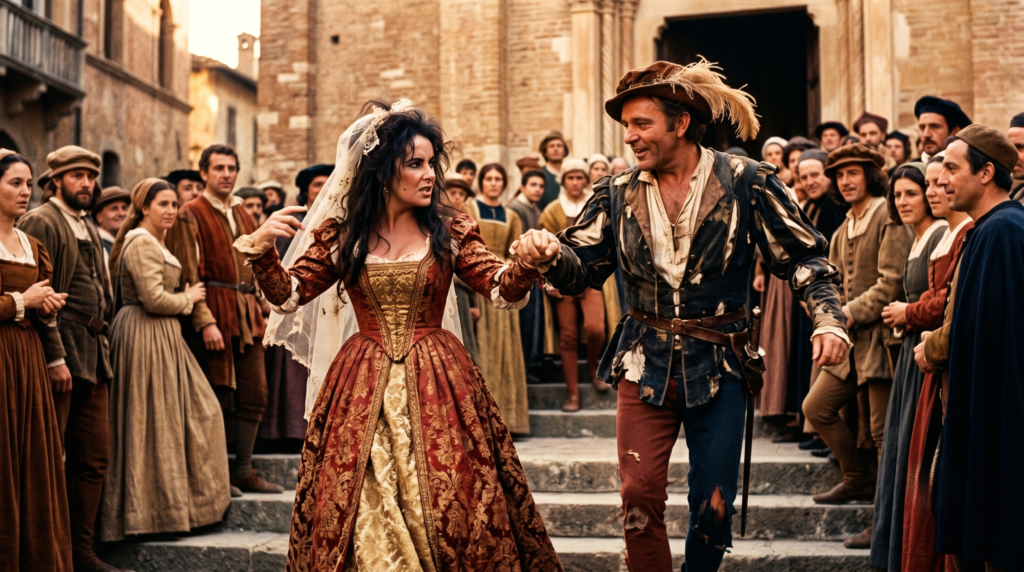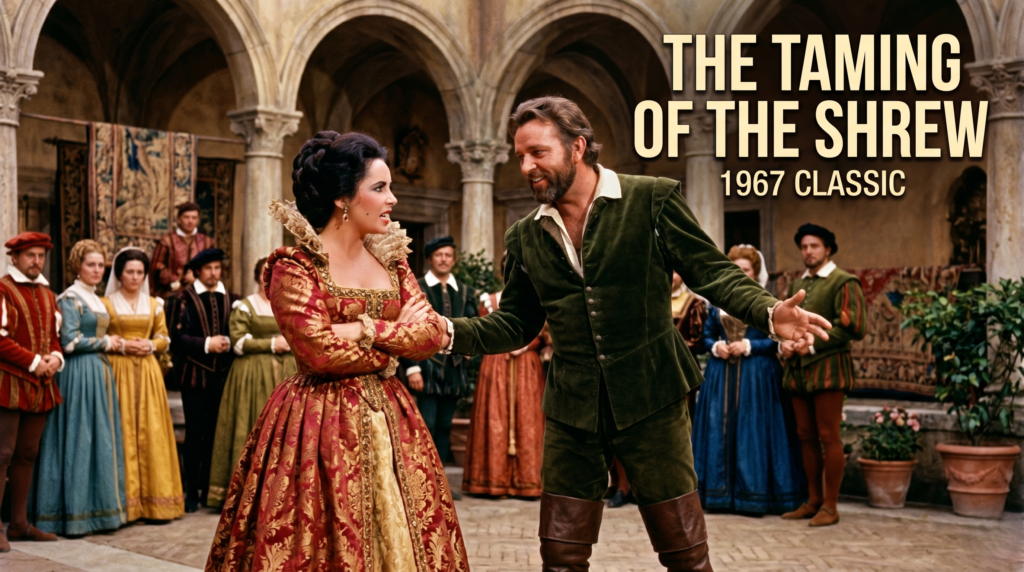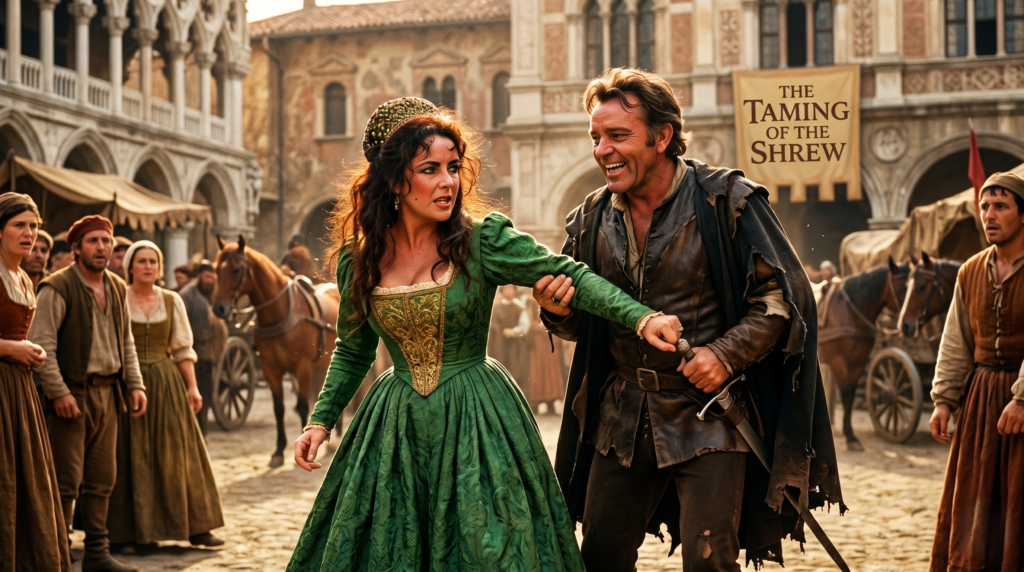
In 1966, Hollywood’s most volatile, glamorous, and intensely scrutinized “it-couple” arrived at the Dino De Laurentiis studios in Rome. Elizabeth Taylor and Richard Burton, whose real-life, alcohol-fueled public brawls and passionate reconciliations kept the global paparazzi on permanent high alert, were there to film a Renaissance comedy.
When director Franco Zeffirelli released the taming of the shrew 1967, audiences were treated to a cinematic spectacle where the chaotic, off-screen friction of its lead actors perfectly mirrored the violent, psychological courtship of Katherina and Petruchio.
Yet, nearly sixty years after its initial theatrical release, this specific production remains an ideological battleground for literary scholars, film historians, and modern audiences alike.
The enduring controversy surrounding the 1967 film does not stem from a lack of cinematic quality. On the contrary, it is widely celebrated as a lush, visually magnificent, and impeccably acted masterpiece.
Instead, the friction lies within the text itself and how Zeffirelli chose to interpret it during a period of massive global upheaval.
For students, educators, and Shakespeare enthusiasts, analyzing this film presents a unique problem: How do we reconcile the undeniable charm, comedic timing, and star power of Taylor and Burton with a narrative that details the systematic breaking of a woman’s independent spirit?
This comprehensive analysis will deconstruct the film’s complex legacy, examine how it navigated the turbulent cultural waters of the late 1960s, and decode the subversive choices hidden within Elizabeth Taylor’s legendary final performance.
1. The Perfect Storm: 1967 Hollywood vs. 1590s Elizabethan England
To understand why this adaptation continues to ignite fierce debates, one must first analyze the historical collision of two distinct eras: the late 16th century when William Shakespeare penned the source material, and the late 1960s when the cinematic version was unleashed upon a rapidly changing world.
Shakespeare’s Original Intent: Farce or Social Commentary?
When Shakespeare wrote The Taming of the Shrew around 1590, the theatrical landscape of Elizabethan London was dominated by broad, physical comedies, folk tales of “shrewish” wives being beaten into submission, and patriarchal anxieties regarding independent women.
Queen Elizabeth I sat on the throne—a powerful, unmarried female monarch ruling an intensely patriarchal society. This reality created a distinct cultural tension.
Some scholars argue that Shakespeare’s play was a conservative piece of social reinforcement, written to reassure anxious Elizabethan men that domestic order would always prevail.
Others, however, point to the play’s inherent meta-theatricality and exaggerated cruelty as a subtle, satirical critique of the very patriarchal structures it claimed to uphold.
The 1960s Cultural Shift and Second-Wave Feminism
Fast forward to 1967. Franco Zeffirelli’s adaptation arrived precisely at the dawn of Second-Wave Feminism. Women were fighting for reproductive rights, entering the workforce in unprecedented numbers, demanding legal equality, and actively dismantling the traditional “submissive housewife” archetype popularized in the 1950s.
The introduction of the birth control pill and the rise of women’s liberation movements meant that gender roles were being rewritten globally.
Into this highly charged cultural environment dropped a multi-million-dollar Hollywood film depicting a wealthy man starving, sleep-depriving, and publicly humiliating a headstrong woman until she openly declared her complete and absolute submission to his whim.
The cinematic timing was explosive. For progressive audiences of the era, the film felt like a glamorous, regressive backlash against contemporary feminist progress. For traditionalists, it was a harmless, nostalgic romp. This ideological split remains entirely unchanged today.
The Meta-Narrative of “Battling Burton and Taylor”
Adding fuel to this cultural fire was the ingenious—and arguably manipulative—casting of Richard Burton and Elizabeth Taylor. Having previously starred together in the historic scandal Cleopatra (1963) and the suffocatingly dark domestic drama Who’s Afraid of Virginia Woolf? (1966), the couple’s real-life marriage was public property.
They were famous for buying each other multimillion-dollar diamonds one day and screaming at each other in luxury hotel suites the next.
[Real-Life Marriage] -------- Mirrors -------- [On-Screen Dynamic]
Taylor & Burton:                                Katherina & Petruchio:
• Volatile Public Brawls                       • Violent Physical Clashes
• Intense Passion & Luxury                     • Battle of Wills & Wealth
• Equal Intellectual Footing                   • Intellectual Matches
When audiences watched Petruchio wrestle Katherina to the ground or heard Katherina spit insults at her suitor, they weren’t just watching Elizabethan characters; they were watching “Battling Burton and Taylor” air their marital laundry on the silver screen.
This meta-narrative made the film incredibly intoxicating to watch, but it also obscured the dark, systemic nature of the play’s domestic abuse by masking it as the eccentric, passionate foreplay of Hollywood’s wealthiest couple.
2. Director’s Vision: How Franco Zeffirelli Softened the Misogyny
Italian director Franco Zeffirelli was a master of grand, romantic spectacles. Known for his later work on Romeo and Juliet (1968), his aesthetic relied heavily on breathtaking realism, vibrant colors, and dynamic movement.
When tackling the inherent misogyny of The Taming of the Shrew, Zeffirelli’s primary strategy was defensive: he sought to soften the text’s harshness by burying it beneath a mountain of exquisite slapstick, cinematic pacing, and auditory cues.
Slapstick Comedy and Choreographed Chaos
In Zeffirelli’s hands, the psychological warfare of the play is translated into high-energy physical comedy. The first meeting between Katherina and Petruchio is transformed into an epic, athletic, ten-minute chase sequence.
They smash through wooden doors, fall through roofs into piles of wool, hurl heavy furniture, and wrestle through mud.
By framing their interaction as a slapstick cartoon, Zeffirelli attempts to establish an underlying sense of physical equality between the two. The underlying message to the audience is clear: Look how evenly matched they are! This isn’t abuse; it’s a mutual, consensual battle of wills.
However, this cinematic choice is precisely where modern critics find fault. By aestheticizing the violence and transforming domestic intimidation into an entertaining obstacle course, the film risks sanitizing the stark reality of what is happening to Katherina.
It invites the viewer to laugh at actions that, if stripped of the comedic sound effects and gorgeous scenery, would be recognized as deeply abusive.
Nino Rota’s Playful Score
The auditory landscape of the 1967 film plays a vital role in shaping the audience’s moral judgment. Legendary composer Nino Rota provided a musical score filled with bouncing brass, whimsical woodwinds, and festive, carnival-like melodies.
Whenever Petruchio is executing his most cruel tactics—such as denying Katherina food or insulting her tailor—Rota’s score remains lighthearted and mischievous.
Petruchio's Actions (Cruel/Abusive) + Nino Rota's Score (Playful/Jovial) = Audience Perception (Harmless Farce)
This classic cinematic technique acts as an emotional guide for the viewer, constantly signaling that the stakes are low, the danger is artificial, and the ultimate outcome is meant to be joyful. Without Rota’s jovial music, the scenes at Petruchio’s country house would play more like a psychological thriller than a romantic comedy.
The Erasure of Christopher Sly: Stripping the Meta-Theatrical Shield
Perhaps the most significant editorial choice Zeffirelli made was the complete elimination of Shakespeare’s Induction framework. In the original stage play, the story of Katherina and Petruchio is actually a play-within-a-play, performed by a troupe of traveling actors to trick a passed-out, drunken beggar named Christopher Sly into believing he is a wealthy lord.
By cutting Christopher Sly entirely, Zeffirelli made a critical trade-off:
-
What was gained: A streamlined, highly realistic, and immersive narrative that immediately sucks the audience into the world of Renaissance Padua.
-
What was lost: The vital meta-theatrical shield.
Without the Sly framework, the story loses its context as an overt, exaggerated fantasy being performed for a drunkard’s amusement. Instead, it becomes a literal, straightforward narrative presented as a direct reflection of romantic courtship, significantly amplifying the uncomfortable nature of its domestic politics for modern audiences.
3. The Crux of the Controversy: Petruchio’s Methods Under a Modern Lens
To contemporary audiences influenced by modern understandings of domestic dynamics and psychological health, Petruchio’s “taming” process looks less like an eccentric romance and more like a textbook study in coercive control.
When analyzing the film today, three specific sequences stand out as flashpoints for intense discussion and discomfort.
The Wedding Day Humiliation
The humiliation of Katherina begins long before she is taken to Petruchio’s home. On their wedding day, Petruchio deliberately arrives hours late, leaving Katherina to endure the pity and mockery of Paduan society.
When he finally appears, he is dressed in a deliberately grotesque, tattered, and mismatched outfit, riding a diseased horse. During the ceremony itself, he behaves crudely, strikes the priest, and drinks the holy wine.
In Zeffirelli’s film, Richard Burton plays this sequence with a boisterous, drunken swagger that elicits laughs from the onscreen spectators and the audience alike.
But from Katherina’s perspective, this is a calculated deconstruction of her social standing. By publicly degrading her wedding day, Petruchio signals to Katherina that her wealth, her pride, and her family’s status cannot protect her from his absolute whims. He strips her of her dignity before a single marital vow is spoken.
Sleep and Food Deprivation as Gaslighting
Once they arrive at his isolated country estate, Petruchio escalates his campaign into systematic psychological warfare. Under the guise of absolute love and devotion, he claims that the food prepared by his servants is not good enough for his beautiful bride, and he violently throws it to the ground.
He claims the bed is improperly made, tearing apart the sheets and pillows, forcing a freezing, exhausted Katherina to remain awake all night.
[Petruchio's Stated Intent]                               [Actual Psychological Impact]
"I do all this out of perfect love for her."  ======>     Complete Sleep Deprivation
"This meat is burnt, it will upset her."     ======>     Severe Nutritional Starvation
"This cap is poor, it does not suit her."     ======>     Total Destabilization of Reality
What makes this sequence so disturbing under a modern lens is Petruchio’s reliance on psychological manipulation. He never strikes her; instead, he frames his cruelty as acts of ultimate care.
By weaponizing basic human needs like food, sleep, and shelter, he destabilizes her cognitive faculties.
For modern audiences, this is a depiction of severe gaslighting and trauma bonding, making it deeply difficult to celebrate as the foundation of a healthy, lasting marriage.
The Broken Will vs. Playing the Game
The climax of this psychological conditioning occurs on the road back to Padua, when Petruchio forces Katherina to agree that the bright midday sun is actually the moon, and that an old, bearded traveler (Vincentio) is a young, blooming virgin.
When Katherina finally relents, exhausted and desperate, she states:
“And be it moon, or sun, or what you please: And if you please to call it a rush-candle, Henceforth I vow it shall be so for me.”
This moment marks the ultimate turning point of the narrative, dividing audiences into two distinct camps:
-
The Tragically Broken Interpretation: Katherina has been completely broken by systemic torture, surrendering her cognitive independence and objective reality to appease her captor.
-
The Subversive Strategic Interpretation: Katherina has cracked the code of the patriarchal game. She realizes that verbal compliance costs her nothing, and by simply feeding Petruchio’s fragile ego with the words he wants to hear, she can regain her freedom, her comfort, and her agency.
4. Elizabeth Taylor’s Subversive Performance: The Final Monologue Decoded
The true saving grace of the 1967 film—and the primary reason it avoids becoming an unwatchable relic of historical misogyny—is the legendary performance of Elizabeth Taylor.
Though Richard Burton brought his unmatched Shakespearean vocal training to Petruchio, it was Taylor, a veteran of the screen who had never performed Shakespeare before, who delivered the film’s most nuanced, intelligent, and subversive work.
The Sadness Beneath the Scowl
Before Petruchio ever enters the narrative, Zeffirelli shows us Katherina pacing her room, smashing objects, and glaring down at the suitors who court her younger sister, Bianca.
While a stage production often plays these moments for broad laughs, Taylor utilizes the intimacy of the film camera to inject a profound sense of human vulnerability into the character.
Through quiet, lingering close-ups, Taylor conveys that Katherina’s “shrewishness” is not an inherent psychological defect, but a desperate defense mechanism. She is a highly intelligent, fiercely independent woman trapped in a transactional society where women are bartered off to the highest bidder like livestock.
Her anger is a rational response to her systemic imprisonment. By establishing this profound sadness and isolation early on, Taylor ensures that the audience’s deep empathy remains firmly with Katherina throughout the entire film.
Deconstructing the Infamous Submission Speech
The absolute pinnacle of the film’s controversy occurs in the final scene. Having returned to Padua, the men hold a wager to see whose wife is the most obedient. While Bianca and the Widow refuse to come when called, Katherina arrives instantly, drags the other women into the room, and delivers her infamous, 44-line monologue on the absolute duty of a wife to her husband:
“Thy husband is thy lord, thy life, thy keeper,
Thy head, thy sovereign; one that cares for thee…
And places his hands below his husband’s foot:
In token of which duty, if he please,
My hand is ready, may it do him ease.”
If delivered with genuine, wide-eyed submission, this speech is an incredibly bitter pill for modern audiences to swallow.
However, Taylor’s delivery is an absolute masterclass in cinematic irony and theatrical subversion.
[Traditional Submissive Interpretation]                 [Elizabeth Taylor's Subversive Delivery]
• Kneeling physically on the floor.                  • Stands tall, dominating the room visually.
• Soft, defeated, or broken vocal tone.              • Strong, resonant, highly commanding voice.
• Sincere expression of utter inferiority.           • Subtle, knowing smile; speaks directly to the men.
Taylor does not deliver these lines like a beaten dog. She stands tall, commanding the room with the booming voice of an absolute queen, delivering the speech with a calm, measured, and highly intelligent authority.
She addresses the other wives not to humiliate them, but to instruct them on how the social game is played. Her vocal tone suggests that she is not confessing her own inferiority, but rather articulating a strategic social contract.
The Irony in the Exit: Who Truly Won?
The brilliant stroke of Zeffirelli and Taylor’s interpretation occurs in the film’s final seconds, completely altering the power dynamic of the play’s conclusion.
After completing her grand speech, Katherina does not wait for Petruchio to grant her permission to leave, nor does she kneel to let him step on her hand. Instead, she turns on her heel, offers a subtle, knowing smile, and exits the grand banquet hall completely alone, holding her head high.
Petruchio sits at the table, surrounded by his friends who have just lost the bet. But instead of looking like a triumphant conqueror, Richard Burton’s face registers a sudden, profound shock. He realizes that he hasn’t broken her spirit at all; she has simply mastered his game and outmaneuvered him publicly.
He is forced to get up and hurriedly chase after her through a crowd of laughing women. By ending the film on this precise note, Zeffirelli and Taylor successfully subvert the patriarchal triumph of the text, leaving the audience with the distinct impression that Katherina remains the true intellectual sovereign of her marriage.
5. Production Mastery: Why It Remains a Cinematic Masterpiece
Despite the thorny ideological questions it raises, The Taming of the Shrew (1967) cannot be dismissed as a mere relic of historical marketing. Its status as an enduring classic is anchored by its extraordinary production value, which set a new standard for how Elizabethan literature could be translated to film.
Oscar-Nominated Visuals and Period Authenticity
Zeffirelli, who began his career as a stager of grand operas, brought a painterly eye to every frame of the film. Together with legendary production designer Lorenzo Mongiardino, he transformed the Cinecittà backlots in Rome into a living, breathing, dirt-and-marble recreation of 16th-century Padua.
Unlike earlier Hollywood adaptations that opted for pristine, sanitized soundstages, Zeffirelli’s Padua is textured, crowded, and authentically chaotic. The streets are filled with animals, merchants, mud, and dynamic movement, making the environment feel less like a theatrical set and more like a historical documentary.
Complementing this world-building were the stunning, lavish costumes designed by Danilo Donati. The wardrobe choices do more than just look beautiful; they serve as critical narrative devices:
-
Katherina’s Progression: She begins the film encased in stiff, heavy, dark-colored velvet gowns with high collars—visual armor that reflects her hostility and self-imposed isolation from the world. As she navigates Petruchio’s world, her wardrobe becomes progressively lighter, more fluid, and expressive, culminating in her radiant, golden banquet gown that symbolizes her newly discovered tactical freedom.
-
Petruchio’s Chaos: Petruchio’s clothing is initially structured but intentionally unkempt, evolving into the grotesque, oversized, and tattered wedding ensemble that highlights his total disregard for societal expectations. His clothes act as an extension of his psychological warfare.
Donati and Mongiardino’s exceptional work earned the film two Academy Award nominations for Best Costume Design and Best Art Direction, solidifying its place as a high-water mark for cinematic historical design.
A Gateway to the Bard
For educators and literary scholars, the 1967 film serves an invaluable practical purpose: it makes Shakespeare highly accessible. The original text’s language can often feel dense and impenetrable on the page, but the visceral, highly physical performances of Taylor and Burton bridge that gap effortlessly.
When Taylor spits her lines with venomous speed or Burton delivers a monologue with booming, theatrical resonance, the emotional intent behind the Elizabethan English becomes immediately crystal clear to students. It remains one of the most widely used visual aids in classrooms worldwide, acting as a perfect springboard for discussions on gender politics, performance history, and adaptation theory.
6. Key Comparisons: 1967 vs. Other Famous Adaptations
To fully appreciate the unique space the 1967 version occupies in cinematic history, it is highly useful to contrast it with how other eras have attempted to solve the play’s central problem of misogyny.
| Adaptation | Creative Approach | Tone / Resolution | Historical Context |
|
1929 Film
(Mary Pickford & Douglas Fairbanks) |
Hollywood Royalty Satire | The Wink: Mary Pickford delivers the final submission speech straight, but directly winks at the camera, signaling to the audience that she is merely humoring her husband. | The dawn of “talkies” and the height of the roaring twenties star system. |
|
1967 Film
(Elizabeth Taylor & Richard Burton) |
High-Octane Renaissance Farce | The Subversive Exit: Katherina delivers a commanding, powerful speech and exits the room alone, forcing an astonished Petruchio to chase after her. | The dawn of Second-Wave Feminism and the height of Hollywood’s “it-couple” media obsession. |
|
1980 BBC Production
(John Cleese & Sarah Badel) |
Rigid, Literal Realism | The Psychological Realignment: John Cleese plays Petruchio with a quiet, austere sanity. The submission feels genuine, framed as a religious and social necessity for harmony. | Part of the BBC’s highly traditional, complete Shakespeare collection for television. |
|
1999 Film
(10 Things I Hate About You) |
Late-90s Teen Rom-Com | Mutual Vulnerability: The “taming” is entirely mutual. Kat (Julia Stiles) retains her feminist ideals, while Patrick (Heath Ledger) changes his behavior to win her genuine, unforced love. | The height of the 1990s teen literary adaptation boom and third-wave feminist mainstreaming. |
By examining this timeline, we can see that Zeffirelli’s version stands out because it doesn’t try to sanitize the play’s rough edges by modernizing the setting (like 10 Things I Hate About You), nor does it resort to a simple meta-theatrical gag like a camera wink.
Instead, it leans fully into the period’s harshness and relies entirely on the complex, nuanced acting choices of Elizabeth Taylor to salvage Katherina’s dignity.
7. Frequently Asked Questions About the 1967 Film
Did Elizabeth Taylor and Richard Burton actually fight while filming?
While they did not engage in genuine domestic violence, their physical brawls on screen were fueled by an intense, high-stakes creative energy. Both actors were known for their explosive real-life arguments, and crew members noted that they frequently used the film’s highly physical choreography to vent their actual marital frustrations.
Furthermore, Taylor was initially terrified of performing Shakespeare alongside her husband, who was a celebrated, classical Old Vic theatre veteran. This real-life professional anxiety added an authentic edge of genuine anger and defensive pride to her performance as Katherina.
Is the 1967 Taming of the Shrew sexist?
The answer is deeply nuanced. By 21st-century standards, the narrative structure itself is inherently sexist, as it charts the systematic psychological breakdown of a woman’s autonomy.
However, the film itself can be viewed as a critique or a reflection of sexism rather than a celebration of it. Because of Elizabeth Taylor’s powerful delivery and the ambiguous ending where she retains her dignity and outmaneuvers Petruchio, the film functions as a fascinating, multi-layered text that allows audiences to question and analyze patriarchal power structures rather than blindly accept them.
Why did Zeffirelli cut the Christopher Sly prologue?
Zeffirelli wanted to create a highly cinematic, fast-paced, and lushly realistic romance. The original Christopher Sly prologue requires a frame story set in an English tavern, which breaks the visual illusion of the sunny, romantic Italian setting of Padua.
By eliminating the framing device, Zeffirelli streamlined the running time and created a more direct, emotionally immersive experience for the mainstream cinema-going audience of 1967.
An Enduring Mirror of Cultural Anxiety
Franco Zeffirelli’s The Taming of the Shrew (1967) survives as a cinematic masterwork not because it provides neat, comfortable answers to the problem of gender politics, but precisely because it refuses to do so. It remains a fascinating, double-sided mirror reflecting both the patriarchal anxieties of the 1590s and the explosive social revolutions of the 1960s.
Driven by the unparalleled star power, magnetic chemistry, and subversive acting choices of Elizabeth Taylor and Richard Burton, the film transforms what could have been a deeply regressive narrative into an open-ended, intellectual debate. It proves that great art is rarely polite; instead, it challenges, uncomfortably provokes, and forces successive generations to redefine their own values.
Whether you view the film as a lighthearted farce, a tragic depiction of a broken spirit, or a masterful showcase of a woman learning to beat a rigged system at its own game, one thing remains absolutely undeniable: sixty years later, we are still talking about it.