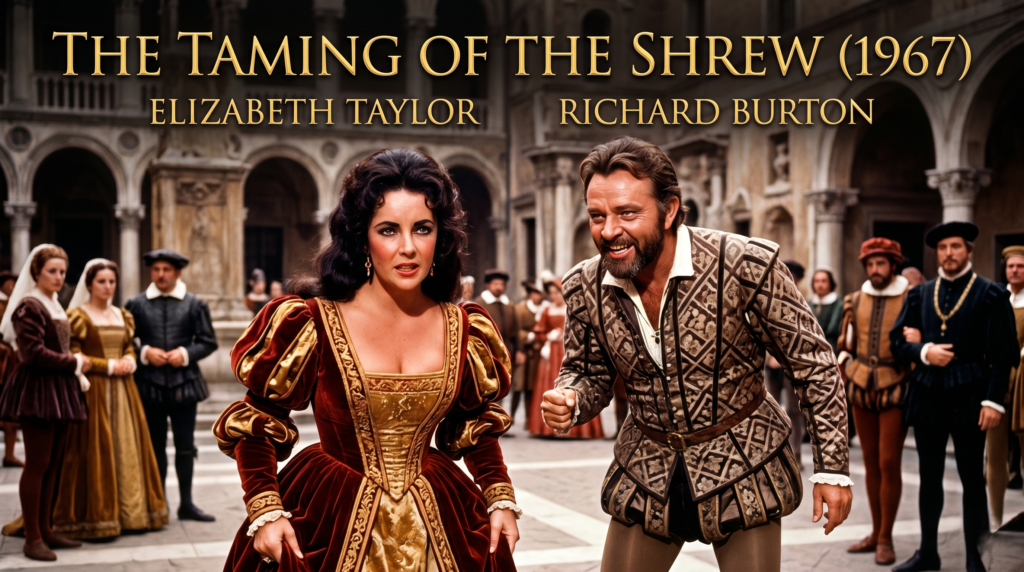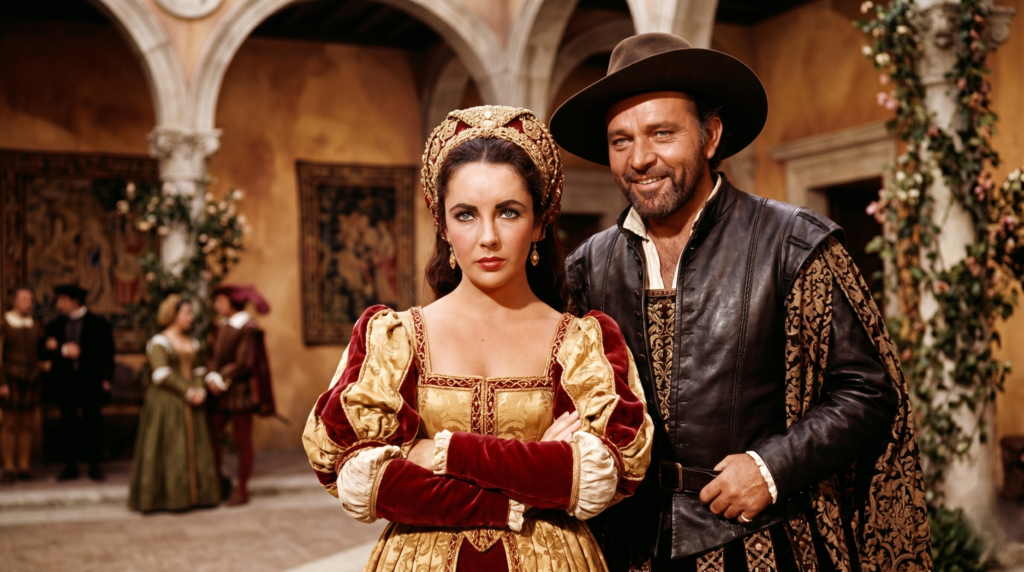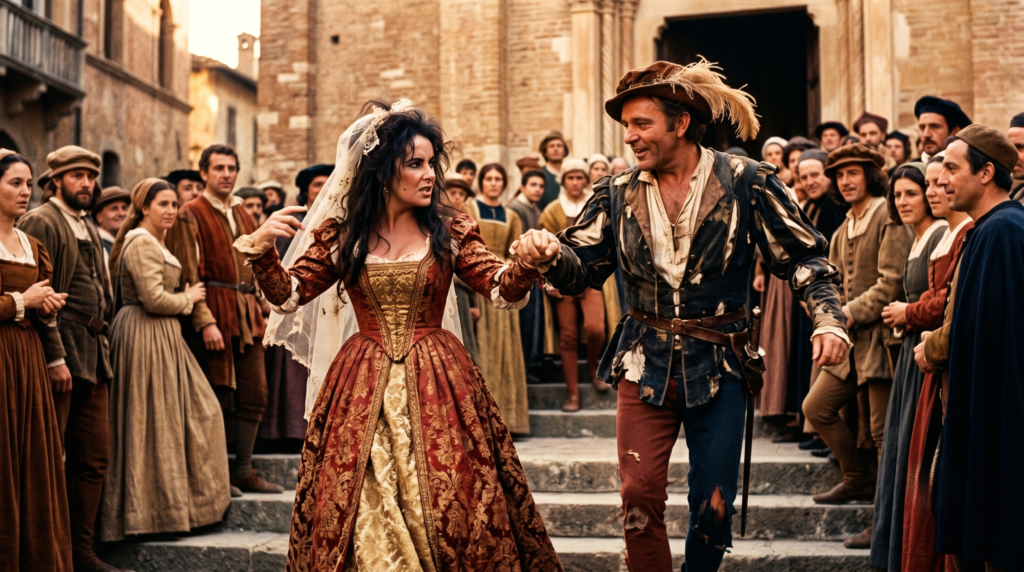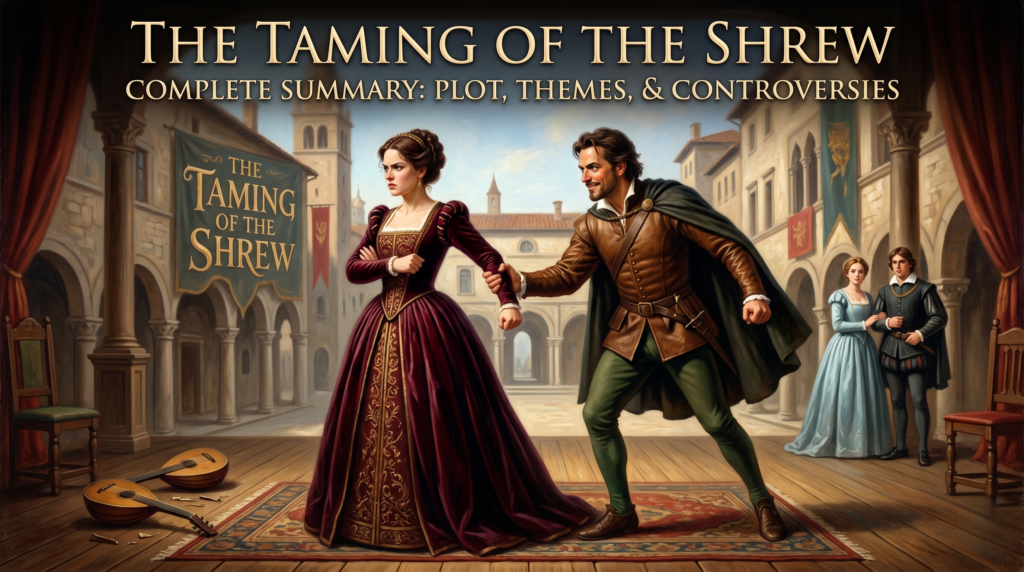
For over four centuries, William Shakespeare’s comedies have delighted audiences with their sharp wit, mistaken identities, and romantic resolutions. Yet, few plays in the Western canon provoke as much fierce debate, visceral discomfort, and critical divide today as The Taming of the Shrew. It is a work that exists in a state of perpetual cultural tension: it is simultaneously one of the Bard’s most physically hilarious, commercially successful stage farces and a deeply polarizing narrative centered on psychological manipulation and marital capitulation.
When students, theatergoers, and literary enthusiasts look for a comprehensive taming of the shrew summary, they are rarely seeking a simple sequence of plot points. The true challenge of this play lies in its execution. How do we reconcile the brilliant, lightning-fast verbal sparring of its central characters with a climax that features a woman delivering a lengthy monologue on the absolute submission of a wife to her husband?
To understand this play is to look beyond the surface-level slapstick of the Elizabethan stage and dive into the social anxieties of early modern England. This expert guide offers a definitive, skyscraper-level analysis of The Taming of the Shrew. By examining its nested plot structure, parsing its rich historical context, analyzing its complex characters, and exploring modern theatrical interpretations, this article serves as your ultimate academic and theatrical companion to mastering one of Shakespeare’s most enigmatic works.
Quick-Access Play Profile
Author: William Shakespeare
Estimated Date of Composition: 1590–1592
Genre: Elizabethan Comedy / Farce / Play-within-a-play
Setting: Padua and Verona, Italy
Protagonists: Katherina (Kate) Minola and Petruchio of Verona
Core Conflict: A fiercely independent woman is forced into marriage by a patriarchal society, while her eccentric husband deploys psychological warfare to “tame” her into behavioral compliance.
Historical Context: Shakespeare’s Padua and Elizabethan Marriage
To analyze The Taming of the Shrew through a modern lens without understanding its historical framework is to miss the very target Shakespeare was aiming at. The play was written during the final decade of the 16th century, a period governed by Queen Elizabeth I, yet thoroughly ruled by strict patriarchal legal and social structures.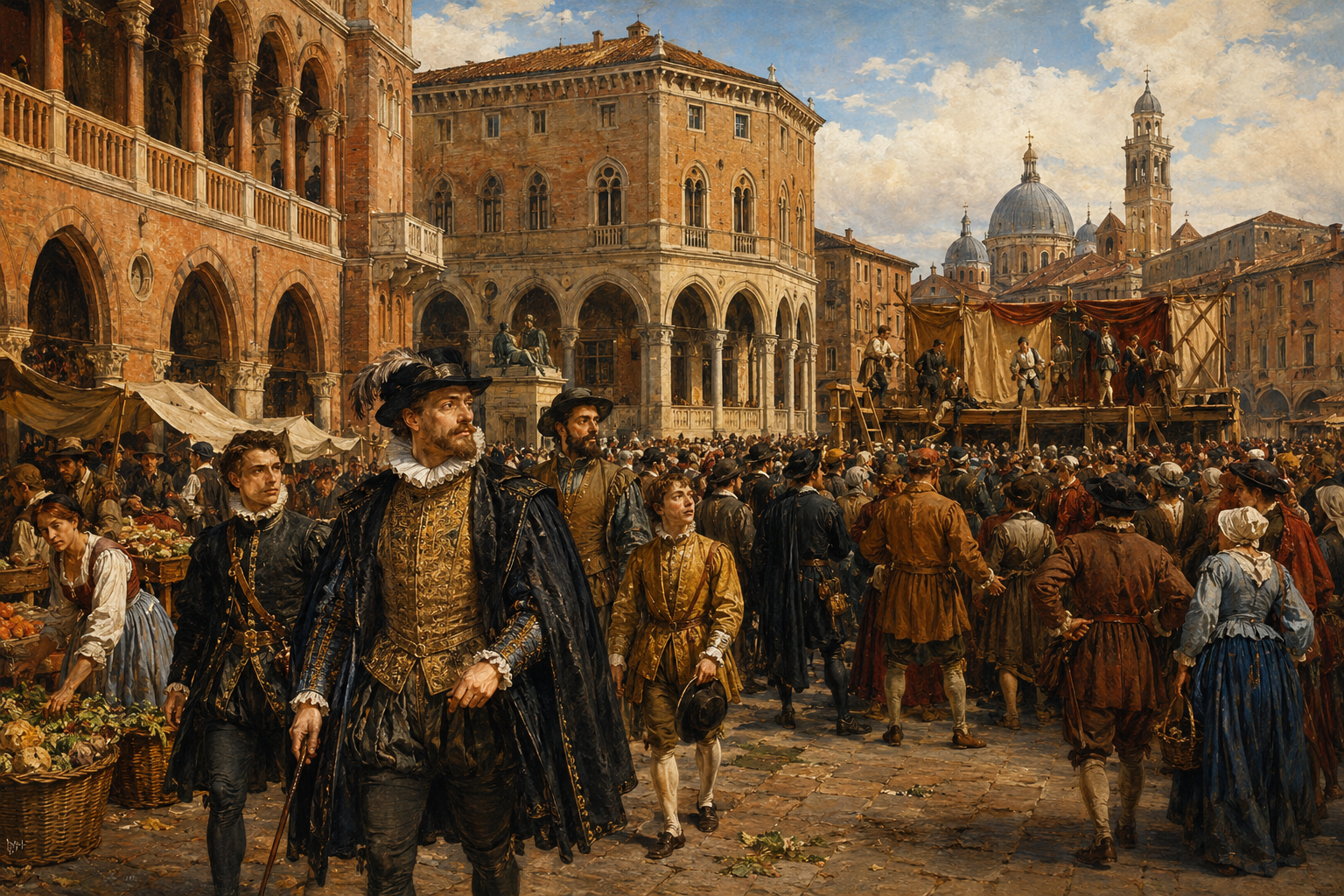
The Socio-Political Landscape of the 1590s
In Elizabethan England, women were legally subordinate to their fathers and, upon marriage, to their husbands—a legal status known as coverture. Under this doctrine, a woman’s legal rights were subsumed by those of her husband. An unmarried woman who displayed a fierce intellect, a quick temper, or a refusal to submit to male authority was labeled a “shrew” or a “scold.”
A “shrew” was considered a threat not just to domestic peace, but to the fabric of social order itself. Communities frequently resorted to public humiliation rituals to punish unruly women, such as the “cucking-stool” (dunking chairs) or the “scold’s bridle” (a metal mask designed to lock the tongue in place). Thus, when Shakespeare’s audience watched a comedy about “taming” a headstrong woman, they were watching a literal, everyday social anxiety played out on stage as a comedic farce. Padua, the Italian setting chosen by Shakespeare, was renowned throughout Europe as a progressive wealthy university town, making it the perfect ironic backdrop for a play obsessed with education, social conditioning, and behavioral modification.
The Framing Device: Christopher Sly and the Induction
One of the most frequently misunderstood aspects of the play is its structure. Many film adaptations and high school stage productions entirely omit the “Induction”—the two-scene framing device that opens the play. This omission is an academic mistake.
The play begins not with Kate or Petruchio, but with Christopher Sly, a drunk, belligerent tinker who is kicked out of an alehouse. A passing nobleman decides to play an elaborate practical joke on the unconscious Sly. He takes him to his manor, dresses him in luxury, places him in a lavish bed, and convinces him upon waking that he is actually a wealthy lord who has suffered from temporary insanity for fifteen years. To entertain this “lord,” a traveling troupe of actors performs a play. That play-within-a-play is The Taming of the Shrew.
By framing the story of Kate and Petruchio as an illusion performed for a delusional, lower-class drunkard, Shakespeare inserts an immediate layer of theatrical skepticism. The Induction signals to the audience that what they are about to see is explicitly a performance—an artificial construction of reality. It asks us to question whether the “taming” of a wife is just as much of a fantasy or an absurd fiction as Christopher Sly’s sudden ascension to the aristocracy.
Character Directory: Who’s Who in Padua?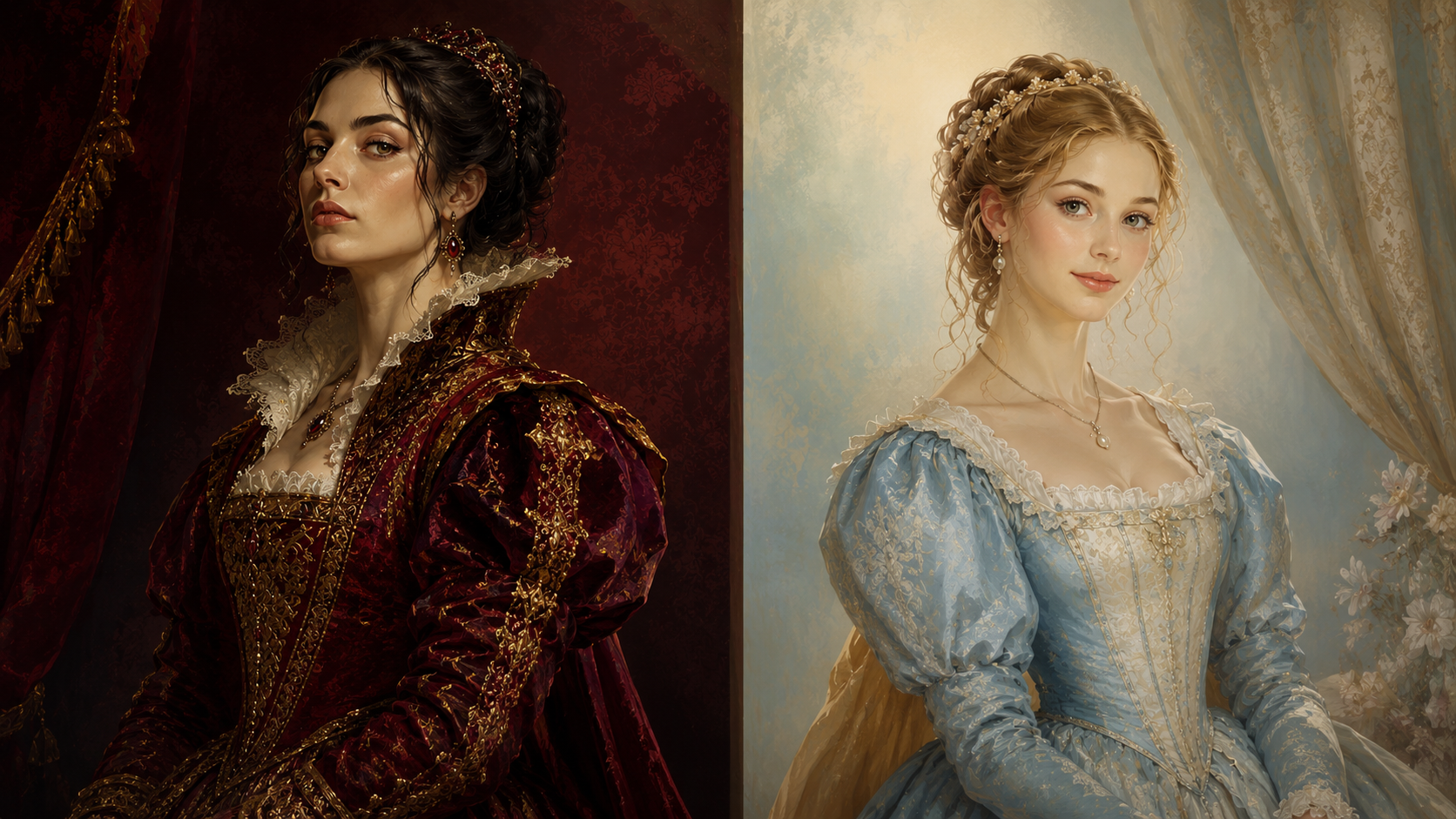
Before untangling the narrative, it is essential to map out the web of characters inhabiting Padua. Shakespeare splits his dramatis personae into two distinct camps: those involved in the psychological combat of the main plot, and those navigating the classical, romantic deception of the subplot.
The Primary Couple
-
Katherina (Kate) Minola: The titular “shrew.” Kate’s anger is not unprovoked; she is trapped in a world where her younger sister is universally adored and she is treated as a social liability. Her sharp tongue is her only weapon against a society trying to auction her off.
-
Petruchio: A man of fortune who arrives in Padua following his father’s death. Unlike the traditional romantic hero, Petruchio treats marriage as a tactical campaign. He recognizes in Kate a fierce intellect that matches his own, and he approaches her not with fear, but with an eccentric, calculated confidence.
The Subplot Players
-
Bianca Minola: The antithesis of her sister, Bianca plays the role of the ideal Elizabethan woman perfectly. However, as the play progresses, Shakespeare reveals that Bianca’s sweetness may be a calculated performance designed to navigate patriarchal rules far more comfortably than Kate’s overt rebellion.
-
Lucentio (and his servant Tranio): The epitome of courtly love, Lucentio abandons his academic studies the moment he spots Bianca. He switches clothes with his servant, Tranio, entering the Minola household disguised as a Latin tutor named “Cambio,” while Tranio masquerades as Lucentio to negotiate with Baptista.
Act-by-Act Taming of the Shrew Plot Summary
Act 1: The Ultimatum and the Disguises
The narrative proper opens in a street in Padua. Lucentio, a wealthy young student, arrives with his servants Tranio and Biondello, eager to study philosophy. His academic ambitions are instantly derailed when he witnesses a public family dispute. Baptista Minola, one of the wealthiest men in Padua, is being hounded by two suitors, the elderly Gremio and the younger Hortensio, who both desperately wish to marry his beautiful, gentle younger daughter, Bianca.
Frustrated by the ongoing chaos, Baptista hands down a strict ultimatum: no one will be permitted to court Bianca until her elder, tempestuous sister, Katherina, is securely married. Kate, who is present, reacts with characteristic fury, insulting the suitors and mocking her father’s blatant favoritism. Gremio and Hortensio realize that if they ever want to access Bianca, they must put aside their rivalry and work together to find someone—anyone—willing to marry the terrifying Kate.
                  [ Baptista Minola's Ultimatum ]
                                 |
         +-----------------------+-----------------------+
         |                                               |
[ Katherina (Elder Daughter) ]                  [ Bianca (Younger Daughter) ]
   * Must be married first.                        * Forbidden to marry until Kate is wed.
   * Viewed as a "shrew."                          * Pursued by multiple suitors.
         |                                               |
         v                                               v
[ Petruchio arrives to court her ]             [ Suitors disguise themselves to woo her ]
Seeing an opportunity, Lucentio plots a deception. Having fallen instantly in love with Bianca, he decides to disguise himself as a humble schoolmaster named Cambio so he can infiltrate the Minola household and tutor Bianca in secret. To maintain his social standing and continue negotiations with Baptista, Lucentio commands his clever servant, Tranio, to dress in his aristocratic clothes and masquerade as the true Lucentio. Shortly thereafter, Petruchio arrives from Verona with his cynical servant, Grumio. Petruchio openly declares his singular goal: “I come to wive it wealthily in Padua; / If wealthily, then happily in Padua.”
Hortensio, an old friend of Petruchio, jokingly tells him about Katherina’s immense dowry and equally immense temper. Undeterred, and rather intrigued by the challenge, Petruchio demands an introduction. Hortensio decides to jump on the disguise bandwagon, transforming himself into a music tutor named “Licio” to gain access to Bianca, while Petruchio agrees to present him to Baptista.
Act 2: Petruchio Arrives and the Verbal Sparring Match
Act 2 moves inside the Minola home, where the domestic reality of the sisters’ relationship is laid bare. Kate has bound Bianca’s hands, aggressively interrogating her sister to find out which of her suitors she truly prefers. When Bianca offers to give up any of them to please her sister, Kate strikes her, furious at Bianca’s performative victimhood. Baptista intervenes, weeping over Bianca’s plight and scolding Kate for her malicious behavior.
The house is soon flooded with guests. Petruchio introduces himself to Baptista, presenting Hortensio (disguised as Licio, the music teacher). Tranio (disguised as Lucentio) and Lucentio (disguised as Cambio, the language tutor) also arrive, offering their services. Petruchio gets straight to business, negotiating Kate’s dowry with Baptista: twenty thousand crowns immediately, and half of Baptista’s lands upon his death. Baptista agrees, on one critical condition—Petruchio must win Kate’s love.
While the tutors head off to teach, Hortensio rushes back in, holding a broken lute. He reveals that when he attempted to correct Kate’s hand placement on the instrument, she broke the lute over his head. Intrigued rather than terrified, Petruchio exclaims, “I love her ten times more than e’er I did: / Oh, how I long to have some chat with her!”
What follows is one of the most celebrated and analyzed dialogues in theatrical history—the first meeting between Kate and Petruchio. It is a rapid-fire, stylized battle of stichomythia (alternating lines of verse), packed with sexual innuendo, animal metaphors, and linguistic puns:
Petruchio: Good morrow, Kate; for that’s your name, I hear. Katherina: Well have you heard, but something hard of hearing: They call me Katharine that do talk of me. Petruchio: You lie, in faith; for you are call’d plain Kate, And bonny Kate and sometimes Kate the curst…
Kate responds to his presence with physical and verbal violence, even striking him across the face. Petruchio warns her that if she strikes him again, he will return the blow, but he shifts his strategy to psychological mirror-imaging. Every time she rages, he tells her she sings as sweetly as a nightingale; if she frowns, he praises her piercing clarity. When Baptista returns to check on their progress, Petruchio boldly claims that their meeting was a spectacular success. He asserts that while they are wildly affectionate in private, they have agreed that Kate will continue to pretend to hate him in public. Despite Kate’s loud protests, Petruchio commands: “I will be married to-morrow Sunday.” He leaves for Venice to buy wedding clothes, leaving Kate stunned and outmaneuvered.
Act 3: The Disastrous Wedding
Act 3 splits its focus between the escalating deceptions of the subplot and the escalating absurdity of the main plot. At the Minola residence, Lucentio (Cambio) and Hortensio (Licio) attempt to teach Bianca. Under the guise of translating Latin poetry by Ovid, Lucentio reveals his true identity and his romantic intentions to Bianca. Bianca responds cautiously but favorably, writing her own message of interest between the lines. Hortensio tries a similar tactic using musical scales, but Bianca flatly rejects his advances.
Sunday arrives—the day of the grand wedding—and the Minola household is thrown into a panic. The guests are gathered, the feast is prepared, but Petruchio is nowhere to be found. Kate is humiliated, weeping openly as she realizes she has been set up to look like a fool before all of Padua.
When Petruchio finally appears, the situation turns from stressful to bizarre. He arrives dressed in ridiculous, filthy, mismatched clothes, riding a diseased, limping horse, accompanied by Grumio in similarly wretched attire. Baptista and the guests are horrified, offering him clean garments, but Petruchio refuses, stating, “To me she’s married, not unto my clothes.”
The wedding takes place offstage, but the audience receives a vivid description from Gremio, who watched the ceremony in absolute disbelief. Petruchio behaved like a madman: he swore loudly at the altar, struck the priest for dropping the Bible, and drank the sacramental wine before throwing the dregs into the sexton’s face.
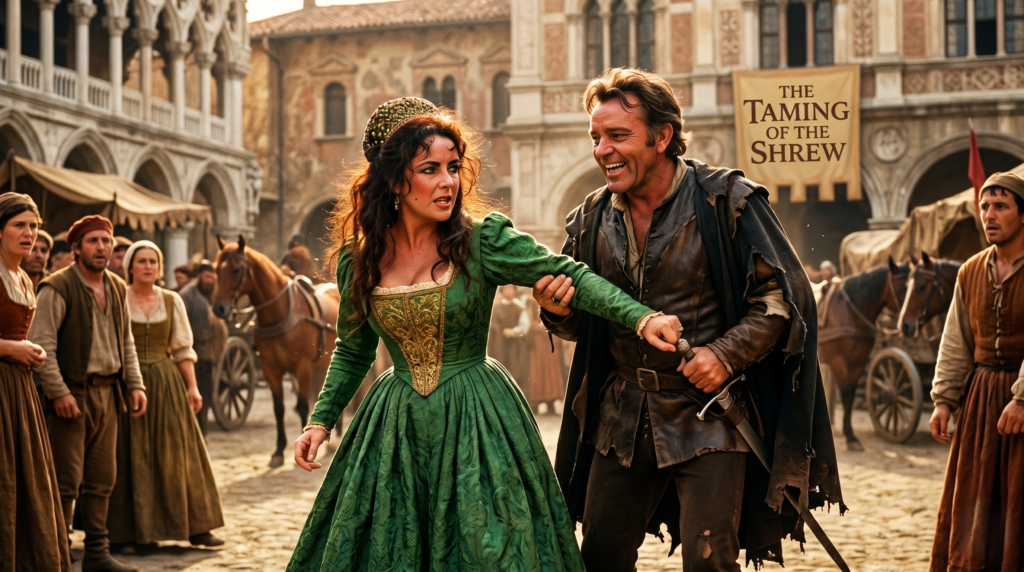
Upon returning to the house for the wedding feast, Petruchio drops his final bombshell. He announces that he and Kate must leave for Verona immediately, refusing to let her stay for her own celebration. When Kate rebels, commanding her father and friends to proceed with the banquet without her, Petruchio draws his sword, claiming her as his legal property:
“I will be master of what is mine own: / She is my goods, my chattels; she is my house, / My household stuff, my field, my barn, / My horse, my ox, my ass, my any thing…”
He forces a furious, weeping Kate out of the house, leaving the remaining guests to finish the feast in stunned silence.
Act 4: The Taming School at Verona
Act 4 shifts the setting to Petruchio’s country house in Verona, a cold, isolated environment far removed from Kate’s familiar support systems. Grumio arrives first, freezing and exhausted, describing to the other servants the disastrous journey home: Kate’s horse fell in the mud, pinning her beneath it, and Petruchio left her there to beat Grumio for letting the horse stumble.
When Petruchio and Kate arrive, the true “taming” process begins. Petruchio acts with erratic, volatile rage, but notably, his anger is never directed at Kate; instead, it is directed at his servants on her behalf. When dinner is served, Petruchio declares the meat is burnt and overcooked—claiming that eating it would induce choler (anger) in both of them. He throws the food across the room, leaving a starving Kate with nothing to eat. When she goes to bed, he tears the sheets off the mattress, arguing that they are not clean or soft enough for his bride.
In a famous soliloquy at the end of Act 4, Scene 1, Petruchio reveals his methodology to the audience, explicitly using the language of falconry:
“My falcon now is sharp and passing empty; / And till she stoop she must not be full-gorged… / She ate no meat to-day, nor none shall eat; / Last night she slept not, nor more shall she not…”
He calls this strategy “killing a wife with kindness”—by acting out an exaggerated version of her own volatile nature and pretending it is out of pure love for her, he deprives her of food, sleep, and comfort while leaving her with no logical ground to argue against him.
Back in Padua, the romantic subplots untangle quickly. Hortensio, observing Bianca flirting happily with the lowly tutor Cambio, gives up his pursuit in disgust, vowing to marry a wealthy widow instead. Meanwhile, Tranio (still pretending to be Lucentio) tricks a passing pedant (a traveling schoolmaster) into pretending to be Lucentio’s father, Vincentio, to formalize the marriage contracts with Baptista.
Back in Verona, Petruchio continues his psychological warfare using a tailor and a haberdasher. He orders a beautiful cap and gown for Kate so they can return to Padua for Bianca’s wedding. However, when the clothes arrive, Petruchio tears them to pieces, declaring them ugly and misshapen, despite Kate’s desperate pleas that the cap is fashionable and exactly what she wants.
The ultimate turning point occurs on the road back to Padua. Petruchio looks up at the bright daytime sky and remarks on how beautifully the moon is shining. When Kate corrects him, pointing out that it is clearly the sun, Petruchio stops the entire entourage, threatening to turn back to Verona unless she agrees with him. Exhausted, starving, and realizing that compliance is her only path to freedom, Kate finally surrenders. Prompted by Hortensio, she declares:
“And be it moon, or sun, or what you please: / And if you please to call it a rush-candle, / Henceforth I vow it shall be so for me.”
Immediately testing her compliance, Petruchio points to an old traveler on the road (who happens to be the real Vincentio, Lucentio’s father) and commands Kate to embrace him as if he were a young, beautiful virgin maiden. Kate complies without hesitation, changing her tune instantly when Petruchio corrects her and notes that Vincentio is an old man. Kate apologizes, blaming her temporary blindness on the sun.
Act 5: The Final Banquet and the Infamous Speech
Act 5 brings all the characters back to Padua for a final, chaotic convergence. The real Vincentio arrives at Lucentio’s house only to find the disguised Pedant claiming to be him, and Tranio wearing his son’s expensive clothes. Just as the real Vincentio is about to be dragged off to jail for fraud, the true Lucentio returns from a secret chapel wedding with Bianca. Lucentio kneels before his father, confesses the entire plot, and begs for forgiveness. Baptista and Vincentio, realizing their children are happily married and that the financial arrangements can still be salvaged, forgive the young couple.
The play concludes with a grand celebratory banquet hosted by Lucentio. Three newly married couples sit at the table: Lucentio and Bianca, Hortensio and his wealthy Widow, and Petruchio and Kate. During the dinner, the men exchange insults, with the guests mocking Petruchio for having married a violent shrew.
Tired of the teasing, Petruchio proposes a high-stakes wager: each man will send for his wife, and the husband whose wife returns most obediently when called will win one hundred crowns. Lucentio, completely confident in Bianca’s sweet nature, sends a servant to fetch her. The servant returns with a message: Bianca is busy and cannot come. Hortensio sends for his Widow, who sends back word that she suspects he is playing a joke on her and tells him to come to her instead.
Finally, Petruchio commands Grumio: “Go to your mistress; say, I command her come to me.”
To the absolute shock of everyone present, Kate enters immediately, asking what her husband requires. Petruchio sends her back out to fetch the other two wives. When she returns, dragging a protesting Bianca and Widow with her, Petruchio commands Kate to throw her velvet cap on the ground, calling it unseemly. She does so without question.
Horrified by Kate’s sudden, robotic obedience, Bianca exclaims, “Fie! what a foolish duty call you this?” Petruchio then commands Kate to give the other independent wives a lecture on what they owe to their husbands.
What follows is Kate’s infamous 44-line final speech. She argues that a husband is a wife’s lord, king, governor, and keeper; that he endures painful labor at sea and on land while she sits safely at home; and that in return, he asks only for love, kind looks, and true obedience. She concludes the speech with a physical gesture of total submission:
“Then vail your stomachs, for it is no boot, / And place your hands below your husband’s foot: / In token of which duty, if he please, / My hand is ready; may it do him ease.”
Stunned by his complete victory, Petruchio cries, “Why, there’s a wench! Come on, and kiss me, Kate.” They exit the stage to head to bed, leaving the remaining guests whispering in disbelief at the absolute transformation they have just witnessed.
Key Themes and Literary Devices
Domestic Subjugation vs. Romantic Farce
At the heart of the play is a dark question: Is The Taming of the Shrew an account of domestic abuse, or is it a romantic farce about two social misfits finding a unique dynamic?
If read literally, Petruchio’s methods are indistinguishable from standard psychological torture techniques: sleep deprivation, starvation, isolation, and systemic reality-distortion (gaslighting). However, if read as an Elizabethan farce, Petruchio is a therapist using radical exposure therapy. He holds up a chaotic mirror to Kate’s own social performance, forcing her to realize that her constant rage is an ineffective way to handle an oppressive world.
Disguise, Deception, and Performance
The play is obsessed with the concept of theatricality. In the subplot, characters put on literal disguises (servants become masters, aristocrats become schoolmasters) to get what they want. In the main plot, characters wear behavioral disguises.
Bianca wears the disguise of the quiet, obedient, perfect submissive woman, but the moment she secures a husband in Act 5, she drops the act, refuses her husband’s commands, and reveals herself to be stubborn and independent. This raises a fascinating question about Kate: Is her final speech a sign of genuine psychological defeat, or has she simply learned how to wear the performance of obedience to secure a comfortable life and a powerful partnership with Petruchio?
Money and Marriage as a Business Transaction
While modern love stories prioritize romantic chemistry, Shakespeare makes it clear that in the world of Padua, marriage is primarily a financial mergers-and-acquisitions meeting. Baptista does not ask his daughters who they love; he openly auctions Bianca off to whichever suitor can guarantee the largest dower upon their death. Petruchio is entirely transparent about his desire for gold. By treating marriage as an explicit business transaction, Shakespeare satirizes the economic coldness of his society’s courtship practices.
The Big Controversy: How to Interpret Kate’s Final Speech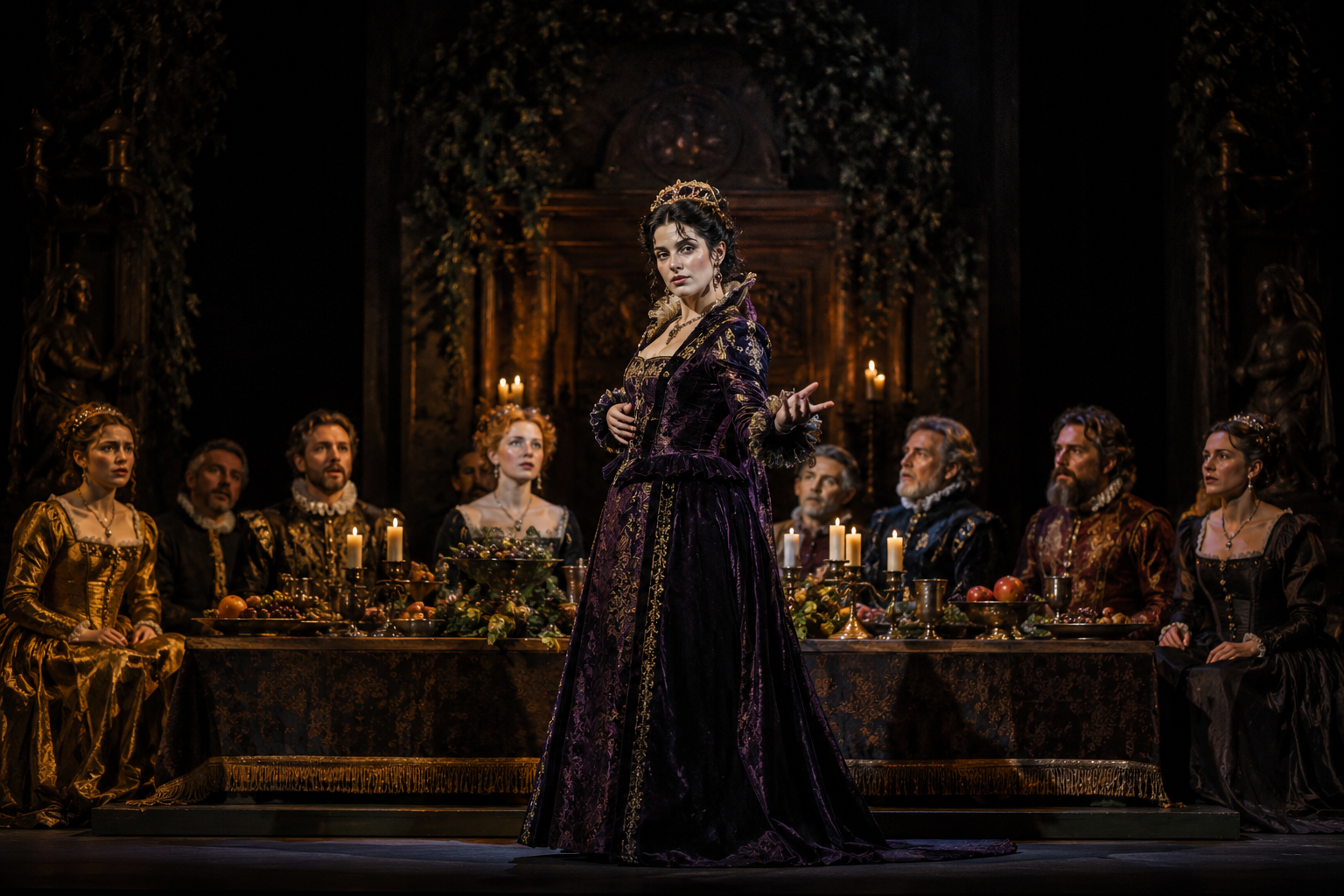
Kate’s final monologue remains one of the most heavily debated texts in all of English literature. Directors, actors, and academics generally split their interpretations into three distinct schools of thought:
              [ Interpretations of Kate's Final Speech ]
                                  |
      +---------------------------+---------------------------+
      |                           |                           |
[ 1. The Literal Reading ]   [ 2. The Irony / Satire ]   [ 3. The Secret Alliance ]
  * Kate is broken.            * Speech is sarcastic.      * Kate and Petruchio
  * Society's patriarchal     * Highlights patriarchal      dupe high society
    order is restored.           absurdity.                  to win the wager.
1. The Direct / Historical Reading
This perspective argues that the speech should be taken at face value. For an Elizabethan audience, this ending represented a deeply satisfying restoration of natural social order. A chaotic, disruptive element (the shrew) has been successfully brought into alignment with church and state doctrine. In this reading, Kate is genuinely broken, and her submission is real.
2. The Revisionist / Satirical Reading
Popularized heavily by 20th and 21st-century feminist criticism, this reading argues that Kate delivers the speech with blistering, dripping sarcasm. By exaggerating her submission to an absurd degree (offering to let him step on her hand), she exposes the ridiculous nature of male ego and patriarchal expectations. The speech becomes a public mockery of Petruchio’s victory rather than a celebration of it.
3. The Secret Alliance Reading
This nuanced theatrical reading suggests that through their shared journey, Kate and Petruchio have fallen in love and developed a mutual understanding. They both realize that the high-society world of Padua is full of fake, performative nonsense. In the final scene, they work together as business partners to scam the other husbands out of one hundred crowns. Kate delivers the performance Petruchio needs to win the bet, and in return, they secure their financial future and establish a private relationship built on mutual wit.
The Taming of the Shrew in Pop Culture and Adaptations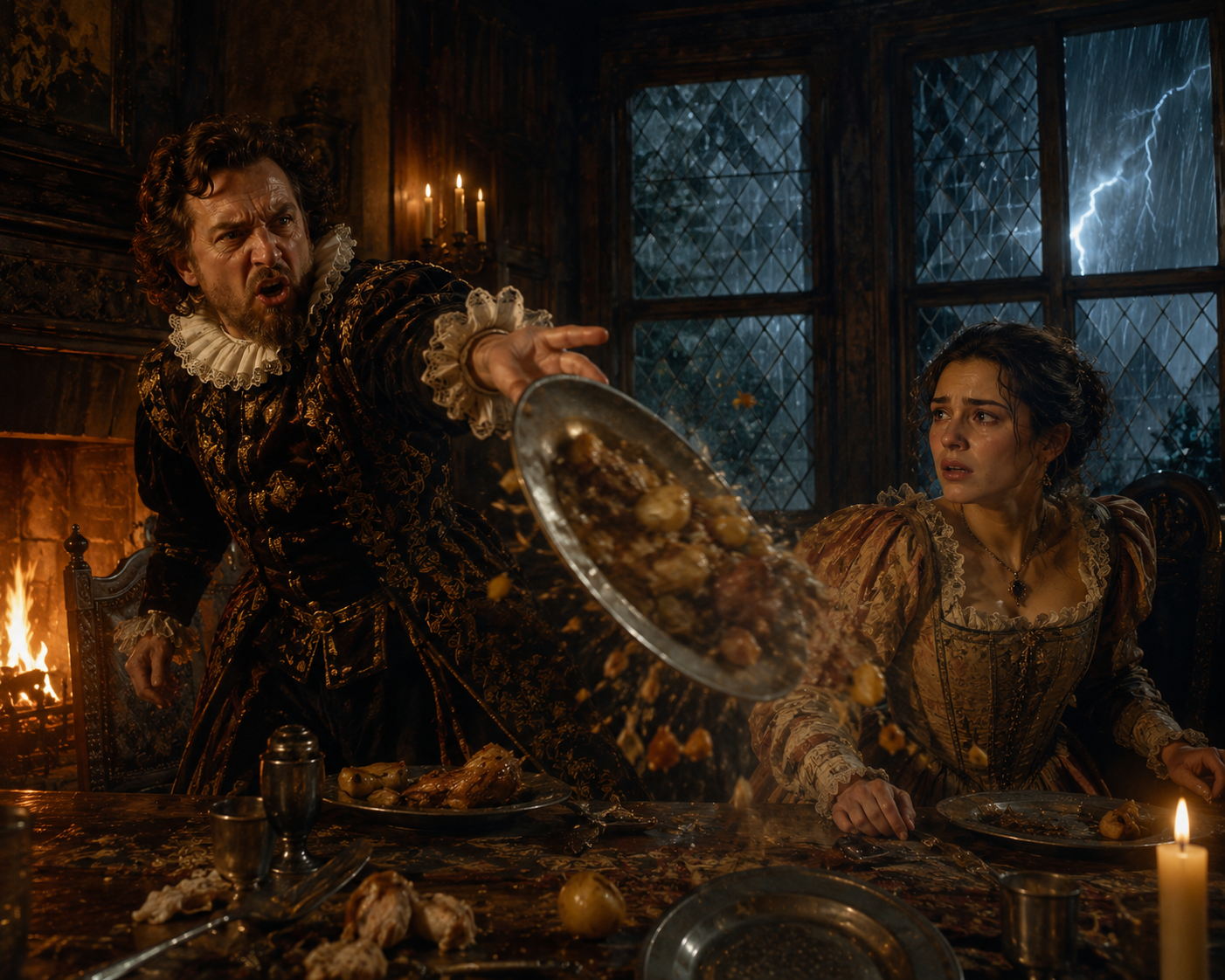
The play’s brilliant narrative pacing has allowed it to be adapted into various cultural formats, proving its structural longevity despite its controversial themes.
-
Cole Porter’s Kiss Me, Kate (1948): This classic Broadway musical employs a meta-theatrical structure mirroring Shakespeare’s Induction. It follows a divorced theatrical couple playing Kate and Petruchio in a musical production of the play, where their backstage fights bleed directly into the onstage performance.
-
10 Things I Hate About You (1999): This cult-classic teen comedy transposes the play to a modern American high school. Julia Stiles plays “Kat Stratford,” a fierce, feminist high schooler, while Heath Ledger plays “Patrick Verona,” a charismatic bad boy paid to take her out so Kat’s younger sister, Bianca, is allowed to date. The film brilliantly updates the “taming” aspect into a story of mutual acceptance and vulnerability.
-
BBC’s ShakespeaRe-Told (2005): A modern television retelling starring Shirley Henderson and Rufus Sewell. In this version, Katherine is an ambitious, short-tempered politician running for leadership who is told she must marry to improve her public image, leading to a highly dynamic, eccentric relationship with the unpredictable Petruchio.
Frequently Asked Questions
Is The Taming of the Shrew a comedy or a tragedy?
Structurally, it is an Elizabethan comedy. It features classical comedic tropes: farcical subplots, physical slapstick, mistaken identities, and it concludes with multiple marriages. However, due to its dark psychological themes regarding gender politics, modern scholars frequently classify it as one of Shakespeare’s “problem plays” or perform it with a tragic undertone.
What is the main message of The Taming of the Shrew?
While historically viewed as a lesson in social order and marital obedience, a modern analysis suggests the play comments on the performative nature of identity. It demonstrates how individuals must navigate, subvert, or perform within harsh societal expectations to survive.
Why does Petruchio want to marry Kate if she is so difficult?
Initially, Petruchio is driven entirely by money. He explicitly states that a massive dowry can compensate for any personality flaws. However, upon meeting her, he is clearly charmed and energized by her quick wit, viewing her not as an enemy to destroy, but as an intellectual equal worth challenging.
How does 10 Things I Hate About You relate to the play?
The film is a direct, modernized adaptation. The character arcs match precisely: Kat/Katherina, Patrick/Petruchio, and Bianca retain their core dynamics. The narrative constraint remains the same (the younger sister cannot date until the older sister does), and the characters’ last name, “Stratford,” is a direct homage to William Shakespeare’s birthplace, Stratford-upon-Avon.
The Play’s Enduring, Complicated Legacy
Ultimately, The Taming of the Shrew remains a vital piece of theatrical literature precisely because it refuses to offer easy answers. It forces every director, actor, and reader to make a definitive choice. Is it a historical document tracking the harsh realities of Elizabethan marriage, or is it a timeless satire exposing the performative nature of gender roles?
By examining the intricate framework of the Induction, the parallel deceptions of Padua’s suitors, and the psychological battlegrounds of Verona, we see a playwright operating at the height of his early comedic powers. Kate and Petruchio’s relationship may be uncomfortable to watch, but it remains one of the most electric, complex human pairings ever committed to parchment.