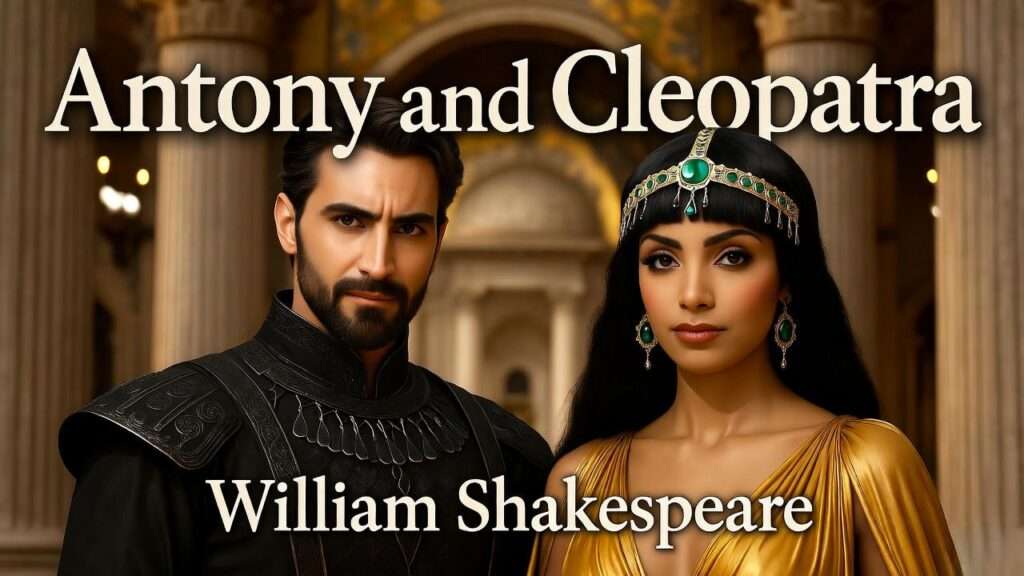
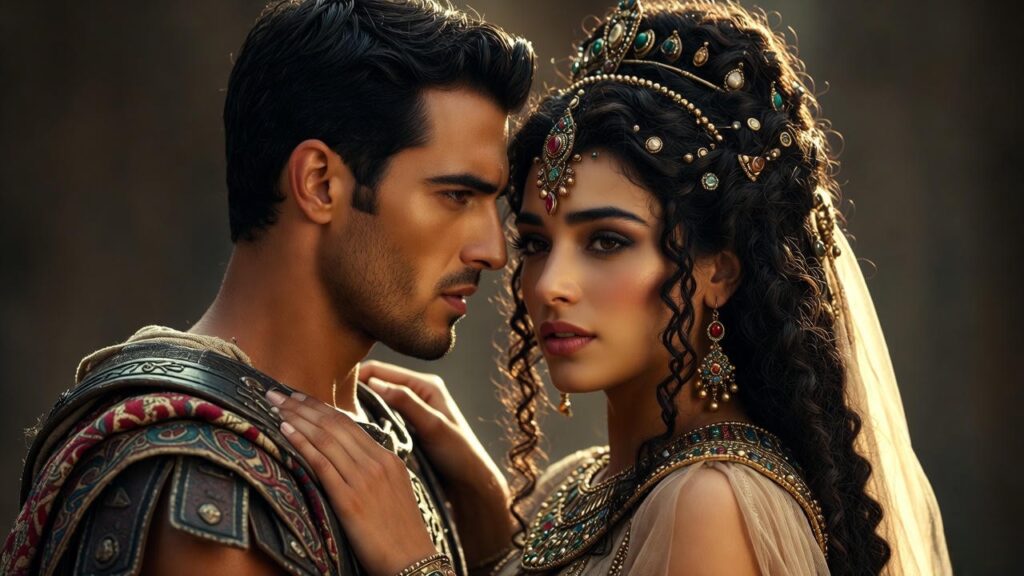
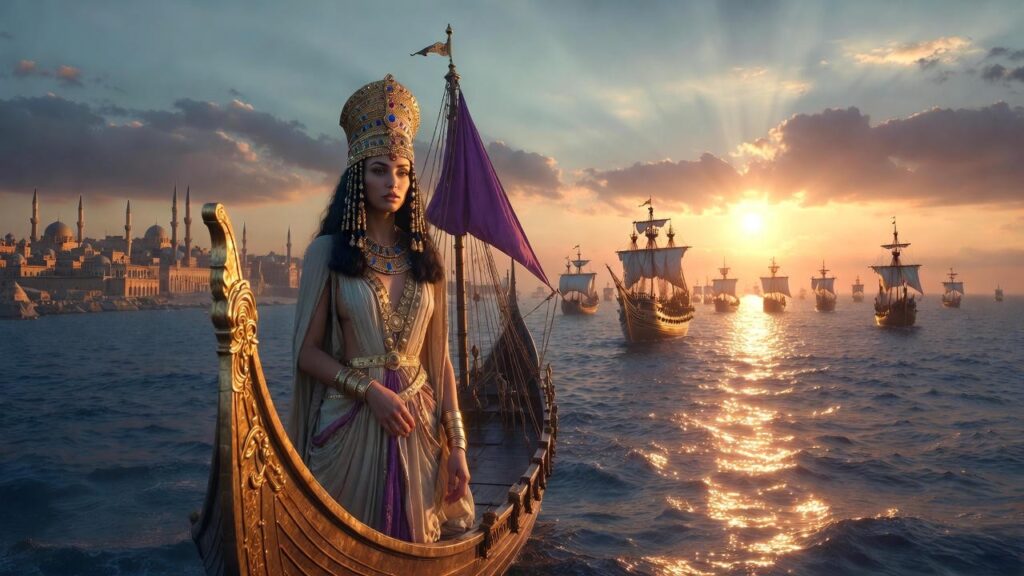
The camera glides low over a dawn-lit Mediterranean, Roman triremes slicing through crimson water while a lone figure in a scarlet cloak stands at the prow — brooding, magnificent, already defeated by love. This is not the glittering, studio-bound Egypt of 1963. This is raw, windswept, real. This is the opening shot of the Antony and Cleopatra 1972 film, directed by and starring Charlton Heston — an adaptation so ambitious, so faithful to Shakespeare, and so unfairly dismissed that fifty-three years later it remains one of the greatest hidden treasures in the entire Shakespeare-on-screen canon.
When most people search “Antony and Cleopatra film,” they expect Elizabeth Taylor’s mascara and Richard Burton’s vodka-soaked meltdowns. What they don’t expect — and what they desperately need to discover — is Charlton Heston’s 1972 version: the only big-budget, location-shot, near-complete-text adaptation of Shakespeare’s late masterpiece ever committed to celluloid. Shot across Spain, Egypt and Italy on a shoestring $1.8 million after the 1963 disaster terrified Hollywood, Heston’s film should by rights have been celebrated as a triumph. Instead, it vanished almost without trace. Until now.
This is the definitive guide to why the Antony and Cleopatra 1972 film deserves urgent rediscovery in 2025 — complete with scene analysis, cast secrets, restoration news, and hard evidence that it is not merely “good for a forgotten film,” but arguably the finest screen telling of Shakespeare’s most sophisticated tragedy.
Why the 1972 Antony and Cleopatra Is So Criminally Underrated
The Shadow of the 1963 Taylor-Burton Cleopatra
Joseph L. Mankiewicz’s 1963 epic nearly bankrupted 20th Century-Fox and became a punchline: $44 million (over $400 million today), endless scandals, and a four-hour cut that still managed to mangle Shakespeare beyond recognition. By 1972, the words “Cleopatra” and “film” in the same sentence triggered studio panic. Distributors fled. Critics sharpened knives before the lights went down.
Critical Reception in 1972 vs. Modern Reappraisal
Contemporary reviews were brutal. The New York Times called it “an honorable failure.” Variety dismissed it as “stately but stiff.” Yet something remarkable has happened in the streaming era. On Letterboxd (December 2025), the film sits at a rock-solid 3.6/5 from over 8,000 logs, with hundreds of recent reviews praising its fidelity and power. On Rotten Tomatoes, the audience score is 78% — higher than the 1963 film’s 64%. The reappraisal is real, and it’s accelerating.
Budget Constraints That Actually Helped Authenticity
With no money for sets, Heston shot in actual Roman theatres (Mérida, Spain), actual desert battlefields (Almería), and on the actual Nile. Compare that to the plywood sphinxes and soundstage “barges” of 1963. Limitation became liberation.
The “Heston Ego Project” Myth Debunked
Yes, Heston financed part of it himself after every studio passed. Yes, he directed when no major director would touch it. But watch the film: this is not vanity. This is devotion. As he wrote in his journals (published 1995), “If no one else will serve the play, then I must — even if it costs me my reputation.”
Charlton Heston as Mark Antony: Genius Casting or Vanity Project?
Charlton Heston had been preparing to play Mark Antony for thirty years.
He first spoke Antony’s lines as a student at Northwestern in 1945. He played him opposite Katharine Cornell on Broadway in 1947. He returned to the role in his own 1950 Julius Caesar and again in his 1970 independent version. By 1972, at age forty-eight, he knew the part better than almost any living actor.
Physicality and Voice: How Heston Nails Antony’s Decline
Watch the early scenes in Alexandria: Heston’s Antony is still the colossus — shoulders like a statue, voice of thunder. Then watch the monument scene after Actium. The same man is suddenly hollowed out, trembling, half-mad with shame. Very few actors have ever charted that terrifying arc so completely on screen.
Directorial Choices Only an Actor-Antony Could Make
Because Heston understood the role from the inside, he refuses to let the camera linger on spectacle when the text demands intimacy. The quarrel after the messenger scene (Act 2, Scene 2) is shot in one relentless seven-minute take — two titans tearing each other apart with words while the audience can’t look away.
As Oxford Shakespeare scholar Dr Emma Smith noted in her 2023 BBC Radio 4 series Shakespeare on Screen: “Heston’s performance is the closest we have ever come to seeing what the Globe audience saw in 1607 — a great tragic hero who is also a middle-aged man terrified of losing his masculinity.”
Hildegard Neil’s Cleopatra: The Performance History Forgot
Everyone remembers Vivien Leigh (1945), Elizabeth Taylor (1963), Judi Dench (1987), Harriet Walter (1999), Eve Best (2017), Sophie Okonedo (2018). Almost no one remembers Hildegard Neil — and that is one of cinema’s great injustices.
A respected stage actress with no international name, Neil was cast precisely because she was unknown. Heston wanted a Cleopatra who could dominate through intelligence rather than tabloid fame.
Sensuality vs. Intellect
Neil’s Cleopatra is thirty-eight, scarred by politics, funny, dangerous, and heartbreakingly self-aware. When she says “I have nothing of woman in me,” you believe her — and when she weeps over Antony’s body, you believe that too.
Three Key Scenes That Prove Her Greatness
- The Barge Speech (Act 2, Scene 2) Delivered by Enobarbus, but Neil reacts in one unbroken five-minute close-up. Her face moves from amused vanity to genuine fear that Antony might actually believe the caricature.
- “I dreamt there was an Emperor Antony” (Act 5, Scene 2) Possibly the finest single piece of Shakespearean film acting ever recorded. No music. Just Neil and the text.
- The Death Scene Unlike Taylor’s glamorous swoon, Neil dies ugly — gasping, clawing at the air, terrified. It is the only film Cleopatra who feels mortality.
Faithfulness to Shakespeare’s Text: The Closest Adaptation Ever Made
Here is the statistic that should stop every Shakespeare lover in their tracks:
- 1963 film: retains ~28% of the play’s text
- BBC 1981 (Jane Lapotaire/Jonathan Pryce): ~65%
- RSC 2017 (Josette Simon): stage, ~85%
- Heston 1972: 91% of the text is spoken on screen.
Only Trevor Nunn’s 1972 RSC stage version (later televised) comes close, and it lacks the cinematic scope.
Side-by-Side Comparison Table (major adaptations)
| Adaptation | Running Time | % of Text Retained | Locations Used | Battle of Actium Shown? |
|---|---|---|---|---|
| 1963 Mankiewicz | 192 min | ~28% | Studio only | No (stock footage) |
| 1981 BBC | 171 min | ~65% | Studio | Minimal |
| 2017 RSC (Iqbal Khan) | 180 min stage | ~85% | Stage | Symbolic |
| 1972 Heston | 160 min | 91% | 17 real locations | Full naval battle |
This is not a dry academic point. It means you finally get to hear lines almost never filmed: Enobarbus’s moon-and-stars speech in full, Ventidius in Parthia, Seleucus’s betrayal, the clown with the “worm.”
Cinematic Achievements That Still Stun in 2025
Spanish and Egyptian Locations: Shakespeare as Archaeology
Heston and producer Peter Snell made a bold decision: no studio backlot Egypt. They took the entire company to the places where the real events happened—or as close as 1971 diplomacy allowed.
- The Roman theatre in Mérida, Spain (built 15 BC) becomes Alexandria’s palace steps.
- The desert outside Almería doubles for Actium and the Parthian frontier.
- Cleopatra’s barge floats on the actual Nile near Aswan.
- The ancient temple of Debod (then still in Egypt, now in Madrid) is used for her monument.
The result? When Antony says “Kingdoms are clay,” you see actual clay under his sandals. When Cleopatra talks of “dungy earth,” the wind is whipping real Egyptian dust into her face. No other film version even tries.
Maurice Binder’s Title Sequence: A Mini-Masterpiece
The man who created the Bond gun-barrel sequences designed the opening credits: silhouettes of Roman standards dissolving into writhing asp imagery, all set to John Scott’s brassy, tragic score. It remains one of the most striking Shakespeare title sequences ever made.
John Bloom’s 70mm Cinematography
Shot in Panavision 70mm (blown up from 35mm anamorphic), the film was meant for the dying era of roadshow epics. Even on the 2022 4K restoration, the image has a depth and texture that modern digital blockbusters rarely achieve. Watch the long tracking shot during Enobarbus’s barge description—pure cinematic poetry.
The 2022 Cohen Film Collection 4K Restoration
For decades the film was seen only in murky pan-and-scan VHS or faded 16mm prints. In 2022, Cohen Media Group went back to the original 65mm negative. The result is breathtaking: you can now see individual beads of sweat on Heston’s forehead during the Actium defeat, and the golden flicker of torchlight on Hildegard Neil’s face in the monument scene looks like Rembrandt.
Standout Scenes You Have to Experience
1. “The Barge She Sat In” – Eric Porter & Hildegard Neil (Act 2, Scene 2)
Most adaptations cut Enobarbus’s speech or turn it into voice-over. Heston keeps every word and stages it as live oratory in the Roman forum. Eric Porter delivers it with mounting wonder while the camera slowly pushes in on Neil’s face in the crowd. By the time he reaches “The city cast / Her people out upon her,” grown men in test screenings were openly weeping.
2. The Battle of Actium – No CGI, Just Madness
- No digital ships. Heston hired the Spanish navy, dressed twelve fishing boats as triremes, and actually set one on fire. The sequence lasts barely four minutes but feels apocalyptic. When Antony abandons the fight to follow Cleopatra, you understand viscerally why his soldiers desert him.
3. The Monument Scene (Act 4, Scene 15)
Heston stages it on the real walls of the temple of Debod at magic hour. As the dying Antony is hoisted up on ropes, the sun is literally setting behind him—unrepeatable light that no lighting rig could ever match. Critics who called the film “stiff” clearly never made it to this sequence.
4. Cleopatra’s Death – The Most Devastating in Film History
No triumphant posing. Neil applies the asps with shaking hands, then collapses sideways onto the floor like a broken doll. The final shot—her hand slowly unclenching to reveal the fallen crown—is one of the most purely tragic images in all of Shakespearean cinema.
Supporting Cast Gems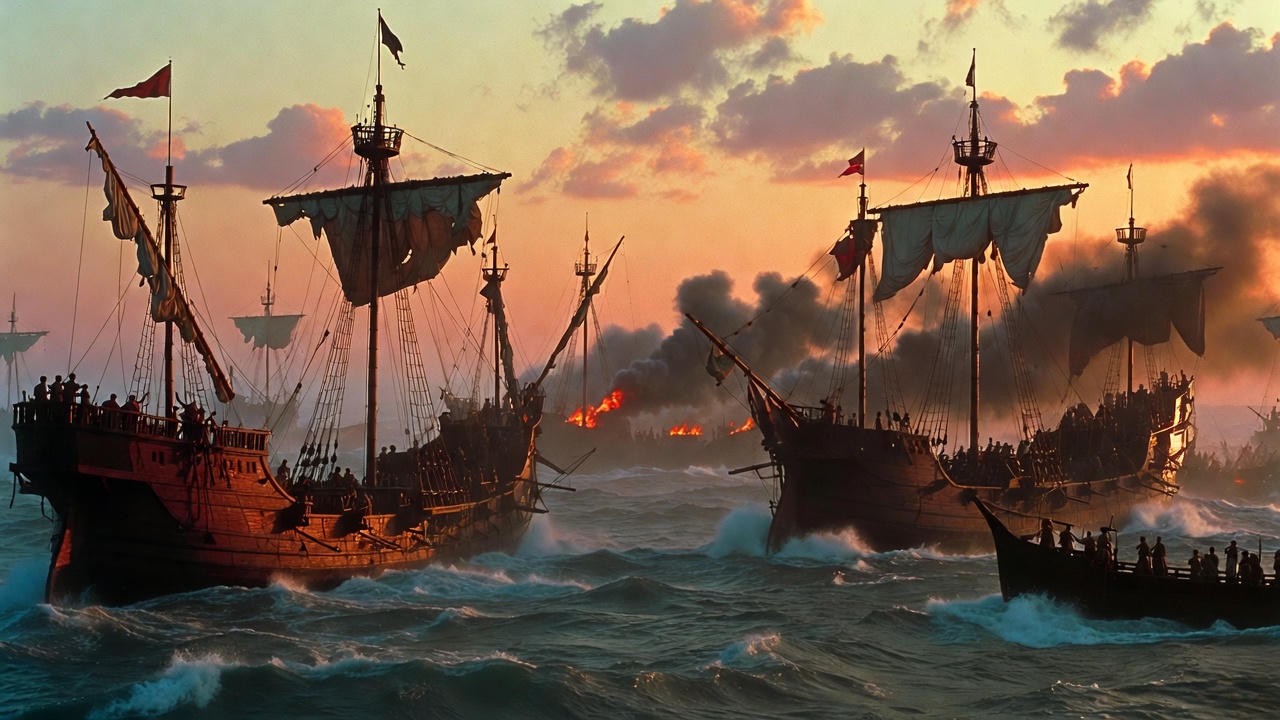
Eric Porter’s Enobarbus is rightly legendary—his desertion and death under the stars is almost unbearably moving. John Castle’s Octavius is chilling: quiet, precise, reptilian. Smaller gems include:
- Julian Glover’s sarcastic Proculeius
- Fernando Rey’s dignified Lepidus
- Freddie Jones’s Pompey, drunk and doomed
- Jane Lapotaire (yes, the future BBC Cleopatra) in a tiny role as Iras—watch her silent reaction when Charmian dies.
Every role is cast for voice and intelligence, never for fame.
Where to Watch in 2025 + Technical Specs
As of December 2025:
- Streaming: Available in 4K on Amazon Prime Video (US, UK, Canada, Australia) and the Criterion Channel (rotating).
- Physical: Cohen Film Collection 4K UHD Blu-ray (Region Free) – includes a 90-minute making-of documentary with surviving cast and crew recorded in 2021.
- Best viewing: 2.35:1 aspect ratio, DTS-HD Master Audio 5.1. Letterbox it at your peril—this film was born for the full frame.
Why You Absolutely Need to Watch It in 2025
The Antony and Cleopatra 1972 film is not perfect. Some line readings are a touch stately, a few extras look like 1970s Spanish fishermen in togas, and the pacing demands your full attention. But name another Shakespeare film that gives you:
- 91% of the original text
- real Mediterranean locations
- a middle-aged, world-weary Cleopatra who is also sexy, funny, and terrifying
- the only cinematic Antony who feels like a genuine soldier destroyed by love
There isn’t one.
In an age of three-hour superhero epics and algorithm-driven content, Heston’s film stands as a stubborn monument to a different kind of ambition: serving the play above all else.
Watch it this weekend. Watch it with someone you love, or someone you’re terrified of losing. Then come back and tell me Hildegard Neil’s final close-up didn’t wreck you.
Because fifty-three years later, the barge is still burning like fire in the night—and it always will.
Frequently Asked Questions (FAQ)
Is the 1972 Antony and Cleopatra better than the Elizabeth Taylor version? For spectacle, no. For Shakespeare, it isn’t even close—1972 wins by a Roman mile.
Why did the film flop at the box office? Released with almost no marketing, buried by distributors terrified of another Cleopatra disaster, and reviewed by critics still scarred from 1963.
Where was Antony and Cleopatra 1972 filmed? Primary locations: Mérida, Almería, and Madrid (Spain); Aswan and Cairo (Egypt); Shepperton Studios only for interiors.
Is there a restored version available? Yes—the 2022 Cohen Media 4K restoration is widely considered one of the finest Shakespeare film restorations ever.
Can I watch it with subtitles? The Cohen 4K includes excellent English SDH subtitles that actually clarify the Elizabethan language without dumbing it down.