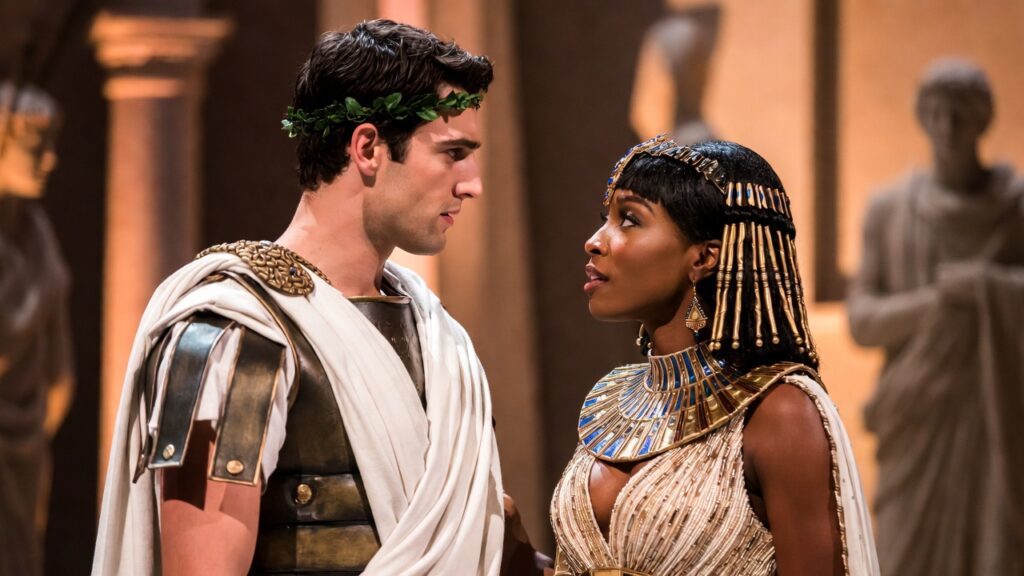
Imagine being mere feet away from history’s most legendary lovers as they tease, rage, reconcile, and ultimately destroy each other—close enough to catch every smirk, every lingering touch, every whispered betrayal. In William Shakespeare’s Antony and Cleopatra, the volatile romance between the Roman general Mark Antony and the Egyptian queen Cleopatra has captivated audiences for centuries, blending grand politics, intoxicating passion, and tragic downfall. Yet few stagings make this epic feel so immediate and human as the Folger Theatre’s 2017 production did. Directed by Robert Richmond from October 10 to November 19, 2017, at the Folger Shakespeare Library in Washington, D.C., this Antony and Cleopatra Folger Theatre rendition transformed the play by stripping away distance—literally and figuratively—through an innovative in-the-round staging that placed audiences in the heart of the lovers’ world.
Featuring powerhouse performances by Shirine Babb as Cleopatra and Cody Nickell as Mark Antony, the production prioritized the couple’s destructive obsession over sprawling spectacle. Critics hailed it as electrifying, sumptuous, and intimately revealing, with Babb’s layered portrayal earning praise as “queenly, coy, and ferocious by turns” (DC Theater Arts) and the overall experience described as a “beautifully detailed” sensory indulgence (various reviews). For Shakespeare enthusiasts, theater lovers, students analyzing the text, or anyone drawn to tales of power, love, and empire, this production offered fresh insights into why Antony and Cleopatra remains one of the Bard’s most challenging yet rewarding tragedies. This article dives deep into what made the 2017 Folger staging stand out, exploring its innovative design, standout acting, directorial vision, critical reception, and enduring relevance—providing a comprehensive guide far beyond typical summaries.
Overview of Shakespeare’s Antony and Cleopatra: The Epic Tragedy
Shakespeare’s Antony and Cleopatra (written around 1606–1607) stands as one of his late tragedies, drawing from Plutarch’s Lives to chronicle the real historical figures whose relationship reshaped the ancient world. The play follows Mark Antony, a member of Rome’s Second Triumvirate alongside Octavius Caesar and Lepidus, as he becomes entangled in a passionate affair with Cleopatra, Queen of Egypt. Torn between Roman duty and Egyptian indulgence, Antony’s choices lead to military defeats, personal betrayals, and mutual suicides that pave the way for Octavius’s rise as Augustus, the first Roman emperor.
At its core, the tragedy pits private passion against public responsibility, Eastern sensuality against Western discipline, and individual desire against imperial order. Unlike more straightforward tragedies like Hamlet or Othello, Antony and Cleopatra sprawls across dozens of short scenes, shifting rapidly between Rome, Egypt, and battlefields. This structure mirrors the lovers’ chaotic lives—moments of ecstasy interrupted by politics, jealousy, and war. Shakespeare infuses the text with magnificent poetry, from Enobarbus’s famous description of Cleopatra’s barge (“The barge she sat in, like a burnish’d throne”) to Cleopatra’s final, defiant act of self-mythologizing.
Staging challenges abound: the large cast, tonal swings from comedy to tragedy, and the need to convey vast geopolitical stakes without overwhelming spectacle. Many productions opt for lavish sets or cinematic battles, but the Folger’s 2017 approach succeeded by embracing restraint and proximity, making the play’s emotional core feel urgent and personal.
Transforming the Folger Stage: The Innovative In-the-Round Staging
One of the production’s boldest decisions was converting the Folger’s Elizabethan-style theater—typically a thrust or proscenium space—into an in-the-round configuration. This was only the second time in recent memory the Folger had done so (following a haunting Richard III), requiring the removal of traditional seating and a complete rebuild of the stage area. The result? An intimate arena seating around six rows deep, with some audience members even utilizing the balcony for additional views, creating a closer, more electric connection between performers and spectators.
Director Robert Richmond’s vision emphasized this intimacy to heighten the play’s voyeuristic quality. Private boudoir scenes in Egypt felt exposed and public, while Roman political debates gained a claustrophobic, personal edge. As Richmond noted in interviews, the setup allowed overlapping action—Egyptian characters lingering onstage during Roman scenes—to illustrate how Cleopatra’s presence haunted Antony’s mind even across the Mediterranean.
Scenic designer Tony Cisek crafted a revolving circular stage with symbolic elements: a striking pyramid motif overhead representing Egypt’s allure and mystery, contrasted by a Roman shield below evoking martial duty. The constant rotation shifted perspectives, mirroring the flux of alliances and emotions. Lighting designer Andrew F. Griffin bathed scenes in warm, ethereal glows for Egyptian indulgence and stark, dim tones for Roman austerity. Costumes by Mariah Hale amplified the contrast—glamorous, glittering gowns and sensual fabrics for Cleopatra and her court versus restrained, leather-accented Roman attire (including Antony’s tight pants and playful eye shadow, giving him a rock-star edge).
This design not only solved logistical challenges but redefined the play’s scale: instead of epic distance, audiences experienced the lovers’ volatility up close, turning Shakespeare’s dense text into an accessible, sensory experience.
Standout Performances – Bringing the Legendary Lovers to Life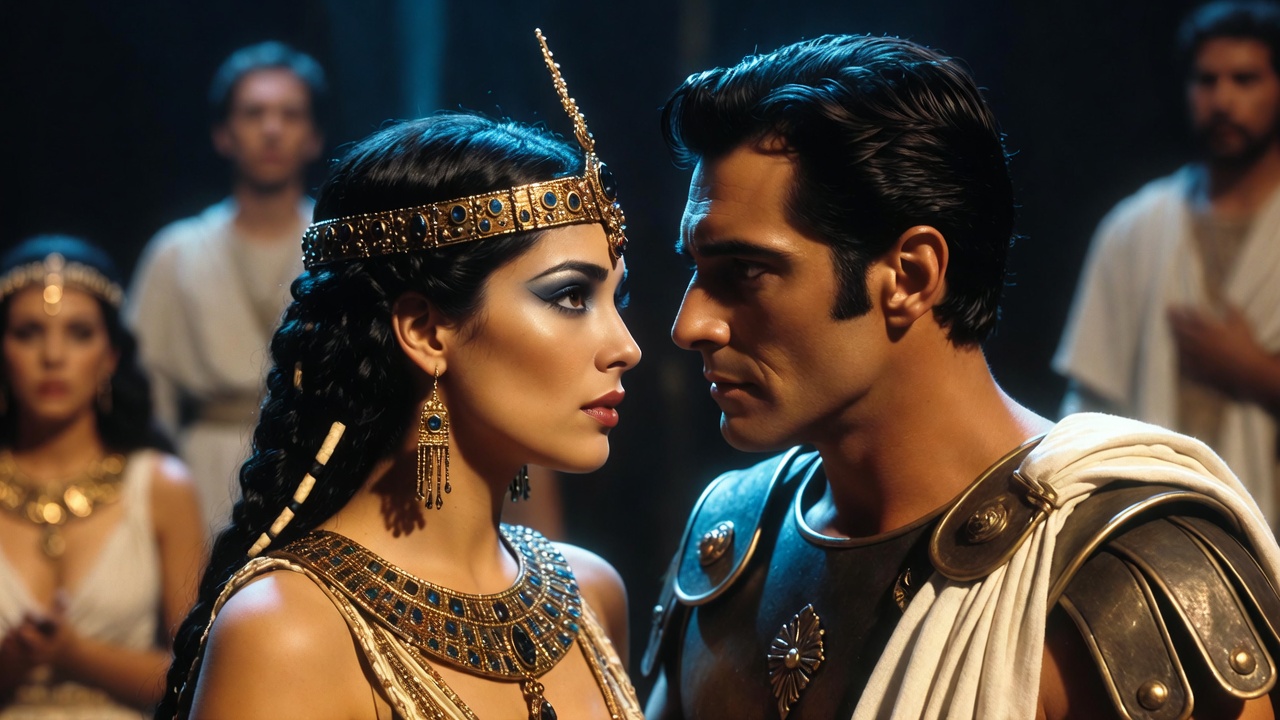
The heart of any successful Antony and Cleopatra lies in the chemistry between its title characters. Shakespeare demands actors who can navigate extreme emotional registers—playful seduction one moment, volcanic rage the next, profound grief, and finally a transcendent dignity in death. The Folger’s 2017 cast delivered exactly that, with Shirine Babb and Cody Nickell forming one of the most compelling central pairings in recent memory.
Shirine Babb as Cleopatra: Queenly, Coy, and Ferociously Human
Shirine Babb was not new to the role; this marked her third time portraying Cleopatra, giving her a deep, lived-in understanding of the character’s contradictions. Shakespeare presents Cleopatra as both an irresistible enchantress and a shrewd political operator, capable of genuine love yet also manipulative calculation. Babb refused easy caricature. Instead, she offered a Cleopatra who was regal yet vulnerable, commanding yet needy, playful yet dangerous.
In the intimate in-the-round space, Babb’s every micro-expression landed with impact. When she teased Antony about his “Roman” stiffness or playfully mocked his attempts at duty, the audience could see the flicker of genuine affection beneath the gamesmanship. Her physicality was equally telling: languid, sensual movements in Egypt contrasted with sharp, decisive gestures when asserting her power. Costumed in shimmering, flowing gowns that caught the light like liquid gold, Babb embodied the opulence and mystery of the Nile queen.
Critics were unanimous in their admiration. DC Theater Arts described her as “queenly, coy, and ferocious by turns,” while Metro Weekly praised her “magnificent” presence in glittering attire. What set Babb apart was her refusal to sanitize Cleopatra’s flaws—she allowed the queen’s jealousy, insecurity, and occasional cruelty to coexist with her charisma, making the character feel achingly human rather than mythic. In the final scenes, as Cleopatra prepares for death, Babb’s performance achieved a quiet grandeur: no histrionics, just a woman choosing how she will be remembered.
Cody Nickell as Mark Antony: The Headstrong Roman Torn by Passion
Opposite Babb stood Cody Nickell as Mark Antony, a performance that captured the Roman general’s tragic arc with equal nuance. Antony begins the play as a celebrated warrior, one of the three most powerful men in the world. By the end, he is a man undone by love, military miscalculation, and self-disgust. Nickell traced this descent with precision and emotional honesty.
Physically imposing and charismatic, Nickell initially exuded the easy confidence of a man accustomed to command. Yet even in the early Egyptian scenes, subtle cracks appeared—restless glances toward Rome, a momentary tightening of the jaw when duty was mentioned. As the play progressed, Nickell allowed Antony’s internal war to become visible: the hedonistic abandon of late-night revels giving way to despair after Actium, the explosive rage when he believes Cleopatra has betrayed him, and the devastating tenderness of their final reunion.
The in-the-round staging amplified Nickell’s work. When Antony delivered soliloquies or raged at messengers, the audience surrounded him, witnessing every bead of sweat, every clenched fist. His post-coital haze after the lovers’ reconciliations felt palpably real—lazy smiles, tousled hair, a man briefly content before the next crisis intrudes. Nickell’s chemistry with Babb was undeniable: their scenes together crackled with flirtation, accusation, forgiveness, and inevitable doom. The moment Antony learns of Cleopatra’s supposed suicide and falls on his sword was gut-wrenching—Nickell made the act feel both impulsive and inevitable.
Supporting Cast Highlights
No production of Antony and Cleopatra succeeds without a strong ensemble, and the Folger’s company rose to the occasion. Dylan Paul’s Octavius Caesar was chillingly effective—cold, calculating, and utterly devoid of the passion that destroys Antony. His measured delivery and rigid posture stood in stark contrast to the lovers’ volatility, making Caesar’s eventual triumph feel like the inevitable victory of order over chaos.
Nigel Gore delivered a standout Enobarbus, Antony’s loyal friend whose famous “barge speech” describing Cleopatra’s arrival was delivered with quiet awe and poetic grace. Simoné Elizabeth Bart brought warmth and loyalty to Charmian, Cleopatra’s attendant, while the rest of the ensemble fluidly doubled roles—Romans, Egyptians, messengers, soldiers—creating a constant sense of a world in motion around the central tragedy.
Directorial Choices That Redefined the Play
Robert Richmond’s direction was the unifying force that elevated individual performances and design elements into a cohesive, redefining vision. Rather than emphasizing the play’s political machinations or military spectacle, Richmond placed the lovers’ relationship at the absolute center. Every directorial choice served this focus.
One of the most striking innovations was the decision to keep Egyptian characters visible during Roman scenes (and vice versa) through careful blocking and the revolving stage. Cleopatra might linger at the edge of the circle while Antony argued with Caesar in Rome, a silent reminder that she occupied his thoughts even when continents apart. This staging choice literalized the play’s theme of obsession: the lovers cannot escape each other, no matter the distance.
Richmond also accelerated the tempo in places, allowing scenes to overlap and bleed into one another. The result was a production that felt urgent and alive—less a stately historical pageant and more a volatile human drama. The in-the-round configuration turned the audience into active witnesses: lovers’ private arguments became public spectacles, political betrayals felt intimate, and moments of tenderness carried an almost voyeuristic charge.
Richmond drew modern parallels without forcing them. Antony and Cleopatra’s relationship echoed celebrity power couples whose private lives become public spectacle; their glamour and excess recalled rock-star excess. Yet these resonances never overshadowed the text—they emerged organically from Shakespeare’s words and the production’s intimacy.
Critical Reception and Lasting Impact
The 2017 Folger Theatre production of Antony and Cleopatra was met with widespread critical acclaim, earning praise across major Washington-area outlets for its intimacy, emotional depth, and fresh approach to a notoriously difficult play. Reviewers consistently highlighted how the in-the-round staging and focused direction transformed what can sometimes feel like a sprawling, uneven text into a taut, passionate human drama.
DC Theatre Scene called it “electrifying” and “sumptuous,” noting that the close proximity made every glance and gesture feel charged with meaning. Metro Weekly described the production as “intimate and revealing,” singling out the “beautifully detailed” performances and the “gorgeous” visual design. The Washington Post praised the “gorgeous spectacle” balanced with genuine emotional stakes, while Shakespeareances offered a more nuanced take: the central chemistry between Babb and Nickell was deliberately volatile rather than smoothly romantic, mirroring the play’s theme that this love is destructive by nature.
Some critics noted minor reservations—occasional pacing lulls in the dense political scenes or the challenge of Shakespeare’s rapid scene shifts—but these were outweighed by admiration for how Richmond and his team made the play accessible without dumbing it down. The production was frequently cited as one of the standout Shakespeare offerings of the 2017 season in the D.C. region, and it reinforced the Folger Theatre’s reputation for innovative, text-driven work.
Its lasting impact extends beyond the run. The staging demonstrated that Antony and Cleopatra thrives when directors trust the intimacy of live theater rather than chasing cinematic scale. It influenced subsequent regional productions that leaned into smaller venues and closer audience relationships. For scholars and students, the Folger’s choice to prioritize the lovers’ psychology over epic battles provided a powerful case study in how staging choices can illuminate Shakespeare’s themes of obsession, performance, and self-destruction.
Key Themes Illuminated by the Production
The Folger staging brought several of the play’s central themes into sharp relief through its design and direction.
Love and Destruction At the heart of Antony and Cleopatra is the paradox that the same passion that elevates the lovers also annihilates them. Richmond’s focus on their volatile relationship—moments of tenderness immediately followed by betrayal, jealousy, and rage—made this theme visceral. The in-the-round setup ensured audiences witnessed the cycle up close: every reconciliation carried the seed of the next rupture.
Cultural Clash: East vs. West Shakespeare contrasts Rome’s austere discipline with Egypt’s sensual abundance. The production visualized this beautifully: stark Roman lighting and restrained costumes versus warm Egyptian glows and opulent fabrics. Yet the revolving stage and overlapping blocking blurred these boundaries, suggesting that the lovers are each contaminated by the other’s world—Antony grows “Egyptian” in his excess, Cleopatra adopts Roman pragmatism in her final act.
Gender and Power Cleopatra’s agency is one of the play’s most fascinating elements. Babb’s performance emphasized her as a ruler who uses sexuality, wit, and manipulation strategically, yet remains vulnerable to love. The intimacy of the staging allowed audiences to see her power and fragility simultaneously—no distant icon, but a woman navigating a male-dominated world.
Theatricality and Myth-Making The play is full of meta-theatrical moments—characters perform for each other, construct public images, and worry about how history will remember them. The in-the-round format amplified this: actors were always “on,” visible from every angle, mirroring the lovers’ constant self-presentation.
Behind-the-Scenes Insights and Expert Analysis
Robert Richmond drew inspiration from his own travels in Rome and Egypt, seeking to understand the physical and cultural landscapes that shaped the historical figures. He emphasized in program notes and interviews that the goal was never historical reenactment but emotional truth: “What does it feel like to be so consumed by another person that the rest of the world falls away?”
Shirine Babb spoke about how the in-the-round space changed her approach: “The words land differently when the audience is right there. You can’t hide. Every choice is exposed, which forces greater honesty.” Cody Nickell noted the challenge of sustaining Antony’s arc over three hours in such close quarters: “You have to live every moment truthfully because there’s nowhere to retreat.”
Compared to more spectacle-driven productions (such as the 2018 National Theatre version with Ralph Fiennes or the 2010 RSC staging), the Folger’s was deliberately smaller in scale yet larger in emotional impact. Where others leaned on grand sets and battle sequences, Richmond trusted Shakespeare’s language and the actors’ presence to carry the weight of empire and heartbreak.
Why This Production Still Matters Today
Nearly a decade later, the 2017 Folger Antony and Cleopatra remains strikingly relevant. The tension between private desire and public duty echoes in modern leadership scandals, celebrity relationships that implode under scrutiny, and the ongoing clash between personal freedom and institutional expectation.
For today’s audiences, the production offers a reminder that great love stories are rarely tidy. Antony and Cleopatra’s passion is messy, selfish, destructive—and yet profoundly human. In an era of curated social-media personas, their willingness to risk everything for feeling feels both reckless and brave.
For readers seeking to deepen their appreciation:
- Re-read key scenes: Enobarbus’s barge speech (II.ii), Cleopatra’s “infinite variety” line (II.ii), Antony’s “I am dying, Egypt, dying” (IV.xv), and Cleopatra’s final monologue (V.ii).
- Compare adaptations: the 1972 film with Elizabeth Taylor and Richard Burton (lavish but dated), the 1981 Jonathan Miller BBC version (austere and intimate), or recent stage revivals.
- Explore Folger resources: the Shakespeare Library’s digital collections include prompt books, costume sketches, and production photos from this run.
FAQs About Antony and Cleopatra Folger Theatre 2017
What made the 2017 Folger production unique? Its in-the-round staging, intimate focus on the lovers’ relationship, and rejection of epic spectacle in favor of emotional proximity.
Who starred as Cleopatra and Antony? Shirine Babb (Cleopatra) and Cody Nickell (Mark Antony), supported by a versatile ensemble including Dylan Paul as Octavius Caesar and Nigel Gore as Enobarbus.
Was it well-reviewed? Yes—widely praised as “electrifying,” “sumptuous,” and “intimate,” with particular acclaim for the central performances and innovative direction.
How does it compare to the original text? It remained remarkably faithful to Shakespeare’s language and structure while using staging to illuminate psychological and thematic depths often lost in larger venues.
Where can I learn more or see related content? Visit the Folger Shakespeare Library website for archival materials, program notes, and production images. YouTube and theater review archives (DC Metro Theater Arts, Washington Post) offer additional commentary.
The 2017 Folger Theatre production of Antony and Cleopatra proved that Shakespeare’s most sprawling tragedy can be most powerful when brought closest to home. By embracing intimacy over grandeur, Robert Richmond and his extraordinary cast revealed the play’s beating heart: two people so consumed by each other that empires crumble in their wake. Shirine Babb and Cody Nickell gave us a Cleopatra and Antony who were neither saints nor villains—just gloriously, fatally human.
Whether you’re a longtime Shakespeare devotee, a theatergoer seeking unforgettable performances, or a student grappling with the text, this production offers enduring lessons in love, power, and the cost of surrendering to passion. Return to the play with fresh eyes, and you may find—as those Washington audiences did in 2017—that the distance between ancient Alexandria and your own seat has vanished entirely.