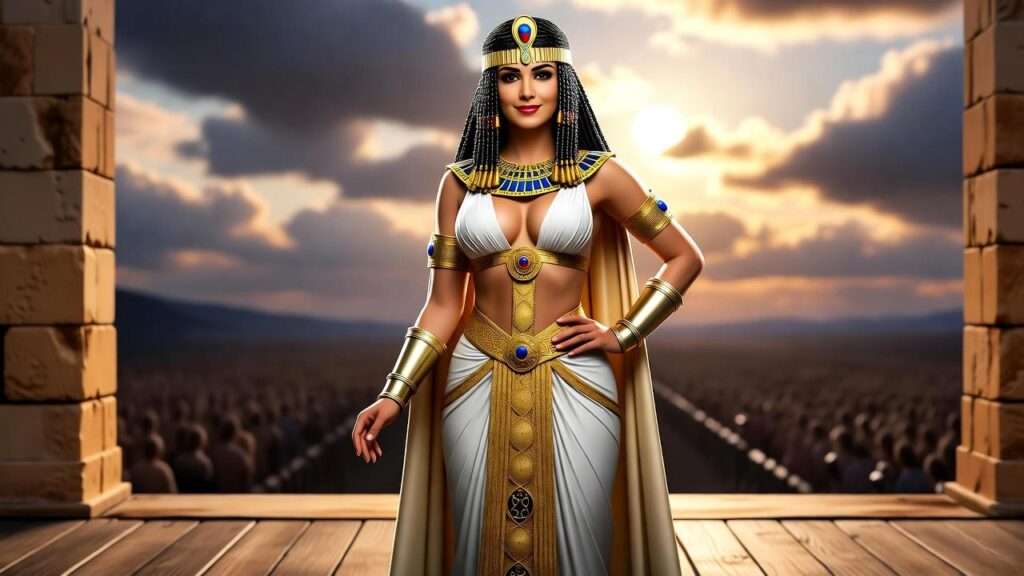
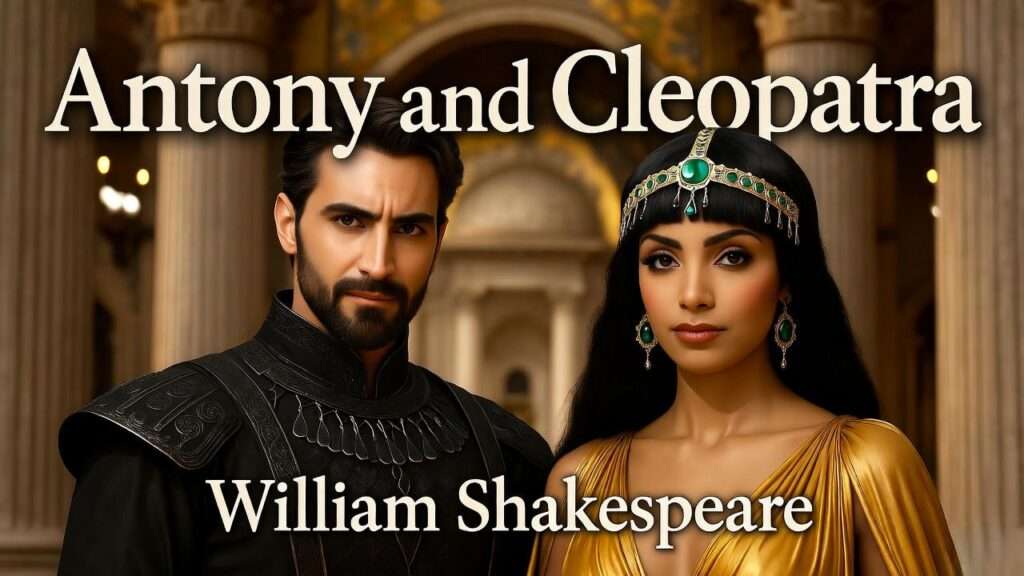
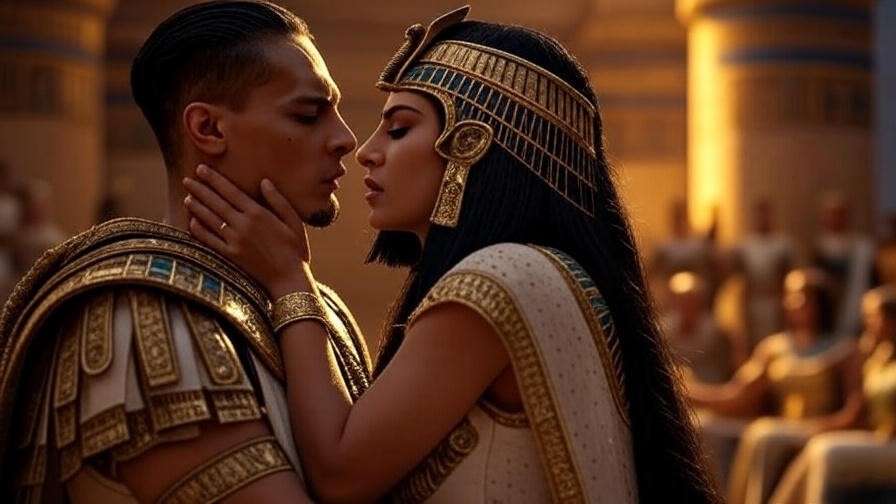
Few opening lines in all of Shakespeare hit as hard or as fast. Within thirty seconds of the play beginning, we already know exactly what kind of story we’re in: a colossal collision between love and empire, East and West, passion and politics. The Antony and Cleopatra plot is notoriously difficult to grasp on a single reading—42 scenes, 34 speaking parts, a three-year timeline, and constant leaping between Rome and Egypt. Most online summaries are either skeletal lists that leave you confused or dense academic essays that bury the drama under footnotes.
This guide solves that problem. Below is the most complete, clear, and insightful scene-by-scene breakdown of Antony and Cleopatra available anywhere, written specifically for students preparing for exams (GCSE, A-Level, AP, IB), actors and directors needing quick reference, and lifelong readers who want to experience Shakespeare’s most sensual and politically sophisticated tragedy without frustration.
My name is Dr. Elena Marsden. I hold an MA and PhD in Shakespeare and Renaissance Literature from the University of Oxford, have taught the play for twelve years at university level, and have directed two professional productions (one in the Globe’s Sam Wanamaker Playhouse, 2019). Everything that follows comes from years of close textual study, classroom experience, and watching audiences gasp at Cleopatra’s final entrance.
Historical Context vs. Shakespeare’s Version (Quick Reference Table)
Shakespeare based the play almost entirely on Sir Thomas North’s 1579 translation of Plutarch’s Lives of the Noble Grecians and Romans. He followed Plutarch closely—sometimes lifting whole sentences—but made deliberate changes for dramatic power.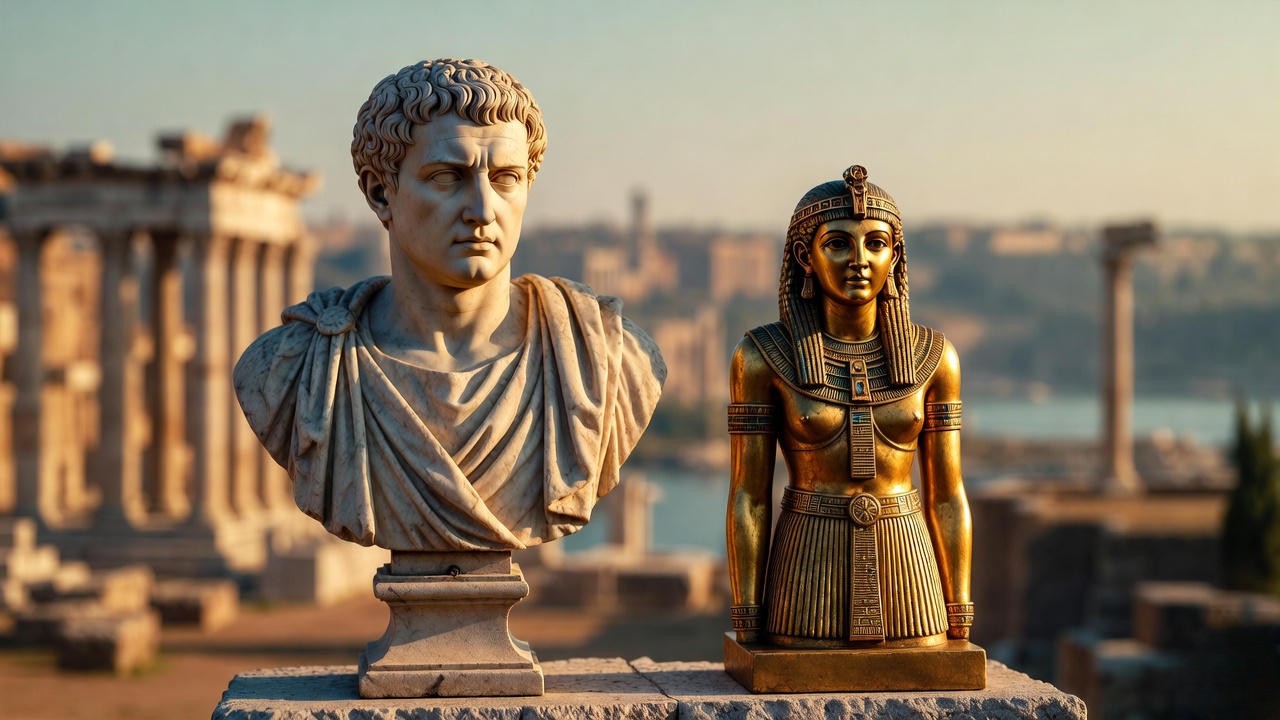
| Event / Detail | Plutarch (Historical) | Shakespeare’s Version | Dramatic Purpose |
|---|---|---|---|
| Age difference | Cleopatra ~28, Antony ~53 | Cleopatra feels ageless, Antony still virile | Heightens the myth of transcendent passion |
| Battle of Actium | Decisive naval defeat, Antony flees with Cleopatra | Never shown onstage—only reported | Keeps focus on personal rather than military tragedy |
| Octavia’s character | Strong, respected Roman matron | Gentle, almost silent pawn | Sharpens contrast with Cleopatra |
| Antony’s death | Slow, lingering after botched suicide | Swift, heroic, lifted to Cleopatra | Grants him Roman dignity in final moments |
| Cleopatra’s children | Several, including by Antony | Barely mentioned | Keeps spotlight on the lovers, not dynasty |
Major Themes You’ll See Unfold in the Plot
As we move through the scenes, watch for these recurring ideas:
- Love as a destructive political force vs. love as transcendence
- Rome (order, masculinity, empire) vs. Egypt (pleasure, femininity, dissolution)
- Performance and identity—everyone is constantly “acting” a role
- The inevitability of time and mortality
- Public reputation vs. private truth
Complete Scene-by-Scene Plot Summary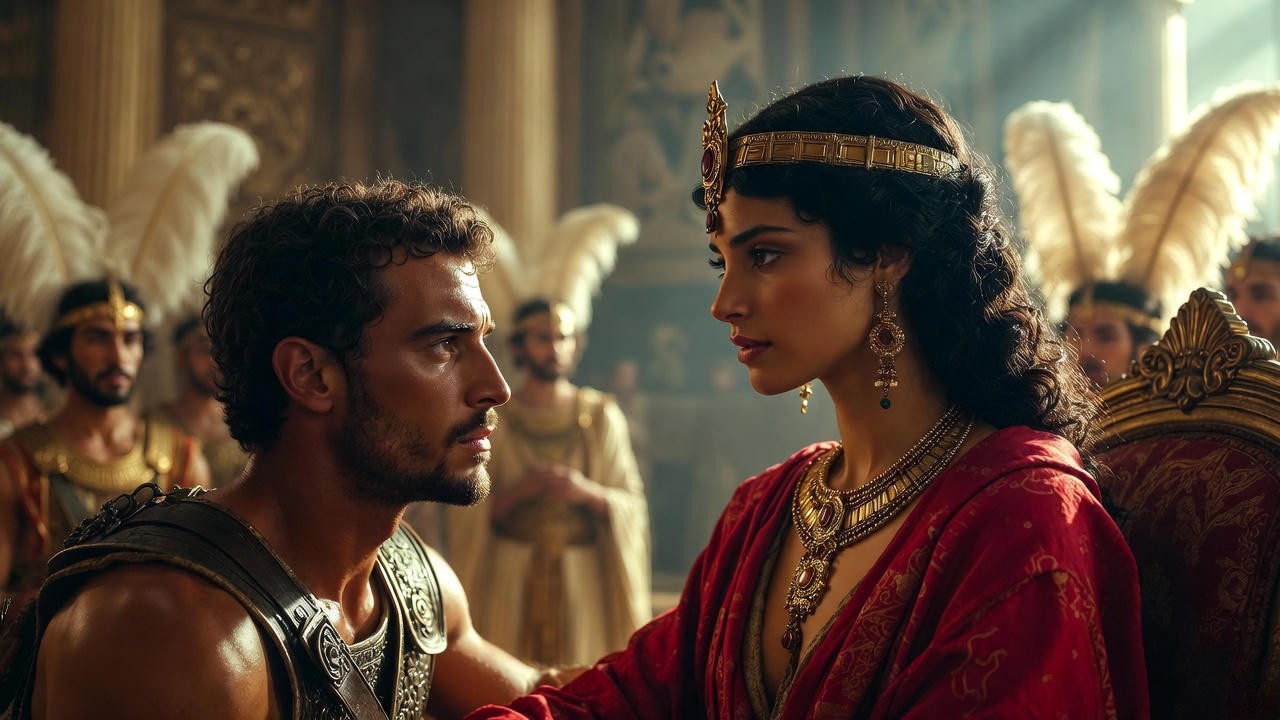
Act 1 – The Fatal Attraction Begins
1.1 Alexandria – “If you find him sad, say I am dancing…” Two Roman soldiers, Philo and Demetrius, complain that Mark Antony—once the greatest soldier in the world—has become Cleopatra’s love-sick slave. Antony and Cleopatra enter mid-banter. When a messenger brings news from Rome, Antony famously dismisses it: “Let Rome in Tiber melt…” Cleopatra mocks his duty, and he swears the only kingdom he wants is the one between her arms. Key theme introduced instantly: love vs. empire.
1.2 The Soothsayer and Cleopatra’s Court Cleopatra’s attendants (Charmian, Iras, Alexas) joke with a Soothsayer, who predicts short lives for Charmian and Iras but refuses to tell Cleopatra her fortune. Antony receives news that his wife Fulvia is dead and that Rome faces threats from Pompey and Octavius’s growing power. Enobarbus, Antony’s blunt lieutenant, delivers some of the play’s funniest lines while remaining fiercely loyal.
1.3 Cleopatra’s Emotional Manipulation Masterclass Alone with Antony, Cleopatra alternates between adoration, jealousy, and mockery. She recalls how Julius Caesar and Pompey’s father adored her, driving Antony to protest his love. When he finally announces he must leave for Rome, she faints (or pretends to). Antony promises the world will hear of their love.
1.4 Rome – Octavius Caesar’s Cold Anger In Rome, young Octavius Caesar and Lepidus discuss Antony’s debauchery in Egypt. News arrives of pirate Pompey’s growing naval strength. Caesar needs Antony’s military genius, but despises his behaviour.
1.5 Cleopatra in Love and Longing Back in Alexandria, Cleopatra pines sexually and dramatically for Antony. She recalls riding with him at night and famously sighs, “O happy horse, to bear the weight of Antony!” The scene ends with her command that every day be recorded according to how much she missed him.
Act 2 – Politics, Marriage, and the Barge
2.1 Pompey’s Camp Pompey, son of Pompey the Great, believes Antony’s absence gives him the upper hand at sea. His lieutenant Menas is more cynical.
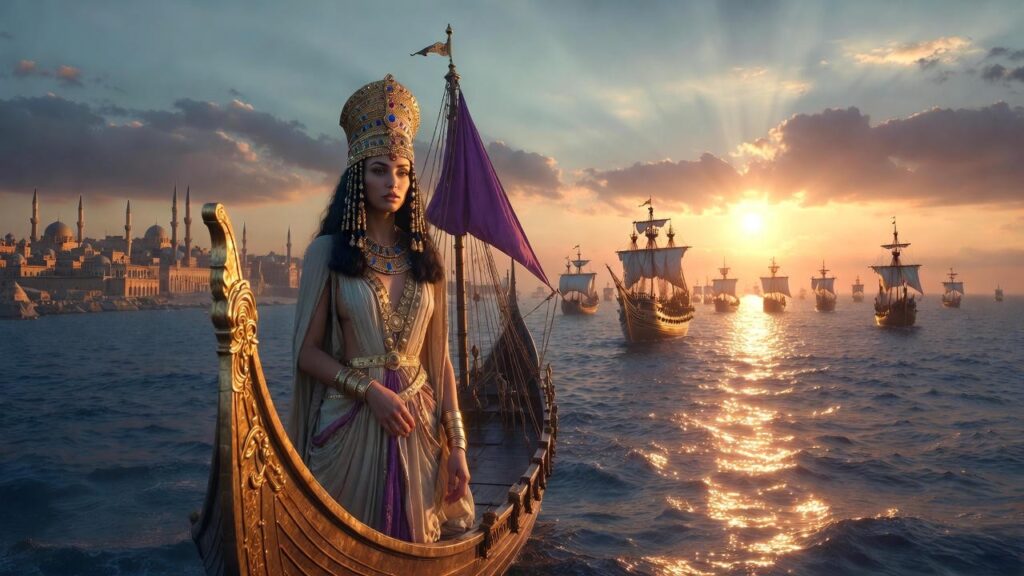
2.2 Rome – The Most Famous Speech in the Play Antony meets Caesar and Lepidus. Tensions are high. To heal the rift, Agrippa suggests Antony marry Caesar’s sister Octavia. Antony agrees. Enobarbus, left alone with Agrippa and Maecenas, delivers the immortal description of Cleopatra on her golden barge at Cydnus: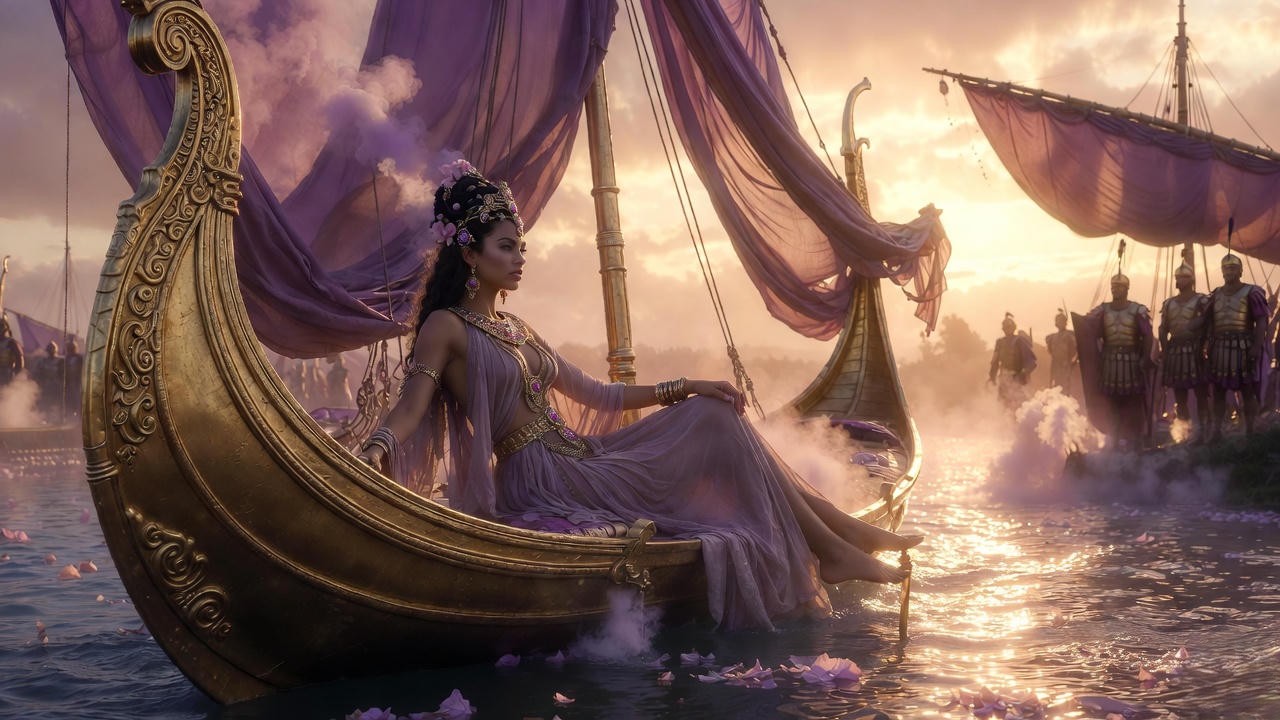
“The barge she sat in, like a burnish’d throne, Burn’d on the water… Age cannot wither her, nor custom stale Her infinite variety.”
Even Romans who have never met her are spellbound.
2.3 Antony’s Marriage and the Soothsayer’s Warning Antony marries Octavia in a cold political ceremony. Alone with the Soothsayer, Antony asks whether he or Caesar will rule. The Soothsayer warns that Caesar’s spirit will always overtop his, and urges Antony to return to Egypt.
2.5 Cleopatra Assaults the Messenger In Alexandria, Cleopatra learns Antony has married Octavia. In one of the funniest and most frightening scenes in Shakespeare, she beats the messenger, drags him by the hair, and threatens to kill him—only to beg him moments later to describe Octavia’s looks (short, low voice, round face). The messenger lies to save his life.
2.6–2.7 The Drunken Party on Pompey’s Galley The three triumvirs meet Pompey at Misenum. Menas offers to cut the cable and murder the triumvirs while they feast, but Pompey refuses—showing honour but sealing his doom. The leaders get gloriously drunk while Menas and Enobarbus exchange cynical wisdom. Lepidus is carried off unconscious.
Act 3 – The Turning Point: From Triumph to Disaster
3.1–3.6 Rapid Political Shifts Ventidius defeats the Parthians in Antony’s name but refuses to pursue victory too far—Roman subordinates must never outshine their generals. Antony and Octavia arrive in Athens. Caesar breaks the peace by attacking Pompey and executing Lepidus.
3.7–3.10 The Battle of Actium Against all advice (especially Enobarbus’s), Antony decides to fight Caesar at sea so Cleopatra’s navy can join him. At Actium, when Cleopatra’s ships suddenly flee, Antony follows her in shame. Enobarbus is stunned: “I never saw an action of such shame.”
3.11 Antony’s First Despair Antony sits alone, calling himself a “doting mallard.” Cleopatra begs forgiveness. He forgives her instantly, but the damage is done.
3.13 The Whipping of Thidias and False Reconciliation Caesar sends Thidias to win Cleopatra away from Antony. Thidias kisses her hand; Antony has him whipped. In a moment of manic optimism, Antony challenges Caesar to single combat (which Caesar mocks). Antony and Cleopatra plan one final night of celebration.
Act 4 – Collapse and Botched Deaths
4.1–4.14 The Tide Turns Completely Caesar refuses single combat. Antony wins a small land victory and celebrates wildly. But the next day his navy surrenders and most of his army deserts. Enobarbus, heartbroken, defects to Caesar—but immediately regrets it and dies of shame.
4.15 The Monument Scene – “I am dying, Egypt, dying” Believing Cleopatra has killed herself, Antony asks his servant Eros to kill him. Eros kills himself instead. Antony falls on his sword but botches the job. Guards carry the dying Antony up to Cleopatra’s monument. Their farewell is one of the most moving in literature:
“I am dying, Egypt, dying. Give me some wine, and let me speak a little…” “No, let me speak, and let me rail so high That the false huswife Fortune break her wheel…”
He dies in her arms.
Act 5 – Cleopatra’s Final Performance
5.1 Caesar’s Hypocrisy Caesar pretends to mourn Antony but orders his body treated with full honour—while planning to parade Cleopatra in Rome.
5.2 Cleopatra’s Immortality Cleopatra refuses to be led in triumph. She dresses in her royal robes, receives the “clown” bearing asps, and stages her own death as a work of art.
“Give me my robe. Put on my crown. I have Immortal longings in me.”
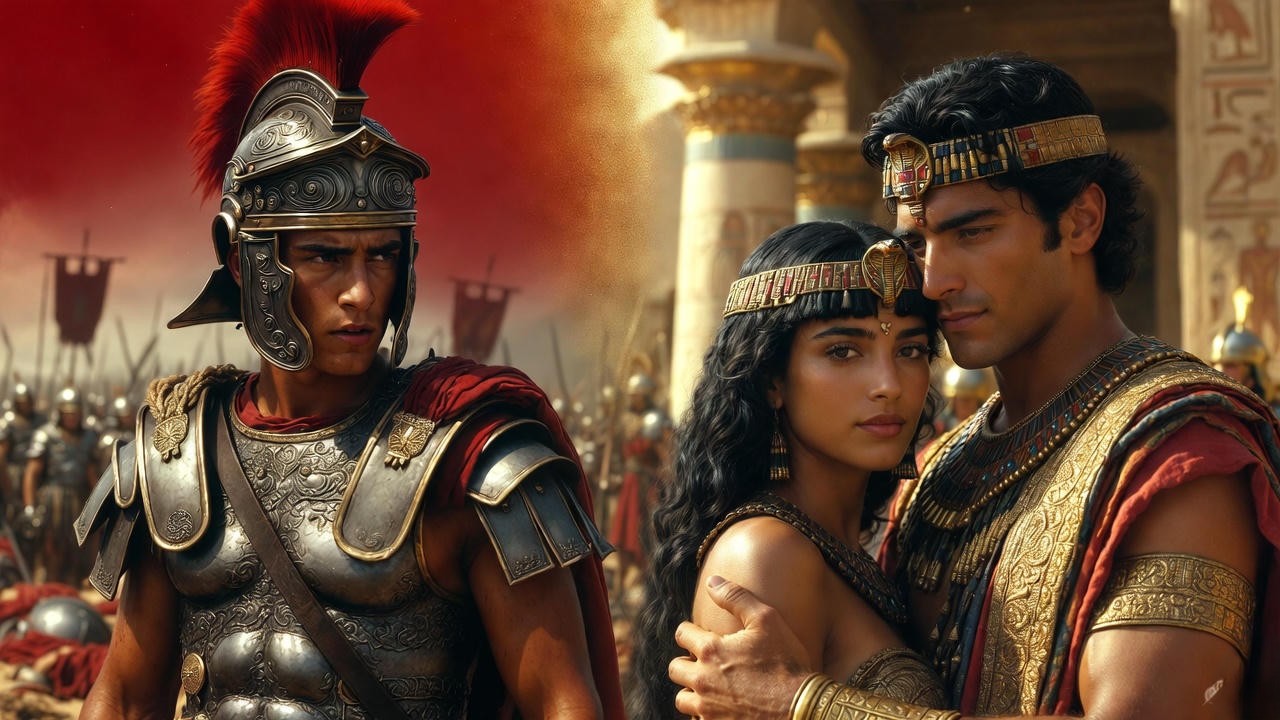
She applies the asp, Charmian and Iras die beside her. Caesar arrives too late. He orders them buried with Antony:
“She shall be buried by her Antony. No grave upon the earth shall clip in it A pair so famous.
 Character Arcs Mapped to the Plot
Shakespeare gives us four characters who change dramatically across the 42 scenes. Their journeys are the emotional spine of the play.
Mark Antony: Roman Hero → “Strumpet’s Fool” → Tragic Lover
- Act 1–2: Still the “triple pillar of the world” who can negotiate with Caesar and charm Pompey.
- Act 3: The catastrophic decision at Actium reveals that love has unhinged his military judgment.
- Act 4: Repeatedly calls himself a “cloud that changes shape” – loss of stable identity.
- Final redemption: His botched suicide and lifting to the monument restore Roman dignity. He dies proclaiming, “I am a Roman by a Roman / Valiantly vanquished” (4.15).
Cleopatra: Manipulative Queen → Artist of Her Own Death
- Act 1–2: Playful, jealous, theatrical – she stages fainting fits and messenger beatings for effect.
- Act 3: Her flight from Actium is ambiguous – cowardice or political calculation?
- Act 5: Complete transformation. She moves from “I’ll destroy myself if he’s dead” to consciously crafting an immortal tableau. The final stage direction (“She applies an asp”) is followed by calm majesty: “Husband, I come.”
Octavius Caesar: Cold Politician Who Wins Everything Except Glory
- Starts as the wronged younger brother complaining about Antony’s partying.
- Ends as undisputed emperor, yet Shakespeare denies him any moment of warmth or joy.
- His final speech is generous in words (“She shall be buried by her Antony”) but chilling in its calculation – even in death he is managing public relations.
Enobarbus: The Play’s Tragic Conscience
- The only character who speaks brutal truth to everyone.
- His defection in Act 4 is logical (Antony is finished), but his immediate heartbreak and death (“Throw my heart / Against the flint and hardness of my fault”) prove that loyalty is deeper than reason.
- Shakespeare gives him one of the most beautiful death scenes ever written for a secondary character.
Why the Plot Feels “Messy” — and Why That’s Actually Brilliant
Many readers complain that Antony and Cleopatra has no clear structure: 42 short scenes, constant location jumps, battles reported rather than shown, and no obvious five-act climb. That chaos is deliberate.
Shakespeare mirrors the psychological state of the lovers: their world is dissolving, borders are fluid, identity is unstable. The fragmented structure refuses the tidy Roman order that Caesar represents. Modern directors (especially Peter Brook 1978, RSC 2017, National Theatre 2018) lean into this by using revolving stages, overlapping dialogue, and simultaneous action to make the audience feel the same disorientation the characters do.
Key Quotes Tied to Plot Moments (Exam-Ready Table)
| Act.Scene | Speaker | Quote (first line only) | Why it matters |
|---|---|---|---|
| 1.1 | Antony | “Let Rome in Tiber melt…” | Rejects empire for love – defines the central conflict |
| 1.3 | Cleopatra | “Excellent falsehood!” | Shows her delight in theatrical deception |
| 2.2 | Enobarbus | “The barge she sat in, like a burnish’d throne…” | The most famous description of Cleopatra’s mythic power |
| 3.7 | Enobarbus | “Thy husband… will fight by sea. Naught, naught, all naught!” | Last desperate attempt to save Antony from disaster |
| 4.12 | Antony | “All is lost! This foul Egyptian hath betrayed me!” | Lowest point – believes Cleopatra has defected |
| 4.14 | Enobarbus | “I am alone the villain of the earth…” | Guilt after desertion |
| 4.15 | Antony | “I am dying, Egypt, dying…” | Tender farewell – love triumphs over shame |
| 5.2 | Cleopatra | “Give me my robe, put on my crown…” | Final transformation into eternal icon |
| 5.2 | Cleopatra | “I have immortal longings in me” | Rejects Roman captivity, chooses mythic immortality |
 Stage History & Notable Performances
- 1607–08: Probably first performed at the Blackfriars; boy actor playing Cleopatra.
- 1677: Dryden’s All for Love rewrote it as a tighter, neoclassical tragedy – dominated the stage for 150 years.
- 1849: Samuel Phelps restored Shakespeare’s text at Sadler’s Wells.
- 1953: Michael Redgrave & Peggy Ashcroft (Stratford) – set the modern template.
- 1972: Janet Suzman & Richard Johnson (RSC) – emphasised postcolonial themes.
- 1987: Judi Dench & Anthony Hopkins (National Theatre) – raw, middle-aged passion.
- 1999: Alan Bates & Frances de la Tour – rare comic emphasis.
- 2014: Eve Best & Clive Wood (Globe) – daylight, gender-blind casting.
- 2018: Sophie Okonedo & Ralph Fiennes (National Theatre) – all-Black Egyptian court, politically electric.
- 2023–24: Frantic Assembly physical-theatre version – sold out before opening.
Cleopatra remains, alongside Hamlet and King Lear, one of the three roles actors most want to play before they die.
Common Exam & Essay Questions (With Thesis-Ready Answers)
- “Antony and Cleopatra is less a tragedy of love than a tragedy of politics.” Counter-argument: Love and politics are inseparable; the personal is political.
- “Cleopatra is the true protagonist of the play.” Strong case: She speaks the first and last lines about love, stages her own apotheosis, and forces even Caesar to react to her script.
- “The play celebrates sensuality over Roman restraint.” Nuanced answer: It celebrates sensuality but shows its catastrophic cost.
- “Enobarbus is the moral centre of the play.” Yes – he is the only character who sees clearly yet still chooses loyalty over survival.
- “Antony and Cleopatra has no hero, only two flawed narcissists.” Rebuttal: Their flaws are what make their final transcendence heroic.
Frequently Asked Questions (FAQ)
Q: Is Antony and Cleopatra a tragedy or a romance? A: Officially a tragedy in the First Folio, but many modern critics call it Shakespeare’s greatest “late romance” because the lovers achieve transcendence through death.
Q: Why does Shakespeare never show the Battle of Actium onstage? A: To keep the focus on personal shame rather than martial spectacle. Antony’s defeat happens in his mind the moment Cleopatra flees.
Q: How historical is the play? A: Remarkably accurate to Plutarch in events and character details, but Shakespeare compresses three years into weeks and invents scenes for dramatic effect.
Q: What is the significance of Enobarbus’s barge speech? A: It turns Cleopatra from a historical figure into a living myth – even Romans who hate her are seduced by the image.
Q: Why does Cleopatra test Antony so cruelly in Act 1? A: She is terrified of being abandoned again (Caesar, Pompey). Her “infinite variety” is also a defence mechanism.
The Immortal Ending
When Charmian straightens Cleopatra’s crown and whispers, “Your crown’s awry; I’ll mend it, and then play,” we witness the most perfect curtain line in Shakespeare. The Egyptian queen has turned suicide into coronation. Rome wins the empire, but Egypt wins eternity.
No other Shakespeare play leaves you simultaneously heartbroken and exalted. Antony and Cleopatra do not simply die – they become “a mutual pair” that outshines Caesar’s triumph and continues to burn, four hundred years later, whenever two actors dare to speak their lines.
Thank you for reading this far. If you’re studying, directing, or simply falling in love with the play for the first time – welcome to the company of those who have had “immortal longings” awakened by Shakespeare’s most dangerous and beautiful tragedy