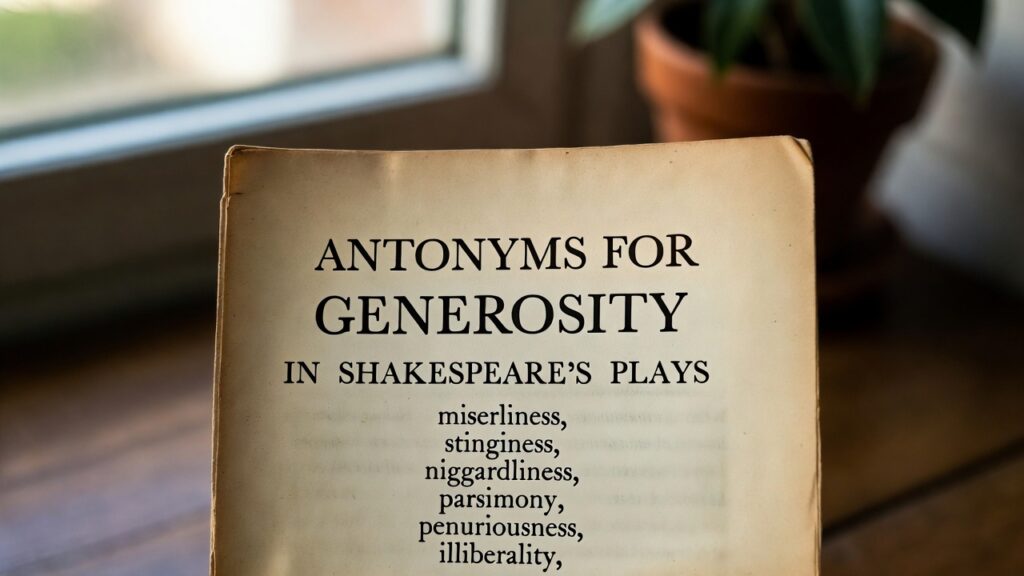
What happens when the open hand of kindness closes into a fist of self-interest? In William Shakespeare’s universe, the answer is often catastrophe—betrayal, ruin, and the unraveling of human bonds. Generosity, that noble quality of giving freely without expectation, stands as one of literature’s highest virtues. Yet its opposites—selfishness, stinginess, and greed—drive some of the Bard’s most gripping tragedies and comedies, exposing the darker impulses that lurk beneath civility.
Antonyms for generosity include selfishness (prioritizing one’s own needs above others), stinginess (or miserliness, a reluctance to part with resources), and greed (or avarice, an insatiable hunger for more). These terms appear in thesauruses as direct opposites: meanness, parsimony, tightfistedness, cupidity, and churlishness. Understanding these antonyms not only sharpens vocabulary but illuminates Shakespeare’s profound commentary on human nature. In plays like The Merchant of Venice, King Lear, Timon of Athens, and Macbeth, Shakespeare portrays these traits not as mere flaws but as forces capable of destroying individuals, families, and societies.
This comprehensive guide begins with a clear breakdown of the antonyms for generosity, then delves deeply into Shakespeare’s masterful depictions. Whether you’re a student analyzing texts, a literature enthusiast seeking fresh insights, or someone reflecting on modern parallels to these vices, you’ll find value here. By examining exact quotes, character motivations, and thematic layers, this article offers more depth than standard vocabulary lists or basic summaries—revealing why Shakespeare’s warnings about selfishness, stinginess, and greed remain urgently relevant today.
The Precise Antonyms for Generosity – A Comprehensive List
To address the core search intent, let’s start with precision. Generosity is defined as the quality of being kind, liberal in giving, and unselfish—rooted in Latin generosus (noble-born, magnanimous). Its antonyms span shades of meaning, drawn from reliable sources like Merriam-Webster, Thesaurus.com, and WordHippo.
Here are the primary and nuanced antonyms:
- Selfishness: The core opposite, emphasizing excessive concern for one’s own advantage. It contrasts with generosity’s focus on others’ welfare.
- Stinginess (or miserliness): Reluctance to spend or give money/time, often implying pettiness. Distinct from prudent frugality—stinginess borders on hoarding.
- Greed (avarice): Insatiable desire for wealth or power. From Latin avaritia, it implies not just wanting but craving beyond need.
- Meanness: Small-minded unkindness, combining pettiness with cruelty.
- Parsimony: Extreme economy or stinginess, often in financial matters.
- Tightfistedness / penuriousness: Refusal to open the hand (or purse), synonymous with being close-fisted.
- Cupidity: Lustful greed, especially for material gain.
- Churlishness: Surly, ungracious behavior, rejecting generosity in spirit.
Etymologically, “avarice” traces to Latin roots meaning “to crave,” while “miserliness” derives from “miser” (wretched person who hoards). In modern usage, these words warn against extremes: selfishness erodes relationships, stinginess isolates, and greed corrupts.
Shakespeare’s language enriches these concepts. He rarely uses “generosity” directly but evokes it through actions and contrasts—lavish giving versus withholding. His antonyms appear in dialogue: “avarice” in moral condemnations, “selfish” impulses in betrayals. This linguistic depth makes his works ideal for exploring these opposites.
Why Shakespeare’s Portrayal of Anti-Generosity Matters Today
Shakespeare’s exploration of selfishness, stinginess, and greed transcends his Elizabethan era. In an age of corporate scandals, social inequality, and viral displays of self-interest, these vices feel eerily contemporary. The Bard shows how unchecked anti-generosity destroys: families fracture (King Lear), justice warps (The Merchant of Venice), and societies collapse under avarice (Timon of Athens).
As the preeminent English dramatist, Shakespeare’s insights carry authority. His characters embody universal human flaws, backed by centuries of scholarship. Studying these antonyms through his lens builds empathy, ethical awareness, and vocabulary—solving the real need for deeper understanding in literature education and personal reflection.
Selfishness in Shakespeare – The Betrayal of Bonds
Selfishness manifests as prioritizing personal gain over loyalty, often leading to betrayal.
King Lear – The Ultimate Act of Selfishness
In King Lear (1606), selfishness drives the tragedy. Goneril and Regan profess love to inherit their father’s kingdom, but their actions reveal cold calculation. “Nothing will come of nothing,” Lear warns Cordelia, whose honest generosity contrasts sharply with her sisters’ selfish flattery.
Edmund, the bastard son, embodies ruthless self-interest: “Legitimate Edgar, I must have your land.” His forged letter and manipulations stem from resentment and ambition. Selfishness here shatters familial bonds—Lear’s division of the kingdom invites ingratitude, leading to madness and death.
Shakespeare illustrates how selfishness poisons trust: what begins as calculated gain ends in chaos.
Other Examples
Iago in Othello (1603) manipulates through selfish envy: “I hate the Moor.” His schemes destroy Othello’s marriage and life, showing selfishness as active malice.
These portrayals highlight selfishness’s corrosive power—eroding relationships and self.
Stinginess and Miserliness – The Hoarding of Wealth
Stinginess involves withholding resources, often tied to fear or prejudice.
Shylock in The Merchant of Venice – Beyond Stereotype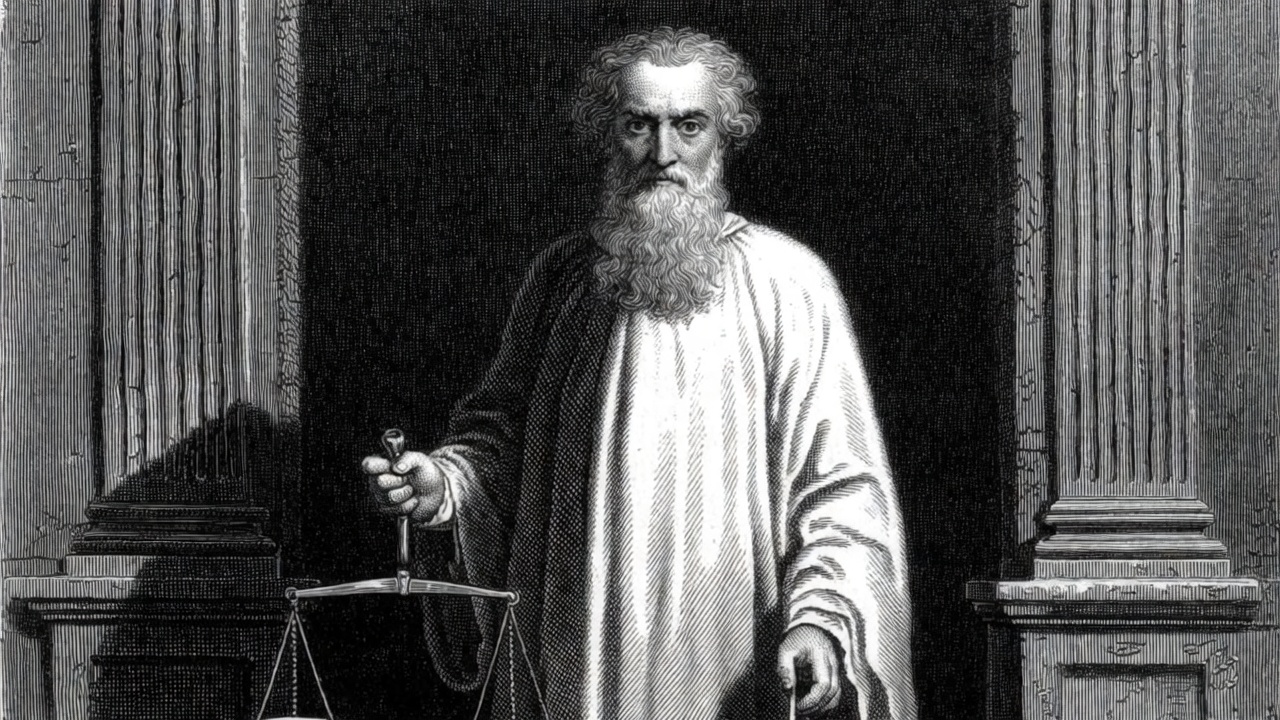
In The Merchant of Venice (1596-1597), Shylock demands a “pound of flesh” for Antonio’s loan. Critics debate: is he truly stingy, or a victim responding to Venetian antisemitism?
Shylock hoards ducats and resents prodigality: “I hate him for he is a Christian.” Yet his “merry sport” bond reveals miserly calculation. Contrast Antonio’s open-handed lending (without interest), embodying generosity.
The trial scene pits mercy (Portia’s “The quality of mercy is not strained”) against strict justice. Shakespeare critiques stinginess while humanizing Shylock’s motivations—prejudice breeds defensiveness, turning generosity into scarcity.
Timon of Athens – From Generosity to Extreme Reaction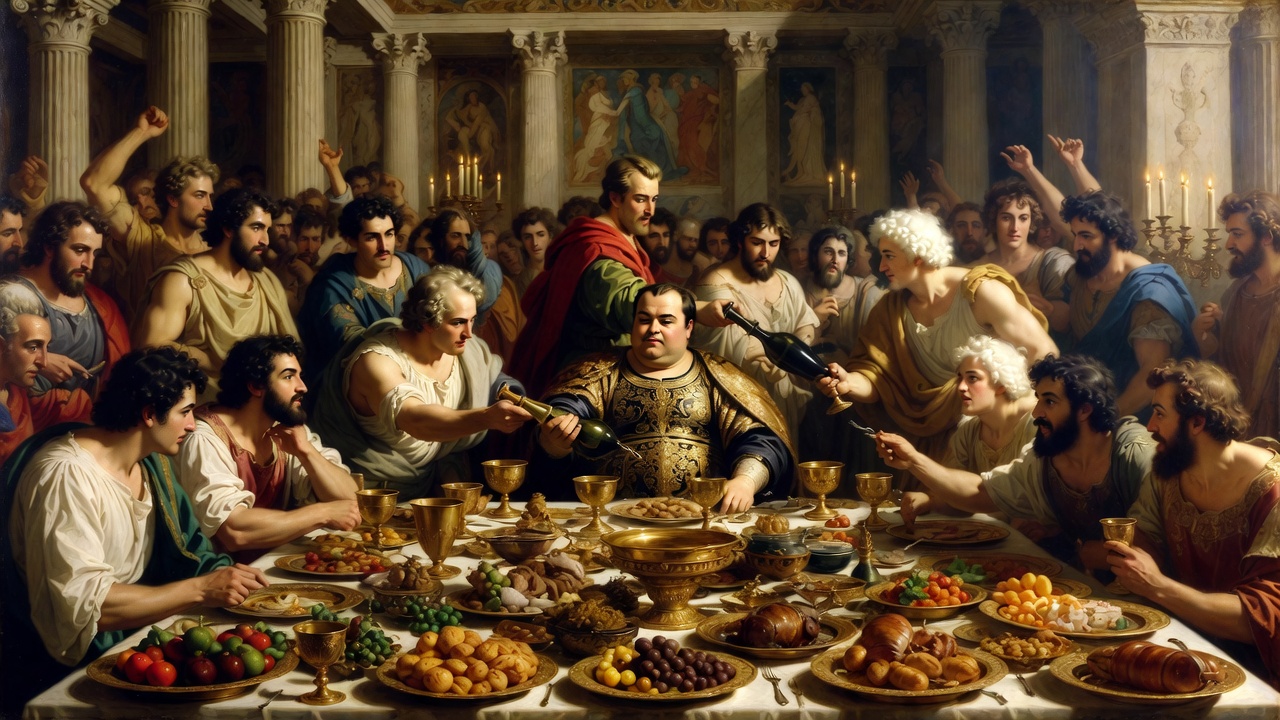
Timon of Athens (c. 1606) presents extremes. Timon lavishes gifts, but when bankrupt, friends refuse aid. His turn to misanthropy—cursing humanity—reacts to others’ stinginess.
Flavius laments: “No kindness to his friends.” The play shows stinginess as societal norm, where “bounty” attracts parasites.
Greed (Avarice) – The Insatiable Hunger That Destroys
Of all the antonyms for generosity, greed—also called avarice—carries the most devastating force in Shakespeare’s canon. Unlike stinginess, which hoards what one already possesses, greed hungers endlessly for more, often at any moral cost. Shakespeare repeatedly shows greed as a cancer of the soul that spreads outward, corrupting individuals and entire realms.
Macbeth – Ambition as Greedy Overreach
In Macbeth (1606), ambition morphs into outright greed for power. Macbeth’s initial hesitation gives way to insatiable desire after the witches’ prophecy. Lady Macbeth urges him: “Art thou afeard / To be the same in thine own act and valour / As thou art in desire?” Once crowned, he murders Banquo and attempts to kill Fleance to secure his line, revealing greed’s endless appetite.
The famous soliloquy captures the tragedy: “I have no spur / To prick the sides of my intent, but only / Vaulting ambition, which o’erleaps itself / And falls on th’ other.”
Here, Shakespeare equates greedy ambition with self-destruction. Macbeth’s kingdom descends into tyranny and paranoia, illustrating how avarice for power destroys both the greedy person and the society they rule.
Other Greed-Driven Characters
Claudius in Hamlet (c. 1600–1601) murders his brother for the crown and queen, driven by cupidity. His confession reveals torment: “O, my offence is rank, it smells to heaven; / It hath the primal eldest curse upon’t, / A brother’s murder.” Yet he cannot relinquish what greed has gained.
In The Tempest, Antonio usurps his brother Prospero’s dukedom out of greedy ambition, showing how avarice fractures blood ties.
Greed vs. Generosity in Timon of Athens (Deep Dive)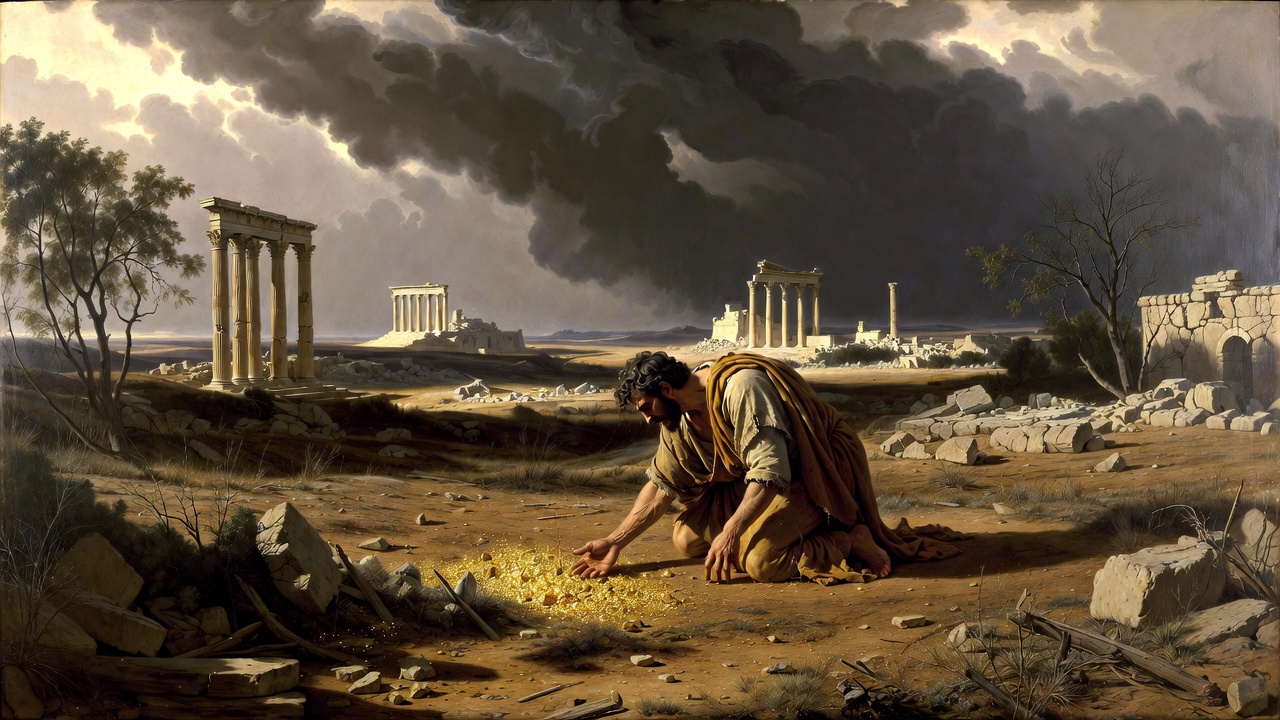
Timon of Athens offers the starkest contrast. Timon begins as the epitome of generosity, hosting endless feasts and giving without limit: “Unwisely, not ignobly, have I given.” When his coffers empty and supposed friends refuse help, he discovers universal greed and stinginess in others. His curse on Athens—“Gold? Yellow, glittering, precious gold? … Thus much of this will make black white, foul fair”—becomes one of literature’s most powerful condemnations of avarice.
Shakespeare uses Timon to explore the spectrum: excessive generosity invites parasitic greed, while societal stinginess starves true bounty. The play ends in isolation and death, underscoring greed’s ultimate emptiness.
Lessons from Shakespeare – Balancing Generosity and Its Opposites
Shakespeare does not glorify unthinking generosity. Timon’s downfall shows that boundless giving without discernment can be foolish and self-destructive. Conversely, the antonyms—selfishness, stinginess, greed—lead to moral and material ruin.
Key takeaways for modern readers:
- Discernment in giving — Cordelia’s honest restraint in King Lear proves wiser than Goneril and Regan’s false largesse. Generosity thrives with boundaries.
- Dangers of extremes — Selfishness erodes trust, stinginess breeds loneliness, and greed invites downfall (Macbeth’s paranoia, Timon’s exile).
- Healthy middle ground — Antonio’s generous lending in The Merchant of Venice is noble, yet he survives because of others’ mercy. Balanced generosity fosters community.
- Modern applications — In leadership, unchecked greed fuels corporate scandals. In relationships, selfishness destroys intimacy. In philanthropy, stinginess starves worthy causes, while reckless giving wastes resources.
Shakespeare teaches that true nobility lies in generous spirit tempered by wisdom—not in the extremes of open-handed folly or closed-fisted vice.
Key Quotes on Generosity and Its Antonyms in Shakespeare
Here are carefully selected quotations that crystallize these themes (with act/scene references):
- “The quality of mercy is not strained; / It droppeth as the gentle rain from heaven” — Portia, The Merchant of Venice (4.1) (Generosity/mercy vs. Shylock’s strict, stingy justice)
- “Vaulting ambition, which o’erleaps itself / And falls on th’ other” — Macbeth (1.7) (Greed/ambition as self-destructive)
- “Nothing will come of nothing” — Lear to Cordelia, King Lear (1.1) (Punishing honest generosity, rewarding selfish flattery)
- “Gold? Yellow, glittering, precious gold? … This yellow slave / Will knit and break religions” — Timon, Timon of Athens (4.3) (Scathing attack on greed/avarice)
- “I am a Jew. Hath not a Jew eyes? … If you prick us, do we not bleed?” — Shylock, The Merchant of Venice (3.1) (Humanizing the stingy figure often reduced to stereotype)
- “Legitimate Edgar, I must have your land” — Edmund, King Lear (1.2) (Selfishness in action)
- “Bounty, and bounteous recompense, / Are now grown strangers” — Flavius on Timon’s friends, Timon of Athens (1.2) (Stinginess of supposed friends)
- “I hate the Moor” — Iago, Othello (1.3) (Selfish envy as motivator)
These lines remain powerful teaching tools for students and profound reflections for anyone studying human nature.
The antonyms for generosity—selfishness, stinginess, greed—serve as dark mirrors in Shakespeare’s plays, reflecting what happens when the impulse to give is replaced by the impulse to take. From Lear’s shattered kingdom to Timon’s bitter exile, from Macbeth’s bloody crown to Shylock’s tragic demand, the Bard shows these vices as engines of destruction.
Yet Shakespeare also offers hope: mercy, honest generosity, and wise restraint can counterbalance human flaws. By studying these opposites, we gain not only richer vocabulary but timeless insight into morality, society, and self.
Revisit these plays with fresh eyes. Reflect on where selfishness, stinginess, or greed appear in your own life or world. And explore more Shakespearean themes here on William Shakespeare Insights—because the Bard’s wisdom never ages.
FAQs
What are the main antonyms for generosity? The primary antonyms are selfishness, stinginess (miserliness), and greed (avarice). More nuanced terms include meanness, parsimony, tightfistedness, cupidity, penuriousness, and churlishness.
How does Shakespeare portray greed differently from stinginess? Stinginess is about hoarding what one has (e.g., Shylock’s ducats, Timon’s false friends). Greed is an active, insatiable craving for more (Macbeth’s throne, Claudius’s crown). Both destroy, but greed drives expansion and violence, while stinginess contracts and isolates.
Is Shylock truly stingy, or a victim of prejudice? Shakespeare presents a complex figure. Shylock’s demand for the pound of flesh appears stingy and vengeful, yet his famous speech (“Hath not a Jew eyes?”) reveals deep hurt from Venetian antisemitism. The play critiques both individual vice and societal cruelty.
What Shakespeare play best shows the dangers of selfishness? King Lear stands out. Goneril, Regan, and Edmund’s ruthless self-interest fractures the royal family, drives Lear to madness, and ends in multiple deaths—making it a devastating portrait of selfishness unbound.
Can generosity be a flaw? Yes—Timon of Athens illustrates this powerfully. His indiscriminate, boundless giving attracts parasites and leaves him destitute when he needs reciprocation. Shakespeare suggests generosity must be wise and selective to endure.
How do these themes apply to modern life? They remain strikingly relevant: corporate greed mirrors Macbeth’s ambition, social media self-promotion echoes Iago’s manipulations, and financial stinginess appears in unequal wealth distribution. Shakespeare’s warnings encourage ethical reflection in leadership, relationships, and personal choices.