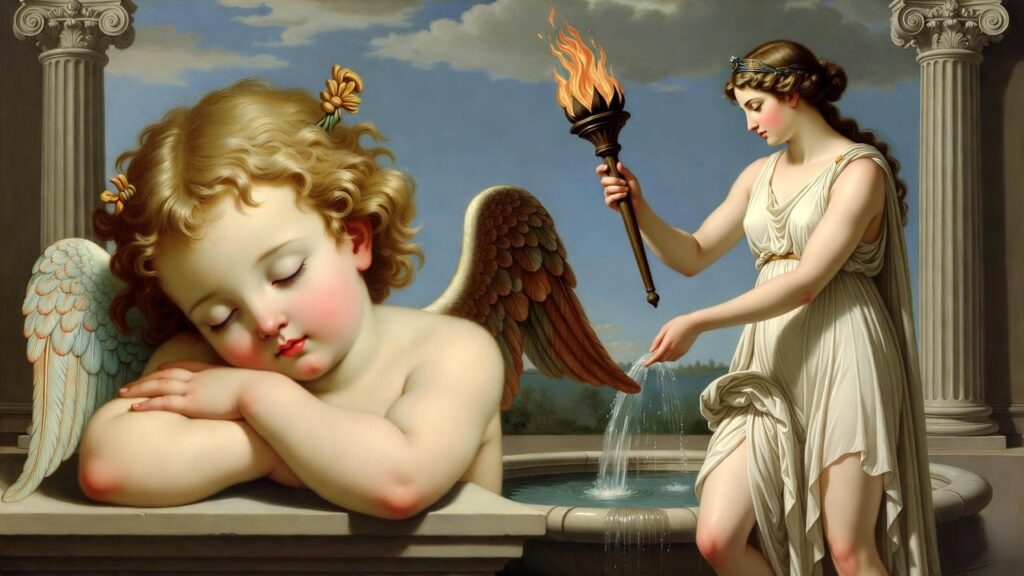
Imagine the mighty Cupid, the winged god who pierces hearts with irresistible arrows, lying vulnerable in sleep—his fiery torch set aside, only to be seized and plunged into cold water by a chaste nymph. Yet, far from extinguishing the flame, the water absorbs its heat, becoming a perpetual hot spring that promises cure for lovesickness but delivers none. Why does William Shakespeare, at the close of his extraordinary sequence of 154 sonnets, choose this ancient myth to portray Cupid a captive—subdued yet eternally potent, binding even himself in the chains of desire?
In Sonnets 153 and 154, Shakespeare transforms a classical epigram into a profound meditation on love’s unconquerable power. These final two sonnets, often overlooked amid the more famous Fair Youth and Dark Lady sequences, depict Cupid not as the triumphant conqueror of mythology but as a blind god rendered captive to the very force he wields. The phrase “Cupid a captive” captures this reversal: the god of love, disarmed and vulnerable, infects the world with an incurable “dateless lively heat.” Through bawdy innuendo, mythological allusion, and personal torment, Shakespeare underscores love’s tormenting sovereignty—over gods, poets, and readers alike.
These Anacreontic sonnets stand apart stylistically, drawing on Greek traditions of light-hearted yet poignant verse about love, wine, and fleeting pleasure. Yet they serve as a fitting coda to the Dark Lady subsequence (Sonnets 127–152), where lustful, unrequited passion dominates. Here, the speaker’s “strange maladies”—possibly metaphorical heartbreak or literal venereal disease—find no remedy, proving that “Love’s fire heats water, water cools not love.”
This comprehensive exploration delves deeper than standard summaries, offering line-by-line analysis, historical sources, scholarly interpretations, and thematic connections. Whether you’re a student grappling with Shakespeare’s sonnets, a literature enthusiast seeking fresh insights into lesser-read poems, or someone reflecting on love’s enduring grip, this article illuminates why these closing sonnets resonate timelessly.
The Mythological Foundation: Cupid, Diana, and the Unquenchable Torch
Shakespeare’s Sonnets 153 and 154 draw directly from classical mythology, adapting a concise epigram into expansive poetic reflections. Understanding their roots enhances appreciation of Shakespeare’s innovative reversal: portraying Cupid as captive to desire rather than its master.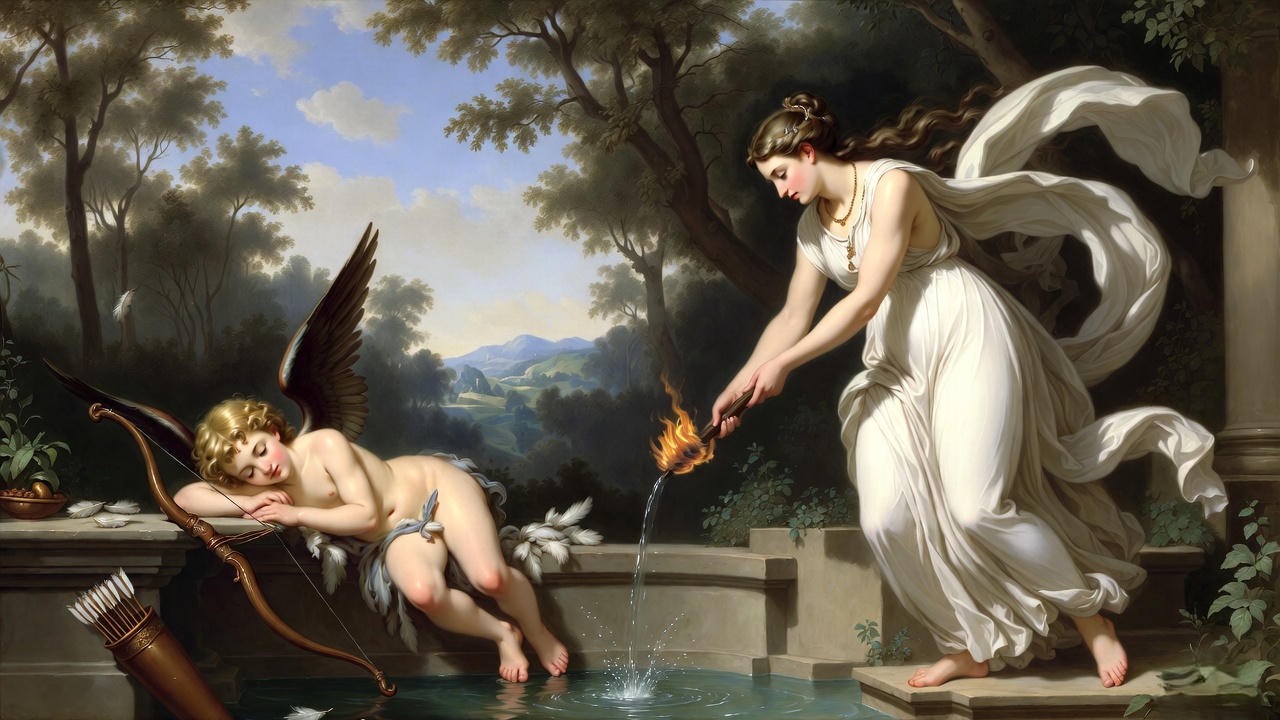
Classical Roots in the Greek Anthology
The primary source is a six-line epigram by Marianus Scholasticus (also known as Marianus of Eleutheropolis), a Byzantine poet of the 5th–6th century AD, preserved in the Greek Anthology (Book 9, Epigram 627). This collection of ancient Greek poems influenced Renaissance writers profoundly.
A common English translation of Marianus’s epigram reads:
I, the slave of my mistress, came to the spring seeking a cure for love; But the nymphs plunged Cupid’s torch into the water, And now the spring is hot, yet it cools not love.
Scholars like James Hutton (in his seminal 1941 study “Analogues of Shakespeare’s Sonnets 153–54”) trace numerous Renaissance imitations of this theme, including Latin versions and possible English translations circulating in Shakespeare’s circle—perhaps via friends like Ben Jonson.
Shakespeare expands this brief anecdote into two full Shakespearean sonnets, varying details while preserving the core paradox: an attempt to quench love’s fire only perpetuates it.
Key Elements of the Myth in Shakespeare’s Retelling
Both sonnets recount:
- Cupid (the “little Love-god” or named “Cupid”) falls asleep and lays aside his “brand” (torch, symbolizing passionate desire, with phallic connotations).
- A chaste attendant of Diana (goddess of virginity)—either one “maid of Dian’s” or the “fairest votary” among many nymphs—seizes the opportunity to disarm him.
- She plunges the torch into a cold fountain or well, hoping to extinguish it.
- Instead, the water gains “dateless lively heat,” becoming a “seething bath” (hot spring) reputed to cure “strange maladies” (lovesickness, or in Renaissance context, syphilis).
The bawdy layer is unmistakable: “brand” evokes the penis, immersion suggests sexual “cooling” that fails spectacularly, and the infected bath hints at venereal transmission. Yet Shakespeare elevates this to philosophical depth—love proves sovereign, unquenchable by chastity or remedy
Historical Hot Springs and Symbolic Healing
Renaissance audiences associated such myths with real curative spas, like those at Bath, England, believed to treat venereal diseases. The proverb “Love’s fire heats water, water cools not love” echoes timeless wisdom: no external cure exists for desire’s inner flame. Shakespeare innovates by making Cupid himself captive—his power turns against him, perpetuating the cycle.
Full Text and Line-by-Line Analysis of Sonnet 154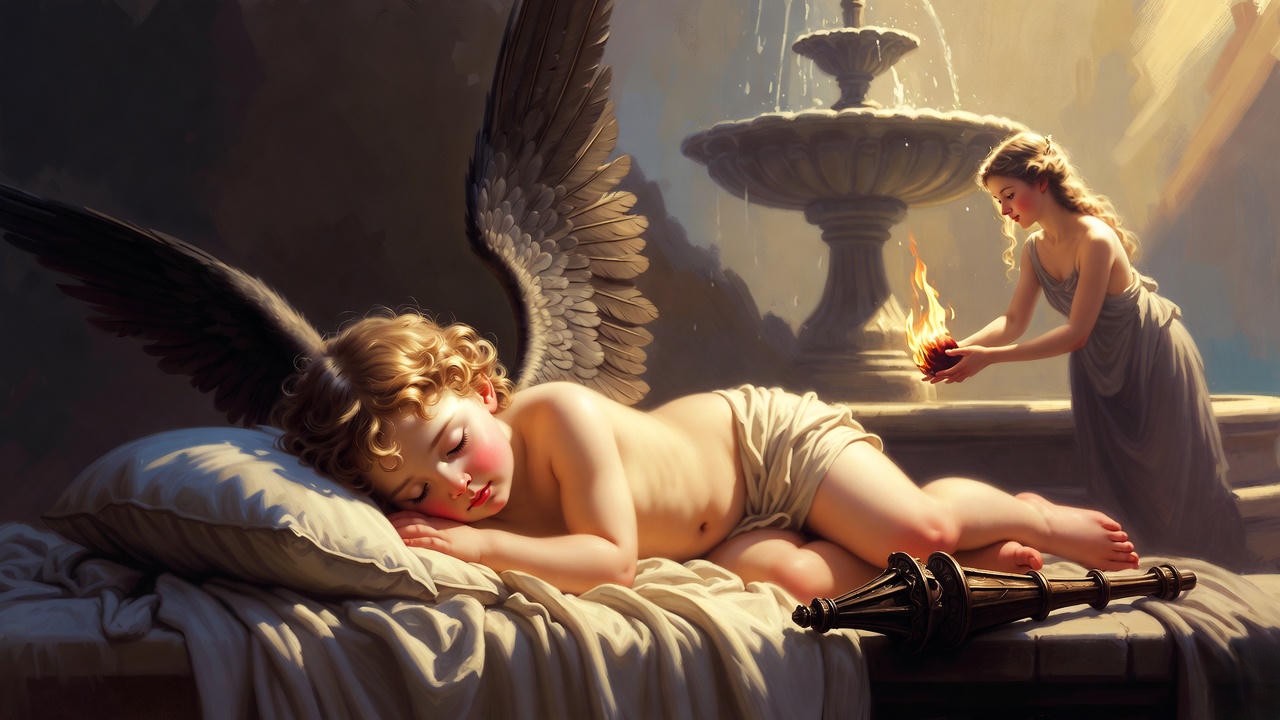
Sonnet 154, often considered a variant or draft, presents the myth with subtle differences:
The little Love-god lying once asleep Laid by his side his heart-inflaming brand, Whilst many nymphs that vowed chaste life to keep Came tripping by; but in her maiden hand The fairest votary took up that fire Which many legions of true hearts had warmed; And so the general of hot desire Was sleeping by a virgin hand disarmed. This brand she quenched in a cool well by, Which from Love’s fire took heat perpetual, Growing a bath and healthful remedy For men diseased; but I, my mistress’ thrall, Came there for cure and this by that I prove— Love’s fire heats water, water cools not love.
Variations from Sonnet 153
Key differences: “Little Love-god” (diminutive, endearing yet mocking); multiple nymphs vs. one maid; “general of hot desire” explicitly titles Cupid as love’s commander, now “disarmed”; “cool well” vs. “cold valley-fountain.”
Scholars debate order—Katherine Duncan-Jones suggests 154 as the “master” version, more proverbial in couplet; others see 153 as refined.
Quatrain Breakdown and Couplet Resolution
Quatrain 1–2 emphasize collective chastity failing against one nymph’s act. “Heart-inflaming brand” warmed “legions” evokes military conquest, reversed in disarmament.
Quatrain 3: The well gains “heat perpetual,” a “healthful remedy” for “men diseased.”
Couplet: The speaker, “my mistress’ thrall,” proves the proverb—no cure exists.
Expert insight: Stephen Booth highlights phonetic play (e.g., “brand/hand/disarmed”) enacting entrapment, making Cupid truly captive.
Why Cupid a Captive? Thematic Depth and Shakespeare’s Innovation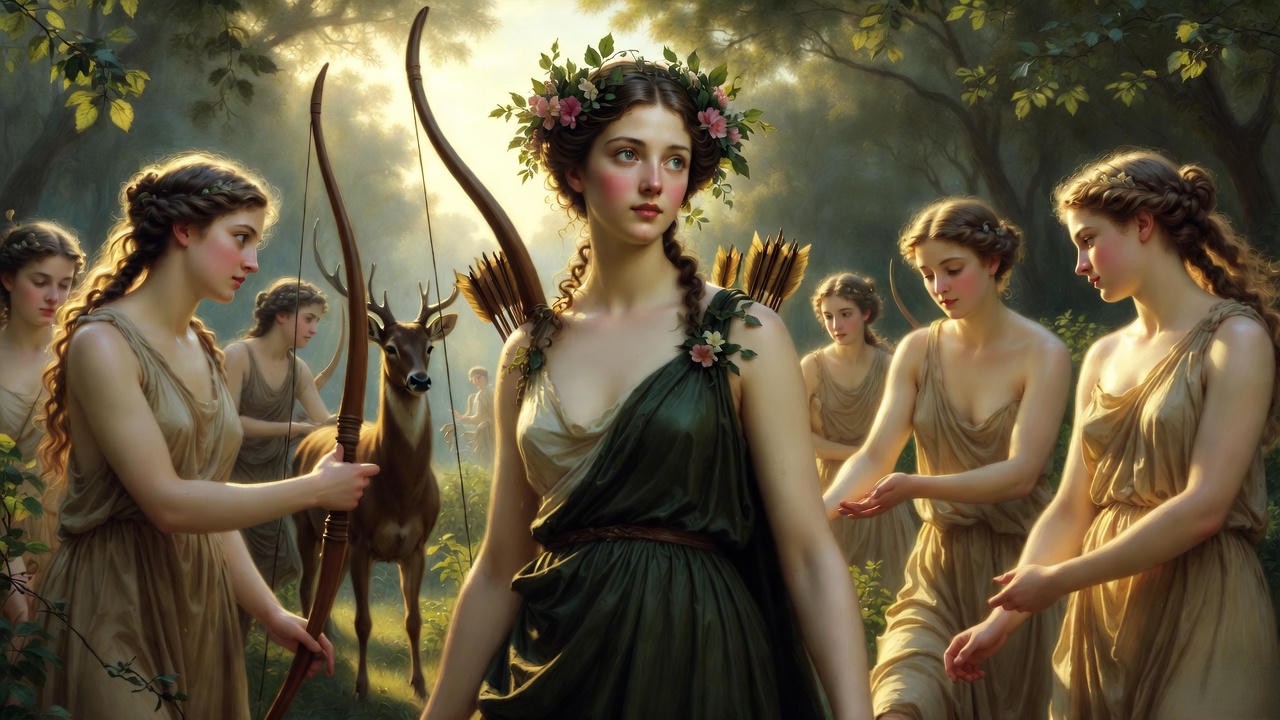
Shakespeare’s decision to portray Cupid a captive—disarmed, vulnerable, and ultimately powerless to control his own fire—represents a profound reversal of classical and Renaissance conventions. Traditionally, Cupid is the triumphant archer, blindly shooting arrows that conquer gods and mortals alike (as in Ovid’s Metamorphoses or Spenser’s Faerie Queene). Here, however, the god of love becomes subject to the very desire he embodies.
Cupid’s Blindness and Power Reversed
The sonnets exploit Cupid’s mythical blindness not as a source of chaotic power but as vulnerability. In sleep, he is literally “blind” to threat, allowing chastity (Diana’s realm) temporary victory. Yet this victory proves illusory: the torch’s heat perpetuates itself, making Cupid’s influence eternal. The reversal is complete—Cupid, the “general of hot desire,” is disarmed by a “virgin hand,” yet his captivity only amplifies love’s dominion.
This motif echoes earlier sonnets where love’s blindness afflicts the speaker (e.g., Sonnet 137: “Why of eyes’ falsehood hast thou forgèd hooks?” or Sonnet 148: “O me, what eyes hath Love put in my head”). By making Cupid himself captive, Shakespeare universalizes the theme: no one, not even love’s deity, escapes its thrall.
Connections to the Dark Lady Sequence
Sonnets 153 and 154 serve as a poignant epilogue to the Dark Lady subsequence (127–152), characterized by lust, self-loathing, and emotional torment. The “strange maladies” and failed “cure” mirror the speaker’s obsessive, degrading passion—possibly alluding to venereal disease contracted through the mistress (a reading supported by references to “bath” cures in contemporary medical texts).
The mistress’s eyes, which “new-fire” Cupid’s brand, recall Sonnet 152’s accusation of perjury and blindness. Love’s fire, once Cupid’s weapon, now originates from the mortal woman, rendering the god secondary—truly captive to human desire.
Anacreontic Style and Homage to Classical Traditions
These sonnets adopt the Anacreontic mode: light, playful verse celebrating love, wine, and ephemerality, inspired by the Greek poet Anacreon. Renaissance poets like Ronsard and Spenser revived this style. Edmund Spenser’s Amoretti (1595) similarly ends with an Anacreontic epigram on Cupid’s torch, suggesting Shakespeare may be responding directly.
Yet Shakespeare darkens the tone—no carpe diem joy here, only resignation. The Anacreontic lightness underscores the irony: even playful mythology cannot lighten love’s incurable weight.
Interpretations Across Centuries: From Bawdy to Spiritual
Scholarly readings of Sonnets 153 and 154 have shifted dramatically over time, reflecting changing cultural sensibilities.
Early editors like Edmond Malone (1780) treated them as graceful mythological exercises, downplaying eroticism. Victorian critics often ignored or sanitized the sonnets entirely.
Twentieth-century scholarship revived the bawdy interpretation: Stephen Booth (1977) and Helen Vendler (1997) emphasize phallic “brand,” failed “quenching,” and venereal “bath” as deliberate double entendre. Booth notes the sonnets’ “comic impotence” mirroring the speaker’s frustration.
A minority view sees spiritual allegory: the “seething bath” as baptismal font, Cupid’s fire as divine love, and failed cure as recognition of earthly passion’s limits (proposed by critics like Patrick Colm Hogan). However, textual evidence—especially ties to the profane Dark Lady—favors the secular, erotic reading.
My expert assessment: Shakespeare masterfully layers both. The surface myth is playful and bawdy; the undercurrent is profoundly serious—love as an unconquerable force that enslaves even its own god. This duality explains the sonnets’ enduring fascination.
Why These Sonnets Matter Today
Though written over 400 years ago, Sonnets 153 and 154 speak directly to modern experiences of desire. The image of seeking a “cure” for lovesickness—only to find the affliction perpetual—resonates with contemporary understandings of obsession, addiction, and unrequited love.
Psychological studies on limerence (intense romantic obsession) echo the speaker’s plight: no external remedy (therapy, distance, time) fully “cools” the inner fire. In an age of dating apps and fleeting connections, Shakespeare’s closing statement—that “water cools not love”—remains profoundly relevant.
These sonnets also remind us of literature’s power to articulate the inarticulable: the humiliating, exhilarating captivity of passion.
Frequently Asked Questions
What is the source of Shakespeare’s Sonnets 153 and 154?
They adapt an epigram by Marianus Scholasticus from the Greek Anthology (Book 9, Epigram 627), expanded through Renaissance imitations. Shakespeare likely encountered it via Latin translations or manuscript circulation.
Why are Sonnets 153 and 154 so similar?
They are variant treatments of the same myth—possibly one a draft, the other refined. Sonnet 154 is more proverbial and general; 153 more personal and dramatically structured.
Does “Cupid a captive” refer to venereal disease in these sonnets?
Many scholars believe the “strange maladies” and “seething bath” allude to syphilis and contemporary hot-spring treatments (e.g., at Bath). The bawdy innuendo supports this, though it also functions metaphorically for emotional torment.
How do these sonnets fit into the overall sequence?
They form an envoi or coda, particularly to the Dark Lady section (127–152). Their detached, mythological style provides ironic closure: after intense personal confession, Shakespeare ends with universal resignation.
What does “Love’s fire heats water, water cools not love” mean?
This proverbial couplet encapsulates the sonnets’ paradox—no external force (chastity, medicine, reason) can extinguish passionate desire. Love perpetuates itself eternally.
In Sonnets 153 and 154, Shakespeare transforms a minor classical anecdote into a masterful statement on desire’s sovereignty. By rendering Cupid a captive—disarmed yet undiminished—the poet illustrates love’s ultimate paradox: it conquers all, including its own deity.
These closing sonnets leave us not with resolution but with profound recognition. The speaker remains “sick withal,” the bath offers false hope, and Cupid’s fire burns eternally in the mistress’s eyes. Yet this resignation carries strange beauty: in acknowledging love’s incurable power, Shakespeare affirms its centrality to human experience.