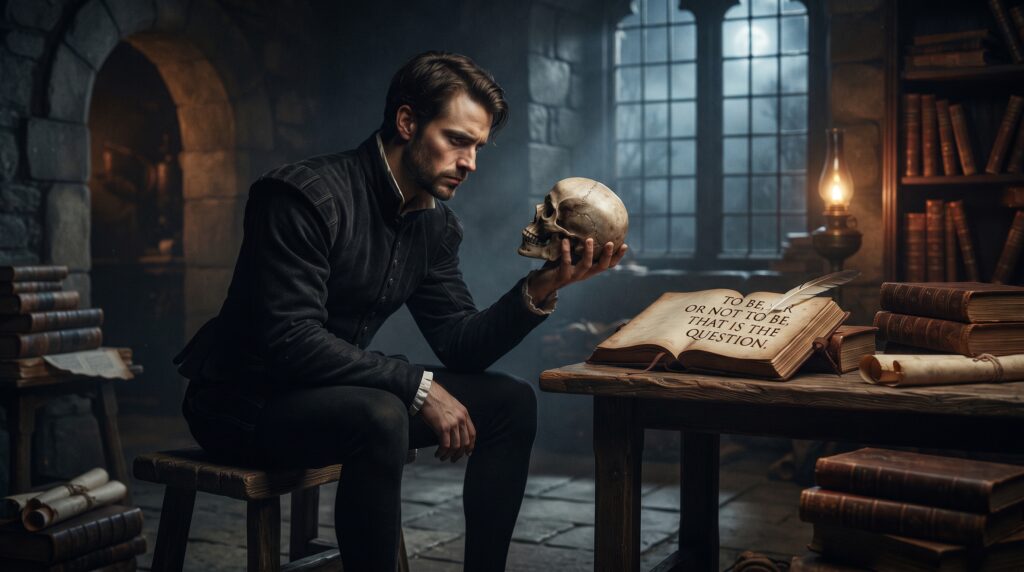
Few works in global literature have woven themselves into the fabric of daily human speech quite like William Shakespeare’s Hamlet. Whether you realize it or not, if you have ever debated whether to take action, worried that someone “doth protest too much,” or felt that something was fundamentally wrong in your environment, you are quoting the Prince of Denmark. For centuries, literature lovers, actors, and philosophers have turned back to these famous lines hamlet has gifted the world, looking for profound insights into the human condition.
Yet, because Shakespeare wrote during the late Elizabethan and early Jacobean eras (c. 1599–1602), modern readers often encounter a double-edged sword. These iconic phrases are instantly recognizable, but they are frequently taken out of context, misattributed, or misconstrued. In this comprehensive guide, we will unpack 15 of the most essential, widely quoted lines from Hamlet, exploring their dramatic context, historical nuances, and true psychological meanings.
Setting the Scene: Why Hamlet Remains Shakespeare’s Most Quoted Masterpiece
To understand why Hamlet yields more household adages than almost any other English text, we must look at its cultural and historical weight. Written at the turn of the 17th century, Hamlet captures a palpable societal anxiety. The Elizabethan era was drawing to a close, and the certainty of the medieval worldview—where humanity occupied a neat, divinely ordered place in the cosmos—was giving way to early modern skepticism, existential dread, and scientific curiosity.
Prince Hamlet is literature’s first truly modern protagonist. Unlike classical heroes who act swiftly and decisively based on honor, Hamlet thinks too much. He hesitates, philosophizes, feigns madness, and questions the very nature of reality, death, and duty. Because his internal monologue addresses universal dilemmas—grief, betrayal, procrastination, and mortality—his words transcend the boundaries of Renaissance drama. They speak directly to anyone trying to navigate an unpredictable world.
The Core Collection: 15 Essential Hamlet Quotes Decoded
1. “To be, or not to be, that is the question” (Act 3, Scene 1)
-
The Context: Alone on stage, Hamlet contemplates the unbearable weight of his existence. He weighs the agonizing choice between enduring life’s suffering (“to suffer / The slings and arrows of outrageous fortune”) or ending it all through suicide.
-
Deeper Meaning: While often reduced to a cliché about general indecision, the quote is a profound philosophical inquiry into human endurance. Hamlet is asking whether it is nobler of mind to suffer life’s indignities passively or to take arms against them—knowing full well that the “undiscovered country” of death might be far worse than the misery we already know.
2. “Though this be madness, yet there is method in ‘t” (Act 2, Scene 2)
-
The Context: Polonius, the king’s chief counselor, observes Hamlet’s erratic behavior and sharp, biting insults, trying to decode whether the prince has genuinely lost his mind.
-
Deeper Meaning: This line highlights the tension between chaos and calculated control. Polonius senses that Hamlet’s bizarre performance carries a razor-sharp logic. It serves as a reminder that what appears to be unhinged behavior can often conceal a deliberate, strategic intent.
3. “The lady doth protest too much, methinks” (Act 3, Scene 2)
-
The Context: Hamlet and Queen Gertrude are watching a play-within-a-play (The Mousetrap). The fictional Player Queen passionately vows never to remarry if her husband dies, prompting Hamlet to ask his mother how she likes the performance.
-
Deeper Meaning: This line is frequently misquoted as “methinks the lady doth protest too much.” It speaks directly to human psychology: when someone denies a fault or overcompensates in their vows with excessive emotional defense, they usually reveal their own guilt, insecurity, or hypocrisy. Gertrude, who hurriedly married her late husband’s murderer/brother Claudius, feels the sting of this mirror.
4. “Brevity is the soul of wit” (Act 2, Scene 2)
-
The Context: Polonius enters the royal court, promising to reveal the exact cause of Hamlet’s supposed madness, and launches into a long-winded, pompous preamble before finally spitting out the statement.
-
Deeper Meaning: The supreme irony of this line is that Polonius is entirely incapable of being brief. Shakespeare uses Polonius to mock intellectual pomposity. True “wit” (which in Elizabethan English meant understanding, intelligence, and sharpness) requires concise expression, a virtue the verbose counselor utterly lacks.
5. “Something is rotten in the state of Denmark” (Act 1, Scene 4)
-
The Context: Marcellus, a guard, utters this line to Horatio after Hamlet follows the ghost of his father into the darkness, sensing that an ominous supernatural event signals broader political decay.
-
Deeper Meaning: This has become a universal political metaphor. In Hamlet, the supernatural appearance is a symptom of a deeper societal rot—specifically, the regicide committed by Claudius. The line establishes a direct thematic link between moral corruption in leadership and the breakdown of the natural order.
6. “There are more things in heaven and earth, Horatio, / Than are dreamt of in your philosophy” (Act 1, Scene 5)
-
The Context: Hamlet admonishes his pragmatic, university-educated friend Horatio, who is struggling to rationalize the appearance of the King’s Ghost.
-
Deeper Meaning: A critique of academic arrogance and rationalism. Hamlet reminds Horatio that human science, philosophy, and institutional knowledge are inherently limited. Reality contains mysteries far beyond the scope of human textbooks and logical frameworks.
7. “Conscience does make cowards of us all” (Act 3, Scene 1)
-
The Context: A concluding realization in the “To be, or not to be” soliloquy, where Hamlet reflects on how human thought processes interfere with action.
-
Deeper Meaning: Reflection breeds doubt. When we stop to analyze the moral consequences, risks, and moral weight of our actions, our native hue of resolution is “sicklied o’er with the pale cast of thought.” Overthinking paralyzes us, turning potential heroes into hesitant bystanders.
8. “Rich gifts wax poor when givers prove unkind” (Act 3, Scene 1)
-
The Context: Ophelia speaks these words to Hamlet as she attempts to return the tokens, letters, and gifts he gave her during happier times, now that his behavior has turned erratic and cruel.
-
Deeper Meaning: Material value is entirely dependent on emotional context. Expensive or meaningful gifts lose all their beauty and worth when the person who gave them turns out to be cruel, false, or malicious.
9. “Get thee to a nunnery, go” (Act 3, Scene 1)
-
The Context: During their tense confrontation, Hamlet violently turns on Ophelia (who is being used as bait by Polonius and Claudius), urging her to flee the corrupt world.
-
Deeper Meaning: This line requires historical context. In Elizabethan slang, a “nunnery” could mean a convent, but it was also common slang for a brothel. Hamlet is operating on a dual-layered grief: he wants Ophelia to escape the sinful, corrupt courtly world entirely (convent), but he also cynically views women as breeders of sinners in a corrupt society (brothel). It captures his deep emotional fracture.
10. “A little more than kin, and less than kind” (Act 1, Scene 2)
-
The Context: Hamlet mutters this scathing aside when King Claudius addresses him publicly as “my cousin Hamlet, and my son.”
-
Deeper Meaning: A masterclass in Elizabethan wordplay. Claudius has become “more than kin” because he is now both Hamlet’s uncle and his stepfather. Yet, they are “less than kind” because they share no natural harmony or affection, and “kind” also hints at kindred or natural human decency. It establishes the immediate hostility between the two men.
11. “The play’s the thing / Wherein I’ll catch the conscience of the king” (Act 2, Scene 2)
-
The Context: At the end of Act 2, having arranged for a troupe of traveling actors to perform a murder scene mirroring his father’s death, Hamlet outlines his plot to test Claudius.
-
Deeper Meaning: This highlights the transformative, revelatory power of art. Hamlet believes that rational arguments and accusations can be dodged, but narrative art bypasses intellectual defenses, striking directly at emotional guilt and forcing a guilty man to betray himself.
12. “Alas, poor Yorick! I knew him, Horatio” (Act 5, Scene 1)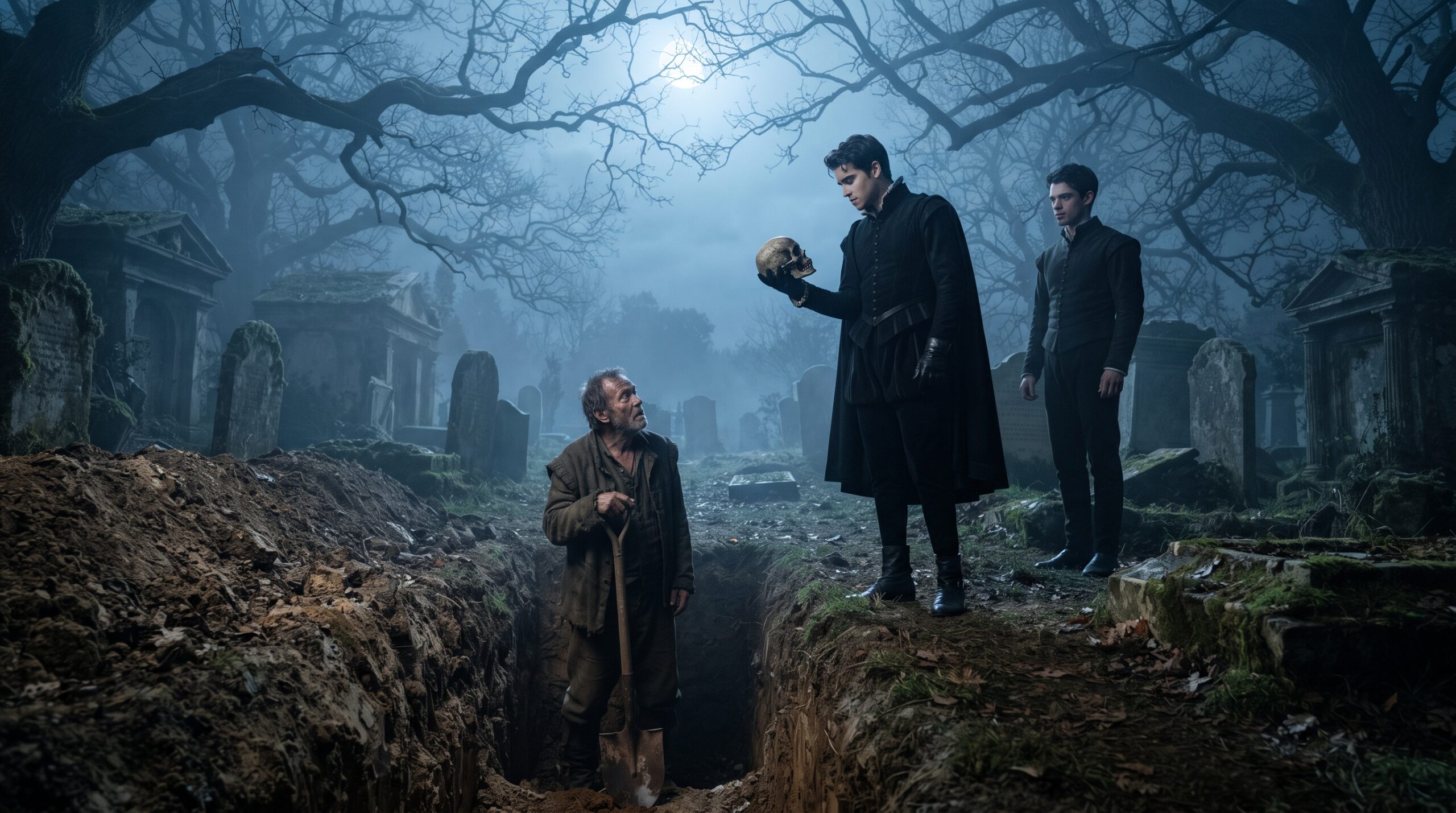
-
The Context: In the graveyard scene, Hamlet picks up the skull of the former court jester who used to carry him on his back.
-
Deeper Meaning: One of literature’s most iconic meditations on mortality. Hamlet confronts the physical reality of death: regardless of how witty, lively, or powerful a person was in life, everyone ultimately reduces to bone and dust. It strips away the pomp of royalty and confronts the great equalizer.
13. “Doubt thou the stars are fire; / Doubt that the sun doth move; / Doubt truth to be a liar; / But never doubt I love” (Act 2, Scene 2)
-
The Context: Polonius reads aloud a love letter that Hamlet previously wrote to Ophelia, attempting to use it as evidence of madness caused by unrequited love.
-
Deeper Meaning: While Polonius mocks it as clumsy courtly verse, these lines reveal a rare glimpse of earnest, passionate vulnerability in Hamlet before his world collapses. It contrasts rigid courtly artifice with raw, romantic hyperbole.
14. “When sorrows come, they come not single spies, / But in battalions” (Act 4, Scene 5)
-
The Context: King Claudius laments the sudden collapse of political and domestic order—Polonius is dead, Hamlet has been banished, and Ophelia has lost her mind.
-
Deeper Meaning: Misfortune rarely visits in isolation. When life falls apart, crises compound, crashing down in waves rather than arriving as manageable, individual events.
15. “The rest is silence” (Act 5, Scene 2)
-
The Context: Hamlet’s final, dying words to Horatio after the tragic bloodbath in the final scene.
-
Deeper Meaning: The ultimate contrast to a play dominated by thousands of lines of philosophical debate, political plotting, and verbal sparring. Death brings an absolute, unanswerable quiet—the final transition from turbulent human consciousness into the unknown.
Common Misconceptions: Famous Lines People Always Get Wrong
When discussing famous lines hamlet provides, even seasoned literature enthusiasts frequently slip up. Let’s clear up two major misconceptions that often plague popular culture:
-
“Neither a borrower nor a lender be”: This famous piece of advice is almost universally attributed to Hamlet. In reality, it is spoken by Polonius giving parting advice to his son Laertes in Act 1, Scene 3. More importantly, within the play’s context, Polonius is a hypocritical, meddling politician; Shakespeare may well be framing this adage as shallow, transactional wisdom rather than absolute moral truth.
-
“To thine own self be true”: Another classic Poloniusism, often quoted as deep existential wisdom. However, coming from a character who spends his entire life spying, manipulating, and counseling others on how to protect appearances rather than integrity, the line carries heavy dramatic irony.
How to Use and Cite Hamlet Quotes Correctly
If you are incorporating these lines into an academic essay, a book review, or a creative writing project, correct citation is vital for maintaining professional authority:
-
Academic Formatting (MLA/APA): Shakespearean plays are cited by Act, Scene, and Line rather than page numbers. For example:
(Ham. 3.1.56)refers to Hamlet, Act 3, Scene 1, line 56. -
Integration: Avoid dropping long quotes blindly into paragraphs. Use analytical framing clauses (e.g., “As Hamlet reflects on the paralyzing nature of moral thought…”) to weave the verse naturally into your prose.
Frequently Asked Questions (FAQs)
Q1: What is the most famous line in Hamlet?
Without a doubt, “To be, or not to be, that is the question” (Act 3, Scene 1) is the most widely recognized line, frequently cited in literature, film, and everyday pop culture.
Q2: Why are Shakespeare’s plays written in iambic pentameter?
Iambic pentameter mimics the natural rhythm of the English heartbeat and spoken speech patterns. It helped actors memorize thousands of lines quickly while giving the dramatic verse an elevated, rhythmic momentum.
Q3: How can beginners better understand Shakespearean language?
Focus on the underlying emotion and rhythm rather than stopping at every unfamiliar word. Reading annotations alongside the text or watching professional stage performances (such as productions by the Royal Shakespeare Company) can instantly bridge the gap.
Q4: Why is Hamlet often considered Shakespeare’s most complex character?
Unlike traditional tragic heroes who possess a single flaw (like ambition in Macbeth), Hamlet struggles with introspection, morality, grief, and inaction, making him feel remarkably human and modern.
Carrying the Torch of Elizabethan Wisdom
The enduring legacy of Hamlet lies in its refusal to offer neat, easy answers. The famous lines hamlet features are not mere decoration; they are lenses through which we examine our own doubts, political anxieties, and mortality. By moving past clichés and understanding their true dramatic context, we unlock a deeper appreciation for why Shakespeare remains the definitive voice of the human experience.