
A kingdom unraveling, a young woman driven to a heartbreaking psychological break, and a furious son storming the castle gates for blood. If you want to understand the explosive turning point of Shakespeare’s most famous tragedy, Hamlet Act 4 Scene 5 is where the collateral damage of the Prince’s delay finally comes to collect.
Whether you are a student writing a literary analysis, an actor preparing for a complex monologue, or a theater enthusiast seeking deeper context, mastering this scene is crucial. It contains some of Shakespeare’s most brilliant use of botanical symbolism, psychological contrast, and political tension. By the time this scene ends, the board is irreversibly set for the bloody climax of Act 5.
This comprehensive guide will provide a thematic breakdown of the scene, decode the hidden meanings of Ophelia’s flowers and songs, analyze Laertes as Hamlet’s ultimate foil, and explore how King Claudius manipulates the chaos to maintain his fragile grip on the Danish crown.
The Plot Unfolds: A Summary of Act 4 Scene 5
By the time the curtain rises on Act 4, Scene 5, the court of Elsinore is in a state of absolute chaos. Polonius has been murdered by Hamlet, who has subsequently been secretly exiled to England. The Danish public is unsettled, whispering rumors about Polonius’s suspicious, hushed-up death and hasty burial.
The scene opens with Queen Gertrude refusing to speak with Ophelia. A Gentleman and Horatio warn the Queen that Ophelia’s condition is deteriorating; she is babbling nonsensically, and her words might “strew dangerous conjectures in ill-breeding minds.” Reluctantly, Gertrude agrees to see her.
Ophelia enters, entirely disconnected from reality, singing disjointed folk songs about death, betrayal, and lost virginity. King Claudius witnesses her tragic state, lamenting that “sorrows come not single spies, but in battalions.”
The political unrest outside suddenly boils over. Laertes, having secretly returned from France, violently breaches the castle with a riotous mob demanding that he be crowned king. Furious and demanding answers about his father’s death, Laertes confronts Claudius. The tension is momentarily defused, only to be reignited when Ophelia wanders back into the room. Seeing his sister’s shattered mind breaks Laertes’s heart. Ophelia distributes her famous symbolic flowers to the court, and after she departs, Claudius uses Laertes’s raw grief to his advantage, promising to help the young man channel his vengeance toward the true culprit.
Decoding Ophelia’s Madness: Grief, Betrayal, and Hidden Truths
Why Does Ophelia Break? The Psychology of Her Madness
Ophelia’s descent into madness is one of the most debated and analyzed psychological breaks in Western literature. Her mental collapse is not merely the result of a single traumatic event, but a compounding of emotional betrayals that strip away her entire identity.
In the patriarchal society of Shakespearean Denmark, Ophelia has no agency. Her existence is entirely defined and controlled by the men in her life: her father (Polonius) dictates her obedience, her brother (Laertes) polices her chastity, and her lover (Hamlet) toys with her affections. When Hamlet murders Polonius, the cognitive dissonance is too much to bear. The man she loves has killed the man who controls her. With her father dead, her brother absent, and Hamlet exiled (and cruel to her before his departure), the external structures that held her identity together vanish. Left defenseless, her psyche shatters.
The Hidden Meanings Behind Ophelia’s Songs
Shakespeare frequently uses madness in his plays as a vehicle for characters to speak dangerous truths. Ophelia’s songs allow her to express taboo subjects—anger at the crown, sexual desire, and betrayal—that she could never voice as a sane, obedient noblewoman.
-
The Dirges for the Dead: She sings of a man laid in the cold ground (“He is dead and gone, lady, / He is dead and gone”). This reflects her profound trauma over Polonius’s rushed, secret burial. As a high-ranking lord, Polonius deserved state honors; instead, he was hidden away in “hugger-mugger,” denying Ophelia the psychological closure of a proper mourning period.
-
The St. Valentine’s Day Song: Perhaps the most shocking moment for an Elizabethan audience is Ophelia’s bawdy song about a maid who visits a man’s window on Valentine’s Day, loses her virginity, and is subsequently abandoned.
“Quoth she, ‘Before you tumbled me, / You promised me to wed.’” This heavily implies that Hamlet and Ophelia’s relationship may have been consummated, or at the very least, it highlights her deep trauma over Hamlet’s sexual betrayal and his aggressive, misogynistic behavior toward her in the “Nunnery Scene” (Act 3, Scene 1).
The Language of Flowers: What Do Ophelia’s Gifts Mean?
When Ophelia returns to the court, she hands out flowers. To the untrained eye, it is the rambling of a madwoman. To those who understand Elizabethan floriography (the language of flowers), she is delivering a devastating, razor-sharp indictment of the Danish court.
Genuine vs. Feigned Madness (Ophelia vs. Hamlet)
Act 4 Scene 5 provides a masterclass in the contrast between genuine psychological collapse and calculated performance. Throughout the play, Hamlet adopts an “antic disposition”—a fake madness used as a cloak to investigate his father’s murder without drawing suspicion. Hamlet’s madness is highly verbal, witty, and deeply philosophical. He is always in control of his “insanity.”
Ophelia’s madness, however, is a terrifying loss of control. Her psychological break is genuine, visceral, and tragic. Yet, ironically, her genuine madness reveals the emotional and moral truths of Elsinore far more clearly than Hamlet’s calculated game of chess. As Laertes notes, her ramblings are a “document in madness, thoughts and remembrance fitted.”
Laertes’ Revenge: The Perfect Foil to Hamlet
“To Hell, Allegiance!”: The Anatomy of a Rebellion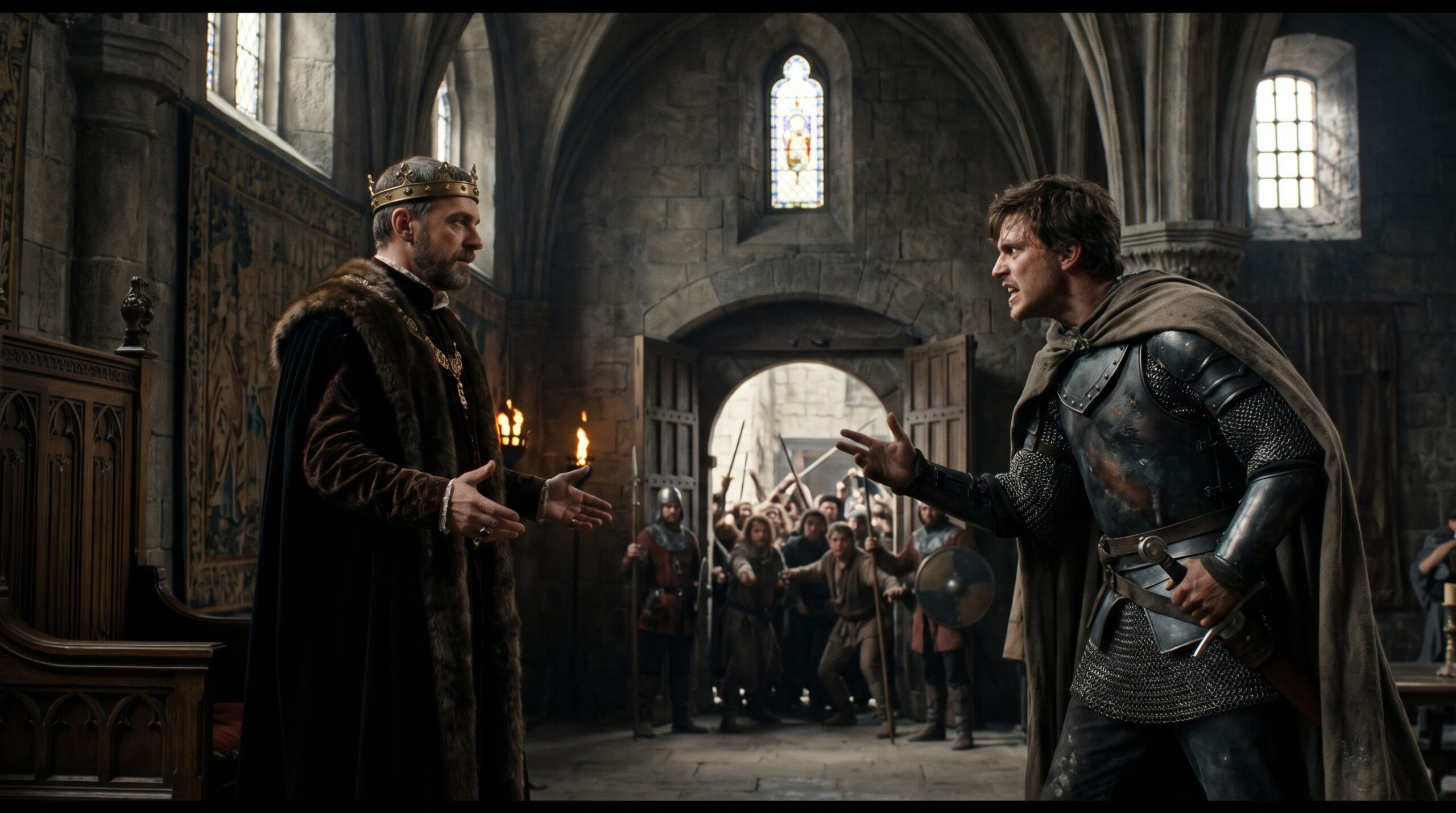
If Hamlet is defined by his tragic inaction, Laertes is defined by his explosive, unthinking action. Laertes serves as the perfect foil (a character whose qualities contrast with another to highlight specific traits) to the Prince of Denmark.
When Laertes discovers his father is dead, he does not soliloquize. He does not debate theology or the nature of existence. He raises an army, breaks down the castle doors, and confronts the King directly.
“To hell, allegiance! Vows, to the blackest devil! / Conscience and grace, to the profoundest pit! / I dare damnation.”
Laertes ignores the “divine right” of kings and is entirely willing to damn his own soul to hell to achieve his revenge. This is in stark, deliberate contrast to Hamlet, who in Act 3, Scene 3, refuses to kill Claudius because the King is praying, overthinking the theological implications of sending his uncle to heaven. Where Hamlet’s intellect paralyzes him, Laertes’s passion propels him.
A Brother’s Grief: “O Rose of May”
Despite his violent entrance, Laertes is not a one-dimensional brute. His reaction to seeing Ophelia’s madness adds immense depth to his character. His political fury instantly shifts into agonizing personal grief. Calling her his “rose of May,” Laertes’s compassion for his sister mixes with his rage. This vulnerability makes his eventual manipulation by Claudius all the more tragic; his love for his family becomes the very weapon the King uses to control him.
King Claudius: The Master Manipulator at Work
“When sorrows come, they come not single spies, but in battalions”
Early in the scene, Claudius delivers one of the play’s most famous lines, realizing that his initial sin—murdering his brother, King Hamlet—has triggered a domino effect of disasters. Tragedies do not arrive as isolated scouts (“single spies”); they attack as an overwhelming military force (“battalions”). Claudius is hyper-aware that the political and social fabric of Denmark is collapsing around him.
Defusing the Bomb: How Claudius Survives Laertes
Claudius’s handling of the furious, armed Laertes is a masterstroke of Machiavellian political survival.
First, he leans heavily on the Divine Right of Kings. Despite having stolen the crown through murder, Claudius hypocritically wraps himself in the protection of God, telling a terrified Gertrude:
“Let him go, Gertrude. Do not fear our person. / There’s such divinity doth hedge a king / That treason can but peep to what it would.”
Second, Claudius executes a brilliant psychological pivot. Instead of fighting Laertes, he validates the young man’s anger. He tells Laertes that he is acting like a “good child and a true gentleman.” By remaining impossibly calm, acknowledging Laertes’s grief, and bringing him into his confidence, Claudius successfully diffuses a violent coup. He then masterfully shifts all the blame away from himself and places a target directly on Hamlet’s back, effectively turning Laertes into his personal assassin.
Why Act 4 Scene 5 is the Catalyst for the Play’s Climax
Act 4, Scene 5 is the structural linchpin of the play. It transitions the narrative from the psychological stalling of the middle acts into the bloody, fatalistic action of the finale.
-
The Setup of the Duel: By weaponizing Laertes’s grief, Claudius sets the stage for the poisoned fencing match in Act 5.
-
The Fate of Ophelia: Her madness here directly foreshadows her tragic death by drowning in the very next scene. Her inability to survive in the toxic environment of Elsinore is sealed the moment she hands out her flowers.
-
The Mirror Image: It forces the audience to see exactly what Hamlet could have done. Laertes demonstrates what immediate, unthinking vengeance looks like, highlighting the consequences of both action and inaction in Shakespeare’s world.
Frequently Asked Questions (FAQs)
What is the significance of the flowers Ophelia hands out in Act 4 Scene 5? Ophelia uses flowers to symbolize the hidden sins and truths of the Danish court. She gives rosemary for remembrance, pansies for thoughts, fennel and columbines for deceit and adultery (targeting Claudius and Gertrude), and rue for sorrow and repentance. She notes that violets, symbolizing faithfulness, all died with her father.
Why is Laertes considered a foil to Hamlet? A foil is a character who contrasts sharply with another. While Hamlet is intellectual, hesitant, and paralyzed by overthinking his revenge, Laertes is passionate, decisive, and acts immediately. Laertes is willing to damn his soul for vengeance, whereas Hamlet constantly worries about the afterlife.
Who is the “riotous mob” supporting Laertes? The mob consists of the Danish public, who are angry and suspicious about the secretive death and burial of Polonius. Their willingness to overthrow Claudius and crown Laertes shows how fragile and unpopular Claudius’s grip on the throne truly is.
What does King Claudius mean by “sorrows come in battalions”? Claudius uses a military metaphor to explain that bad things rarely happen one at a time. Instead of arriving like solitary scouts (“single spies”), tragedies and disasters arrive all at once like an overwhelming army (“battalions”), referring to Polonius’s death, Hamlet’s exile, Ophelia’s madness, and the public uprising.
Conclusion
Hamlet Act 4 Scene 5 is a masterclass in contrasting psychological and physical reactions to grief. It juxtaposes Ophelia’s tragic internal collapse with Laertes’s explosive external rage. Through chilling folk songs and the coded language of flowers, a mad Ophelia manages to indict the entire royal court, while Laertes’s blind fury allows him to be molded into a weapon by a desperate, manipulating King.
Ultimately, this pivotal scene proves that in Shakespeare’s world, buried secrets and delayed justice act like a poison. They rot the state from the inside out, guaranteeing that when the final curtain falls, it will destroy both the guilty who perpetrated the crimes, and the innocent who were caught in the crossfire.