There is an old adage in the theatrical world: a company’s true mettle is not tested by how well they mount a contemporary comedy, but by how they survive the ghost of the Prince of Denmark. Staging Shakespeare’s most notoriously complex tragedy is a monumental undertaking, fraught with centuries of audience expectations and academic scrutiny. So, when the curtains finally parted for Hamlet at Midcity, I approached the evening with a mix of anticipation and scholarly skepticism. As a Shakespearean researcher and lifelong theater critic, I have seen this play performed in every conceivable manner—from Elizabethan purist reconstructions to avant-garde cyberpunk adaptations.
For the average theatergoer, committing to a three-hour descent into grief, madness, and royal espionage can feel daunting. Is this production worth the ticket price? Will the dialogue be accessible? What nuances should you be looking for? In this comprehensive guide and expert review, I will break down exactly how this staging holds up to the Bard’s legacy. We will explore the directorial vision, dissect the core performances, and provide you with an essential viewing guide so you can arrive at the theater fully prepared to experience Elsinore like never before.
The Directorial Vision: Bringing the Prince of Denmark to Midcity
The success of any Hamlet hinges entirely on the director’s foundational vision. Elsinore is not just a castle; it is a psychological landscape.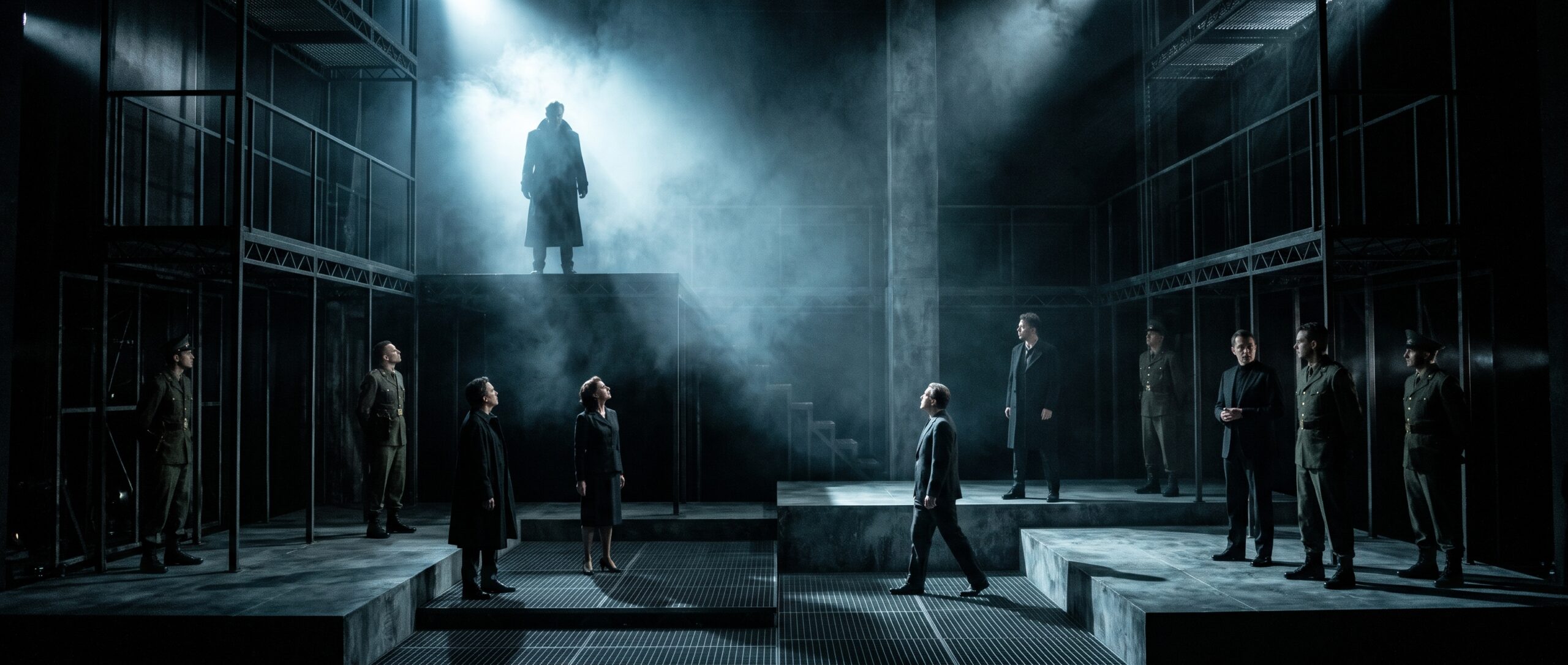
Modern vs. Traditional: Where Does This Production Land?
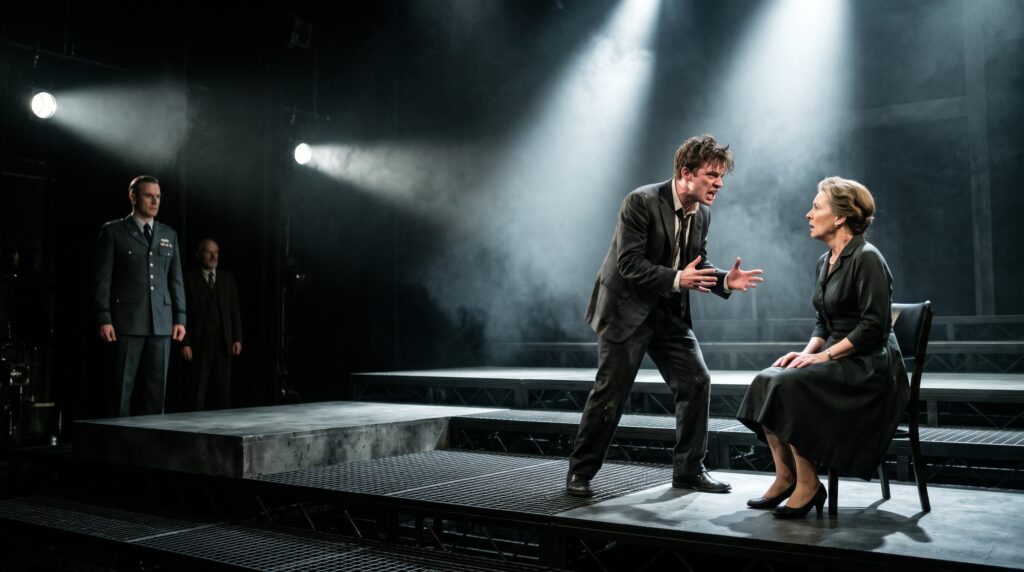
Rather than trapping the characters in stiff Elizabethan ruffs and doublets, this production adopts a strikingly brutalist, mid-century modern aesthetic. It is a world of sharp angles, cold concrete, and pervasive shadows. This is not a romanticized Denmark. By stripping away the velvet and gold, the Midcity production leaves us with a stark, militaristic state.
This aesthetic choice brilliantly externalizes Hamlet’s internal claustrophobia. The modern dress—sharp suits for the politicians, utilitarian uniforms for the guards—makes the political maneuvering feel dangerously contemporary. It bridges the four-hundred-year gap between Shakespeare’s text and today’s audience, rendering the themes of state surveillance and paranoia instantly recognizable without feeling like a forced modernization.
Thematic Focus: What is the Director Saying?
Every staging of Hamlet must choose a primary lens. Is it a revenge thriller? A family drama? A philosophical exploration of mortality? The Midcity production leans heavily into the theme of surveillance and public vs. private performance.
Throughout the play, characters are constantly watching one another. Polonius spies on Laertes; Claudius and Gertrude spy on Hamlet; Hamlet spies on the King. The director accentuates this by keeping supporting characters on the periphery of the stage, half-hidden in the shadows, quietly observing scenes they traditionally would not be present for. It creates an atmosphere of suffocating paranoia. Denmark truly feels like a prison, echoing Hamlet’s famous lament, because there is literally nowhere to hide.
Expert Insight: The Textual Puzzle Hamlet does not exist as one definitive manuscript. Scholars typically debate between three surviving early texts: the “Bad” First Quarto (Q1), the lengthy Second Quarto (Q2), and the First Folio (F1). The Midcity production heavily favors the First Folio text. F1 is known for being a tighter, more theatrical cut that removes some of Hamlet’s more sprawling philosophical detours in favor of a faster-paced revenge narrative. This choice significantly bolsters the production’s thriller-like momentum, keeping the audience on the edge of their seats.
A Scholar’s Review of “Hamlet at Midcity”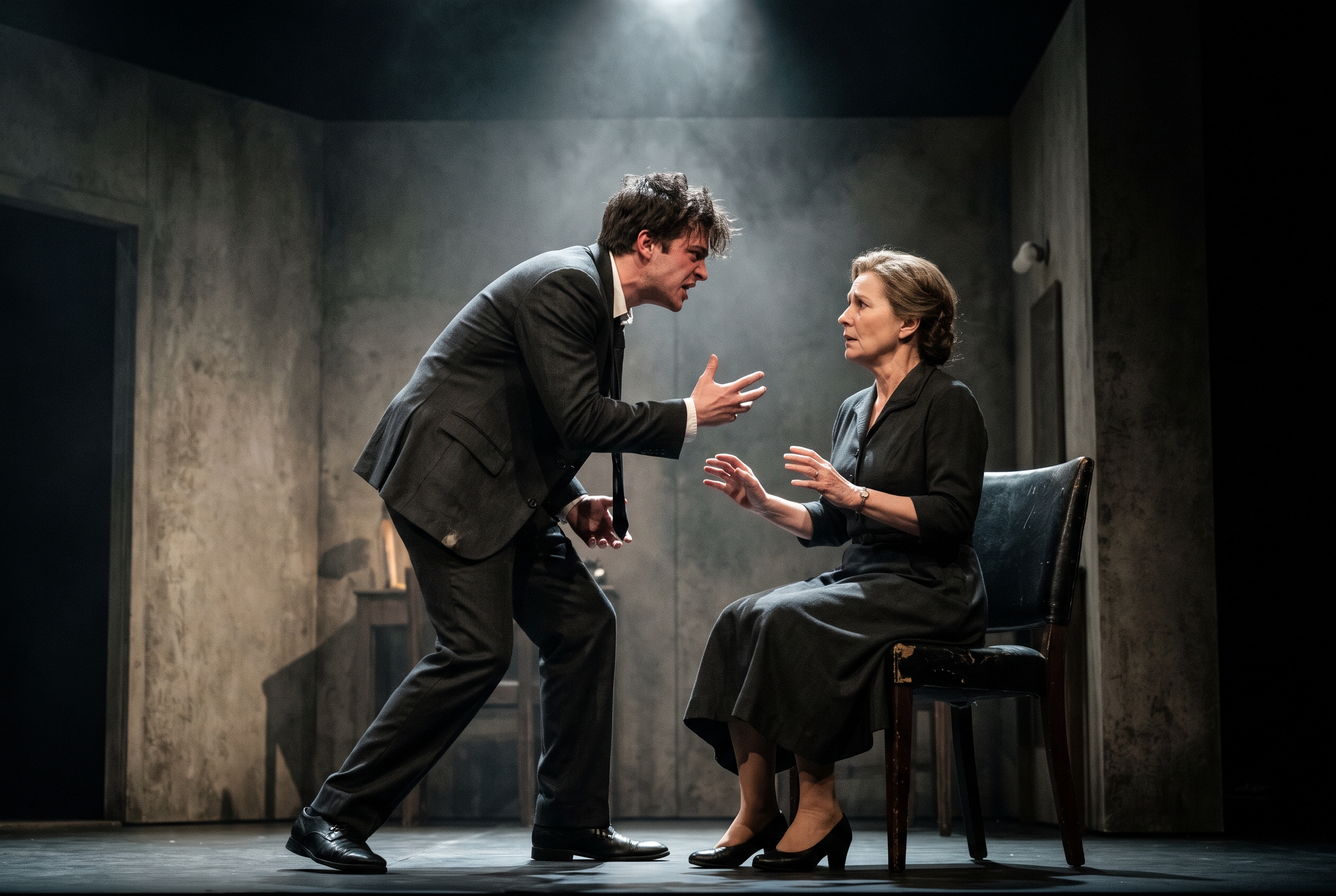
A brilliant set and a clever concept mean very little if the actors cannot navigate the treacherous waters of Shakespeare’s iambic pentameter. Fortunately, the cast assembled here delivers a masterclass in breath control, emotional resonance, and textual clarity.
The Lead: Dissecting the Performance of Hamlet
Playing Hamlet is a tightrope walk. Lean too far into the depression, and the character becomes a tedious, inactive whiner. Lean too far into the “antic disposition” (his feigned madness), and he becomes an unrecognizable clown.
The actor leading this production finds a breathtaking middle ground: a kinetic, fiercely intelligent prince drowning in a sea of grief. What stands out most is the raw, visceral anger beneath the melancholy. This Hamlet is not just sad; he is furious at the hypocrisy of the adult world around him. During the iconic “To be, or not to be” soliloquy, the delivery is not a sleepy philosophical musing directed at the ceiling, but an urgent, desperate debate with the audience itself. The fourth wall is momentarily shattered, pulling us directly into his fractured psyche.
The Supporting Court: Claudius, Gertrude, and Polonius
The tragic arc of the play relies heavily on the threat level of its antagonist. Claudius, often played as a mustache-twirling villain, is presented here as a chillingly competent, charismatic CEO-type leader. His smiles are warm, his political speeches are commanding, and his ruthlessness is entirely terrifying because it is so calm.
Gertrude is equally compelling. The production grants her a tremendous amount of agency, portraying her not as a weak-willed pawn, but as a pragmatic survivor trying to maintain stability in a violently volatile court. The “closet scene” (Act 3, Scene 4) between Hamlet and his mother is the emotional climax of the evening—a brutal, heartbreaking collision of two people fundamentally misunderstanding each other’s grief.
Meanwhile, Polonius is mercifully rescued from being a mere doddering fool. Here, he is a sharp, calculating spymaster whose long-windedness is a deliberate tactic used to disorient his political rivals. When he meets his demise behind the arras, it feels less like a comedic accident and more like the inevitable consequence of playing a deadly political game.
The Tragedy of Ophelia: A Fresh Interpretation?
Historically, Ophelia is often reduced to a fragile victim in a white dress who quietly loses her mind. The Midcity production offers a much-needed course correction. Ophelia’s descent into madness is staged not as a delicate, floral fading away, but as a violent, terrifying psychological break.
Following the murder of her father and the gaslighting by her lover, her “mad scene” in Act 4 is profoundly uncomfortable to watch—which is exactly as it should be. By giving Ophelia’s trauma the weight and ugly reality it deserves, the production forces the audience to confront the collateral damage of Hamlet’s quest for revenge.
Pacing, Cuts, and Adaptation
One of the most common search intents for prospective ticket buyers is simply: How long is this going to take? An uncut Hamlet runs well over four hours. The Midcity production clocks in at a highly manageable two hours and forty-five minutes, including one intermission.
To achieve this, the director made the bold, though not uncommon, choice to excise the character of Fortinbras (the Norwegian prince whose army approaches Denmark) almost entirely. While Shakespeare purists might miss the geopolitical backdrop this subplot provides, removing it tightens the narrative focus squarely onto the rotting core of the Danish royal family. The pacing is relentless, moving with a cinematic fluidity from one scene to the next, ensuring that the momentum never sags even during the heavier expository acts.
Staging, Sound, and Atmosphere at the Midcity Theater
Theater is a profoundly physical medium, and the environment in which a play is staged dictates how its themes are absorbed. The creative team at Midcity has crafted an atmospheric pressure cooker that perfectly complements the actors’ intense performances.
Set Design and Lighting: Building a New Elsinore
The architectural configuration of the Midcity Theater has been brilliantly weaponized to serve the narrative. By utilizing a slightly thrust stage, the production forces the action out into the lap of the audience. Elsinore is constructed of tiered platforms and metallic grating, creating vertical levels of power and subjugation.
Lighting designer choices elevate this bleak architecture into something haunting. Sharp corridors of harsh white light cut through pitch-black shadows, mimicking the feeling of an interrogation room. It is visually arresting, ensuring that the audience feels the same lack of warmth and safety that Hamlet experiences. When characters step out of the light, they vanish entirely, visually reinforcing the production’s core theme of surveillance and hidden threats.
Costumes and Soundscaping
While the costumes root the play in a slick, contemporary reality, it is the soundscaping that anchors it in psychological horror. Rather than relying on traditional orchestral swells, the sound design employs a relentless, low-frequency ambient hum during moments of high tension. It is a subtle acoustic trick—almost imperceptible at first—that tightens the audience’s chests and artificially induces a sense of dread.
This modern auditory backdrop contrasts brilliantly with the sharp, unamplified crack of physical violence, making the swordplay in the final act feel terrifyingly real and painfully loud.
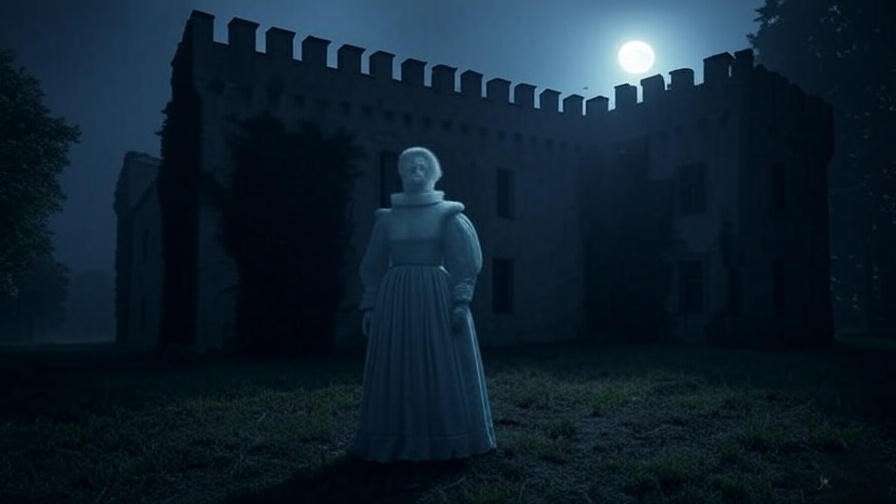
Pro-Tip: Watch for the Ghost in Act 1 Pay special attention to the first appearance of the Ghost of King Hamlet on the battlements. Instead of a clunky suit of armor or a cheesy projection, the production uses a masterful combination of strobe lighting, directional audio, and the physical architecture of the Midcity stage to make the specter appear seemingly out of nowhere. It is a masterclass in theatrical misdirection that will genuinely make the hairs on your arms stand up.
The Essential Viewing Guide: How to Prepare for the Show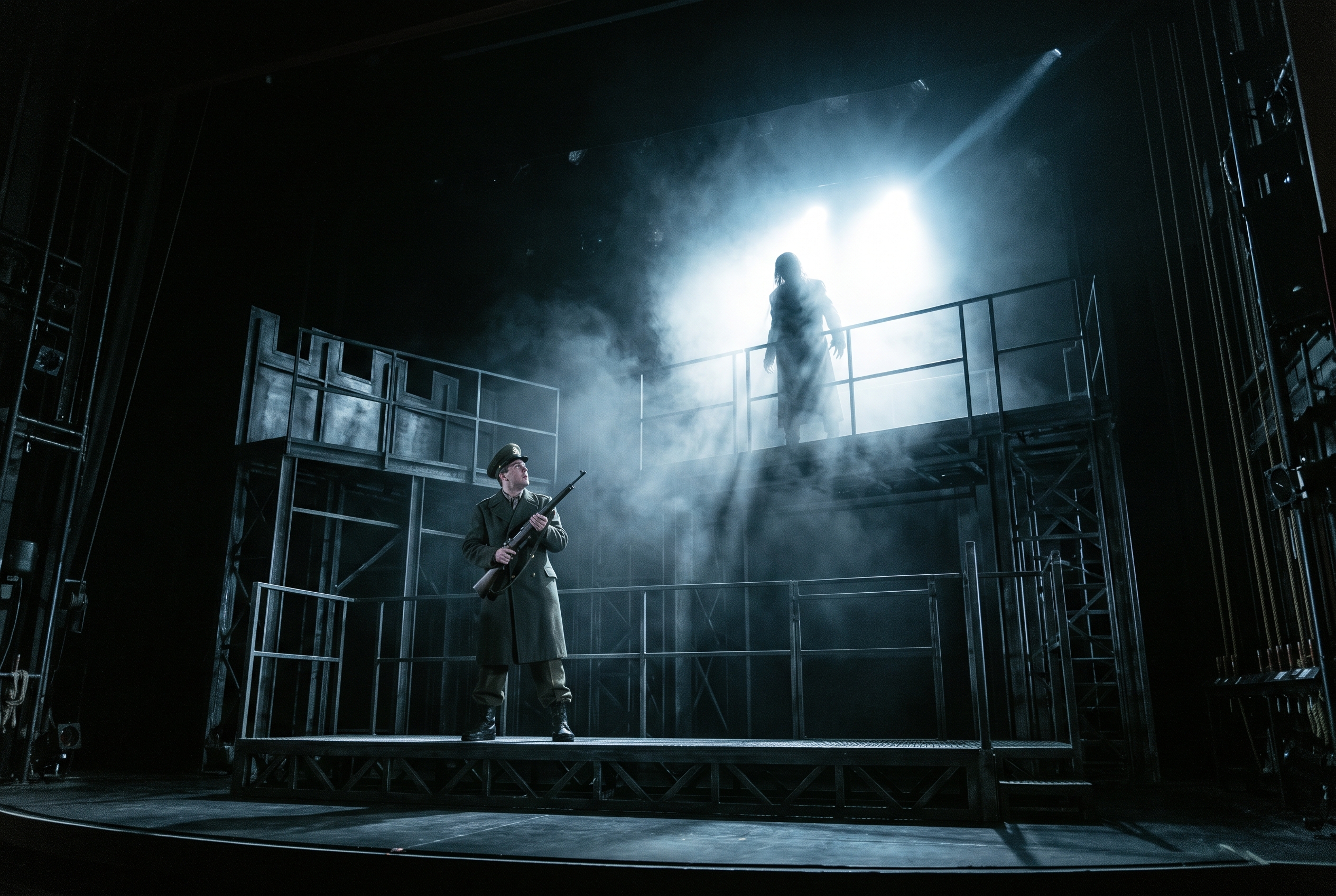
Even with a top-tier production, Hamlet demands active participation from its audience. The language is dense, and the plot is layered with political intrigue. Here is your expert guide to maximizing your theatrical experience.
3 Things to Know Before You Go
If you are walking in without having read the play recently, keep these three foundational facts in mind to immediately grasp the opening stakes:
-
A Hasty Succession: The previous king (Hamlet’s father) died suddenly. Instead of the crown passing to young Hamlet, the king’s brother (Claudius) maneuvered to take the throne.
-
An Uncomfortable Marriage: Within a month of the funeral, Claudius married the widowed queen (Gertrude), Hamlet’s mother.
-
The Threat of War: (Though minimized in this cut, it remains an ambient threat) Denmark is politically unstable, and neighboring nations are watching closely for signs of weakness.
Key Soliloquies to Watch For (Beyond “To be, or not to be”)
While everyone waits for the skull and the famous existential question, the true meat of the play lies in its lesser-known speeches. Keep your ears open for:
-
“O, what a rogue and peasant slave am I!” (Act 2, Scene 2): Watch how the lead actor navigates this massive emotional shift. It begins in self-pity, escalates into a furious, screaming self-indictment of his own cowardice, and ends in the cold, calculated plotting of the “mousetrap” play.
-
Claudius’s Prayer “O, my offence is rank it smells to heaven” (Act 3, Scene 3): This is the moment the villain becomes human. Pay attention to the actor’s body language as he realizes that his prayers for forgiveness are entirely empty because he refuses to give up the crown or the queen.
Maximizing Your Midcity Theater Experience
-
Acoustic Sweet Spots: Due to the thrust stage and the actors frequently turning their backs to the wings, the best acoustics are found in the center orchestra, rows E through K. Avoid the extreme sides of the front mezzanine, as some dialogue directed upstage can become muffled.
-
Intermission Strategy: The intermission occurs immediately after the intense “closet scene” in Act 3. The lobby at Midcity gets incredibly crowded; if you plan to grab a drink or use the restroom, make your move the second the house lights come up, as the second half of the play accelerates rapidly and late seating is strictly prohibited.
Is “Hamlet at Midcity” Right for You? (Audience Breakdown)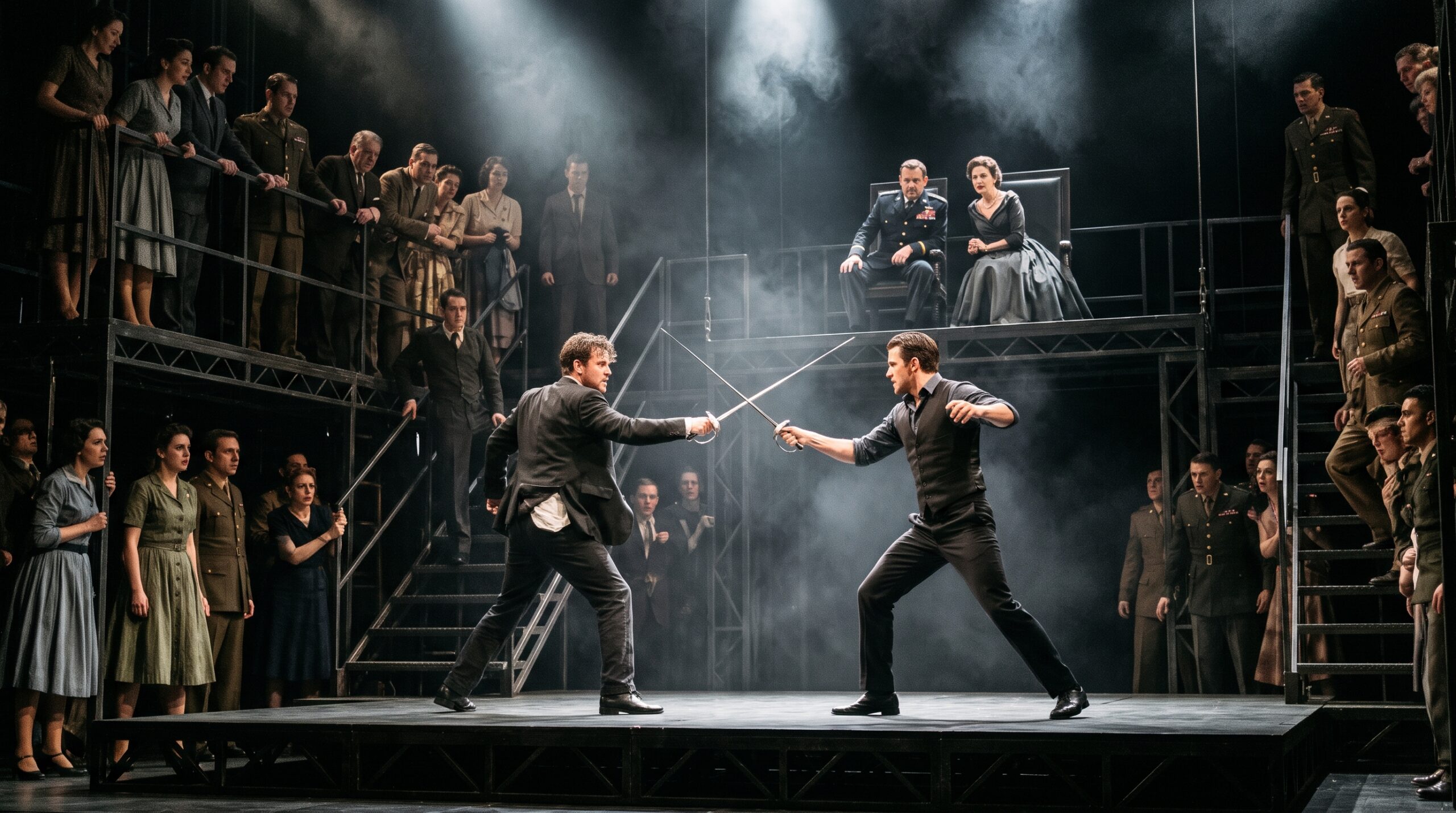
Not every production of Shakespeare is built for every type of viewer. Here is a breakdown of who will get the most out of this specific staging.
For the Shakespeare Purist
If you demand doublets, tights, and a completely uncut First Folio text, this modern, brutally streamlined adaptation might ruffle your feathers. However, if you are a textual enthusiast who appreciates when actors understand the rhythmic pulse of iambic pentameter and use the verse to drive genuine emotional stakes, you will find immense value in this masterful acting clinic.
For the First-Time Theatergoer
This is arguably one of the best possible introductions to Shakespearean tragedy. The modern dress removes a layer of visual alienation, and the thriller-esque pacing keeps the plot moving at a breakneck speed. The actors prioritize clarity of intent over poetic flourishing—meaning even if you do not understand every single 16th-century word, you will always know exactly what the characters are feeling and fighting for.
For Students and Educators
If you are studying the text, this is mandatory viewing. Seeing the play on its feet dissolves the dense, intimidating wall of text found in a textbook. The specific directorial choices regarding surveillance, gender dynamics (particularly Gertrude and Ophelia), and political corruption will provide students with endless material for analytical essays and classroom discussions.
Frequently Asked Questions
To help you plan your visit, here are the answers to the most common logistical questions regarding this production.
How long is the runtime for Hamlet at Midcity?
The total runtime is two hours and forty-five minutes, which includes a single 15-minute intermission.
Is this production of Hamlet suitable for children?
This production is recommended for ages 13 and up. It contains simulated stage violence, blood, discussions of suicide, and intense psychological trauma. There is no explicit language beyond the original Shakespearean text, but the thematic weight makes it inappropriate for young children.
Where is the best place to park for the Midcity Theater?
The most convenient option is the Midcity Arts Garage, located one block south of the theater on 4th Street. It offers a flat evening rate after 5:00 PM. Alternatively, street parking is available but highly limited; arrive at least 45 minutes before curtain if you plan to hunt for a meter.
Are there discounted tickets or rush options available?
Yes. The Midcity box office releases a limited number of $25 student rush tickets two hours before curtain (valid ID required). For general audiences, checking the theater’s official website on Tuesday mornings often reveals discounted digital lottery options for mid-week performances.
Final Verdict: A Must-See Event in This Season’s Theater Lineup
Staging Hamlet is a massive risk, but the creative team at Midcity has delivered a resounding triumph. By stripping away the velvet pageantry and focusing intensely on the psychological rot at the heart of Elsinore, they have created a production that feels urgent, terrifying, and profoundly human. Anchored by a breathtaking lead performance and a uniquely terrifying Claudius, this is not just a museum piece—it is a living, breathing thriller.
Expert Grade: 4.5 out of 5 Stars
Whether you are a seasoned Shakespearean scholar or a weekend theatergoer looking for a compelling night out, Hamlet at Midcity demands your attention. Do not let this cultural touchstone pass you by.
Have you seen the production yet? Did the modern aesthetic enhance the story for you, or do you prefer a traditional Elsinore? Leave your thoughts and reviews in the comments below, and be sure to check the Midcity box office website for remaining ticket availability before the limited run concludes.