Imagine standing on a windswept French coast as a 72-ton beast of steel and carved wood strides toward you, exhaling a thick plume of real fire. You can see the gears turning and the 17 human operators pulling the levers, yet your brain insists the creature is breathing, thinking, and alive. In 1599, William Shakespeare asked the audience at the Globe Theatre to “piece out our imperfections with your thoughts.” Over 400 years later, the Dragon of Calais is proving that the Bard’s ultimate theatrical trick—the willing suspension of disbelief through grand public spectacle—remains the most powerful magic in the world.
For theater students, literature lovers, and cultural travelers, this modern mechanical attraction offers far more than a simple tourist photo op. It bridges the gap between classical Elizabethan stage directions and the massive scale of modern street theater. By examining the engineering, lore, and performance of this French marvel, we gain a tangible, real-world framework to understand the theatrical pageantry that originally brought plays like The Tempest and Macbeth to life.
What is the Dragon of Calais?
To understand why this attraction resonates so deeply with theatrical history, we first have to understand the sheer, overwhelming scale of the spectacle.
The Engineering Behind the Beast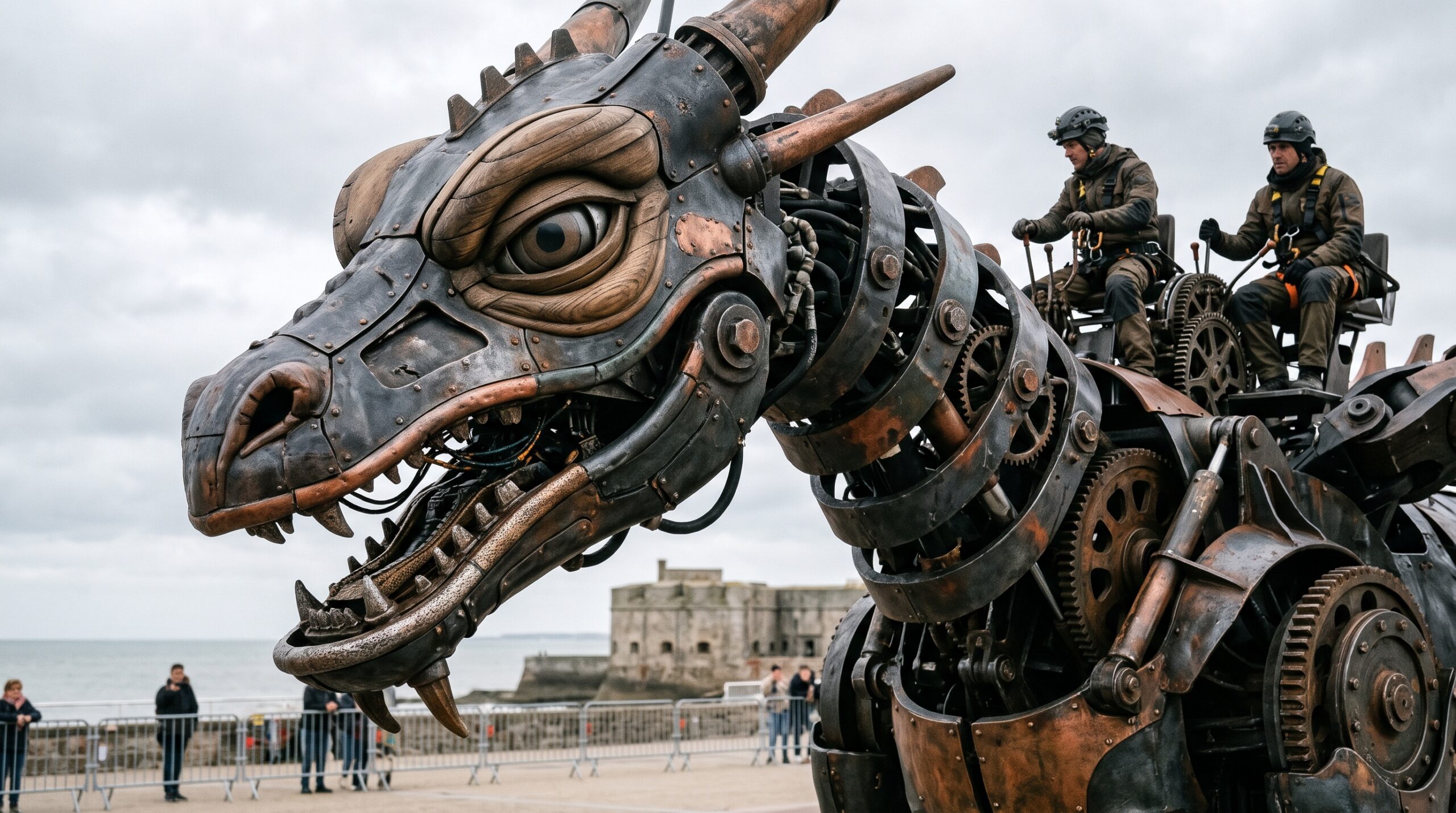
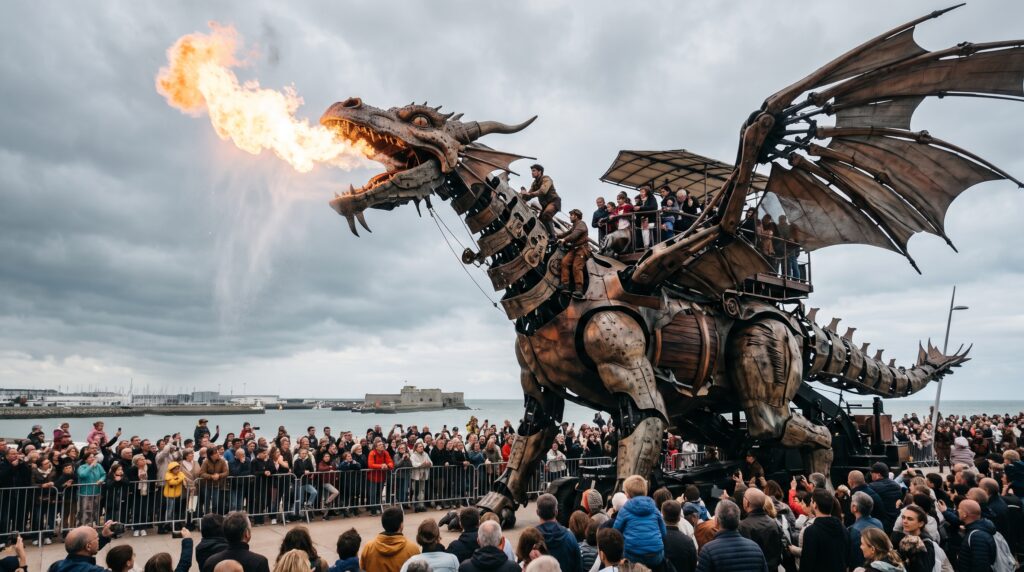
Conceived and built by François Delarozière and the legendary La Machine street theater company, the Dragon is a triumph of kinetic art and mechanical engineering. It measures a staggering 12 meters high and 25 meters long, weighing 72 tonnes. But what sets it apart from static statues or amusement park animatronics is its materiality. The dragon is crafted from exposed steel, intricately carved wood, thick leather, and burnished copper. There is no attempt to hide its artificial nature under synthetic skin or digital projections.
When it moves, it is a masterclass in articulation. The wings stretch out to a span of 17.5 meters, catching the coastal winds. The eyes blink, the heavy wooden eyelids drooping realistically as it “sleeps” or narrowing when it surveys the crowd. Its reptilian mouth opens to roar, spraying water vapor or erupting in genuine, blistering fire. It is, in essence, the largest, most complex practical effect ever built for a public audience.
A Modern Myth for a Historic City
Great theater always requires a compelling narrative, and La Machine did not simply drop a machine onto the beach; they wrote it a myth. According to the lore crafted for the attraction, the creature is a primeval being of earth, air, fire, and water. Long asleep in subterranean galleries beneath the sea, it was awakened by modern construction and emerged to watch over the northern lands of France.
This lore is deeply intertwined with the civic reality of Calais. The dragon was commissioned as the centerpiece of a €46 million renovation of the Calais seafront. Much like the construction of the Globe Theatre revitalized the Bankside district of Elizabethan London, the Dragon demonstrates the enduring power of civic rejuvenation through art. It transforms a standard beach promenade into a mythological landscape, inviting the public to step inside a living story.
“A Kingdom for a Stage”: The Roots of Public Spectacle
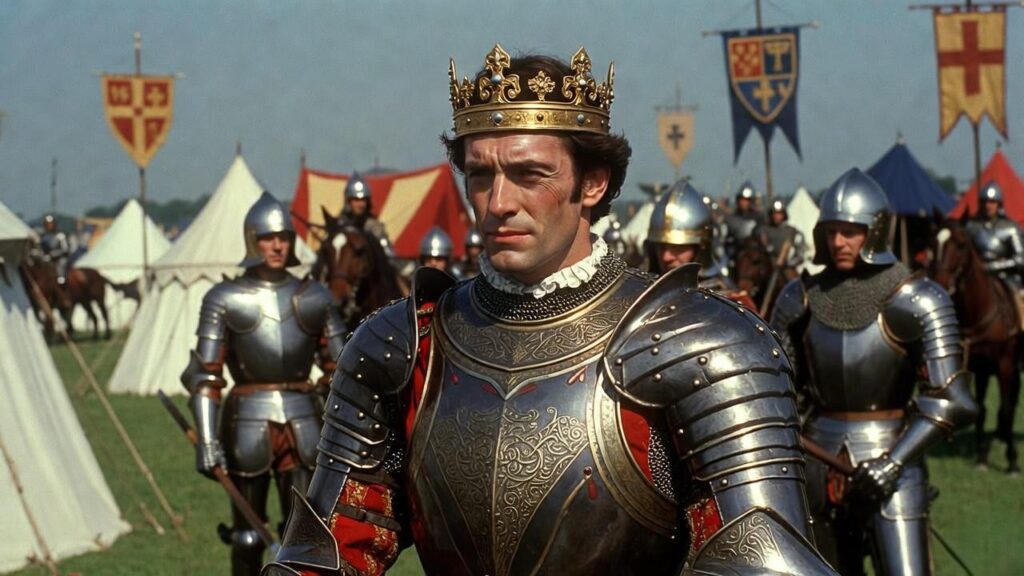
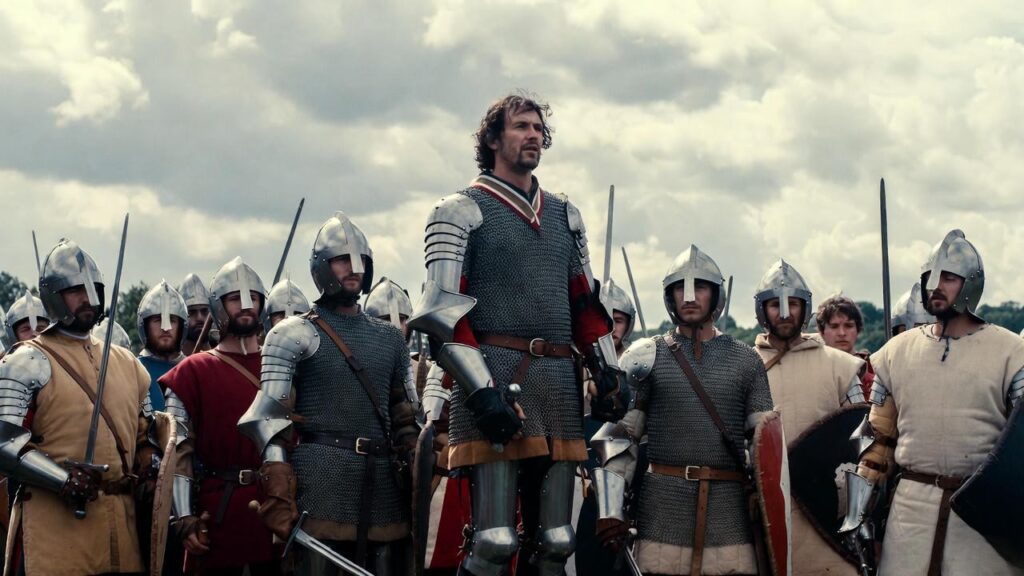
When the Chorus in Shakespeare’s Henry V famously apologizes for attempting to cram the vast fields of France into a “wooden O” (the theater), he is acknowledging the limits of the stage. The creators of the Calais Dragon bypassed this limitation entirely by turning the city itself into the stage.
From Tudor Pageants to French Boulevards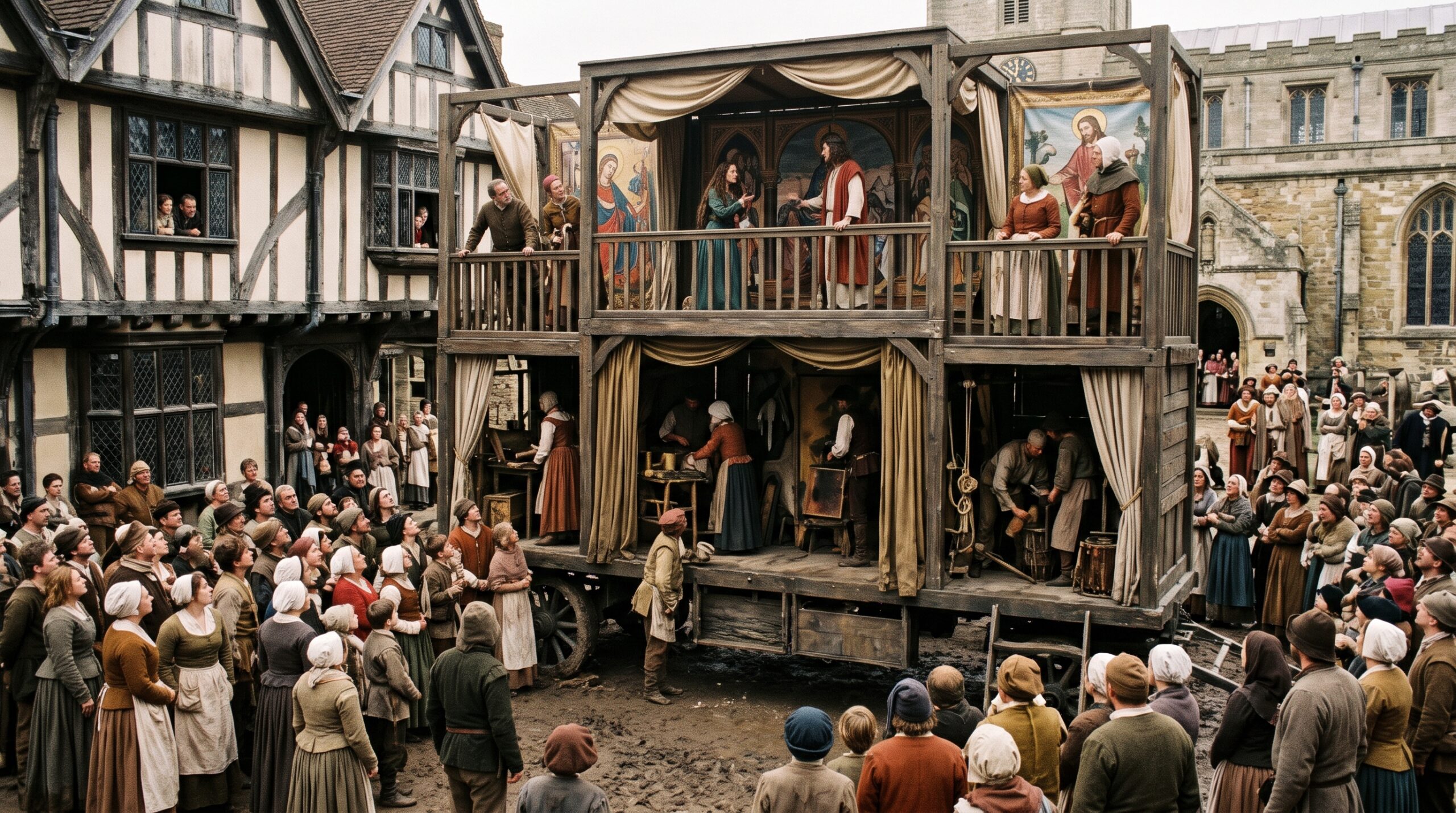
Long before Shakespeare’s characters delivered soliloquies on fixed stages, English theater was a mobile, public affair. Medieval mystery plays and Tudor pageants were performed on massive “pageant wagons” that rolled through the streets of cities like York and Chester. These multi-story, horse-drawn stages brought heaven and hell directly to the town square, ensuring that theater was an unavoidable, communal event.
The Dragon operates on this exact ancestral frequency. It is capable of carrying up to 50 passengers on its back as it lumbers along the seafront. As it moves, the line between performer and audience dissolves. The people on the street looking up are as much a part of the performance as the passengers looking down. This mirrors how Elizabethan theater, with its open-air thrust stages and groundling audiences, blurred the boundaries between the public square and the dramatic fiction taking place before them.
Practical Effects in Shakespeare’s Time vs. Today
Modern audiences are heavily conditioned by computer-generated imagery (CGI). We are used to seamless, digital perfection. But theatrical magic has always relied on tactile, practical reality. In Shakespeare’s time, stagecraft was incredibly visceral. Acting troupes used squibs (early fireworks) to simulate lightning in The Tempest or Julius Caesar, and lowered actors on crude winches from the “Heavens” (the painted roof of the stage). When Shakespeare penned the infamous stage direction, “Exit, pursued by a bear” in The Winter’s Tale, the company likely used a real, terrifying bear from the nearby baiting pits, or a highly convincing, frighteningly tactile costume.
The fire and mist of the French dragon provide that same visceral thrill. Because the fire is hot enough for the crowd to feel its heat, and the water vapor is wet enough to dampen their clothes, the audience’s physical senses confirm the reality of the illusion. It argues—quite successfully—that tangible mechanics, no matter how exposed, create a stronger emotional resonance than any digital rendering.
The Operators as Actors: Mastering the “Wooden O”
In modern cinema, the puppeteer is digitally erased. The wires are painted out, the mechanics hidden, and the creator is completely divorced from the creation on screen. The Dragon of Calais, however, rejects this modern illusion. Instead, it relies on a much older, profoundly Shakespearean tradition: the visible actor.
Hiding in Plain Sight (The Mechanics of Magic)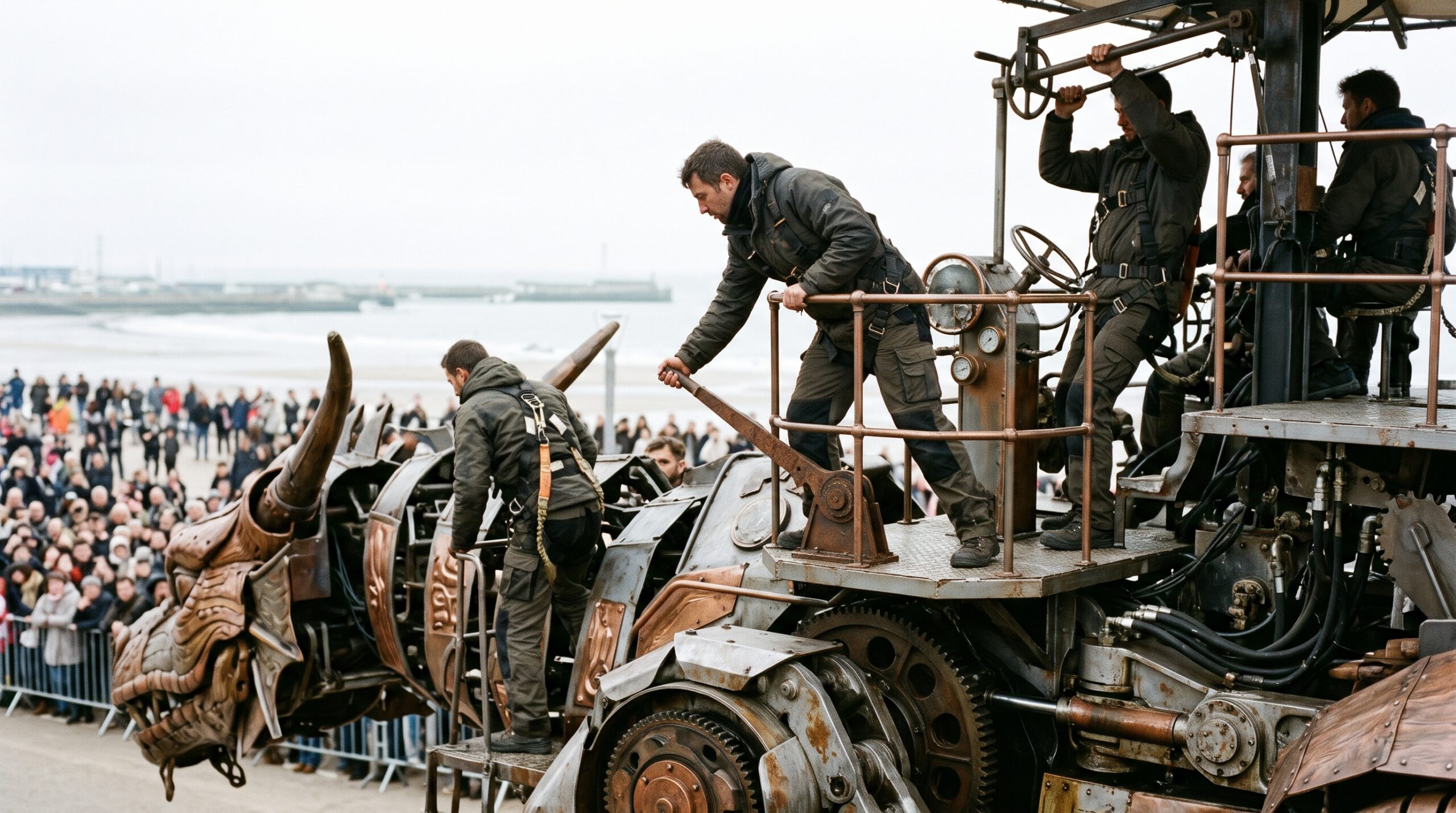
To operate this massive mechanical dragon in France, a highly coordinated crew of up to 17 machinistes (machinists/operators) is required. They do not hide in an enclosed cockpit. Clad in bespoke, steampunk-inspired liveries, they are fully visible, climbing across the beast’s wooden spine, leaping across its wings, and pulling massive levers in full view of the crowd below.
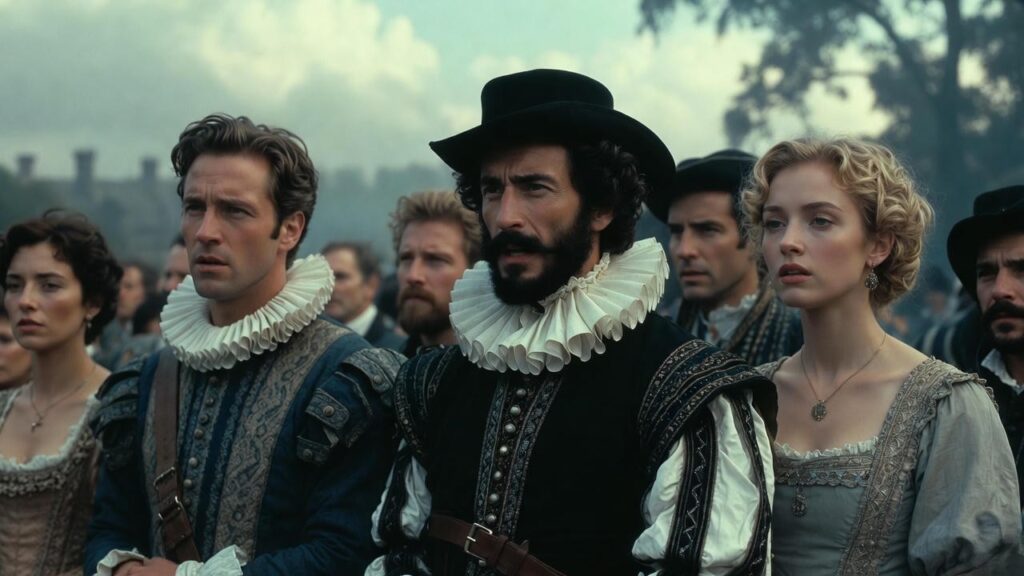
This mirrors the realities of the Elizabethan thrust stage. At the Globe Theatre, there was no stage lighting to plunge the audience into darkness and hide the mechanics of the set. Actors performed in the bright afternoon daylight, fully visible to the groundlings pressing against the stage. Because the audience could clearly see the trapdoors, the wooden pillars, and the musicians in the gallery, they were required to actively collaborate in the illusion. When an actor told them it was the dead of night at Elsinore Castle, the audience had to build that darkness in their minds. Similarly, when we watch a machinist pull a heavy wooden lever to make the dragon’s chest heave, we don’t see a machine breaking; we see the breath of a living myth. The transparency of the mechanics makes the magic stronger.
The Universal Language of Movement
Shakespeare was a master of the English language, but his company, the Lord Chamberlain’s Men, also relied heavily on physical acting, gesture, and pantomime to convey meaning to a raucous, open-air crowd. The Dragon of Calais communicates without a single spoken word, yet its intent is instantly recognizable to anyone who watches it.
Through a symphony of hydraulics and pulleys, the operators give the beast a distinct personality. A slow, heavy drop of its carved wooden eyelids signals ancient weariness. A sudden snap of its jaw and a blast of water vapor denote territorial aggression. A subtle tilt of the head as it approaches a child in the crowd suggests a curious, almost feline intelligence. This is the essence of physical stagecraft. The operators prove that even on a monumental, 72-ton scale, theatrical success still relies on microscopic, human-driven details. It is a masterclass in how movement alone can command an audience’s complete emotional investment.
Experiencing the Drama: A Guide for the Cultural Traveler
For those ready to step off the page and onto the stage, visiting the Dragon of Calais is an accessible and unforgettable experience. Located on the northern coast of France, it provides a perfect cultural detour for travelers crossing the English Channel or exploring the Hauts-de-France region.
How to Ride the Dragon of Calais
The beast makes its home at the Cité du Dragon (Fort Risban), located right on the newly renovated Calais seafront. Visitors can book a ticket to ride upon its intricately carved back, a journey that lasts between 45 to 60 minutes. As a passenger, you are granted a unique vantage point: you get to watch the machinists work up close while taking in panoramic views of the beach and the English Channel.
Pro-Tip for Travelers: Accessibility was heavily factored into the design of this street theater marvel. The boarding platform at the Cité du Dragon is fully equipped with an elevator and wide boarding bridges, ensuring that wheelchair users and those with limited mobility can seamlessly board and experience the ride.
Expanding the Stage: The Varan de Voyage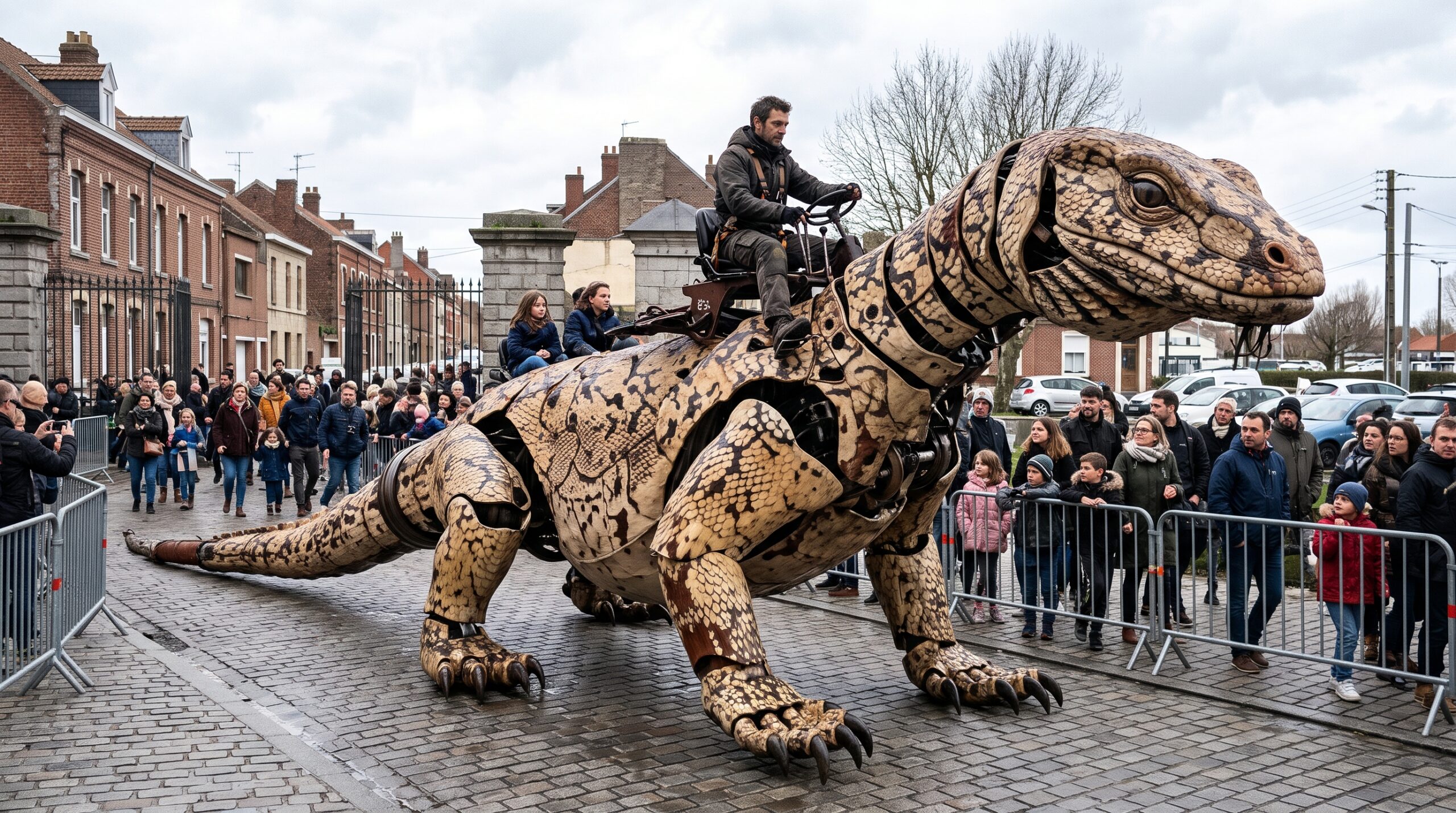
While the Dragon rules the seafront, it is not the only actor in the troupe. La Machine has also introduced the Varan de Voyage (the Traveling Iguana or Monitor Lizard), a smaller—but equally mesmerizing—mechanical creature. While the Dragon is a spectacle of grand scale, the Varan offers an intimate, neighborhood-level performance, often found near Fort Nieulay or exploring the city center. It shows how the “stage” is not confined to one location but stretches across the entire urban landscape.
Frequently Asked Questions
Where exactly is the Dragon of Calais located? The main pavilion, known as the Cité du Dragon, is located at Fort Risban on the Calais seafront in northern France. The dragon’s daily routes take it along the beach promenade.
Does the Calais Dragon actually breathe fire? Yes. As a pinnacle of practical effects, the mechanical dragon is equipped to shoot both a spectacular plume of real fire and thick clouds of water vapor from its mouth, depending on its “mood” and the operators’ commands.
How much does it cost to ride the Dragon? While walking alongside the dragon is free for the public, riding on its back requires a ticket. Prices are generally around €9.50 for adults, with reduced rates for children (prices are subject to change, so always check the official Compagnie du Dragon website before your visit).
Why should literature and theater fans visit? It represents the ultimate surviving form of grand, mechanical street theater. It takes the foundational principles of Elizabethan stagecraft—public spectacle, practical effects, and the visible actor—and magnifies them to a scale that leaves modern audiences just as awe-struck as the groundlings at the Globe.
The Enduring Magic of the Mechanical
We live in an era where digital screens can conjure any image we desire, yet we still crave the tactile, the real, and the communal. The Dragon of Calais succeeds for the exact same reasons William Shakespeare’s plays have survived for four centuries. Both demand our imagination, both transform public spaces into realms of magic, and both remind us that the greatest spectacles are powered not by hidden algorithms, but by human hands. François Delarozière and La Machine have not just built a tourist attraction; they have engineered a masterpiece of modern stagecraft.
If you are a student of the stage, a lover of Renaissance theater, or simply a traveler in search of modern myths, Calais must be on your itinerary.
Have you experienced the thrill of massive street theater, or do you have a favorite practical effect from a stage production of Shakespeare? What Shakespearean beast—perhaps the bear from The Winter’s Tale—would you like to see La Machine build next? Save this guide to your cultural travel Pinterest boards, share it with your local theater troupe, and join the conversation in the comments below!