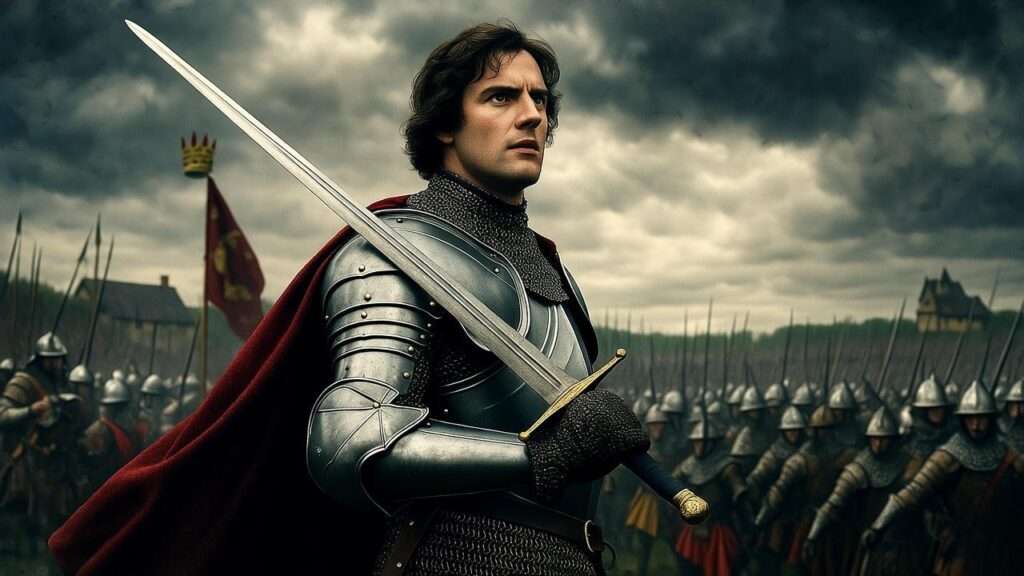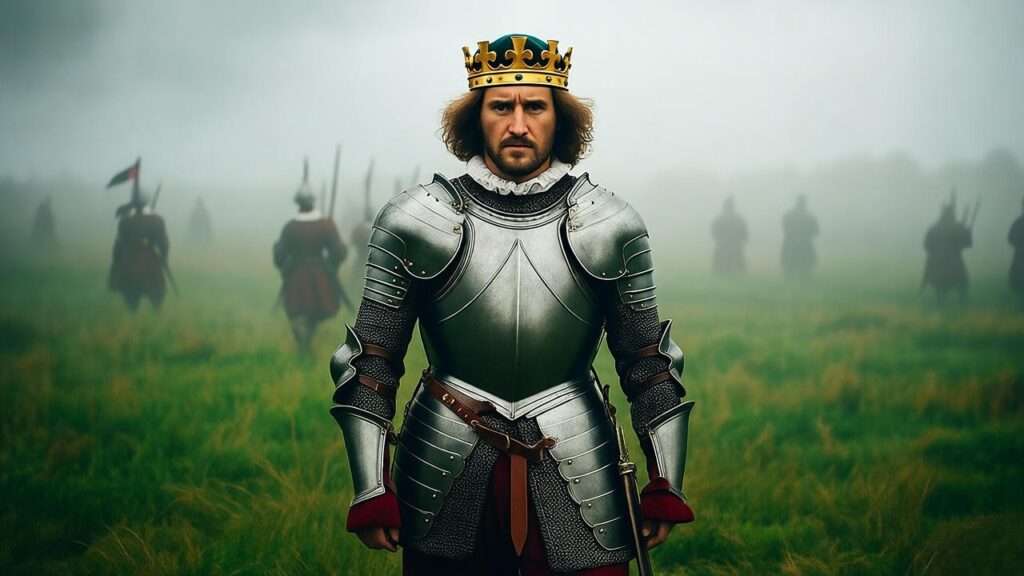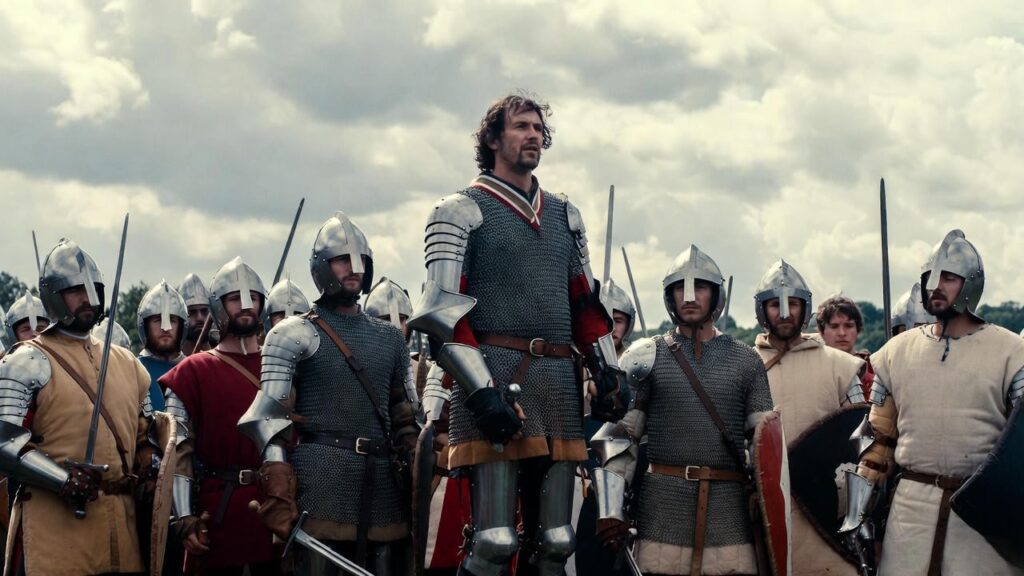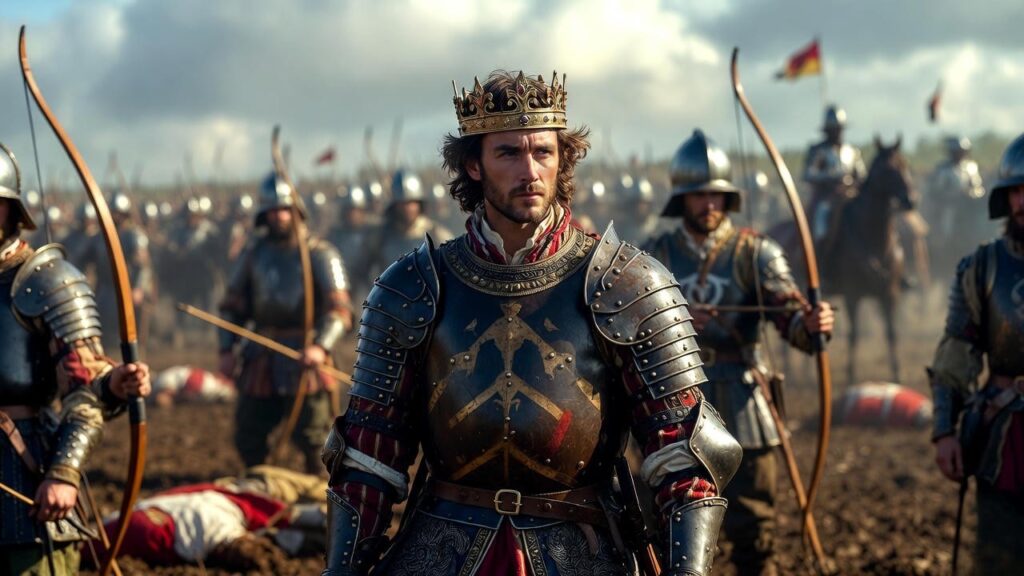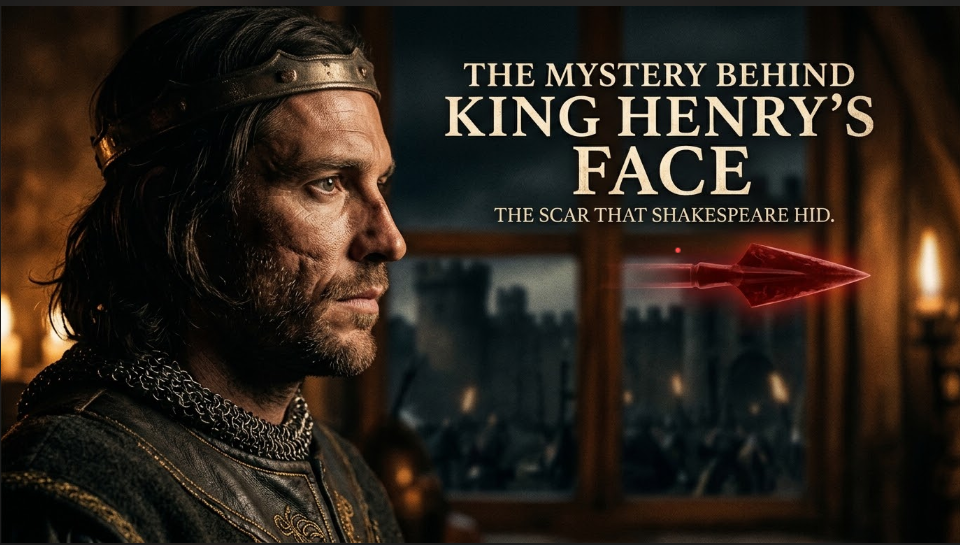
If you visit London’s National Portrait Gallery and stand before the official likeness of King Henry V, a curious detail immediately catches the eye: he is depicted exclusively in profile. Unlike almost every other English monarch whose gaze meets the viewer head-on, Henry’s features are rendered strictly from the side. For centuries, art historians and casual museumgoers alike assumed this was merely an aesthetic preference of early fifteenth-century portraiture. The truth, however, is far darker, bloodier, and more miraculous. The real henry face carried a catastrophic physical secret—a horrific battle wound that nearly claimed his life as a teenager and left him permanently disfigured.
Why, then, when William Shakespeare set out to dramatize the life of England’s most famous warrior king nearly two centuries later, did he virtually erase this dramatic physical mark from the stage?
To understand the disconnect between the real, battle-scarred monarch and Shakespeare’s unblemished hero, we must venture into the brutal realities of medieval warfare, pre-modern surgery, royal propaganda, and Elizabethan theater dynamics. Here is the untold history of King Henry V’s facial trauma, the genius surgeon who saved his life, and the political artifice that erased his scar from legend.
The Battle of Shrewsbury (1403): The Arrow That Changed Henry’s Face
Long before he was the heroic conqueror of Agincourt, Prince Henry—known affectionately as “Prince Hal”—was a sixteen-year-old commander thrust into the crucible of civil war. On July 21, 1403, at the Battle of Shrewsbury, young Hal led the vanguard of his father’s army against the rebel forces of Henry “Hotspur” Percy. It was a vicious, hand-to-hand engagement fought at close quarters, characterized by volley after volley of deadliest weapon of the age: the English longbow.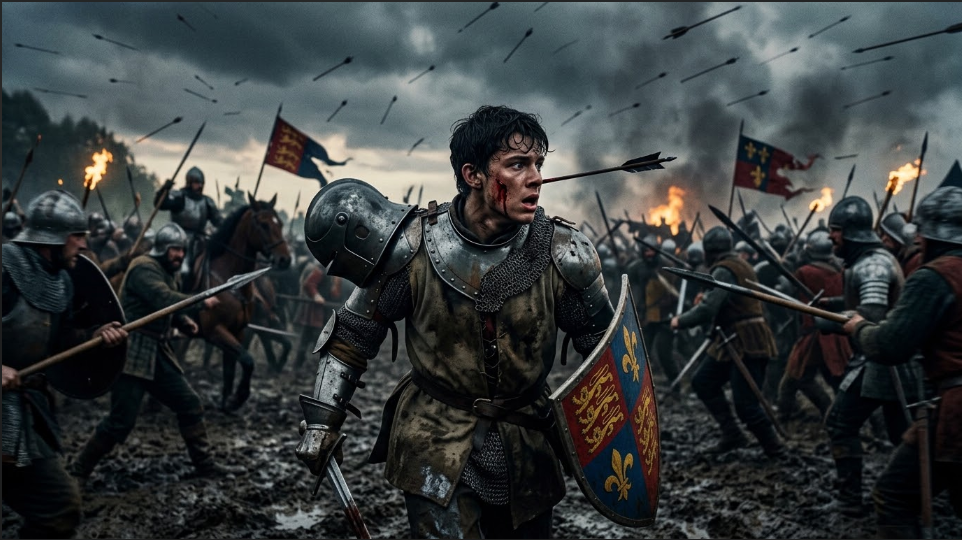
A Sixteen-Year-Old Prince in the Heat of Combat
Despite his youth, Prince Henry refused to fight from the safety of the rear guards. Positions at the front lines exposed noblemen and commoners alike to terrible peril. During a fierce push against rebel archers, Henry raised his visor—either to cool himself down, issue orders, or get a clearer view of the chaotic battlefield.
It was a split-second decision that nearly altered the trajectory of English history. A random Welsh bodkin arrow, designed specifically with a narrow, square-sectioned iron point to pierce plate armor, struck the prince squarely in the face.
The Anatomical Reality of the Injury
The damage was horrific. The arrow entered Henry’s face just beside his nose, penetrating six inches deep into his skull. The iron tip crushed through the facial bones, passing through the left side of his jaw tissue, and lodged in the bone at the back of his skull, adjacent to the upper spine and brain stem.
  [ Arrow Trajectory Diagram ]

  Entry Point (Cheek/Nose) ──► Penetrates 6 Inches ──► Lodges at Base of Skull

  Risks:
  • Massive internal hemorrhaging
  • Fatal brain/spinal cord injury
  • Lethal bacterial infection / Tetanus
  • Permanent facial nerve destruction
In the fifteenth century, an injury of this magnitude was almost universally a death sentence. The immediate dangers were staggering:
-
Hemorrhaging: The arrow was inches away from severing the carotid artery or internal jugular vein.
-
Brain Trauma: Had the arrow penetrated even a fraction of an inch further, it would have pierced the brainstem, causing instant death or total paralysis.
-
Infection: The most deadly hazard was not the initial impact, but the organic debris carried into the wound. The arrow shaft was made of wood, sealed with animal glue, and tipped with a rusted iron socket. In an era centuries before antibiotics or germ theory, sepsis was virtually guaranteed.
“The Mark of His Manhood”: Refusal to Retreat
When his attendants realized the severity of the wound, they desperately urged the young prince to fall back behind the battle lines. Royal chroniclers record that Henry steadfastly refused to abandon his troops. He reportedly declared that his retreat would dishearten his soldiers, stating that he would rather die on the field than betray those fighting under his banner.
Henry remained on his horse, blood pouring across his armor, until the battle was won and Hotspur was slain. Only after victory was secured did the prince collapse, allowing his entourage to transport him urgently to the security of Kenilworth Castle.
The Medical Miracle: How John Bradmore Saved the Prince’s Life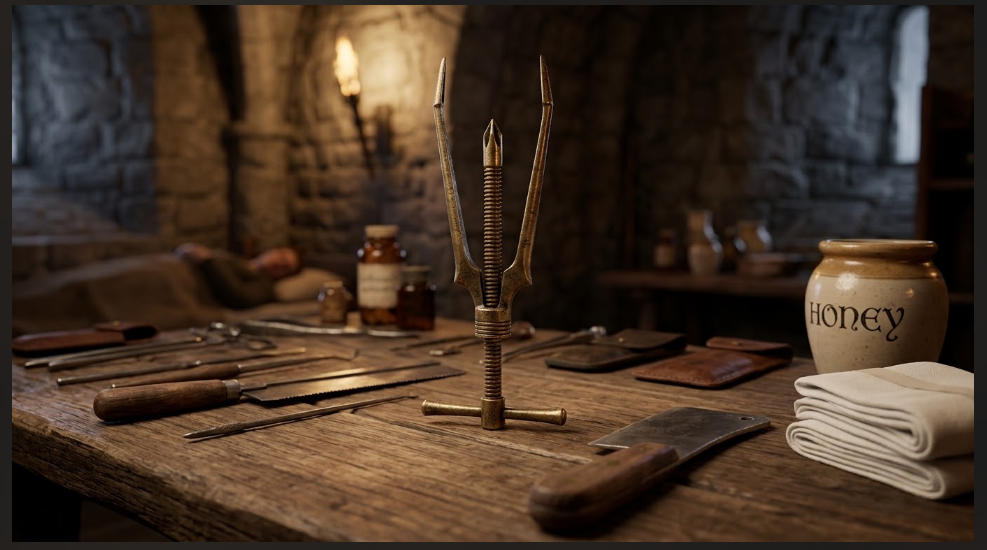
When Prince Henry arrived at Kenilworth, the royal court was in total panic. Local physicians, barber-surgeons, and academic doctors flocked to the prince, attempting various remedies. Some tried pulling on the wooden shaft of the arrow, but this only made matters worse: the wood snapped cleanly off, leaving the jagged, six-inch iron arrowhead buried deep inside the prince’s facial bones. Other doctors attempted herbal poultices and religious chants, but the prince’s condition deteriorated rapidly as fever set in.
Desperate, King Henry IV summoned John Bradmore, a renowned London surgeon who was also a skilled metalsmith and former warden of the craft.
+-----------------------------------------------------------------------+
|                       JOHN BRADMORE'S LOGBOOK                         |
|                                                                       |
| "In the year of our Lord 1403, the noble Prince Henry was struck by   |
| an arrow in the face... The head remained fixed in the bone...        |
| By the grace of Almighty God, I devised an instrument..."             |
+-----------------------------------------------------------------------+
The Surgical Breakthrough
Bradmore realized that conventional instruments were useless. Forceps could not grip an arrowhead lodged tightly in bone six inches below the skin without crushing surrounding tissue or pushing the iron further into the skull. Bradmore recognized that he needed a tool that could enter the wound narrowly and expand inside the socket of the arrowhead to lock onto it from within.
Drawing on his background as a metalsmith, Bradmore personally designed and forged a revolutionary surgical instrument: a pair of custom, threaded brass tongs known historically as the Philomena.
       BRADMORE'S EXTRACTOR TONGS (THE PHILOMENA)

       Closed State (Insertion):
       =======(||)======================> [Narrow Tip Enters Wound]

       Expanded State (Locked inside Arrowhead Socket):
       =======(||)==========<=======>   [Threaded Screw Expands Tongs]
The Extraction Operation
The operation that followed was one of the greatest feats of medieval surgery, documented meticulously by Bradmore in his medical treatise, Philomena:
-
Dilating the Wound: Over several days, Bradmore gradually expanded the narrow entry hole in Henry’s face. He inserted small wooden probes made of dried elderwood, wrapped in linen and soaked in virgin honey (which modern science recognizes as a potent natural antibacterial agent). As the elderwood absorbed moisture, it swelled, gently expanding the wound track without cutting fresh muscle.
-
Inserting the Extractor: Once the cavity was wide enough, Bradmore carefully guided his custom-designed tongs into the facial opening, threading them six inches deep through muscle and bone until the tip slid into the hollow socket of the iron arrowhead.
-
Engaging the Lock: Bradmore turned a central screw mechanism at the handle of the instrument. This forced the split end of the tongs to expand outward, locking tiny metal teeth securely into the internal cavity of the iron head.
-
The Extraction: Working with extreme precision, Bradmore slowly wiggled and pulled the instrument. With a agonizing crack of bone, the arrowhead dislodged and was successfully pulled free from Henry’s face.
-
Post-Surgical Cleansing: To combat infection, Bradmore washed the deep, gaping wound with white wine (acting as an alcohol antiseptic) and cleansed it with additional honey poultices.
Remarkably, after weeks of agonizing recovery, Prince Henry survived. His young, robust immune system, combined with Bradmore’s brilliant surgical design, had accomplished the impossible.
What Henry’s Face Actually Looked Like
While Bradmore saved the prince’s life, he could not prevent permanent disfigurement. The arrow had smashed through cheekbone tissue, destroyed facial nerves, and fractured underlying cartilage.
The resulting scar would have been massive: a thick, indented trail of tissue running from his nose down through his cheek, likely accompanied by partial facial paralysis, a slight droop on one side of his mouth, or structural asymmetry around the nose and jaw. Henry carried this physical mark for the rest of his life—a constant, visual reminder of his brush with death.
Artistic Concealment: Why Royal Portraits Hid Henry’s Scar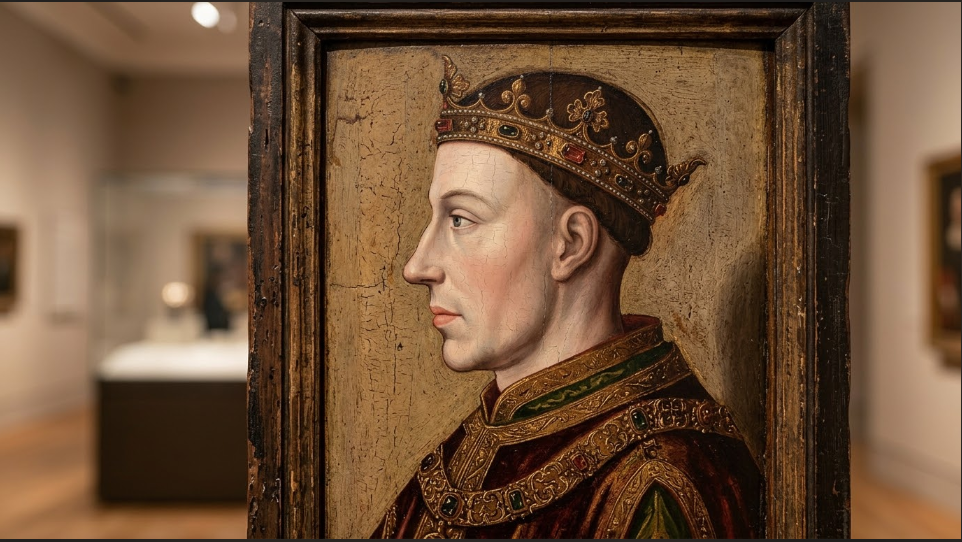
Given that Henry V’s survival was seen by his contemporaries as a miraculous sign of divine favor, one might assume that royal artists would eagerly celebrate the scar as a mark of supreme martial bravery. Instead, the exact opposite occurred.
The Profile Portrait in the National Portrait Gallery
When looking at surviving contemporary and early Tudor depictions of King Henry V, one striking detail stands out:
+-------------------------------------------------------------------+
|               VISUAL REPRESENTATION COMPARISON                    |
+----------------------------------+--------------------------------+
| Standard Medieval Monarchs       | King Henry V                   |
+----------------------------------+--------------------------------+
| • Three-quarter view             | • Strict 180° profile          |
| • Full frontal view              | • Shows only ONE side of face  |
| • Eye contact with viewer        | • Conceals opposite cheek      |
| • Symmetry emphasized            | • Asymmetry completely hidden  |
+----------------------------------+--------------------------------+
The most famous painting of Henry V, housed in the National Portrait Gallery in London, depicts him strictly from his left profile. His right cheek—where many historians believe the primary entry trauma and scarring were located—is rotated entirely away from the viewer.
The Psychology of Medieval Royal Propaganda
To understand this artistic censorship, one must understand medieval political theology—specifically the concept of “The King’s Two Bodies.”
A medieval king possessed both a Body Natural (his mortal, physical frame) and a Body Politic (the divine, spiritual representation of state majesty and power). While a soldier’s scars were honorable on the battlefield, a reigning monarch’s physical appearance was tied directly to the health, stability, and divine favor of his kingdom.
                      THE KING'S TWO BODIES

         ┌──────────────────────┴──────────────────────┐
         │                                             │
  [ BODY NATURAL ]                              [ BODY POLITIC ]
  • Mortal, fragile                             • Immortal, divine
  • Prone to illness                            • Represents the nation
  • Scarred by war                              • Impervious to flaws
  • Must be concealed                           • Must be idealized
A severely disfigured face was viewed with great anxiety in international diplomacy:
-
Foreign Perception: Foreign rivals, particularly the French court during the Hundred Years’ War, could view physical deformity as a sign of physical weakness, vulnerability, or divine disfavor.
-
Dynastic Legitimacy: The House of Lancaster had usurped the throne from King Richard II in 1399. Henry IV and his son, Henry V, faced constant threats of rebellion. Exhibiting a disfigured, mutilated face could invite challenges from rivals claiming the king was “flawed” or cursed.
By adopting a strict profile pose, royal portrait artists executed a sophisticated form of fifteenth-century image management. They presented an idealized, serene image of sovereign authority while completely concealing the physical reality of the king’s trauma.
Why Shakespeare Hid (and Subtly Revealed) Henry’s Face in His Plays
When William Shakespeare wrote his famous Henriad tetralogy—Richard II, 1 Henry IV, 2 Henry IV, and Henry V—in the late 1590s, he relied heavily on Raphael Holinshed’s Chronicles of England, Scotland, and Ireland. Holinshed explicitly detailed Prince Henry’s facial arrow wound at the Battle of Shrewsbury.
Yet, when dramatizing the events on stage, Shakespeare made a conscious artistic and political choice: he systematically downplayed the wound and reshaped the narrative surrounding henry face.
Elizabeth I, Royal Censorship, and Tudor Propaganda
Shakespeare was writing under the reign of Queen Elizabeth I, the grand-daughter of Henry VII (the Tudor monarch who derived his royal legitimacy by connecting his lineage back to the Lancastrian dynasty).
Under Elizabeth I, the Master of the Revels exercised strict political censorship over the theater. Depicting King Henry V—the golden boy of English history and the hero of Agincourt—as a gruesome, disfigured figure would have violated the patriotic standards of Elizabethan public drama.
               TUDOR HISTORICAL PROPAGANDA LINEAGE

                  King Henry V (Lancaster)
                            │
                            ▼
                  King Henry VII (Tudor)
                            │
                            ▼
                  Queen Elizabeth I (Tudor)

  [*Requirement: Henry V must be portrayed as the perfect
   Christian warrior to legitimize Tudor rule.]
For Elizabethan audiences facing threat of Spanish invasion, Henry V needed to represent the ultimate, unblemished icon of English strength, chivalry, and national unity.
Minimal Mention in 1 Henry IV and 2 Henry IV
In 1 Henry IV, the Battle of Shrewsbury forms the climax of the play. Yet, when Prince Hal is struck during the battle, Shakespeare reduces the catastrophic, bone-crushing arrow wound to a minor incident.
In Act 5, Scene 4, King Henry IV sees his son bleeding and urges him to retreat:
KING HENRY IV:
Lord Percy thrives too long, Lord John of Lancaster;
Go, take your brother to your tent.
PRINCE HENRY:
I beseech your Majesty, make up,
Lest your retirement do dismay your friends.
KING HENRY IV:
I will do so. My Lord of Westmorland,
Lead him to his tent.
PRINCE HENRY:
Lead me, my lord? I do not need your help;
And God forbid a shallow scratch should drive
The Prince of Wales from such a field as this…
By dismissing a six-inch deep arrow penetration as a “shallow scratch,” Shakespeare transforms a life-altering medical trauma into a brief display of youthful bravado. The play erases John Bradmore, the surgical tongs, and the long months of agonizing recovery. The prince wipes away the blood, slays Hotspur, and marches onward toward his royal destiny.
The Secret Clues in Henry V: The Wooing of Katherine
Although Shakespeare suppressed the historical arrow wound, he could not entirely ignore historical accounts that described King Henry V as having a harsh, weathered, or scarred visage. In his masterpiece Henry V, Shakespeare cleverly addresses the reality of the king’s face—not through gory battle scenes, but through comedic, romantic dialogue.
In Act 5, Scene 2, King Henry woos Princess Katherine of France. Rather than presenting himself as a smooth, handsome courtier, Henry repeatedly draws attention to his rough, unappealing face:
+-----------------------------------------------------------------------+
|                 SHAKESPEARE'S TEXTUAL CLUES IN HENRY V                |
+-----------------------------------------------------------------------+
| Quote (Act 5, Scene 2)            | Historical Subtext                |
+-----------------------------------+-----------------------------------+
| "If I could win a lady by         | References his rugged, harsh      |
| vaulting into my saddle... I      | physical presence compared to     |
| should quickly leap into a wife." | refined courtiers.                |
+-----------------------------------+-----------------------------------+
| "A sunburnt adieu... I have such  | Acknowledges a visage hardened    |
| a plain and sunburnt face."       | and marked by military life.      |
+-----------------------------------+-----------------------------------+
| "Thou hast hit it... I speak to   | Self-deprecatingly frames his     |
| thee plain soldier... I get thee  | plain, scarred face as the face   |
| with a soldier's visage."         | of an honest warrior.             |
+-----------------------------------+-----------------------------------+
In this scene, Henry tells Katherine:
“If thou canst love a fellow of this temper, Kate, whose face is not worth sunburning, that never looks in his glass for love of anything he sees there, let thine eye be thy cook… I speak to thee plain soldier: if thou canst love me for this, take me.”
Here, Shakespeare performs a brilliant literary sleight of hand. He takes the real, physical harshness of Henry’s face—a visage scarred by war—and reinterprets it as a moral virtue. Henry’s rough face becomes proof of his honesty, soldierly authenticity, and lack of aristocratic vanity. The horrific arrow scar is transformed into the rugged charm of a plain-spoken warrior king.
Physicality vs. Rhetoric on the Shakespearean Stage
Why did Shakespeare prefer theatrical rhetoric over physical makeup to represent Henry’s appearance?
In the Globe Theatre, daylight performances relied heavily on the audience’s imagination—what the Chorus in Henry V calls the “flat unraised spirits” working upon the “piece of deck.” Excessive theatrical makeup or gory prosthetics representing facial disfigurement would have distracted from the play’s primary engine: Shakespeare’s soaring blank verse.
┌─────────────────────────────────────────────────────────────────┐
│                    THEATRICAL REALISM COMPARISON                │
├────────────────────────────────┬────────────────────────────────┤
│ Modern Cinematic Expectation   │ Elizabethan Stage Practice     │
├────────────────────────────────┼────────────────────────────────┤
│ • Gory prosthetic wounds       │ • Minimal facial prosthetics   │
│ • Historical accuracy in detail│ • Symbolic costuming           │
│ • Visual realism over verse    │ • Spoken verse creates reality │
│ • Focus on physical trauma     │ • Focus on heroic rhetoric     │
+--------------------------------+--------------------------------+
By focusing on speeches like the St. Crispin’s Day address (“We few, we happy few, we band of brothers”), Shakespeare elevated Henry from a flawed, battle-scarred mortal into a immortal symbol of national unity.
Modern Adaptations: Bringing the Scar Back to “Henry’s Face”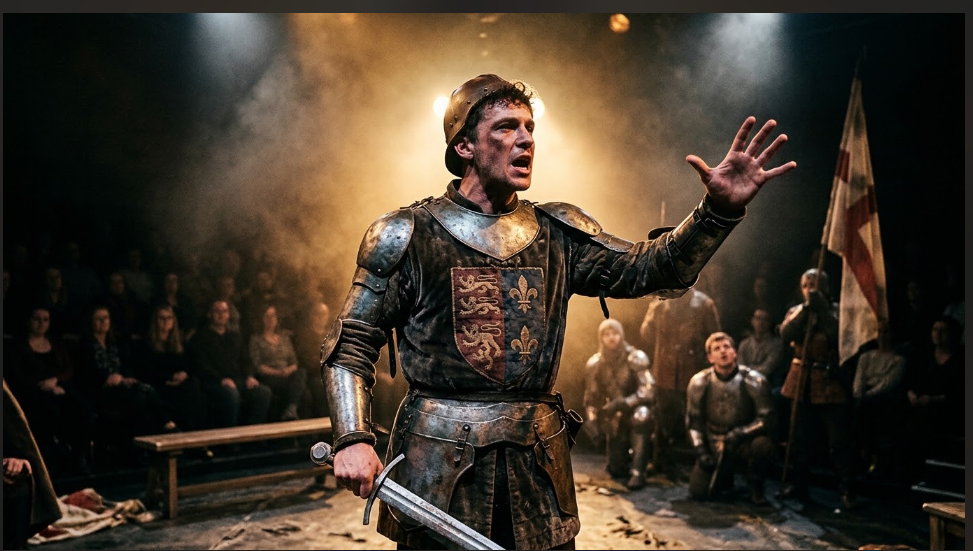
As cultural tastes shifted over the centuries from mythmaking toward historical realism, directors and actors faced a new question: Should modern performances depict King Henry V with his historical scar, or maintain Shakespeare’s idealized vision?
=========================================================================
               EVOLUTION OF HENRY V IN FILM & THEATER
=========================================================================

[ 1944: Laurence Olivier ]
 ──► Propaganda Focus: Unblemished, heroic, pristine royal attire.
 ──► Scar Status: Erased completely.

[ 1989: Kenneth Branagh ]
 ──► Gritty Realism Focus: Mud, rain, blood, and physical exhaustion.
 ──► Scar Status: Subtle battle marks, but no deep 1403 surgical scar.

[ 2019: David Michôd (The King - Timothée Chalamet) ]
 ──► Historical Revisionism: Focus on trauma, politics, and youth.
 ──► Scar Status: Explicit facial scarring incorporated into character design.
=========================================================================
1. Laurence Olivier (1944): WWII Propaganda and the Perfect Hero
Filmed during the height of the Second World War with funding from the British War Office, Laurence Olivier’s Henry V was designed explicitly to boost national morale. Olivier portrayed Henry as an unblemished, shining prince in gleaming armor. Any reference to physical disfigurement, surgical trauma, or moral ambiguity was excised. Olivier’s Henry was the direct heir to Shakespeare’s idealized myth.
2. Kenneth Branagh (1989): Post-Vietnam Realism
Kenneth Branagh’s iconic film adaptation brought mud, blood, and visceral violence back to Shakespeare’s play. Branagh depicted the brutal physical toll of combat—showing soldiers dying in the rain at Agincourt. However, while Branagh’s Henry was dirty, bloody, and exhausted, his face remained free of the massive, structural surgical scar left by the 1403 Battle of Shrewsbury.
3. Netflix’s The King (2019): The Return of Historical Trauma
In David Michôd’s film The King, starring Timothée Chalamet, modern cinema took a major step toward historical accuracy. The film combines Shakespeare’s Henriad with genuine historical events, portraying Prince Hal as a troubled young man deeply impacted by the brutality of war. Modern makeup effects subtly incorporate facial scarring and physical weariness, reflecting a modern audience’s demand for psychological and physical authenticity.
Key Comparisons: Real History vs. Shakespearean Representation
To clearly see how history was altered for the stage, compare the historical facts of Henry V’s life with Shakespeare’s dramatic choices:
| Analytical Dimension | Historical Reality (1403–1422) | Shakespeare’s Literary Representation |
| Cause of Injury | 6-inch bodkin arrow penetration at Battle of Shrewsbury (1403). | Minimizing as a “shallow scratch” in 1 Henry IV. |
| Age at Time of Injury | 16 years old (Prince of Wales). | Portrayed as a young adult in combat against Hotspur. |
| Surgical Procedure | Groundbreaking extraction by surgeon John Bradmore using custom tongs. | Completely omitted; no doctors or surgeons mentioned. |
| Visual Appearance | Significant, permanent facial scar on one side of his face. | Frame metaphorically as a soldier’s “plain, sunburnt” visage. |
| Official Portraiture | Painted strictly in profile to hide damaged side. | Replaced by grand theatrical speeches and royal majesty. |
| Political Objective | Protect dynastic legitimacy; avoid showing weakness to foreign powers. | Build national pride; celebrate the Tudor ancestral line. |
| Core Character Arc | A hardened, survivor warrior king who endured trauma. | A reformed prince who transforms into the ideal Christian king. |
Frequently Asked Questions (FAQ)
Which side of King Henry’s face was wounded by the arrow?
Historical records leave slight ambiguity. Surgeon John Bradmore’s medical treatise, Philomena, states that the arrow entered on the left side of Henry’s nose. However, because official royal portraits consistently depict Henry from his left profile, many art historians speculate that his right side suffered the worst exit/extraction scar, leading artists to paint his undamaged left profile. Conversely, others argue the left profile was shown precisely to display the healed entry site as a badge of honor, though the sheer severity of the wound makes total concealment the more likely motivation.
Did Shakespeare know about Henry V’s facial scar?
Yes. Shakespeare’s primary historical source, Raphael Holinshed’s Chronicles (1587), clearly details the Battle of Shrewsbury and mentions that Prince Henry was struck in the face by an arrow. Shakespeare made a deliberate choice to downplay the wound to maintain the heroic tone of his historical drama.
How old was Henry V when his face was shot by an arrow?
Prince Henry was just 16 years old. He was born in September 1386, and the Battle of Shrewsbury took place on July 21, 1403.
Why are there no front-facing paintings of King Henry V?
Front-facing portraits were extremely rare in fifteenth-century England, but in Henry V’s case, the profile view served a double purpose. Beyond imitating classical Roman coins (which signaled imperial authority), the profile pose allowed royal painters to bypass rendering the deep scar left by John Bradmore’s surgical procedure.
What tool was used to extract the arrow from Henry’s face?
Surgeon John Bradmore invented a custom instrument called the Philomena—a pair of threaded brass tongs. The tool was inserted closed into the hollow socket of the iron arrowhead buried deep in Henry’s skull. When Bradmore turned a screw at the handle, the tip expanded, locking into the iron head so it could be safely pulled free.
The Dual Legacy of King Henry V
The mystery of King henry face reveals a fascinating truth about how history, art, and literature interact.
In the physical world of 1403, Henry V was a flesh-and-blood survivor of horrific military trauma. His facial scar was a testament to the brutal realities of medieval combat and the astonishing ingenuity of pre-modern medicine. Without the surgical genius of John Bradmore, Prince Henry would have died as a teenager at Shrewsbury, and the Battle of Agincourt would never have happened.
Yet in the political and theatrical realm, a different reality was required. Medieval portrait artists rotated the king’s head to hide his disfigurement, preserving the divine image of sovereign power. Two centuries later, William Shakespeare completed this transformation, replacing the scarred, bleeding teenager with an immortal literary icon whose speeches still resonate across theaters worldwide.