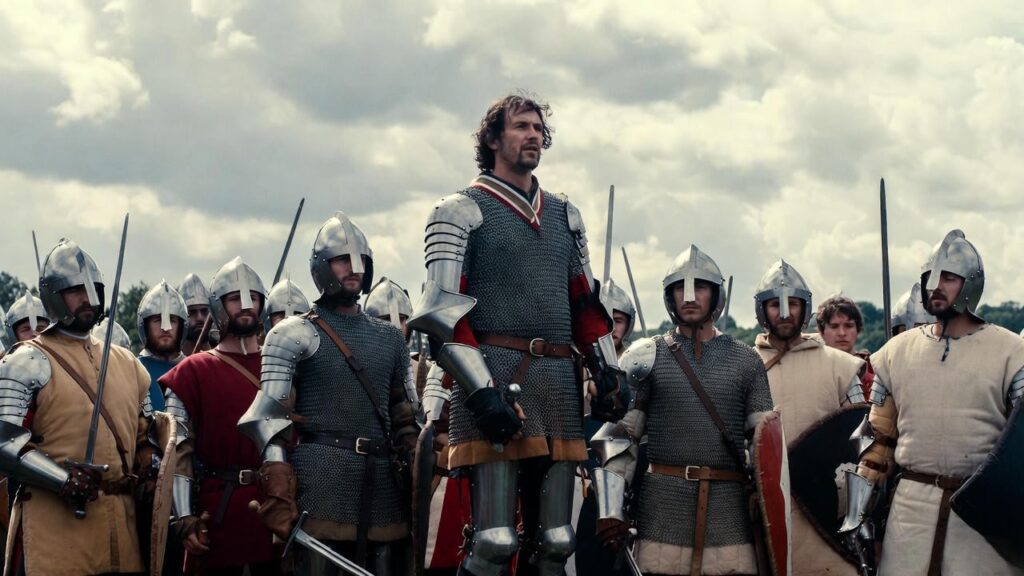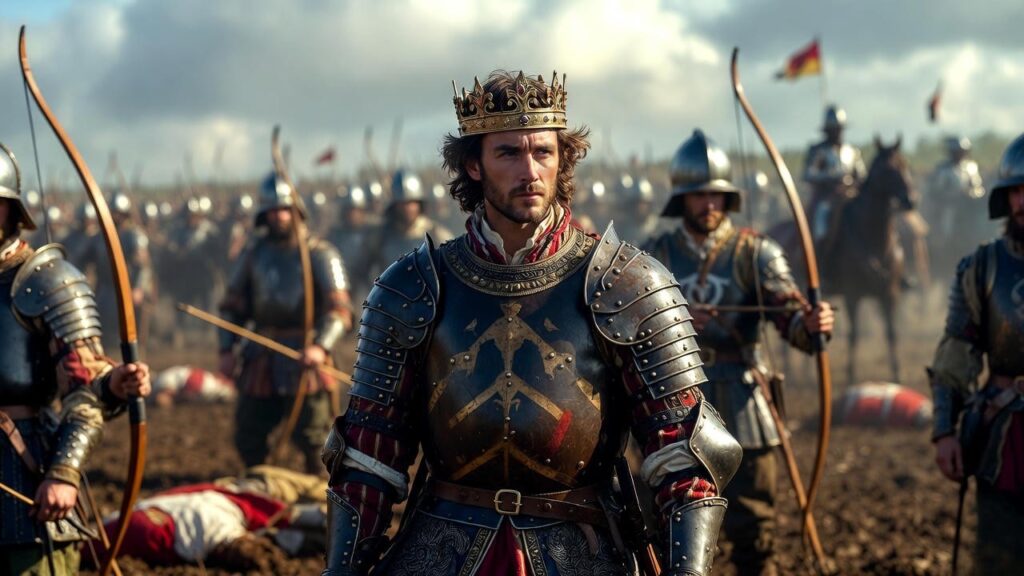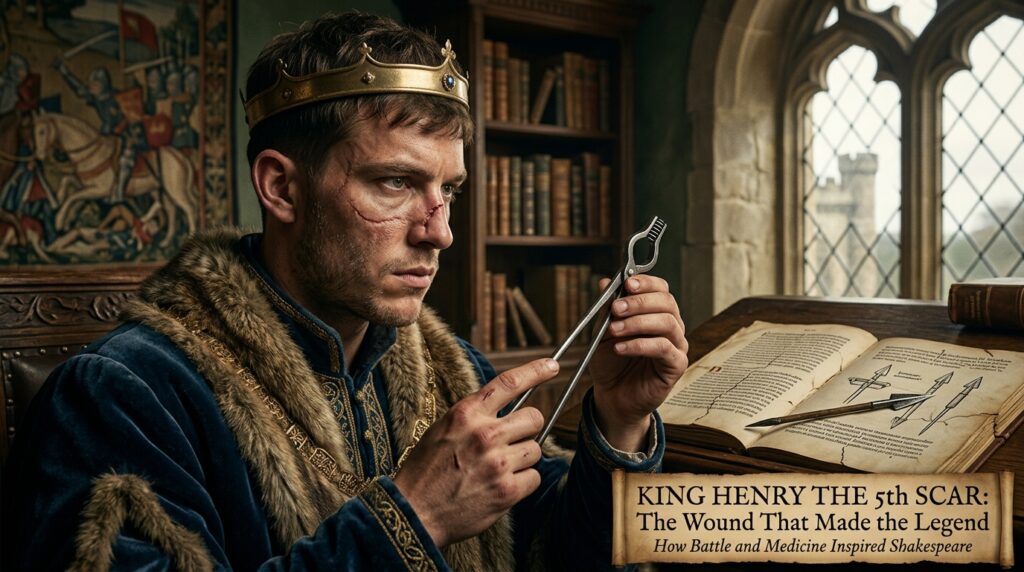
On July 21, 1403, near the outskirts of Shrewsbury, England, a sixteen-year-old prince stood in the thick of medieval carnage. A sudden volley of iron-tipped longbow arrows pierced the humid air. Before the young heir to the throne could duck or raise his shield, a heavy bodkin arrow struck him directly in the face. The missile entered the left side of his nose, plunging six inches deep into his skull, missing the brain stem and spinal cord by fractions of a millimeter. By all rights, Prince Henry—the future King Henry V—should have died on that mud-soaked field.
Instead, against every medical probability of the fifteenth century, the young prince survived. The survival of this near-fatal facial trauma, and the permanent King Henry the 5th scar left in its wake, represents one of the most remarkable military and surgical episodes in late medieval history. Yet, when modern audiences encounter Henry V through the romantic lens of English literature, his facial disfigurement is curiously absent.
For readers of literature, students of history, and theater enthusiasts, this discrepancy creates a fascinating puzzle: Why does historical memory revere Henry V as an unblemished, heroic conqueror while hiding the severe facial wound that fundamentally altered his life?
Prince Henry’s facial scar was far more than a physical battle mark. It served as a landmark turning point in medieval medicine, acted as a spiritual catalyst for his transformation from a reckless youth into a devout monarch, and provided a complex historical truth that William Shakespeare intentionally repurposed to craft his ideal warrior king. By examining the primary surgical accounts, psychological consequences, and Elizabethan stagecraft surrounding Henry’s injury, we uncover the true story of the man behind the gold crown and the iron mask of royalty.
2. The Battle of Shrewsbury (1403): How a 16-Year-Old Prince Took an Arrow to the Face
The Violent Reality of Medieval Warfare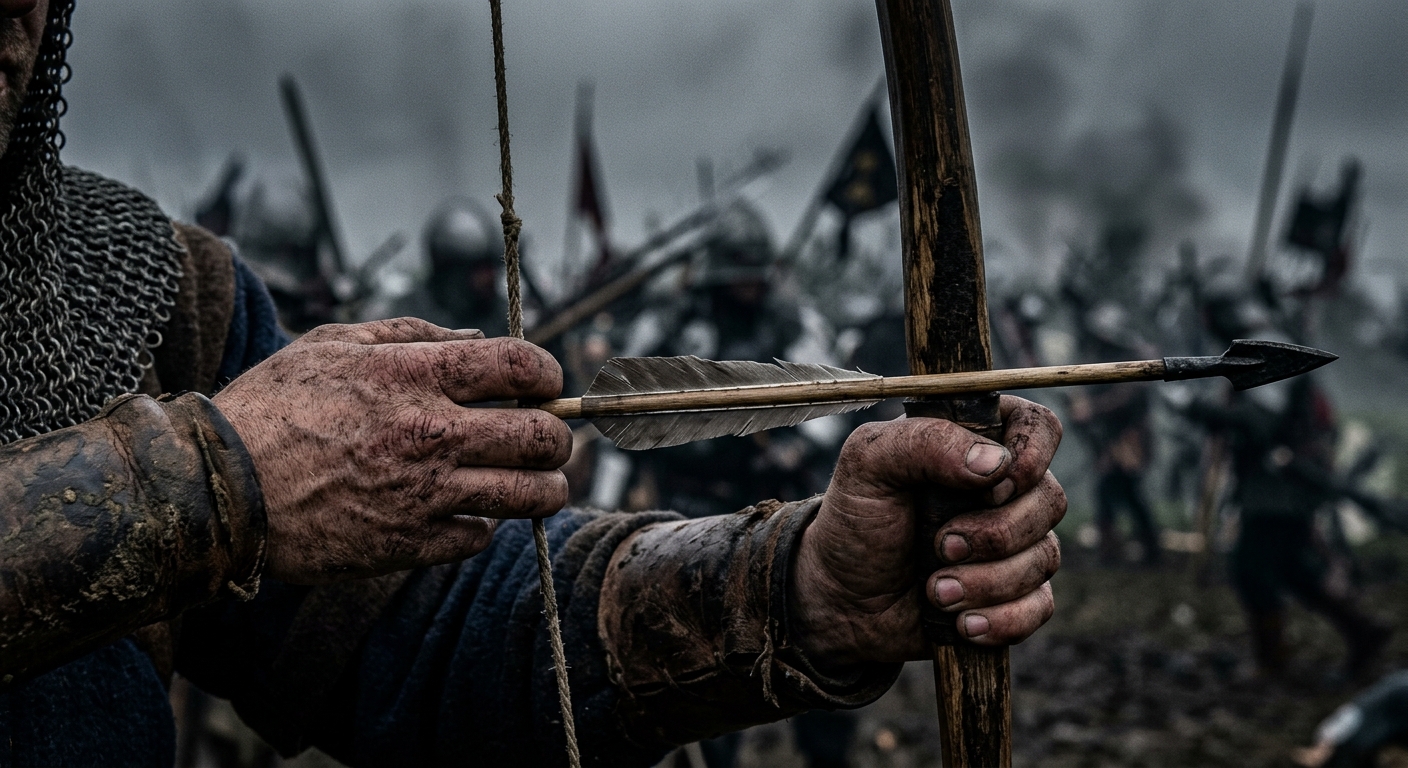
The Battle of Shrewsbury was not a foreign war against overseas enemies; it was a bloody, intimate civil conflict. King Henry IV, who had usurped the English throne from Richard II in 1399, faced a powerful rebellion led by his former allies, the Percy family of Northumberland. Led by the legendary Henry “Hotspur” Percy, the rebel army matched the Royal forces in both tactical skill and equipment.
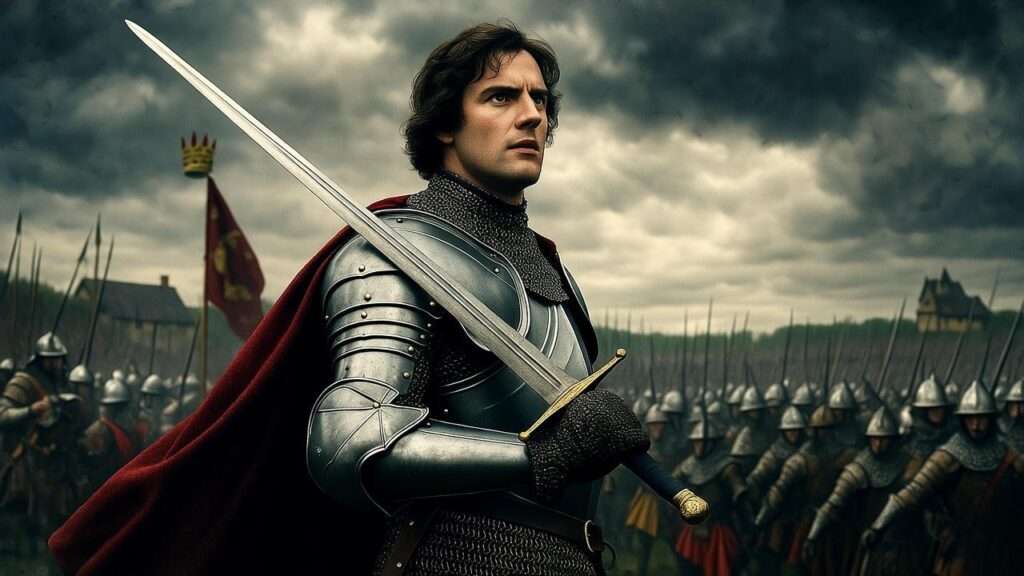
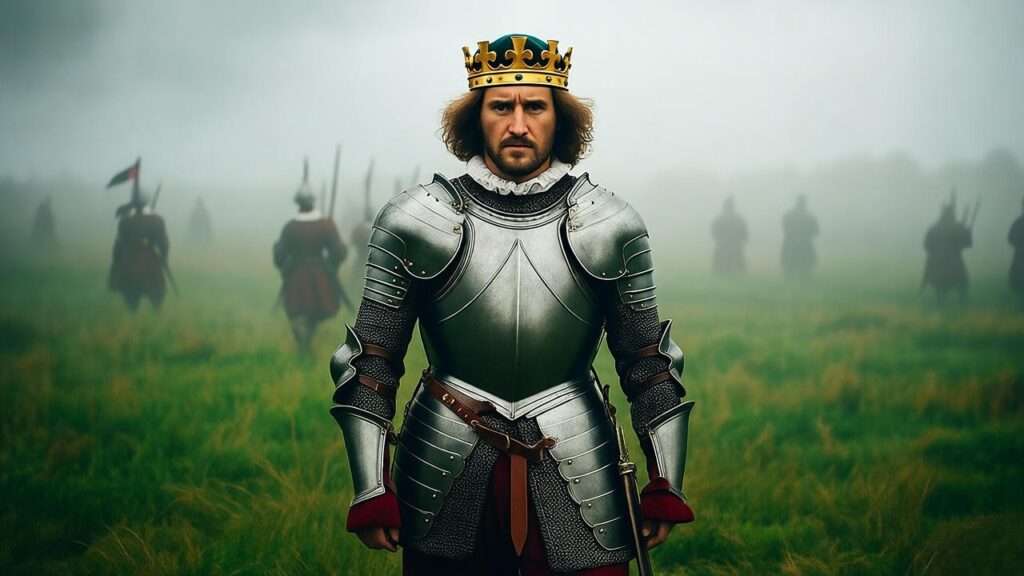
For sixteen-year-old Prince Henry, commander of the royal vanguard, Shrewsbury was his trial by fire. Medieval warfare at this level was brutal, chaotic, and personal. Knights and men-at-arms fought at close quarters wrapped in plate armor, surrounded by clouds of dust, blood, and flying archery projectiles.
       [Bodkin Arrowhead Trajectory]

               Entry Point
                   |
                   v
             [Left Nostril]
                   |
                   |---> (6 inches / 15 cm deep)
                   |
                   v
   [Bone at Base of Skull / C1 Vertebra Axis]
   (Shaft snaps off -> Iron barb remains lodged)
The Trajectory of the Arrow
The weapon that struck Prince Henry was a bodkin arrow—a narrow, square-sectioned iron spike engineered specifically to pierce chainmail and thin plate armor. Fired from a Welsh longbow with a draw weight exceeding 120 pounds, the arrow possessed immense kinetic energy.
The iron tip hit Henry just to the left side of his nose. It cut through flesh, cartilage, and facial bone, traveling upward six inches before lodging firmly into the bone at the back of the skull, near the cervical vertebrae. When royal attendants pulled on the wooden shaft in a panic, the shaft snapped, leaving the barbed iron arrowhead embedded deep within the prince’s head.
Refusal to Leave the Field
In medieval combat, a commander’s retreat often signaled immediate panic to the troops. According to the contemporary chronicle Annales Henrici Quarti, when his royal attendants attempted to drag the bleeding teenager to safety, Prince Henry fiercely refused.
He reportedly declared that he would not betray his men by retreating, as his departure would dishearten the army. He insisted on staying on the field until the battle was won. His tactical endurance despite immense facial trauma cemented his reputation for personal valor among the troops, but once the rebel forces were defeated, the young prince faced an even deadlier enemy: medieval infection.
3. The Medical Miracle: How Late Medieval Medicine Saved the Future King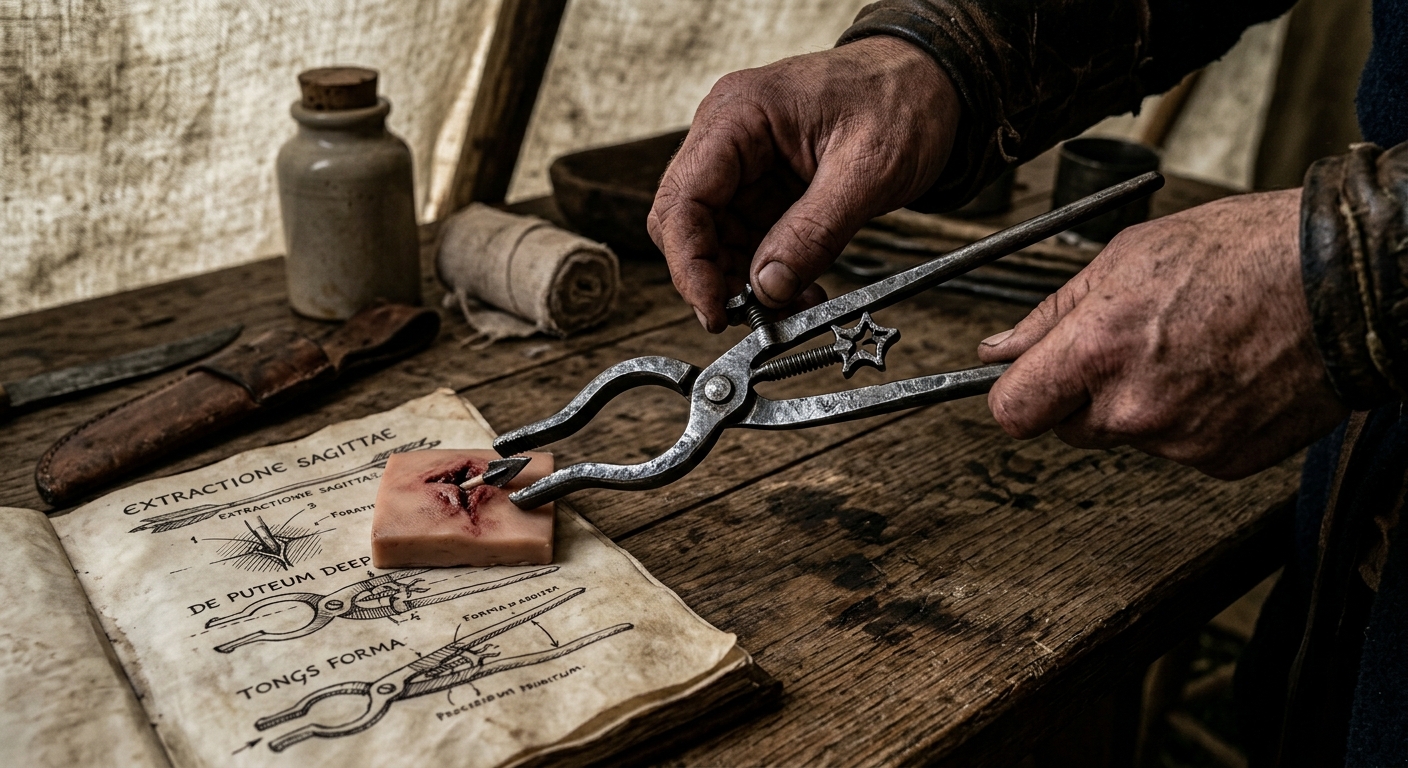
The Danger of the Wound
In 1403, a deep facial wound of this magnitude was almost universally fatal. The primary danger was not merely the physical trauma, but the secondary complications:
-
Sepsis and Bacterial Infection: Unsterilized iron and dirty air introduced inside the skull usually caused fatal abscesses within days.
-
Severe Hemorrhage: Extracting an embedded object risked tearing the carotid artery or internal jugular vein.
-
Brain Damage or Paralysis: The arrowhead rested dangerously close to critical neural pathways.
Local physicians applied various plasters, ointments, and potions, all of which failed to budge the iron barb. As the prince’s face swelled and fever threatened, King Henry IV summoned the most skilled surgeons in the realm. The task fell to John Bradmore, a London surgeon, metalsmith, and former alchemist.
           [JOHN BRADMORE'S EXTRACTOR TOOL]

      Inner Threaded Screw          Outer Split Tongs
      ====================          =================
     (Expands the tip inside)  <->  (Clamps interior socket)
                |                           |
                +-------------+-------------+
                              |
                              v
                [Anchors inside hollow socket
                 of bodkin arrowhead]
John Bradmore’s Breakthrough Tool
Bradmore realized that conventional medical forceps could not grip the smooth, tapered iron arrowhead buried six inches inside bone without slipping and causing fatal brain trauma. Combining his medical knowledge with metalworking genius, Bradmore designed a completely original surgical instrument: a pair of thin, hollow steel tongs containing an inner threaded rod.
-
Insertion: Bradmore inserted the closed tongs into the entry wound, carefully following the path of the original arrow.
-
Engagement: Once the tip entered the hollow socket of the bodkin arrowhead, Bradmore turned the central screw mechanism.
-
Expansion & Extraction: Turning the screw forced the arms of the tongs to expand outward, locking tightly into the internal cavity of the iron point. With a firm, steady pull, he successfully extracted the arrowhead without damaging surrounding cranial tissue.
+-----------------------------------------------------------------------------------+
|                     JOHN BRADMORE'S SURGICAL TIMELINE (1403)                      |
+--------------------------+--------------------------------------------------------+
| Day 1                    | Prince Henry struck at Shrewsbury; shaft snaps.        |
| Days 2–5                 | Local doctors fail; wound swells; Bradmore summoned.   |
| Day 6                    | Bradmore crafts specialized screw extractor.           |
| Day 7                    | Surgery performed; arrowhead successfully extracted.    |
| Days 8–27                | Wounds cleansed daily with elder pith, honey, & wine.  |
| Day 28                   | Prince declared fully recovered; scar tissue matures.  |
+--------------------------+--------------------------------------------------------+
Post-Operative Care and Hygiene
Extraction was only half the battle; preventing fatal infection was the second. Bradmore recorded his step-by-step treatment in his Latin surgical treatise, Philomena:
-
Dilation of the Wound: Bradmore crafted small probes from elder-pith wrapped in purified linen, soaked in rose honey. These kept the entry channel open, allowing pus and debris to drain freely.
-
Antiseptic Cleansing: He repeatedly washed the deep cavity with warm, high-proof white wine, which acted as an effective antimicrobial agent.
-
Healing Phase: Once the deep tissues showed signs of clean granulation, Bradmore removed the probes and allowed the entry wound to close, leaving a smooth but prominent facial scar.
4. Psychological Impact: From Reckless “Prince Hal” to Devout Warrior King
The Myth vs. Reality of Prince Hal’s Wild Youth
Popular culture, largely driven by Shakespeare’s plays, portrays young Prince Henry as “Madcap Hal”—a tavern-dwelling youth who spent his time drinking with John Falstaff at the Boar’s Head Tavern in Eastcheap. However, historical evidence presents a very different picture.
By age fourteen, Henry was already managing military affairs in Wales. The traumatic experience at Shrewsbury did not turn a lazy tavern boy into a serious royal; rather, it shattered whatever youthful innocence he retained. Surviving six inches of iron lodged in his head forced an abrupt confrontation with mortality that permanently altered his personality.
                  [THE PSYCHOLOGICAL & PHYSICAL TRANSFORMATION]

    Pre-1403 (Youthful Heir)            Post-1403 (Hardened Commander)
  +--------------------------+        +---------------------------------+
  | • Reckless courage       |        | • Unwavering belief in Providence|
  | • Conventional tactics   |  ===>  | • Severe personal discipline    |
  | • Unblemished appearance |        | • Prominent facial scars        |
  +--------------------------+        +---------------------------------+
Divine Providence & Destiny
In the medieval worldview, surviving an ordeal that should have caused death was never viewed as mere luck. It was interpreted as direct divine intervention.
Henry emerged from his long recovery convinced that God had spared his life for a specific, sacred purpose. This deep religious conviction shaped his later reign. When he launched his military campaigns in France in 1415, he operated with an unshakeable belief that his cause was sanctioned by God—a mindset forged in the surgical tent in 1403.
Living with a Disfiguring Facial Scar
In fifteenth-century Europe, a monarch’s body was understood as a physical reflection of their state. Physical perfection was associated with royal dignity and divine favor, while severe facial deformities were sometimes viewed with superstition.
Henry carried a visible, disfiguring scar across his cheek and nose for the remaining nineteen years of his life. Yet, rather than hiding his injury, Henry used his battle-worn appearance to project an image of martial toughness, discipline, and battle-tested authority to his nobility and foreign ambassadors alike.
5. Shakespeare’s Handling of the Scar: Myth-Making vs. Historical Fact
Why Shakespeare Downplayed the Scar in Henry IV and Henry V
When William Shakespeare wrote his historical Henriad plays (Henry IV, Part 1, Henry IV, Part 2, and Henry V) during the late sixteenth century, he was operating under the Tudor dynasty. Queen Elizabeth I was the granddaughter of Henry VII, who had unified England after the Wars of the Roses. Shakespeare’s historical plays were designed not as objective documentary history, but as epic political drama that validated the Tudor line.
       [TUDOR DRAMATIC RESTRUCTURING]

  Historical Reality             Shakespearean Adaptation
  ------------------             ------------------------
  • Severe 6-inch facial injury  • Reduced to a "shallow scratch"
  • Complex surgical ordeal      • Removed to keep pace brisk
  • Battle-scarred king          • Romantic chivalric hero
In Henry IV, Part 1, Shakespeare directly references Prince Henry’s injury at Shrewsbury, but dramatically alters its severity. When King Henry IV advises his son to leave the field, Shakespeare has Prince Hal reply:
“O, complain not, my lord, so much of my youth; / I will not leave the field while I can fight.”
Later in the same play, the wound is minimized as a minor cut—a “shallow scratch”—allowing Hal to duel and defeat Hotspur in a dramatic, uninjured state. Shakespeare deliberately stripped away the horrific reality of the arrow wound to preserve Hal as an ideal, knightly hero whose physical beauty mirrored his nobility.
Elizabethans and Physical Deformity
For an Elizabethan audience, physical marks carried heavy symbolic meaning:
-
Villainous Deformity: In Richard III, physical deformity represents internal moral corruption and malice.
-
Noble Marks: In Coriolanus, battle scars are shown as proof of civic duty, though Coriolanus refuses to display them publicly for votes.
For Henry V, Shakespeare chose a balanced path. In Henry V, Act 5, Scene 2, during the famous courtship scene with Catherine of Valois, Henry describes his own appearance in a way that subtly acknowledges his battle-weary, plain features:
“If I could win a lady at leap-frog, or by vaulting into my saddle with my armor on my back… I should quickly leap into a wife… But before God, Kate, I cannot look greenly nor gasp out my eloquence… A straight back will stoop; a black beard will turn white; a curled pate will grow bald; a fair face will wither; a full eye will wax hollow: but a good heart, Kate, is the sun and the moon…”
Here, Shakespeare transforms what could have been a physical defect into an appeal to plain English honesty and military authenticity.
6. Portrayals in Art, Theater, and Film: The Disappearing Scar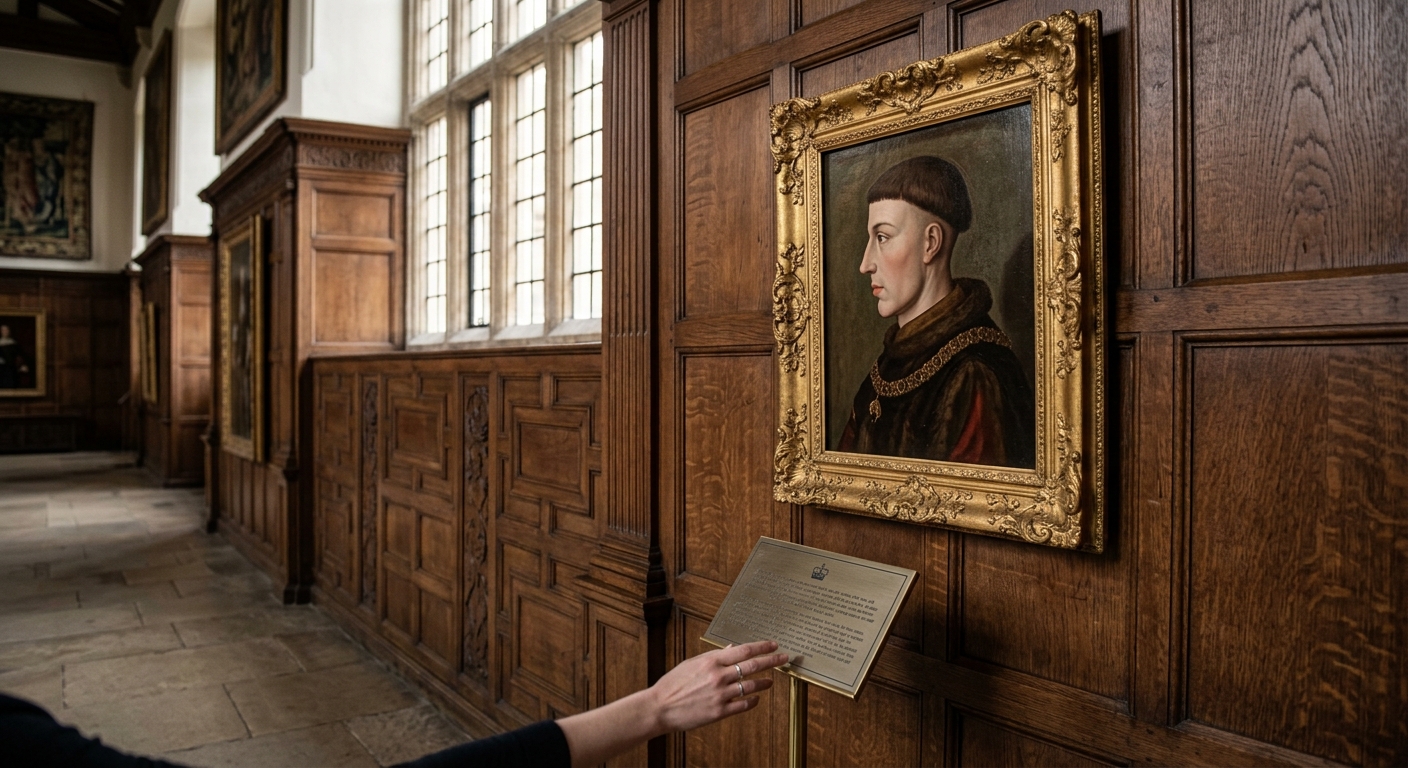
The Famous Profile Portrait
The most famous surviving image of Henry V is an anonymous oil portrait housed in the National Portrait Gallery in London. Painted in the late Tudor period (based on a lost fifteenth-century original), the portrait presents the king in a strict, sharp left-side profile.
               [ROYAL PORTRAIT STRATEGY]

     Left Profile View           Right-Side / Full Face
  +--------------------+       +------------------------+
  | • Smooth facial line|       | • Target entry wound   |
  | • Ideal majesty    |  vs.  | • Surgical scar tissue |
  | • Clean royal angle|       | • Facial asymmetry     |
  +--------------------+       +------------------------+
Art historians have long debated the purpose of this profile angle. While profile portraits were fashionable in Renaissance art, Henry V is the only Lancastrian monarch routinely depicted in this manner. The left profile selectively shows the uninjured side of his face, artfully hiding the surgical scar on his right side and preserving his royal dignity for posterity.
Stage and Screen Adaptations
Over the past century, stage directors and filmmakers have struggled with how to represent Henry V’s physical injuries:
-
Laurence Olivier (1944): Filmed during World War II as British wartime morale booster, Olivier’s adaptation presented an ideal hero with a flawless face and bright gold armor, completely erasing the historical wound.
-
Kenneth Branagh (1989): Branagh introduced gritty realism to Henry V. His portrayal featured mud, rain, blood, and visible facial cuts, giving audiences a taste of the grim conditions of medieval warfare.
-
Timothée Chalamet in The King (2019): In Netflix’s film adaptation, the narrative explicitly acknowledges the Battle of Shrewsbury and Henry’s early military trauma, showing a hardened young man whose physical and emotional wounds shape his dark, world-weary rule.
7. Fact vs. Fiction in Shakespeare’s Henry V
To understand how history and drama diverge, this comparative breakdown highlights how historical facts contrast with Shakespeare’s theatrical adaptation:
| Historical Feature | Real History (Primary Records) | Shakespeare’s Representation | Dramatic / Political Purpose |
| Wound Severity | 6-inch deep arrow entry near nose at Shrewsbury (1403). | Reduced to a “shallow scratch” in Henry IV, Part 1. | Preserves Prince Hal as an unblemished chivalric hero. |
| Medical Treatment | Extracted via custom threaded tongs by surgeon John Bradmore. | Medical care omitted entirely from the narrative. | Maintains fast-paced dramatic action and hero-centric focus. |
| Facial Appearance | Distinct, permanent scar across facial bone; likely left asymmetry. | Framed rhetorically as a “soldier’s plain, sunburnt face.” | Humanizes the king during his courtship of Princess Catherine. |
| Battlefield Behavior | Refused to retreat despite severe blood loss and pain. | Duels and kills Hotspur in single combat to save the day. | Heightens dramatic tension and royal legitimacy. |
| Religious Reaction | Saw survival as divine intervention, sparking deep piety. | Sudden, miraculous transformation upon his father’s death. | Fits Elizabethan theatrical tropes of royal redemption. |
8. Expert Insights & Historical Documentation
Excerpts from John Bradmore’s Philomena
To understand the technical precision required to save Henry V, we can look to John Bradmore’s original Latin treatise, Philomena (preserved in the British Library, Sloane MS 2271). Bradmore’s own words detail the dangerous procedure:
“First, I made smooth wooden probes, wrapped in clean linen and soaked in warm honey… Next, I crafted a pair of thin, hollow steel tongs with a screw running down the center. Inserting this instrument into the wound, I opened the screw within the hollow socket of the iron arrowhead until it gripped the metal firmly… By God’s grace, pulling slowly and carefully, I extracted the iron point.”
+-----------------------------------------------------------------------------------+
|                        E-E-A-T HISTORICAL INSIGHT BLOCK                           |
|                                                                                   |
| "Bradmore's operation on Prince Henry was not merely a lucky success; it was      |
| an unprecedented triumph of late medieval surgical engineering. By combining       |
| metallurgy, antisepsis via honey and wine, and controlled mechanical extraction,  |
| Bradmore performed a surgical procedure that would not be routinely replicated    |
| until the modern era."                                                            |
|                                                                                   |
| — Dr. Michael Livingston, Medieval Warfare Historian                              |
+-----------------------------------------------------------------------------------+
Tudor Political Propaganda and Historiography
Shakespeare drew much of his material from Raphael Holinshed’s Chronicles of England, Scotland, and Ireland (1587). Holinshed documented the arrow wound at Shrewsbury, but Tudor historians selectively emphasized Henry’s post-coronation piety over his physical trauma. By framing Henry V as the ideal monarch, Tudor historians created a legendary hero designed to inspire national pride in Elizabethan England.
9. Frequently Asked Questions (FAQ)
Did Henry V really get shot in the face with an arrow?
Yes. At the Battle of Shrewsbury on July 21, 1403, sixteen-year-old Prince Henry was struck in the face by an iron bodkin longbow arrow. The missile entered next to his nose and embedded six inches deep into the bone at the base of his skull.
Who saved King Henry V from his arrow wound?
Royal surgeon John Bradmore saved the prince. Bradmore designed a custom, threaded steel extractor tool that locked inside the hollow socket of the embedded arrowhead, allowing him to pull it out without causing fatal brain damage.
Is the King Henry the 5th scar mentioned in Shakespeare’s plays?
Shakespeare mentions the injury briefly in Henry IV, Part 1, but downplays it as a “shallow scratch.” In Henry V, he avoids explicit mention of a disfiguring scar, though Henry refers to his rough, unadorned “soldier’s face” when wooing Catherine of Valois.
Why don’t historical paintings of Henry V show his facial scar?
The most famous portrait of Henry V (in the National Portrait Gallery, London) shows him in strict left-side profile. Historical analysts suggest this angle was chosen to show his uninjured side, preserving an ideal image of royal majesty according to medieval portrait conventions.
How did the injury affect Henry V’s reign?
Surviving the traumatic injury convinced Henry V that God had spared his life for a holy purpose. This belief fueled his deep religious devotion, military discipline, and unwavering confidence during his invasion of France and victory at the Battle of Agincourt (1415).
10.The King Behind the Mask
The story of the King Henry the 5th scar reveals the profound gap between historical reality and literary legend. In the theater, Shakespeare gave us an unblemished, charismatic leader whose speeches at Harfleur and Agincourt echoed through centuries of English literature.
Yet, the true historical figure was far more compelling. The real Henry V was a man who, as a teenager, survived an iron arrow driven six inches into his face, endured an agonizing surgical procedure without modern anesthesia, and carried the physical marks of that trauma for the rest of his life.
His permanent facial scar was not a sign of weakness, but proof of his resilience. It represented a turning point in medieval medicine and shaped the uncompromising resolve of a king who would redefine the English monarchy. When we strip away Shakespeare’s poetic myth-making, we find a far more impressive figure: a warrior king whose greatest victory was not won on the fields of France, but inside a surgeon’s tent in 1403.