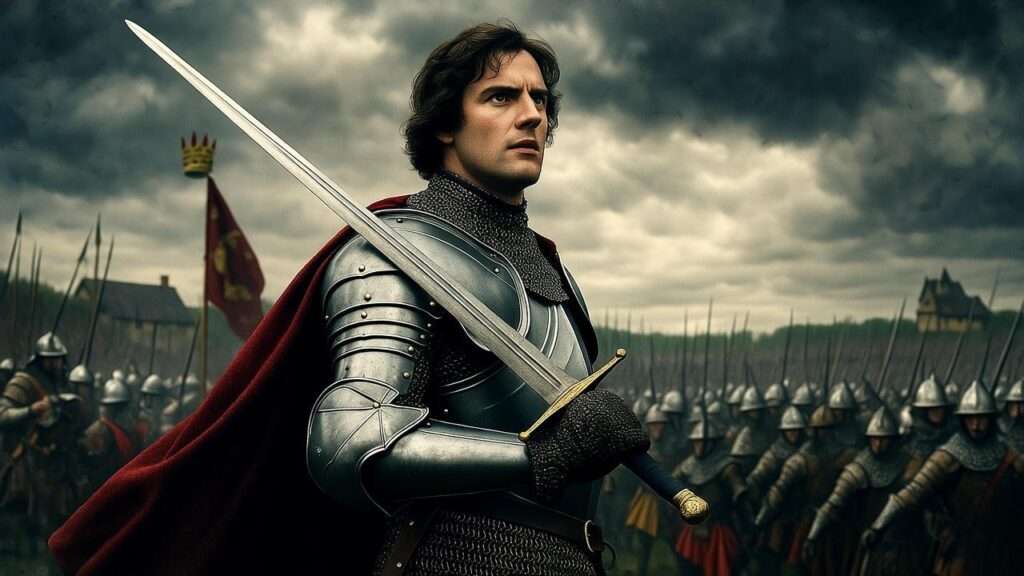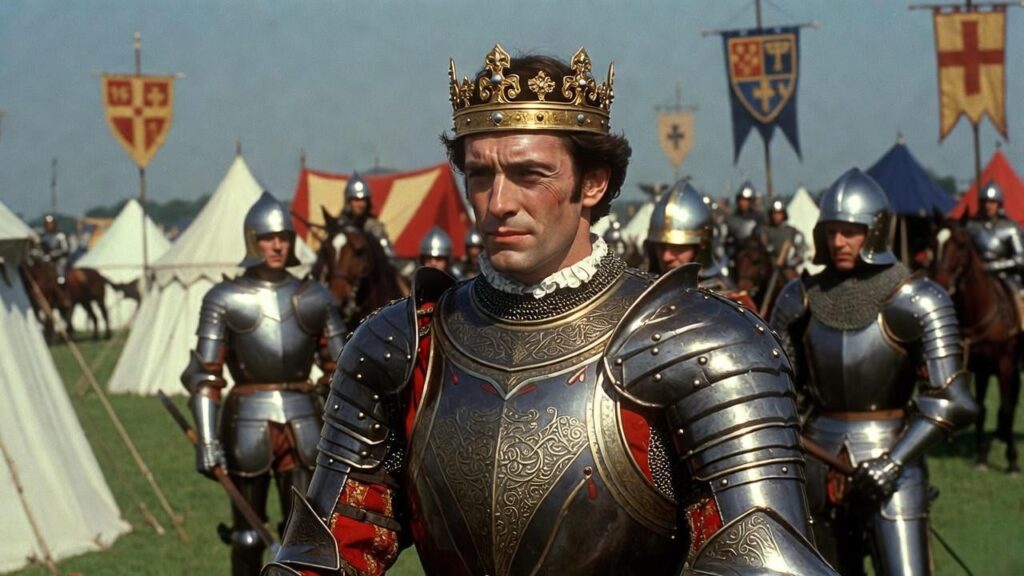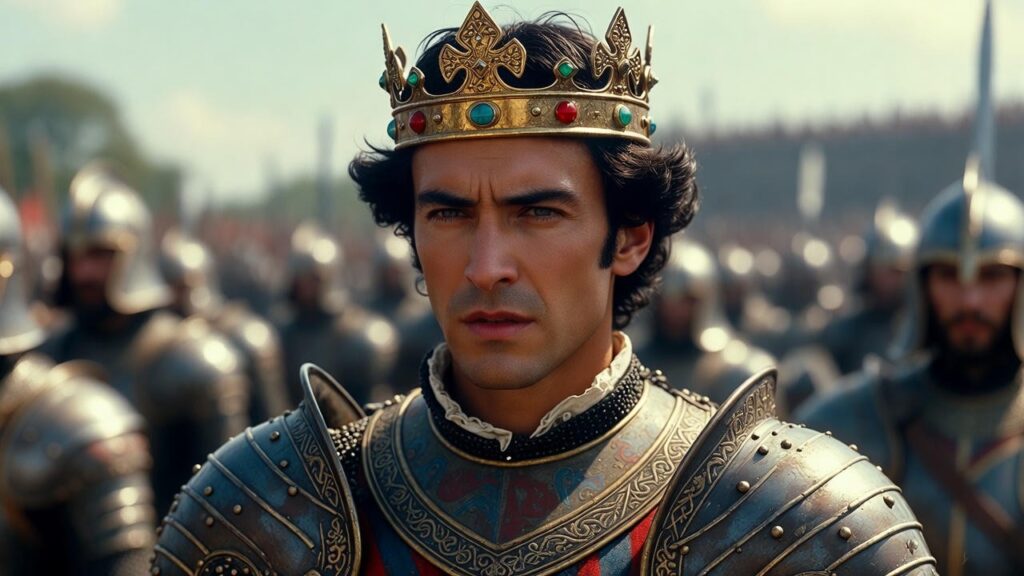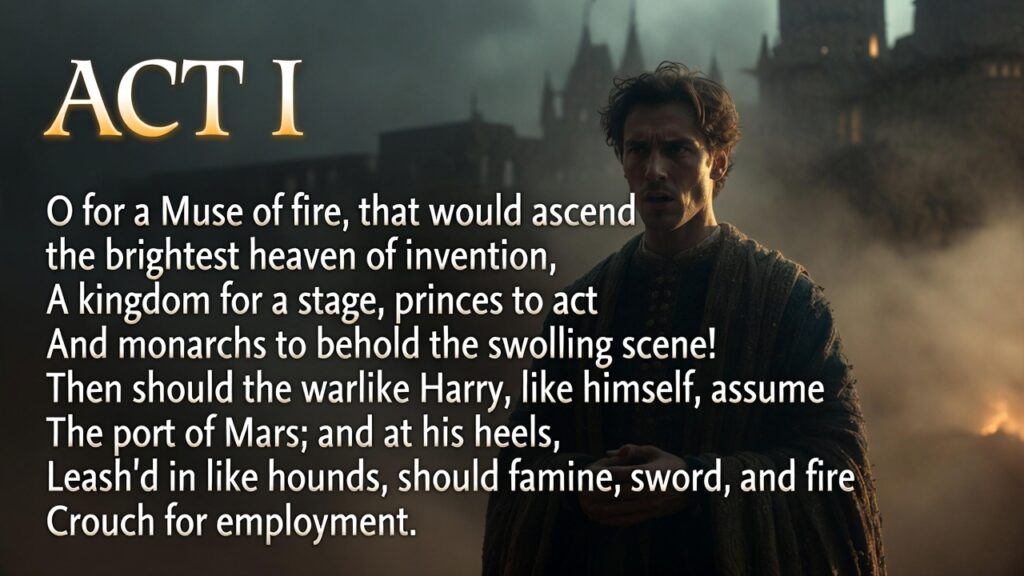
“O for a muse of fire, that would ascend / The brightest heaven of invention!” With these soaring words, Shakespeare’s Chorus ignites Henry V, one of the greatest history plays in the English language, transporting audiences to the epic clash of kings and nations. Henry V Act 1 lays the foundation for this dramatic tale, introducing the Chorus’s call to imagination, the scheming of church leaders, and King Henry’s calculated march toward war with France.
Henry V Act 1 is essential for understanding Shakespeare’s portrayal of kingship, the justification of conquest, and the interplay of rhetoric and power. It reveals how a once-wayward prince becomes a formidable monarch, how religion intertwines with politics, and how provocation can spark invasion. For students preparing essays, teachers crafting lessons, or literature lovers seeking deeper insight, this act offers rich material: dense language, layered characters, and timeless questions about leadership and morality. In this comprehensive guide, we provide a scene-by-scene breakdown, close analysis of themes and quotes, historical context, and practical study tools—going beyond basic summaries to deliver the depth needed for true mastery.
The Role of the Chorus in Henry V – Setting an Epic Stage
Summary of the Prologue
The play opens not with characters but with the Chorus, a single actor who steps forward to frame the action. He laments the inadequacy of the Elizabethan stage—a “wooden O”—to capture the grandeur of Henry’s campaign. He invokes a “muse of fire” to inspire epic storytelling, wishing for “a kingdom for a stage, princes to act, / And monarchs to behold the swelling scene.” Instead, the audience must use their imaginations: “Piece out our imperfections with your thoughts,” turning the cramped theater into vast French fields, humble actors into mighty armies, and spoken words into thundering battles.
Why Shakespeare Uses a Chorus
Shakespeare employs the Chorus sparingly—only in Henry V and Romeo and Juliet among his major works—drawing from classical epic tradition (Homer’s invocations in the Iliad) while acknowledging practical limitations of the Globe Theatre. No elaborate sets or special effects existed; the Chorus compensates by urging spectators to “work, work your thoughts.” This meta-theatrical device also builds excitement, positioning the play as a patriotic spectacle celebrating English valor during a time of national pride under Elizabeth I.
Key Themes Introduced
The Prologue immediately foregrounds imagination versus reality, a motif echoing throughout the play. Language becomes a tool to conjure history: “Think, when we talk of horses, that you see them / Printing their proud hoofs i’ th’ receiving earth.” It also hints at the power of rhetoric—Henry’s greatest weapon—and the audience’s active role in constructing the narrative.
Expert Insight: The Chorus foreshadows Henry’s own mastery of language, from courtroom debates to battlefield speeches. In a play exploring propaganda and heroism, this opening reminds us that history is partly performative, shaped by words as much as deeds.
Act 1, Scene 1 – Church Politics and the Threat to Ecclesiastical Power
Detailed Scene Summary
In an ante-chamber of the king’s palace, the Archbishop of Canterbury and the Bishop of Ely discuss a parliamentary bill threatening to seize church lands for secular use—funding knights, earls, almshouses, and the royal treasury. Valued at immense sums, this “better half of our possession” alarms the clergy. To counter it, Canterbury reveals his strategy: offer Henry substantial church funds to support his claim to France, diverting attention from the bill. They marvel at Henry’s transformation from the riotous Prince Hal (known from Henry IV Parts 1 and 2) to a wise, pious king, likening him to a strawberry thriving under nettles—hidden virtue ripening into greatness.
Character Analysis
- Archbishop of Canterbury: A cunning politician who cloaks ambition in piety. His lengthy justifications later reveal self-interest masked as theological expertise.
- Bishop of Ely: A pragmatic supporter, quick to praise Henry’s reformation while aligning with the church’s survival plan.
Henry’s Transformation – From “Wild Prince” to Ideal King
The bishops reflect on Hal’s past “riots, banquets, sports” and low company, yet note how “the breath no sooner left his father’s body / But that his wildness, mortified in him, / Seemed to die too.” Ely suggests Hal cultivated refinement “under the veil of wildness,” a deliberate disguise. This redemption arc positions Henry as Shakespeare’s ideal Christian monarch—learned, just, and divinely favored.
Themes Explored
- Power and Manipulation: The church uses Henry’s ambitions to protect its wealth, highlighting religion’s role in statecraft.
- Appearances vs. Reality: Henry’s “veil” parallels the bishops’ pious facade.
- Religion vs. State: The scene critiques clerical corruption while showing pragmatic alliances.
Expert Insight: This scene subtly critiques institutional hypocrisy, yet it humanizes politics—everyone maneuvers for advantage. In Elizabethan England, where church-state tensions simmered, Shakespeare invites nuanced reflection on authority.
Act 1, Scene 2 – Henry’s Court: Legal Justification and the Tennis Ball Insult
Detailed Scene Summary
Henry convenes his court, including nobles like Exeter and Westmoreland. He demands Canterbury justify his French claim under conscience and divine law, warning against bias: “For God doth know how many now in health / Shall drop their blood in approbation / Of what your reverence shall incite us to.” Canterbury delivers a convoluted but persuasive argument refuting Salic Law (which barred female inheritance in certain lands), tracing Henry’s lineage through French queens and asserting prior precedents. Henry considers Scottish threats but prioritizes France. French ambassadors arrive with tennis balls from the Dauphin, mocking Henry’s youthful “addiction to courses vain.” Henry responds with controlled fury, vowing to turn the “balls” into “gun-stones” and bring war that will make “many a thousand widows” weep.
Key Character Moments
- Henry V: Poised and strategic; he probes the clergy carefully, then unleashes righteous anger. His rhetoric shifts from inquiry to resolve.
- Archbishop of Canterbury: His speech, though self-serving, provides legal cover for war.
Language and Rhetoric Analysis
Henry’s warning to the clergy (“May I with right and conscience make this claim?”) shows moral caution. His reply to the Dauphin—“We are glad the Dauphin is so pleasant with us”—drips with irony, escalating to: “Tell him he hath made a match with such a wrangler / That all the courts of France will be disturbed.” The tennis balls symbolize underestimation, catalyzing invasion.
Themes Deep Dive
- Legitimacy of Rule: Divine right vs. conquest; Henry’s claim blends genealogy and provocation.
- Honor and Provocation: The insult justifies aggression.
- Foreshadowing Leadership: Henry’s blend of justice and ruthlessness emerges.
Major Themes in Henry V Act 1
Kingship and Leadership
Act 1 establishes Henry as the ideal Renaissance monarch: pious, learned, just, and decisive. The bishops’ astonishment at his transformation—“The breath no sooner left his father’s body / But that his wildness, mortified in him, / Seemed to die too”—underscores the theme of redemption. Yet Shakespeare complicates this portrait. Henry’s careful probing of the clergy (“For God doth know how many now in health / Shall drop their blood…”) reveals moral awareness, but his swift embrace of war suggests pragmatism borders on ruthlessness. This duality—heroic king or calculating politician—fuels centuries of debate.
The Justification of War
The act meticulously constructs the legal, religious, and personal grounds for invading France. Canterbury’s lengthy exposition on Salic Law provides a veneer of legitimacy, but the bishops’ ulterior motive (protecting church wealth) exposes the manipulation beneath. The Dauphin’s tennis balls offer the final, emotional spark. Shakespeare thus presents war as neither purely noble nor wholly cynical, but a complex mixture of right, opportunism, and provocation.
Appearance vs. Reality
This theme permeates every major moment: Henry’s “veil of wildness,” the church’s pious mask for self-interest, and the Dauphin’s fatal misjudgment of the English king. The Chorus reinforces the idea by asking the audience to “piece out our imperfections with your thoughts,” reminding us that what we see on stage—and in history—is always constructed.
Language as Power
From the Chorus’s poetic appeal to imagination, to Canterbury’s rhetorical tour de force, to Henry’s masterful response to the Dauphin, Act 1 demonstrates that words can create kingdoms, justify slaughter, and transform perceptions. Henry’s oratory, in particular, foreshadows his later battlefield speeches, showing language as a weapon as potent as any sword.
Expert Insight: These themes reflect Elizabethan anxieties about monarchy, religion, and foreign policy. Written around 1599, during the final years of Elizabeth I’s reign, the play subtly engages with contemporary debates about succession, church power, and the justification of military action (including the ongoing Irish campaigns).
Important Quotes from Henry V Act 1 with Analysis
Here are some of the act’s most significant lines, with context and interpretation:
- Chorus – “O for a muse of fire…” The opening invocation sets the tone of grandeur and acknowledges theatrical limitation. It establishes imagination as the true stage.
- Archbishop of Canterbury – “The strawberry grows underneath the nettle…” (1.1.60–65) A beautiful metaphor for Henry’s hidden virtue. The image of fruit ripening beneath weeds suggests deliberate concealment and eventual revelation.
- Henry V – “For God doth know how many now in health / Shall drop their blood in approbation / Of what your reverence shall incite us to.” (1.2.18–20) A solemn warning that places moral responsibility on the clergy. It shows Henry’s awareness of war’s human cost.
- Archbishop of Canterbury – “The sin upon my head, dread sovereign!” (1.2.97) Canterbury eagerly accepts the burden of justifying the war, revealing his political calculation.
- Henry V – “We are glad the Dauphin is so pleasant with us…” (1.2.260) Ironic understatement that quickly escalates into a chilling declaration of war: “But this lies within the will of God, / To whom I do appeal…”
- Henry V – “And tell the Dauphin his jest shall turn to earnest.” (1.2.296–297) A concise promise of retribution, showcasing Henry’s controlled anger and rhetorical precision.
These quotes are gold for essays: they illustrate character, theme, and Shakespeare’s linguistic mastery.
Historical and Literary Context for Act 1
Shakespeare drew primarily from Raphael Holinshed’s Chronicles of England, Scotland, and Ireland (1587), which provided the Salic Law debate, the tennis-ball incident, and the church’s political maneuvering. The historical Henry V (1386–1422) was a successful warrior-king whose victory at Agincourt (1415) became legendary.
In the broader Henriad tetralogy (Richard II, Henry IV Parts 1 & 2, Henry V), Act 1 completes Prince Hal’s arc from tavern rogue to national hero. Shakespeare compresses and dramatizes events for theatrical effect, heightening the church’s role to explore power dynamics.
Modern interpretations vary widely: some view Henry as a heroic exemplar of Christian kingship; others read the play as ironic critique of imperialism and propaganda. Both views find support in Act 1’s careful balance of idealism and pragmatism.
Study Tips and Essay Ideas for Henry V Act 1
- For Exams: Focus on Henry’s language—analyze how his tone shifts from cautious to commanding. Memorize 4–5 key quotes with context.
- Essay Prompts:
- “To what extent is the justification for war in Act 1 presented as legitimate?”
- “Discuss the role of the Chorus in shaping the audience’s perception of Henry.”
- “How does Shakespeare use the tennis-ball incident to reveal character and advance theme?”
- Writing Tips: Always link textual evidence to broader themes. Compare Henry’s rhetoric with Falstaff’s in Henry IV to highlight his transformation. Use the phrase “appearance versus reality” as a unifying thread.
Frequently Asked Questions (FAQs)
What is the Salic Law and why does it matter? Salic Law was a Frankish custom prohibiting inheritance through the female line. Canterbury argues it does not apply to France because Henry’s claim descends through a female ancestor (Isabella, mother of Edward III). The argument is historically dubious but dramatically crucial—it provides legal cover for invasion.
Why do the bishops support Henry’s war? Primarily self-interest. A parliamentary bill threatens to confiscate church lands. By funding and legitimizing Henry’s French campaign, they hope to divert attention and secure royal favor.
How does Act 1 show Henry’s change from Prince Hal? Through the bishops’ dialogue and Henry’s own actions. They marvel at his sudden piety and wisdom; he demonstrates strategic caution, rhetorical skill, and moral awareness absent in his earlier tavern days.
Is Henry V portrayed as a hero in Act 1? Partially. He appears just, eloquent, and resolute—but the play also reveals his political calculations and the manipulative forces around him. Shakespeare invites ambiguity.
Act 1 of Henry V masterfully lays the groundwork for the play’s exploration of leadership, war, and the power of language. From the Chorus’s call to imagination, through the church’s political maneuvering, to Henry’s decisive embrace of conflict, Shakespeare creates a portrait that is both inspiring and unsettling. The act ends with war declared—not merely against France, but against underestimation itself.
As the play progresses to Agincourt and beyond, these opening tensions—between idealism and pragmatism, rhetoric and reality—will deepen. For now, Act 1 stands as a brilliant study in transformation, justification, and the theatrical construction of history.