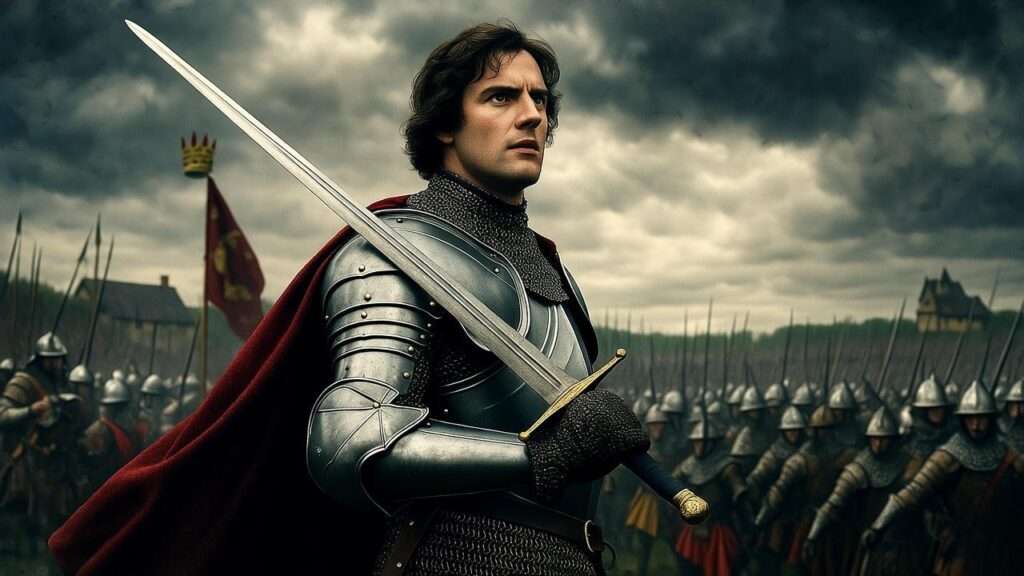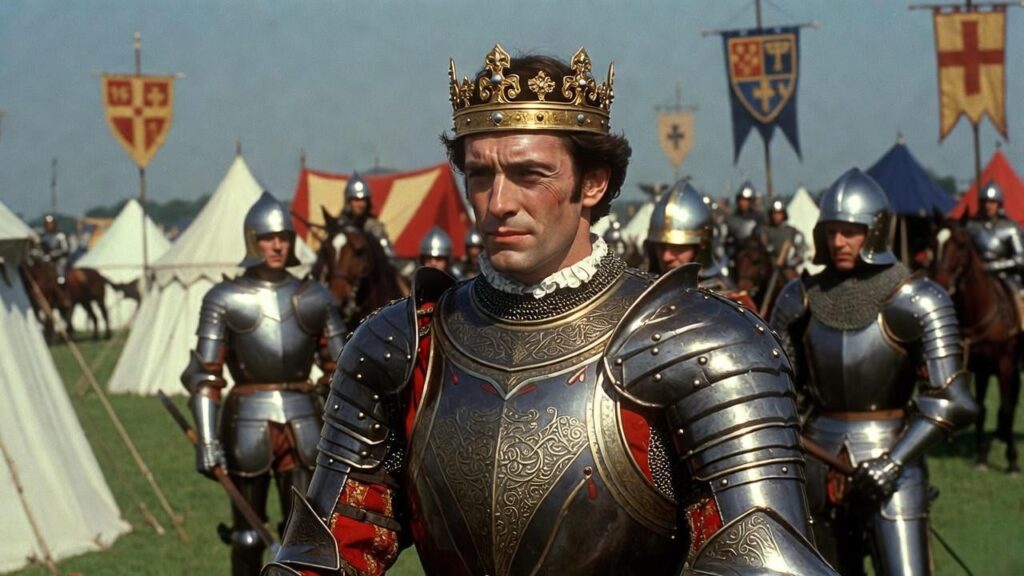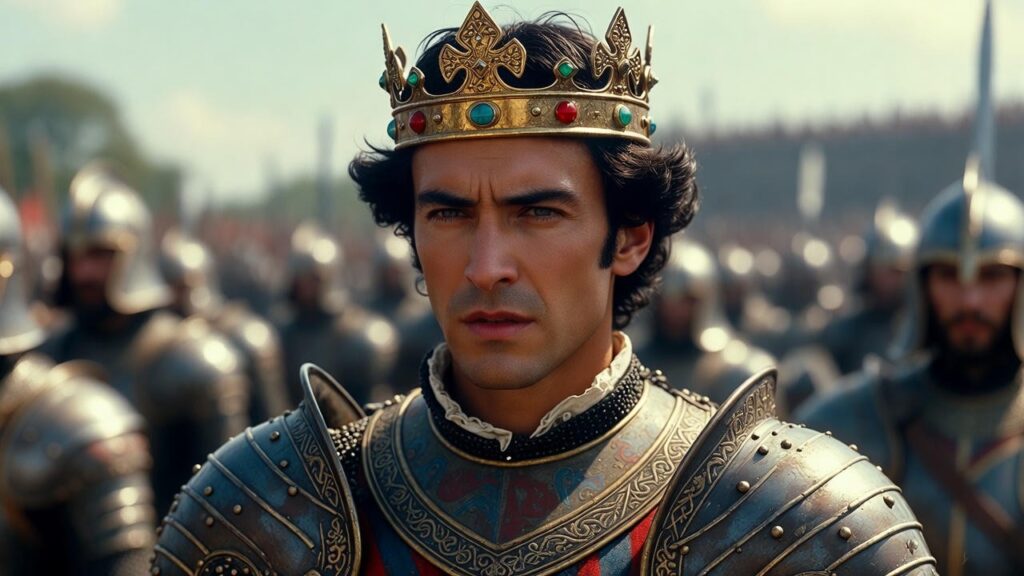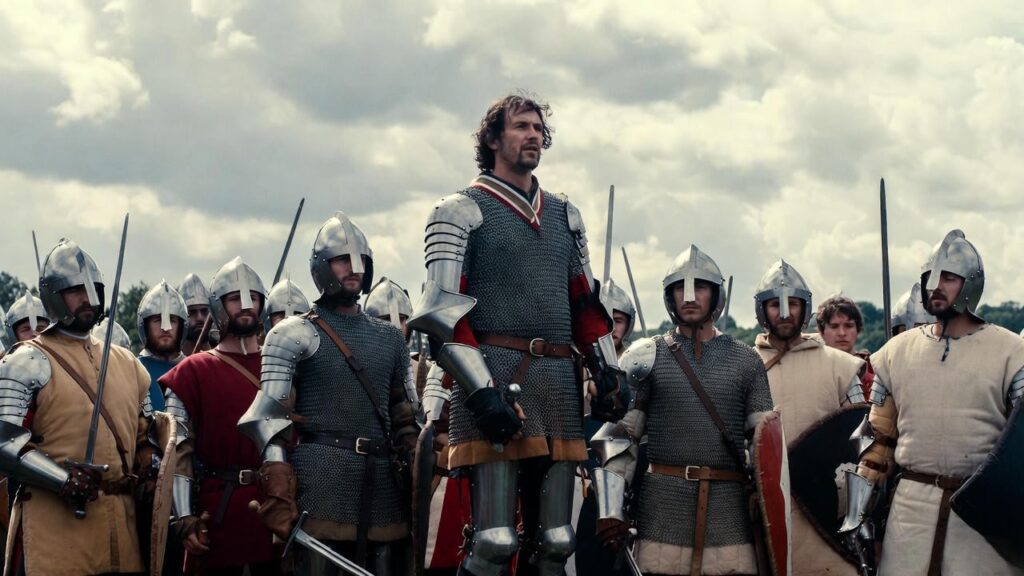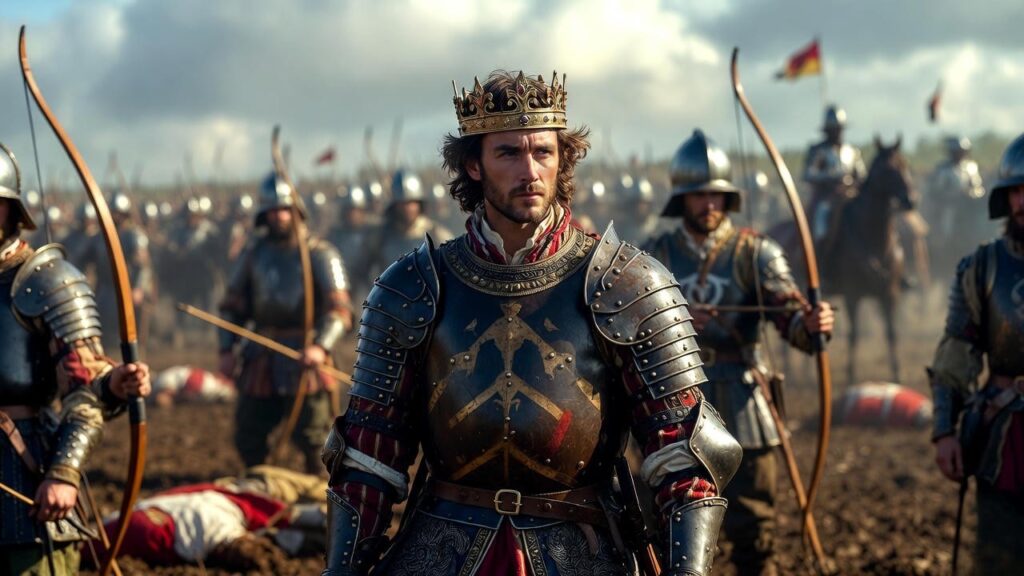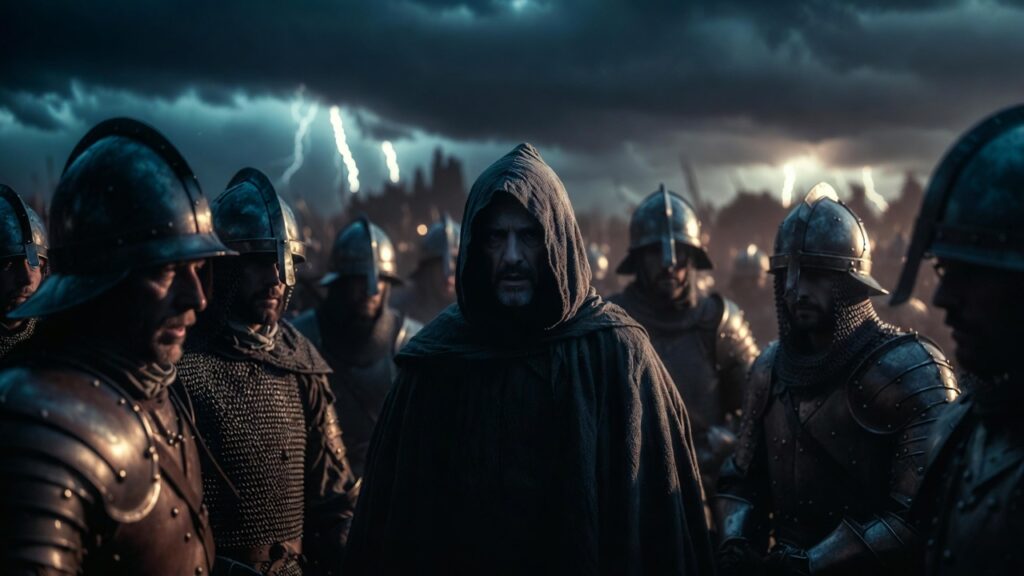
Imagine the pitch-black night before the Battle of Agincourt in 1415: rain-soaked fields, flickering campfires, the distant clank of French armor, and an English army vastly outnumbered—perhaps five to one—facing almost certain annihilation. In this moment of profound vulnerability, King Henry V does something extraordinary. He borrows a common soldier’s cloak, sheds his royal insignia, and walks anonymously among his troops. What he hears and what he reveals in solitude exposes the raw truth beneath the crown: leadership is not glory alone, but an isolating, crushing burden. This is the heart of Henry V Act 4 Scene 1, one of Shakespeare’s most psychologically penetrating scenes.
In Henry V Act 4 Scene 1, Shakespeare strips away the heroic facade to reveal a king grappling with doubt, guilt, and the moral weight of war. The focus keyword “henry v act 4 scene 1” often draws students, teachers, actors, and literature lovers seeking summaries, deep analysis, key quotes, and thematic insights. This comprehensive guide delivers exactly that—more detailed, contextualized, and insightful than standard study aids—while exploring why this scene remains essential for understanding Shakespeare’s portrayal of kingship, leadership, and human vulnerability.
Scene Summary: What Happens in Henry V Act 4 Scene 1
The scene opens in the English camp on the eve of Agincourt, following the Chorus’s vivid prologue contrasting the anxious English with the overconfident French. King Henry, accompanied by his brothers Gloucester and Bedford (and briefly Sir Thomas Erpingham), acknowledges the dire situation but maintains outward optimism. He notes wryly that the French threat has made the English “early stirrers,” turning adversity into a health benefit—a classic example of Henry’s ability to find “some soul of goodness in things evil.”
To gauge true morale and connect with his men, Henry borrows Erpingham’s cloak and disguises himself as a common soldier. This act of incognito reconnaissance echoes his youthful escapades as Prince Hal but now serves a higher purpose: testing loyalty and understanding his army’s fears.
His encounters unfold in quick succession:
- He meets the bombastic Pistol, who curses the French and praises the king as a “lovely bully” with a “heart of gold.” Henry, unrecognized, plays along humorously, revealing comic relief amid tension.
- He overhears Fluellen and Gower discussing military discipline, praising Fluellen’s “care and valour” in private.
- The most significant interaction occurs with three common soldiers—Bates, Court, and Williams. They debate the justice of the war and the king’s responsibility for his men’s souls. Williams argues powerfully: if the cause is unjust, the king bears a “heavy reckoning” for the souls of those who die poorly prepared. Henry defends the king’s position anonymously, insisting every soldier must prepare his own conscience, but the exchange grows heated. They pledge to settle the quarrel post-battle, exchanging gloves as tokens.
Alone after the soldiers depart, Henry delivers the famous “Upon the King” soliloquy, lamenting the burdens of royalty. He then prays fervently, asking God not to punish him in the coming battle for his father’s usurpation and murder of Richard II.
Dramatic irony permeates the scene: the audience knows Henry’s identity, heightening the poignancy of his disguise and the soldiers’ candid criticisms.
Character Development: Henry’s Transformation in Disguise
Henry’s decision to disguise himself marks a profound evolution from the wayward Prince Hal of Henry IV Parts 1 and 2. Once he caroused incognito in taverns to escape princely duties, now he uses anonymity to fulfill them—to understand his men’s fears and bolster their resolve indirectly.
The disguise reveals multiple layers of Henry’s character:
- As an Everyman: By claiming to be “a gentleman of a company,” Henry tests genuine opinions. He hears unfiltered doubts about the war’s legitimacy and his own accountability—insights impossible in his royal persona.
- Interactions as Mirrors: Pistol’s over-the-top loyalty recalls Henry’s Eastcheap past, providing comic continuity. Fluellen’s praise underscores Henry’s reformed military discipline. But the debate with Bates, Court, and Williams exposes fractures: the soldiers view the king as distant and potentially culpable, forcing Henry to confront the gap between ruler and ruled.
- Public vs. Private Henry: Contrast this vulnerable figure with the inspirational leader of the St. Crispin’s Day speech (Act 4 Scene 3). In disguise, he admits fear and isolation; publicly, he projects unbreakable resolve. This duality humanizes him, showing kingship as performance.
Shakespeare uses these moments to portray Henry not as infallible but as a man striving for legitimacy—burdened by inherited guilt yet determined to lead justly.
The Famous “Upon the King” Soliloquy: Line-by-Line Breakdown
After the soldiers exit, Henry is alone. His soliloquy begins with bitter repetition of Williams’ words: “Upon the king! let us our lives, our souls, / Our debts, our careful wives, / Our children and our sins lay on the king!”
This outburst captures resentment: soldiers scapegoat the king for their fates, burdens he must “bear all.” He reflects on the “hard condition” of greatness—twin-born with power yet “subject to the breath / Of every fool.”
The core lament questions ceremony’s value:
- “What infinite heart’s-ease / Must kings neglect, that private men enjoy!”
- “And what have kings, that privates have not too, / Save ceremony, save general ceremony?”
- Henry personifies ceremony as an “idol” and “thou idol ceremony,” a hollow god offering no true comfort, only “poisoned flattery” and endless vigilance.
He envies the peasant’s sleep: “The wretched slave… / With body fill’d and vacant mind / Gets him to rest,” while the king, guardian of peace, endures insomnia.
This soliloquy is Shakespeare’s deepest probe into Henry’s psyche—the only unfiltered glimpse of his doubts. It foreshadows his prayer, where he pleads for divine mercy regarding Richard II’s death, revealing lingering Lancastrian anxiety.
Why iconic? It universalizes the theme of leadership’s toll, resonating far beyond medieval monarchy.
Major Themes Explored in the Scene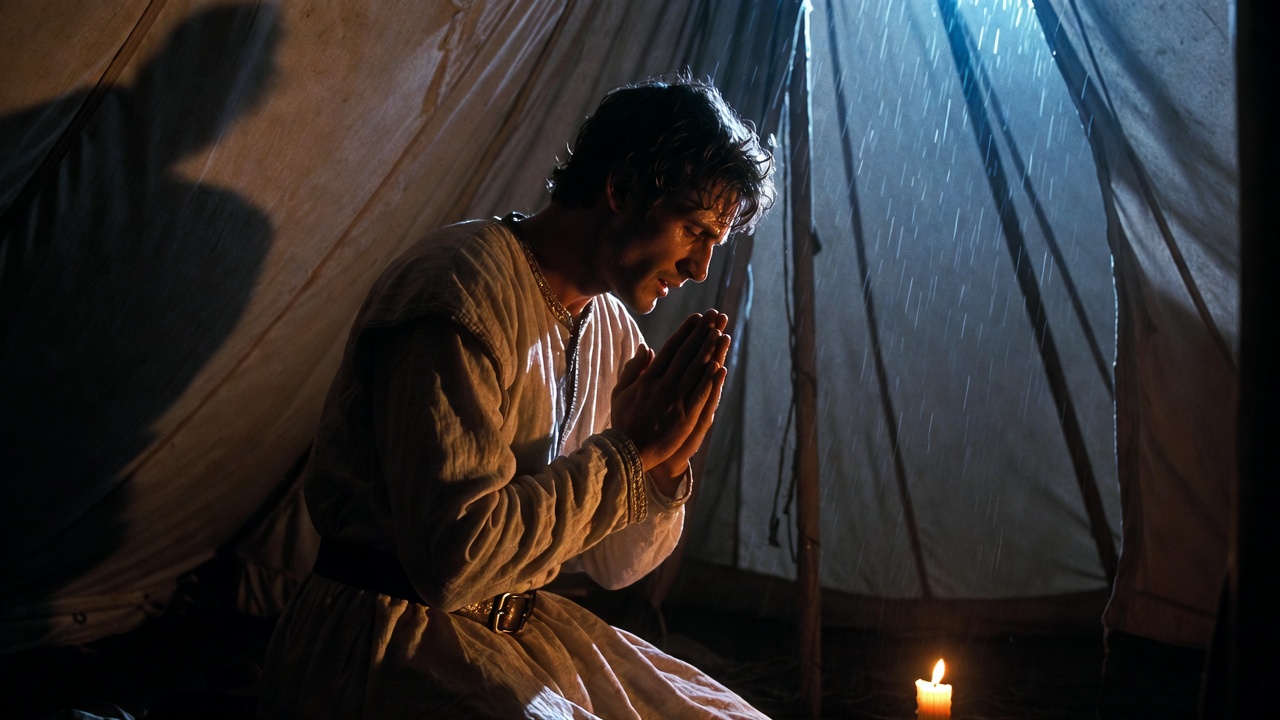
Shakespeare weaves profound ideas through this scene:
- The Burden of Kingship and Leadership Isolation: Power isolates. Ceremony provides no solace; the king bears collective blame without shared ease.
- Moral Responsibility in War: Williams’ challenge—”if the cause be not good, the king himself hath a heavy reckoning”—forces ethical scrutiny. Henry deflects publicly but reflects privately, acknowledging leaders’ accountability.
- Appearances vs. Reality / Disguise and Identity: The cloak symbolizes shedding artifice to find truth, tying to the Henriad’s motif of transformation.
- Ceremony and the Hollow Nature of Power: Ceremony is “idle,” a superficial tide of pomp. True equality emerges in suffering.
- Guilt, Redemption, and Divine Justice: Henry’s prayer seeks atonement for regicide, showing divine right is fragile.
These themes elevate the scene beyond plot, offering timeless commentary on authority.
Historical and Literary Context
Shakespeare drew from Raphael Holinshed’s Chronicles (1587), which portray Henry as virtuous and victorious, part of Tudor propaganda justifying the Lancastrian line. Holinshed describes Henry’s physical prowess and moral character, but Shakespeare adds psychological depth absent in sources.
The scene fits the Henriad tetralogy: it culminates Hal’s arc from irresponsible prince to reflective king, addressing usurpation guilt from Richard II.
In Elizabethan England, it mirrored anxieties over monarchy, divine right, and wars (e.g., Irish campaigns). Performances—from Olivier’s 1944 film (emphasizing heroism) to Branagh’s 1989 version (highlighting vulnerability)—reveal shifting interpretations.
Key Quotes from Henry V Act 4 Scene 1 with Explanations
Here are pivotal lines with modern paraphrases and insights:
- “There is some soul of goodness in things evil, / Would men observingly distill it out.” (Henry on adversity) — Shows optimism and wisdom.
- “I think the King is but a man, as I am: the violet smells to him as it doth to me.” (Henry disguised) — Asserts human equality.
- “If the cause be not good, the king himself hath a heavy reckoning to make…” (Williams) — Core ethical challenge.
- “Upon the king! let us our lives, our souls… lay on the king!” (Soliloquy opening) — Resentment at scapegoating.
- “What infinite heart’s-ease / Must kings neglect…” — Leadership’s cost.
- “And what art thou, thou idol ceremony?” — Ceremony critiqued.
- “O hard condition…” — Kingship’s twin burdens.
- “Not today, O Lord…” (Prayer) — Guilt over Richard II.
These quotes anchor analysis and aid exam prep or performance.
Modern Relevance and Lessons from the Scene
Today’s leaders—CEOs, presidents, military commanders—echo Henry’s isolation: bearing blame, maintaining facade, seeking empathy. “Walking the floor” (disguise) parallels modern leaders listening unfiltered. The war responsibility debate mirrors ethical questions in conflicts. Henry’s vulnerability reminds us power extracts a personal toll—mental health, guilt, sleeplessness.
The scene humanizes authority: even kings are “but a man.”
FAQs About Henry V Act 4 Scene 1
What is the “Upon the King” soliloquy about? It laments kingship’s burdens—ceremony’s emptiness, envy of private men’s peace, and scapegoating by subjects.
Why does Henry disguise himself? To assess true morale, hear honest opinions, and connect as equals—testing loyalty without royal pressure.
What happens with the glove exchange? Henry (disguised) and Williams quarrel; they exchange gloves to identify each other later for a duel if both survive.
How does this scene connect to Agincourt? It builds tension on the eve, humanizing stakes before Henry’s victory speech.
Is Henry justified in his war? Shakespeare leaves ambiguity—Henry believes it just, but soldiers’ doubts and his guilt raise questions.
Why Act 4 Scene 1 Is Essential to Understanding Henry V
Act 4 Scene 1 masterfully balances heroism and humanity. Through disguise, debate, soliloquy, and prayer, Shakespeare reveals kingship as both divine duty and profound suffering. It enriches the play’s exploration of power, making Henry relatable—a leader striving amid flaws.
Revisit the scene, watch adaptations, or explore related soliloquies. This moment captures Shakespeare’s genius: turning history into timeless insight.