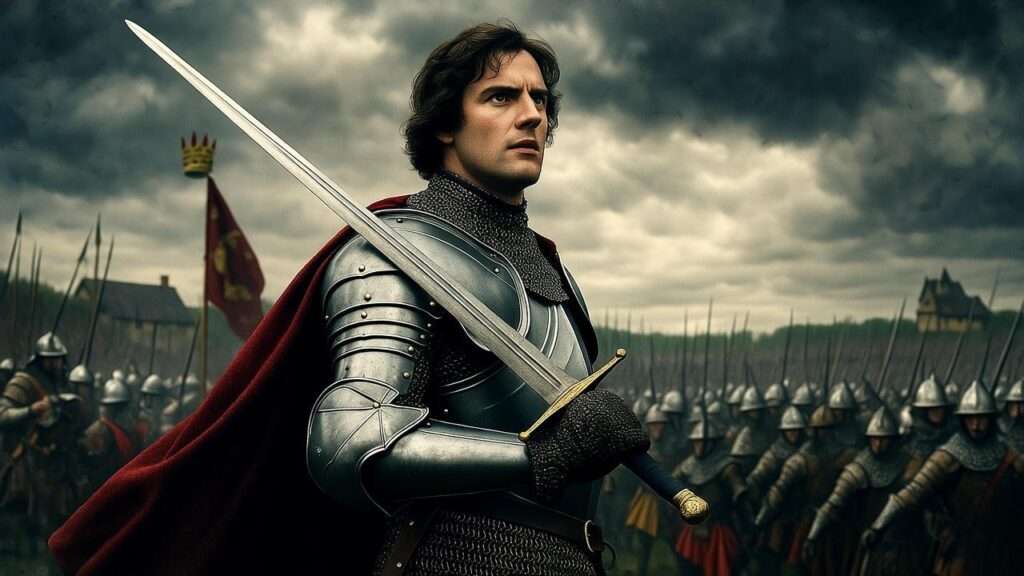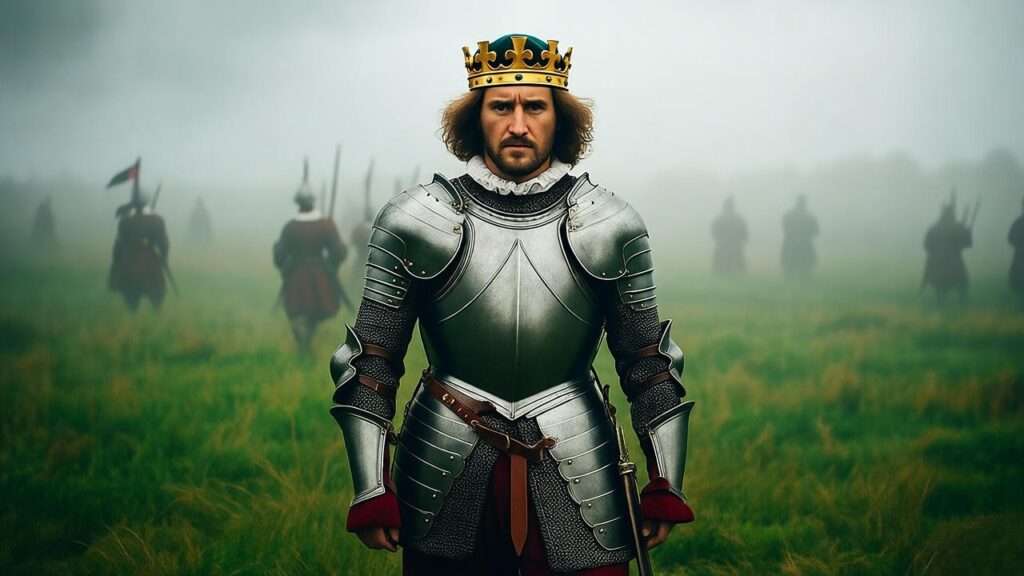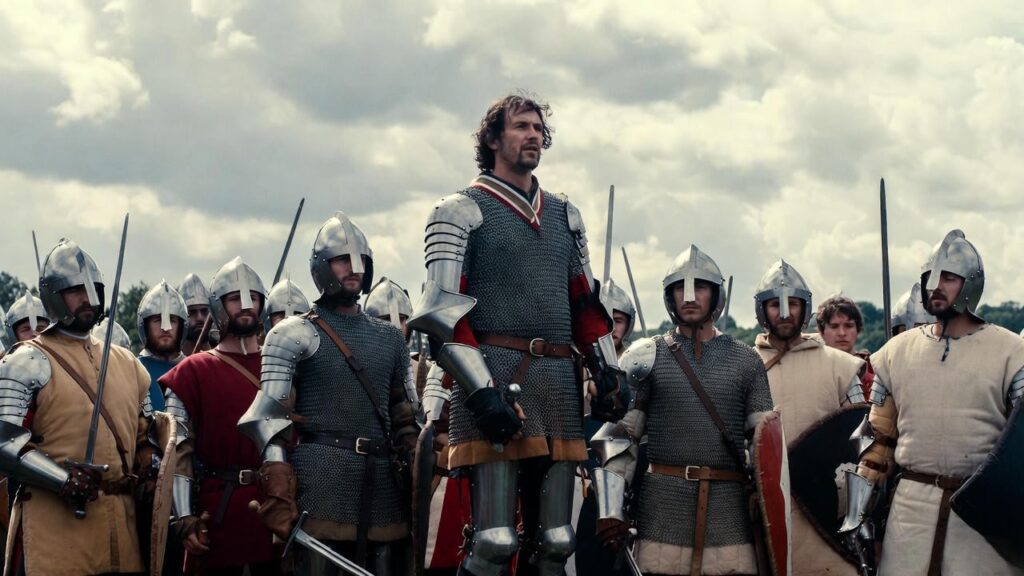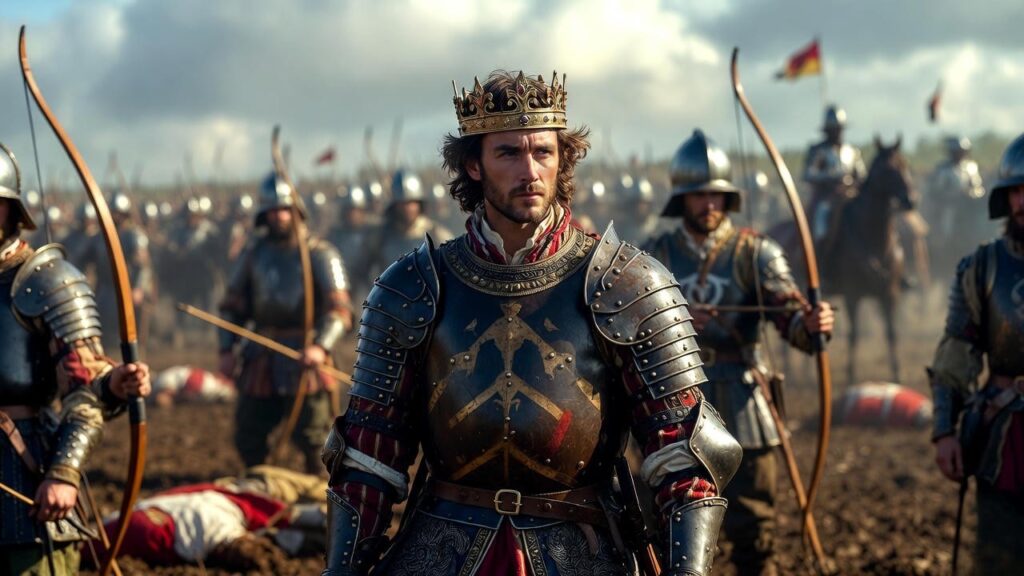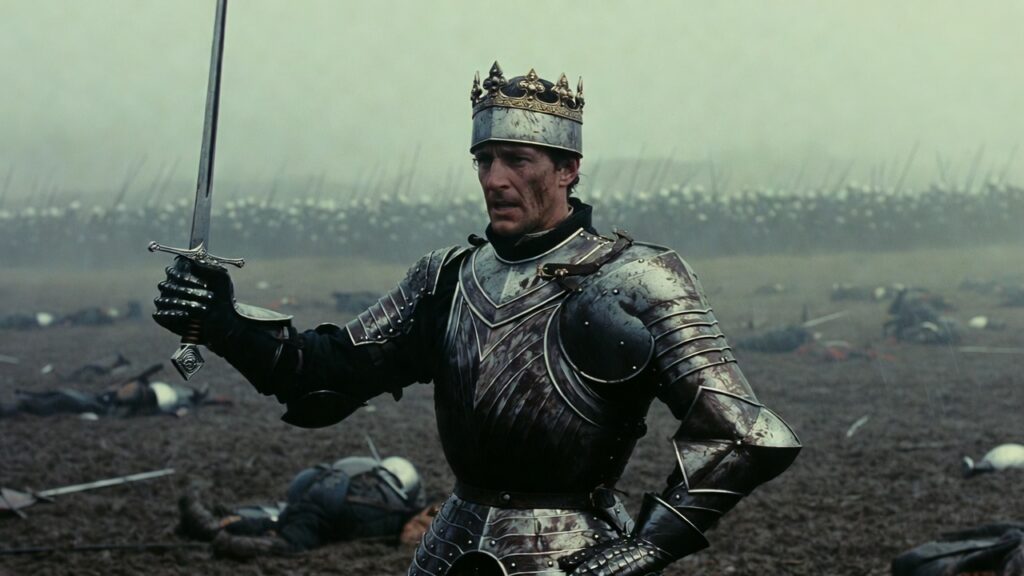
Imagine the mud-choked fields of Agincourt on October 25, 1415: a young English king, vastly outnumbered, rallies his exhausted troops with words that have echoed for centuries. In Shakespeare’s Henry V, he declares, “We few, we happy few, we band of brothers,” transforming a desperate battle into an immortal tale of valor and leadership. But behind this dramatic heroism lies a tangible piece of history—a sword long associated with Henry V himself, preserved in Westminster Abbey. The Henry V sword is more than a relic; it stands as a bridge between the gritty reality of medieval warfare and Shakespeare’s poetic vision of the warrior king.
This famous artifact, with its elegant yet battle-worn design, has captivated historians, sword enthusiasts, and Shakespeare scholars alike. Rediscovered in the mid-20th century and famously described by renowned sword expert Ewart Oakeshott as “one of the most beautiful medieval swords to handle I have ever known… balanced like a good fishing rod,” it embodies the practical lethality that made Henry such a formidable commander. Yet questions linger about its exact origins, adding layers of intrigue. For readers exploring Shakespeare’s history plays, understanding this sword deepens appreciation of how the Bard drew from real historical symbols to craft his complex portrait of kingship, honor, and the brutal costs of war.
In this comprehensive guide, we examine the historical Henry V, the sword’s physical details and ongoing authenticity debates, its symbolic role in the play, and how the artifact enriches modern interpretations. Whether you’re a literature student analyzing themes of power, a history buff interested in Hundred Years’ War weaponry, or a theater lover seeking context for adaptations like Laurence Olivier’s or Kenneth Branagh’s films, this exploration reveals why the Henry V sword remains a powerful link between fact and fiction.
Who Was the Historical Henry V? The Warrior King in Context
Henry V of England (1386–1422) remains one of the most charismatic figures of the late Middle Ages—a king whose brief nine-year reign transformed England’s fortunes in the Hundred Years’ War against France.
Born as Prince Henry (often called “Hal” in popular imagination, thanks partly to Shakespeare), he survived a near-fatal arrow wound to the face at age 16 during the Battle of Shrewsbury in 1403. The arrowhead lodged near his brain; surgeons removed it in a daring operation that left a permanent scar but forged his reputation for resilience.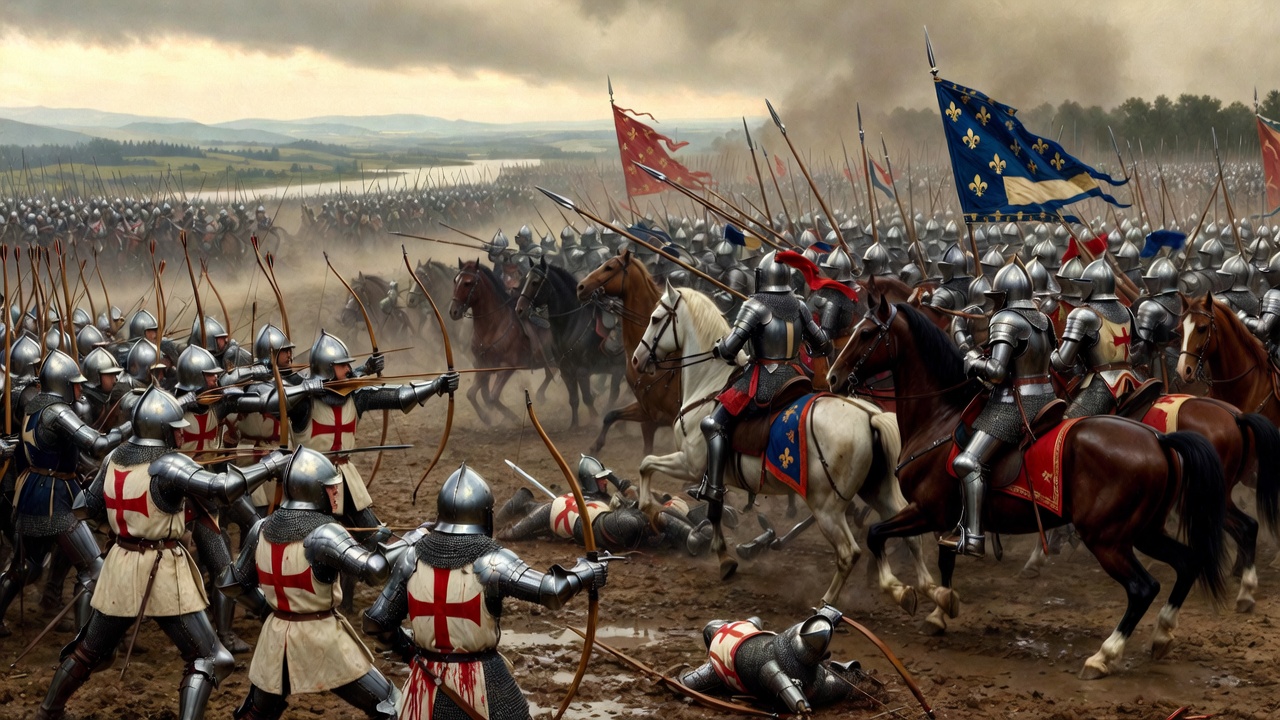
Ascending the throne in 1413 after his father’s death, Henry V proved a master strategist and inspirational leader. He renewed English claims to the French crown, invoking ancient rights through his descent from Edward III. His 1415 campaign culminated in the stunning victory at Agincourt, where English longbowmen and disciplined men-at-arms decimated a much larger French force. Henry’s tactical brilliance—positioning his army between woods to negate French cavalry charges—combined with his personal courage, cemented his legend as a warrior-king.
Shakespeare drew heavily from sources like Raphael Holinshed’s Chronicles and Edward Hall’s histories, but he amplified Henry’s mythic qualities. In the play, the once-wayward prince becomes the “mirror of all Christian kings,” a leader who unites disparate classes through shared hardship. Yet Shakespeare subtly interrogates this heroism: common soldiers question the morality of war, and Henry’s own soliloquies reveal inner burdens.
This historical context is crucial for understanding the sword. As a symbol of royal martial authority, it reflects the real king’s pragmatic approach to combat—effective tools over ostentatious display—mirroring Shakespeare’s portrayal of a king who values substance over ceremony.
The Sword of Henry V: Discovery, Description, and Authenticity
The sword most closely tied to Henry V resides in Westminster Abbey, part of the king’s funeral achievements displayed near his chantry chapel. These “bruised arms hung up for monuments” (as the Chorus in Shakespeare’s play describes similar relics) include a helm, shield, saddle—and this sword.
The Westminster Abbey Relic – History and Rediscovery
Tradition holds that the sword was hung above Henry’s tomb shortly after his death in 1422 from dysentery during the siege of Meaux. It remained there for centuries until, at some point, it was stored in an old chest in the Abbey’s triforium.
In 1869, a sword was noted in Abbey records, but the key rediscovery came in 1951. Ewart Oakeshott, the pioneering sword scholar and author of seminal works like Records of the Medieval Sword and The Sword in the Age of Chivalry, was permitted to clean and study it. Oakeshott became convinced of its association with Henry V, publishing his findings enthusiastically.
Today, the sword is displayed alongside Henry’s other funeral items in the Abbey museum, a testament to England’s royal heritage.
Physical Characteristics and Expert Analysis
Classified as Oakeshott Type XVIII (specifically a variant like XVIII.1), this single-handed arming sword exemplifies late medieval design optimized for both cutting and thrusting against armored opponents.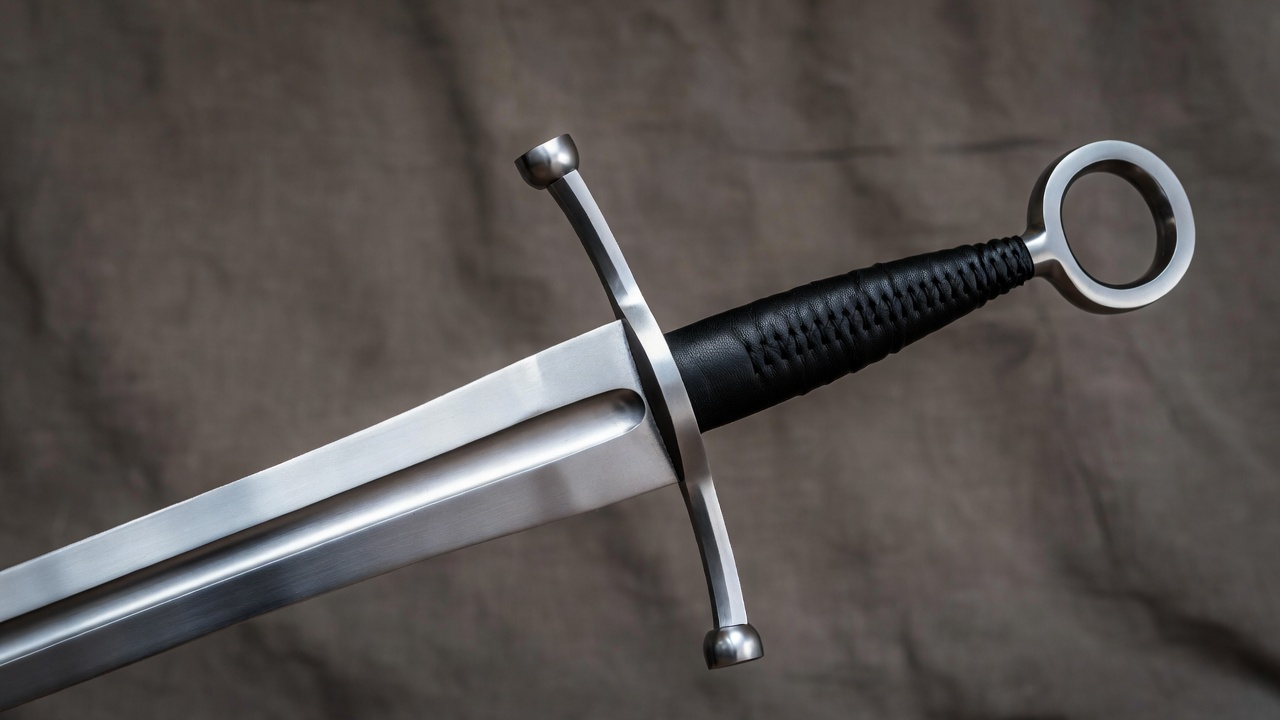
Key features include:
- Overall length: approximately 33–34 inches
- Blade length: around 27–28 inches, broad at the base (about 2–2.125 inches) tapering to an acute point
- Cross-section: flattened diamond or slightly hollow-ground for stiffness and penetration
- Weight: roughly 2.7 pounds
- Pommel: large, wheel-shaped (Oakeshott Type J or similar), hollow to reduce weight despite its imposing appearance; gilded recesses with red crosses (likely added for funerary purposes, evoking St. George or crusading symbolism)
- Guard: straight, down-swept quillons
- Grip: original lost; current wooden replacement rough
Oakeshott praised its handling: “This is no mere funerary object, but a magnificent fighting sword (bearing upon its still sharp edges much indication of use) which comes to life in one’s hand.” The blade shows signs of repeated sharpening, narrowing it slightly—evidence of real combat use rather than pure ceremony.
Modern replicas from makers like Arms & Armor (which offers both flat- and hollow-ground versions), Windlass Steelcrafts, and Dark Sword Armory faithfully recreate these traits, often with high-carbon steel blades for functional testing.
Debates on Authenticity – Was It Really Henry’s?
While Oakeshott championed the sword as Henry’s, recent scholarship introduces caution. Westminster Abbey’s own records note that recent research (including a 2022 Royal Armouries publication, The Funeral Achievements of Henry V at Westminster Abbey) suggests the sword may date later—possibly to Henry VII’s era (late 15th century).
Evidence supporting the traditional attribution includes its long association with the chantry, battle wear consistent with early 15th-century use, and Oakeshott’s detailed examination. Counterarguments point to stylistic features and metallurgical analysis aligning better with post-1420s designs.
This debate underscores the challenges of medieval provenance: funeral achievements were sometimes symbolic or replaced over time. Regardless, the sword remains an archetypal example of the fighting weapons Henry wielded, enhancing its value as a historical touchstone for Shakespeare’s era.
Symbolism of the Sword in Shakespeare’s Henry V
Shakespeare rarely describes weapons in exhaustive physical detail—his stage directions and dialogue prioritize action, rhetoric, and character over props. Yet the sword functions as one of the most potent recurring symbols in Henry V, embodying royal authority, martial honor, justice, and the moral ambiguities of conquest. The real Westminster Abbey sword, with its battle-scarred yet elegant form, offers a striking historical counterpart that illuminates these layers.
Swords as Emblems of Power and Honor in the Play
From the opening Chorus, Shakespeare frames the drama with martial imagery: “O for a Muse of fire… Can this cockpit hold / The vasty fields of France? Or may we cram / Within this wooden O the very casques / That did affright the air at Agincourt?” The “casques” (helmets) and implied arms set a tone of armored grandeur, yet the play quickly contrasts ceremonial display with practical violence.
In Act 4, Scene 1—Henry’s famous night walk among his troops disguised as “Harry le Roy”—the king delivers one of his most introspective speeches. He laments the burdens of kingship: “What infinite heart’s-ease / Must kings neglect that private men enjoy!” He then explicitly rejects empty symbols of power:
“’Tis not the balm, the sceptre and the ball, The sword, the mace, the crown imperial, The intertissued robe of gold and pearl, The farcèd title running ’fore the king…”
Here the sword is listed alongside other regalia, yet stripped of its glamour. It becomes merely one more object that cannot buy true peace. This moment echoes the real Henry V sword’s unadorned functionality: a supreme fighting tool rather than a jewel-encrusted parade piece.
Elsewhere, edged weapons carry heavier symbolic weight. The Chorus describes the English army’s departure for France with “their hearts… / As full of spirit as the month of May,” yet soon the Dauphin’s gift of tennis balls mocks Henry’s claim to the French throne. Henry’s response transforms insult into prophecy:
“When we have match’d our rackets to these balls, We will in France, by God’s grace, play a set Shall strike his father’s crown into the hazard.”
The tennis balls become cannonballs, and the playful metaphor foreshadows the literal “hazard” of battle—where swords, not rackets, will decide the game. At Agincourt itself, the sword represents both individual valor and collective brotherhood. Henry’s St. Crispin’s Day speech famously unites his men: “He that sheds blood with me / Shall be my brother.” The shared act of wielding steel binds king and commoner in a temporary egalitarian bond forged in violence.
The Warrior King’s Sword – From History to Drama
The Westminster Abbey sword’s design—light, balanced, capable of both cut and thrust—mirrors Shakespeare’s portrayal of Henry as a pragmatic, adaptable leader. Unlike the ornate two-handed greatswords of earlier centuries or the parade weapons of later Renaissance courts, this arming sword is built for real combat against plate armor. Its narrow, stiffened blade could find gaps in mail and plate; its weight distribution allowed rapid, precise strikes. Oakeshott’s description of it coming “alive in one’s hand” evokes the same vitality Shakespeare gives his king on the battlefield.
In the play, Henry never brandishes a sword in soliloquy or ceremonial moment; instead, he wields language as his primary weapon. Yet the implied presence of the sword underlies every heroic speech. When he cries, “Once more unto the breach, dear friends, once more,” the audience understands that the king leads from the front—sword in hand—sharing the same dangers as his men.
Shakespeare also uses the sword to probe the darker side of martial glory. Pistol, the cowardly braggart, constantly brandishes his weapon for show; Nym and Bardolph die ignobly. The contrast underscores Henry’s authenticity: his sword is not for display but for decisive action. This tension—between performative kingship and genuine leadership—finds a historical echo in the Westminster sword’s battle wear. Whether or not it personally belonged to Henry V, its nicks and sharpenings speak of real use, reminding us that the “mirror of all Christian kings” was first and foremost a soldier.
Expert literary scholars such as John Julius Norwich and Helen Cooper have noted how Shakespeare’s history plays consistently humanize their monarchs by grounding mythic heroism in material reality. The sword serves exactly this purpose: a concrete object that anchors the play’s soaring rhetoric in the tactile world of steel, blood, and sweat.
Bridging History and Literature: How the Real Sword Enhances Understanding of Shakespeare’s Henry V
The Westminster Abbey sword performs a vital interpretive function: it reminds us that Shakespeare’s Henry V is not pure invention. The king’s tactical genius at Agincourt, his personal courage, and his ability to inspire loyalty were documented in contemporary chronicles. The sword—whether Henry’s own or a symbolic stand-in—grounds these accounts in physical evidence.
For modern readers and theatergoers, handling (or even viewing high-quality replicas of) a Type XVIII arming sword reveals why medieval combat required such precise balance and versatility. This tactile knowledge deepens appreciation of lines like “The game’s afoot: / Follow your spirit, and upon this charge / Cry ‘God for Harry, England, and Saint George!’” The cry is not abstract patriotism; it accompanies the literal swing of steel.
Film adaptations have capitalized on this materiality. Laurence Olivier’s 1944 version opens in the Globe Theatre before transitioning to realistic battle; Kenneth Branagh’s 1989 film lingers on rain-soaked mud and clashing metal, emphasizing the physical toll. Both directors understood that Shakespeare’s language gains power when paired with the visceral reality of medieval arms.
For students writing essays on themes of leadership, honor, or the ethics of war, the sword provides a concrete anchor. It allows analysis of how Shakespeare transforms historical artifacts into dramatic symbols—turning a used fighting tool into an emblem of both glory and moral burden.
Modern Replicas and Collecting the Henry V Sword Today
The enduring fascination with the Henry V sword has spawned a thriving market for high-quality replicas. These modern versions allow enthusiasts, reenactors, students, and collectors to experience something close to the balance, handling, and aesthetics of the Westminster Abbey original—without the museum vitrine standing between them and the steel.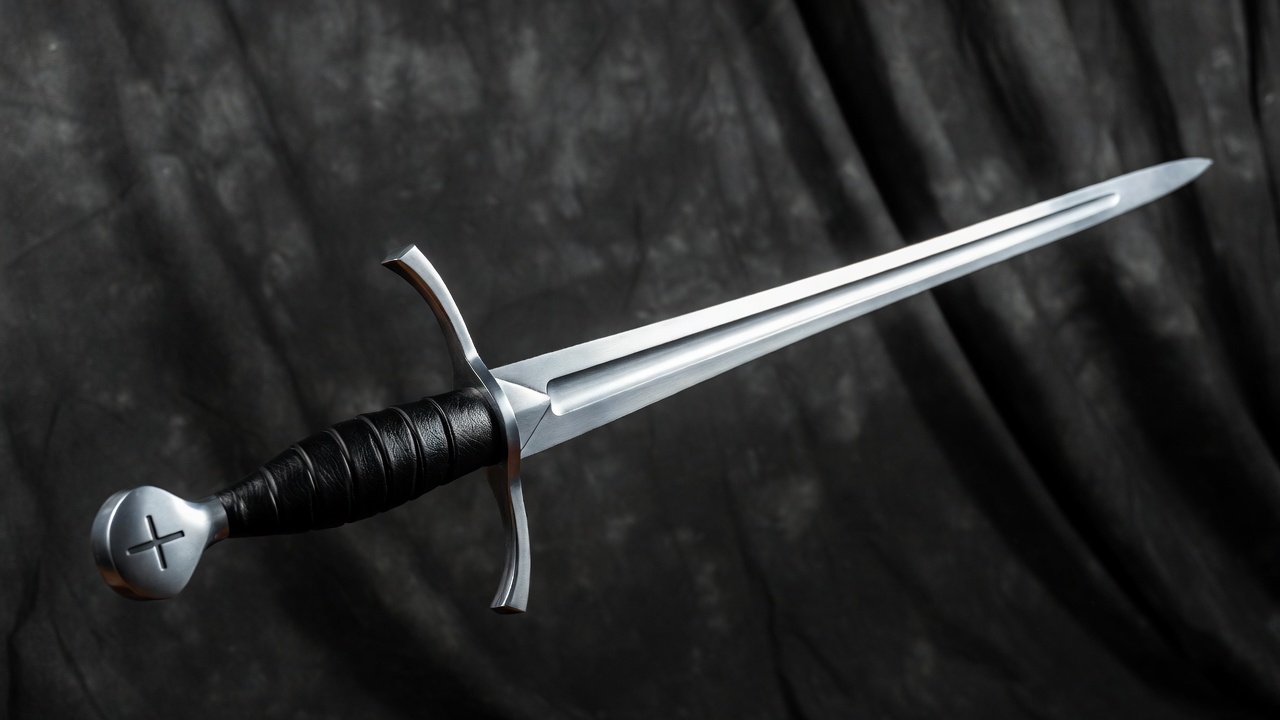
Several reputable makers produce faithful reproductions of the Type XVIII arming sword associated with Henry V:
- Arms & Armor (Minneapolis, USA): Widely regarded as offering one of the most accurate versions. Their “Henry V” model comes in both flat-ground and hollow-ground blade variants, closely matching Oakeshott’s description. The hollow pommel, red-cross detailing, and overall proportions are meticulously recreated. Prices typically range from $800–$1,200 depending on customization. Many owners report that the sword feels remarkably lively in the hand, echoing Oakeshott’s famous “balanced like a good fishing rod” comment.
- Windlass Steelcrafts (India/USA distribution): Offers a more affordable “Henry V Sword” in their museum line (around $250–$400). While not quite as refined in fit and finish as higher-end makers, it captures the essential silhouette, weight distribution (approximately 2.8–3 lbs), and battle-ready feel. Popular among living history groups and Agincourt reenactments.
- Dark Sword Armory and Albion Swords: Both produce custom or semi-custom interpretations of late-medieval English arming swords. Albion’s “Vincenzo” or similar Type XVIII patterns are sometimes recommended as close proxies, though not marketed specifically as “Henry V” replicas.
For serious collectors or those studying historical fencing (HEMA – Historical European Martial Arts), the most valuable replicas are those built to be fully functional rather than mere display pieces. Look for:
- High-carbon or spring steel blades (5160 or 6150 preferred for durability and flex)
- Peened construction (rather than screwed pommel nuts)
- Historically accurate heat treatment and distal taper
- Documentation of dimensions compared to the Abbey original
These replicas serve an educational purpose beyond ownership. Many university drama departments, Shakespeare festivals, and history classrooms use them (or similar swords) when staging fight scenes from Henry V. Handling the weight and balance helps actors understand why Henry’s rhetoric is so effective: the king speaks as one who has personally felt the strain of armored combat and the decisive snap of a well-balanced blade.
The sword also appears in public commemorations. During the 600th anniversary of Agincourt in 2015, replicas and historical discussion panels featured prominently at events organized by the Royal Armouries, English Heritage, and Westminster Abbey itself.
FAQs About the Henry V Sword
Here are answers to the questions most frequently asked by readers, students, and enthusiasts:
Is the Westminster Abbey sword definitely Henry V’s? No definitive proof exists that it was the personal weapon Henry carried at Agincourt or elsewhere. It has been traditionally associated with his funeral achievements since the 15th century, and Ewart Oakeshott strongly supported the attribution after cleaning and handling it in 1951. However, recent scholarship (including studies published by the Royal Armouries in 2022) suggests it may date from the later 15th century—possibly linked to Henry VII or used symbolically rather than personally by Henry V. Regardless of exact ownership, it remains an outstanding and representative example of the type of arming sword used by English men-at-arms during his reign.
What type of sword is it (Oakeshott classification)? It is classified as an Oakeshott Type XVIII (or XVIII.1 variant)—a single-handed cutting-and-thrusting arming sword optimized for combat against plate armor. Key traits include a broad base tapering to an acute point, flattened diamond or hollow-ground cross-section, and a large wheel pommel (likely hollow to keep weight low).
How does it connect to Shakespeare’s play Henry V? While Shakespeare never explicitly describes Henry’s sword, the play is saturated with martial symbolism in which the sword stands for royal authority, honor won through combat, and the moral weight of kingship. The real artifact’s battle-worn yet elegant design mirrors Shakespeare’s portrayal of a pragmatic, inspirational leader who rejects empty ceremony (“the sword, the mace, the crown imperial”) in favor of genuine leadership forged in shared hardship. The sword thus serves as a historical anchor that grounds the play’s soaring rhetoric in material reality.
Where can I see or buy a replica?
- View the original (or at least its display case) at Westminster Abbey in London (the funeral achievements are part of the museum exhibit).
- High-quality replicas are available from Arms & Armor, Windlass Steelcrafts, Dark Sword Armory, and Albion Swords. Check HEMA suppliers, renaissance faire vendors, or online specialty retailers such as Kult of Athena or Arms & Armor’s own site.
Why is it considered one of the finest medieval swords? Ewart Oakeshott, the 20th century’s foremost sword scholar, described it as “one of the most beautiful medieval swords to handle I have ever known,” praising its perfect balance, lively feel, and evidence of actual use (sharpened edges, slight narrowing from repeated honing). Even skeptics of its direct link to Henry V acknowledge that it exemplifies the peak of late-medieval English sword-making: functional, elegant, and deadly effective.
The Henry V sword—whether it once rested in the king’s own hand or served as a symbolic stand-in for royal valor—remains one of the most evocative surviving artifacts of the early 15th century. Its clean lines, battle scars, and superb handling qualities bring us closer to the historical reality behind Shakespeare’s immortal warrior king.
Shakespeare took a real medieval monarch—scarred by an arrow in youth, victorious at Agincourt, dead too young—and transformed him into a dramatic archetype: the once-wayward prince who becomes the mirror of Christian kingship, burdened yet inspiring. The sword stands as a physical reminder that this myth rests on solid ground. It was not forged for parades or sonnets alone; it was made to cut, thrust, and win battles.
For anyone who has ever been stirred by “Once more unto the breach,” “We few, we happy few,” or the quiet introspection of a king who knows the price of glory, the Henry V sword offers a direct, tactile connection to that world. Revisit the play with new eyes. If possible, visit Westminster Abbey and stand before the relic. Or hold a good replica in your hand and feel the balance that Oakeshott so admired.