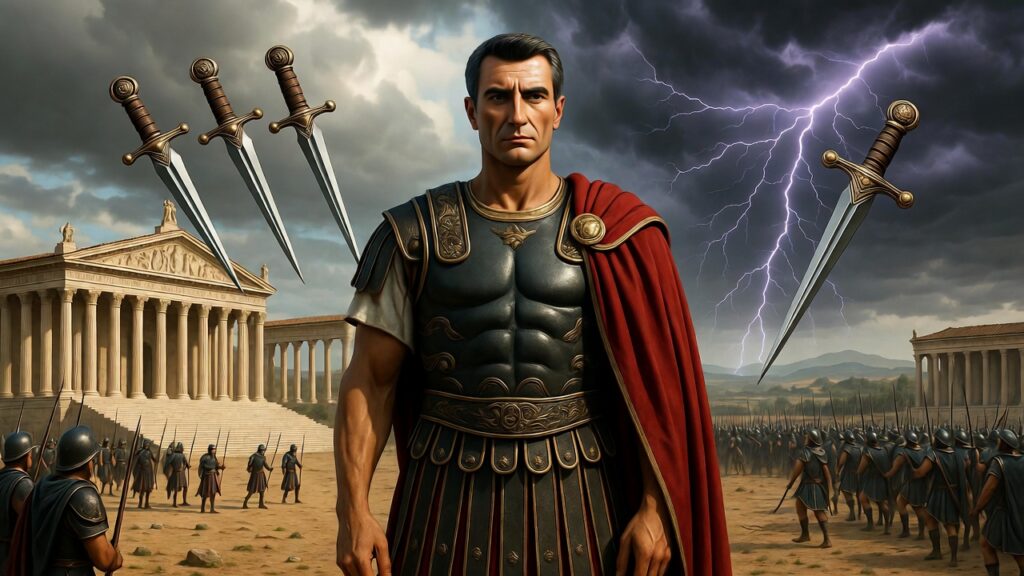
With those four words, the most famous assassination in Western history reaches its devastating climax. In Shakespeare’s Julius Caesar, the dictator’s final line is delivered not in rage or despair, but in stunned betrayal. Moments earlier, the man who had crossed the Rubicon, subdued Gaul, and reshaped the Roman world believed himself untouchable — “constant as the northern star.”
Yet he fell.
Julius Caesar’s leadership qualities propelled him from a politically vulnerable patrician to the most powerful man in Rome. They also placed the dagger in the hands of his closest allies. More than two millennia later, business executives, military officers, political strategists, startup founders, and students of leadership still study Caesar — not only for what he achieved, but for how spectacularly he failed to hold power once he had seized it.
In this article we examine the Julius Caesar leadership qualities that made him legendary, trace how Shakespeare dramatizes (and critiques) those traits, separate historical reality from theatrical portrait, and — most importantly — extract practical, timeless lessons that modern leaders can apply while consciously avoiding Caesar’s fatal missteps.
Whether you lead a company, a team, a movement, or simply yourself, Caesar’s story offers one of the richest case studies in human ambition, charisma, strategic brilliance, and tragic blindness.
Historical Context — The Real Julius Caesar vs. Shakespeare’s Portrayal
Gaius Julius Caesar (100–44 BCE) was born into a distinguished but financially weakened patrician family. By age 31 he had served as a military tribune, quaestor, aedile, pontifex maximus, praetor, and consul. He then spent nearly a decade conquering Gaul, writing his famous Commentarii de Bello Gallico — part war memoir, part brilliant piece of political propaganda.
After the First Triumvirate collapsed, Caesar’s crossing of the Rubicon in 49 BCE ignited civil war against Pompey. He won decisively, became dictator (first for life in 44 BCE), and launched sweeping reforms: debt relief, land redistribution, the Julian calendar, expansion of citizenship, and centralization of power.
Shakespeare compresses fourteen years of history into five tense days surrounding the Ides of March. He minimizes Caesar’s military genius and administrative achievements, focusing instead on his psychology, his rhetoric, and the perceptions others have of him. The historical Caesar was 55–56 years old, balding, epileptic, and famously vain about his appearance; Shakespeare’s Caesar is older, almost statuesque, speaking mostly in the third person and projecting an almost superhuman constancy.
This artistic decision is deliberate. Shakespeare is less interested in documenting Caesar’s successes than in exploring the dangers of concentrated power and the fragility of political trust. Yet the leadership qualities that history records — charisma, decisiveness, courage, strategic foresight, oratorical mastery — are vividly present in the play, often magnified for dramatic effect.
Understanding both versions gives us the fullest picture.
The Core Leadership Qualities of Julius Caesar
1. Charisma and the Power to Inspire Loyalty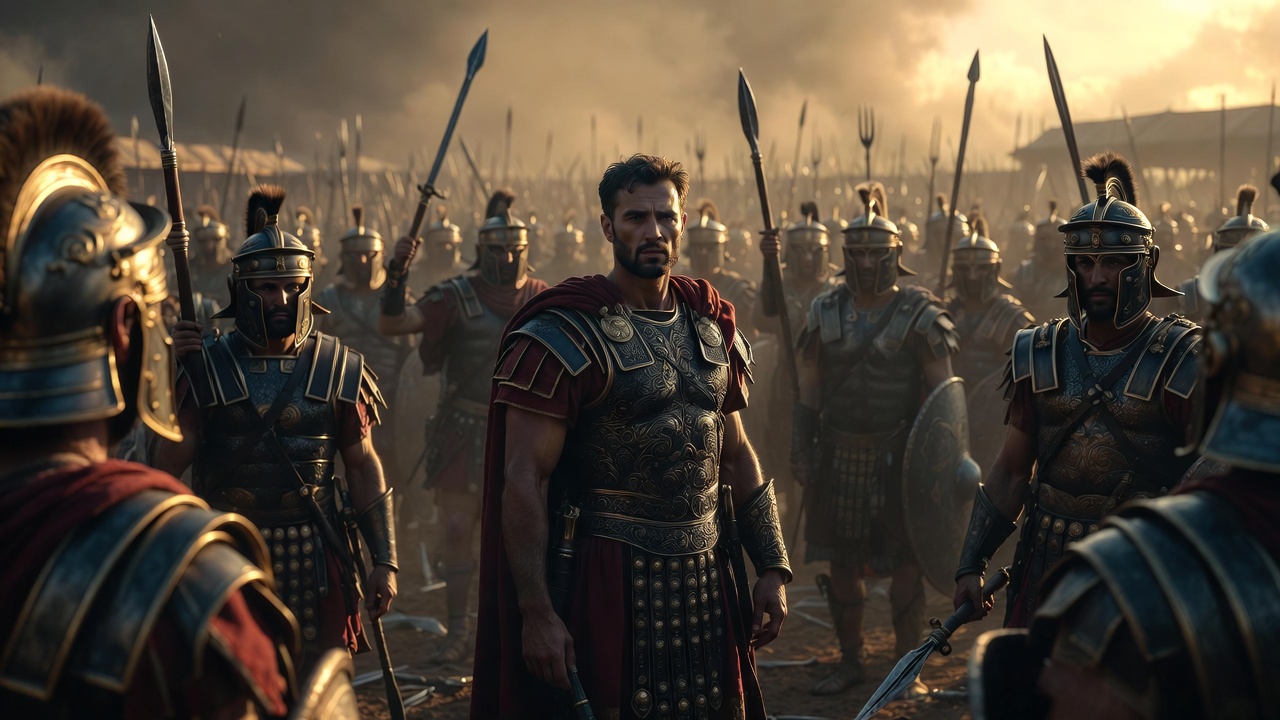
Few ancient figures inspired devotion as intense as Caesar’s.
Legionaries wept when he disciplined them, then fought to the death for him. He knew thousands of soldiers by name, shared their hardships, divided plunder generously, and — most unusually for Roman commanders — called them commilitones (“fellow soldiers”) rather than subordinates.
In Shakespeare, this charisma is inherited by Mark Antony, whose funeral oration turns a hostile crowd into a mob ready to burn Rome for Caesar’s memory. Caesar himself radiates authority even when silent:
“When Caesar says ‘do this,’ it is performed.” (Act 1, Scene 2)
Modern application Today we call this “emotional loyalty.” Leaders who remember names, share credit, celebrate small wins, and visibly care about their people create far stronger commitment than those who rely solely on title or compensation. Studies in organizational psychology consistently show that feeling personally valued is one of the strongest predictors of employee engagement and retention.
Caesar understood that loyalty is emotional before it is rational.
2. Strategic Vision and Decisiveness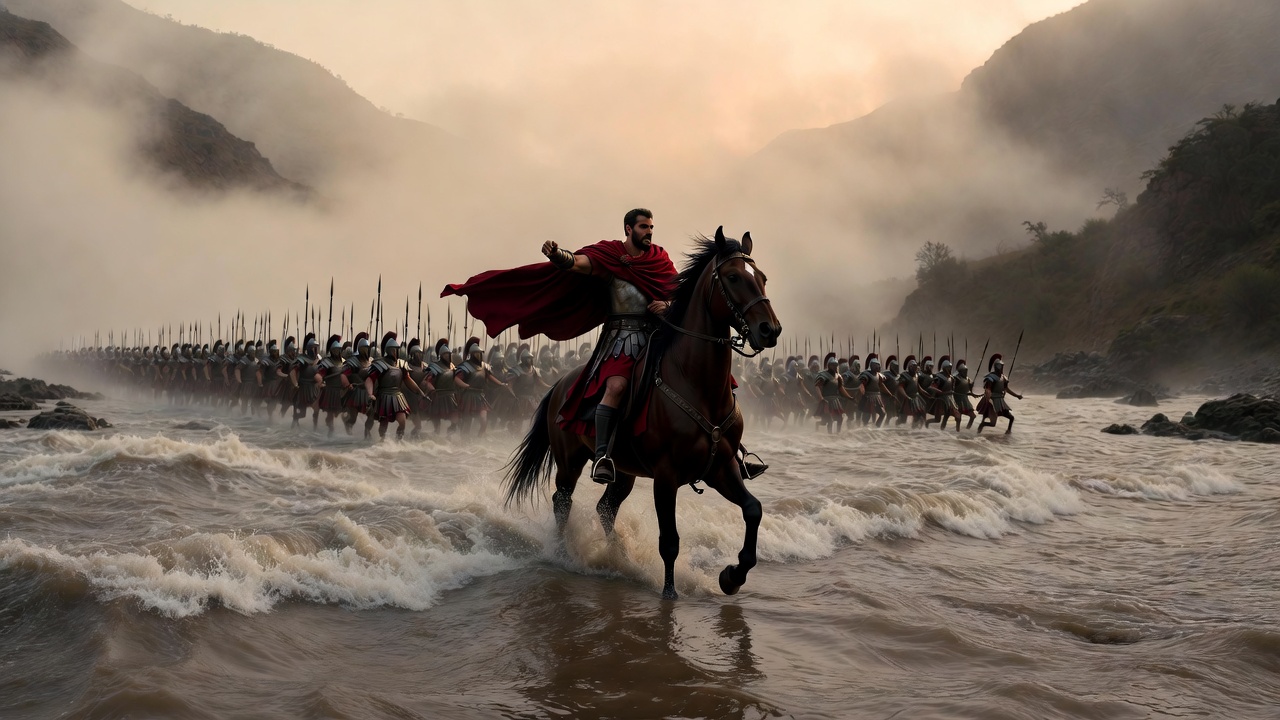
Caesar repeatedly demonstrated an ability to see the larger chessboard while making lightning-fast tactical decisions.
- Crossing the Rubicon with a single legion, knowing it meant civil war, was an enormous calculated risk.
- At Alesia (52 BCE) he built double fortifications — one to besiege Vercingetorix, one to repel the relieving Gallic army — in an engineering feat still studied in military academies.
- During the Alexandrian War he burned his own ships to prevent retreat, forcing his outnumbered troops to win or die.
In the play, this decisiveness appears as unshakable confidence:
“I am constant as the northern star, Of whose true-fix’d and resting quality There is no fellow in the firmament.” (Act 3, Scene 1)
Modern application Great leaders combine long-term vision with the willingness to act before all information is perfect. Indecision kills momentum far more often than imperfect decisions. However, Caesar’s later refusal to compromise or show vulnerability illustrates the shadow side: when decisiveness hardens into inflexibility, it becomes arrogance.
3. Exceptional Communication and Oratorical Skill
Caesar was a prolific writer and one of Rome’s greatest public speakers.
His Commentarii are written in clear, unadorned Latin that became a model for centuries. As an orator he reportedly rivaled Cicero in impact, though with a more direct, soldierly style.
Shakespeare transfers much of this rhetorical genius to Antony, whose “Friends, Romans, countrymen” speech is one of the finest examples of persuasive manipulation in English literature. By contrast, Caesar’s own lines are brief, authoritative, and deliberately sparse — reinforcing the impression of godlike self-assurance.
Modern application Words shape reality. Leaders who can frame a crisis, tell a compelling origin story, simplify complex strategy, and move people emotionally have an enormous advantage. Caesar and Antony both understood that logic alone rarely wins hearts; emotion and memorable imagery usually do.
Quick reference — 5 rhetorical techniques visible in Caesar’s era that still work
- Anaphora — repetition at the beginning of clauses (“I come, I see, I conquer”)
- Antithesis — contrasting ideas in balanced phrases
- Direct address — speaking personally to the audience (“Friends, Romans…”)
- Irony / pretended humility — appearing reluctant while asserting dominance
- Control of pacing — short, forceful sentences when authority is needed; longer, emotive passages when persuasion is the goal
4. Courage and Leading from the Front
Julius Caesar’s physical courage was legendary — and he made sure everyone knew it.
He fought in the front ranks during several major engagements, was wounded multiple times, and once famously held a shield in one hand while swimming across a river under enemy fire to save important documents. Ancient sources (Plutarch, Suetonius, Appian) record that he would rally wavering troops by seizing a fleeing standard-bearer’s shield and charging forward himself.
In Shakespeare’s play, this courage manifests as a refusal to show fear, even when warned repeatedly of danger:
“Cowards die many times before their deaths; The valiant never taste of death but once.” (Act 2, Scene 2)
He dismisses the soothsayer, ignores Calpurnia’s nightmares, and rejects the Senate’s offer of a bodyguard — all to maintain the image of absolute fearlessness.
Modern application Leaders earn credibility when they share risk rather than avoid it. The phrase “eat last” (popularized by Simon Sinek) captures the same principle: the best leaders stand at the front during hardship and at the back during success. Caesar understood this instinctively in military contexts.
However, the play also subtly critiques this trait. Refusing to show vulnerability or accept reasonable protection can cross into recklessness — especially when political rather than battlefield dangers are involved.
5. Political Acumen and Coalition-Building
Caesar was a master of alliances — until he wasn’t.
He formed the First Triumvirate with Pompey and Crassus, the two most powerful men in Rome, effectively neutralizing potential rivals through partnership rather than confrontation. He cultivated the support of the plebeians through lavish games, debt relief, and land reforms. He pardoned many of his Civil War enemies, earning the label clementia Caesaris (Caesar’s mercy) — a calculated political brand.
In the play, however, we see the limits of his political reading. He underestimates the depth of aristocratic resentment, assumes his popularity with the masses will protect him, and fails to notice (or chooses to ignore) the growing conspiracy.
Modern application Stakeholder management is one of the hardest parts of leadership. Caesar excelled at building coalitions when he needed them, but once he reached supreme power he began to treat former equals as subordinates — a shift that proved fatal. Today’s leaders face the same risk: success can breed isolation if you stop investing in relationships once you no longer “need” them.
The Fatal Flaws — When Great Leadership Qualities Become Liabilities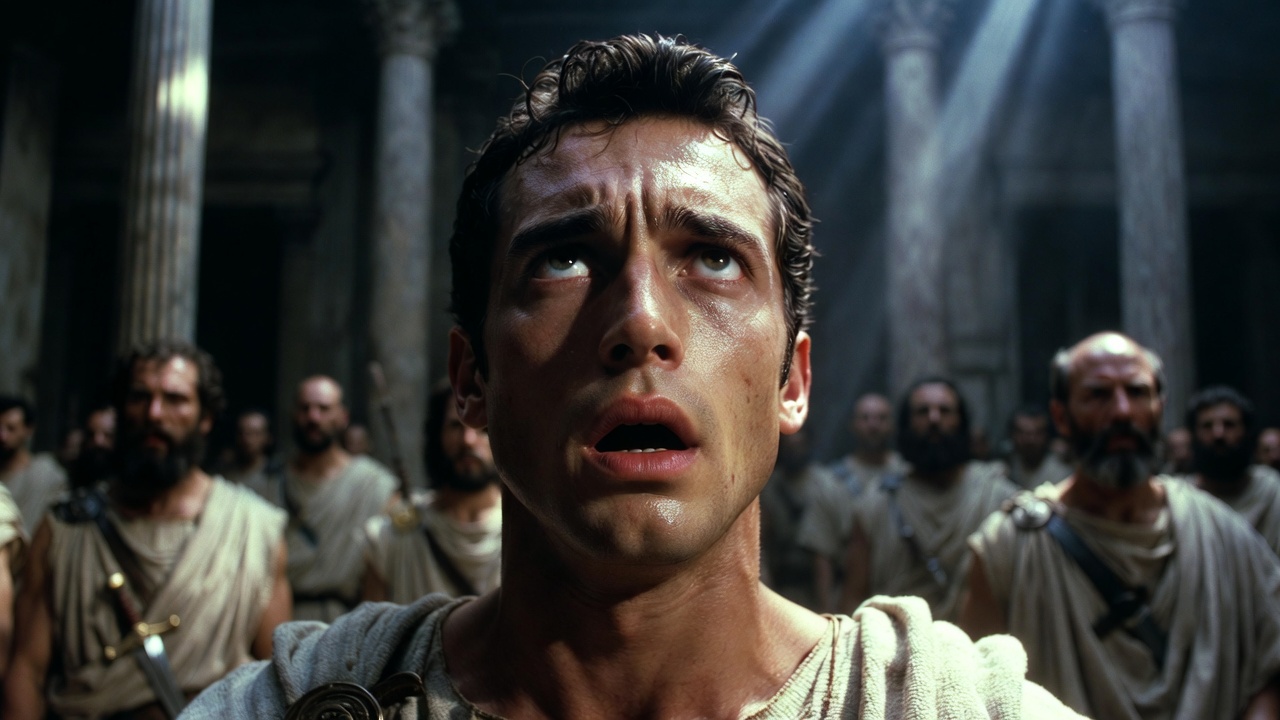
Caesar’s tragedy is not that he lacked virtues — it is that his virtues, taken to extremes, became poisons.
- Hubris and lack of emotional intelligence He repeatedly refers to himself in the third person and compares himself to immovable celestial bodies. He misreads the Senate’s flattery as genuine support and fails to sense the depth of personal offense his dominance caused among the old republican elite.
- Inability to adapt leadership style Battlefield decisiveness and unilateral command worked brilliantly in Gaul and during the Civil War. In peacetime Rome, however, the same approach alienated powerful stakeholders who expected consultation and shared prestige.
- Ambition without visible boundaries His acceptance of perpetual dictatorship, the title Imperator for life, statues among the gods, and the suggestion of kingship (even if he rejected the crown publicly) fed the narrative that he intended to end the Republic. Perception became reality for his enemies.
Shakespeare masterfully shows how the very traits that made Caesar extraordinary — supreme confidence, unshakeable resolve, a sense of personal destiny — turned lethal when unchecked by humility, flexibility, or empathy.
Modern parallel We see the same pattern in business and politics repeatedly: founders who build empires through bold vision and relentless drive often struggle to transition into collaborative, consensus-oriented leadership. The qualities that win the war frequently undermine the ability to govern the peace.
Timeless Lessons Modern Leaders Can Apply Today
Here are twelve distilled, practical takeaways from Caesar’s leadership — both the strengths to emulate and the warnings to heed:
- Build genuine personal connections — Loyalty is emotional before it is rational. Learn names, celebrate wins, share credit.
- Communicate vision emotionally, not just logically — Facts inform; stories persuade.
- Take calculated risks — but never confuse boldness with invincibility.
- Lead from the front in tough times — credibility comes from shared sacrifice.
- Adapt your style to the context — military decisiveness ≠ political consensus-building.
- Surround yourself with honest advisors — actively seek out dissent, not flattery.
- Master public narrative and storytelling — control the story or someone else will.
- Balance ambition with visible humility — unchecked ambition breeds enemies.
- Recognize when success creates resentment — rising too far too fast can make former allies feel diminished.
- Protect your relationships after victory — the day you stop investing in alliances is the day they begin to fray.
- Know when to show vulnerability — absolute certainty can look like arrogance to others.
- Learn from betrayal when it happens — Caesar never got a second chance; most leaders do.
Additional Lessons & Nuances for Today’s Leaders
- Distinguish between conquest mode and consolidation mode Caesar was arguably the greatest conqueror-statesman of his era, yet he never fully shifted gears from “win the war” to “secure the peace.” The skills that let him outmaneuver Pompey and Vercingetorix—speed, secrecy, unilateral command—were exactly the behaviors that convinced the Senate he planned to become a monarch. Today: Many startup founders and turnaround CEOs excel at chaotic growth phases but struggle when stability arrives. The same decisiveness that saved the company in year 2 can feel like steamrolling when the organization needs buy-in and predictability in year 7. Conscious leaders periodically ask: “Which game am I playing right now—disruption or institution-building?” and adjust posture accordingly.
- Perception is a currency you cannot print Caesar rejected the crown three times in public (the Lupercalia incident of 44 BCE), yet the repeated offers themselves fueled the rumor he secretly desired kingship. He controlled armies and calendars, but he lost control of the narrative among the senatorial class. Today: In an age of instant screenshots, Slack threads, town-hall recordings, and X posts, small symbolic acts carry outsized weight. A casual comment in an all-hands meeting, a new title that sounds imperial, or even the design of your office floor plan can signal “I am above consultation” even when you intend the opposite. Audit how your actions are being interpreted by people who do not already love you.
- Mercy is a strategy, not just a virtue Caesar’s famous clementia—pardoning most Civil War opponents—was brilliant political branding in the short term. Yet many of those pardoned men (Brutus, Cassius, Decimus Brutus) later joined the conspiracy. Mercy without continued relationship maintenance or structural safeguards can breed contempt rather than gratitude. Today: This pattern appears when leaders forgive underperformance or betrayal too quickly without clear boundaries or accountability. The gesture feels magnanimous in the moment but can signal weakness if the underlying power dynamic isn’t reinforced. Effective mercy pairs generosity with unambiguous red lines.
- Beware the echo chamber of your own legend By his mid-50s Caesar had been hailed as imperator, pontifex maximus, liberator, and descendant of Venus. He began to inhabit the myth. Shakespeare condenses this into the third-person speech and northern-star imagery, but the historical record (Suetonius, Cassius Dio) shows similar self-mythologizing. The more extraordinary your achievements, the easier it becomes to believe your own press—and the harder it becomes to hear inconvenient feedback. Today: Executive coaches frequently encounter versions of this: the founder whose last three exits were unicorns starts dismissing contrary input as “not getting it.” Regular, structured mechanisms for anonymous upward feedback, outside board advisors, or even executive therapy remain among the few antidotes.
- Death is not the only form of assassination While Caesar was literally stabbed 23 times, modern equivalents are more subtle: being frozen out of decisions, losing key allies overnight, having your budget quietly gutted, or watching your successor rewrite the story of your tenure. Many of the same precursors apply—underestimating resentment, over-centralizing authority, failing to refresh coalitions. Today: Succession planning, transparent career paths for lieutenants, and deliberate power-sharing (even when you don’t need to) are defensive measures against “soft assassination.” Caesar had no real succession mechanism beyond adopting Octavian late; most organizations today can afford to do better.
Quick Diagnostic Questions for Any Leader
If you want a Caesar-style self-audit you can run privately or with a trusted peer group, these questions capture many of the article’s warnings in practical form:
- When was the last time someone senior disagreed with me openly—and how did I respond?
- Do the people who report to me feel psychologically safe enough to tell me bad news quickly?
- Have I recently done something symbolic (title, perk, public statement) that could be read as “I am untouchable”?
- Am I still investing time in relationships with people who no longer “need” me politically or operationally?
- If I were suddenly removed tomorrow, would the narrative about my tenure be written by my allies or my former allies?
Caesar remains one of history’s most illuminating mirrors because his rise was so dazzling and his fall so preventable. The tragedy wasn’t inevitable ambition; it was ambition that stopped listening.
Common Modern “Caesar Moments” and How to Avoid Them
The “Northern Star” Trap: Over-Identification with Personal Destiny Leaders who have achieved repeated big wins often start speaking (and thinking) in terms that echo Caesar’s “constant as the northern star.” They frame decisions as inevitable, historical necessities rather than debatable choices. This can manifest as:
- Dismissing valid concerns with phrases like “Trust the vision—we’ve done this before”
- Treating disagreement as disloyalty rather than healthy tension
- Publicly projecting unbreakable certainty, which discourages candid input
Avoidance tactic: Institute a personal “red-team” ritual. Before major announcements or pivots, assign one trusted colleague (rotating the role) to argue the strongest counter-case—force yourself to hear and respond to it without defensiveness. Caesar had no equivalent mechanism once he consolidated power.
The Coalition Decay Phase Caesar built masterful alliances early (First Triumvirate, plebeian support, pardons after Pharsalus), but after reaching the top he stopped tending them. Former partners felt reduced to subordinates; gratitude curdled into resentment. In today’s terms, this looks like:
- A CEO who stops doing skip-level meetings after a successful IPO
- A founder who no longer grabs coffee with early employees once the headcount hits 500
- Political figures who alienate moderate allies by catering only to the base
Practical counter-measure: Schedule recurring “alliance maintenance” time—quarterly 1:1s with people who were once peers or key supporters, even if you no longer depend on them operationally. The investment is small; the protection against betrayal is large.
Clementia Without Accountability Caesar’s mercy was strategic genius—until it wasn’t. Pardoning enemies without ongoing oversight or structural checks left knives within reach. Modern version: A manager repeatedly overlooks toxic behavior from a high-performer, or a board forgives ethical lapses because “results matter most.” Over time, standards erode and resentment builds among those who do play by the rules. Better approach: Pair forgiveness with clear, documented boundaries and follow-through. Mercy works best when it’s seen as principled strength, not avoidance of hard conversations.
The Final Warning Signs Checklist Before any major power consolidation (promotion, acquisition, election victory, product launch that cements dominance), run through these Caesar red flags:
- Have I recently received (and truly listened to) uncomfortable feedback from someone not trying to flatter me?
- Do people lower in the hierarchy still feel safe telling me “no” or “this won’t work”?
- Am I spending more time defending past decisions than exploring new options?
- Have I visibly shared credit and spotlight in the last month, or has everything started revolving around my narrative?
- If the organization removed me tomorrow, would the culture and coalitions I built survive—or collapse?
Answering “no” to more than two of these is a signal to pause and recalibrate.
Closing Thought on Caesar’s Enduring Value
What makes Julius Caesar such a perennial leadership study isn’t that he was perfect (he wasn’t), or uniquely evil (he wasn’t), but that his arc compresses the full human leadership spectrum into one vivid life: meteoric rise through talent and audacity, consolidation of power through brilliance and ruthlessness, and catastrophic fall through the very confidence that got him there.
Shakespeare’s genius was to show us not just the man, but the mirror: every leader carries a little Caesar inside—the drive to cross Rubicons, the hunger to reshape systems, the temptation to see oneself as immovable. The difference between legend and tragedy often comes down to whether that inner Caesar learns humility, keeps listening, and remembers that no star, however bright, is immune to eclipse.
Julius Caesar Leadership FAQ
Q1: Was Julius Caesar a good leader or a tyrant? A: He was both—and neither fully captures the truth. By ancient Roman standards, Caesar was an exceptionally effective leader: brilliant strategist, reformer (Julian calendar, debt relief, citizenship expansion), and beloved by soldiers and the masses for his clemency and generosity. He earned fierce loyalty through personal connection and shared hardship. However, his centralization of power, acceptance of perpetual dictatorship, and dismissal of republican norms made him appear tyrannical to the senatorial elite. Modern verdict: outstanding wartime/transformational leader; poor peacetime/consensus leader. The lesson is contextual—traits that win wars can destroy institutions if not adapted.
Q2: Why did Caesar’s closest allies betray him despite his mercy and success? A: Mercy without sustained relationship maintenance or power-sharing bred resentment. Many pardoned enemies (Brutus, Cassius, Decimus Brutus) felt humiliated rather than grateful when Caesar treated former equals as subordinates after victory. He underestimated how his dominance diminished their status and prestige in a status-obsessed aristocracy. Modern parallel: forgiving a high-performer’s missteps without clear accountability, or a founder who stops consulting early team members once success arrives. Betrayal often stems from perceived diminishment, not ingratitude alone.
Q3: How much of Caesar’s success was genius versus luck? A: A mix, with genius amplifying good fortune. He seized opportunities (e.g., crossing the Rubicon at the right moment, surviving pirate captivity to later crucify them), but his propaganda machine (Commentarii de Bello Gallico) shaped the narrative to emphasize skill over chance. He also benefited from timing—Pompey’s overconfidence, Crassus’s death weakening rivals. Today’s takeaway: great leaders acknowledge luck to stay humble; over-attributing success to personal brilliance invites the “CEO illusion” of invincibility.
Q4: Could Caesar have avoided assassination if he’d shown more humility? A: Almost certainly yes, at least delayed it. Rejecting the crown publicly (Lupercalia 44 BCE) was clever theater, but repeated kingly honors, third-person self-references, and refusal of bodyguards fed the “monarch” perception. Ignoring warnings (soothsayer, Calpurnia’s dreams) signaled arrogance. A dose of visible vulnerability—consulting the Senate more, sharing power symbolically—might have disarmed conspirators. Modern application: when success breeds flattery, force mechanisms for dissent; absolute certainty reads as arrogance.
Q5: What’s the biggest leadership mistake Caesar made in his final years? A: Failing to transition leadership styles. Battlefield decisiveness and unilateral command worked in Gaul and civil war; in peacetime Rome, the same approach alienated stakeholders who expected collegiality. He stopped building coalitions once he no longer “needed” them. Echo chamber effect: surrounded by yes-men, he lost emotional radar. Today this appears as founders who excel at disruption but falter at scaling through collaboration, or executives who centralize too much post-success.
Q6: How does Shakespeare’s portrayal differ from the historical Caesar, and why does it matter for leadership study? A: Shakespeare compresses time, ages Caesar, minimizes military/administrative genius, and amplifies hubris (third-person speech, “northern star” imagery) to critique concentrated power and the fragility of trust. Historical Caesar was vain, epileptic, and pragmatic; Shakespeare’s is more statuesque and psychologically rigid. The play uses him as a mirror for ambition’s dangers rather than a biography. For leaders: it highlights how perception shapes reality—small symbolic acts (or inaction) can fuel conspiracy faster than policy.
Q7: Which modern leaders remind people most of Caesar (positively or negatively)? A: Positive parallels often include bold visionaries who take calculated risks and inspire loyalty (e.g., certain tech founders who cross “Rubicons” like pivots or aggressive expansions). Negative echoes appear in executives or politicians who over-centralize, ignore dissent, or let success breed isolation/arrogance—leading to board revolts, talent exodus, or public backlash. The pattern is universal: unchecked strengths become liabilities.
Q8: Is it possible to be “too good” at leadership like Caesar was? A: Yes—when excellence in one domain (conquest, disruption) isn’t balanced by emotional intelligence and adaptability in another (governance, consensus). Caesar’s over-reliance on decisiveness and self-mythologizing made his underdeveloped relational skills fatal. Modern leaders avoid this by regularly auditing: Are my strengths creating blind spots? Do I still seek uncomfortable truth?
Q9: What one habit could have saved Caesar? A: Actively courting honest dissent from powerful peers, not just loyal subordinates. He had no equivalent to a “red team” or rotating devil’s advocate once at the top. Regular, structured feedback from people unafraid to disagree would have surfaced the brewing conspiracy earlier.
Q10: Why study Caesar in 2026 when there are so many fresh business books on leadership? A: Because his story compresses the entire leadership lifecycle—rise, peak, overreach, fall—into one dramatic arc, free of modern jargon. It forces reflection on timeless human dynamics: ambition vs. humility, loyalty vs. resentment, perception vs. reality. Fresh books build on these archetypes; Caesar provides the raw, unfiltered prototype.