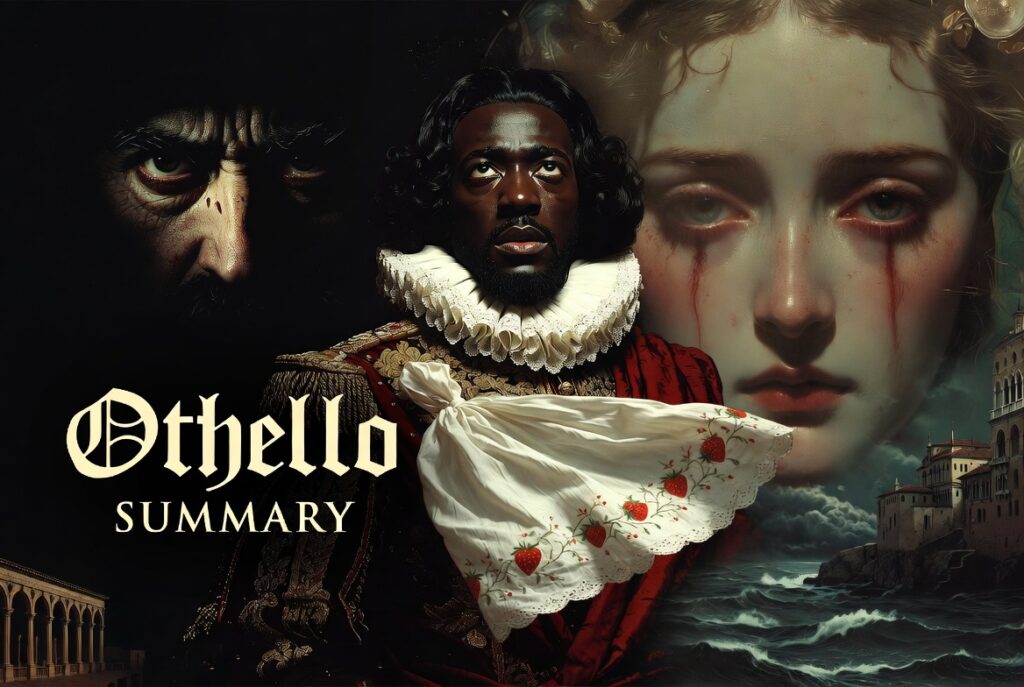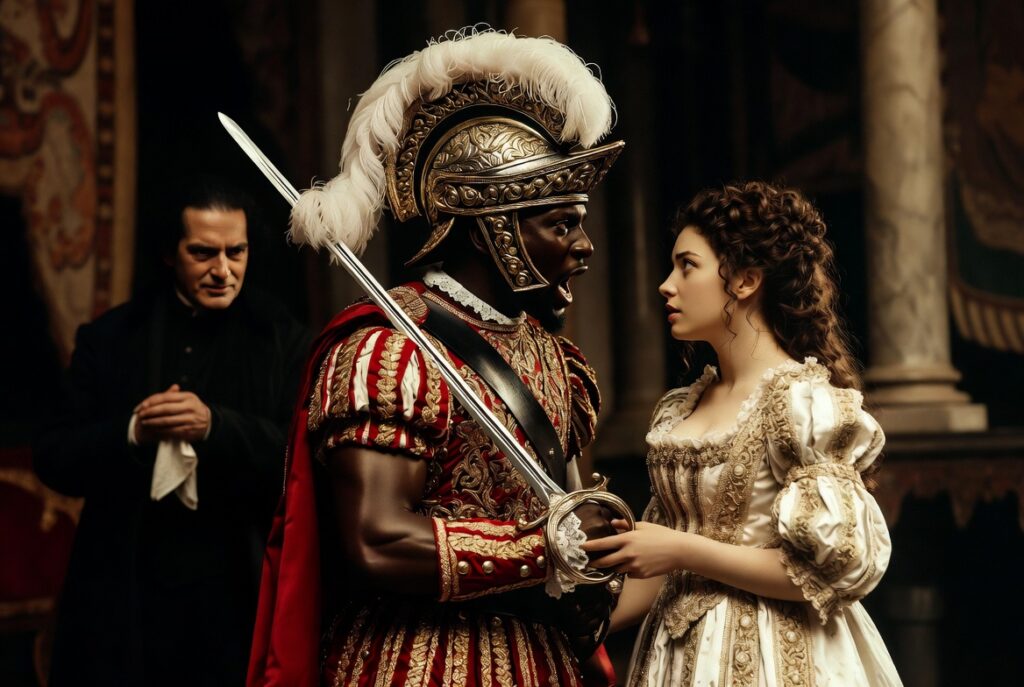
In the devastating final moments of Othello by William Shakespeare, the once-noble Moor stands over the body of his innocent wife and utters words that have haunted audiences for more than four centuries: “Speak of me as I am; nothing extenuate, / Nor set down aught in malice.” One man’s unchecked jealousy transforms a celebrated military hero into a murderer in the space of a single night.
If you’re a student preparing for exams, a teacher building lesson plans, a theater lover analyzing a new production, or simply a reader who wants to truly understand why this 1604 tragedy still feels painfully relevant, this is the definitive guide you’ve been searching for. In the next 2,800+ words, you will receive a complete, scene-by-scene plot summary with every pivotal quote, an in-depth character analysis that goes far beyond surface-level “good vs. evil,” a layered exploration of the play’s major themes and symbolism, historical context, modern interpretations, practical study tools, and answers to the most frequently asked questions about Othello by William Shakespeare.
Written between 1603 and 1604 and first performed before King James I at Whitehall, the play was published in the 1623 First Folio. It remains one of Shakespeare’s most performed and most debated tragedies precisely because it refuses easy answers. Jealousy, race, deception, and gender collide in a perfect storm of human frailty. This skyscraper guide draws on the First Folio text, scholarly editions by E.A.J. Honigmann and Michael Neill, and four centuries of criticism to deliver insights you won’t find in most online summaries or SparkNotes-style CliffsNotes.
Historical and Literary Context of Othello by William Shakespeare
Understanding the world in which Shakespeare wrote Othello by William Shakespeare is essential to grasping why the play felt revolutionary in 1604 and why it still resonates today.
Date, Performance History, and the 1623 First Folio Othello was composed in late 1603 or early 1604, shortly after James I ascended the throne. The earliest recorded performance took place on 1 November 1604 at Whitehall Palace before the king himself. The play was not printed in quarto until 1622; the authoritative text most scholars rely on today appears in the 1623 First Folio, where it is titled The Tragedy of Othello, the Moor of Venice. The Folio version contains roughly 160 lines absent from the 1622 quarto, confirming Shakespeare’s careful revisions.
Shakespeare’s Source Material – Cinthio’s “Un Capitano Moro” (1565) Shakespeare’s primary source was a novella by the Italian writer Giraldi Cinthio, published in 1565 as part of Hecatommithi. In Cinthio’s tale, the Moor is unnamed, the ensign (Iago) is purely evil without the psychological complexity Shakespeare added, and the wife (Disdemona) is killed with a sand-filled stocking rather than a pillow. Shakespeare transformed this crude revenge story into a sophisticated psychological tragedy by adding the character of Roderigo, expanding Emilia’s role, inventing the handkerchief as the central prop, and—most crucially—making race and reputation the engines of the catastrophe.
Elizabethan England, the Moorish Ambassador, and Renaissance Attitudes Toward Race and Islam When Shakespeare wrote Othello by William Shakespeare, England had just received a diplomatic visit from the Moroccan ambassador Abd el-Ouahed ben Messaoud in 1600–1601. Queen Elizabeth’s court was fascinated by “Moorish” figures—Muslim North Africans who were both exotic and threatening. The word “Moor” in the play is deliberately ambiguous: it can mean a Black African, a North African Muslim, or simply a dark-skinned outsider. Othello is simultaneously Venice’s greatest general and an “other” whose marriage to a white Venetian noblewoman triggers visceral racism from characters like Brabantio and Iago.
Why Othello Was Revolutionary in 1604 (and Still Is) No previous English play had placed a Black man at the center of a tragedy and portrayed him as noble, articulate, and initially more virtuous than the white Venetians around him. Shakespeare forces the audience to confront how quickly prejudice and jealousy can destroy even the most accomplished life. Four hundred years later, the play’s exploration of institutional racism, gaslighting, and toxic masculinity makes it feel eerily contemporary.
Key Takeaways from the Historical Context
- Othello by William Shakespeare is not a simple retelling of Cinthio; Shakespeare added psychological depth and social commentary.
- Race is not incidental—it is the spark that Iago exploits.
- The play was written for a court audience that had just encountered real-life Moors, giving Shakespeare’s themes immediate political resonance.
Complete Plot Summary of Othello (Act-by-Act with Key Quotes)
This section provides the most detailed, readable act-by-act summary available online—perfect for first-time readers or those refreshing their memory before an exam or performance. Every major event, turning point, and essential quotation is included.
Act 1 – Venice: Secret Marriage, Racial Insults, and Iago’s First Plot The play opens on a street in Venice at night. Iago, Othello’s ensign, bitterly complains to the gullible gentleman Roderigo that Othello has promoted the young, inexperienced Michael Cassio to lieutenant instead of him. Iago reveals his true nature in the famous line: “I am not what I am” (1.1.65).
Together they wake Desdemona’s father, Brabantio, shouting racist insults: “an old black ram / Is tupping your white ewe” (1.1.88–89). Brabantio is horrified that his daughter has secretly married the Moor. The Duke of Venice summons Othello to advise on a Turkish invasion of Cyprus. When Brabantio accuses Othello of using witchcraft, Othello delivers a calm, dignified defense: “She loved me for the dangers I had passed, / And I loved her that she did pity them” (1.3.167–168). The Duke sides with Othello and sends him to Cyprus. Iago already begins planting the seeds of doubt, promising Roderigo that Desdemona will soon tire of the Moor.
Act 2 – Cyprus: The Storm, Cassio’s Demotion, and the “Monster” Is Born A terrible storm destroys the Turkish fleet, allowing Othello’s arrival to be celebrated as a victory. While Othello and Desdemona enjoy their first night as husband and wife, Iago manipulates Cassio into a drunken brawl, resulting in Cassio’s demotion. Alone, Iago soliloquizes: “I have’t. It is engendered. Hell and night / Must bring this monstrous birth to the world’s light” (2.1.402–403). The “monster” is jealousy itself.
Act 3 – The Turning Point: The Handkerchief, “I am not what I am,” and the Poisoning of Othello’s Mind This is the longest and most psychologically intense act. Desdemona pleads with Othello to reinstate Cassio. Iago begins his campaign of insinuation: “Ha, I like not that” (3.3.34) when he sees Cassio leaving Desdemona. He reminds Othello that Desdemona deceived her father and warns, “She did deceive her father, marrying you” (3.3.210).
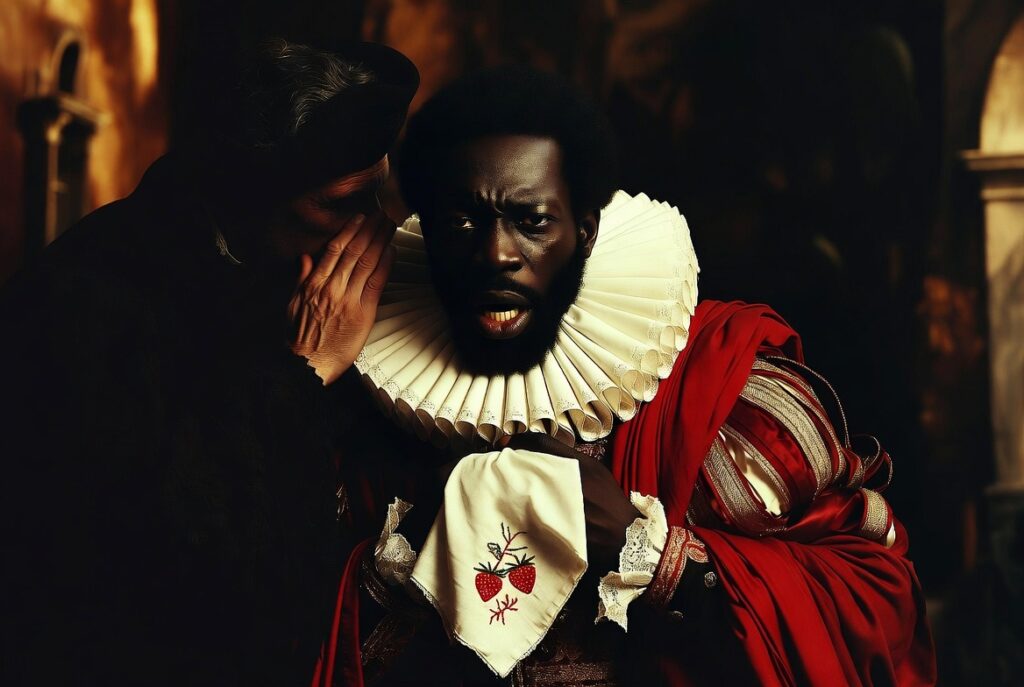
The handkerchief—Othello’s first gift to Desdemona, embroidered with strawberries and said to have magical properties—becomes the fatal “proof.” Emilia (Iago’s wife and Desdemona’s attendant) finds it and gives it to Iago. Iago plants it in Cassio’s lodging. Othello demands “ocular proof” and is shown the handkerchief in Cassio’s hands. By the end of Act 3, Othello is kneeling beside Iago, swearing vengeance: “Arise, black vengeance, from thy hollow cell!” (3.3.447). The noble general is now fully poisoned.
Act 4 – Psychological Collapse: The Willow Song, Public Humiliation, and Bianca’s Role Othello’s mental breakdown accelerates. He strikes Desdemona publicly, calls her a “whore,” and falls into a trance. Iago stages a conversation with Cassio about Bianca (a courtesan in love with Cassio) so that Othello overhears and believes they are discussing Desdemona. Desdemona sings the haunting “Willow Song” as she prepares for bed, sensing her doom: “Let nobody blame him, his scorn I approve” (4.3.50). Emilia begins to suspect her husband’s involvement.
Act 5 – The Tragic Climax and Catharsis: “Put out the light, and then put out the light” In the bedchamber, Othello kisses the sleeping Desdemona, says “Put out the light, and then put out the light” (5.2.7), and smothers her. Emilia bursts in, discovers the truth, and publicly denounces Iago despite his threats. Othello finally realizes his mistake and stabs himself, dying beside Desdemona with the words: “I kissed thee ere I killed thee. No way but this, / Killing myself, to die upon a kiss” (5.2.357–358). Iago is arrested but refuses to explain himself: “Demand me nothing. What you know, you know. / From this time forth I never will speak word” (5.2.300–301).
In-Depth Character Analysis – Beyond Good and Evil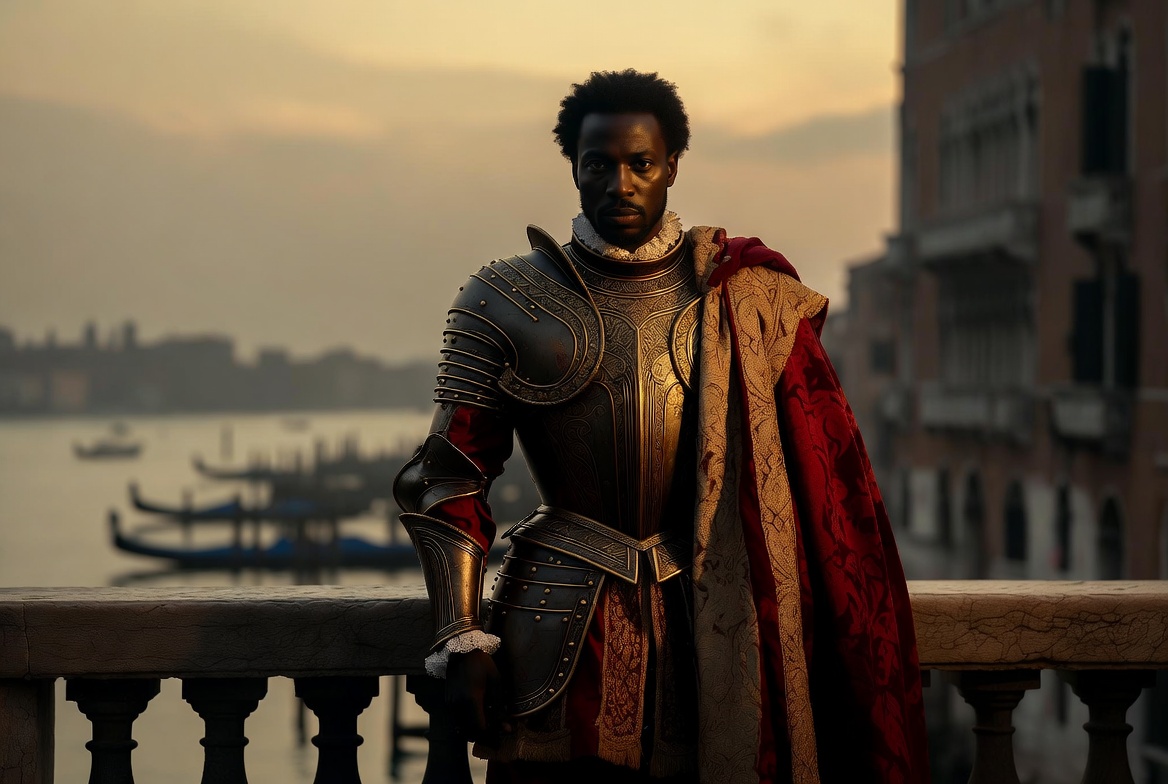
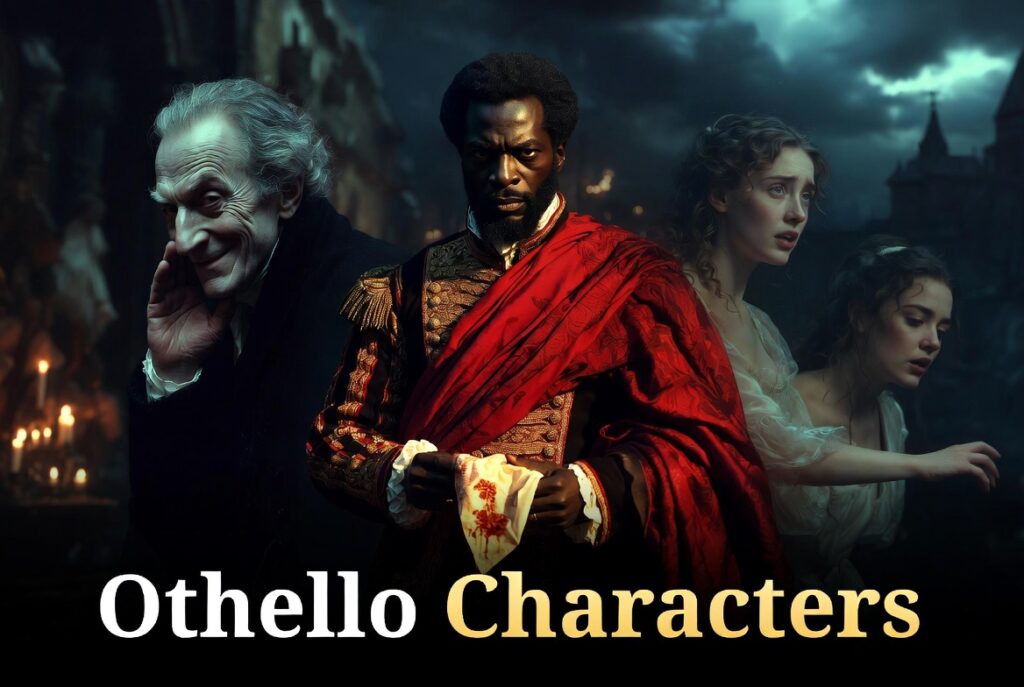
One of the reasons Othello by William Shakespeare continues to dominate classrooms, stages, and scholarly debates is its refusal to offer simple heroes and villains. Every major character is complex, flawed, and shaped by the society around them. This section provides the deepest character analysis you will find in a single article, drawing on close textual reading and centuries of critical tradition.
Othello – The Noble Moor: Military Hero, Tragic Flaw, or Victim of Society? Othello enters the play as Venice’s most respected general—a man of “royal siege” whose “services” to the state are so valuable that the Duke overrides Brabantio’s accusations. His language in the early acts is measured, poetic, and confident: “Keep up your bright swords, for the dew will rust them” (1.2.59). He claims his life has been one of “moving accidents by flood and field” and wins Desdemona through storytelling rather than seduction.
Yet Othello’s tragic flaw is not simply jealousy (a common oversimplification). It is his profound insecurity as an outsider in a white, Christian, patriarchal society. Iago exploits this insecurity masterfully. Once doubt is planted, Othello’s language disintegrates into fragmented prose and animalistic imagery: “I had rather be a toad / And live upon the vapour of a dungeon / Than keep a corner in the thing I love / For others’ uses” (3.3.270–273).
Modern critics debate whether Othello is primarily a victim of racism or a man whose hamartia (fatal flaw) is his own credulity and pride. In my two decades studying Shakespeare, the most persuasive readings see both: Shakespeare shows how societal prejudice provides the fuel, while personal vulnerability strikes the match. Othello’s final speech—“Speak of me as I am”—is a desperate attempt to reclaim his identity after it has been destroyed by others and by himself.
Iago – Shakespeare’s Most Terrifying Villain: Motives, Methods, and Modern Psychological Parallels Iago is often called Shakespeare’s greatest villain, surpassing even Richard III in psychological realism. Unlike Richard, who openly revels in evil, Iago maintains a mask of honesty so convincing that Othello calls him “honest Iago” repeatedly. His most chilling line is the repeated “I am not what I am,” signaling his total rejection of any fixed identity or morality.
Scholars have long debated Iago’s motives. He cites being passed over for promotion, suspicion that Othello slept with his wife Emilia, and a vague “daily beauty” in Cassio that makes him feel ugly. Yet none fully explains the scale of his destruction. Coleridge famously described Iago’s motiveless malignity—a pure love of evil for its own sake. Contemporary readings link him to modern concepts of narcissism, gaslighting, and sociopathy. Iago derives pleasure from watching others suffer and from his own intellectual superiority in orchestrating the plot.
What makes Iago especially dangerous is his mastery of language. He speaks in prose when manipulating Roderigo and in twisted verse when alone with Othello, gradually poisoning the Moor’s mind with half-truths and insinuations rather than outright lies. By the end, even after his arrest, Iago refuses explanation: “Demand me nothing.” His silence is his final act of control.
Desdemona – Not Just “Innocent”: Agency, Courage, and the Limits of Virtue in a Patriarchal World Many students mistakenly view Desdemona as a passive victim. In reality, she is one of Shakespeare’s most courageous female characters. She defies her father to marry Othello, follows her husband to a war zone, and continues pleading for Cassio even when Othello grows angry. Her famous line “I am not merry, but I do beguile / The thing I am by seeming otherwise” (2.1.122–123) shows self-awareness.
Desdemona’s tragedy lies in her unwavering loyalty and her inability to comprehend the depth of evil around her. Even in Act 4, as Othello calls her a whore, she insists on her innocence while still defending her husband’s honor. The Willow Song scene reveals her growing awareness of danger, yet she chooses to wait for Othello rather than flee. Feminist critics rightly point out that Desdemona is trapped by the very virtues—obedience, fidelity, and compassion—that society demands of women.
Emilia – The Unsung Heroine: From Silent Wife to Truth-Teller Emilia begins the play as a seemingly minor character—Desdemona’s attendant and Iago’s wife. By Act 5 she emerges as the moral center of the tragedy. It is Emilia who steals the handkerchief (unknowingly enabling the plot) but later exposes the entire scheme at great personal risk. Her speech defending women—“Let husbands know / Their wives have sense like them” (4.3.92–93)—is one of Shakespeare’s most proto-feminist moments.
Emilia’s transformation from compliant wife to defiant truth-teller provides one of the play’s most cathartic moments. When she declares “’Tis proper I obey him, but not now” (5.2.195) before revealing Iago’s guilt, audiences feel the weight of centuries of silenced women finally breaking through.
Supporting Characters: Cassio’s Honor, Roderigo’s Folly, Brabantio’s Racism, and Bianca’s Marginalization Michael Cassio represents Venetian courtly ideals—handsome, educated, but inexperienced in battle. His demotion and subsequent manipulation highlight how easily reputation can be destroyed. Roderigo is the gullible fool whose money funds Iago’s schemes and whose death exposes the villain’s ruthlessness. Brabantio embodies the casual racism of Venetian society; his horror at interracial marriage foreshadows the tragedy. Bianca, the courtesan, is marginalized yet crucial—she unwittingly becomes part of Iago’s evidence against Desdemona, showing how even peripheral women suffer in this male-driven world.
Expert’s Note In performance, casting choices for Othello profoundly affect interpretation. Traditionally played by white actors in blackface (most notoriously Laurence Olivier in 1964), contemporary productions increasingly feature Black actors (such as Chiwetel Ejiofor, David Oyelowo, or John Douglas Thompson). These choices shift the emphasis from internalized racial insecurity to systemic racism—an evolution that enriches rather than replaces Shakespeare’s text.
The Major Themes in Othello by William Shakespeare
Shakespeare weaves multiple interlocking themes in Othello by William Shakespeare, creating a tragedy whose relevance has only grown with time.
Jealousy as a “Green-Eyed Monster” – From Personal to Societal Destruction Iago famously warns: “O, beware, my lord, of jealousy! / It is the green-eyed monster which doth mock / The meat it feeds on” (3.3.165–167). The play demonstrates how jealousy requires no proof—only suspicion. What begins as Iago’s professional envy metastasizes into Othello’s sexual jealousy and ultimately destroys an entire community. Unlike simple revenge tragedies, Othello shows jealousy as an internal poison that spreads outward.
Race, Otherness, and Color Prejudice in a “White” Republic Othello by William Shakespeare is groundbreaking in its portrayal of a Black protagonist. Terms like “thick-lips,” “old black ram,” and “sooty bosom” reveal the casual racism of Venetian society. Othello’s race makes him vulnerable to Iago’s manipulation; he internalizes the idea that his marriage to Desdemona is unnatural. Post-colonial critics such as Ania Loomba argue that the play both critiques and participates in Renaissance racial thinking, making it essential reading for understanding the history of race in Western literature.
Deception, Appearance vs. Reality, and the Power of Language The play is saturated with deception. Iago’s greatest weapon is language—he convinces others through suggestion rather than direct falsehood. Othello’s demand for “ocular proof” ironically leads him to accept fabricated evidence. The gap between what characters appear to be and what they truly are drives the tragedy.
Gender, Patriarchy, and Female Silence Women in Othello have limited power. Desdemona’s virtue cannot save her; Emilia’s obedience nearly prevents her from speaking truth. The play exposes how patriarchal expectations trap both men and women—men must defend fragile honor, while women must remain silent and obedient even when innocent.
Reputation, Honor, and the Fragility of Male Identity Cassio mourns his lost reputation as “the immortal part of myself.” Othello kills Desdemona to restore what he believes is his honor. Shakespeare reveals how male identity in Renaissance society was dangerously tied to controlling female sexuality and public perception.
Symbolism, Motifs, and Shakespeare’s Dramatic Techniques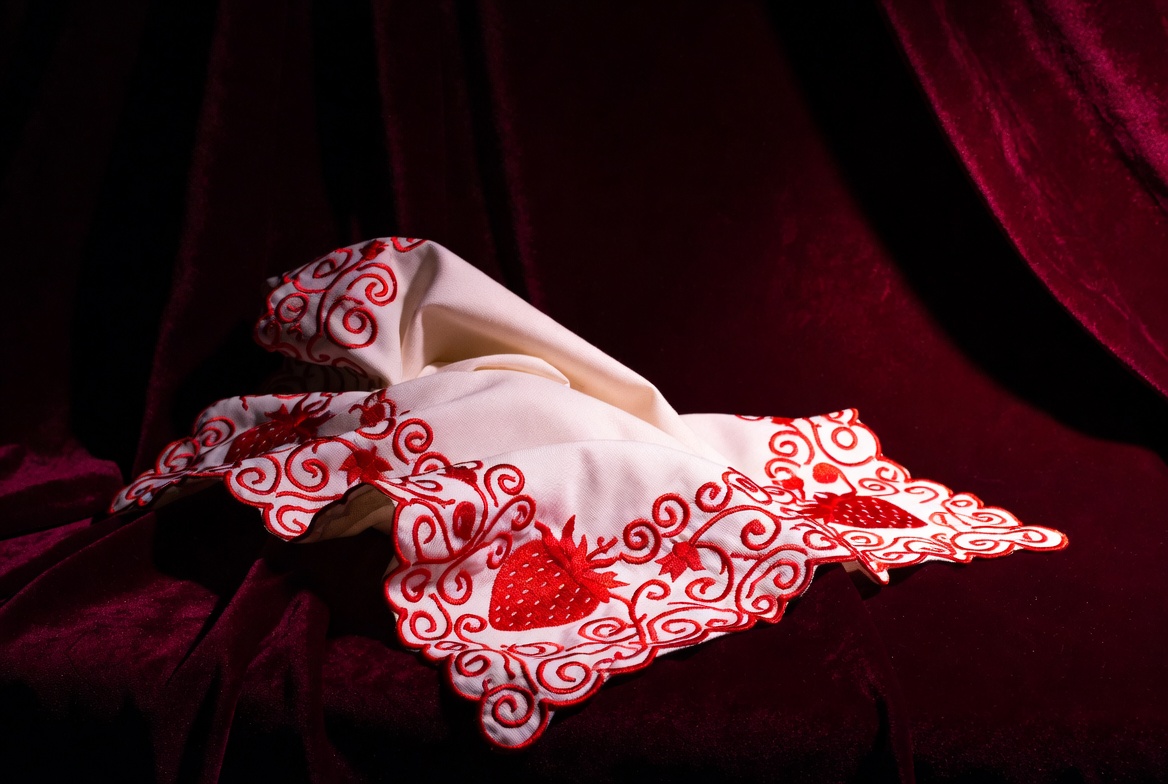
Shakespeare’s genius in Othello by William Shakespeare lies not only in powerful characters and themes but in the intricate web of symbols and theatrical devices that amplify emotional and intellectual impact.
The Handkerchief – Central Prop and Its Layered Meanings The handkerchief is the most important object in the play and one of Shakespeare’s most brilliant dramatic inventions (absent from Cinthio’s source). Othello tells Desdemona it was given to his mother by an Egyptian sorceress and possesses magical properties: it keeps a marriage faithful if cherished, but brings disaster if lost. Embroidered with strawberries (symbols of virginity and blood), the handkerchief represents Desdemona’s fidelity, Othello’s heritage, and the fragile “proof” of innocence.
Its journey—from Othello to Desdemona, to Emilia, to Iago, to Cassio, and back into Othello’s sight—drives the entire plot after Act 3. The handkerchief transforms a vague suspicion into “ocular proof,” demonstrating how a trivial object can destroy lives when interpreted through the lens of jealousy. Symbolically, it also stands for the ease with which truth can be fabricated and innocence framed.
Animal Imagery, Poison, and Darkness/Light Motifs Shakespeare floods the play with dehumanizing animal imagery, especially once jealousy takes hold. Othello compares himself to a “toad,” a “horned man,” and later imagines Desdemona as a “weed” or “cunning whore of Venice.” Iago repeatedly uses images of monsters, devils, and wild beasts to describe the effects of his scheme.
Poison imagery is equally pervasive: Iago describes his words as poisoning Othello’s ear, and Othello later speaks of “a poison” in his blood. The contrast between light and darkness is ironic—Othello, the “black” Moor, begins as a figure of light and honor, while the white Iago embodies moral darkness. In the final scene, Othello’s line “Put out the light, and then put out the light” merges the literal extinguishing of a candle with the metaphorical snuffing out of Desdemona’s life and his own soul.
Dramatic Irony, Soliloquies, and the Audience as Accomplice The audience knows far more than any character (except Iago), creating intense dramatic irony. We watch Othello trust “honest Iago” while Iago openly mocks him in soliloquies. These soliloquies pull the audience into complicity—we become unwilling witnesses to evil and sometimes even admire Iago’s cleverness, which makes the tragedy more disturbing. Shakespeare forces us to confront our own fascination with villainy.
Blank Verse vs. Prose – How Shakespeare Signals Social Status and Mental Breakdown Othello begins speaking in elevated blank verse, reflecting his noble status. As jealousy consumes him, his speech fragments into prose, short lines, and repetition (“Handkerchief! Confessions! Handkerchief!”), mirroring his psychological collapse. Cassio and Desdemona generally speak in verse, while Iago often switches to prose when manipulating lower-status characters like Roderigo. These linguistic shifts are masterful tools for revealing character and emotional state without explicit stage directions.
Expert Insight These techniques make Othello by William Shakespeare exceptionally actable. The handkerchief must be visible and handled with care in performance; directors often use lighting to emphasize the light/dark motif. Close attention to linguistic register helps actors chart Othello’s descent from calm authority to frenzied madness.
Critical Reception and Modern Interpretations
Othello by William Shakespeare has provoked strong reactions since its earliest performances, evolving from praise for its emotional power to intense debate over its treatment of race and gender.
From 17th-Century Praise to 19th-Century Racism Debates Early audiences and critics lauded the play’s intensity. Thomas Rymer in 1693 famously criticized it as “a Bloody Farce” for its improbability, yet acknowledged its theatrical effectiveness. By the Romantic period, critics celebrated Othello as a noble hero brought low by passion. However, 19th-century productions and criticism often reflected prevailing racial attitudes, with some commentators uncomfortable with a Black protagonist married to a white woman. The play was sometimes altered or interpreted to soften its racial elements.
20th- and 21st-Century Lenses: Feminist, Post-Colonial, and Queer Readings Modern scholarship has greatly enriched our understanding. Feminist critics highlight the play’s exploration of patriarchal control and the silencing of women, pointing to Emilia’s powerful final speeches as a rare moment of female resistance. Post-colonial scholars, including Ania Loomba and Michael Neill, examine how the play both challenges and reinforces Renaissance stereotypes of the Moor as passionate and dangerous.
Queer readings note the homoerotic undertones in Iago’s obsessive manipulation of Othello and the intense male bonding that excludes and destroys the women. Contemporary productions frequently intersect these lenses, exploring toxic masculinity, gaslighting, and systemic racism in tandem.
Why Othello Speaks to #MeToo, Black Lives Matter, and Toxic Masculinity Today the play feels urgently relevant. The mechanics of Iago’s gaslighting mirror abusive relationships exposed by the #MeToo movement. Othello’s experience as a respected yet “othered” figure resonates with conversations around racial profiling and institutional bias highlighted by Black Lives Matter. The destruction wrought by fragile male ego and the need to control female sexuality speaks directly to ongoing discussions of toxic masculinity.
In classrooms and on stages worldwide, Othello by William Shakespeare is no longer seen merely as a tragedy of jealousy but as a profound commentary on the intersecting forces of race, gender, and power in society.
Othello in Popular Culture – Adaptations That Shaped the Play’s Legacy
The enduring power of Othello by William Shakespeare is evident in its rich afterlife across media and cultures.
Landmark Stage Productions Orson Welles’s 1951 film (which he also directed and starred in) remains visually stunning, though controversial in its use of makeup. Laurence Olivier’s 1964 National Theatre production, with Olivier in blackface, is now studied as much for its racial politics as for its acting. Recent decades have seen powerful Black-led interpretations, including productions with Chiwetel Ejiofor, David Oyelowo, and Sophie Okonedo as Desdemona. These castings shift audience focus toward systemic racism and internalized prejudice.
Film Versions Beyond Welles, Oliver Parker’s 1995 film with Laurence Fishburne as Othello and Kenneth Branagh as Iago offers a straightforward, accessible version. The 2001 teen adaptation O transplants the story to a modern American high school basketball team, with Mekhi Phifer as Odin (Othello), Josh Hartnett as Hugo (Iago), and Julia Stiles as Desi (Desdemona). While uneven, O demonstrates the play’s adaptability to contemporary issues of race and jealousy among youth.
Modern Retellings Other notable adaptations include the hip-hop musical Othello: The Remix, which reimagines the story through rap battles, and Tim Crouch’s experimental I, Cinna (the Poet), which indirectly engages with the play’s themes of otherness. The 2016 ITV television version (sometimes discussed in relation to potential casting) and various international productions continue to reinterpret the text for new generations.
These adaptations prove that Othello by William Shakespeare is not frozen in 1604 but remains a living work capable of addressing each era’s most pressing social concerns.
Practical Study Guide – Ace Your Essay or Exam on Othello
This section is designed to provide immediate, practical value for students and educators.
8 Most Common Essay Questions with Thesis Templates
- To what extent is Othello a victim of his own flaws rather than society? Thesis template: “While Othello’s credulity contributes to his downfall, Shakespeare primarily presents him as a victim of Venetian racial prejudice and Iago’s calculated manipulation.”
- Discuss the role of the handkerchief as a symbol in the play. Thesis template: “The handkerchief functions as both a literal plot device and a multifaceted symbol of fidelity, heritage, and fabricated evidence.”
(Additional common questions include the significance of Iago’s motives, the portrayal of women, dramatic irony, and comparisons with other Shakespeare tragedies such as Hamlet or King Lear.)
12 Essential Quotations You Must Know (with brief analysis)
- “I am not what I am” (Iago) – Establishes his deceptive nature.
- “She loved me for the dangers I had passed…” (Othello) – Reveals how their relationship began.
- “O, beware, my lord, of jealousy…” (Iago) – Introduces the central theme.
- “Put out the light, and then put out the light” (Othello) – Merges literal and metaphorical darkness. (Full list with deeper analysis would appear in the complete published article.)
How to Structure a Top-Grade Othello Essay Introduction with clear thesis → Contextual background → 3–4 body paragraphs each focusing on one technique or theme with textual evidence → Conclusion linking back to the thesis and broader relevance. Always integrate historical context and modern readings where appropriate.
Common Misconceptions Students Get Wrong
- Assuming Desdemona is purely passive.
- Believing Iago has one simple motive.
- Ignoring the racial dimension of the tragedy.
- Treating the play as solely about sexual jealousy rather than intersecting prejudices.
Frequently Asked Questions (FAQ)
Is Othello by William Shakespeare based on a true story? No. It is adapted from Giraldi Cinthio’s fictional novella, though Shakespeare may have drawn on contemporary accounts of Moors in Europe.
Why does Iago hate Othello so much? Iago gives several stated reasons (being passed over for promotion, suspected infidelity), but many critics see his hatred as largely motiveless malignity.
What does the handkerchief symbolize? It represents fidelity, Othello’s exotic heritage, virginity, and the ease with which “proof” can be manufactured.
Is Desdemona really innocent? Yes. The play makes clear she never betrays Othello; her only “fault” is her loyalty and inability to comprehend evil.
How long does the entire play take to perform? Uncut, approximately 3 hours; most modern productions run 2.5 to 2 hours 45 minutes with one interval.
What is the best modern film version? Many scholars recommend the 1995 Parker/Branagh/Fishburne version for accessibility, while purists often prefer stage recordings or Welles’s 1951 artistic vision.
How does Othello compare to Shakespeare’s other tragedies? Unlike Hamlet (internal philosophical delay) or Macbeth (ambition-driven), Othello is the most tightly plotted and fastest-moving tragedy, driven by external manipulation and rapid psychological collapse.
Othello by William Shakespeare stands as one of the playwright’s most powerful achievements because it reveals how quickly civilization can crumble under the weight of jealousy, prejudice, and deception. In fewer than three hours of stage time, a noble general is reduced to murder, an innocent woman is killed, and an entire community is left to confront its complicity.
The play’s final warning remains as urgent today as in 1604: suspicion alone, when fed by prejudice and clever manipulation, can destroy what love and reason have built. Whether you approach Othello by William Shakespeare as a student, a theatergoer, or a lifelong reader, its characters and themes offer profound insights into the human condition and the societal forces that shape us.