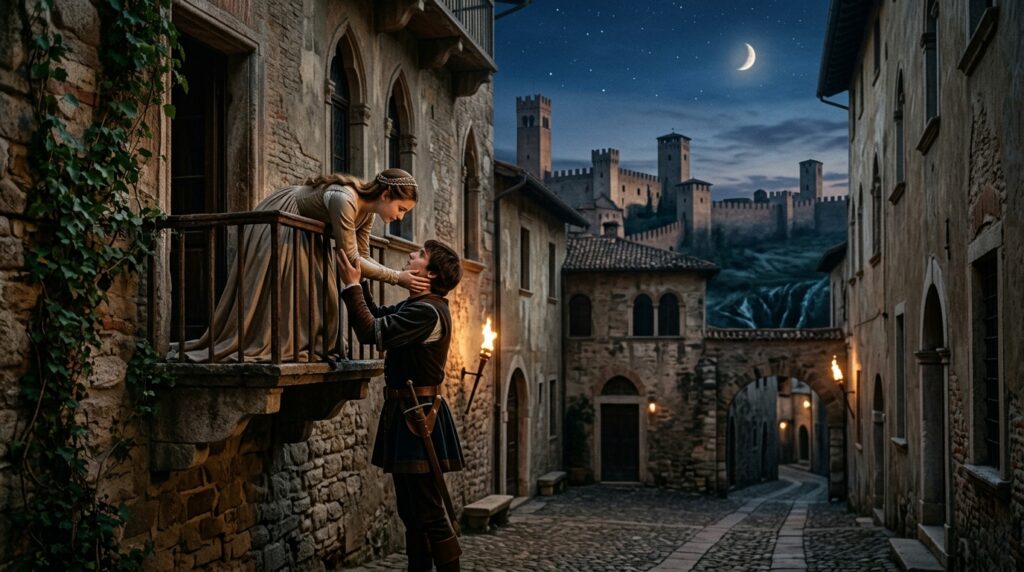
For over four centuries, William Shakespeare’s tragic tale of star-crossed lovers has defined our cultural understanding of romance and heartbreak. Audiences around the world weeping over the fate of the young Veronese lovers often assume the play was a brilliant piece of pure dramatic fiction. However, the real story romeo and juliet is built upon is rooted in the bloody, turbulent history of 14th-century northern Italy. Shakespeare did not invent the Montagues and Capulets, nor did he construct their tragedy out of thin air; rather, he adapted a historical narrative forged in medieval political warfare, refined across Renaissance novellas, and grounded in authentic Italian feud culture.
Disentangling historical fact from Elizabethan theatrical embellishment solves a persistent mystery for scholars and readers alike: where does real history end, and where does Shakespeare’s dramatic genius begin? By exploring medieval municipal records, Renaissance literary records, and contemporary accounts of Renaissance Italy, we can uncover the authentic 14th-century history that inspired the Bard’s greatest tragic masterpiece.
I. Verona, 1303: The Blood Feud That Set the Stage
To understand the origins of the tragic lovers, one must look past Victorian romanticism and step into the factional violence of medieval Verona around the year 1300. Far from being a peaceful Renaissance haven, northern Italy was torn apart by a devastating, centuries-long political conflict.
Guelph vs. Ghibelline: The Political Civil War
The underlying cause of the violence depicted in Romeo and Juliet was not a simple domestic disagreement between two stubborn patriarchs, but a broader, continent-spanning civil war. Northern and central Italy were divided between two fiercely opposed political factions:
-
The Guelphs: Supporters of the Papacy, who advocated for the political supremacy of the Pope in Roman affairs.
-
The Ghibellines: Supporters of the Holy Roman Emperor, who sought imperial authority over Italian city-states.
In 14th-century Verona, loyalty to these factions was a matter of life and death. Neighborhoods were fortified with watchtowers, high stone walls, and iron gates. Street brawls between rival political houses were not rare occurrences—they were a constant feature of civic life. Young noblemen walked the streets armed to the teeth, accompanied by mercenaries and retainers. Political assassinations, public street duels, and summary banishments were routine legal measures taken by ruling magistrates to maintain order.
       [ Holy Roman Emperor ]                [ The Papacy ]
                 │                                 │
                 ▼                                 ▼
         [ GHIBELLINES ]                      [ GUELPHS ]
                 │                                 │
                 ▼                                 ▼
        Montecchi Family                  Cappelletti Family
        (Imperial Align)                   (Papal Align)
                 └──────────────┬──────────────────┘
                                │
                                ▼
                   14th-Century Veronese Feud
When Shakespeare’s Prince Escalus warns that “three civil brawls, bred of an airy word” have disturbed the quiet of Verona’s streets, he is describing the documented historical reality of 14th-century Italian governance.
The Real Families: Montecchi and Cappelletti
The family names that Shakespeare anglicized into Montague and Capulet were not fictional fabrications. Historical archives confirm that both the Montecchi and the Cappelletti were prominent, powerful clans during the 13th and 14th centuries.
-
The Montecchi Clan: A dominant Ghibelline political family based directly in Verona. They held immense wealth, military strength, and territorial influence during the late 1200s and early 1300s under the rule of the Scaligeri (Dalla Scala) dynasty.
-
The Cappelletti Clan: A major faction centered primarily in Cremona, with closely allied branches residing throughout Lombardy and the Veneto region.
While popular tradition places both families as rival neighbors within the city walls of Verona, historical records indicate that their rivalry was part of the larger regional struggle between Ghibelline and Guelph alliances across northern Italy.
Primary Source Evidence: Dante’s Divine Comedy
The most conclusive contemporary proof of the historical Montecchi-Cappelletti feud comes from Italy’s greatest medieval poet, Dante Alighieri.
Writing his masterwork The Divine Comedy (La Divina Commedia) between 1308 and 1321, Dante was intimately familiar with the political chaos of Verona, having lived there in exile under the protection of Can Grande della Scala. In Purgatorio (Canto VI, lines 106–108), Dante explicitly calls out the two families by name as symbols of political destruction and negligence:
“Vieni a veder Montecchi e Cappelletti,
Monaldi e Filippeschi, uom sanza cura:
color già tristi, e questi con sospetti!”
Translation:
“Come see the Montecchi and Cappelletti,
Monaldi and Filippeschi, careless man:
those already sorrowful, and these in dread!”
Dante recorded this passage decades before Shakespeare was born. This primary historical source confirms beyond doubt that the Montecchi and Cappelletti were well-known, bitterly divided families whose mutual hostility was legendary throughout medieval Italy.
II. The Real Lovers: Mariotto and Giannozza (The Earliest Known True Story)
While the political feud between the Montecchi and Cappelletti is a proven historical fact, how did the romantic narrative of the secret marriage and tragic double suicide emerge? The literary genealogy traces back to a series of Renaissance writers who claimed to be recording actual historical events.
+-----------------------------------------------------------------------+
|                       THE LITERARY TRANSMISSION                       |
+-----------------------------------------------------------------------+
| 1. Masuccio Salernitano (1476) — "Mariotto and Giannozza" (Siena)     |
|    └─ First recorded novella of secret marriage & tragic potion.      |
|                                                                       |
| 2. Luigi da Porto (1530) — "Giulietta e Romeo" (Verona)               |
|    └─ Shifted setting to Verona; introduced Montecchi & Cappelletti.   |
|                                                                       |
| 3. Matteo Bandello (1554) — Novella Collection                        |
|    └─ Added secondary characters (Tybalt, Paris, Nurse).              |
|                                                                       |
| 4. Pierre Boaistuau (1559) — French Translation                       |
|    └─ Dramatized tone; introduced moral warnings on tragic passion.   |
|                                                                       |
| 5. Arthur Brooke (1562) — "The Tragicall Historye of Romeus and Juliet"|
|    └─ English verse adaptation; Shakespeare's primary direct source.  |
|                                                                       |
| 6. William Shakespeare (1597) — First Quarto Edition                  |
|    └─ Condensed timeline to 4 days; immortalized as world drama.      |
+-----------------------------------------------------------------------+
Masuccio Salernitano (1476): The Original Novella
The earliest documented version of the narrative framework appears in the Novellino of Masuccio Salernitano, published in 1476. The 33rd story in this collection recounts the tragic tale of two young lovers named Mariotto Mignanelli and Giannozza Saraceni, set in the Italian city of Siena.
In Salernitano’s account, key elements of the legend are already fully present:
-
The young couple falls in love and marries in secret with the assistance of a renegade Augustinian friar.
-
Mariotto gets into a violent altercation with a prominent citizen, kills him, and is condemned to exile in Alexandria, Egypt.
-
Giannozza’s father attempts to arrange a marriage for her with another suitor.
-
To escape the forced marriage, Giannozza drinks a sleeping potion provided by the friar that simulates death.
-
She is buried in a vault, revived by the friar, and brought out to escape to Egypt.
-
The Fatal Miscommunication: The messenger sent to inform Mariotto of the plot is intercepted by pirates. Mariotto receives word only of Giannozza’s “death,” rushes back to Siena in disguise, gets captured at her tomb, and is publicly executed. Giannozza later dies of grief in a convent.
Salernitano insisted in his preface that these events took place during his own lifetime and were based on real incidents in Siena.
Luigi da Porto (1530): Bringing the Tale Home to Verona
In 1530, a nobleman and wounded soldier named Luigi da Porto published Historia novellamente ritrovata di due nobili amanti (“A Newly Found History of Two Noble Lovers”). Da Porto made two critical structural changes that permanently tied the story to history:
-
He shifted the location from Siena to Verona.
-
He explicitly named the lovers Romeo Montecchi and Giulietta Cappelletti, directly connecting Salernitano’s romance plot to Dante’s historical families.
Da Porto claimed he was told the story by a Veronese archer named Peregrino while riding near Vicenza. Looking out at the twin ruined castles of Montecchio Maggiore, Peregrino supposedly recounted the legend as a historical warning about the destructive nature of familial factionalism. Da Porto also introduced enduring character archetypes: Mercutio, Tybalt, Count Paris, and the concept of the balcony/window meeting.
III. From Renaissance Italy to Elizabethan London: The Transmission Chain
The journey of the story from an Italian novella to the English stage illustrates how Renaissance folklore was translated across borders.
Matteo Bandello and Pierre Boaistuau: The European Expansion
In 1554, Matteo Bandello, a Dominican monk and talented storyteller, published a refined, highly popular version of da Porto’s tale in his Novelle. Bandello expanded the psychological depth of the characters, emphasized the role of the Nurse, and detailed the street violence between the Montagues and Capulets.
Bandello’s Italian text was translated into French in 1559 by Pierre Boaistuau in his Histoires Tragiques. Boaistuau added dramatic flair, altered the scene at the tomb, and highlighted moral themes surrounding forbidden love and filial disobedience.
Arthur Brooke (1562): Shakespeare’s Direct Source
The French version crossed the English Channel and fell into the hands of the young English poet Arthur Brooke. In 1562, Brooke published a narrative poem titled The Tragicall Historye of Romeus and Juliet.
Brooke’s poem was the immediate, primary source material used by William Shakespeare thirty-five years later. Shakespeare relied heavily on Brooke’s narrative arc, character names, and structural beats. However, Brooke’s version was heavily moralistic, warning English youth against unbridled passion and disobeying parental counsel. Shakespeare stripped away Brooke’s rigid moralizing, transforming the tale into an empathetic exploration of human emotion, fate, and societal failure.
IV. What Shakespeare Kept, Changed, and Purely Invented
Understanding how Shakespeare modified his historical and literary sources reveals his dramatic genius while highlighting what was authentic to 14th-century Italy.
Historical Fact vs. Shakespearean Adaptation
| Narrative Element | 14th-Century Italian Reality | Shakespeare’s Dramatic Adaptation |
| Duration of Events | Spanned several months (winter through summer) | Condensed into 4 to 5 days (Sunday to Thursday) |
| Age of Juliet | Typically 16–18 in earlier novellas | Lowered to 13 years old (turning 14 at Lammas-tide) |
| The Balcony | Terraced courtyard windows and stone arches | Stage directions specified “at a window” or upper stage |
| The Rivalry | Factional political war (Guelphs vs. Ghibellines) | A private, domestic blood feud between noble families |
| Role of Friar Laurence | Franciscan herbalist/confessor (common civic role) | Neutral mediator attempting political reconciliation |
| Climactic Tomb Scene | Giulietta wakes before Romeo dies (da Porto) | Romeo dies seconds before Juliet awakens |
Key Differences Analyzed
-
Compression of Time: In da Porto’s and Brooke’s versions, the romance develops across several months. Shakespeare dramatically compressed the entire action into less than a week. This intense pressure cooker environment heightened the tragedy and highlighted the impetuous nature of youth.
-
The “Balcony” Misconception: Contrary to popular belief, Shakespeare never wrote the word “balcony” in the stage directions of Romeo and Juliet. Balconies were virtually unknown in Elizabethan England, and the word did not enter the English language until decades after Shakespeare’s death. In the First Folio, the stage direction simply reads: “Enter Juliet above at a window.”
-
Political Context: Shakespeare downplayed the complex imperial and papal politics of medieval Italy to make the feud relatable to Elizabethan audiences, framing it instead as an ancient, irrational family conflict.
V. Verona Today: Truth vs. Tourism Marketing
Every year, hundreds of thousands of literary pilgrims travel to Verona, Italy, seeking physical traces of the star-crossed lovers. While Verona’s medieval heritage is genuine, much of what tourists visit today is a blend of historical architecture and 20th-century preservation efforts.
Casa di Giulietta (Juliet’s House)
Located on the Via Cappello in Verona, Casa di Giulietta is a magnificent 13th-century gothic palazzo.
-
The Historical Truth: The building was originally an inn owned by the Dal Cappello family—a name remarkably similar to Cappelletti. The city of Verona purchased the building in the early 20th century.
-
The Balcony Addition: The iconic stone balcony attached to the courtyard was constructed in the late 1930s. Restoration experts built the balcony using repurposed 14th-century gothic sarcophagus fragments to satisfy tourist demands inspired by Hollywood film adaptations.
       [ Casa di Giulietta (Via Cappello) ]
                       │
       ┌───────────────┴──────────────┐
       ▼                              ▼
  13th-Century Building         1930s Added Balcony
  Owned by Dal Cappello         Built from 14th-century
  family (Historical)           sarcophagus fragments (Myth)
Tomba di Giulietta (Juliet’s Tomb)
Situated inside the ancient monastery of San Francesco al Corso, an open red marble sarcophagus is identified as Juliet’s tomb.
-
Historical Record: Records show that as early as the 16th century—long before Shakespeare wrote his play—travelers visited this specific monastery to view the tomb of the legendary lovers.
-
While the sarcophagus is an authentic medieval artifact from the early 1300s, there are no human remains or inscriptions identifying its original occupant.
VI. Expert Insights: Why the “Real” Story Matters
Understanding the true historical foundations of Romeo and Juliet changes how we interpret Shakespeare’s work:
-
A Critique of Civic Violence: The play is not merely a romantic tragedy; it is a serious critique of senseless violence and lawlessness. Shakespeare’s portrayal reflects real Renaissance concerns over street violence, dueling, and political factionalism.
-
The Power of Myth-Making: The evolution from Masuccio’s Siena novella to Shakespeare’s stage play demonstrates how historical trauma—such as the Guelph-Ghibelline civil wars—can be transformed by culture into timeless romantic mythology.
-
Universal Human Truths: Whether or not a specific Romeo Montecchi and Giulietta Cappelletti died together in 1303, thousands of young lovers in medieval Italy were caught in the crossfire of their families’ political wars.
VII. Frequently Asked Questions (FAQ)
Was Romeo and Juliet based on a real story?
Yes and no. The story is based on real historical elements. The rival families (the Montecchi and Cappelletti) were real 14th-century Italian factions, as documented in primary sources like Dante’s Divine Comedy. However, the tragic story of the specific star-crossed lovers was developed through Italian novellas by Masuccio Salernitano and Luigi da Porto before being adapted by Shakespeare.
Did the Montague and Capulet families really exist?
Yes. Historical records confirm that the Montecchi family lived in Verona during the 13th and 14th centuries, while the Cappelletti family was a prominent political faction in Cremona and surrounding northern Italian regions.
Is Juliet’s balcony in Verona real?
The building known as Casa di Giulietta is an authentic 13th-century building owned by the Dal Cappello family. However, the famous balcony was added in the late 1930s by the city of Verona to match public expectations created by stage and film adaptations.
Who wrote the original story before Shakespeare?
The earliest version of the narrative was written by Masuccio Salernitano in 1476. It was later relocated to Verona and given its familiar names by Luigi da Porto in 1530. Matteo Bandello expanded the tale in 1554, and Arthur Brooke translated it into English verse in 1562, providing Shakespeare with his primary direct source.
VIII. Conclusion
The real story behind Romeo and Juliet reveals that William Shakespeare was not merely a teller of romantic fables, but a master literary archivist who drew from real-world history. Behind the poetry and tragic drama lies the genuine history of 14th-century Italy: a world marked by political division, civil unrest, and real families like the Montecchi and Cappelletti whose conflicts devastated generations.
By grounding his play in authentic historical context, Shakespeare created a timeless work that continues to resonate today. The next time you encounter the tragedy of Verona’s star-crossed lovers, remember that beneath the Elizabethan verse lies the true history of medieval Italy—where family loyalty, political war, and youth collided.