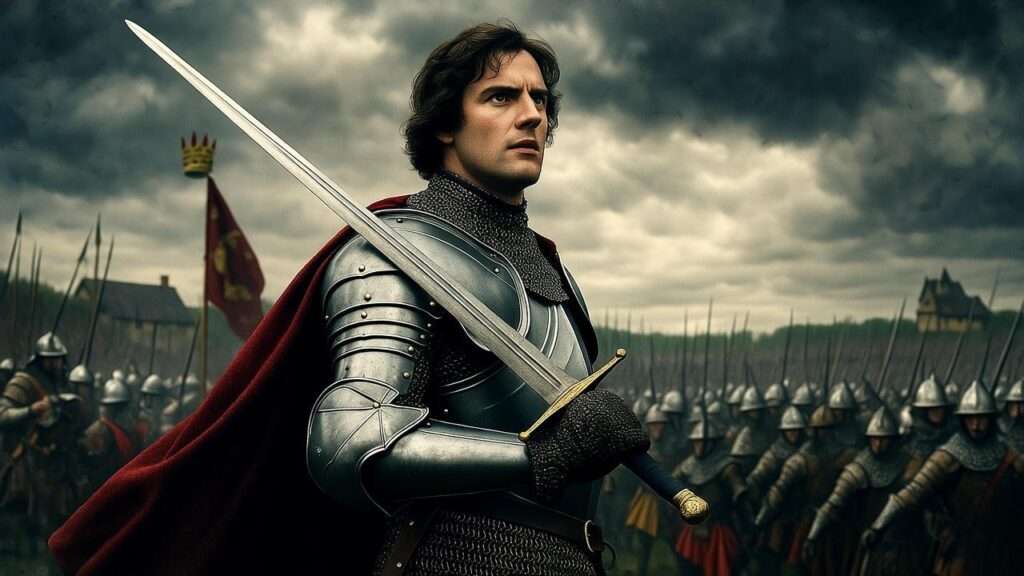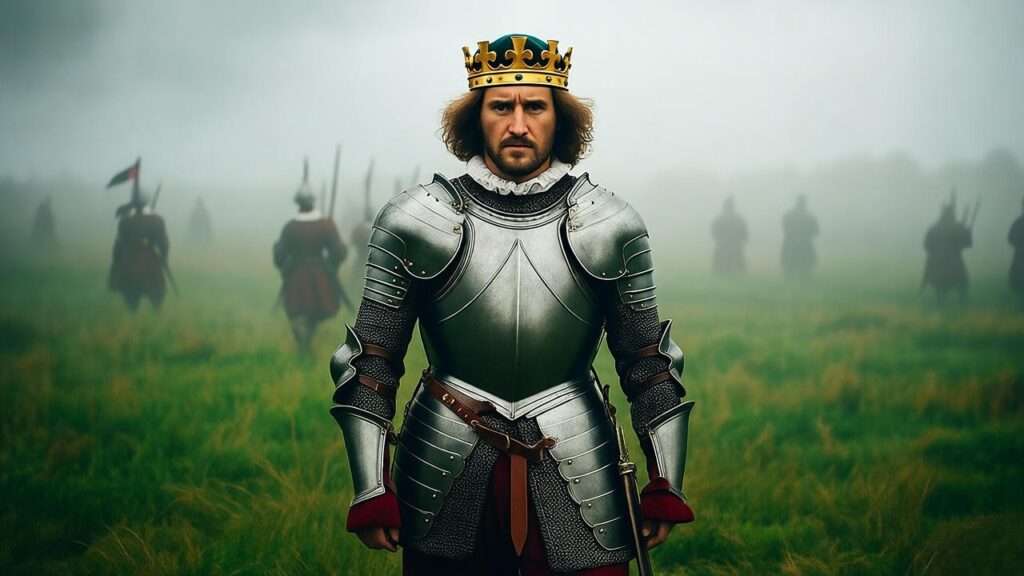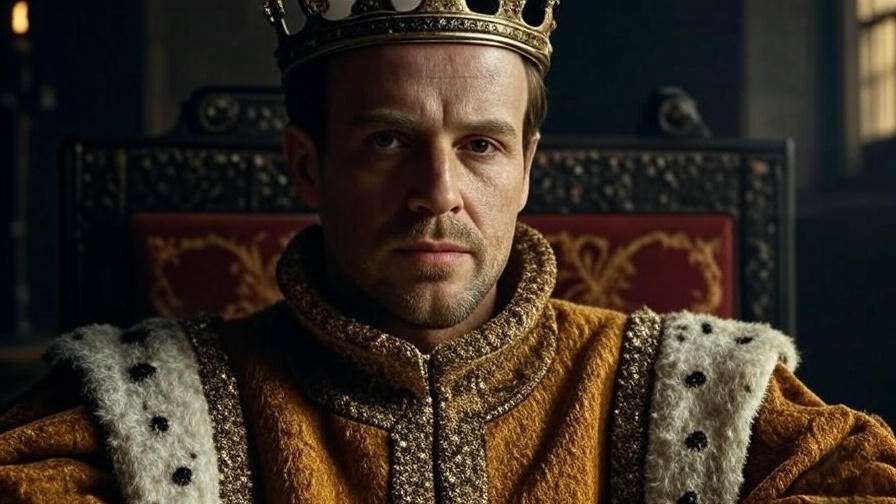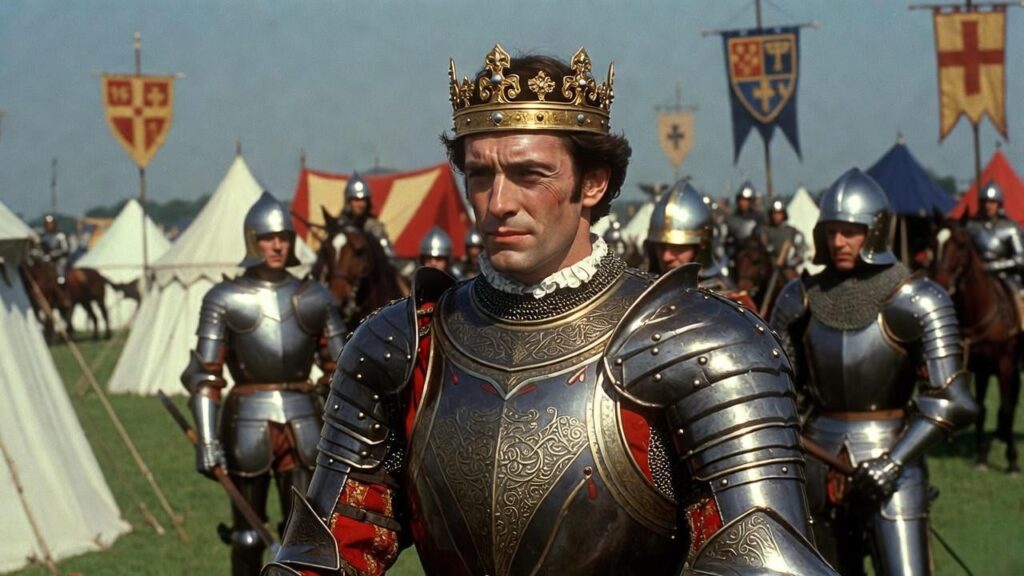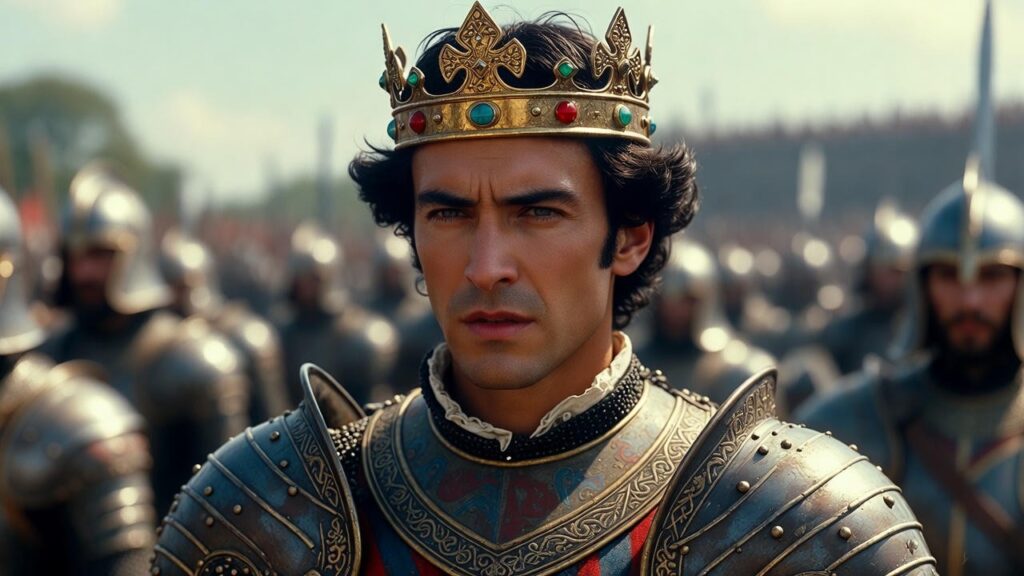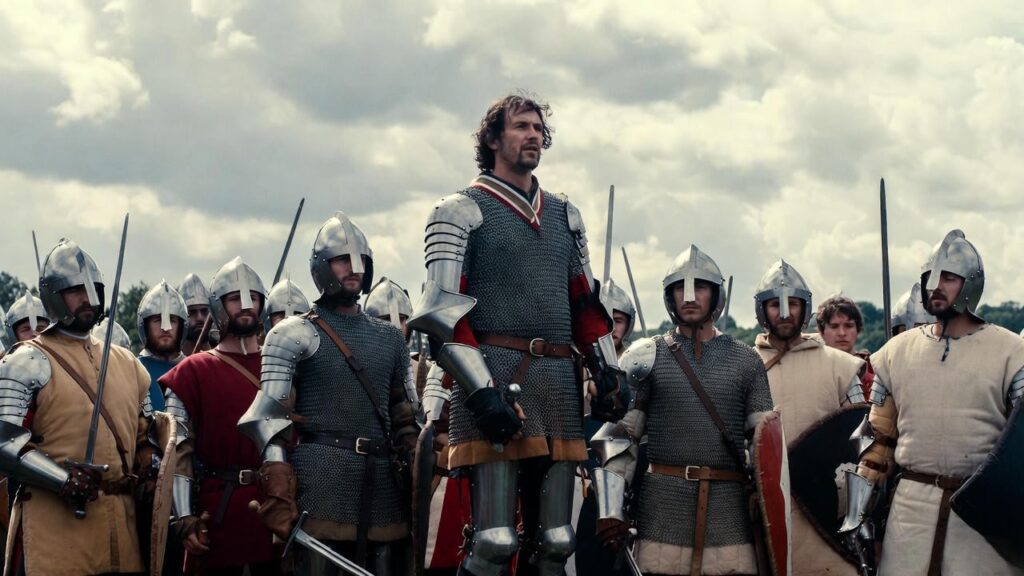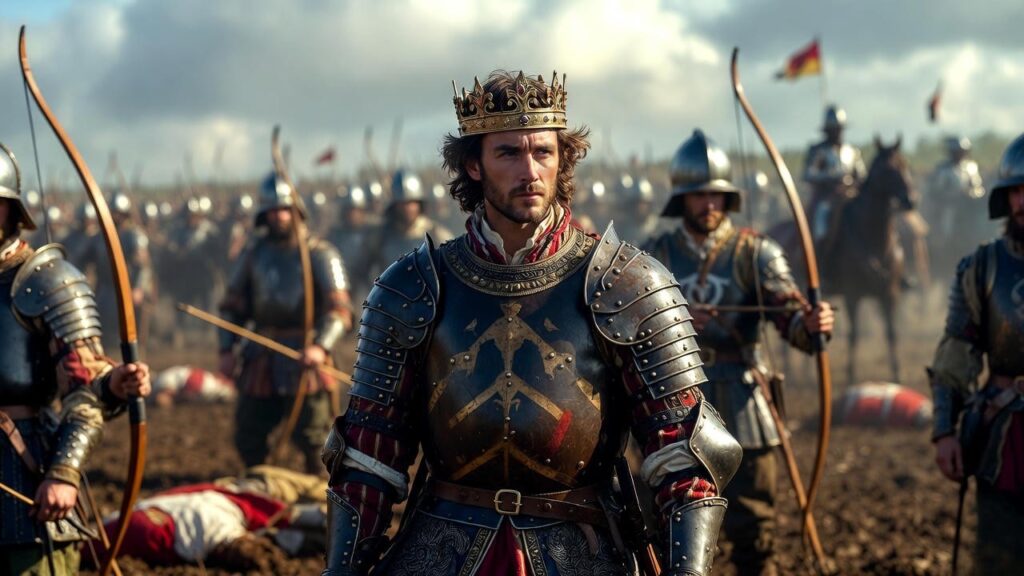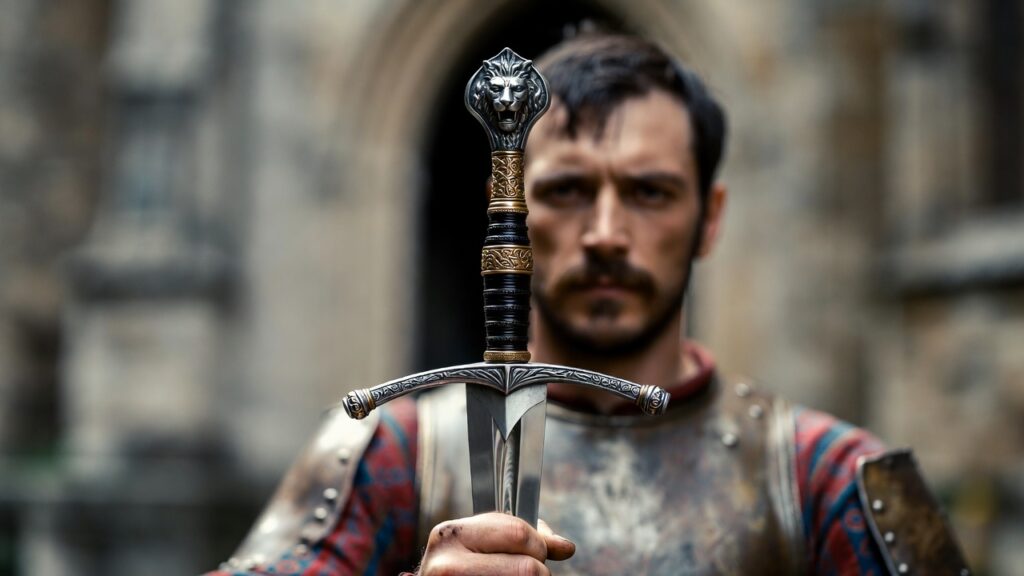
+Imagine the muddy fields of Agincourt on October 25, 1415. Rain-soaked English archers, outnumbered five to one, face the flower of French chivalry. At their head stands a young king, Henry V, whose words—and perhaps whose blade—will turn the tide of history. Centuries later, a single sword hangs in Westminster Abbey, its edges worn from use, its balance praised as legendary. This is the Sword of Henry V, a medieval masterpiece that sword expert Ewart Oakeshott called “one of the most beautiful medieval swords to handle I have ever known… balanced like a good fishing rod.” It embodies the real warrior-king whose victories Shakespeare immortalized in his history play Henry V.
For readers drawn to Shakespearean insights, this artifact bridges gritty historical fact and dramatic poetry. It reveals how a practical fighting weapon symbolizes leadership, courage, and the machinery of war in one of literature’s greatest portrayals of kingship. Whether you’re a student analyzing the play, a history enthusiast exploring the Hundred Years’ War, or someone seeking deeper understanding of heroic rhetoric, this article uncovers the sword’s origins, design, authenticity debate, and profound ties to Shakespeare’s text—offering fresh perspectives that go beyond surface summaries.
Who Was Henry V? The Historical King Behind the Legend
Henry V (1386–1422) remains one of England’s most celebrated medieval monarchs, thanks in large part to Shakespeare’s portrayal of him as the ideal warrior-king. But the historical figure was complex: a reformed prince turned disciplined ruler and brilliant tactician.
From Prince Hal to Warrior King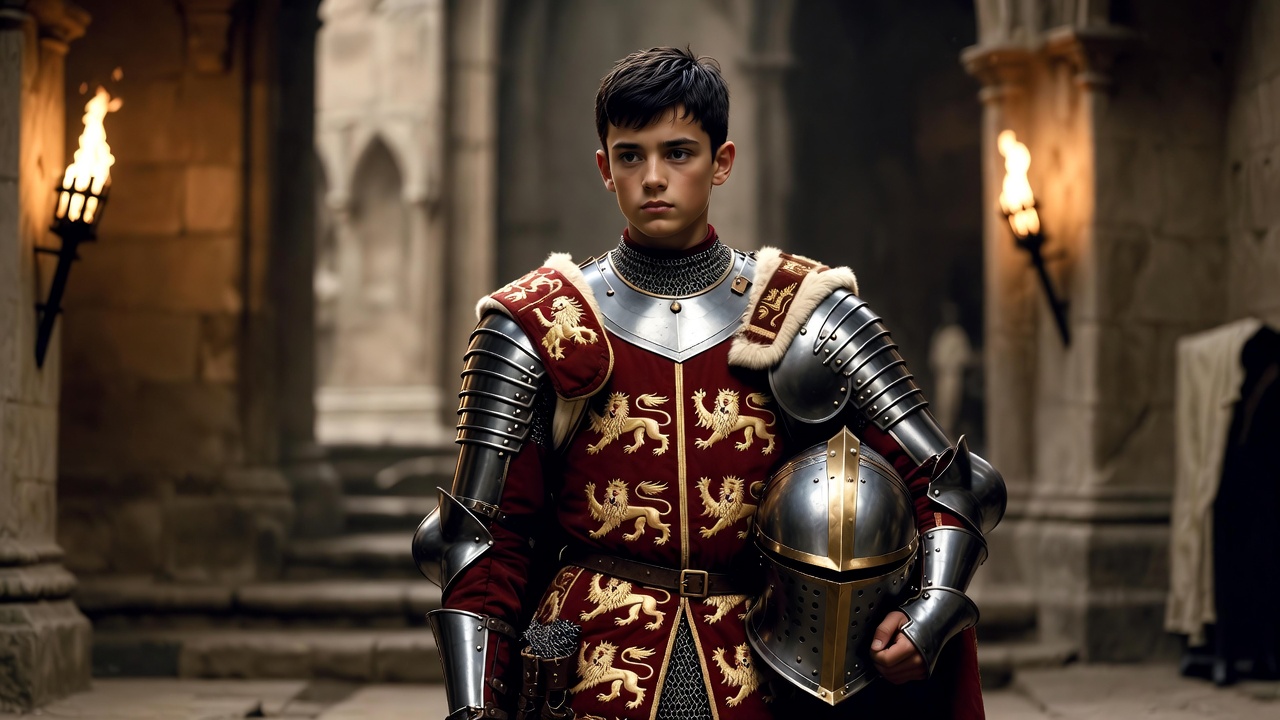
Born as Henry of Monmouth, the future king spent his youth in the turbulent court of his father, Henry IV. Shakespeare famously dramatizes this in the Henry IV plays as the wayward Prince Hal, carousing with Falstaff. In reality, young Henry showed early martial promise. At age 16, he led troops at the Battle of Shrewsbury (1403), suffering a severe arrow wound to the face—removed surgically in a procedure that nearly killed him. This scar, a permanent reminder of combat’s cost, hardened him into a focused leader.
Ascending the throne in 1413 at age 26, Henry transformed England. He quelled internal rebellions, reformed finances, and revived claims to the French throne, reigniting the Hundred Years’ War. His reign emphasized discipline, piety, and strategic genius—qualities Shakespeare amplifies into the mirror of Christian kings.
The Battle of Agincourt and Its Lasting Impact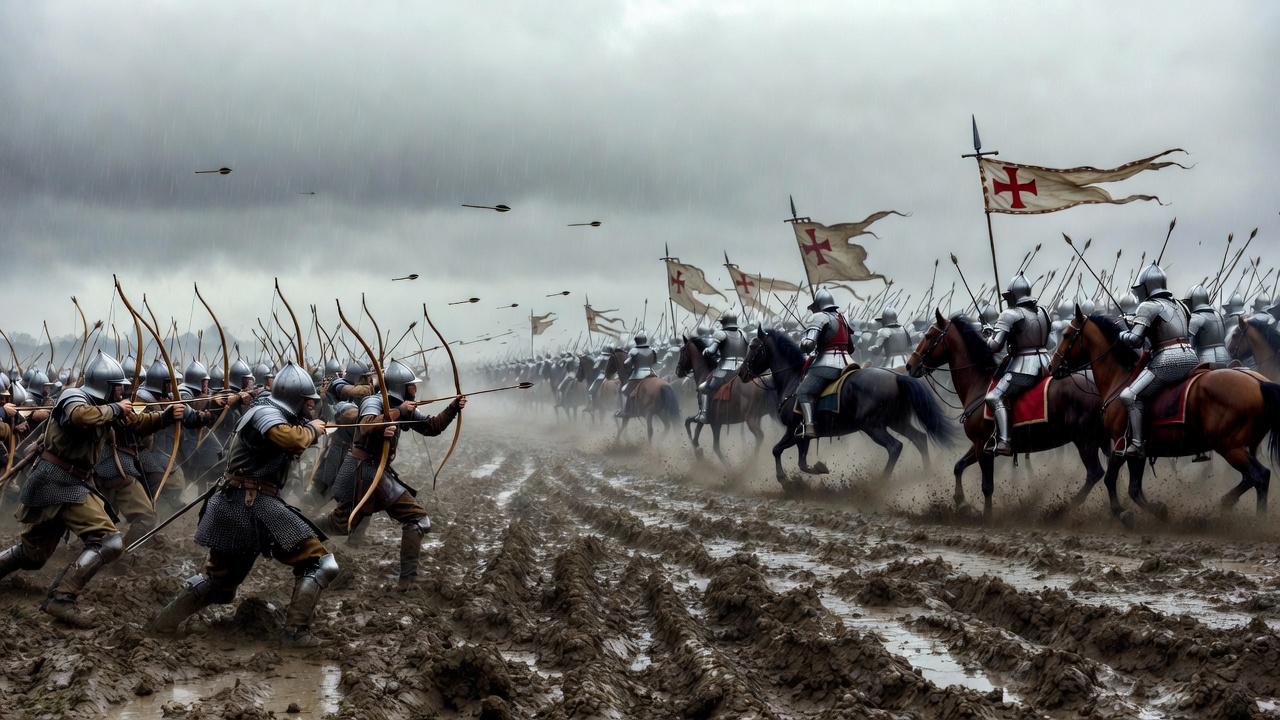
Agincourt stands as Henry’s defining triumph. Facing overwhelming odds, he exploited terrain, longbow volleys, and French disarray to secure victory. English losses were minimal (hundreds) compared to French (thousands, including nobility). This underdog win echoed through European chronicles, cementing Henry’s reputation as a divinely favored ruler.
The battle’s legacy influenced military tactics, national identity, and literature. Shakespeare draws heavily on chroniclers like Holinshed, transforming historical events into stirring oratory that still inspires.
Henry V’s Death and Funeral Achievements
Henry died young in 1422 from dysentery during a French campaign, leaving an infant heir and unfinished conquests. Buried at Westminster Abbey, his tomb became a site of royal pilgrimage. Among his funeral achievements—helm, shield, saddle—hung a sword above his chantry chapel, symbolizing his martial life. Displayed for centuries, it later vanished into storage until rediscovered in the 19th–20th century.
Modern scholarship, including recent analyses from the Royal Armouries, debates exact provenance but affirms its connection to Henry’s era and legacy.
The Sword of Henry V: Physical Description and Historical Provenance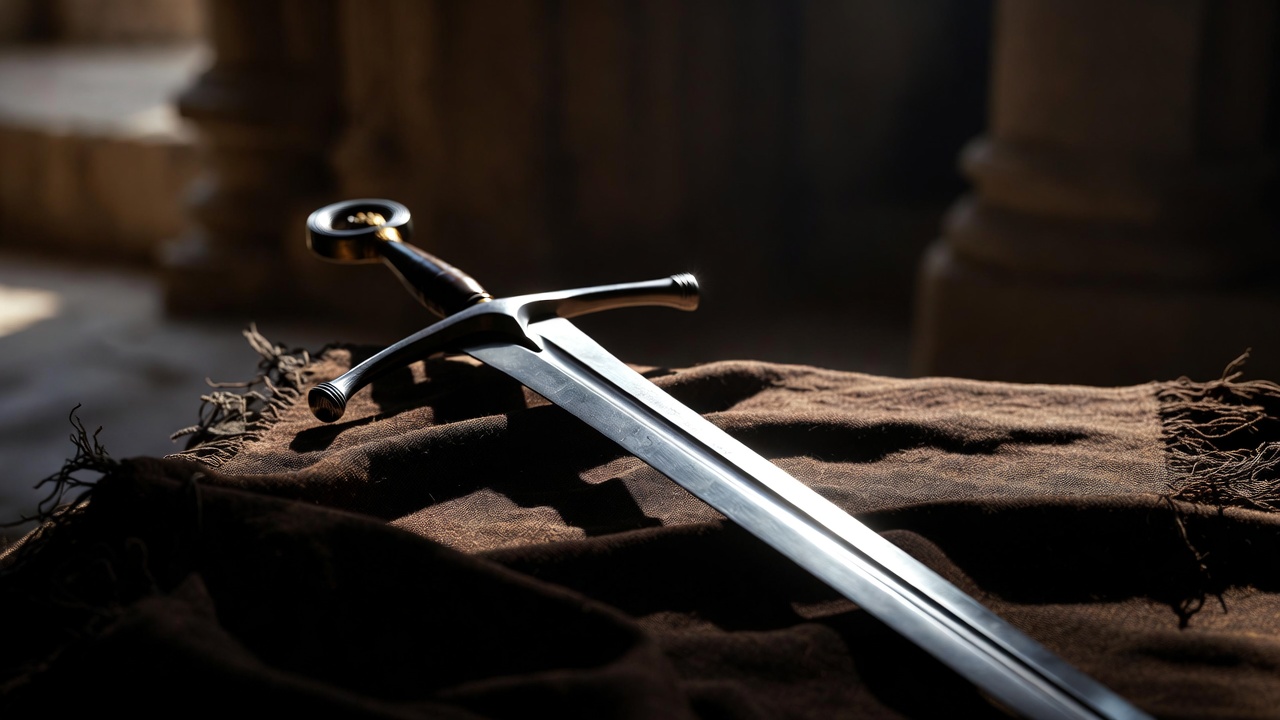
The sword associated with Henry V is preserved at Westminster Abbey, a tangible link to the king. Expert examination reveals a weapon of exceptional quality.
Discovery and Rediscovery
Accounts vary slightly, but the sword was reportedly found in the 19th century near Henry’s tomb or in an old chest within the Abbey. It hung above his chantry until stowed away post-funeral. In 1951, renowned sword scholar Ewart Oakeshott was permitted to clean and study it, publishing findings that elevated its status. He integrated it into displays with Henry’s other achievements.
Design and Specifications
Classified as Oakeshott Type XVIII (specifically XVIII.1), this single-handed arming sword features:
- Overall length: approximately 33–34 inches
- Blade length: 27–28 inches
- Blade width at base: 2–2.125 inches, tapering gracefully to an acute point
- Cross-section: flattened diamond for stiffness in thrust
- Pommel: Type J1 (elaborated wheel), hollow with gilded recesses and red crosses (funerary additions)
- Weight: around 2.3–2.7 lbs (light for power)
- Balance: exceptional, lively in hand
The blade shows wear—sharpened multiple times, edges narrowed—indicating real use. The grip is a later replacement; original lost.
Oakeshott Type XVIII swords represent a transitional design: broad base for cutting, tapered point for thrusting against improving plate armor.
Oakeshott’s Glowing Endorsement
Oakeshott, author of seminal works like Records of the Medieval Sword and The Sword in the Age of Chivalry, handled the blade personally. He described it as “no mere funerary object, but a magnificent fighting sword… which comes to life in one’s hand.” Its simplicity suited a practical warrior like Henry, contrasting ornate ceremonial pieces. He praised its balance, grace, and lethality—calling it one of the finest medieval swords ever handled.
Authenticity Debate
Is this Henry’s Agincourt sword? Evidence is mixed. Dating places it pre-1422, matching Henry’s lifetime. Wear suggests battlefield use. However, some scholars (including recent Royal Armouries studies) propose it may date later or serve purely as a funeral achievement. Regardless, it emblemizes the era’s high-quality weaponry and Henry’s martial image.
The Sword in Shakespeare’s Henry V: Symbolism and Dramatic Power
While Shakespeare never directly describes or mentions the specific sword now preserved in Westminster Abbey, the play Henry V is saturated with martial imagery where the sword functions as a potent symbol of kingship, authority, honor, and the brutal realities of war. The historical artifact—praised for its balance, lethality, and practicality—mirrors the qualities Shakespeare ascribes to his protagonist: a leader who blends grace with ferocity, eloquence with action.
Swords as Symbols of Kingship and Authority
In Shakespeare’s history plays, weapons often transcend mere tools to embody power itself. Henry dismisses superficial emblems of rule in his famous soliloquy on ceremony (Act 4, Scene 1): “I know / ’Tis not the balm, the scepter and the ball, / The sword, the mace, the crown imperial…” Here, the sword is listed alongside other regalia, yet Henry rejects their hollow pomp. True authority, he implies, stems from inner resolve and moral legitimacy—not objects.
This rejection contrasts sharply with earlier scenes. The Dauphin’s mocking gift of tennis balls provokes Henry’s famous retort: the balls will become “gun-stones” in a deadly match. War transforms playful symbols into instruments of destruction, paralleling how a simple, functional sword like the Westminster blade becomes an emblem of royal might when wielded by a capable king.
Swords also signify justice and vengeance. The Chorus in the Act 1 Prologue unleashes “famine, sword, and fire” as hounds at Henry’s heels, personifying war’s horrors. In Act 5, the Chorus describes Henry’s triumphant return with “his bended sword” and bruised helm—battle-worn trophies hung as monuments, echoing the real funeral achievements displayed above his tomb.
The Warrior King’s Blade in Action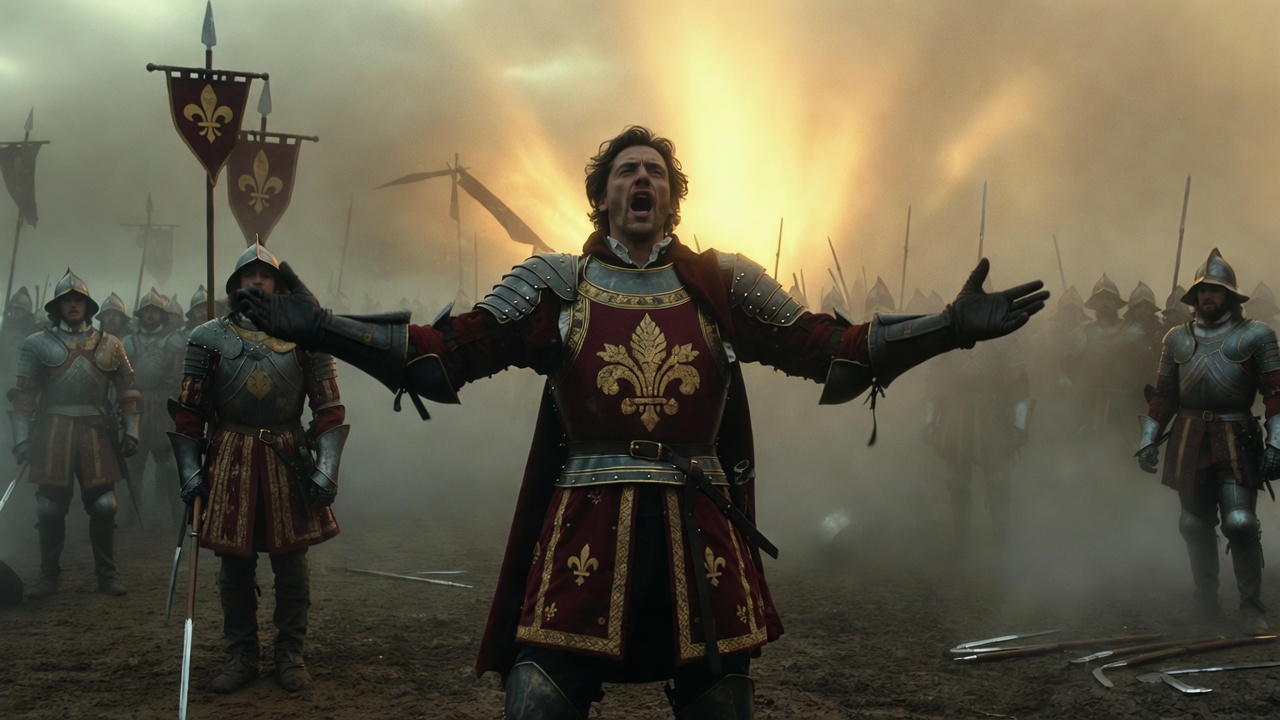
Shakespeare’s Henry wields rhetoric as his sharpest weapon, but the sword underlies every call to arms. In the “Once more unto the breach” speech (Act 3, Scene 1), he urges soldiers to “imitate the action of the tiger: / Stiffen the sinews, conjure up the blood.” The imagery evokes a blade drawn for the cut—swift, decisive, animalistic.
The pinnacle arrives in the St. Crispin’s Day oration (Act 4, Scene 3): “We few, we happy few, we band of brothers.” Henry transforms a desperate situation into shared glory, promising that survivors will display scars as badges of honor. The sword here symbolizes brotherhood forged in combat, much like the real blade’s worn edges testify to hard use.
Henry’s personal evolution—from wayward prince to commanding king—parallels the sword’s dual nature: elegant yet brutally effective. Just as Oakeshott noted the Westminster sword’s lively balance suits a “down-to-earth warrior,” Shakespeare’s Henry balances piety, strategy, and raw courage.
Bridging History and Drama
Shakespeare drew from chroniclers like Raphael Holinshed and Edward Hall, who portrayed Henry as a model of chivalric kingship. The play amplifies this, turning historical events into timeless drama. The sword artifact enriches our reading: its Type XVIII design—cut-and-thrust versatility against plate armor—mirrors the tactical innovations (longbows, disciplined infantry) that won Agincourt.
Expert analyses, including those referencing Oakeshott’s work and recent Royal Armouries publications on Henry’s funeral achievements, underscore the blade’s emblematic power. It represents not just a weapon but the machinery of medieval warfare that Shakespeare dramatizes—leadership tested in blood, where symbols become reality.
For modern readers, this connection deepens appreciation: the sword reminds us that Shakespeare’s Henry is no mere myth but rooted in a tangible historical figure whose martial tools shaped England’s legacy.
Why This Sword Matters Today: Legacy and Modern Interpretations
The Sword of Henry V endures beyond its display in Westminster Abbey’s Queen’s Diamond Jubilee Galleries (where Henry’s funeral achievements—helm, shield, saddle, and associated sword—are now conserved and exhibited following recent work). It inspires replicas, scholarly debate, and cultural reflection.
Replicas and Reproductions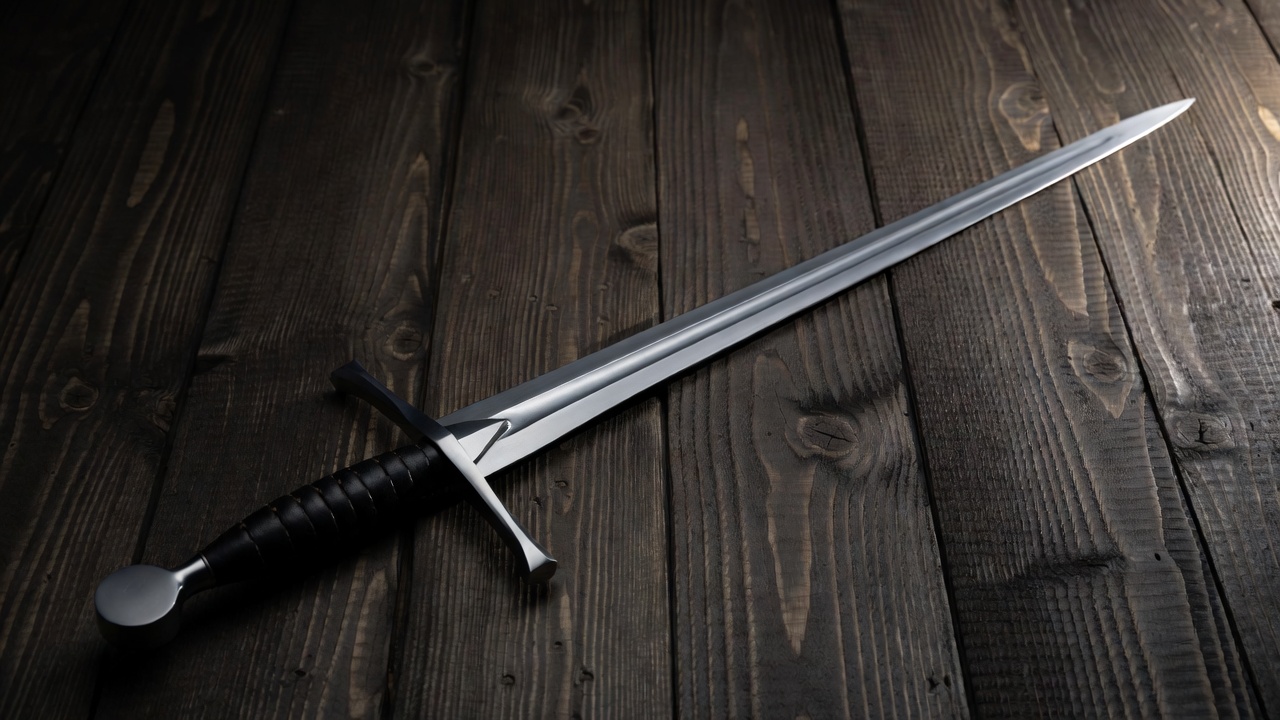
High-quality reproductions from makers like Arms & Armor (based directly on Oakeshott’s notes and sketches) and Windlass Steelcrafts allow enthusiasts to experience its balance firsthand. These functional swords appeal to Historical European Martial Arts (HEMA) practitioners, who test Type XVIII designs in sparring. Collectors prize them as tributes to medieval craftsmanship—practical beauty over ornament.
Modern versions often retain the hollow pommel, gilded recesses, and red crosses, capturing the original’s funerary elegance while emphasizing its fighting pedigree.
Cultural Resonance
From Laurence Olivier’s 1944 film (filmed amid WWII) to Kenneth Branagh’s 1989 adaptation, the St. Crispin’s Day speech has become shorthand for inspirational leadership against odds. The sword symbolizes underdog victory, national pride, and the power of words to rally troops—timeless themes in an era of complex global conflicts.
In literature and education, it bridges Shakespeare studies with material history, helping students visualize the play’s martial world.
Lessons for Readers
The blade teaches balance: Henry’s success came from discipline, strategy, and inspiration—not brute force alone. In leadership today, it reminds us that true authority blends action with eloquence, courage with compassion. For Shakespeare enthusiasts, it invites rereading Henry V with eyes attuned to symbolism—where a sword is never just steel, but a mirror of the soul wielding it.
The Sword of Henry V stands as a rare fusion: a surviving medieval artifact tied to one of history’s greatest warrior-kings, and a silent partner in Shakespeare’s dramatic masterpiece. Whether viewed in Westminster Abbey or evoked through the play’s stirring rhetoric, it embodies leadership forged in adversity.
Visit the Abbey’s galleries to see Henry’s achievements firsthand, or revisit the text with fresh insight into how a practical blade amplifies themes of honor, brotherhood, and the cost of power. In our own time of uncertainty, this legendary sword—and the king it represents—reminds us that greatness emerges not from symbols alone, but from the courage to wield them wisely.
FAQs
Is the Sword of Henry V really the one he used at Agincourt? Likely not directly—recent scholarship (including Royal Armouries analyses) suggests it may postdate Henry V slightly or serve as a funeral achievement. However, its design, wear, and era align closely with his lifetime, making it emblematic of the weapons he would have carried.
What makes Oakeshott Type XVIII swords special? They represent a transitional medieval design: broad at the base for powerful cuts, tapering to a stiff point for thrusts against armor. The Westminster example excels in balance and handling, as Oakeshott personally attested.
How does Shakespeare’s Henry V differ from the historical figure? Shakespeare idealizes him as the “mirror of all Christian kings,” emphasizing piety and inspiration while downplaying ruthlessness (e.g., prisoner executions). The real Henry was a skilled administrator and tactician, but Shakespeare crafts a more poetic, unifying hero.
Where can I see the original sword today? It forms part of Henry V’s funeral achievements on display in Westminster Abbey’s Queen’s Diamond Jubilee Galleries, following conservation.
Why do replicas of this sword remain popular? Its praised handling, historical prestige, and connection to Agincourt make it ideal for collectors, reenactors, and those studying medieval weaponry.
Does the play mention swords explicitly? Yes—frequently as metaphors for war, power, and honor (e.g., “sword” in Chorus descriptions, Henry’s dismissal of regalia, battle imagery).