Imagine Romeo Montague sliding into Juliet Capulet’s DMs after the feast, or Hamlet dropping a cryptic note into his private Notes app while muting his family’s group chat. For centuries, readers encountering William Shakespeare for the first time have hit a wall built of Early Modern English, intricate poetic meter, and complex Elizabethan social norms.
Today, literature enthusiasts, students, and educators are turning to modern digital adaptations to bridge that four-hundred-year gap. Finding a texting story online that translates the Bard’s classic plays into modern chat logs, SMS threads, and social media exchanges offers an accessible, visually intuitive entry point into world-class drama.
Whether you are a student striving to untangle the plot of Macbeth before a mid-term exam, a teacher seeking to boost classroom engagement, or a casual fan curious about modern digital storytelling, reading a Shakespeare texting story online transforms intimidating texts into relatable, real-time drama.
This comprehensive guide explores how text-based adaptations work, where to find the best platforms and series, how classic scenes translate into chat fiction, and how you can use these modern adaptations to deepen your appreciation of Shakespeare.
The Modern Twist on Early Modern Drama
The Accessibility Barrier of Traditional Shakespeare
The primary challenge in reading Shakespeare today is not the plot, the themes, or the character motivations—it is the language. Archaic vocabulary (such as wherefore, anon, and cozen), inverted syntax designed to fit iambic pentameter, and outdated cultural idioms create a heavy cognitive load. Readers often spend so much mental energy decoding individual sentences using footnotes that they miss the pacing, tension, and emotional weight of the drama itself.
Traditional Text:
"O Romeo, Romeo! wherefore art thou Romeo? Deny thy father and refuse thy name..."

Texting Format:
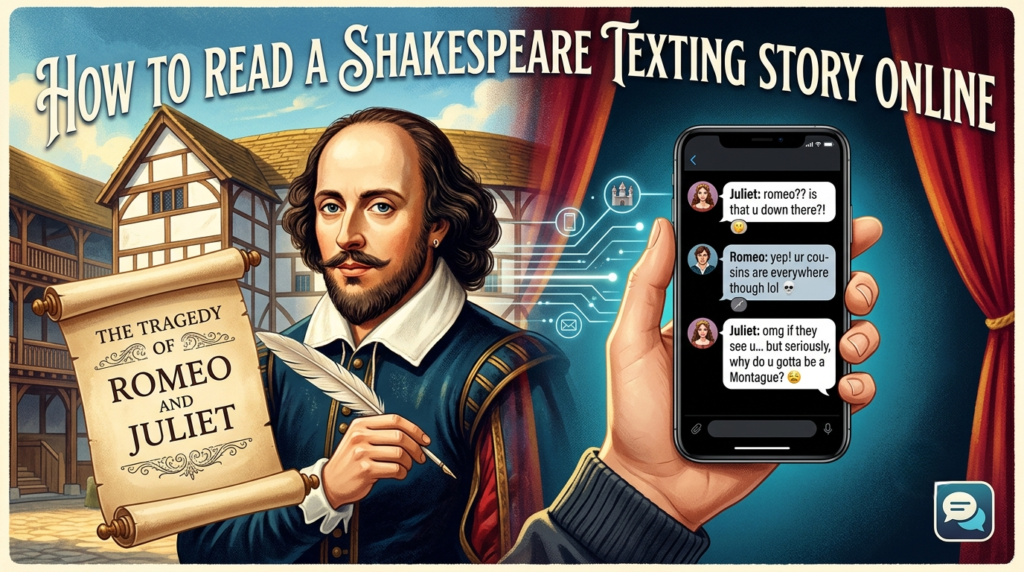
Juliet: why did u have to be a Montague 😩
Juliet: change ur name or I'll change mine fr
What Is a Shakespeare Texting Story?
A Shakespeare texting story is a form of digital narrative that renders dramatic dialogue, internal monologues, and offstage action into the familiar interface of modern smartphone communications.
These adaptations use instant messaging conventions to communicate narrative details:
-
Direct Messages (DMs): Replace intimate soliloquies or confidential conversations.
-
Group Chats: Represent public scenes, court gatherings, or factional rivalries (e.g., Montagues vs. Capulets or the Roman Senate).
-
Status Updates & Stories: Mirror public announcements or proclamations.
-
Typing Indicators (
...) & Read Receipts (Read 2:14 AM): Convey dramatic subtext, hesitation, and unanswered tension. -
Emojis & GIFs: Function as modern stand-ins for Elizabethan stage directions, tone of voice, and body language.
By stripping away the linguistic friction of Early Modern syntax while preserving the core plot beats, character relationships, and psychological conflicts, chat-style adaptations make complex literary works instantly legible to digital-native audiences.
Why Modern Readers Are Turning to Chat Fiction for the Classics
┌────────────────────────────────────────────────────────────────────────┐
│                        TRADITIONAL VS. TEXT FORMAT                     │
├───────────────────────────────┬────────────────────────────────────────┤
│ Traditional Play Script       │ Chat-Style Adaptation                  │
├───────────────────────────────┼────────────────────────────────────────┤
│ Dense, iambic pentameter      │ Bite-sized, modern dialogue            │
│ Relies on marginal glossaries │ Relies on visual context & emojis      │
│ Pacing interrupted by notes   │ Fast-paced, real-time narrative flow   │
│ Abstract spatial directions   │ Familiar digital environment (SMS/DMs) │
└───────────────────────────────┴────────────────────────────────────────┘
De-Coding Soliloquies via Instant Messaging
In traditional theater, a soliloquy allows a character to speak their private thoughts directly to the audience. In a text-based format, this device translates into a character typing into an unsent message, a personal Notes app, or a muted individual thread.
Consider Hamlet’s famous meditation on mortality in Act 3, Scene 1. In a digital format, this scene can be formatted as a private note or an agonizingly drafted text message that is repeatedly deleted before sending:
Hamlet (Draft Note): to be or not to be… that really is the question. is it better to just suffer through all this nonsense or just turn everything off? 💭
This formatting mirrors the psychological state of an overthinking, isolated character in a way that feels natural to modern readers accustomed to writing draft posts or private memos on their phones.
Visualizing Dynamics: Read Receipts and Typing Indicators
One of the greatest advantages of digital adaptations is their ability to represent subtext using UI mechanics. Shakespeare’s plays rely heavily on dramatic irony—instances where the audience knows information that a character does not.
In a chat-style retelling, dramatic irony can be expressed visually:
-
The Delayed Reply: In Romeo and Juliet, when Juliet drinks Friar Laurence’s potion, Friar John’s failure to deliver the letter to Romeo can be depicted as a text marked as Undelivered due to poor cell service or a full inbox.
-
Read Receipts: A message marked Read at 1:15 AM with no follow-up response communicates dismissal, anger, or betrayal far more instantly than a long stage direction.
-
Typing Bubbles: A persistent
...indicator that suddenly disappears captures hesitation, fear, or a character deciding to lie.
Lowering Cognitive Load for Diverse Readers
Educational research indicates that alternative narrative formats lower the cognitive barrier for readers, including ESL (English as a Second Language) students, neurodivergent readers, and individuals with reading challenges like dyslexia.
By presenting dialogue in short, distinct text blocks paired with contextual icons, readers can focus on story structure, character motivation, and thematic development without getting stuck on unfamiliar vocabulary. Once the foundational plot is understood through a texting format, readers can approach the original source material with higher confidence and comprehension.
Where to Find and Read a Shakespeare Texting Story Online
Finding high-quality, accurate chat adaptations requires knowing where to look. Below is a curated breakdown of published book series, interactive academic experiments, and free web platforms hosting chat fiction retellings.
┌─────────────────────────────────────────────────────────────────────────────┐
│                       SHAKESPEARE TEXTING PLATFORMS                         │
├───────────────────┬──────────────────────┬──────────────────────────────────┤
│ Platform / Series │ Format Type          │ Key Feature                      │
├───────────────────┼──────────────────────┼──────────────────────────────────┤
│ OMG Shakespeare   │ Published E-Books    │ Full play retellings with emojis │
│ WillPlay (Oxford) │ Interactive AI Chat  │ Direct character interaction     │
│ myShakespeare     │ Free Web Modules     │ Modern translations & media      │
│ Text-Fiction Apps │ Tap-to-Read Web Apps │ Visual interface with sound      │
└───────────────────┴──────────────────────┴──────────────────────────────────┘
Commercial E-Books and Published Series
The OMG Shakespeare Series (Random House)
Created by author Brett Wright and various co-creators, the OMG Shakespeare series is one of the most prominent published entries in this genre. The series takes Shakespeare’s major tragedies and comedies and translates them into modern mobile device interfaces complete with texts, group chats, status updates, and location tags.
-
Key Titles:
-
srsly Hamlet (Hamlet)
-
YOLO Juliet (Romeo and Juliet)
-
Macbeth #killingit (Macbeth)
-
A Midsummer Night #NoFilter (A Midsummer Night’s Dream)
-
-
What Makes It Stand Out: These books preserve the complete plot structure from Act I to Act V while populating the pages with character avatar profile photos, group chat titles (e.g.,
#DenmarkRoyalFamily), and humorously adapted character handles.
Interactive Academic & Educational Projects
WillPlay by Oxford University & Charisma.ai
Developed as a research collaboration between Oxford University researchers and AI narrative studio Charisma.ai, WillPlay is an advanced interactive storytelling project that transforms classic plays into digital messaging experiences.
-
How It Works: Rather than simply reading a static text thread, users enter an interactive chat where they can message characters directly or watch the story unfold in real-time text threads on their screens.
-
Educational Intent: Designed to test how immersive digital media can make early modern drama engaging for younger audiences, WillPlay blends original narrative beats with adaptive conversational AI.
myShakespeare (myShakespeare.me)
While not exclusively a text-message format, myShakespeare is an open-access, web-based platform that integrates modern digital communication formats directly alongside the original text.
-
Features: It provides pop-up video monologues, modernized paraphrases, and simulated social media activity from characters to help readers visualize what individual figures are thinking during crucial scenes.
Web-Based Platforms and Tap-Story Apps
Tap-Style Chat Fiction Apps (Yarn, Hooked, Wattpad Chat)
Online narrative platforms often host community-created Shakespeare chat retellings. Users can open these web apps or phone applications and tap their screens to reveal the next text message in a thread.
-
Search Strategy: Entering search queries such as
"Romeo and Juliet texting story"or"Hamlet chat fiction"on open web fiction archives like Wattpad or dedicated tap-story readers uncovers hundreds of fan-submitted and educator-designed retellings. -
Community Engagement: Readers can often comment on individual text bubbles, creating a shared reading experience where users discuss character decisions in real time.
Deep-Dive Analysis: Famous Scenes Translated into Text Stories
To understand how a classical text transitions into a modern digital interface, let us compare original Shakespearean passages with their text-thread equivalents across three major plays.
1. Romeo and Juliet — The Balcony Scene (Act 2, Scene 2)
Original Text (Folio/Arden Edition):
ROMEO: But, soft! what light through yonder window breaks?
It is the east, and Juliet is the sun.
Arise, fair sun, and kill the envious moon…
JULIET: O Romeo, Romeo! wherefore art thou Romeo?
Deny thy father and refuse thy name;
Or, if thou wilt not, be but sworn my love,
And I’ll no longer be a Capulet.
Text Thread Adaptation:
─────────────────────────────────────────────────────────────
                  DIRECT MESSAGE: Romeo & Juliet
─────────────────────────────────────────────────────────────
Romeo:   hey... are u awake?
Romeo:   saw a light go on in ur window 🌟
Juliet:  omg romeo??? what are u doing down in the garden?!
Juliet:  if my cousins see u here ur literally dead 💀
Romeo:   i don't care about ur cousins. ur stunning.
Juliet:  sigh... why did u have to be a Montague though? 😩
Juliet:  either disown ur family or just promise u love me
         and i'll stop being a Capulet right now.
Romeo:   [Typing...]
Romeo:   say less. I'll change my last name right now.
─────────────────────────────────────────────────────────────
Literary Analysis:
-
Preserved Core Elements: The secrecy of the encounter, the speed at which their romance progresses, and the structural barrier created by their feud remain central.
-
Linguistic Translation: Juliet’s famous line “wherefore art thou Romeo?” (which means why are you Romeo, not where are you) is accurately translated as “why did u have to be a Montague though?”—preventing the common reader misconception that she is searching for his physical location.
2. Hamlet — The Ghost’s Revelation (Act 1, Scene 5)
Original Text:
GHOST: I am thy father’s spirit,
Doom’d for a certain term to walk the night…
Revenge his foul and most unnatural murder.
HAMLET: Murder!
GHOST: Murder most foul, as in the best it is;
But this most foul, strange and unnatural.
Text Thread Adaptation:
─────────────────────────────────────────────────────────────
             GROUP CHAT: 🏰 Elsinore Watch Duty 🏰
─────────────────────────────────────────────────────────────
Horatio:  Hamlet u need to log on right now.
Marcellus: fr we just saw ur dad's ghost outside the wall again
Hamlet:   what?? stop trolling
Horatio:  i'm 100% serious. he's signaling for u.

────────────── PRIVATE DIRECT MESSAGE: Ghost_Dad ─────────────
Ghost_Dad: Hamlet.
Hamlet:    Dad??? Is that really u?
Ghost_Dad: Listen to me closely. I didn't die from a snake bite.
Ghost_Dad: Claudius poisoned me in the garden while I was sleeping 🐍💉
Ghost_Dad: You need to avenge me.
Hamlet:    ...Claudius??? my UNCLE??
Ghost_Dad: Yes. Don't let him get away with this.
Ghost_Dad: Gtg, sun is coming up. Remember me.
─────────────────────────────────────────────────────────────
Literary Analysis:
-
Dramatic Tension: Moving from a public group chat with guard friends to a private DM thread highlights Hamlet’s isolation and the secret burden placed upon him.
-
Modern Parallels: The use of snake and syringe emojis concisely captures both the cover story (snake bite) and the actual murder method (poisoning), maintaining narrative fidelity while using modern visual symbols.
3. Macbeth — Lady Macbeth’s Persuasion (Act 1, Scene 7)
Original Text:
MACBETH: We will proceed no further in this business:
He hath honour’d me of late…
LADY MACBETH: Was the hope drunk
Wherein you dress’d yourself? hath it slept since?…
Art thou afeard
To be the same in thine own act and valour
As thou art in desire?
Text Thread Adaptation:
─────────────────────────────────────────────────────────────
               DIRECT MESSAGE: Lady Macbeth & Macbeth
─────────────────────────────────────────────────────────────
Macbeth:      Hey... I've been thinking. We shouldn't do this.
Macbeth:      Duncan just gave me a new title. Everyone respects us.
Lady Macbeth: Are u serious right now??? 😒
Lady Macbeth: Yesterday u were talking so big about taking the throne.
Lady Macbeth: Were u drunk or are u just a coward?
Macbeth:      I am NOT a coward. I just don't think we should risk it.
Lady Macbeth: If u won't do it, I will. Stick to the plan and we won't fail.
─────────────────────────────────────────────────────────────
Literary Analysis:
-
Psychological Manipulation: The dynamic between Macbeth and Lady Macbeth centers on domestic pressure and ego questioning. Translating this exchange into a rapid text conversation emphasizes how quickly Lady Macbeth shifts Macbeth’s resolve.
Educational Value & Classroom Integration (E-E-A-T Insights)
Integrating digital retellings into traditional curricula provides educators with a tool for active learning. Rather than replacing the primary source, text adaptations act as a scaffolding strategy.
┌───────────────────────────────────────────────────────────────────────────┐
│                      CLASSROOM SCAFFOLDING WORKFLOW                       │
├───────────────────────────────────────────────────────────────────────────┤
│  STEP 1: Read the Chat Adaptation                                         │
│  ───────► Grasp plot, core character motives, and scene conflict.         │
│                                                                           │
│  STEP 2: Read the Original Shakespearean Text                             │
│  ───────► Focus on poetic devices, meter, imagery, and historical nuance. │
│                                                                           │
│  STEP 3: Student Creative Project                                         │
│  ───────► Translate a new scene into a custom texting thread.            │
└───────────────────────────────────────────────────────────────────────────┘
Classroom Implementation Strategies
1. The Pre-Reading Scaffolding Strategy
Before asking students to analyze Act 3 of Julius Caesar, assign a 5-minute read of the corresponding text story online. When students understand who is conspiring against whom and why, they can read the original blank verse with greater contextual awareness.
2. Character Motivation Exercises
Teachers can ask students to evaluate whether a text story adaptation accurately captures a character’s motive. For instance:
-
Did the adapter capture Iago’s deceitful nature in his DMs to Othello?
-
Is the tone too modern, or does it correctly reflect the betrayal in the original scene?
3. Student Creation Project: “Adapt a Scene”
One of the best ways to test reading comprehension is to have students create their own texting stories based on an unadapted scene.
Assignment Framework:
-
Select a Scene: Choose a 20–30 line section from any Shakespeare play.
-
Identify Core Beats: Pinpoint the main argument, secret revelation, or decision made in the scene.
-
Map the Voice: Determine how each character’s personality should sound in modern texts (e.g., formal, heavy use of slang, short clipped sentences, or heavy emoji use).
-
Build the Thread: Use a free chat generator to write the scene, complete with status updates and typing indicators.
Free Tools for Creating Your Own Shakespeare Text Story
If you or your students want to build a custom Shakespeare texting story, several web tools and applications offer quick, template-based formatting:
-
TextingStory App (iOS / Android): Allows users to write a script that automatically plays back as an animated video, complete with typing sounds and pauses.
-
ChatMaker / Fake Simulators: Free web utilities where creators can upload custom character avatars (e.g., using historical portraits of Shakespearean actors) and output static image screenshots of text conversations.
-
Google Docs / Slides Templates: Custom table templates styled to look like iOS or Android message screens, allowing collaborative editing for group assignments.
Quick Reference Guide to Shakespearean Emoji Lexicon
When translating 17th-century theatrical rhetoric into 21st-century messaging, certain symbols and messaging tropes reappear frequently. Below is a reference table showing how key Shakespearean literary devices translate into modern digital texting equivalents.
| Shakespearean Device / Concept | Digital Texting Equivalent | Example Application |
| Soliloquy / Aside | Private Notes App / Muted Sub-Thread | Hamlet listing his existential doubts in a locked phone note. |
| Dramatic Irony | Undelivered Message / Read at 12:00 AM |
Romeo taking the poison because a crucial text failed to send. |
| Factional Conflict | Muted vs. Active Group Chats | Capulets kicking Montagues out of a community server. |
| Fate / Omens | Spooky Emojis (🔮, 🗡️, 👻) |
The Witches in Macbeth sending mysterious group invitations. |
| Unrequited Love | Left on “Read” / One-Sided Messaging | Roderigo messaging Iago about Desdemona’s unanswered texts. |
| Comic Relief | Meme Sharing / GIF Reactions | The Fools (e.g., Touchstone, Puck) dropping chaotic memes into group chats. |
Critical Discussion: What Is Lost and What Is Gained?
While reading a Shakespeare texting story online offers clear advantages for accessibility and plot comprehension, it is important to evaluate the trade-offs involved in adapting verse into chat logs.
┌─────────────────────────────────────────────────────────────────────────┐
│                      WHAT IS GAINED VS. WHAT IS LOST                    │
├────────────────────────────────────┬────────────────────────────────────┤
│ GAINED                             │ LOST                               │
├────────────────────────────────────┼────────────────────────────────────┤
│ • Instant plot clarity             │ • Iambic pentameter & meter        │
│ • Clear character dynamics         │ • Layered poetic metaphors         │
│ • Higher reader engagement         │ • Period-specific rhetorical devices│
│ • Lower barrier for ESL/students   │ • Subtleties of Early Modern English│
└────────────────────────────────────┴────────────────────────────────────┘
What Is Gained
-
Immediate Narrative Clarity: Readers never get lost regarding who is speaking, where they are, or what their primary objective is.
-
Pacing Realism: The rapid back-and-forth of text messaging captures the urgent, high-stakes nature of Shakespeare’s tragedies.
-
Democratization of Classical Literature: Demystifies Shakespeare, demonstrating that his plays were originally written as popular entertainment for general audiences, not abstract academic texts.
What Is Lost
-
Poetic Rhythms: The musicality of iambic pentameter, blank verse, and rhyming couplets is lost when converted to informal chat dialect.
-
Rhetorical Depth: Complex double-entendres, extended metaphors (conceits), and intricate rhetorical figures cannot easily fit into short text messages without losing their poetic resonance.
-
Historical Context: Modern digital adaptations substitute modern cultural references for Elizabethan ones, which can obscure the original historical context of the Renaissance.
The Expert Verdict
A texting story online should not be viewed as an absolute replacement for Shakespeare’s original performance scripts. Instead, it serves as an effective gateway—an entry point that builds the foundational plot literacy necessary to appreciate, enjoy, and analyze the original works as they were performed on stage.
Frequently Asked Questions (FAQs)
Can I read a Shakespeare texting story online for free?
Yes. Several web-based platforms, academic research tools like Oxford’s WillPlay pilot, educational portals such as myShakespeare, and open web fiction communities host free chat-style retellings and interactive previews of classic plays.
Are texting story adaptations faithful to Shakespeare’s original plots?
Most major published adaptations (such as the OMG Shakespeare series) stick closely to the original narrative arcs, main character deaths, and structural plot points of the original plays. While the dialogue is modernized, the sequence of events remains true to the source material.
Is reading chat fiction helpful for studying Shakespeare in school?
Yes. Using chat fiction retellings as a supplementary reading aid helps establish plot clarity, character relationships, and key thematic beats before diving into the original Early Modern text and poetic meter.
What is the best app for creating a custom texting story?
Popular apps include TextingStory (for generating video animations of chat logs) and various free web-based Fake Text Generators (for creating static screenshots of messaging threads suitable for essays and slides).
Bridging the Gap Between 1595 and Today
William Shakespeare wrote his plays to be seen, heard, and felt in real time by diverse audiences inside lively, crowded theaters. He relied on the fast-paced vernacular and theatrical conventions of his era to deliver high-stakes human drama.
Reading a texting story online brings that same immediate, dynamic energy into the 21st century. By translating early modern stagecraft into modern digital interfaces, chat adaptations help readers connect with the timeless themes of love, ambition, jealousy, and betrayal that make Shakespeare’s works enduringly relevant.
Whether you are using chat fiction as a quick study guide or creating your own digital adaptations in the classroom, these modern retellings prove that while our tools for communication change, the core human stories we tell remain constant across the centuries.