Imagine a dramatic climax where a newlywed husband freely gives away his wife’s most precious betrothal ring to a mysterious legal clerk, only to discover later that the clever stranger was actually his wife in disguise. Why did Elizabethan audiences gasp at this exact plot twist? To modern readers, theatergoers, and students, rings in classic literature might seem like simple romantic props. But in Renaissance theater, these small bands of gold represented legally binding contracts and matters of social life and death. Understanding the wedding ring rule is the master key to unlocking the true stakes of Shakespeare’s greatest comedies.
In Shakespeare’s plays, the wedding ring rule acts as the ultimate test of loyalty, a brilliantly subversive tool for female empowerment, and a direct reflection of the rigid—yet manipulable—marriage laws of Renaissance England. Whether you are preparing a line-by-line analysis for an essay or simply want to understand the deeper historical context behind the Bard’s work, decoding this literary trope reveals how Shakespeare transformed simple jewelry into weapons of matrimonial warfare.
What is the “Wedding Ring Rule” in Shakespearean Literature?
To truly grasp the mechanics of Shakespearean comedy, one must understand how the playwright weaponized everyday objects. The “wedding ring rule” is a specific literary trope and plot device where the exchange, loss, or intentional giving away of a betrothal ring dictates the fate of a romantic relationship.
The mechanics of this rule are strictly defined within the text of the plays:
-
The Vow: The giving of the ring explicitly seals a legally and spiritually binding vow between two lovers.
-
The Breach: The loss or giving away of the ring—no matter the context or excuse—symbolizes the immediate breaking of that vow and the betrayal of the giver.
-
The Reveal: The dramatic recovery and reveal of the ring (often facilitated by mistaken identity or a clever disguise) restores social order, though usually after the offending party has been thoroughly publicly shamed.
What makes Shakespeare’s use of the ring trick so revolutionary is the power dynamic shift. In a patriarchal Elizabethan society where women were largely treated as property, Shakespeare routinely placed these rings—and therefore the power to enforce the wedding ring rule—in the hands of his female protagonists. The rule subverts traditional gender roles, allowing heroines to test, manipulate, and ultimately educate their unruly male counterparts.
Expert Insight: The Weight of the Band When analyzing Shakespeare’s comedies, never overlook a ring. Elizabethan audiences would have viewed the careless disposal of a betrothal ring not just as a romantic faux pas, but as a massive breach of honor and a literal violation of verbal contracts. A character giving away a ring on stage was the Elizabethan equivalent of tearing up a signed legal document in public.
The Historical Context: Elizabethan Marriage Laws vs. Stage Drama
To understand why the wedding ring rule created such incredible tension on the stage, we must look at the real-world history of Elizabethan marriage laws. The legal landscape of sixteenth-century England was a complex web of religious doctrine and secular property laws.
The Weight of “Handfasting” and Betrothal
In Renaissance England, getting married did not necessarily require a church, a priest, or a formalized religious ceremony to be considered legally valid. The cornerstone of Elizabethan marriage was a practice known as handfasting or betrothal.
According to the ecclesiastical law of the time, a couple could be legally bound through sponsalia per verba de praesenti—vows made using words in the present tense (e.g., “I take thee to be my wife”). If a couple exchanged these present-tense vows, often accompanied by the physical exchange of a ring and a clasping of hands, they were legally married in the eyes of the law, even before the marriage was consummated or blessed in a church. The ring was the physical, undeniable proof that the verba de praesenti had occurred.
Why Losing a Ring Was a Social Catastrophe
Because the ring served as the physical receipt of a verbal contract, losing it was a social catastrophe. It wasn’t just a romantic gesture; it represented a transfer of property, social standing, and legal rights.
If a man gave away the ring his wife had used to bind him, he was symbolically rejecting the legal and spiritual union. Breaking the wedding ring rule meant breaking the law of the land. This is exactly why Shakespeare’s heroines use the ring trick: they are not just testing their husbands’ love; they are forcing them to prove their legal and moral reliability in a society where a woman’s entire survival depended on the integrity of her husband’s word.
The Merchant of Venice: The Ultimate Ring Test
There is no clearer example of the wedding ring rule in action than in The Merchant of Venice. While the play is heavily focused on the pound of flesh and the courtroom drama of Shylock and Antonio, the overarching romantic plot is entirely dictated by Portia and her mastery of the ring trick.
Portia’s Ultimatum: The Ring as a Symbol of Power
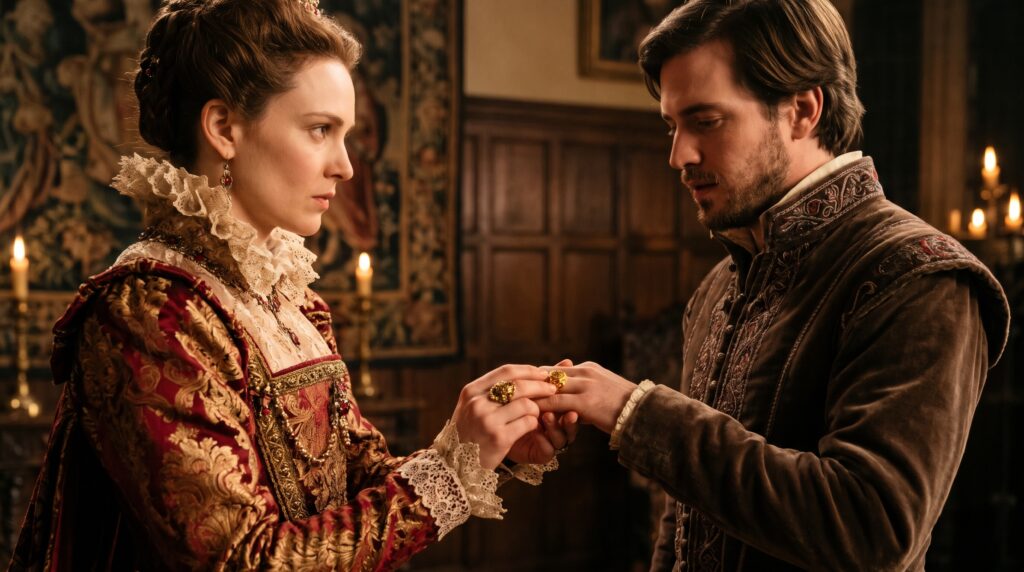
When Portia of Belmont finally marries Bassanio, she transfers her vast wealth and property to him. However, she retains her power by instituting a strict, undeniable condition bound to a single piece of jewelry. As she gives him the ring, her dialogue lays out the absolute terms of the wedding ring rule:
“This house, these servants, and this same myself / Are yours, my lord. I give them with this ring, / Which when you part from, lose, or give away, / Let it presage the ruin of your love…” (Act 3, Scene 2)
Portia’s ultimatum is crystal clear. The ring is a test of his fidelity and his ability to honor a contract.
The Courtroom Trick: Bassanio’s Failure
The climax of the ring plot occurs immediately after the famous trial scene. Portia, disguised as the brilliant young lawyer Balthazar, saves the life of Bassanio’s closest friend, Antonio. When Bassanio offers “Balthazar” anything as a reward, the disguised Portia demands the one thing he cannot give: the ring.
Initially, Bassanio refuses, adhering to his wife’s rule. But Antonio pressures him, arguing that Bassanio’s debt to a male friend should outweigh his vow to his new wife. Bassanio yields and sends the ring after the lawyer. Here, Shakespeare highlights a profound societal tension: the conflict between male homosocial bonds and heterosexual marital vows. Bassanio fails the test, proving that he currently values male loyalty over his wife’s absolute authority.
The Resolution: Comic Relief or Serious Warning?
In the final act, Portia wields the broken wedding ring rule like a sword. When Bassanio returns to Belmont without the ring, she publicly shames him, threatening to sleep with the “lawyer” who holds the ring. The dramatic tension peaks before Portia reveals the truth of her disguise.
While the resolution is framed as comic relief, the underlying message is a serious warning. By enforcing the wedding ring rule, Portia successfully establishes dominance, demands equality in her new marriage, and proves to Bassanio that her intellect and authority are not to be underestimated.
All’s Well That Ends Well: The Ring as Identity and Leverage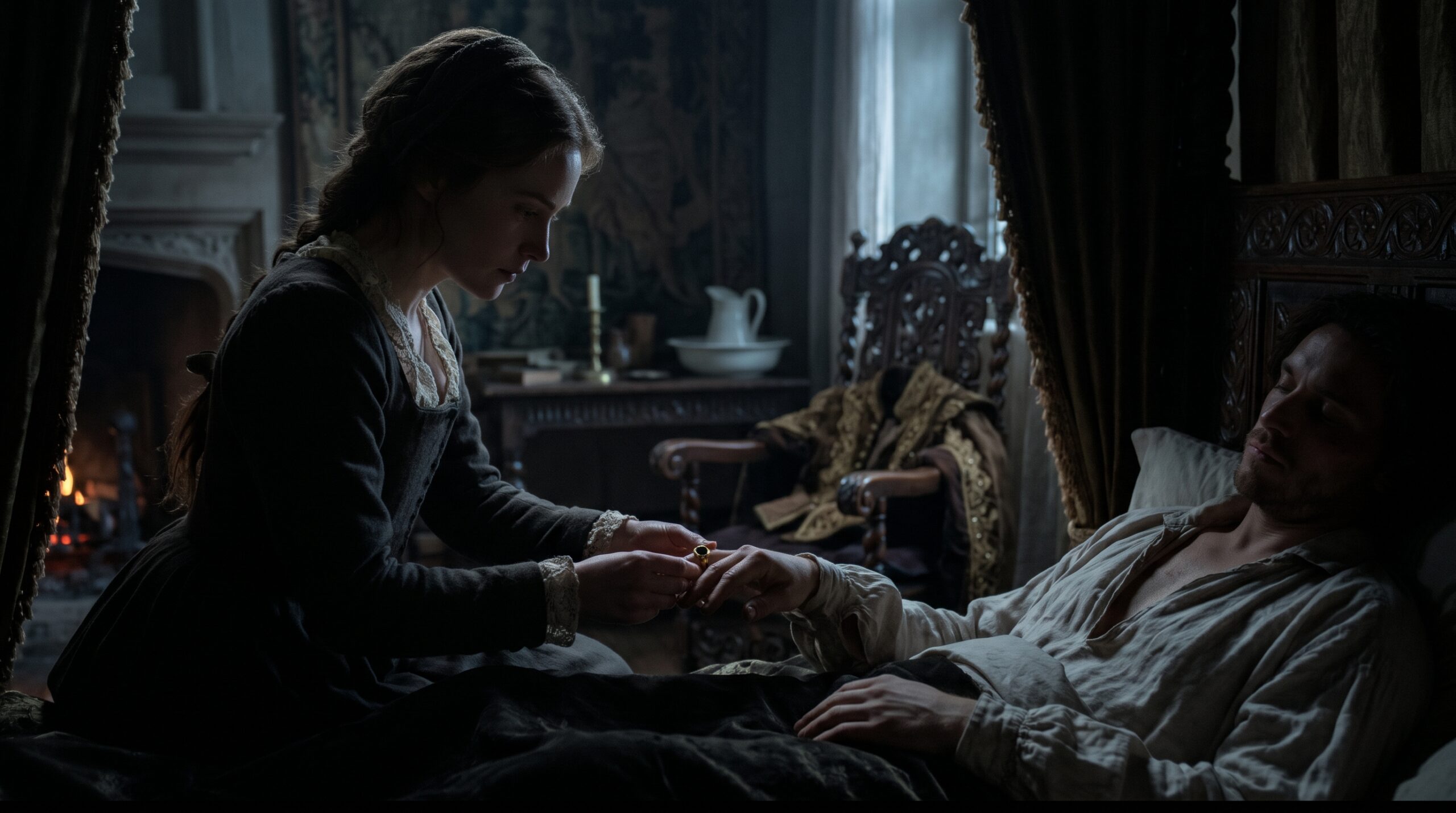
If The Merchant of Venice uses the wedding ring rule to test a husband’s loyalty, All’s Well That Ends Well weaponizes the trope to force a husband to acknowledge his own marriage. In this complex “problem play,” the ring transitions from a symbol of abstract romantic devotion to undeniable, concrete legal proof.
Bertram’s Impossible Condition
The conflict is initiated when the low-born Helena cures the King of France, who rewards her by granting her the right to choose any husband from his court. She chooses Count Bertram, who is horrified by her lower social status and flees immediately after the forced wedding ceremony.
To ensure the marriage is never consummated and therefore legally vulnerable to annulment, Bertram writes a cruel letter to Helena, setting an impossible condition that relies entirely on the wedding ring rule:
“When thou canst get the ring upon my finger, which never shall come off, and show me a child begotten of thy body that I am father to, then call me husband; but in such a ‘then’ I write a ‘never’.” (Act 3, Scene 2)
Bertram’s ancestral ring is tied directly to his identity, his noble lineage, and his patriarchal power. By declaring that the ring will “never come off,” he is aggressively rejecting the marriage contract. He believes he has used the strict rules of Renaissance betrothal to permanently lock Helena out of his life.
Helena’s “Bed Trick” and the Exchange of Rings
Helena’s response is a masterclass in exploiting Elizabethan legal loopholes. She tracks Bertram to Italy, where he is attempting to seduce a local virgin named Diana. Helena orchestrates the infamous “bed trick”—convincing Diana to demand Bertram’s ancestral ring in exchange for a night in her bed, while Helena takes Diana’s place in the dark.
During this clandestine encounter, Helena gives Bertram a ring of her own—a jewel previously gifted to her by the King of France. Because Bertram believes he is sleeping with Diana, he unwittingly consummates his marriage with his actual wife, fully sealing the verba de praesenti contract that he had tried so hard to avoid.
The Ring as Proof of Consummation
In the final scene, the wedding ring rule is executed with forensic precision. Bertram’s possession of the King’s ring (which he thinks is Diana’s) and Helena’s possession of Bertram’s ancestral ring serve as airtight evidence.
Helena uses the ring to trap Bertram in his own legally binding ultimatum. The ring is no longer a mere token of affection; it is the physical receipt of a sexual and legal transaction. The wedding ring rule allows Helena to bypass Bertram’s emotional reluctance, using the rigid laws of the Renaissance patriarchy to secure her rightful position as his Countess.
The Symbolism of Rings Across Other Key Plays
While The Merchant of Venice and All’s Well That Ends Well provide the most robust examples of the wedding ring rule, Shakespeare frequently sprinkled this motif across his other works to quickly establish character morality and heighten dramatic tension.
The Two Gentlemen of Verona (Julia and Proteus)
In one of Shakespeare’s earliest comedies, we see a foundational, less refined version of the ring trick. Before Proteus leaves for Milan, he and Julia exchange betrothal rings. However, upon arriving in Milan, Proteus instantly falls in love with Silvia and attempts to use Julia’s ring as a gift to woo his new obsession.
Because Julia has followed him in disguise (as the page boy Sebastian), she is forced to act as the messenger, delivering her own ring to her rival. Proteus’s willingness to break the wedding ring rule instantly signals to the audience that his moral compass is deeply flawed. The careless disposal of the ring is the physical manifestation of his fickle, disloyal nature, serving as a cautionary tale about the fragility of young, untested vows.
Cymbeline (Imogen’s Diamond)
In the tragicomedy Cymbeline, the wedding ring rule takes a darker turn, equating jewelry directly with a woman’s chastity and bodily autonomy. When Posthumus is exiled, his wife Imogen gives him a diamond ring. In Rome, the foolish Posthumus makes a wager with the villainous Iachimo regarding Imogen’s fidelity, using the diamond ring as the stake.
When Iachimo sneaks into Imogen’s bedchamber while she sleeps, he notes the details of her room and her body, and steals a bracelet to use as false proof of her infidelity. While the primary stolen item is a bracelet, the diamond ring that Posthumus wagers becomes the central symbol of the broken trust. The forfeiture of the ring highlights a toxic Elizabethan anxiety: the fear that a woman’s honor could be stolen, traded, or gambled away by the men who were supposed to protect it.
How to Analyze the Wedding Ring Rule in Your Own Essays
For students, academics, and theater critics, unpacking the wedding ring rule offers a wealth of thesis opportunities. When developing a literary analysis or study guide around Shakespeare’s comedies, consider these three critical frameworks:
1. Focus on the Tension Between the Legal and the Emotional Do not write about Shakespearean rings merely as romantic gifts. Frame them as physical contracts. A strong essay will analyze the tension between the strict, unfeeling statutory laws of Elizabethan England and the messy, unpredictable emotions of the characters forced to navigate those laws.
2. Analyze the Gender Dynamics Examine who holds the rings and who demands them back. The wedding ring rule is almost always utilized by Shakespeare’s women to control patriarchal chaos. A compelling thesis might explore how characters like Portia and Helena use the legal weight of the ring to outsmart men who hold systemic power over them, effectively turning the law into an instrument of female agency.
3. Look at the Transaction, Not Just the Object When analyzing a scene, pay close attention to the exchange. Who is giving the ring? What specific words (the verba de praesenti) are spoken during the transfer? What are the stated consequences if the ring is lost? By dissecting the verbal contract that accompanies the physical ring, you can uncover the true motivations of the characters.
Frequently Asked Questions (FAQs) About Shakespeare’s Ring Plots
What does the ring symbolize in The Merchant of Venice? In The Merchant of Venice, Portia’s ring symbolizes her wealth, her property, and her agency. By giving it to Bassanio, she conditionally transfers her power to him; by taking it back in disguise, she proves that she retains ultimate control over her estate and her marriage.
Did Elizabethans wear wedding rings on a specific finger? Yes, much like today, Elizabethan wedding and betrothal rings were typically worn on the fourth finger of the left hand. This was driven by the romantic, anatomically incorrect belief in the vena amoris (the “vein of love”), which was thought to run directly from that specific finger to the heart.
Why are rings so important in Shakespeare’s comedies? Rings serve as highly visible, easily transferable stage props that drive the plot forward. They create immediate dramatic tension, facilitate scenarios of mistaken identity, provide undeniable proof of off-stage actions (like the bed trick), and allow for satisfying, neatly resolved conclusions where social order is restored.
Conclusion
The Elizabethan wedding ring rule in Shakespearean literature is never just a matter of misplaced jewelry. It is a profound, calculated commentary on loyalty, the inescapable weight of the law, and the shifting dynamics of gender power in Renaissance England. By elevating the simple gold band from a romantic token to a strict legal contract, Shakespeare created a literary device that tested the true limits of human devotion.
This brilliant trope has left a lasting legacy, surviving centuries to become a foundational element in modern storytelling, echoing in the romantic comedies and dramas of today. Understanding the severity of the wedding ring rule not only enriches our appreciation of the Bard’s genius but allows us to see his heroines for what they truly were: brilliant legal strategists fighting for agency in a man’s world.