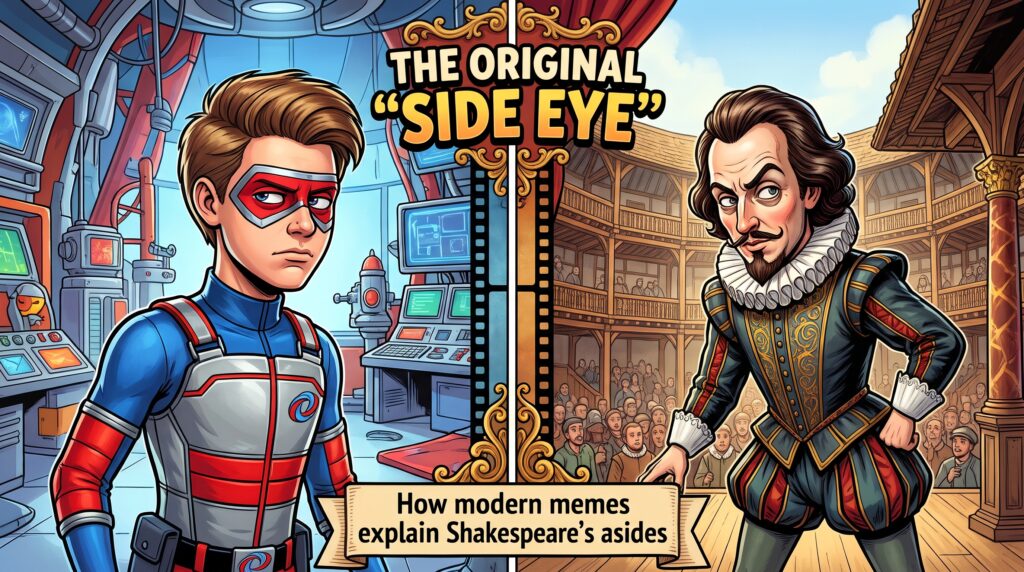
Picture this: you are staring at a dense, heavily annotated page of Elizabethan text. The “thous,” “thees,” and iambic pentameter are blurring together, and you feel completely disconnected from the 16th-century dialogue in front of you. To many modern readers, classical literature can feel like an alien language. But what if I told you that one of William Shakespeare’s most brilliant and frequently used theatrical tools can be perfectly understood through a modern internet trend? If you have spent any time on social media recently, you have undoubtedly encountered the henry danger side eye.
It is that hilarious, heavily judgmental, fourth-wall-breaking glare that perfectly captures the modern feeling of, “Are you seeing this nonsense?”
While a Nickelodeon sitcom and the world’s greatest playwright might seem lightyears apart, that exact viral facial expression is the ultimate 21st-century translation of Shakespeare’s favorite literary device: the dramatic aside.
By the end of this comprehensive guide, literature students, educators, and Shakespeare enthusiasts will be able to master complex literary concepts—like dramatic irony, audience complicity, and stage mechanics—simply by understanding the mechanics of a meme. Welcome to the modern way to read The Bard.
II. Decoding the Trend: What is the ‘Henry Danger Side Eye’?
To understand why this specific meme is the perfect scaffolding for classical literary analysis, we first have to break down the anatomy of the viral moment itself and the search intent behind it.
Where Did It Come From?
The meme originates from Henry Danger, a popular Nickelodeon television series that ran from 2014 to 2020. The show follows Henry Hart, a teenager who lands a part-time job as a sidekick to the local superhero, Captain Man. Because it is a multi-camera sitcom aimed at younger audiences, the acting is intentionally broad, highly expressive, and relies heavily on physical comedy. The specific “side eye” meme isolates moments where a character—usually reacting to something absurd, clueless, or hypocritical said by someone else in the room—shifts their gaze away from the scene and casts a sharp, sidelong glance.
What Does It Actually Mean?
In the lexicon of internet slang, this specific side eye communicates a very distinct set of emotions: disbelief, judgment, or hidden knowledge. When a user posts this meme, they are essentially saying, “I know something you don’t,” or “I cannot believe they just said that out loud.”
Crucially, the side eye operates on a dual level of communication. The character is physically present in the scene with other characters, but their facial expression is a secret message broadcast directly to the viewer. The other characters in the room are blissfully unaware of the judgment happening right next to them.
Expert Insight Box: Media Literacy & The “Camera Stare” In modern media studies, we see this technique frequently. Shows like ‘The Office’ (Jim Halpert’s famous camera stares) or ‘Fleabag’ use direct eye contact with the lens to build a secret relationship with the audience. This visual trope establishes a baseline for understanding how theater operated long before cameras were invented.
III. The 16th-Century Equivalent: What is a Dramatic Aside?
Long before Jim Halpert looked at a documentary crew, and centuries before the Henry Danger meme flooded TikTok, William Shakespeare was using this exact same psychological trick on the wooden stages of London. In classical theater, this technique is called the aside.
Aside vs. Soliloquy: Clearing the Confusion
For students studying Shakespeare, two terms frequently get mixed up: the soliloquy and the aside. Understanding the difference is critical for passing any AP Literature exam or college-level seminar.
-
The Soliloquy: This occurs when a character is entirely alone on stage (or believes they are alone). They speak their innermost thoughts aloud, processing their emotions for the audience to hear. Think of Hamlet’s famous “To be, or not to be” speech. It is a deep, internal monologue turned outward.
-
The Aside: This is Shakespeare’s version of the side eye. An aside happens when a character delivers a quick, secret remark directly to the audience (or sometimes to just one other specific character) while other people are standing right there on stage. By the magic of theatrical convention, the other characters are “deaf” to the aside.
The aside is a surgical strike of dialogue. It is sharp, witty, often cynical, and creates an instant bond of dramatic irony between the speaker and the audience.
The Mechanics of the Fourth Wall in The Globe Theatre
To truly appreciate why Shakespeare used the aside so frequently, we have to look at the physical architecture of the Globe Theatre in 1599.
Today, we are used to sitting in dark movie theaters watching a glowing screen, separated by an invisible “fourth wall.” Elizabethan theater was not like this. The Globe was an open-air amphitheater lit by natural daylight. The actors could perfectly see the faces of the audience. More importantly, the “groundlings”—the working-class audience members who paid a single penny for entry—stood in the yard directly at the edge of the stage. Actors were literally inches away from the crowd.
When a character like Iago or Hamlet had an aside, they didn’t just stare off into the distance. The actor would physically turn, make direct eye contact with a groundling in the front row, and deliver their line with a knowing smirk or an exasperated glare.
IV. Shakespearean Side Eyes: Masterpieces of Dramatic Irony
Now that we understand the mechanics of the stage, we can look at the text itself. Shakespeare utilized the aside to achieve a variety of effects—from generating comedic relief to establishing deep psychological dread. Let’s look at four iconic moments in Elizabethan drama where characters delivered the classical equivalent of the viral internet glare, mastering the art of dramatic irony.
Hamlet’s Sarcastic Glare (Hamlet)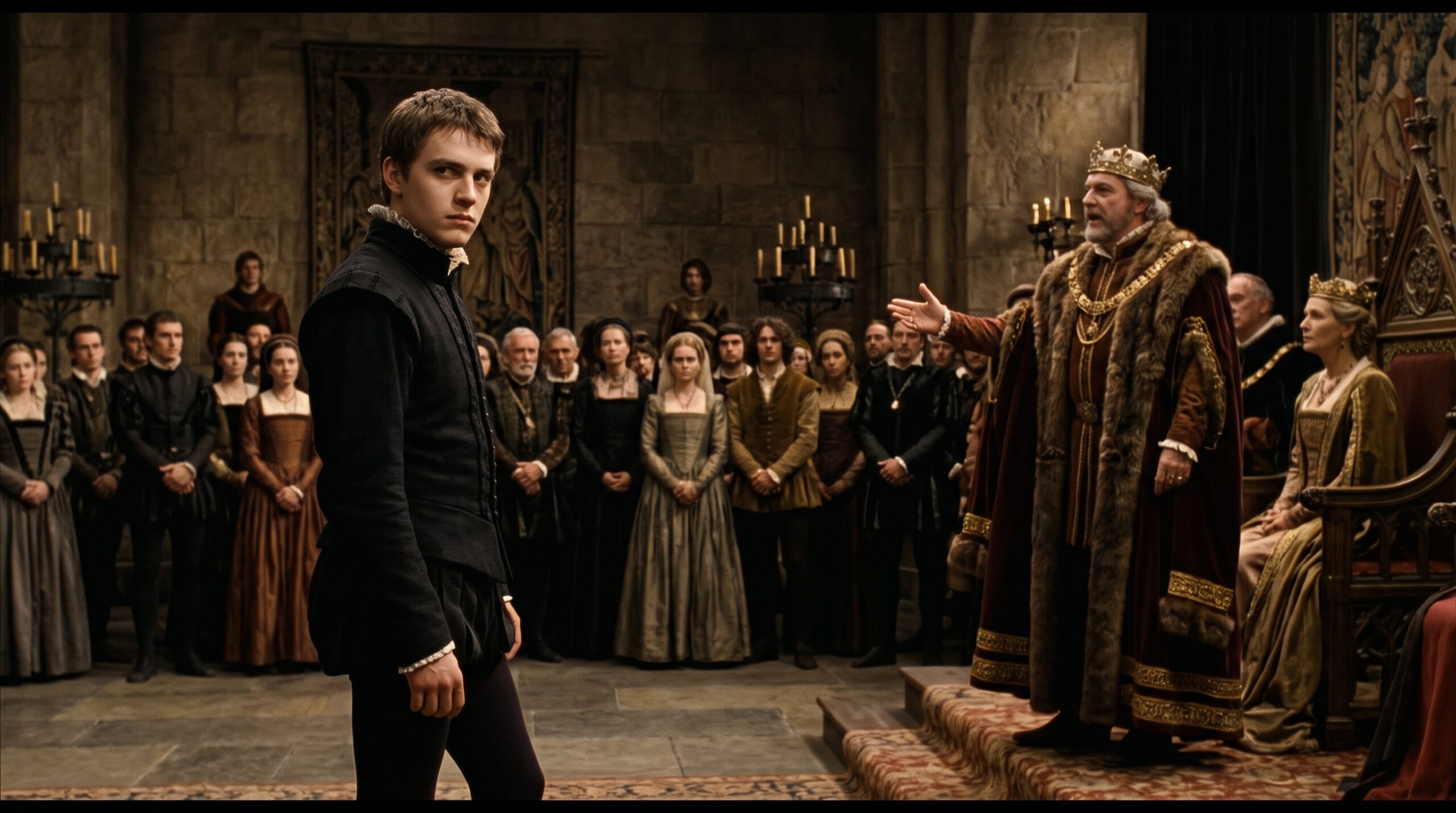
The Context: In Act 1, Scene 2, we see the new King Claudius addressing his court. Claudius has just married Queen Gertrude, the widow of his brother (the former King), making him both uncle and stepfather to young Prince Hamlet. Claudius turns to Hamlet and smoothly says, “But now, my cousin Hamlet, and my son—”The Aside: Before Hamlet even replies to Claudius, he delivers a sharp, bitter aside to the audience: “[Aside] A little more than kin, and less than kind.”The Meme Connection: This is the ultimate moody, sarcastic side eye. Hamlet refuses to play along with the happy family facade. By turning to the audience to deliver this line, he instantly aligns us with his disgust. It is the 16th-century equivalent of staring directly into the camera like a disgruntled teenager trapped at a painful family Thanksgiving dinner, silently communicating, “Can you believe the audacity of this guy?”
Iago’s Villainous Smirk (Othello)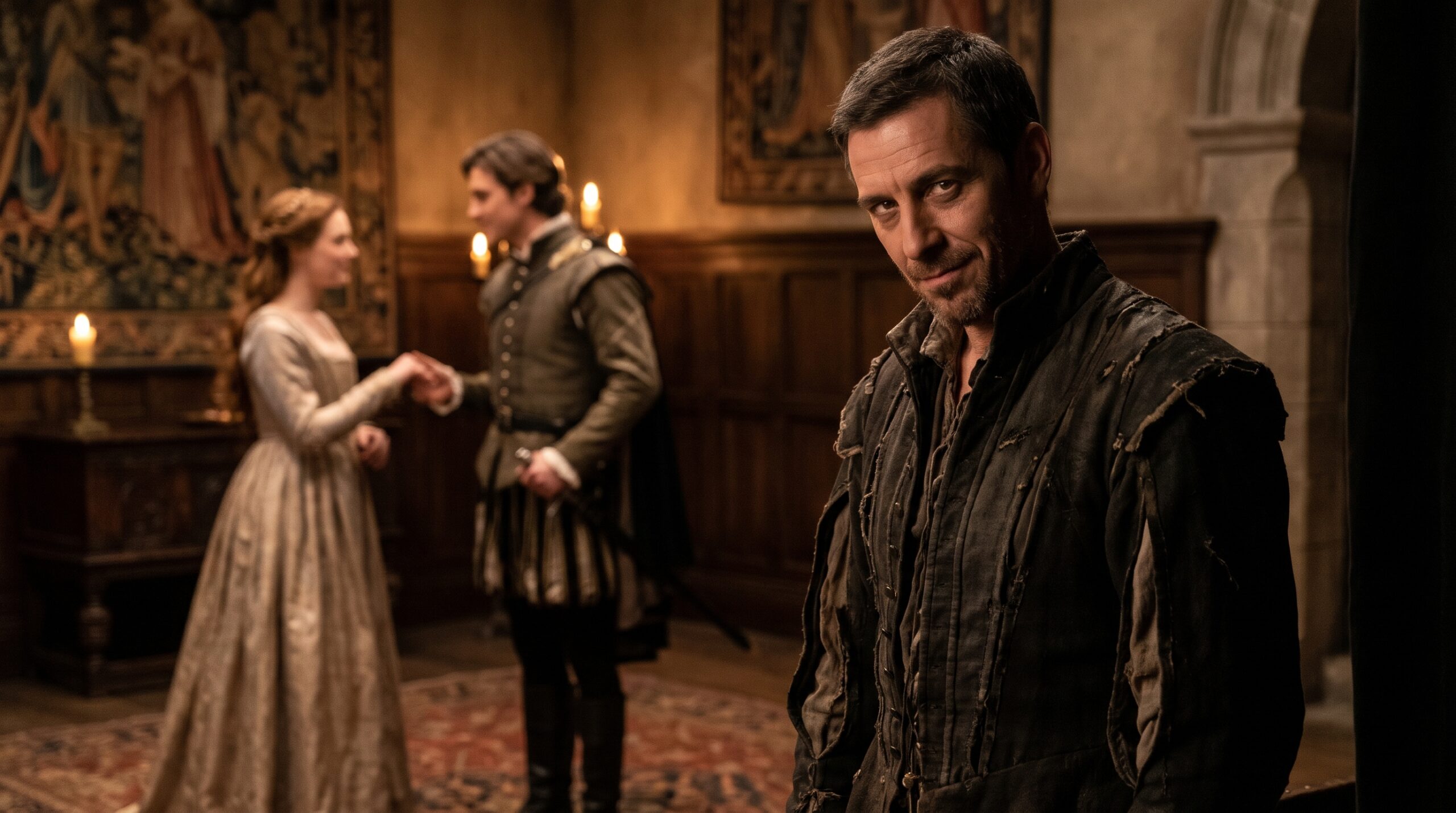
The Context: Iago is arguably the most terrifying villain in classic literature because he makes the audience his unwilling accomplices. In Act 2, Scene 1, Iago watches the handsome and polite Cassio take the hand of Desdemona (Othello’s wife) in a gesture of innocent courtly courtesy.The Aside: Iago turns to the audience and whispers his sinister plot: “[Aside] He takes her by the palm: ay, well said, whisper: with as little a web as this will I ensnare as great a fly as Cassio.”The Meme Connection: This is the malicious side eye. Iago is standing in the same room as the people he is planning to destroy. When he breaks the fourth wall, he forces the audience to be complicit in his toxic scheming. It is a chilling, conspiratorial look that says, “Watch closely as I ruin their lives using this exact innocent moment.”
Richard III’s Manipulative Wink (Richard III)
The Context: In one of the most audacious scenes in all of Shakespeare, the sociopathic Richard successfully woos Lady Anne. Why is this audacious? Because Richard recently murdered her husband and her father-in-law. Despite this, through relentless psychological manipulation, he gets her to accept his ring.The Aside: After Anne leaves the stage, Richard turns to the audience alone (blurring the line between soliloquy and aside) and marvels at his own dark charisma: “Was ever woman in this humour woo’d? Was ever woman in this humour won?”The Meme Connection: This is the narcissistic side eye. Richard is looking at the groundlings in pure, unadulterated disbelief that his evil plan actually worked. It is a flex. He is breaking the fourth wall to ask the audience, “Are you seeing what I am getting away with?”
Puck’s Exasperated Glare at Mortals (A Midsummer Night’s Dream)
The Context: In the magical forest of Athens, the mischievous fairy Puck is watching four young human lovers chase each other around in a confusing, magically-induced love square, crying and threatening to duel.The Aside: Puck observes this chaotic soap opera from the shadows and remarks to his master, Oberon (and the audience): “Lord, what fools these mortals be!”The Meme Connection: This is the omniscient, comedic side eye. It is the look of absolute judgment directed at human foolishness. Puck acts as a stand-in for the audience, watching the ridiculous drama unfold and rolling his eyes at how seriously teenagers take their romantic problems.
Analyzing the Archetypes of the Aside (Comparison Table)
To synthesize these concepts for text analysis, here is a breakdown of how modern visual shorthand translates directly to Shakespearean literary devices.
| Modern Meme Emotion | Shakespearean Character | Play | Literary Function & Impact |
| The Sarcastic Eye Roll | Hamlet | Hamlet | Characterization: Establishes alienation and intellectual superiority over the court. |
| The Conspiratorial Smirk | Iago | Othello | Dramatic Irony: Gives the audience knowledge of impending doom that the protagonist lacks. |
| The Sociopathic Flex | Richard III | Richard III | Audience Complicity: Charms the viewer into rooting for the villain against their own morals. |
| The Judgmental Stare | Puck | A Midsummer Night’s Dream | Comedic Relief: Validates the audience’s perspective that the unfolding drama is inherently absurd. |
V. Why Teaching Shakespeare Through Memes Actually Works
There is often a hesitance in academia to mix “high culture” (classic literature, Elizabethan drama) with “low culture” (internet slang, TikTok trends). However, expert educators and literary analysts understand that meeting readers where they are is the most effective way to teach complex concepts.
Cognitive Scaffolding in Education
In educational psychology, there is a concept called cognitive scaffolding. This is the process of attaching new, complex information to a framework (schema) that a student already understands.
If you stand in front of a classroom and say, “Today we will discuss how Elizabethan playwrights utilized dramatic asides to foster dramatic irony and bypass the fourth wall,” you will likely be met with blank stares. The terminology is dense and intimidating.
However, if you say, “Today we are going to look at how characters in a 400-year-old play used the exact same technique as the Henry Danger side eye to secretly judge their friends,” you instantly activate pre-existing knowledge. The student immediately understands the social dynamics of the scene. They know what it feels like to share a secret look of disbelief with a friend across a crowded room. By anchoring the literary device to a relatable cultural touchstone, the barrier to entry is eliminated.
Bringing the Stage Directions to Life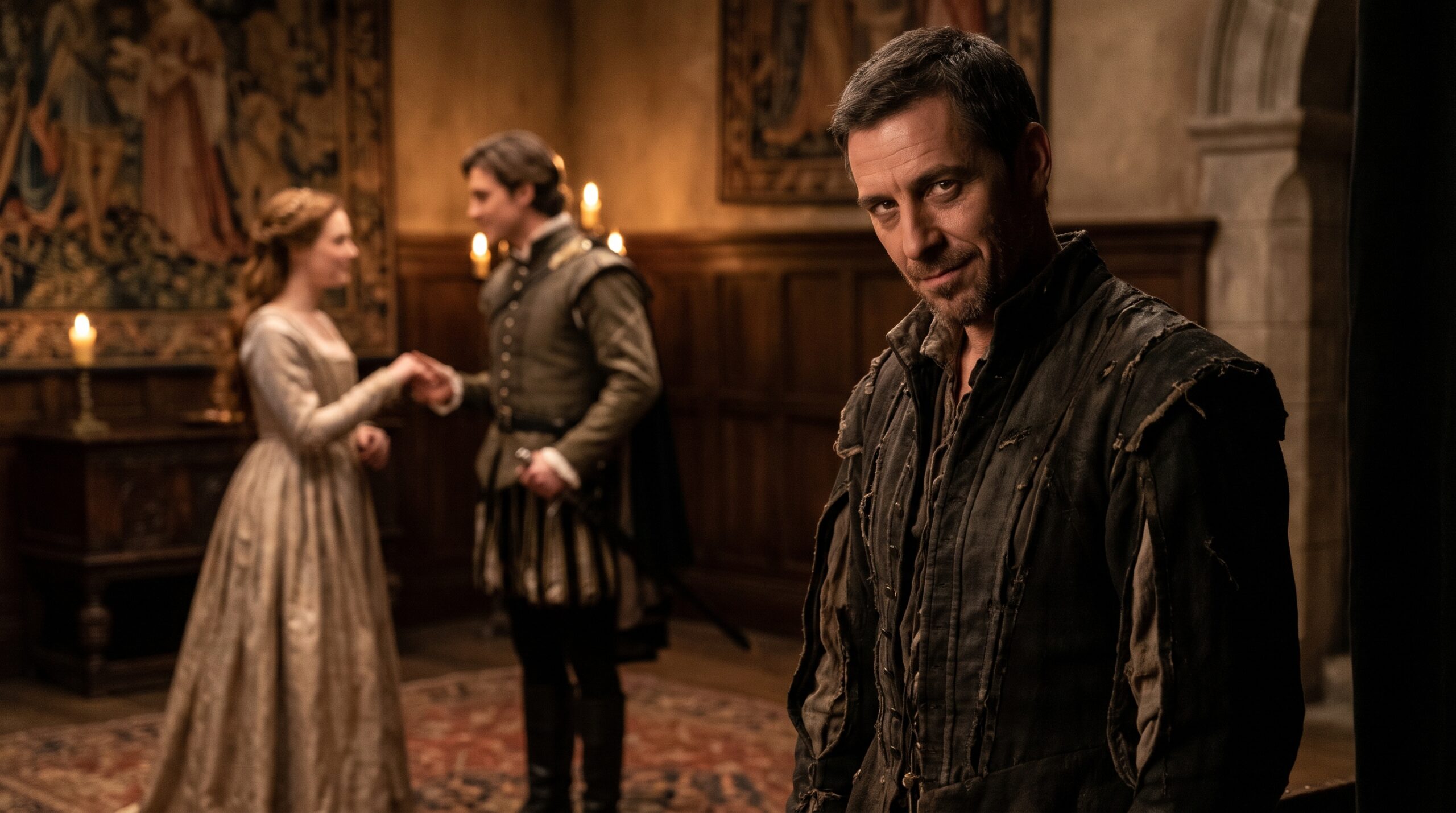
The greatest tragedy of teaching William Shakespeare is that his works are often treated as novels. Shakespeare never intended for his plays to be read silently at a desk. They were written as blueprints for live, chaotic, physical action.
Text on a page is inherently flat. When a student reads the italicized stage direction [Aside], it is easy to gloss over it as mere formatting. But by associating that word with a highly specific, physical facial expression—a sharp turn of the head, widening eyes, a smirk directed at the viewer—the text suddenly leaps off the page. It requires a physical shift in body language. It helps readers visualize the play as a living, breathing performance. They begin to read the play like a director, rather than a passive consumer.
Pro Tip for English Teachers: The Storyboard Method
Bring this concept into the classroom with a modern twist. Have students select a scene rich in dramatic irony (such as Act 1, Scene 5 of Macbeth). Ask them to storyboard the scene using modern meme templates. Have them insert a specific “camera stare” or side-eye reaction shot every time an aside is used. This forces them to critically analyze the character motivations and physical blocking of the scene.
VI. Actionable Guide: How to Spot an Aside in Any Play
Understanding the theory behind the theatrical side eye is one thing, but identifying it while reading a dense text is another. Whether you are analyzing Macbeth for a final paper or reading Julius Caesar for personal enjoyment, you need to know what to look for.
Here is your actionable cheat sheet for spotting when a character is breaking the fourth wall and communicating directly with the audience:
-
Look for the Bracketed Stage Direction: This is the most obvious tell. In modern publications of classic texts, editors will explicitly include the word [Aside] right before the line of dialogue. If you see this, the character is no longer talking to the people on stage. They are looking directly at you.
-
Watch for Sudden Shifts in Meter or Rhyme: Shakespeare often wrote in iambic pentameter (a rhythmic pattern of unstressed and stressed syllables). When a character shifts from speaking in measured, poetic blank verse to a sudden, jagged prose rhythm, or drops a rhyming couplet out of nowhere, they are often stepping out of the scene’s reality to drop a truth bomb on the audience.
-
Identify Moments of Maximum Dramatic Irony: If a character is harboring a dark secret—such as Macbeth internally wrestling with the witches’ prophecy while pretending to be a loyal subject to King Duncan—pay close attention to their dialogue. The moment they say something that the audience knows is true, but the other characters are oblivious to, they are effectively delivering that conspiratorial glare.
-
Track the Pronouns: Characters engaging in standard dialogue usually address each other with “you” or “thou.” If a character suddenly shifts to using first-person contemplative pronouns (“I,” “my”) or addresses a generalized “we” while in a crowded room, they have likely severed the fourth wall.
-
Search for Sudden Whispers or Murmurs: In the text, a character might be instructed to speak sotto voce (under the breath). If a character is whispering while in the presence of an authority figure, they are usually leaning toward the audience to deliver a sarcastic or judgmental aside.
VII. The Timelessness of the Theatrical Glare
Human behavior has not fundamentally changed in 400 years. The deep-seated urge to look at an invisible audience and silently judge the sheer absurdity of a situation is a universal human trait. It was true for groundlings standing on the dirt floor of the Globe Theatre in 1599, and it remains true for millions of users scrolling through TikTok today.
William Shakespeare understood that the most powerful way to hook an audience was not just through poetic language, but by making them accomplices in the narrative. By utilizing the dramatic aside, he invited the audience into the minds of his most complex heroes and most manipulative villains.
The next time you encounter a difficult passage of classical literature, do not let the archaic language intimidate you. Look closely at the stage directions, visualize the physical blocking of the actors, and remember that underneath the iambic pentameter, characters are still just giving each other the exact same side eye you see on your timeline every single day.
If you found this breakdown helpful in decoding Elizabethan drama, explore our other deep-dive analyses and literary guides to master the works of the Bard.
VIII. Frequently Asked Questions (FAQ)
What is the difference between a soliloquy and an aside? A soliloquy is a long speech delivered by a character who is alone on stage (or believes they are alone), used to reveal their innermost thoughts to the audience. An aside is a brief remark made directly to the audience while other characters are physically present on stage, creating an instant bond of dramatic irony. The other characters do not hear the aside.
Did Shakespeare invent the dramatic aside? No, Shakespeare did not invent the dramatic aside. The technique has its roots in ancient Greek theater, where the Chorus would frequently break the fourth wall to address the audience directly. However, Shakespeare mastered and modernized the aside, using it not just for exposition, but for deep psychological character development and comedic relief.
Why do characters break the fourth wall in Shakespeare? Characters break the fourth wall primarily to establish dramatic irony and audience complicity. By sharing a secret, a joke, or a villainous plot directly with the viewers, the playwright bridges the gap between the fictional world of the stage and the reality of the audience, making the viewers feel involved in the unfolding drama.
What does the Henry Danger side eye mean in internet slang? In internet pop culture, the “Henry Danger side eye” meme is a visual shorthand for judgment, disbelief, or secondary embarrassment. It is used when someone witnesses something absurd or hypocritical and breaks eye contact with the subject to cast a knowing, exasperated glare at an invisible audience.