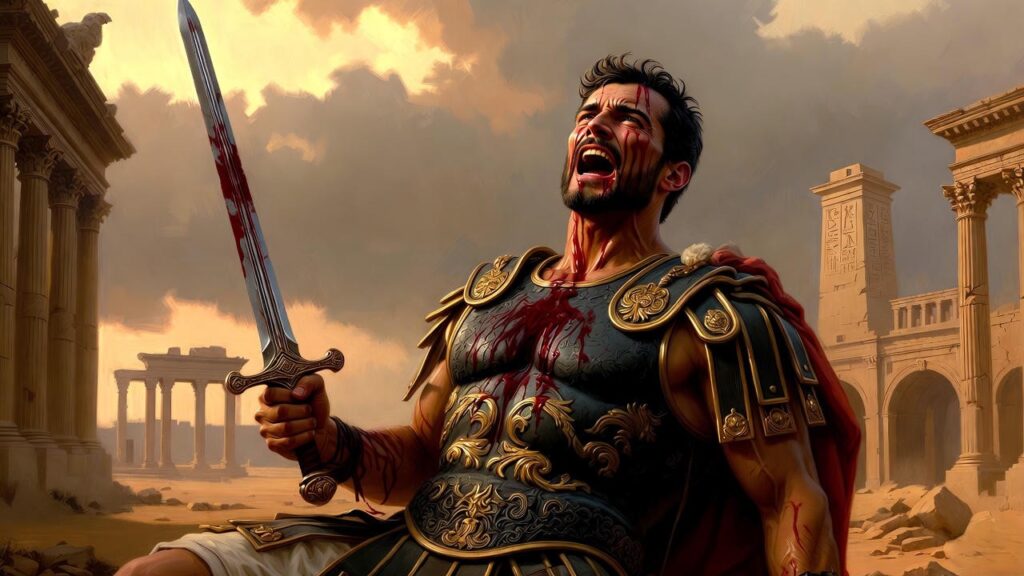
“I am dying, Egypt, dying.” — Mark Antony, Antony and Cleopatra, Act 4, Scene 15
These haunting words, spoken as blood pours from a self-inflicted wound, mark one of the most devastating moments in all of Shakespeare’s tragedies. For centuries, readers and audiences have asked the same urgent question: why did Mark Antony kill himself? Was it purely the false report of Cleopatra’s death that drove him to fall upon his sword? Or did deeper forces—grief, shattered honor, lost identity, and the inexorable pull of fate—converge to make life unbearable for Rome’s once-mighty triumvir?
In Shakespeare’s Antony and Cleopatra (written around 1606–1607), Mark Antony’s suicide is not a simple act of despair. It is the climactic expression of a man torn between two worlds: the austere, duty-bound Rome he once dominated and the sensual, boundless Egypt embodied by Cleopatra. Drawing primarily from Sir Thomas North’s 1579 translation of Plutarch’s Lives, Shakespeare transforms historical events into a profound exploration of love, power, mortality, and legacy.
This in-depth analysis will examine the immediate trigger for Antony’s suicide, the psychological and thematic layers beneath it, key passages from the text, comparisons with the historical record, and the enduring significance of this tragic end. Whether you’re a student preparing for an exam, a theater enthusiast revisiting the play, or a lifelong Shakespeare reader seeking fresh insight, this article offers the most comprehensive guide available to understanding why Mark Antony chose death over defeat.
Plot Summary Leading to Antony’s Suicide
To grasp why Antony takes his own life, we must first trace the cascade of events that leaves him isolated and broken.
Antony’s Divided World – Rome vs. Egypt
Antony and Cleopatra opens with the Roman general Mark Antony luxuriating in Alexandria, neglecting his military and political responsibilities in Rome. Philo’s famous opening lines immediately establish the tension:
“Nay, but this dotage of our general’s O’erflows the measure” (1.1.1–2).
Antony has become “the triple pillar of the world transformed / Into a strumpet’s fool” in the eyes of his Roman subordinates. His passionate relationship with Cleopatra, Queen of Egypt, is both his greatest joy and his fatal distraction.
Political necessity briefly pulls him back to Rome, where he agrees to marry Octavius Caesar’s sister Octavia in an attempt to mend the fracturing Second Triumvirate. Yet the marriage is doomed; Antony soon returns to Cleopatra, cementing the perception in Rome that he has abandoned duty for pleasure.
The Turning Point – Defeat and Despair
The pivotal military disaster occurs at the Battle of Actium (31 BC in history, dramatized in Act 3). When Cleopatra’s fleet unexpectedly retreats, Antony—unable to bear separation from her—follows, abandoning his own forces. The defeat is catastrophic. As the play progresses, Antony suffers a second naval loss, and his remaining troops desert to Caesar’s side.
In Act 4, Scene 12, Antony watches in anguish as his fleet surrenders:
“All is lost! This foul Egyptian hath betrayed me” (4.12.9–10).
Rage gives way to despair. Cleopatra, fearing Antony’s fury, retreats to her monument and instructs her eunuch Mardian to tell Antony she has killed herself—adding dramatically that her last words were “Antony, most noble Antony!”
The Immediate Trigger
The false report reaches Antony in Act 4, Scene 14. His reaction is instantaneous and overwhelming:
“Since Cleopatra died I have liv’d in such dishonour that the gods Detest my baseness” (4.14.55–57).
Believing the love of his life is gone and that his military reputation is irredeemable, Antony resolves to die. He calls upon his servant Eros to kill him, invoking the loyal slave’s earlier vow to do so if the need arose. Eros, unable to strike his master, instead turns the sword on himself—an act that shames and inspires Antony.
Antony then attempts to fall upon his own sword but botches the wound, lingering in agony long enough to be carried to Cleopatra’s monument. There, in one of the most moving scenes Shakespeare ever wrote, he dies in her arms, urging her to seek honorable terms with Caesar and to remember him at his best.
Key Reasons Why Mark Antony Kills Himself in the Play
Antony’s suicide is triggered by the false news of Cleopatra’s death, but Shakespeare layers multiple motivations that reveal the complexity of his tragic hero.
Overwhelming Grief and Devastating Love
The most immediate cause is grief. Upon hearing Mardian’s report, Antony declares:
“The crown o’ th’ earth doth melt. My lord? O, withered is the garland of the war, The soldier’s pole is fall’n! Young boys and girls Are level now with men. The odds is gone, And there is nothing left remarkable Beneath the visiting moon” (4.15.65–70).
In these lines, Cleopatra is not merely a lover—she is the very structure of meaning in Antony’s universe. Without her, the world loses all distinction and vitality. Shakespeare presents their love as transcendent, capable of eclipsing empire itself.
Loss of Honor and Roman Identity
For a Roman nobleman of Antony’s stature, dishonor is worse than death. Repeated military failures, desertions by his soldiers, and the perception that he has been emasculated by an Eastern queen erode his sense of self. Earlier, he laments:
“I have lost command” (3.11.23).
And later:
“I / Have lost my way for ever” (3.11.3–4).
Roman cultural ideals—virtus (manly courage), honor, and fama (reputation)—demand that a defeated general choose suicide rather than suffer the humiliation of capture and a triumphal parade in chains through Rome. Brutus and Cassius do the same in Julius Caesar; Cato the Younger became legendary for it. Antony explicitly invokes this tradition when he calls for death “after the high Roman fashion” (4.15.92).
The Role of Miscommunication and Fate
Cleopatra’s well-intentioned deception backfires tragically. She sends the false report to calm Antony’s anger and draw him back to her, never imagining he would kill himself. This miscommunication underscores one of the play’s central themes: the capriciousness of fortune. Antony repeatedly personifies Fortune as a fickle force that has abandoned him.
Shakespeare also suggests an almost supernatural inevitability. The Soothsayer’s early warnings and omens throughout the play create a sense that the lovers are doomed by forces beyond their control.
Comparison to Other Characters’ Deaths
Eros’s suicide directly inspires Antony, demonstrating unwavering loyalty and shaming him into action. Enobarbus, Antony’s most trusted lieutenant, defects to Caesar out of practicality but dies of grief and shame when Antony generously sends his treasure after him. These parallel deaths reinforce the idea that true Roman honor cannot survive betrayal or defeat.
Key Quotes Explaining Antony’s Motivation
Shakespeare’s language in the suicide scenes is among his most poetic and psychologically revealing. The following key passages illuminate the layered reasons behind Antony’s decision to end his life.
-
On hearing of Cleopatra’s supposed death
“Unarm, Eros; the long day’s task is done, And we must sleep together.” (4.14.35–36)
Antony equates death with rest after a lifetime of warfare. The word “together” reveals his hope to be reunited with Cleopatra in the afterlife.
-
The shattering of his world
“O, thy vile lady! She has robb’d me of my sword.” (4.14.22–23)
Earlier he blames Cleopatra, but this line shows he feels emasculated and stripped of his martial identity.
-
The cosmic collapse of meaning
“The crown o’ th’ earth doth melt… And there is nothing left remarkable Beneath the visiting moon.” (4.15.65–70)
This extraordinary speech expresses existential despair: without Cleopatra, the entire hierarchy and wonder of the universe collapses.
-
Inspiration from Eros
“Thrice nobler than myself! Thou teachest me, O valiant Eros, what I should, and thou couldst not.” (4.14.95–97)
Eros’s suicide shames Antony into action and reaffirms the Roman code of loyalty and honor.
-
Final words to Cleopatra
“I am dying, Egypt, dying. Give me some wine, and let me speak a little… The miserable change now at my end Lament nor sorrow at, but please your thoughts In feeding them with those my former fortunes… Wherein I liv’d the greatest prince o’ th’ world, The noblest.” (4.15.53–59)
Even in agony, Antony seeks to control his legacy, asking Cleopatra to remember him at his peak rather than in defeat.
-
Defiance of Caesar
“Not Caesar’s valour hath o’erthrown Antony, But Antony’s hath triumph’d on itself.” (4.15.15–16)
By choosing suicide, Antony claims a final victory over his rival—he dies a free Roman rather than a captive.
These quotations, drawn directly from the First Folio and modern scholarly editions (such as the Arden and Folger Shakespeare Library texts), reveal a man driven by grief, yet determined to die with dignity.
Historical Mark Antony’s Suicide vs. Shakespeare’s Version
Shakespeare did not invent Antony’s suicide; he adapted it from his principal source, Plutarch’s Life of Antonius (translated by Sir Thomas North in 1579). Examining the parallels and divergences highlights Shakespeare’s dramatic genius.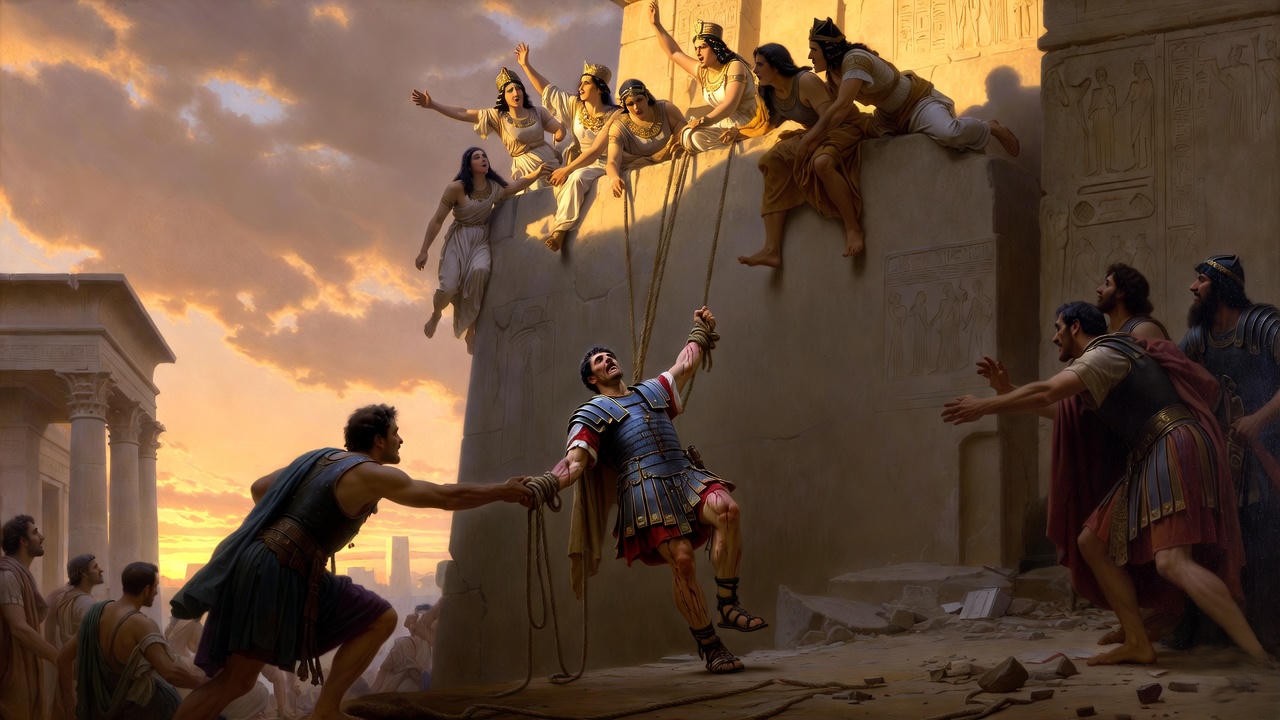
Plutarch’s Account (Shakespeare’s Primary Source)
According to Plutarch:
- After the final defeat at Alexandria in 30 BC, a false report reached Antony that Cleopatra had killed herself.
- Antony asked his servant Eros to kill him; Eros killed himself instead.
- Antony then stabbed himself but survived the initial wound.
- He was hoisted up to Cleopatra’s monument, where he died in her arms after learning she was still alive.
The broad outline is remarkably faithful.
Key Differences and Dramatic Enhancements
| Aspect | Historical (Plutarch) | Shakespeare’s Play |
|---|---|---|
| Timing and pacing | Events unfold over days | Compressed into rapid, consecutive scenes for tragic intensity |
| Eros scene | Brief mention | Expanded into a powerful demonstration of loyalty |
| Antony’s botched wound | Survives long enough to reach Cleopatra | Lingering death allows extended farewell dialogue |
| Cleopatra’s motive | Fear of Antony’s anger | Explicitly dramatized as protective deception |
| Emotional emphasis | Political and military downfall | Transcendent love as the central tragedy |
Shakespeare heightens irony and pathos. In history, Antony learns Cleopatra is alive before dying; in the play, he dies still believing she is dead (until she tells him otherwise moments before his last breath). This change amplifies the tragic waste caused by miscommunication.
Why Shakespeare Altered It
By emphasizing love over politics, Shakespeare transforms a story of military failure into a mythic romance that rivals Romeo and Juliet. The lovers’ deaths become a defiant assertion of passion against the cold pragmatism of Octavius Caesar’s new Roman order. As critic Janet Adelman notes in The Common Liar (1973), Shakespeare “makes the Egyptian world of imagination and bounty triumph over the Roman world of calculation and restraint.”
Broader Themes in Antony and Cleopatra Tied to the Suicide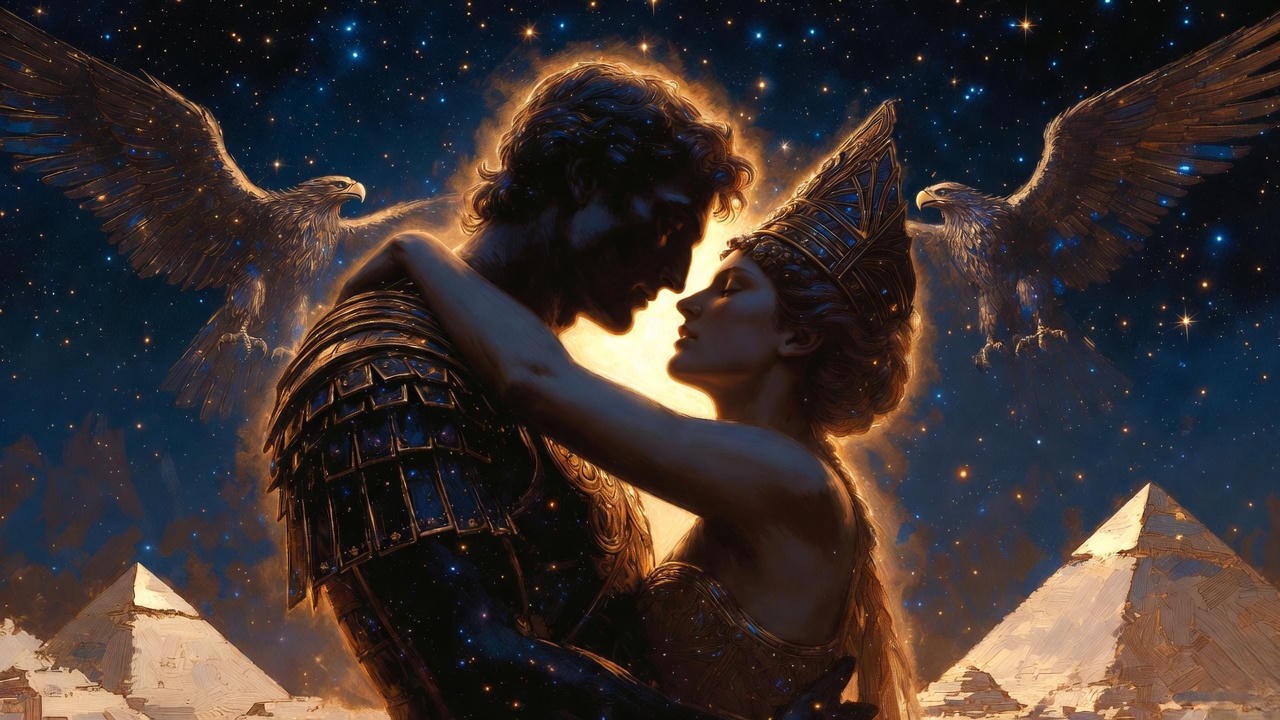
Antony’s suicide is the fulcrum on which the play’s major themes pivot.
Love vs. Duty and Empire
The central conflict is Antony’s inability to reconcile his role as Roman leader with his devotion to Cleopatra. His suicide resolves this tension: by dying for love, he rejects Roman duty entirely. Yet paradoxically, he dies “after the high Roman fashion,” reclaiming a form of Roman identity in his final act.
Power, Gender, and East vs. West
Roman characters repeatedly frame Cleopatra as a dangerous enchantress who has “beguiled” Antony. His suicide can be read as both submission to her power and an attempt to reassert masculine control by choosing death on his own terms. Cleopatra’s agency in sending the false report complicates any simple gender reading—she orchestrates events even in apparent defeat.
Mortality, Immortality, and Legacy
The play repeatedly contrasts fleeting earthly power with enduring fame. Antony worries that Caesar’s actors will “boy my greatness / I’ th’ posture of a whore” (5.2.216–217) in triumphal pageants. By choosing suicide, the lovers seize narrative control. Cleopatra’s later assertion—“I am marble-constant; now the fleeting moon / No planet is of mine” (5.2.238–240)—and her own magnificent death ensure they become immortal legends rather than humiliated captives.
Modern Interpretations and Stage/Film Adaptations
Directors and actors have long grappled with how to stage Antony’s protracted death scene without losing emotional impact.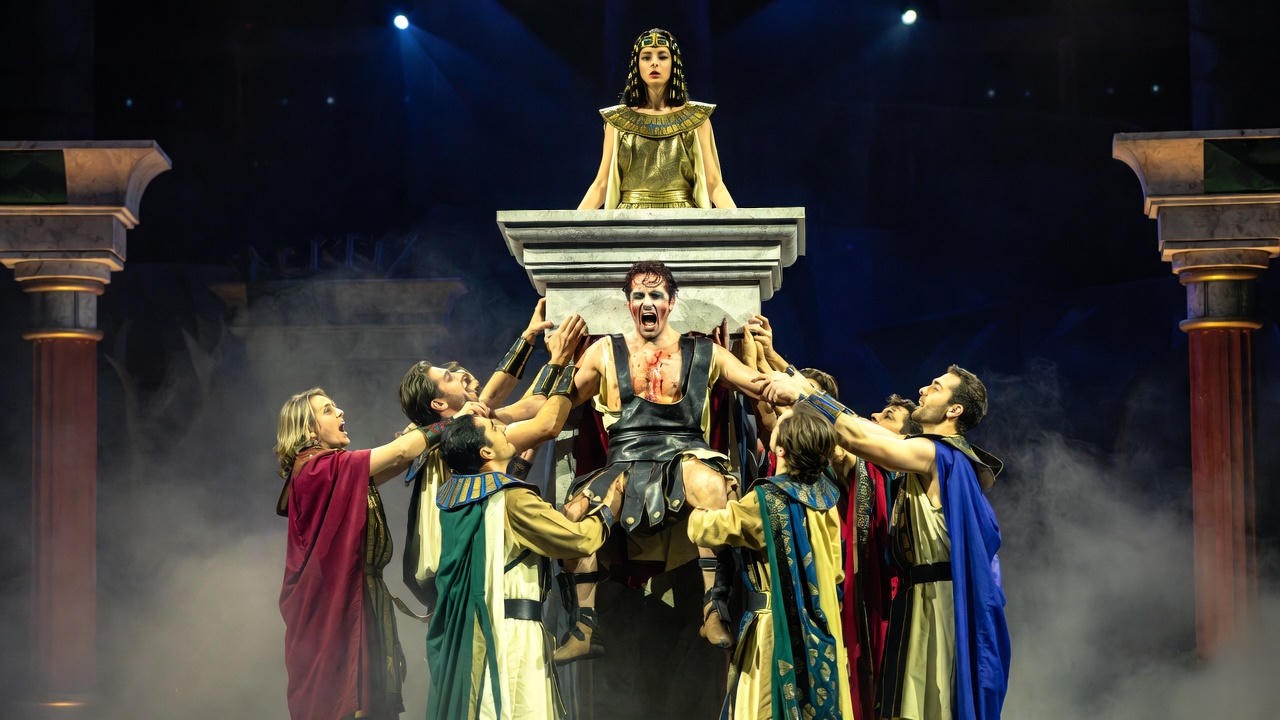
- The 1972 Trevor Nunn RSC production (with Richard Johnson and Janet Suzman) emphasized physical realism—Antony’s blood-soaked body hoisted laboriously to the monument.
- The 1987 BBC Television Shakespeare version (Colin Blakely and Jane Lapotaire) lingered on close-ups of anguish and reconciliation.
- More recent productions, such as Simon Godwin’s 2017 National Theatre staging (Ralph Fiennes and Sophie Okonedo), highlighted the scene’s erotic charge amid tragedy.
Frequently Asked Questions (FAQ)
Why does Cleopatra send false news of her death?
Cleopatra retreats to her monument out of genuine fear of Antony’s rage after his fleet’s desertion. She instructs Mardian to tell Antony she has killed herself, adding that her final words were his name—an attempt to soothe him and rekindle his affection. As she later confesses:
“I little thought You would have followed” (4.15.80–81).
The deception is protective rather than malicious, but it reveals the dangerous volatility of their relationship and the tragic consequences of miscommunication.
Does Antony die immediately in the play?
No. Unlike many Shakespearean suicides (Brutus, Cassius, Othello), Antony’s is botched. He stabs himself but fails to deliver a fatal blow instantly. This prolongs his suffering, allowing him to be hoisted up to Cleopatra’s monument for an extended, heartbreaking farewell. The lingering death heightens the pathos and gives space for some of the play’s most tender and noble dialogue.
Is Antony’s suicide based on true events?
Yes, closely. Plutarch’s Life of Antonius records almost the exact sequence: the false report of Cleopatra’s death, Eros killing himself rather than his master, Antony’s self-stabbing, and his prolonged death in Cleopatra’s arms after being lifted to her hiding place. Shakespeare follows his source faithfully while intensifying the emotional and dramatic impact.
What does Antony’s death symbolize in the tragedy?
Antony’s suicide symbolizes the ultimate triumph of private passion over public duty, of Egypt over Rome, and of love over empire. By choosing death rather than submission to Caesar, he reclaims agency and ensures that his story will be remembered on his own terms. It also sets the stage for Cleopatra’s even grander self-orchestration of her death, transforming historical defeat into mythic transcendence.
How does Cleopatra react to Antony’s suicide?
Cleopatra’s response evolves from frantic grief to resolute admiration. She initially faints at the sight of his bloodied body:
“O, withered is the garland of the war, The soldier’s pole is fall’n” (4.15.66–67).
But she quickly recovers composure, helping to hoist him up and listening to his final instructions. After his death, her mourning is profound yet regal—she calls him “husband” openly for the first time and vows to follow him soon, refusing to become Caesar’s trophy.
Why is Antony and Cleopatra considered one of Shakespeare’s greatest tragedies?
Unlike the more straightforward moral downfalls in Hamlet, Othello, or Macbeth, Antony and Cleopatra presents flawed protagonists whose “tragic flaw” is their boundless capacity for love and imagination. Their suicides are not punishments but defiant assertions of identity. The play’s linguistic grandeur, geopolitical scope, complex gender dynamics, and celebration of excess make it uniquely expansive and enduring.
Did the historical Mark Antony really love Cleopatra as deeply as Shakespeare portrays?
Ancient sources are divided. Plutarch emphasizes their genuine passion while noting political motivations. Roman propaganda (spread by Octavian) painted Cleopatra as a seductive witch who ensnared Antony. Modern historians generally accept that their relationship combined sincere affection, mutual political advantage, and shared theatrical flair for self-presentation.
Why did Mark Antony kill himself? The immediate spark was the devastating false report of Cleopatra’s death—a report that shattered the one remaining pillar of his existence. But Shakespeare reveals far deeper currents: a Roman hero stripped of honor, a lover unable to imagine life without his queen, and a man determined to author his own ending rather than suffer humiliation at Caesar’s hands.
In the end, Antony’s suicide is neither weakness nor simple despair. It is a final, paradoxical act of triumph. By falling on his sword “after the high Roman fashion,” he reclaims his nobility. By dying for love, he and Cleopatra transcend the cold new world order rising under Octavius. As Cleopatra declares after his death:
“’Tis paltry to be Caesar: Not being Fortune, he’s but Fortune’s knave” (5.2.2–3).
Together, their deaths transform historical losers into eternal legends—the greatest prince of the world and the incomparable queen whose love outshone empire itself.
If this exploration has deepened your appreciation of Shakespeare’s masterpiece, consider revisiting the play or watching a powerful production. The tragedy of Antony and Cleopatra continues to speak to us across centuries: a reminder that the most destructive forces in human life are often the most magnificent.