Imagine plotting the cold-blooded murder of the person who stood shoulder-to-shoulder with you on the battlefield, saved your life, and shared your deepest secrets—simply because a trio of mysterious strangers promised his children a crown instead of yours. This chilling betrayal sits at the structural and emotional heart of William Shakespeare’s classic tragedy. Readers, students, and theater lovers frequently ask: why does Macbeth kill Banquo? The answer goes far beyond simple political ambition. Banquo’s murder is driven by an unstable cocktail of generational fear, crippling paranoia, and an existential obsession with defying fate, marking the precise moment Macbeth transitions from a reluctant killer into an unhinged tyrant.
Quick Summary: Why Macbeth Turns on Banquo
The Threat to Destiny: The Witches predicted that Banquo’s descendants—not Macbeth’s—would inherit the Scottish crown, rendering Macbeth’s reign “fruitless.”
Paranoia & Suspicion: Banquo was the only living witness to the Witches’ original prophecies and openly suspected Macbeth of foul play in King Duncan’s assassination.
Moral Intimidation: Banquo’s noble character and unflinching integrity served as a constant, unbearable mirror to Macbeth’s fallen state.
The Turning Point: Banquo’s assassination in Act 3 marks Macbeth’s transition into independent tyranny, carried out without Lady Macbeth’s involvement.
The Witches’ Prophecy: Royal Ambition vs. Generational Fear
To fully comprehend why Macbeth turns on his closest ally, one must return to the foggy heath in Act 1, Scene 3. When the Witches hail Macbeth as the future Thane of Cawdor and King of Scotland, his immediate reaction is one of rapt fascination. Yet, the Witches do not limit their supernatural foretelling to Macbeth alone. They turn to Banquo with a paradoxical riddle: “Lesser than Macbeth, and greater,” and “Not so happy, yet much happier.”
The core of the tension, however, lies in their ultimate declaration to Banquo: “Thou shalt get kings, though thou be none.”
                       [ THE WITCHES' PROPHECY ]
                                  │
         ┌────────────────────────┴────────────────────────┐
         ▼                                                 ▼
  [ FOR MACBETH ]                                  [ FOR BANQUO ]
"All hail, Macbeth,                              "Thou shalt get kings,
that shalt be King hereafter!"                   though thou be none."
         │                                                 │
         ▼                                                 ▼
Immediate Crown (Act 1-2)                         Generational Legacy (Act 3+)
         │                                                 │
         └────────────────────────┬────────────────────────┘
                                  ▼
                   [ MACBETH'S EXISTENTIAL CRISIS ]
              "Upon my head they placed a fruitless crown,
              And put a barren sceptre in my gripe..."
The Double-Edged Prediction in Act 1
At first, Macbeth is consumed entirely by his own prophecy. The rapid fulfillment of his title as Thane of Cawdor validates the Sisters’ words, igniting an overwhelming desire for the ultimate prize: Duncan’s throne. However, once Duncan is murdered and Macbeth ascends the throne at Scone, the immediate thrill of power quickly gives way to existential dread.
Macbeth realizes that achieving the crown was only half the equation. If the Witches’ words regarding his own ascension were true, then their predictions regarding Banquo must be equally infallible. This realization poisons his victory. Every time Macbeth looks at Banquo, he does not see a comrade-in-arms; he sees the father of a future dynasty that will inevitably supplant his own.
“A Fruitless Crown and a Barren Sceptre”
The psychological turning point occurs in Act 3, Scene 1. Left alone on stage, Macbeth delivers one of the most revealing soliloquies in the Shakespearean canon. He lays bare the agony of knowing his reign may end with him:
“Upon my head they placed a fruitless crown,
And put a barren sceptre in my gripe,
Thence to be wrenched with an unlineal hand,
No son of mine succeeding. If ‘t be so,
For Banquo’s issue have I filed my mind;
For them the gracious Duncan have I murdered;”
The imagery here is precise and brutal. A “fruitless crown” and a “barren sceptre” highlight Macbeth’s intense anxiety over his lack of an heir to secure his legacy. The phrase “filed my mind” (meaning defiled or corrupted his soul) reveals the bitter ironies eating away at him: he damns his soul to eternal damnation not for his own lineage, but to pave the way for Banquo’s children.
To Macbeth’s mind, if Banquo’s son Fleance lives, then Duncan’s murder was ultimately an act of sacrifice for Banquo’s benefit. Driven by an inability to accept a temporary reign, Macbeth resolves to challenge Fate itself to a duel, declaring, “Come fate into the list, / And champion me to the utterance!”
The Psychological Drivers: Paranoia, Guilt, and Banquo’s Character
While the threat to his lineage provides the long-term motive, immediate psychological pressure pushes Macbeth over the edge. Banquo is not merely a passive bystander in the drama unfolding at Inverness and Dunsinane; he is a sharp, perceptive nobleman who possesses the exact clues needed to bring down the usurper.
Banquo as Macbeth’s Moral Mirror
In dramatic literature, Banquo functions as a structural foil to Macbeth. Both men hear the Witches’ predictions, but their moral reactions could not be more divergent:
-
Macbeth yields immediately to “black and deep desires,” allowing temptation to override his moral code.
-
Banquo remains deeply cautious, warning Macbeth early on: “And oftentimes, to win us to our harm, / The instruments of darkness tell us truths, / Win us with honest trifles, to betray ‘s / In deepest consequence.”
Banquo’s quiet integrity makes Macbeth deeply uncomfortable. Macbeth admits as much in Act 3, Scene 1: “Our fears in Banquo / Stick deep, and in his royalty of nature / Reigns that which would be feared.” Banquo possesses a natural nobility, courage, and wisdom that highlights Macbeth’s moral collapse. As long as Banquo walks the earth, his presence serves as an unbearable reminder of what Macbeth sacrificed when he yielded to ambition.
The Escalation of Paranoia
Beyond moral discomfort lies a concrete, existential threat: Banquo knows too much.
Banquo was present on the heath when the Weird Sisters spoke. He witnessed Macbeth’s trance-like reaction. He was at Inverness the night Duncan was slaughtered. At the opening of Act 3, Scene 1, Shakespeare gives Banquo a brief soliloquy that confirms Macbeth’s worst fears:
“Thou hast it now: King, Cawdor, Glamis, all,
As the weird women promised, and I fear
Thou played’st most foully for ‘t.”
Banquo keeps his suspicions guarded, but his intelligence makes him inherently dangerous. Macbeth recognizes that Banquo has both the motive and the moral authority to rally the Scottish thames against him. In an atmosphere fueled by guilt and sleeplessness, paranoia convinces Macbeth that his seat on the throne will never be secure so long as Banquo draws breath.
The Murder Plot: Why Macbeth Delegates the Crime
When Macbeth plotted King Duncan’s murder, he relied heavily on Lady Macbeth’s cold, calculating resolve. However, his approach to Banquo’s assassination demonstrates a dramatic shift in his character, strategy, and psychological stability.
Manipulating the Hired Murderers
Unlike the direct, hands-on regicide of Duncan, Macbeth hires third-party assassins to ambush Banquo and Fleance. In Act 3, Scene 1, Macbeth meets with two impoverished men and employs psychological tactics to convince them to strike:
-
Shifting the Blame: He convinces them that their poverty and suffering are not his fault, but are instead the direct result of Banquo’s oppression.
-
Questioning Their Manhood: Just as Lady Macbeth questioned Macbeth’s manhood in Act 1 to spur him to murder Duncan, Macbeth now questions the manhood of these desperate men to goad them into violence.
-
Framing Regicide as Loyalty: He convinces them that killing Banquo is an act of personal service to their king that will earn them favor and status.
This manipulation highlights Macbeth’s rapid descent into cold, tactical villainy. He no longer needs his wife to bolster his resolve; he has internalized her methods and turned them outward.
Excluding Lady Macbeth: A Crucial Character Shift
Perhaps the most significant aspect of Banquo’s murder plot is that Lady Macbeth is completely excluded from it.
In Act 3, Scene 2, when Lady Macbeth notices her husband isolating himself and asks what he is planning, Macbeth dismisses her with the famous line:
“Be innocent of the knowledge, dearest chuck,
‘Till thou applaud the deed.”
This line signals a complete reversal in their dynamic. In the first two acts, Lady Macbeth was the driving force behind the violence. By Act 3, Macbeth takes full ownership of his villainy. He shields her from the details not out of kindness, but because he no longer requires her council. He has evolved past his initial hesitation and now acts independently, plunging deeper into tyranny without a second thought.
Act 3, Scene 3 & The Aftermath: Why Fleance’s Escape Changes Everything
Macbeth’s carefully laid scheme culminates in the dark woods near the palace in Act 3, Scene 3. The hired murderers ambush Banquo and Fleance as they return from an evening ride.
The Failure of the Murder Plot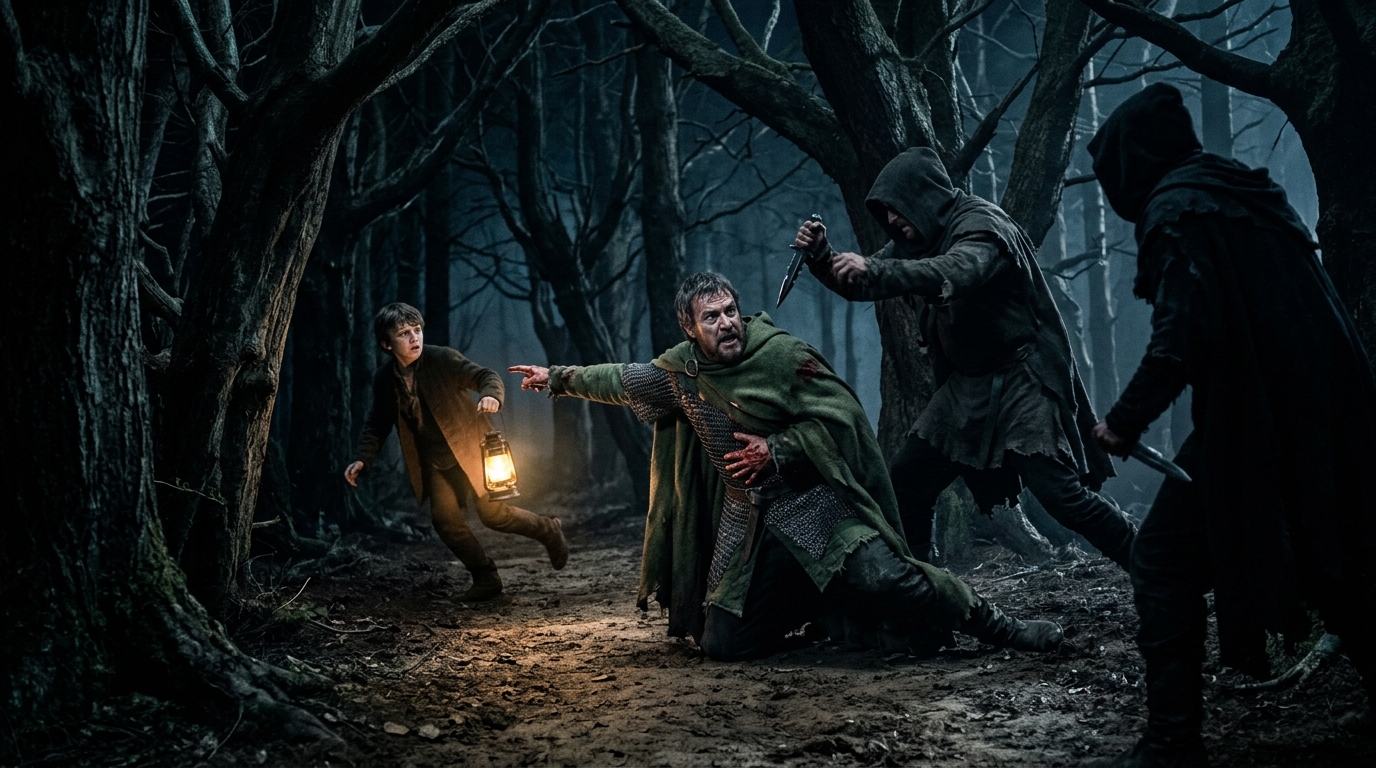
The attack is swift and brutal, but it fails in its primary objective. As the assassins strike, Banquo calls out to his son in his dying breath:
“O, treachery! Fly, good Fleance, fly, fly, fly!
Thou mayst revenge. O slave!”
Banquo dies, but Fleance escapes into the darkness.
┌─────────────────────────────────────────────────────────────────┐
│                     THE AMBUSH (Act 3, Scene 3)                 │
└─────────────────────────────────────────────────────────────────┘
                                 │
                 ┌───────────────┴───────────────┐
                 ▼                               ▼
       [ BANQUO KILLED ]                 [ FLEANCE ESCAPES ]
  • Threat of suspicion silenced    • Witches' prophecy remains active
  • Guilt consumes Macbeth          • Macbeth's tyranny becomes futile
  • Leads to Banquet hallucination  • Fate triumphs over violence
When the chief murderer reports the outcome to Macbeth during the royal banquet in Act 3, Scene 4, Macbeth’s psychological state fractures completely. He responds with visceral horror:
“Then comes my fit again. I had else been perfect,
Whole as the marble, founded as the rock…
But now I am cabined, cribbed, confined, bound in
To saucy doubts and fears.”
Killing Banquo achieved nothing because Fleance survived. The escape of Fleance proves a central thematic point of the play: fate cannot be cheated by violence. Macbeth’s desperate effort to break the Witches’ prophecy fails
The Banquet Scene: Banquo’s Ghost and the Public Breakdown
The fallout of Banquo’s murder reaches its dramatic peak in Act 3, Scene 4 during the royal banquet. As Macbeth prepares to take his seat among his nobles, the bloody spectre of Banquo appears and sits in the King’s chair.
       [ MACBETH'S PROGRESSION OF MURDERS ]

    KING DUNCAN             BANQUO            MACDUFF'S FAMILY
 ┌───────────────┐    ┌───────────────┐    ┌──────────────────┐
 │ • Motive:     │    │ • Motive:     │    │ • Motive:        │
 │   Ambition    │    │   Paranoia &  │    │   Pure Malice &  │
 │ • Reluctant   │───>│   Legacy      │───>│   Terrorism      │
 │ • Driven by   │    │ • Strategic   │    │ • Total Moral    │
 │   Lady M.     │    │ • Secretive   │    │   Collapse       │
 └───────────────┘    └───────────────┘    └──────────────────┘
The ghost—whether viewed as a literal supernatural apparition or a hallucination produced by Macbeth’s guilt-ridden mind—serves crucial dramatic functions:
-
Exposing the King’s Guilt: Macbeth screams in terror at an empty chair (“Thou canst not say I did it. Never shake / Thy gory locks at me!”), terrifying his guests and exposing his mental instability to the lords of Scotland.
-
Symbolizing Unresolved Justice: While Duncan was buried quietly, Banquo’s bloodied ghost physically occupies the throne, signaling that Macbeth’s rule is illegitimate and doomed to end in violence.
-
Ruining Political Authority: Lady Macbeth is forced to prematurely end the banquet, shattering the illusion of order and royal authority Macbeth tried to build.
Strategic Comparison: How Banquo’s Death Transforms Macbeth
To appreciate the significance of Banquo’s murder within the overarching plot, it is helpful to contrast it with the other major acts of violence in the play.
| Analytical Dimension | The Murder of King Duncan (Act 2) | The Murder of Banquo (Act 3) | The Slaughter of Macduff’s Family (Act 4) |
| Primary Motivation | Unchecked ambition to seize the crown. | Paranoia, political self-preservation, and securing a legacy. | Pure malice, blind panic, and ruthless intimidation. |
| Macbeth’s Mental State | Tormented by guilt, hesitant, deeply conflicted. | Cold, calculating, paranoid, and secretive. | Completely callous, indifferent, and impulsive. |
| Role of Lady Macbeth | Mastermind and active instigator. | Excluded entirely from planning and execution. | Completely unaware and descending into madness. |
| Political Consequence | Macbeth secures the throne through deception. | Suspicions rise among nobles; court unity shatters. | Open rebellion forms; Scottish lords defect to Malcolm. |
This progression maps Macbeth’s complete moral collapse. Duncan’s murder was driven by ambition; Banquo’s by paranoia; Macduff’s family by pure, unadulterated terror. Banquo’s death acts as the structural bridge between Macbeth as a hesitant killer and Macbeth as a ruthless tyrant.
Critical Perspectives & Historical Context
To fully appreciate why Shakespeare wrote Banquo’s murder with such tactical precision, one must look beyond the stage and examine the political realities of early 17th-century England.
                  [ HISTORICAL CONTEXT: 1606 ENGLAND ]
                                   │
         ┌─────────────────────────┴─────────────────────────┐
         ▼                                                   ▼
[ HOLINSHED'S CHRONICLES ]                          [ KING JAMES I ]
• Historical Banquo was an accomplice               • Claimed direct descent from Banquo
  in King Duncan's murder.                          • Obsessed with witchcraft & treason
         │                                          • Patron of Shakespeare's troupe
         │                                            (The King's Men)
         └─────────────────────────┬─────────────────────────┘
                                   ▼
                   [ SHAKESPEARE'S DRAMATIC REVISION ]
             • Re-wrote Banquo as noble, innocent, and loyal.
             • Turned Banquo's murder into a tragic betrayal.
             • Validated the Stuart dynasty via Fleance's survival.
King James I and the Stuart Lineage
When Macbeth was first performed around 1606, King James VI of Scotland had recently assumed the English throne as King James I following the death of Queen Elizabeth I. James was an important patron of Shakespeare’s theater company, The King’s Men.
Crucially, King James claimed direct genealogical descent from the historical Banquo. In Raphael Holinshed’s Chronicles of England, Scotland, and Ireland—Shakespeare’s primary historical source for the play—Banquo was actually depicted as an active accomplice in Duncan’s murder.
However, portraying the King’s ancestor as a regicidal traitor would have been dangerous and politically irresponsible. Shakespeare deliberately sanitized Banquo’s character, transforming him into a paragon of loyalty, wisdom, and moral fortitude.
By having Macbeth murder Banquo while Fleance escapes, Shakespeare accomplished two vital goals:
-
Flattering the King: The play framing Banquo as a blameless victim validated James I’s legitimacy, presenting the Stuart dynasty as chosen by divine providence.
-
The Mirror Scene (Act 4, Scene 1): When the Witches show Macbeth a vision of eight future kings descended from Banquo, the final king holds a mirror showing an endless line of rulers—a direct, theatrical nod to King James I sitting in the audience.
Modern Psychological Interpretations
For modern audiences and directors, Banquo’s murder resonates beyond Jacobean politics. Psychologically, Banquo represents Macbeth’s suppressed conscience and lost humanity:
-
Imposter Syndrome & Insecurity: Macbeth knows he took the crown by force rather than merit. Banquo’s presence triggers an intense sense of inadequacy; he cannot enjoy power while someone who knows the truth is watching.
-
Existential Dread: Macbeth’s obsession with stopping Banquo’s descendants reflects a fear of mortality and oblivion. Unable to build a lasting legacy, Macbeth tries to destroy the future itself.
Frequently Asked Questions (FAQ)
Why did Macbeth want to kill Fleance along with Banquo?
Macbeth targeted Fleance because Fleance represented the ultimate threat to his long-term legacy. The Witches predicted that Banquo’s descendants—not Macbeth’s—would inherit the Scottish crown. Killing Banquo removed the immediate threat of a political rival, but leaving Fleance alive left the prophecy intact. From Macbeth’s perspective, killing both father and son was necessary to rewrite destiny.
Did Lady Macbeth know about the plan to kill Banquo?
No. Macbeth planned Banquo’s assassination in total secrecy without consulting Lady Macbeth. When she asked him what he was planning in Act 3, Scene 2, he dismissed her, saying, “Be innocent of the knowledge, dearest chuck, / ‘Till thou applaud the deed.” This marks a major shift in their relationship, demonstrating Macbeth’s growing isolation and his move into independent tyranny.
How does Banquo’s reaction to the Witches differ from Macbeth’s?
When the Witches deliver their prophecies in Act 1, Scene 3, Macbeth is captivated and yields to ambition. Banquo remains deeply skeptical, warning that “the instruments of darkness tell us truths, / Win us with honest trifles, to betray ‘s / In deepest consequence.” While Macbeth acts on the predictions through violence, Banquo places his trust in providence, refusing to compromise his moral integrity.
What are Banquo’s last words, and why are they important?
Banquo’s last words as he is ambushed in Act 3, Scene 3 are: “O, treachery! Fly, good Fleance, fly, fly, fly! / Thou mayst revenge. O slave!” These lines are critical because they ensure Fleance’s survival, keep the Witches’ prophecy alive, and plant the seeds for Macbeth’s eventual ruin.
Is Banquo’s ghost real, or is it a hallucination?
Shakespeare leaves the ghost open to interpretation, and both choices work on stage:
-
As a Hallucination: The ghost appears only to Macbeth, while Lady Macbeth and the Scottish lords see an empty chair. This suggests it is a projection of Macbeth’s fractured psyche, fueled by guilt and sleeplessness.
-
As a Real Supernatural Entity: In Jacobean drama, ghosts were common physical characters. Coming right after the Witches’ magic, the apparition visually reinforces divine retribution for Macbeth’s crimes.
The Legacy of Banquo’s Murder
The question of why Macbeth kills Banquo finds its answer at the intersection of political panic, existential fear, and psychological collapse. Banquo’s murder is not a random act of violence; it is the central axis upon which Macbeth transforms from a story of ambition into a relentless tragedy of ruin.
By choosing to eliminate his loyal friend, Macbeth attempts the impossible: to wage war against time, truth, and fate. Yet, the escape of Fleance and the spectral appearance of Banquo at the royal banquet prove that violence cannot secure a stolen crown. In trying to cut down Banquo’s line, Macbeth only secures his own destruction, leaving behind a legacy remembered not for glory, but for tragic betrayal.