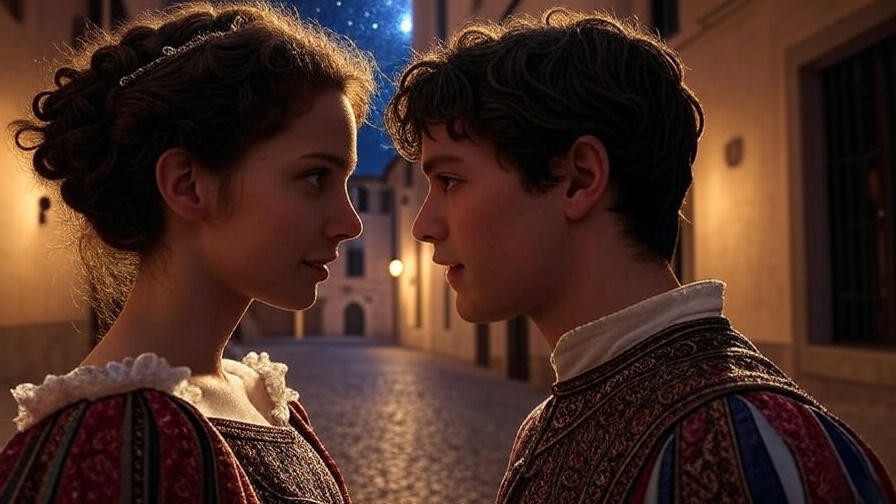
When most theatergoers and literary enthusiasts think of William Shakespeare, they immediately recall the stately, dignified pulse of standard blank verse—the unrhymed iambic pentameter that mimics the natural cadence of noble human speech. It is the steady heartbeat of Hamlet contemplating mortality, of Othello declaring his love, and of Portia reasoning in a court of law.
Yet, when the stage turns dangerous, atmospheric, or supernatural, Shakespeare systematically abandons this human rhythm. He pivots to a distinct, highly specialized acoustic architecture: spell poetry.
                               THE SHAKESPEAREAN ACOUSTIC DIVIDE

     HUMAN REALM (Order & Reason)                SUPERNATURAL REALM (Chaos & Magic)
  ┌─────────────────────────────────┐           ┌─────────────────────────────────┐
  │   Unrhymed Iambic Pentameter   │           │   Rhymed Trochaic Tetrameter    │
  │   da-DUM / da-DUM / da-DUM      │    VS     │   DUM-da / DUM-da / DUM-da      │
  │   "To be or not to be..."       │           │   "Double, double toil and..."  │
  └─────────────────────────────────┘           └─────────────────────────────────┘
For students, actors, and lovers of early modern literature, the supernatural passages in Macbeth, A Midsummer Night’s Dream, or The Tempest often present a reading puzzle. Are these rhyming chants merely decorative musical breaks, or do they serve a deeper structural purpose?
Viewing these incantations as mere stage ornament misses their true function. Spell poetry in the Shakespearean canon—defined by its trochaic rhythms, percussive rhymes, and ritualistic repetition—functions as an engine of psychological and dramatic destabilization.
By stepping away from standard meter, Shakespeare alters the physics of his theatrical world. To understand how spell poetry works is to gain the master key to decoding Shakespeare’s darkest plays, revealing how acoustic structure drives character madness, foreshadows tragic ruin, and manipulates stage tension.
II. The Anatomy of Early Modern Magic: What Is “Spell Poetry”?
To read Shakespearean magic with scholarly precision, one must look closely at its prosody—the rhythmic and acoustic structure of the verse. Shakespeare did not write his magical chants by accident; he built them using a rigorous set of poetic rules designed to contrast sharply with standard dramatic dialogue.
                  METRICAL FOOT COMPARISON

      IAMBIC FOOT (Human)            TROCHAIC FOOT (Spell)
      ┌─────────┬─────────┐          ┌─────────┬─────────┐
      │ Unstress│ Stress  │          │  Stress │ Unstress│
      │  (da)   │ (DUM)   │          │  (DUM)  │  (da)   │
      └─────────┴─────────┘          └─────────┴─────────┘
      Rising Heartbeat Rhythm        Falling Percussive Rhythm
The Meter of the Supernatural vs. The Meter of Mortals
The primary distinction between standard Shakespearean dialogue and supernatural verse lies in the choice of metrical foot:
-
Iambic Pentameter (The Mortal World): Consists of five iambic feet per line, moving from an unstressed syllable to a stressed syllable ($\mathtt{da\text{-}DUM}\ \mathtt{da\text{-}DUM}\ \mathtt{da\text{-}DUM}\ \mathtt{da\text{-}DUM}\ \mathtt{da\text{-}DUM}$). It represents order, rationality, and human agency.
-
Trochaic Tetrameter Catalectic (The Spell Meter): Reverses this direction entirely. It moves from a stressed syllable to an unstressed syllable ($\mathtt{DUM\text{-}da}\ \mathtt{DUM\text{-}da}\ \mathtt{DUM\text{-}da}\ \mathtt{DUM}$). The term catalectic indicates that the final unstressed syllable of the fourth foot is intentionally dropped, leaving a hard, truncated stress at the end of the line.
When a character speaks in trochaic meter, the rhythm hits the ear with a falling, percussive force. Instead of rising like a natural human heartbeat, it strikes forward like a drumbeat or a physical hammer blow.
Acoustic Elements of Incantatory Verse
Beyond meter, early modern spell poetry relies on three core acoustic devices:
-
Plosive Alliteration and Assonance: Heavy usage of hard consonants (such as $b$, $p$, $t$, and $k$) combined with gut-level short vowels. Consider the heavy, tactile weight of words like bubble, boil, toil, and trouble.
-
Paradoxical Parallelism (Chiasmus): The linguistic inversion of reality. The most famous example, “Fair is foul, and foul is fair,” uses structural symmetry to signal that moral and physical laws have been reversed.
-
Binding Couplets: While noble characters occasionally speak in rhyming couplets at the end of a scene, supernatural entities speak almost exclusively in rapid, closed AABB or AAAA rhyme schemes. The rhyme acts as a sonic trap, symbolizing the binding nature of magical ritual.
III. Case Study 1: Macbeth and the Dark Engine of Trochaic Tetrameter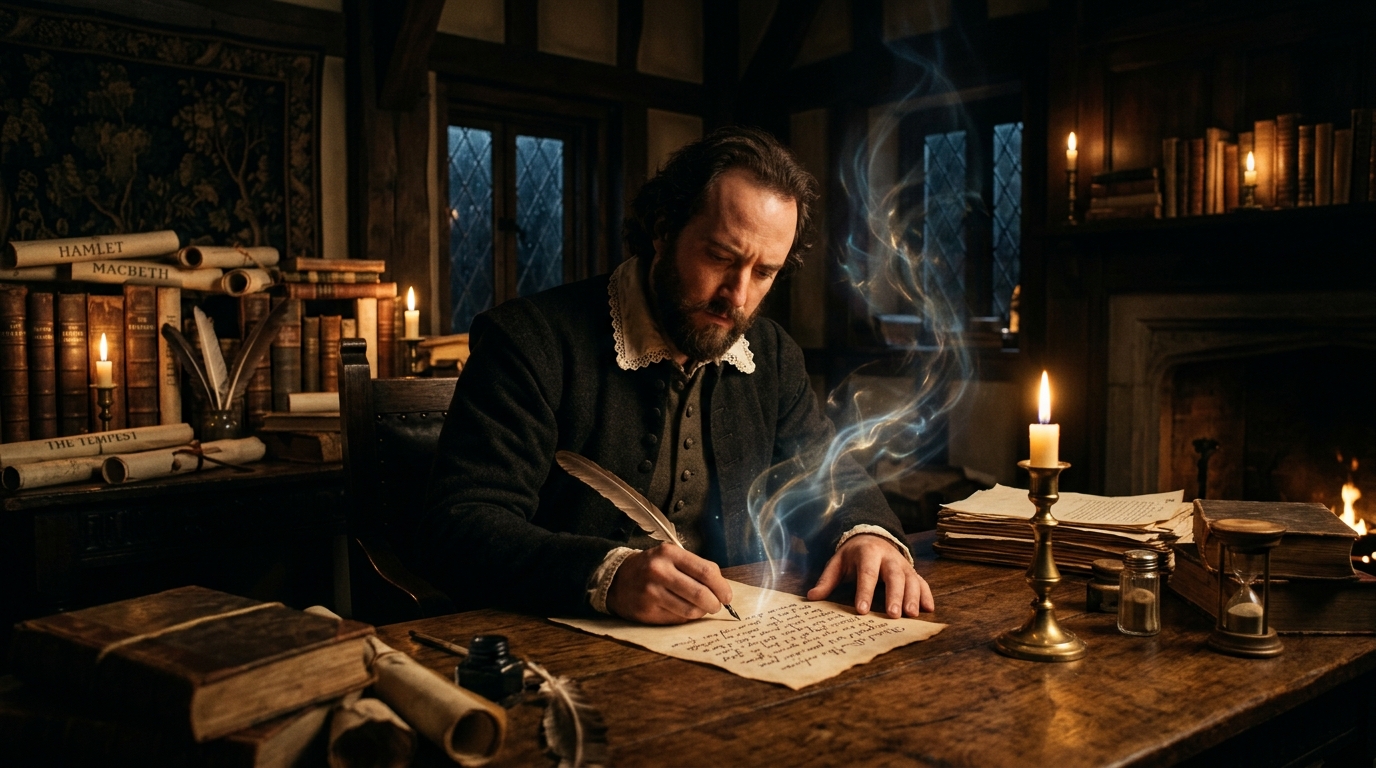
Nowhere is the power of incantatory verse more potent or terrifying than in Macbeth. Written around 1606 during the reign of King James I—a monarch obsessed with demonology and witchcraft—the play relies on metrical distortion to create an atmosphere of impending doom.
                         METRICAL INFECTION IN MACBETH

   THE WEIRD SISTERS                         MACBETH
┌───────────────────────┐             ┌───────────────────────┐
│ Trochaic Tetrameter   │ ──────────> │ Iambic Pentameter     │
│ (Ritual / Contagion)  │  Infects    │ (Infected by Trochees)│
└───────────────────────┘             └───────────────────────┘
                                                  │
                                                  ▼
                                      "So foul and fair a day
                                       I have not seen."
Breaking Down the Weird Sisters’ Incantations
Consider the opening of Act 4, Scene 1, as the three witches gather around the cauldron:
“Double, double toil and trouble;
Fire burn, and cauldron bubble.”
Scanning these lines demonstrates how Shakespeare uses catalectic trochaic tetrameter to drive the scene:
Notice the dropped final syllable after “trouble” and “bubble.” This abrupt truncation forces the actor to pause briefly before launching into the next line, creating a driving, restless tempo that mirrors the boiling of a cauldron.
How Spell Poetry Infects the Protagonist
The true dramatic brilliance of Macbeth lies not just in the witches speaking this meter, but in how their spell poetry psychologically infects Macbeth himself.
When Macbeth first enters the play in Act 1, Scene 3, his very first line echoes the witches’ earlier chant before he has even met them on the heath:
“So foul and fair a day I have not seen.”
Metrically, Macbeth attempts to speak in his natural iambic meter, but the sonic DNA of the witches’ spell (“Fair is foul, and foul is fair”) has already invaded his subconscious mind. As the play progresses and Macbeth sinks deeper into tyranny and madness, his speech grows increasingly fragmented, broken by trochaic spikes and abrupt rhyming incantations. The spell poetry acts as a linguistic virus that erodes his moral agency.
Historical Context: King James I and Jacobean Witchcraft Realities
To a Jacobean audience at the Globe Theatre, these rhythms were not abstract poetic exercises—they evoked real terror. King James I had personally published Daemonologie in 1597 and participated in the North Berwick witch trials.
By incorporating authentic elements of early modern ritual—such as the repetition of odd numbers (three, seven, nine) and cataloging gruesome physical ingredients—Shakespeare crafted a style of verse that felt dangerously authentic to his contemporaries.
IV. Case Study 2: The Tempest and the Dual Nature of High vs. Low Magic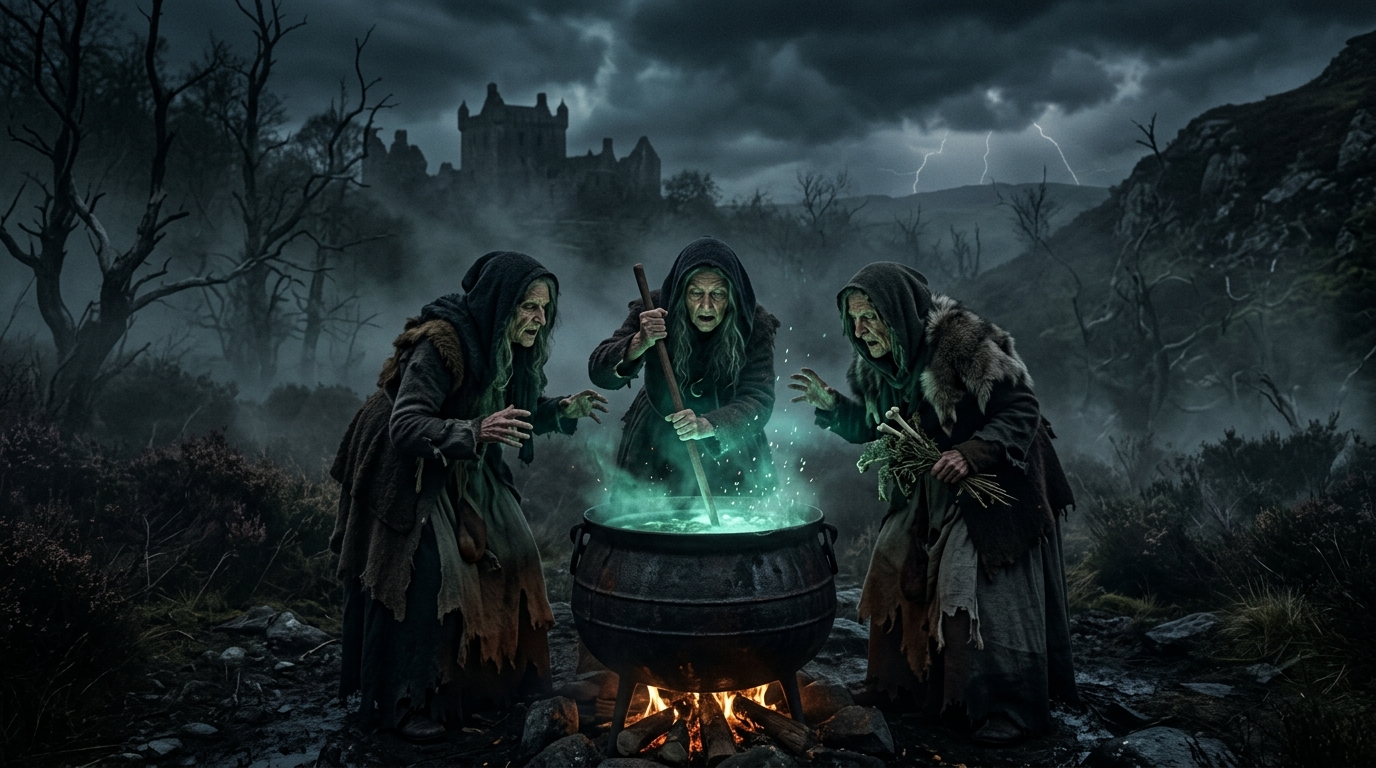
While Macbeth presents spell poetry as an engine of corruption, The Tempest demonstrates its capacity for transformation, healing, and control. Here, Shakespeare contrasts the dark, earthy magic of the witch Sycorax with the refined, artful magic of Prospero and his spirit servant, Ariel.
                      THE DUAL SPECTRUM OF SHAKESPEAREAN MAGIC

  GOETIA / LOW MAGIC (Sycorax)                 THEURGY / HIGH MAGIC (Prospero/Ariel)
┌───────────────────────────────┐             ┌─────────────────────────────────────┐
│ Chaotic, Corporeal, Malicious │             │ Harmonic, Metaphorical, Restorative │
│ Grotesque Material Binding   │     VS      │ Musical Lullabies & Elemental Chants│
│ Nightshade, Toad, Bat-wings   │             │ "Full fathom five thy father lies"  │
└───────────────────────────────┘             └─────────────────────────────────────┘
Sycorax vs. Prospero: Dark Spells vs. High Neoplatonic Magic
In early modern intellectual history, scholars distinguished between Goetia (low, demonic magic relying on pacts and physical ingredients) and Theurgy (high, divine magic utilizing music, geometry, and cosmic harmony).
In The Tempest, the unseen witch Sycorax represents Goetia. Her spells are remembered as visceral, earthbound curses that imprisoned Ariel in a cloven pine. Prospero’s magic, by contrast, operates primarily through acoustic harmony—channeled through Ariel’s songs and incantations.
Ariel’s Chants as Harmonic Spell Poetry
Ariel’s spell verse uses trochaic structures not to curdle life, but to soothe grief and reorder human consciousness. Consider Ariel’s famous chant to the shipwrecked Prince Ferdinand in Act 1, Scene 2:
“Full fathom five thy father lies;
Of his bones are coral made;
Those are pearls that were his eyes:
Nothing of him that doth fade
But doth suffer a sea-change
Into something rich and strange.”
Here, the trochaic meter works in tandem with rich imagery of physical transfiguration. The rhythm lulls Ferdinand out of his paralyzing grief, reframing his father’s supposed death not as a horrific drowning, but as a magical transformation into coral and pearls.
Through harmonic spell poetry, Shakespeare proves that incantatory verse can heal psychological wounds just as easily as it can inflict them.
V. Case Study 3: A Midsummer Night’s Dream — When Spell Poetry Goes Awry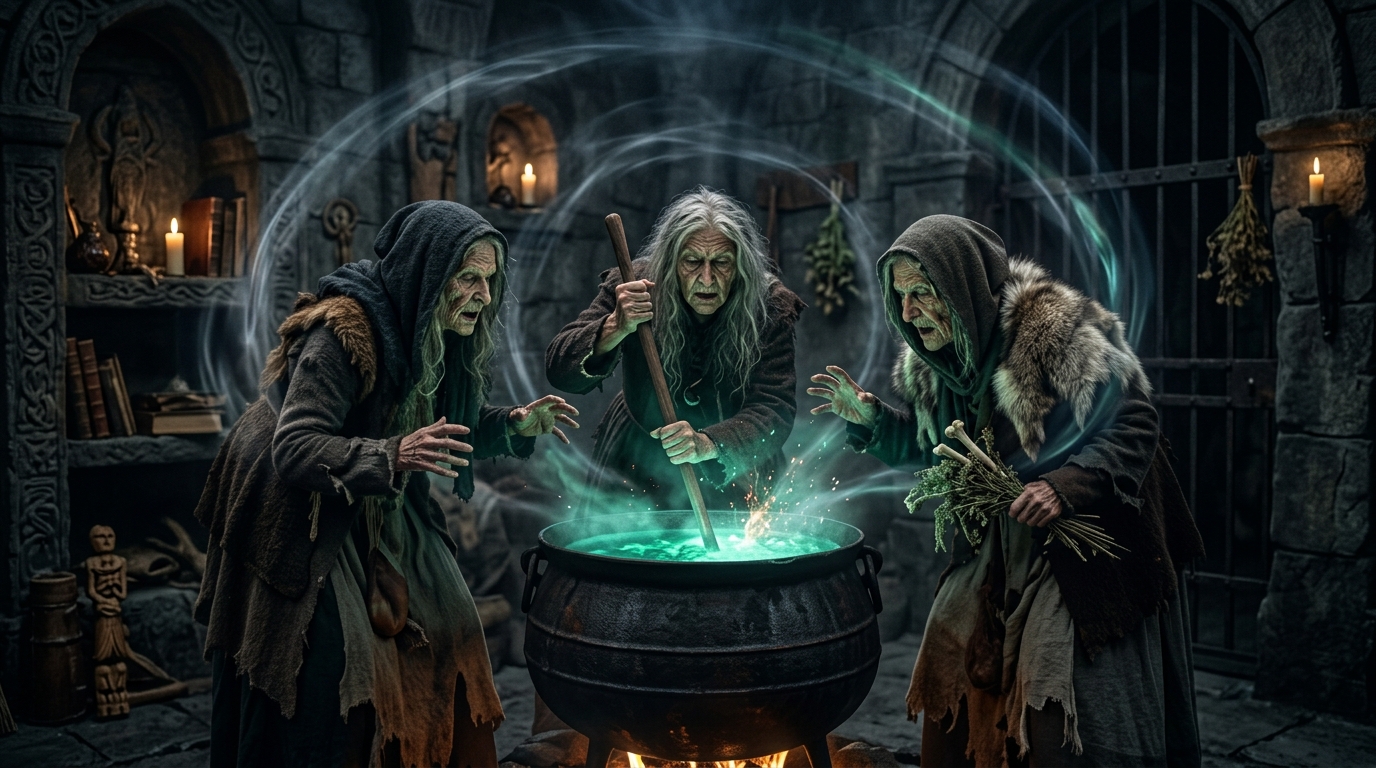
In A Midsummer Night’s Dream, Shakespeare explores the lighter, comedic side of supernatural incantations. Yet beneath the play’s playful surface lies the same volatile metrical engine found in his darkest tragedies.
                             FAIRY INCANTATION IN ACTION

   SPELL INTENT (Oberon)                          UNINTENDED EFFECT (Puck)
┌──────────────────────────────┐              ┌──────────────────────────────┐
│ Restore Order & Harmony      │ ───────────> │ Metrical & Romantic Chaos    │
│ "Charming" Titania's eyes    │  Misapplied  │ Lysander loves Helena;       │
│ Trochaic Love-Juice Formula  │  Juice       │ Titania falls for Bottom     │
└──────────────────────────────┘              └──────────────────────────────┘
Puck and Oberon: The Darker Edge of Fairy Charms
The fairies of Athens do not speak like human courtly lovers. When Oberon and Puck apply the magic juice of “love-in-idleness” to sleeping eyelids, they speak in rapid trochaic couplets:
“Flower of this purple dye,
Hit with Cupid’s archery,
Sink in apple of his eye.”
This is structurally identical to the witches’ cauldron chant in Macbeth. The meter is sharp, binding, and authoritative. It operates as a verbal contract that overrides the sleeping victim’s free will.
Comedy Born from Linguistic Mischief
The humor of the play arises when this binding language is misapplied. When Puck squeezes the magical potion onto the wrong sleeping Athenian’s eyes, the strict, unyielding nature of spell poetry ensures that the error takes immediate effect.
Because spell verse is absolute in its execution, characters wake up instantly bound to love whoever stands before them—whether it is an inappropriate lover or a weaver transformed into a donkey. Shakespeare uses the rigid mechanics of magical verse to show how easily human reason can be overthrown by irrational desire.
VI. Step-by-Step Guide: How to Read and Analyze “Spell Poetry” Like an Expert
When reading or performing a Shakespeare play, encountering a section of supernatural verse requires a specific analytical approach. Use this four-step framework to uncover the structural meaning of any incantatory passage:
[Step 1: Mark the Stresses (Scansion)]
                 │
                 ▼
[Step 2: Check for Metrical Truncation (Catalexis)]
                 │
                 ▼
[Step 3: Map Sonic & Physical Ingredients]
                 │
                 ▼
[Step 4: Track Metrical Infection across Characters]
Step 1: Mark the Stresses (Scansion)
Read the passage aloud and pay attention to where your voice naturally places emphasis. If the line begins with a strong, emphatic push ($\mathtt{DUM\text{-}da}$) rather than a gentle rise ($\mathtt{da\text{-}DUM}$), you have identified a trochaic metrical foot.
Step 2: Check for Metrical Truncation (Catalexis)
Count the syllables in the line. Standard iambic pentameter contains 10 syllables. Spell poetry typically drops to 7 or 8 syllables. A 7-syllable line ending on a hard stress signals a catalectic line, designed to create a driving, percussive pause at the end of the phrase.
Step 3: Map Sonic and Physical Ingredients
Catalog the specific nouns, verbs, and consonant sounds used in the chant. Look for:
-
Plosive consonants ($b, p, t, d, k, g$): Create physical impact.
-
Sibilance ($s, sh, z$): Suggests whispering, snakes, or secrecy.
-
Concrete physical items: Bones, body parts, animals, and herbs that anchor the magic in tangible reality.
Step 4: Track Metrical Infection across Characters
Examine the scene immediately following the spell. Do the human characters speaking in iambic pentameter begin to adopt trochaic words, unexpected rhymes, or broken rhythms? If so, the spell is actively altering their psychological stability.
VII. Key Comparison: Standard Shakespearean Verse vs. Spell Poetry
To quickly distinguish between human dialogue and magical incantation, refer to this structural breakdown:
| Feature | Standard Blank Verse | Spell Poetry |
| Primary Meter | Iambic Pentameter (10 Syllables) | Trochaic Tetrameter Catalectic (7–8 Syllables) |
| Rhythmic Pattern | Unstressed $\rightarrow$ Stressed ($\mathtt{da\text{-}DUM}$) | Stressed $\rightarrow$ Unstressed ($\mathtt{DUM\text{-}da}$) |
| Rhyme Scheme | Unrhymed (Blank Verse) | Rapid Rhyming Couplets (AABB / AAAA) |
| Acoustic Feel | Rising, natural, speech-like, reflective | Falling, percussive, chant-like, driving |
| Dramatic Function | Rational debate, emotional intimacy, internal thought | Ritual command, altering reality, psychological control |
| Associated Characters | Kings, noblemen, tragic heroes, lovers | Witches, spirits, fairies, enchanters |
VIII. Frequently Asked Questions (FAQ)
Did Shakespeare invent spell poetry?
No. Shakespeare adapted the traditions of early modern folk charms, church litanies, and classical poetry (such as Ovid’s Metamorphoses). However, he popularized the technique of contrasting trochaic spell verse directly against iambic pentameter to create dramatic tension on stage.
Why do the witches in Macbeth speak in rhyming trochees while Macbeth speaks in blank verse?
The contrast emphasizes that the witches belong to an inverted order of reality. By speaking in trochees, their very language sounds unman, unnatural, and uncanny to human ears attuned to iambic speech.
Is all rhyming verse in Shakespeare considered spell poetry?
No. Shakespeare frequently used rhyming couplets for prologues, epilogues, comedic lovers, and dramatic scene endings. Spell poetry specifically combines rhyming couplets with trochaic meter, shorter line lengths, and incantatory thematic content.
Can a human character learn to speak spell poetry?
Yes. Characters who practice magic (like Prospero in The Tempest) or characters who are consumed by supernatural corruption (like Macbeth or Lady Macbeth in her sleepwalking scene) often shift into trochaic and rhymed structures as their authority over normal reality changes.
IX.The Lasting Magic of the Bard’s Incantations
Spell poetry is far more than an artistic embellishment or a colorful musical interlude. It is a calculated prosodic engine that allows William Shakespeare to disrupt the natural order of his dramatic worlds.
By reversing the fundamental heartbeat of English verse—moving from the rational rise of the iamb to the relentless fall of the trochee—Shakespeare alters how his plays feel at a visceral level. Whether used to manifest terror on the blasted heath of Macbeth, bring peace to a fractured family in The Tempest, or induce comedic chaos in A Midsummer Night’s Dream, spell poetry remains one of the most sophisticated tools in early modern drama.