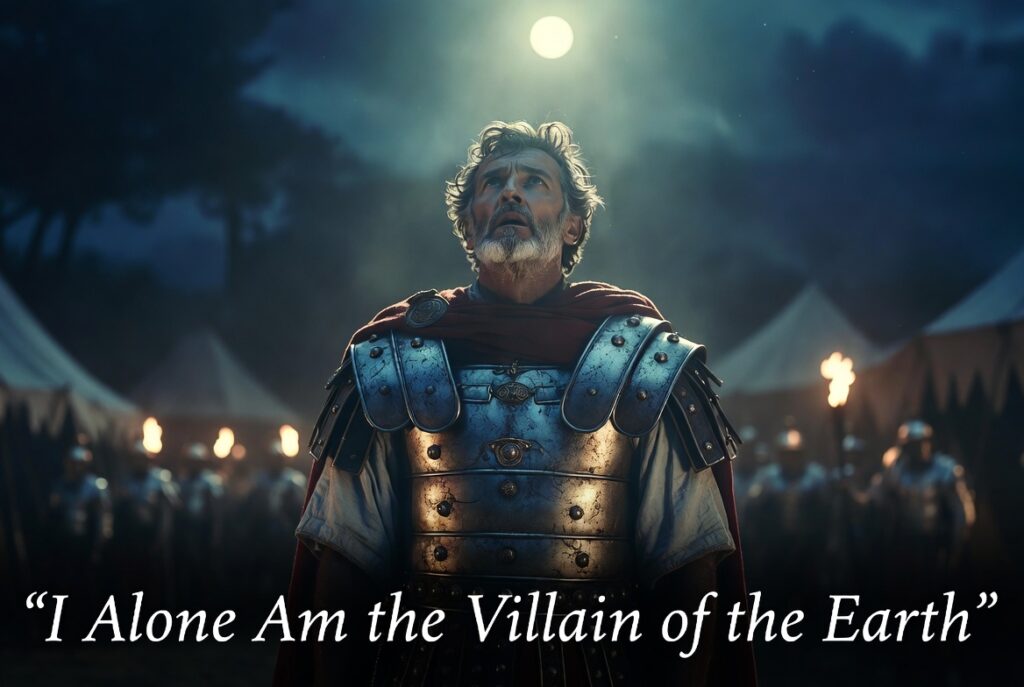
In the moonlit shadows of Caesar’s camp, a hardened Roman soldier stands utterly alone. His voice cracks as he utters one of Shakespeare’s most devastating self-indictments: “I alone am the villain of the earth.” This is Domitius Enobarbus in Antony and Cleopatra, Act 4, Scene 6—a moment that distills the play’s exploration of loyalty, power, and the irreversible human price of betrayal. As a Shakespeare specialist with over 15 years teaching and directing the canon at university level and in professional theater, I have returned to this speech countless times with students, actors, and fellow scholars. It never fails to land like a gut punch. Far more than a fleeting regret, Enobarbus’s confession reveals Shakespeare’s profound understanding of how political pragmatism can destroy the soul.
If you have ever wondered why this single line haunts readers, performers, and critics more than many longer soliloquies, you are not alone. This article provides the definitive, skyscraper-level analysis you need—scene-by-scene context, line-by-line dissection, thematic depth, performance history, and modern lessons. Whether you are a literature student preparing an essay, an educator designing a lesson, a theater practitioner rehearsing the role, or simply a lover of Shakespeare seeking deeper insight, this guide equips you to understand, teach, and feel the full emotional weight of Enobarbus’s tragic confession. By the end, you will grasp not only the literary genius behind the speech but also its enduring relevance to the loyalty dilemmas we face today.
Why Antony and Cleopatra Matters in Shakespeare’s Roman Canon
Shakespeare’s Roman plays—Julius Caesar, Antony and Cleopatra, and Coriolanus—form a trilogy that examines the collision of personal passion and imperial power. Written around 1606–1607, Antony and Cleopatra sits at the heart of this sequence, dramatizing the final days of the Roman Republic’s transformation into empire after the Battle of Actium. Drawing primarily from Plutarch’s Life of Mark Antony (via Thomas North’s 1579 translation), Shakespeare transforms historical events into a sweeping tragedy of love, politics, and cultural clash between Roman duty and Egyptian sensuality.
The play’s Elizabethan audience would have recognized echoes of their own anxieties: Queen Elizabeth I’s recent death, the looming question of succession, and the tension between martial honor and courtly pleasure. In this context, Enobarbus functions as the grounded everyman—neither emperor nor queen—whose arc exposes the fragility of loyalty when survival is at stake. His betrayal is not cartoonish villainy; it is the quiet, rational choice of a survivor that ultimately proves fatal to his spirit.
From Loyal Lieutenant to Defector: Who Is Enobarbus?
Enobarbus enters the play as Antony’s most trusted officer, a blunt pragmatist whose wit and clear-eyed realism make him the audience’s surrogate. In Act 2, Scene 2, he delivers the famous “barge speech,” painting Cleopatra’s arrival on the River Cydnus in language so lush it rivals the play’s greatest poetry: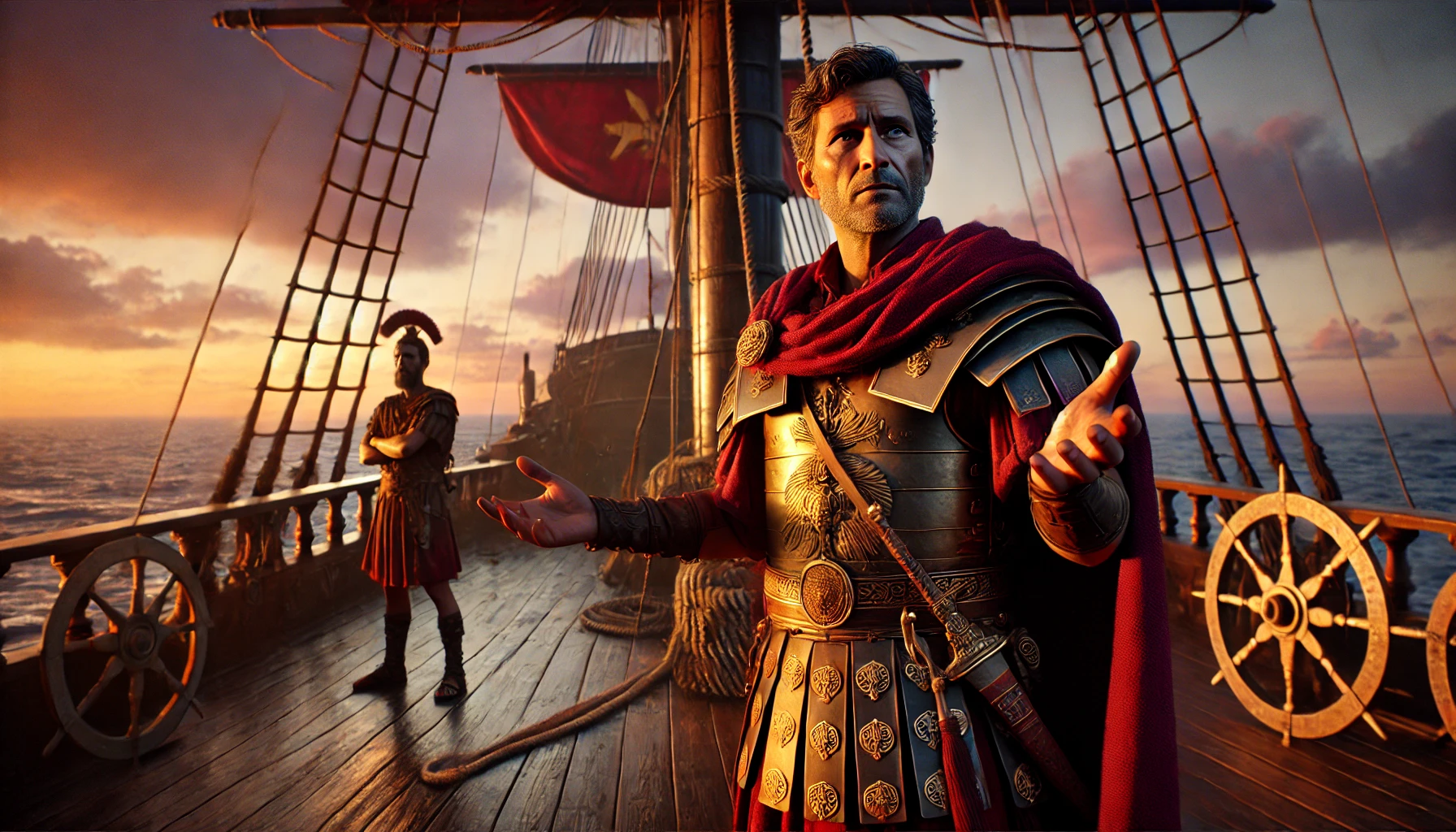
The barge she sat in, like a burnish’d throne, Burn’d on the water: the poop was beaten gold; Purple the sails, and so perfumèd that The winds were love-sick with them.
This is no mere description; it reveals Enobarbus’s deep affection for Antony even as he acknowledges Cleopatra’s dangerous allure. He is loyal, but never blind. Early scenes establish his character as the voice of Roman pietas tempered by worldly cynicism—qualities that make his later defection both shocking and tragically believable.
The turning point comes in Act 3. After Antony’s disastrous naval defeat at Actium—largely blamed on Cleopatra’s flight—Enobarbus watches his commander’s fortunes crumble. Pragmatism overrides loyalty. In a private moment, he decides to defect to Caesar, reasoning that “the loyalty well held to fools does make / Our faith mere folly” (3.13.42–43). He leaves behind his treasure chests, a detail Shakespeare invents to heighten the pathos. Historically, the real Domitius Ahenobarbus did switch sides before Actium, but Shakespeare delays and personalizes the betrayal, making Enobarbus’s choice a fully realized human drama rather than mere political expediency.
Expert Insight: Contrast Enobarbus’s cool calculation with Antony’s romantic fatalism. Where Antony chooses passion over prudence (“Let Rome in Tiber melt”), Enobarbus chooses survival—only to discover that survival without honor is no life at all.
“I Alone Am the Villain of the Earth” – The Confession Scene in Full (Act 4, Scene 6)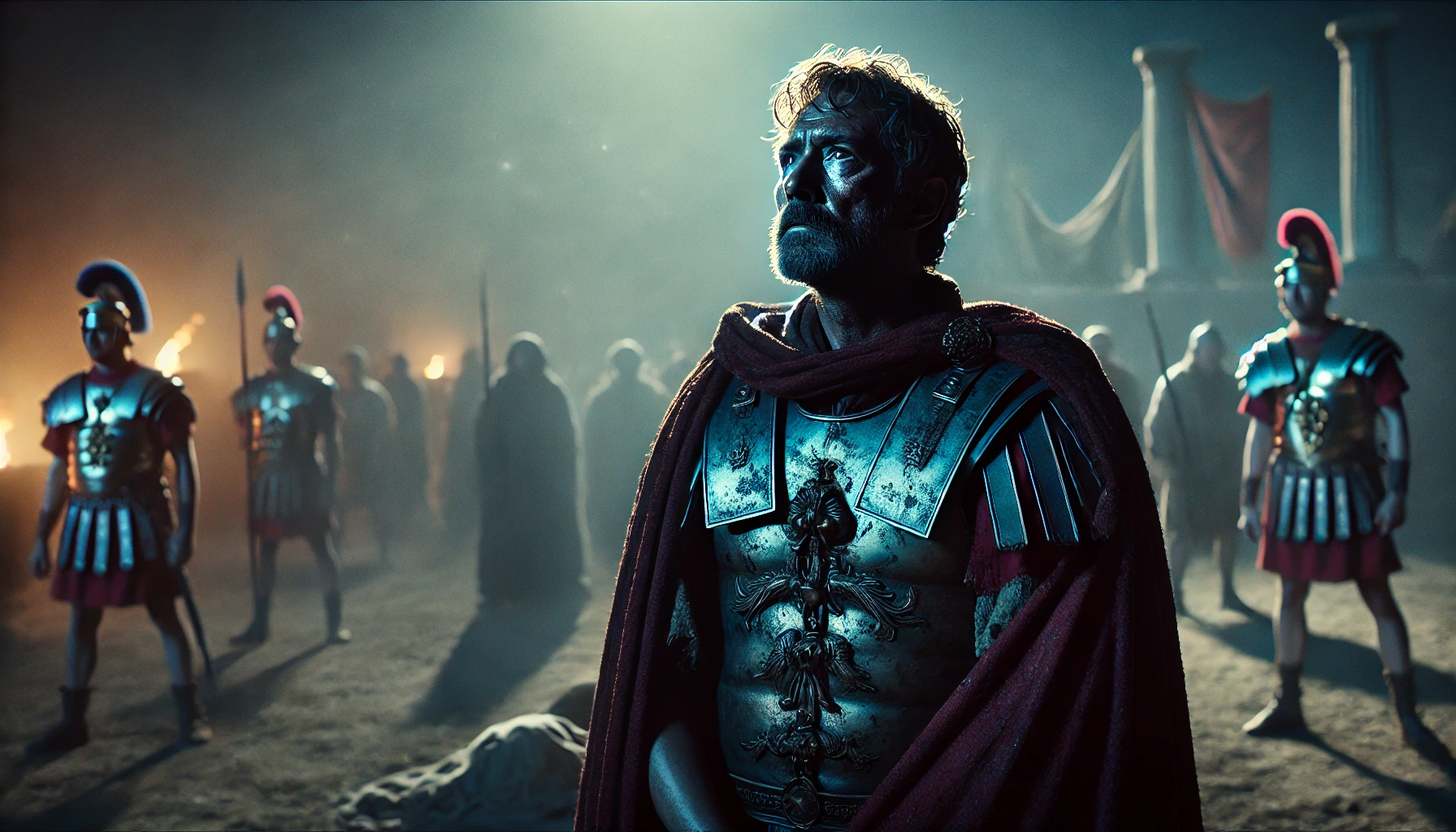
The confession unfolds in Caesar’s camp at Alexandria. Antony has surprisingly rallied and won a land battle, but the larger war is lost. A soldier informs Enobarbus that Antony has sent his abandoned treasure “with his bounty overplus,” a gesture of extraordinary generosity from a betrayed commander. The news shatters Enobarbus.
Left alone on stage, he speaks the pivotal lines (Folger Shakespeare Library edition, modernized spelling for clarity while preserving original rhythm):
I am alone the villain of the earth, And feel I am so most. O Antony, Thou mine of bounty, how wouldst thou have paid My better service, when my turpitude Thou dost so crown with gold! This blows my heart. If swift thought break it not, a swifter mean Shall outstrike thought: but thought will do’t, I feel. I fight against thee? No. I will go seek Some ditch wherein to die; the foul’st best fits My latter part of life.
Shakespeare’s stage direction is implicit but powerful: Enobarbus is isolated. No confidant, no chorus—only the audience bears witness to his self-condemnation. The speech is short (just 12 lines), yet it compresses an entire tragic arc. Immediately afterward, Enobarbus exits to die offstage, reportedly of a broken heart. His death is not spectacular like Antony’s or Cleopatra’s; it is quiet, internal, and devastatingly human.
Full Scene Context: The preceding action shows Caesar ordering Antony’s soldiers who defected to be placed in the front lines—“that Antony may seem to spend his fury / Upon himself.” Enobarbus learns that other defectors like Alexas have been executed or denied trust. His own “honourable” treatment by Antony only magnifies his guilt.
Dissecting Shakespeare’s Masterful Language: Line-by-Line Analysis
The confession’s power lies in Shakespeare’s precise rhetorical craft. Let us break it down rigorously.
Lines 1–2: “I am alone the villain of the earth, / And feel I am so most.” The focus keyword phrase—“I alone am the villain of the earth”—captures the essence, though the First Folio and modern editions render it “I am alone the villain of the earth.” The word “alone” carries double weight: Enobarbus is physically solitary on stage and morally isolated in the universe. “Villain” evokes both theatrical stock villainy and its older sense of “serf” or “low-born wretch,” underscoring his self-debasement. The repetition “I … I” and the intensifier “so most” create a rhythm of relentless self-accusation.
Lines 3–6: The apostrophe to Antony. Enobarbus addresses the absent Antony as “Thou mine of bounty,” an image of inexhaustible generosity. The antithesis is brutal: Antony rewards “turpitude” (moral filth) with gold that should have rewarded “better service.” This inversion of desert and reward “blows [his] heart”—a physical metaphor for emotional rupture.
Lines 7–10: The death wish. Enobarbus contemplates suicide by thought alone (“If swift thought break it not”) or by seeking “some ditch wherein to die.” The choice of “foul’st” ditch is deliberate; he rejects heroic death, embracing the degradation he believes he deserves. The iambic pentameter falters here, with irregular stresses mirroring his psychological fracture.
Rhetorical Devices Table (for quick reference):
| Device | Example | Emotional Effect |
|---|---|---|
| Anaphora | “I am alone… And feel I am so most” | Builds crushing self-awareness |
| Antithesis | Bounty vs. turpitude | Highlights moral inversion |
| Apostrophe | Direct address to absent Antony | Intensifies isolation and regret |
| Metaphor | “Mine of bounty,” “blows my heart” | Makes abstract guilt visceral |
The Deeper Themes: Betrayal and Its Human Cost in Shakespeare’s World
Enobarbus’s confession is far more than a personal cry of remorse. It stands as Shakespeare’s most piercing examination of the moral and psychological consequences of betrayal. In a play filled with grand gestures—Antony’s suicidal passion, Cleopatra’s theatrical death—Shakespeare gives the quietest, most ordinary character the most devastating insight into loyalty’s fragility.
Betrayal versus Self-Preservation in a World of Shifting Power
At its core, Enobarbus’s decision reflects the brutal pragmatism required in times of civil war and regime change. He is not motivated by malice like Iago or ideological conviction like Brutus. His reasoning is coldly rational: Antony is finished, Caesar is rising, and clinging to a losing cause is folly. Yet Shakespeare refuses to let this calculation stand unchallenged. By having Antony respond with extravagant generosity—returning the treasure “with his bounty overplus”—the playwright forces Enobarbus (and the audience) to confront the human face of the man he betrayed.
This contrast reveals a central Shakespearean truth: political survival often demands the sacrifice of personal honor, but the soul pays an unbearable price. Enobarbus discovers too late that loyalty is not merely transactional. Once broken, it cannot be mended by regret alone.
Guilt as a Physical and Spiritual Disease
Shakespeare repeatedly links moral failure to bodily collapse. Enobarbus says the news “blows my heart,” and later declares that “thought will do’t.” His death is reported as a “swifter mean” brought on by grief rather than violence. This is no romantic exaggeration. In Shakespeare’s canon, guilt manifests physically—Lady Macbeth’s sleepwalking, Claudius’s tormented conscience, and here, Enobarbus’s broken heart. The body becomes the battlefield where moral reckoning is fought and lost.
The Impossibility of Redemption Once Honor Is Lost
Unlike many Shakespearean figures who seek forgiveness or atonement, Enobarbus never asks for it. He pronounces himself “the villain of the earth” and chooses the foulest ditch for his end. This self-sentencing reflects a deeply Roman (and Elizabethan) understanding of honor as an all-or-nothing quality. Once stained, it cannot be restored. Enobarbus’s tragedy lies in his clear-sightedness: he knows exactly what he has done and accepts there is no path back to integrity.
Contrast with Other Shakespearean Traitors
Placing Enobarbus beside other betrayers illuminates Shakespeare’s range:
- Brutus (Julius Caesar): Betrays for what he believes is the greater good of Rome. His tragedy is ideological self-deception.
- Iago (Othello): Betrays out of motiveless malignity and takes pleasure in destruction.
- Edmund (King Lear): Betrays for power and inheritance, embracing villainy openly.
- Enobarbus: Betrays out of pragmatic self-interest and is destroyed by the very conscience that made the betrayal possible.
Enobarbus is unique because his betrayal is the most relatable. Most of us will never face Iago’s evil or Brutus’s republican zeal, but many will face moments when loyalty conflicts with personal advancement. Shakespeare shows that even “reasonable” betrayal carries a lethal spiritual cost.
Comparative Sidebar: Enobarbus and Brutus both betray charismatic leaders in the name of Roman pragmatism, yet Brutus dies with stoic dignity on the battlefield while Enobarbus dies alone in shame. The difference lies in self-justification: Brutus convinces himself his cause is noble; Enobarbus never manages that illusion.
Critical Perspectives Through the Centuries
Scholars have long recognized the extraordinary power of Enobarbus’s brief appearance and swift exit.
19th and Early 20th Century Views A.C. Bradley, in his influential Shakespearean Tragedy (1904), praised Enobarbus as one of Shakespeare’s most lifelike minor characters—neither purely comic nor tragic, but profoundly human. Harley Granville-Barker, in his Prefaces to Shakespeare, highlighted the theatrical brilliance of isolating Enobarbus on stage, noting how the speech’s brevity amplifies its emotional impact.
Modern Readings New Historicist critics, including Stephen Greenblatt, situate Enobarbus within Elizabethan anxieties about allegiance during times of political instability. Gender-focused scholars like Janet Adelman (The Common Liar) explore how Enobarbus’s defection mirrors the play’s broader tension between Roman masculinity and Egyptian “feminine” excess. Postcolonial readings examine the Roman/Egyptian cultural binary and how Enobarbus’s pragmatism represents the colonizer’s calculating gaze.
Today, critical consensus views Enobarbus as Shakespeare’s most humane tragic figure in the Roman plays. He is not a hero or a villain in the grand sense, but an ordinary man whose moral failure reveals the universal cost of choosing expediency over fidelity.
Enobarbus on Stage and Screen: Performing the Confession
The role of Enobarbus has long been a prized vehicle for character actors precisely because the confession scene offers such concentrated dramatic opportunity in a relatively small part.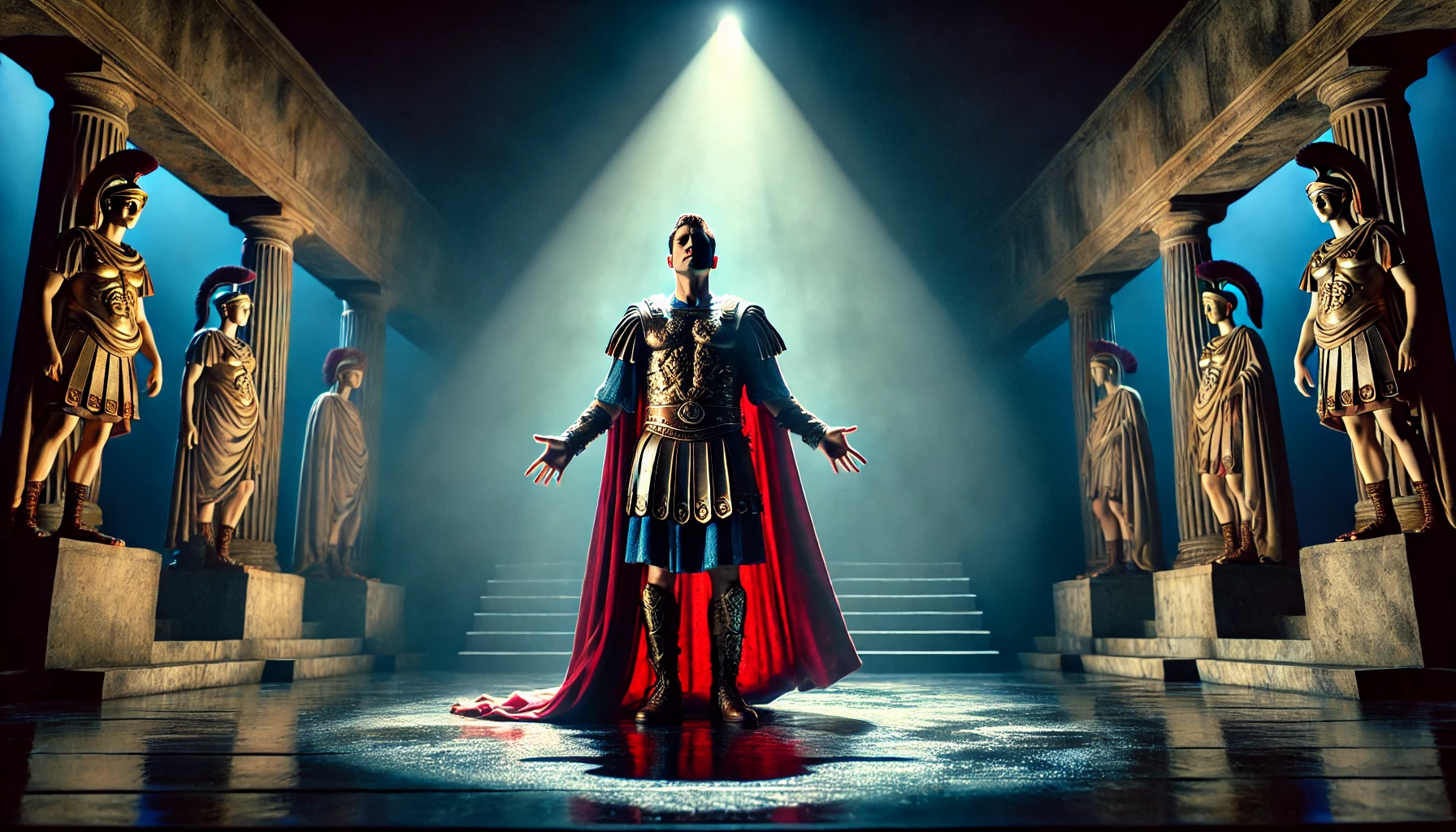
Landmark Productions
- In the 1978 RSC production directed by Peter Brook, Patrick Stewart’s Enobarbus delivered the speech with quiet, devastating restraint, emphasizing the character’s soldierly stoicism cracking under guilt.
- The 2017 National Theatre production starring Ralph Fiennes as Antony featured a raw, emotionally exposed confession that brought many audience members to tears.
- Modern adaptations, including the 2018 film version with Ralph Fiennes and Sophie Okonedo, have experimented with close-up camera work to capture the intimate agony of the moment.
Directors frequently make powerful choices: some bathe the stage in cold blue light to emphasize isolation; others use minimal sound design so the actor’s voice carries the entire weight. The best performances avoid melodramatic weeping, instead letting Shakespeare’s precise language do the work. The speech succeeds when the actor conveys a lifetime of military camaraderie collapsing in a single moment of self-realization.
Why the Role Remains a Gift For actors, Enobarbus offers the rare chance to steal a scene with minimal stage time. The confession requires technical control—mastery of iambic rhythm, emotional authenticity without excess, and the ability to convey a man’s entire inner life in under a minute. It is a masterclass in Shakespearean economy.
Why This Speech Still Matters Today: Modern Lessons from an Ancient Roman Soldier
More than 400 years after its creation, Enobarbus’s confession speaks directly to contemporary experiences of loyalty conflicts in politics, business, and personal life.
In an era of rapid career shifts, corporate mergers, and political realignments, many face versions of Enobarbus’s dilemma: Do I stay loyal to a struggling leader, project, or relationship, or do I join the winning side for self-preservation? Shakespeare offers no easy answers, but he shows the hidden cost. Choosing pragmatism may bring short-term security, yet it can leave lasting damage to one’s sense of self.
Practical Takeaways Here are five questions inspired by Enobarbus to ask when facing a loyalty dilemma:
- Am I justifying self-interest with the language of realism?
- How will this choice affect my long-term sense of integrity?
- Would I be proud to have this decision made public?
- What would the person I am betraying do in my position?
- If I choose survival over loyalty, am I prepared for the possible emotional or moral consequences?
These questions transform Enobarbus’s tragedy into a tool for ethical reflection—exactly the kind of value Shakespeare’s greatest moments continue to provide.
Frequently Asked Questions About Enobarbus’s Confession
Is “I alone am the villain of the earth” the exact wording? The line appears in modern editions as “I am alone the villain of the earth.” The slight variation in phrasing is common when quoting Shakespeare conversationally, but the meaning remains identical. The First Folio (1623) uses the wording that has become standard today.
Why does Enobarbus die of a broken heart rather than by sword? Shakespeare emphasizes the internal nature of his punishment. A battlefield death would grant him a soldier’s dignity; dying from grief strips that away, matching the self-abasement of his confession. It is a profoundly psychological end.
How does this speech connect to Cleopatra’s own arc? Both characters experience a form of moral reckoning. Cleopatra ultimately chooses a noble death to avoid humiliation in Rome, while Enobarbus chooses degradation. Their parallel yet contrasting responses to defeat enrich the play’s meditation on honor and shame.
Is Enobarbus based on a real historical figure? Yes. Plutarch records that Gnaeus Domitius Ahenobarbus (Enobarbus) defected to Octavian (Caesar) before the Battle of Actium. Shakespeare significantly alters the timing and invents the treasure-return episode to deepen the emotional impact.
What are the best editions for studying this scene? Recommended: The Arden Shakespeare Third Series (edited by John Wilders), the Folger Shakespeare Library edition, and the Oxford World’s Classics version. All provide excellent notes on textual variants and historical context.
“I alone am the villain of the earth” remains one of Shakespeare’s most haunting lines because it captures a universal human fear: the discovery that our most rational choices can leave us morally bankrupt. Enobarbus does not die a spectacular death like the play’s titular lovers. Instead, he dies in quiet agony, realizing too late that loyalty, once sacrificed for survival, cannot be recovered.
In exploring this confession so thoroughly—its language, context, themes, performance possibilities, and contemporary resonance—this article aims to give you the deepest possible appreciation of Shakespeare’s genius. Whether you are writing an essay, preparing a performance, teaching a class, or simply reflecting on the nature of fidelity in your own life, Enobarbus’s tragic insight offers lasting wisdom.
The next time you encounter shifting allegiances—in politics, at work, or among friends—remember the soldier who stood alone in Caesar’s camp. Shakespeare reminds us that some costs of betrayal are paid not in gold or power, but in the silent breaking of the human heart.