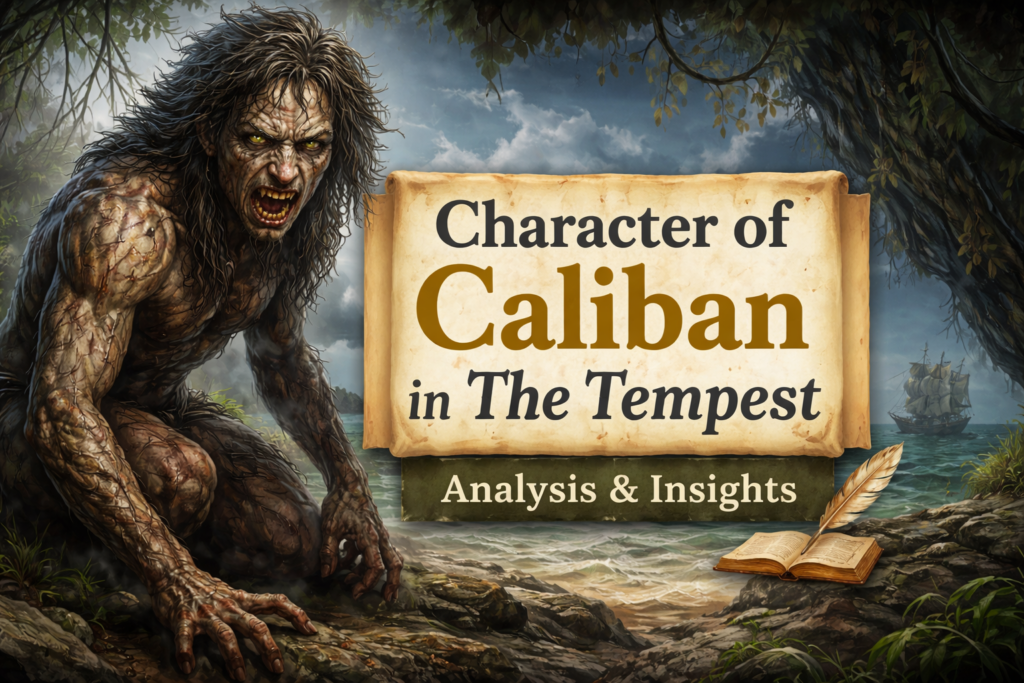
The character of Caliban in The Tempest delivers one of Shakespeare’s most electrifying opening salvos: “This island’s mine, by Sycorax my mother, / Which thou tak’st from me.” (1.2.331–332). A “monster” labeled savage and enslaved, he nonetheless commands the play’s most haunting poetry about freedom, dreams, and belonging. This immediate tension—between dehumanizing labels and eloquent resistance—hooks every reader, student, and theatergoer who encounters him.
In exploring the character of Caliban in The Tempest, we confront a figure who is simultaneously victim of colonial violence, villain through his attempted rape of Miranda, and the clearest voice of the oppressed in Shakespeare’s canon. His ambiguity refuses easy categorization, making him endlessly relevant in Caliban Tempest analysis across classrooms, stages, and scholarly debates.
Written around 1611 amid Jacobean fascination with New World voyages, Bermuda shipwrecks, Montaigne’s essays on cannibals, and witch-hunt panics, The Tempest places the exiled Duke Prospero, his daughter Miranda, the spirit Ariel, and Caliban—the son of the banished Algerian witch Sycorax—on a remote island. Prospero’s magic orchestrates revenge and reconciliation, but Caliban’s claim to original ownership drives the central conflict. Initially befriended and “civilized” through language, Caliban is enslaved after his assault on Miranda; he later conspires with the drunken Stephano and Trinculo to overthrow his master.
A post-colonial reading of The Tempest has dominated since the mid-20th century, yet the play’s moral complexity endures. In 2026, amid global conversations on indigenous rights, climate displacement, migration, and systemic power imbalances, Caliban’s story resonates more powerfully than ever. This comprehensive Shakespeare Caliban character study moves beyond plot summary. It delivers a scene-by-scene, theme-by-theme examination grounded in direct textual evidence, key Caliban quotes, balanced debate, and fresh insights from recent scholarship. Whether you are a student writing an essay, a teacher designing a unit, or a theater lover preparing for a production, this analysis equips you with nuanced tools for deeper appreciation and high-impact discussion.
Who Is Caliban? Origins, Backstory, and Dramatic Function
The Son of the “Blue-Eyed Hag” Sycorax — Historical and Literary Sources
Caliban’s mother, Sycorax, described by Prospero as the “blue-eyed hag” who imprisoned Ariel in a cloven pine, provides the character’s pre-colonial lineage. Banished from Algiers for sorcery, she died before Prospero’s arrival, leaving Caliban sole heir to the island. His famous assertion—“This island’s mine, by Sycorax my mother”—establishes legitimate prior claim, a detail that undercuts Prospero’s narrative of benevolent rule.
Shakespeare drew from Montaigne’s “Of Cannibals” (translated 1603), which questions European cultural superiority, and Bermuda pamphlets recounting the 1609 Sea Venture shipwreck. Caliban’s name evokes “cannibal” (a near-anagram) and the Carib peoples, blending New World stereotypes with witch-hunt hysteria. Recent Caliban Tempest analysis (Ezzat, 2025) frames him as a diasporic figure—displaced, hybrid, never fully belonging to one culture or race.
Caliban’s Pre-Prospero Life vs. Subjugation
Before the Europeans landed, Caliban was “king” of the island, lord of its “qualities”: fresh springs, brine-pits, fertile and barren ground. He showed Prospero and Miranda its riches and received initial kindness—“Thou strok’st me and made much of me” (1.2.332–333). Prospero’s “gift” of language and attempted education soured after the Miranda incident, resulting in enslavement, rock confinement, and forced labor. This arc mirrors colonial contact narratives: initial alliance, resource extraction, then domination justified by moral superiority.
Dramatic Role: Foil to Ariel, Mirror to Prospero, and Bridge Between Worlds
Caliban functions as earthy foil to Ariel’s airy obedience—resentful physical labor versus willing service. He mirrors Prospero in claiming mastery and wielding curses or magic for power. Most crucially, he bridges the “natural” (instinct, body, island ecology) and “civilized” (language, hierarchy, European learning), exposing the fragility of those binaries. As Jeffrey R. Wilson notes in his stigma studies, Caliban dramatizes how abnormality acquires meaning through hostile social interactions rather than inherent monstrosity.
Physical Appearance and the Politics of Monstrosity
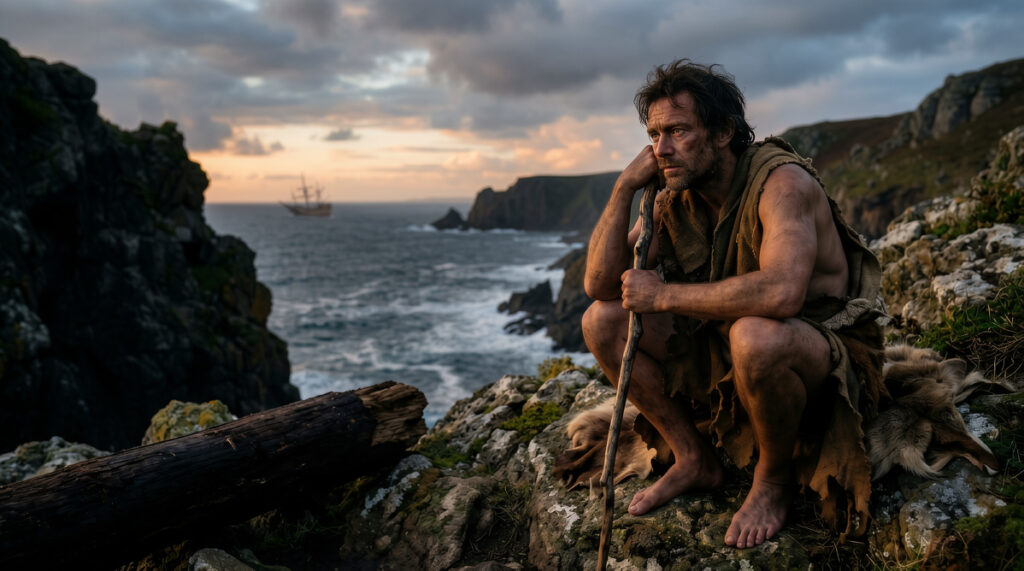
Shakespeare offers scant stage directions—“a savage and deformed slave”—yet early modern audiences expected hybrid “monsters” from travel literature. Prospero and Miranda brand him “filth,” “tortoise,” “Hag-seed,” and “thing of darkness.” Trinculo imagines exhibiting him in England for profit, like a carnival freak.
Caliban’s deformity operates as potent metaphor: racialized other (New World native or African), disabled body, or class grotesque. In Caliban colonialism readings, his form embodies the colonizer’s anxious projection of otherness. Höfele’s 2024 analysis of “artifice and animality” highlights how Caliban’s indeterminacy mirrors the island itself—neither fully human nor beast, forcing audiences to wrestle with his humanity.
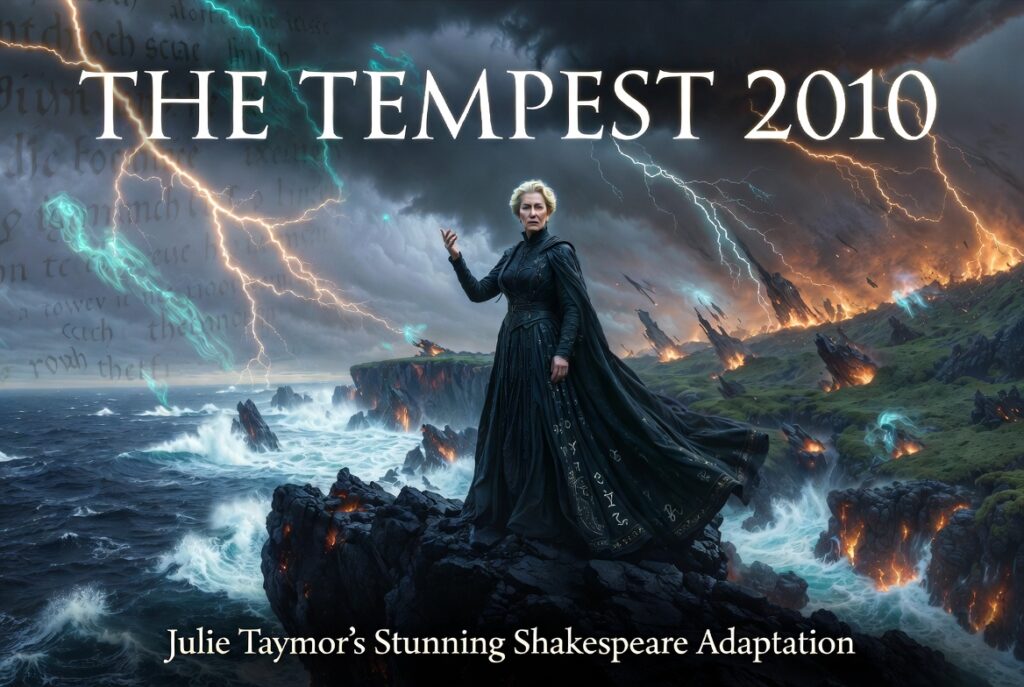
Twenty-first-century productions deliberately reimagine his body to challenge stereotypes. Julie Taymor’s 2010 film features Djimon Hounsou as a scarred, dignified Caliban with ritualistic markings that evoke trauma rather than inherent monstrosity. Recent RSC touring productions (2025) and Shakespeare’s Globe’s 2026 Sam Wanamaker Playhouse staging (Faizal Abdullah as Caliban, directed by Tim Crouch) portray him as athletic and indigenous-coded, emphasizing agency and resilience over deformity. International stagings increasingly incorporate local contexts—Caribbean resistance, ecological activism, or disability pride—turning Caliban’s physicality into a site of political reclamation rather than spectacle.
Pull Quote: “You taught me language, and my profit on’t / Is, I know how to curse.” (1.2.363–365) — Caliban’s indictment of linguistic colonialism
Key Scenes That Define Caliban’s Character (Scene-by-Scene Breakdown)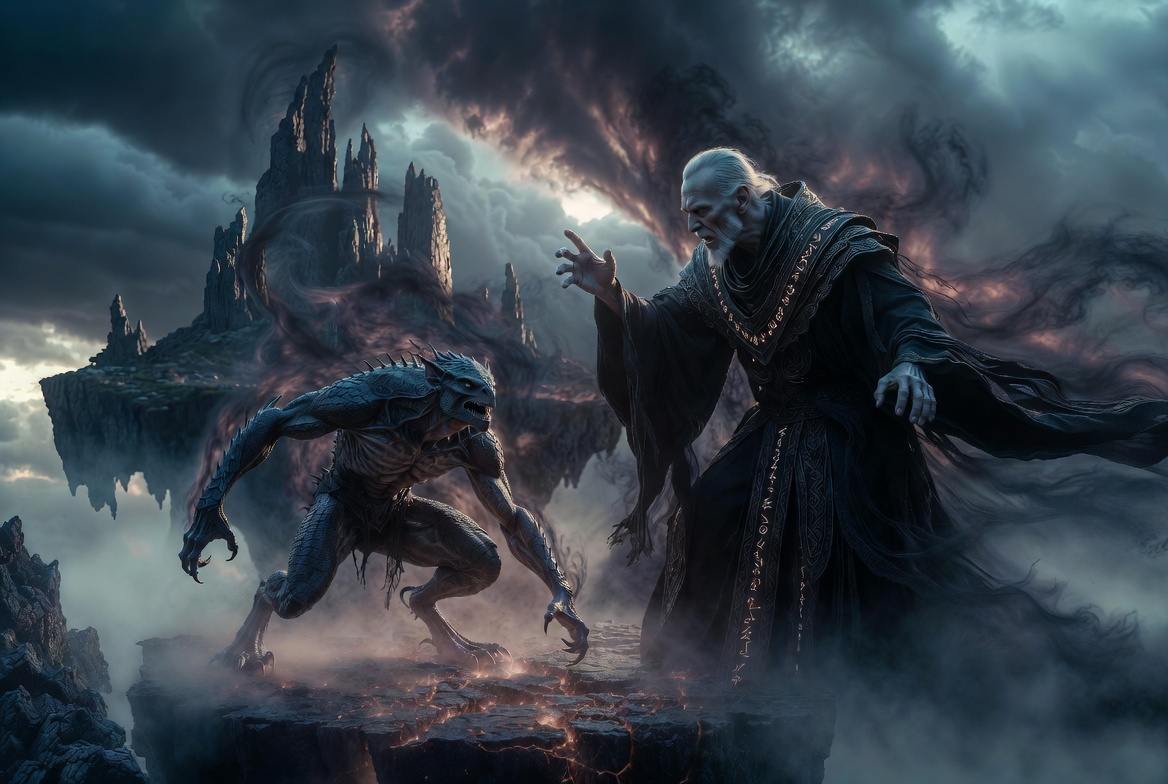
Act 1, Scene 2 — The First Confrontation
Caliban erupts onstage cursing: “As wicked dew as e’er my mother brushed / With raven’s feather from unwholesome fen / Drop on you both!” (1.2.321–323). His confrontation with Prospero crystallizes the master-slave rupture. The landmark Caliban quote—“You taught me language, and my profit on’t / Is, I know how to curse”—reveals language as double-edged: Prospero’s “civilizing” tool becomes a weapon of resistance. The scene exposes the backstory of attempted rape and shifts sympathy, forcing audiences to weigh Caliban’s grievance against his crime.
Act 2, Scene 2 — The “Drunken Butler” Subplot and Comic-Tragic Rebellion
Paired with Stephano and Trinculo, Caliban worships wine as divine and sings of liberation: “’Ban, ’Ban, Ca-Caliban / Has a new master: get a new man!” The subplot parodies colonial exploitation while humanizing Caliban’s desperate longing for freedom. His poetic sensitivity surfaces even here, contrasting the clowns’ buffoonery and underscoring his tragic isolation.
Act 3, Scene 2 — The Conspiracy and Most Eloquent Speech on Dreams and Freedom
Caliban delivers Shakespeare’s most lyrical defense of the island:
“Be not afeard. The isle is full of noises, Sounds and sweet airs that give delight and hurt not. Sometimes a thousand twangling instruments Will hum about mine ears, and sometimes voices That, if I then had waked after long sleep, Will make me sleep again; and then, in dreaming, The clouds methought would open and show riches Ready to drop upon me, that when I waked I cried to dream again.” (3.2.130–138)
This passage shatters the “savage” stereotype, revealing profound ecological attunement and spiritual depth. Recent ecocritical scholarship (2024) links this speech to Caliban’s role as environmental steward, contrasting Prospero’s exploitative magic.
Act 5, Scene 1 — Final Lines and Ambiguous Redemption
Prospero’s admission—“This thing of darkness I / Acknowledge mine” (5.1.275–276)—marks partial reckoning. Caliban’s closing words—“I’ll be wise hereafter / And seek for grace” (5.1.294–295)—remain provocatively open. Does he achieve redemption, or simply submit? The ambiguity invites ongoing Caliban victim or villain debate.
Caliban’s Language: Poetry, Curses, and Linguistic Resistance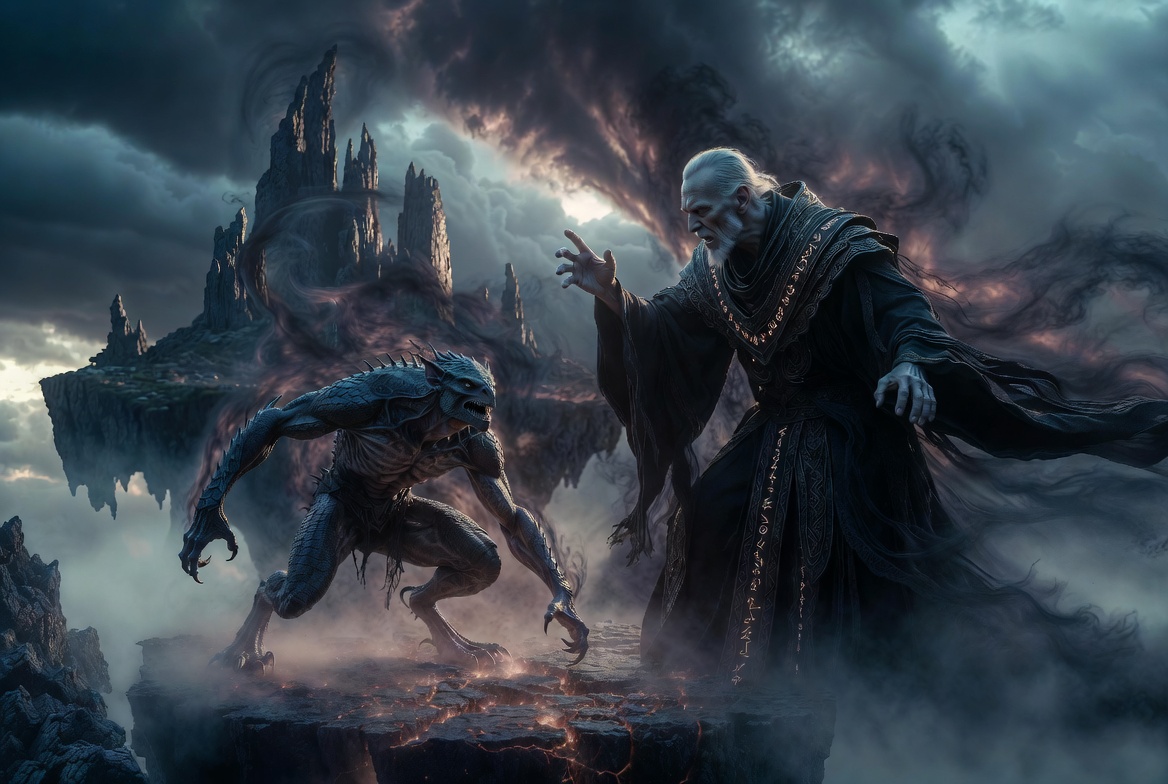
Caliban’s command of language stands as one of the most subversive elements in The Tempest. Prospero boasts of having “taught thee language,” yet Caliban weaponizes that same gift against his oppressor. His speeches alternate between visceral curses and transcendent poetry, creating a linguistic duality that mirrors his conflicted position: both shaped by European imposition and resistant to it.
The curse in Act 1, Scene 2 exemplifies raw defiance:
“As wicked dew as e’er my mother brushed With raven’s feather from unwholesome fen Drop on you both! A south-west blow on ye And blister you all o’er!” (1.2.321–324)
This imagery draws from the island’s natural elements—dew, fen, wind—turning the environment itself into an instrument of revenge. It contrasts sharply with Prospero’s more controlled, book-learned magic. Later, Caliban’s dream speech in Act 3, Scene 2 reveals an almost mystical attunement to the island’s “noises” and “sweet airs,” evoking a pre-colonial harmony that Prospero’s arrival disrupts. The passage’s rhythmic beauty and sensory richness undermine any simple “savage” label.
Scholars like Stephen Greenblatt have long noted how Caliban’s eloquence exposes the limits of colonial “civilizing” projects. Language here is not neutral; it is a site of power. By cursing in the colonizer’s tongue, Caliban performs what postcolonial theorist Homi Bhabha calls “mimicry” with a difference—repeating the master’s language but with subversive intent. Recent 2025–2026 linguistic studies (for example, analyses in Shakespeare Quarterly and digital humanities projects mapping curse patterns) highlight how Caliban’s vocabulary blends European blank verse with earthy, elemental terms, creating a hybrid idiolect that prefigures creole languages in colonial contexts.
Pull Quote: “You taught me language, and my profit on’t / Is, I know how to curse.” (1.2.363–365)
This remains one of Shakespeare’s most quoted lines on linguistic imperialism, frequently invoked in discussions of education under occupation or cultural assimilation.
Power Dynamics: Master, Slave, and the Illusion of Control
The relationship between Prospero and Caliban forms the play’s core power struggle. Prospero positions himself as enlightened ruler and teacher, yet his methods—confinement, torment by spirits, and constant threats—reveal authoritarian control. Caliban’s labor (fetching wood, gathering fuel) sustains Prospero’s magical regime, echoing real colonial economies where indigenous or enslaved bodies supported European enterprises.
Prospero’s famous line in Act 5—“This thing of darkness I / Acknowledge mine”—suggests a moment of self-reflection, possibly recognizing the monstrous aspects within himself projected onto Caliban. Yet the acknowledgment stops short of liberation; Caliban’s future on the island after Prospero’s departure remains uncertain. Is he freed or merely abandoned?
Feminist and postcolonial critics (including Ania Loomba and Kim Hall) point out intersecting oppressions: Caliban’s attempted rape of Miranda links sexual violence to colonial conquest, complicating his victim status. Miranda’s education of him is framed as benevolent, but it also erases his pre-existing knowledge of the island. Recent scholarship in 2026, influenced by #MeToo and decolonial movements, increasingly reads this triangle as a microcosm of gendered and racial power imbalances in early modern exploration narratives.
Caliban’s conspiracy with Stephano and Trinculo further complicates the dynamics. While comic on the surface, it reveals his strategic (if flawed) attempt to reclaim agency. The failure underscores the play’s pessimism about subaltern revolt, yet his loyalty to the island’s “qualities” persists.
Thematic Breakdown: Key Motifs Through Caliban
- Colonialism and Otherness: Caliban embodies the “noble savage” debate inherited from Montaigne, but Shakespeare complicates it. He is neither purely innocent nor irredeemably brutal.
- Nature vs. Nurture: His “deformity” raises questions about whether monstrosity is innate or constructed through social rejection.
- Freedom and Servitude: Contrasted with Ariel’s willing service, Caliban’s desire for liberty feels more visceral and earth-bound.
- Forgiveness and Reconciliation: The play’s comic resolution marginalizes Caliban, leaving his arc open-ended and resistant to Prospero’s harmonious closure.
- Ecocriticism: Caliban as steward of the island’s ecology versus Prospero’s disruptive magic anticipates modern environmental justice themes.
History of Scholarship on Caliban
Early 18th–19th century views often saw Caliban as a comic grotesque or Darwinian “missing link.” 20th-century shifts, especially after Octave Mannoni’s Prospero and Caliban (1950) and the rise of postcolonial theory (Aimé Césaire’s Une Tempête, 1969; Roberto Fernández Retamar’s “Caliban,” 1971), reframed him as a symbol of anti-colonial resistance. In the 1980s–2000s, new historicist and cultural materialist readings emphasized Jacobean context and power structures.
Contemporary 2020s scholarship integrates intersectionality, disability studies, and ecocriticism. Works from 2024–2026 increasingly link Caliban to climate refugees, indigenous land rights (e.g., Standing Rock or Amazonian activism), and hybrid identities in global migration. Digital projects and performance-as-research have expanded access to diverse global stagings.
Modern Adaptations and Productions
Beyond Taymor’s film, notable adaptations include:
- Césaire’s Une Tempête (recasting Caliban as revolutionary Black figure).
- The 2010s–2020s surge in non-traditional casting and indigenous-led productions (e.g., Australian or Māori-inflected versions emphasizing Caliban’s connection to land).
- 2025–2026 Globe and RSC stagings mentioned earlier, which foreground ecological themes and Caliban’s poetry as protest.
These reinterpretations transform Caliban from peripheral “monster” to central protagonist in many retellings.
Contemporary Relevance in 2026
In an era of ongoing debates about reparations, cultural appropriation, land back movements, and AI-driven surveillance of marginalized voices, Caliban’s cry—“This island’s mine”—echoes powerfully. His language of resistance resonates with activists fighting linguistic erasure and environmental exploitation. Educational contexts use him to discuss decolonizing curricula, while theater serves as a space for empathy-building across divides.
Caliban defies singular categorization. He is victim of dispossession and enslavement, villain in his violent impulses, and the most articulate voice of the oppressed in Shakespeare’s works. His ambiguity invites us to question who truly “owns” narratives of civilization, belonging, and freedom. In The Tempest’s final reckoning, Prospero departs, but Caliban remains—perhaps the true inheritor of the island’s dreams and noises. Shakespeare leaves the judgment to us, ensuring Caliban’s relevance endures.
Table: Caliban vs. Prospero – Key Oppositions
| Aspect | Caliban | Prospero |
|---|---|---|
| Claim to Island | By maternal inheritance | By conquest and magic |
| Relationship to Nature | Embodied, sensory, harmonious | Controlling, instrumental |
| Use of Language | Curses and poetry of resistance | Commands and spells of domination |
| Freedom | Desires bodily and territorial | Seeks political restoration |
| Resolution | Ambiguous submission/grace | Forgiving return to Milan |
FAQ
Is Caliban a hero or villain? Neither exclusively. He embodies both victimhood and moral failing, making him a complex anti-hero.
Why is Caliban’s attempted rape included? It complicates sympathy and reflects early modern anxieties about miscegenation and “savage” sexuality, while inviting critical interrogation in modern readings.
How has interpretation changed since Shakespeare’s time? From comic monster to symbol of colonial resistance and beyond—now often a figure of ecological wisdom and indigenous resilience.
What makes Caliban’s poetry special? Its grounded, sensory quality contrasts with the play’s more ethereal or rhetorical speeches, grounding the island’s magic in lived experience.