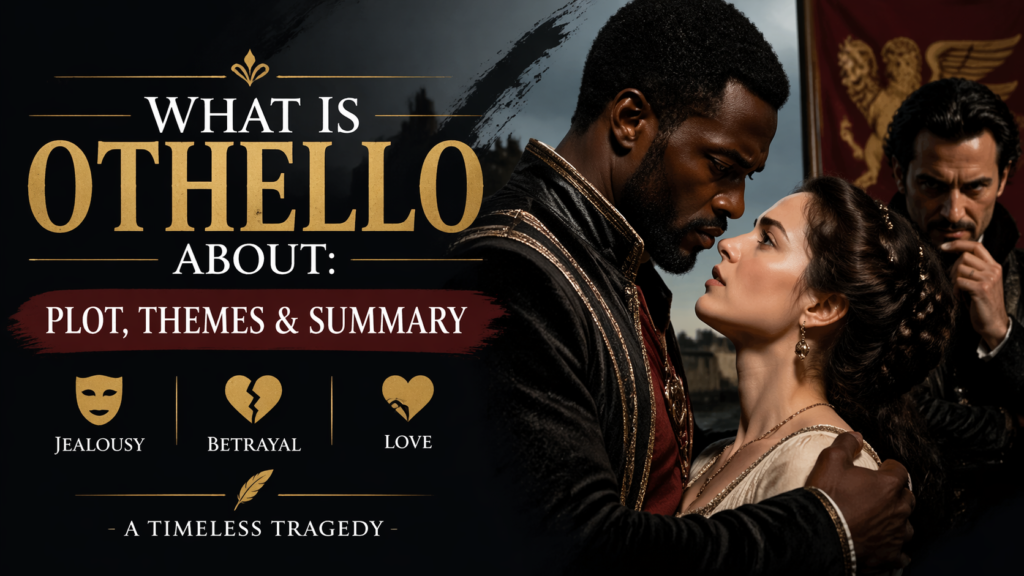
Some stories refuse to age. Written more than four hundred years ago, William Shakespeare’s Othello continues to disturb, move, and provoke audiences in ways that feel startlingly modern. A story about a man destroyed not by his enemies but by his own consuming doubt — Othello cuts straight to some of the most uncomfortable truths about human nature: our hunger for trust, our vulnerability to manipulation, and the devastating cost of jealousy left unchecked.
So what is Othello about, exactly? On the surface, it is a tragedy about a Moorish general in the Venetian army who is manipulated into believing his faithful wife has been unfaithful. But beneath that deceptively simple premise lies one of the richest, most psychologically complex plays ever written — a masterwork that wrestles with race, identity, power, gender, and the terrifying ease with which one poisonous voice can dismantle an entire life.
Whether you are a student approaching the play for the first time, a literature enthusiast revisiting it with fresh eyes, or simply someone who wants to understand why Othello is still performed on stages worldwide, this guide covers everything you need to know.
What Is Othello About? The Short Answer
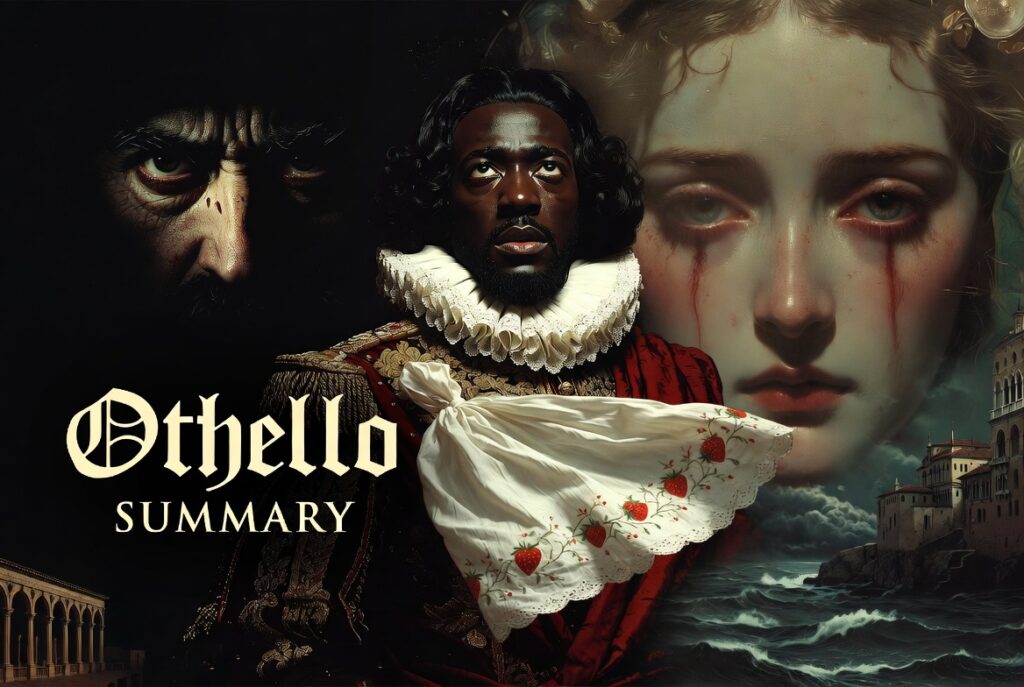
Othello is a Shakespearean tragedy about Othello, a celebrated Moorish general serving Venice, who is secretly manipulated by his resentful ensign Iago into believing that his loyal and loving wife, Desdemona, has been having an affair with his lieutenant, Cassio. Driven to madness by jealousy, Othello murders Desdemona — only to discover, moments too late, that every accusation was a lie. He takes his own life in grief and shame.
That is the plot in its barest form. What makes the play immortal, however, is not the story itself but the devastating psychological realism with which Shakespeare tells it — and the uncomfortable questions it forces us to ask about trust, race, and what it means to truly know another person.
Background — Shakespeare and the Making of Othello
When Was Othello Written and First Performed?
Shakespeare wrote Othello around 1603, and it received its first recorded performance on the 1st of November, 1604, at the court of King James I. This places it squarely within Shakespeare’s most fertile creative period — the same years that produced Hamlet, King Lear, and Macbeth. It is one of his four great tragedies, and many scholars argue it is the most intimate and emotionally concentrated of the four, unfolding with an almost suffocating dramatic intensity.
Unlike the sprawling political scope of Hamlet or King Lear, Othello is a chamber tragedy — tight, domestic, and deeply personal. Its destruction takes place not on battlefields or in royal courts, but in bedrooms and drawing rooms. That closeness is precisely what makes it so unbearable to watch.
What Was Shakespeare’s Source Material?
Shakespeare did not invent the story from scratch. He adapted it from a 1565 Italian prose tale titled Un Capitano Moro (“A Moorish Captain”), written by the Italian author Cinthio in his collection Gli Hecatommithi. Cinthio’s version is darker in some respects — the “Iago” figure and Othello commit the murder together — but far less psychologically sophisticated.
Shakespeare’s genius lay in what he changed. He gave Iago a mesmerising, almost philosophical villainy. He transformed Desdemona from a largely passive figure into a woman of genuine moral courage. And most crucially, he placed race at the centre of the drama in a way that Cinthio never did — making Othello’s identity as an outsider not merely incidental but structurally essential to every conflict in the play.
The Main Characters of Othello
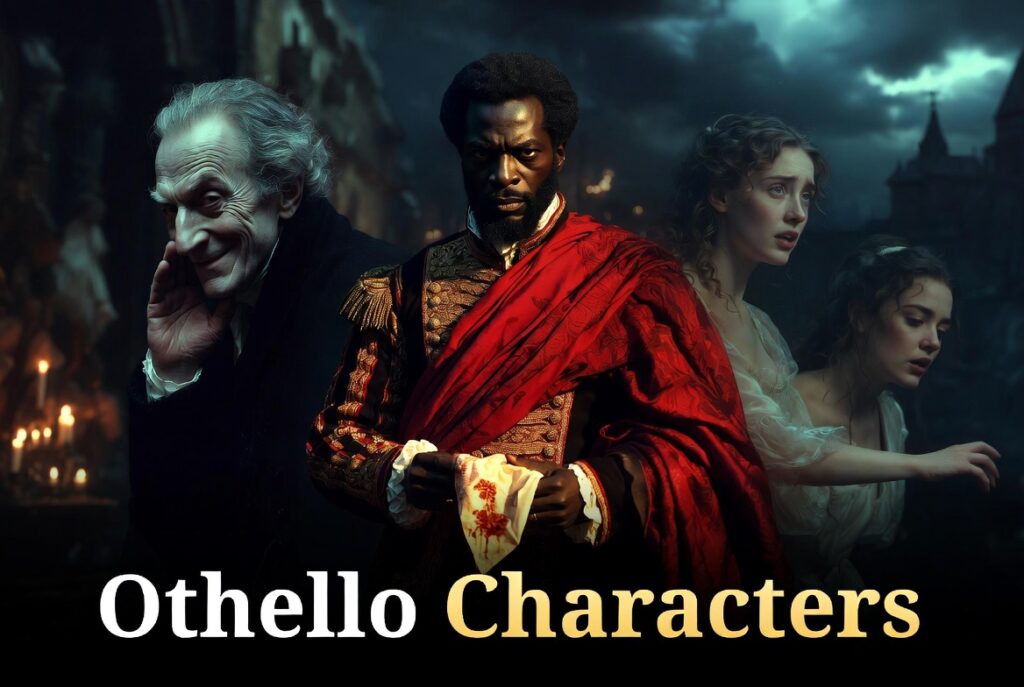
Othello — The Tragic Hero
Othello is one of Shakespeare’s most complex and debated protagonists. He is a Moorish general — a man of immense military achievement, natural dignity, and genuine emotional depth. Venice trusts him to defend the state. Desdemona loves him unreservedly. And yet, beneath his commanding exterior, Othello carries the wound of a man who has never fully belonged — a foreigner in a world that respects his usefulness but quietly questions his place.
This vulnerability is precisely what Iago exploits. The tragedy of Othello is not that he is a weak man brought low. It is that he is a great man undone by the one insecurity he cannot conquer: the fear that he is not truly worthy of the love he has been given.
His racial identity deserves careful attention. Shakespeare never lets the audience forget that Othello is Black in a white European world. From the very first scene, other characters define him by his race before his name is even spoken. Iago and Roderigo refer to him in dehumanising terms designed to reduce him to his otherness. Understanding this context is essential to understanding the full weight of the play.
Iago — One of Literature’s Greatest Villains
If Othello is the heart of the play, Iago is its engine. He is one of the most fascinating, frightening, and brilliantly realised villains in all of literature — and what makes him so compelling is precisely his inscrutability.
On the surface, his motivations seem clear enough: he is furious that Othello has passed him over for promotion, giving the lieutenancy to the less experienced Cassio instead. But as the play unfolds, Iago’s malice seems to outgrow any rational explanation. He lies compulsively, manipulates effortlessly, and appears to derive genuine pleasure from the suffering he engineers.
His most chilling declaration — “I am not what I am” — signals something profound: here is a man whose entire identity is performance, a man with no stable self beneath the mask. Critics have argued for centuries over whether Iago represents pure evil, repressed desire, professional resentment, or something far more existentially disturbing. That ambiguity is a mark of Shakespeare’s genius.
Desdemona — More Than a Victim
Desdemona is too often remembered only as Othello’s victim, which does a serious injustice to one of Shakespeare’s most quietly courageous female characters. She defies her father, Brabantio, to marry a man her society considers an outsider. She pleads for Cassio’s reinstatement with admirable persistence. And even in the final, horrifying moments of her life, she refuses to condemn her husband.
Far from being passive, Desdemona represents a form of moral purity that the play sets against Iago’s nihilism. Her tragedy is that her virtues — loyalty, trust, openness — are turned against her. In a world run by men like Iago, goodness itself becomes a liability.
Cassio, Emilia, and Roderigo
Cassio is Othello’s lieutenant — handsome, charming, and entirely innocent of the accusations levelled against him. His role is largely to be the unwitting instrument of Iago’s plot, though his genuine affection and respect for Othello add to the tragedy’s emotional weight.
Emilia, Iago’s wife and Desdemona’s loyal attendant, is one of the play’s most underrated figures. Sharp-tongued, perceptive, and ultimately brave, she is the character who finally speaks the truth — at enormous personal cost. Her act of defiance in the final act is one of the most powerful moments in the play.
Roderigo is Iago’s dupe: a wealthy, lovesick fool who funds Iago’s schemes in the deluded hope of winning Desdemona. He functions partly as dark comedy, partly as a warning about the dangers of allowing desire to override judgement.
What Happens in Othello? A Full Plot Summary
Act I — Love, Elopement, and the First Seeds of Doubt
The play opens in Venice at night, as Iago and Roderigo inform Brabantio, a prominent senator, that his daughter Desdemona has secretly eloped with Othello. The scene is deliberately ugly — Iago’s language is crude and racially charged, framing what is in fact a love match as something shameful and transgressive.
When Brabantio brings his complaint before the Venetian Duke, Othello defends himself and his marriage with eloquence and dignity, and Desdemona confirms that she chose him freely. The Duke dismisses Brabantio’s objections and dispatches Othello to Cyprus to repel a Turkish invasion — with Desdemona to follow. Iago, meanwhile, begins laying his plans. We learn his surface motive: revenge for being denied the lieutenancy. We also hear his first manipulation of Roderigo. The trap is set.
Act II — Arrival in Cyprus and the Unraveling Begins
A storm destroys the Turkish fleet, rendering the military threat moot — but the real battle is only just beginning. In Cyprus, Iago engineers a brawl involving Cassio and Roderigo that results in Cassio being stripped of his lieutenancy by a disappointed Othello.
Iago immediately pivots, advising the disgraced Cassio to seek Desdemona’s help in appealing to Othello. It is a brilliantly cynical move: he uses Desdemona’s genuine kindness as the raw material for her own destruction.
Act III — The Handkerchief and the Point of No Return
Act III is the fulcrum of the play — the scene in which Othello’s fate is effectively sealed. Iago begins dripping poison into Othello’s ear, planting insinuations about Cassio and Desdemona with masterful, infuriating subtlety. He never accuses directly. He suggests, implies, then retreats, feigning reluctance — making Othello beg for the very suspicions that are destroying him.
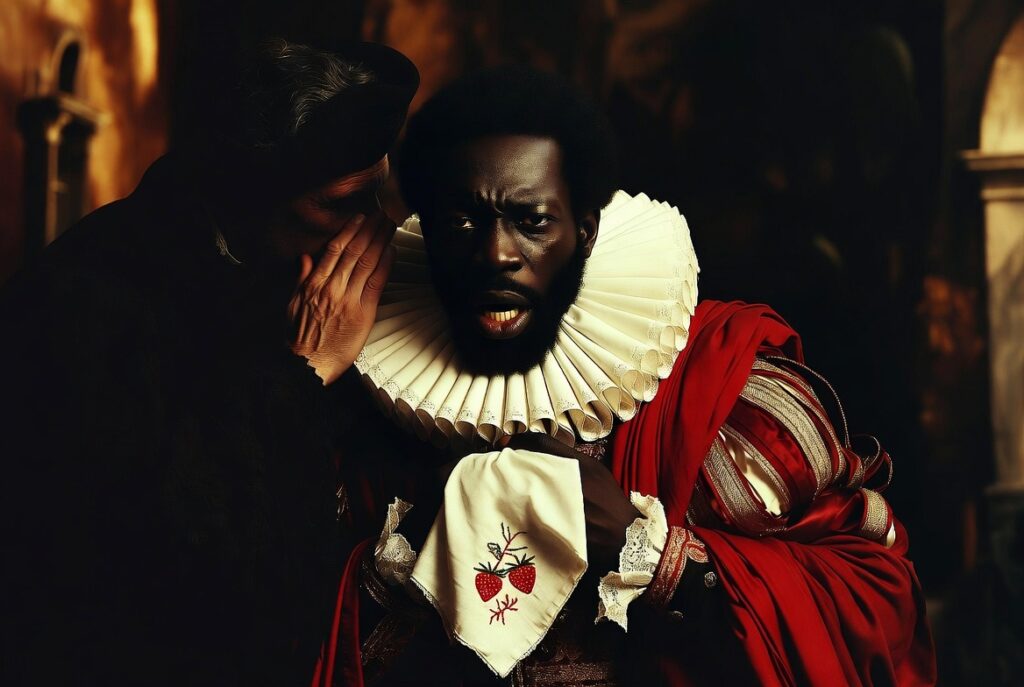
The handkerchief — a small embroidered cloth Othello gave Desdemona as his first gift — becomes the play’s most powerful symbol. Emilia finds it and gives it to Iago, who plants it in Cassio’s lodgings. When Othello demands “ocular proof” of Desdemona’s supposed infidelity, the handkerchief becomes that proof. By the end of Act III, Othello has made a terrible vow: Desdemona must die.
Act IV — Othello’s Descent
Act IV charts Othello’s complete psychological collapse. He publicly strikes Desdemona. He cross-examines her like a criminal. The noble general of Act I is almost unrecognisable — hollowed out, consumed, barely coherent. Iago continues to orchestrate events with cold precision, arranging for Othello to eavesdrop on a conversation between himself and Cassio that appears to confirm Desdemona’s guilt, though it concerns something else entirely.
Emilia watches Desdemona’s suffering with growing alarm. Desdemona, bewildered and heartbroken, nonetheless refuses to believe she has truly lost Othello’s love.
Act V — Tragedy, Truth, and Too Late
The final act moves with terrible swiftness. Iago arranges for Roderigo to kill Cassio; the attempt fails and Iago kills Roderigo to silence him. Othello goes to Desdemona’s chamber and murders her, smothering her despite her desperate protests of innocence.
Moments later, Emilia arrives and the truth comes pouring out. The handkerchief. The lie. Iago’s entire architecture of deceit collapses in minutes. Othello, confronted with the magnitude of what he has done and what he has lost, delivers one of the most hauntingly self-aware final speeches in all of drama — then takes his own life.
Iago, exposed and cornered, refuses to explain himself: “Demand me nothing. What you know, you know. From this time forth I never will speak word.” It is, characteristically, one final act of control. He is taken away to be tortured. We never hear his explanation. We never get to understand him fully. And that, perhaps, is the most disturbing thing of all.
The Major Themes of Othello
Jealousy — “The Green-Eyed Monster”
No theme in Othello is more central, or more carefully examined, than jealousy. Shakespeare did not merely use jealousy as a plot device — he dissected it with the precision of a surgeon, exposing its irrationality, its self-feeding nature, and its capacity to override everything a person knows to be true.
It is Othello himself who coins the phrase that has entered the permanent vocabulary of the English language. In Act III, Iago warns him: “O, beware, my lord, of jealousy! It is the green-eyed monster which doth mock the meat it feeds on.” The warning is, of course, grotesquely ironic — spoken by the very man who is manufacturing the jealousy he pretends to caution against.
What makes Shakespeare’s treatment so psychologically sophisticated is his insistence on showing jealousy as a form of self-destruction. Othello does not simply become suspicious of Desdemona — he becomes suspicious of himself. His jealousy is inseparable from his deeper fear: that he is unworthy of her love, that the gap between who he is and where he stands will ultimately be exposed. Iago does not create this fear. He merely finds it and fans it.
It is also worth noting that jealousy in Othello is not confined to Othello alone. Iago’s original grievance is professional envy — a bitter resentment at being passed over, at watching a less experienced man receive the recognition he believes is his. His jealousy is colder and more calculating than Othello’s, but in many ways more corrosive. Where Othello’s jealousy burns hot and destroys quickly, Iago’s smoulders for the entire length of the play.
Race and Identity in Othello
Othello is one of the earliest and most searching examinations of race in Western literature, and its relevance to contemporary audiences has only deepened with time.
Othello exists at a painful intersection: he is indispensable to Venice — its greatest military commander, the man the state turns to in crisis — and yet he is never allowed to forget that he is an outsider. Before we ever meet him, other characters have already defined him by his race. Iago and Roderigo’s opening dialogue is laced with racial slurs, reducing the man we will come to know as noble and eloquent to a crude caricature.
This is not incidental background detail. It is the structural condition of Othello’s tragedy. His vulnerability to Iago’s manipulation is inseparable from the social reality he inhabits. When Iago suggests that Desdemona’s love is unnatural — that a Venetian woman would not truly choose a Moorish husband unless something were wrong — he is weaponising the racial prejudice of the society around them. And Othello, for all his stature, has absorbed enough of that world’s contempt to half-believe it.
Modern productions and scholarship have rightly foregrounded this theme with increasing urgency. Othello is not simply a play that happens to feature a Black protagonist. Race is woven into every relationship, every power dynamic, and every act of cruelty in the text. To read it without that awareness is to miss a significant portion of what Shakespeare was actually doing.
Manipulation and Deception
If jealousy is the play’s emotional core, manipulation is its mechanism. Othello is, among other things, a masterclass in how language can be weaponised — how a sufficiently skilled manipulator can use a person’s virtues against them, turning trust into gullibility and love into a source of torment.
Iago never lies clumsily. He is a careful, adaptive deceiver who tailors his approach to each target. With Othello, he uses the language of reluctance and friendship, pretending to hold back information out of loyalty, thereby making Othello desperate to hear more. With Roderigo, he exploits infatuation and vanity. With Cassio, he plays the sympathetic ally. Each performance is perfectly calibrated.
What Shakespeare is exploring, beneath the plot mechanics, is something deeply unsettling about the limits of human perception. We cannot see into other minds. We depend on language, behaviour, and the testimony of those we trust to construct our picture of reality. Iago understands this with cold clarity — and exploits it without mercy.
This theme resonates powerfully in the modern world, where the vocabulary of psychological manipulation has become more widely understood. What Iago practises on Othello maps with disturbing precision onto what contemporary psychologists describe as gaslighting: the systematic undermining of a person’s trust in their own perceptions.
Gender, Power, and the Treatment of Women
Othello contains three significant female characters — Desdemona, Emilia, and Bianca — and through each of them Shakespeare examines, with considerable complexity, the position of women in a patriarchal society.
Desdemona is owned, in the eyes of her world, first by her father and then by her husband. When she exercises her own will — choosing Othello, defending Cassio, refusing to accept her husband’s violence as deserved — she is met with incomprehension or punishment. Her tragedy is that she inhabits a world that has no framework for a woman of her moral independence.
Emilia’s arc is among the most quietly radical in Shakespeare. For much of the play she appears to accept the diminished role her world assigns her, even stealing the handkerchief for her husband without fully understanding why. But in the final act she undergoes a transformation of extraordinary courage, speaking truth to power at the cost of her own life. Her speech on the double standards applied to men and women in matters of fidelity is one of the most proto-feminist passages Shakespeare ever wrote.
Bianca, a courtesan, occupies the lowest rung of the play’s social hierarchy, and is used by Iago as additional false evidence against Cassio and Desdemona. Her presence in the play serves as a reminder of how completely male characters define and exploit female identity for their own purposes.
Honour and Reputation
In the world of Othello, reputation is not merely important — it is treated as synonymous with identity. Cassio, stripped of his lieutenancy, cries: “Reputation, reputation, reputation! O, I have lost my reputation! I have lost the immortal part of myself.” It is an extravagant statement, and Shakespeare intends us to notice that — but he also takes it seriously.
For Othello, reputation and honour are everything. They are the foundations on which his improbable place in Venetian society rests. This is precisely why Iago’s strategy works: he does not attack Othello’s military record or his intelligence. He attacks the one thing Othello cannot defend by force of arms — the private fidelity of his wife, and by extension the private worth of his own self.
The play suggests, with uncomfortable honesty, that an obsession with public honour can become just as destructive as the vices it claims to oppose.
Why Othello Is Still Relevant Today
It would be easy to treat Othello as a historical artefact — a product of early seventeenth-century Venice and London, with little direct bearing on the world we inhabit now. That would be a serious mistake.
The themes Shakespeare embedded in this play four centuries ago map onto contemporary life with startling precision. Racial othering — the mechanism by which a society simultaneously depends on and demeans those it considers outsiders — remains one of the defining social tensions of the modern world. Othello’s experience of being valued for his usefulness while never being fully accepted is a story that resonates deeply across cultures and contexts today.
The psychology of coercive control and intimate partner violence has also brought renewed critical attention to Othello. The trajectory of Othello and Desdemona’s relationship — the isolation, the accusations, the escalating violence — follows a pattern that domestic abuse specialists now recognise and document. Productions in recent decades have increasingly staged the play through this lens, to powerful and disturbing effect.
Then there is Iago — and the modern relevance of his particular form of evil. In an era of disinformation, social media manipulation, and the deliberate manufacture of mistrust, the figure of a man who destroys not through direct violence but through the careful corruption of information feels less like a theatrical villain and more like a recognisable type.
Notable recent productions have reflected this relevance compellingly. The 2007 Donmar Warehouse production starring Chiwetel Ejiofor as Othello and Ewan McGregor as Iago brought the play to a new generation of audiences and was widely praised for its psychological intensity. The National Theatre’s 2013 production with Adrian Lester and Rory Kinnear similarly foregrounded the racial and psychological dimensions of the text with extraordinary power.
Famous Quotes From Othello (With Meaning)
Few plays in the English language have generated as many quotable lines as Othello. Here are five of the most significant, with plain-English explanations of their meaning and importance:
“O, beware, my lord, of jealousy! It is the green-eyed monster which doth mock the meat it feeds on.” (Iago, Act III, Scene 3) One of the most famous lines in Shakespeare, delivered with poisonous irony by the man who is actively cultivating Othello’s jealousy. The image of jealousy as a monster that torments its own host is psychologically precise.
“I am not what I am.” (Iago, Act I, Scene 1) Iago’s defining statement — an inversion of the biblical “I am that I am.” He announces, almost casually, that his entire persona is performance. It is the play’s first and most important warning, ignored by everyone who hears it.
“She loved me for the dangers I had passed, and I loved her that she did pity them.” (Othello, Act I, Scene 3) Othello’s account of how he and Desdemona fell in love — through shared storytelling, mutual fascination, and genuine emotional exchange. It is one of the most tender and human moments in the play, and makes the tragedy that follows even more devastating.
“Reputation, reputation, reputation! O, I have lost my reputation!” (Cassio, Act II, Scene 3) Cassio’s anguished cry after being disgraced captures the play’s preoccupation with honour and social identity. Shakespeare presents it sympathetically but also with a trace of irony — Cassio is, after all, lamenting a reputation that is entirely intact.
“Demand me nothing. What you know, you know. From this time forth I never will speak word.” (Iago, Act V, Scene 2) Iago’s final lines — and one of the most chilling endings to a villain’s arc in all of drama. He refuses explanation, refuses remorse, and refuses to give his victims the closure of understanding. Even in defeat, he maintains control.
Othello in Performance and Popular Culture
Notable Stage Productions
Othello has attracted some of the greatest actors in theatrical history to its two central roles. Laurence Olivier’s 1964 performance — physically transformative, controversial in its choices, and overwhelming in its emotional force — remains one of the most discussed interpretations of the twentieth century, even as later generations have rightly questioned aspects of its approach to race.
More recent landmark productions have placed Black actors at the centre of the play with the authority and complexity the role demands. Chiwetel Ejiofor’s 2007 Othello, directed by Michael Grandage at the Donmar Warehouse, brought a restrained, interior quality to the role that made his eventual collapse all the more devastating. Adrian Lester’s 2013 National Theatre performance was acclaimed for its physical grace and its unflinching engagement with the play’s racial politics.
Film and TV Adaptations
The play has inspired numerous significant screen adaptations. The 1995 film directed by Oliver Parker and starring Laurence Fishburne as Othello and Kenneth Branagh as Iago brought Shakespeare’s text to mainstream cinema audiences with considerable atmospheric success. Fishburne’s performance — dignified, powerful, and ultimately heartbreaking — remains the definitive screen Othello for many viewers.
O (2001), directed by Tim Blake Nelson, offered a provocative modern retelling set in an American high school, with the Othello figure reimagined as a Black basketball star and Iago as his resentful white teammate. The adaptation is a serious and intelligent work that demonstrates how precisely Shakespeare’s themes map onto the racial and social dynamics of contemporary American life.
Beyond these, Othello has influenced countless works of literature, film, and television that draw on its central dynamic of manipulation, jealousy, and betrayal — from Verdi’s opera Otello (1887) to modern psychological thrillers that owe more to Shakespeare than their creators sometimes acknowledge.
Frequently Asked Questions About Othello
What is the main message of Othello? At its heart, Othello is a warning about the destructive power of jealousy and the catastrophic consequences of misplaced trust. It also explores how prejudice — racial, social, and gendered — creates the vulnerabilities that manipulation requires. Shakespeare’s message is not hopeful: in a world where appearances can be so thoroughly falsified, the virtues of trust and openness become dangerous.
Who is the real villain in Othello — Iago or jealousy itself? This is one of the play’s richest debates. Iago is undeniably the architect of the tragedy — without his scheming, no catastrophe occurs. But Shakespeare seems to suggest that Iago could not have succeeded without the pre-existing conditions: a society shaped by racial prejudice, a hero with a hidden wound of insecurity, and a world in which women’s virtue is treated as a commodity to be policed. Iago is the spark, but the tinder was already laid.
Is Othello a hero or a villain? Othello is a tragic hero in the classical sense — a great man brought low by a fatal flaw. His nobility is genuine and his love for Desdemona is real. But he also commits an act of terrible violence, and Shakespeare does not allow the audience the comfort of fully excusing him. He is both — and that moral complexity is precisely what makes him such an enduring figure.
What does the handkerchief symbolize in Othello? The handkerchief functions as one of the richest symbols in Shakespearean drama. On one level it represents Othello and Desdemona’s love — his first gift to her, imbued with personal and almost mystical significance. On another it represents the fragility of trust: a small, easily misplaced object that becomes, in Iago’s hands, sufficient evidence to condemn an innocent woman to death. It is also, more broadly, a symbol of how easily the truth can be fabricated — how a single object, stripped of context, can be made to mean almost anything.
How long does it take to read Othello? Reading Othello in full takes most readers between three and four hours, depending on pace and familiarity with Elizabethan language. Many readers find it useful to read alongside a modern prose translation or annotated edition on a first encounter, before returning to Shakespeare’s original text to appreciate the full power of the language.
Is Othello based on a true story? Not directly. Shakespeare based the play on a fictional Italian tale by Cinthio, published in 1565. However, Moors — Muslim North Africans — did serve in European military forces during the period, and the social and racial tensions Shakespeare dramatises reflect real historical conditions of the late sixteenth and early seventeenth centuries.
So what is Othello about? It is about jealousy — the irrational, self-consuming kind that needs no real evidence because it has already decided the verdict. It is about race, and the quiet, persistent violence of a world that values a man’s usefulness while denying his full humanity. It is about manipulation so skilled that it turns a person’s own greatest virtues into instruments of their destruction. And it is about love — real, tender, and genuine — that is not enough to save anyone, because the real enemy was never outside the relationship to begin with.
What makes Othello endure is not the elegance of its poetry, though that is extraordinary. It is the play’s refusal to comfort us. There is no redemption here, no last-minute rescue, no sense that justice has ultimately been served. Desdemona is dead. Othello is dead. Iago remains, silent and unrepentant. The truth arrived too late to save anyone.
That is Shakespeare at his most honest — and most devastating. Four centuries on, Othello remains one of the most urgent, relevant, and emotionally shattering works in the world literary canon. If you have not yet read it, or if it has been a long time since you last encountered it, there has never been a better moment.