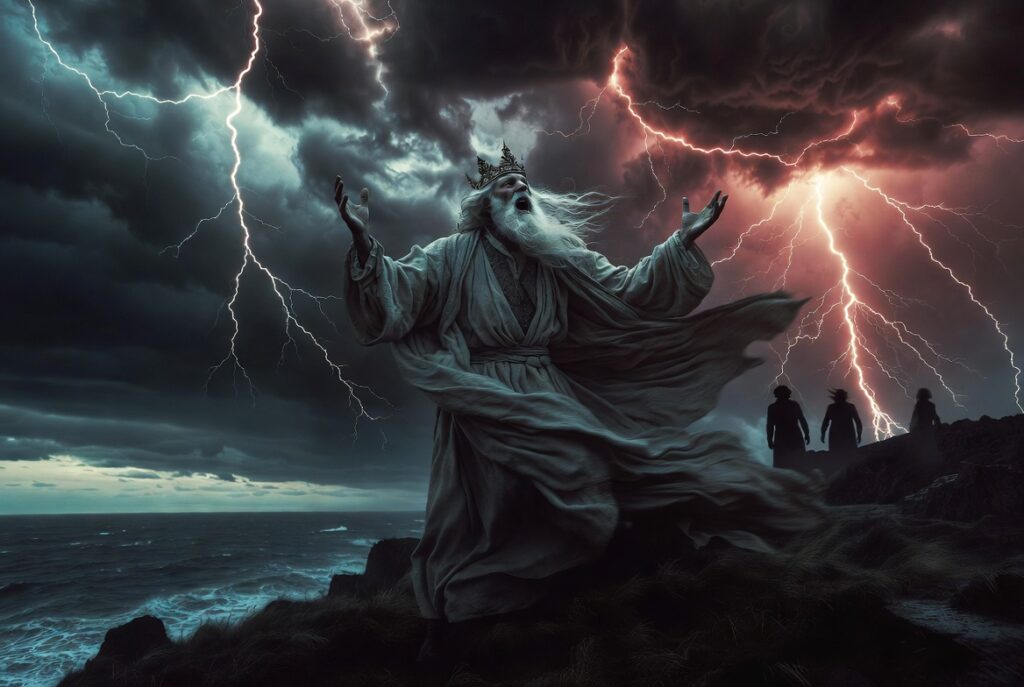
In the drama King Lear, Shakespeare unleashes one of the most shattering explorations of power, betrayal, and human fragility ever written for the stage. Picture a once-mighty ruler who, in a single impulsive act, tears his kingdom apart and sets in motion a cascade of madness, blindness, and death that still leaves audiences reeling four centuries later. If you’ve ever wondered why this particular tragedy feels so brutally relevant in our own age of divided families, fragile leadership, and public storms of outrage, you’re not alone. This definitive guide delivers everything you need: a scene-by-scene plot summary, penetrating character analysis, major themes, Shakespeare’s dramatic techniques, historical context, landmark adaptations, and practical lessons you can apply to your own life and relationships today.
As a Shakespeare specialist with more than 15 years of teaching, directing, and publishing on Elizabethan and Jacobean drama, I’ve returned to King Lear more times than I can count—both in the classroom and on the rehearsal floor. What follows is far more than a simple recap. It is a skyscraper-level resource designed to give students, teachers, actors, directors, and general readers a deeper, more insightful understanding than most existing online guides provide. Whether you’re preparing for an exam, staging the play, or simply seeking to understand why this drama continues to “tear our hearts” (as critic A.C. Bradley once wrote), you will leave with clarity, fresh perspectives, and actionable wisdom.
The Historical Context and Origins of the Drama King Lear
To fully appreciate the drama King Lear, we must first understand the world that shaped it. Shakespeare composed the play between late 1605 and early 1606, during the early reign of King James I. Only a few years earlier, in 1603, James had united the crowns of England and Scotland, raising urgent questions about royal succession, the limits of monarchical power, and the stability of a newly enlarged kingdom. These anxieties echo powerfully through King Lear.
Shakespeare did not invent the story from nothing. His primary sources included the anonymous play The True Chronicle Historie of King Leir (printed 1605 but performed earlier), Raphael Holinshed’s Chronicles of England, Scotland, and Ireland (1587 edition), and earlier legendary accounts of the ancient British king Leir found in Geoffrey of Monmouth’s Historia Regum Britanniae (c. 1136). In the older versions, the tale often ended happily: Cordelia restores her father to the throne. Shakespeare’s radical decision to transform this folk-tale into unrelenting tragedy reflects the darker Jacobean mood and his own maturing vision of human suffering.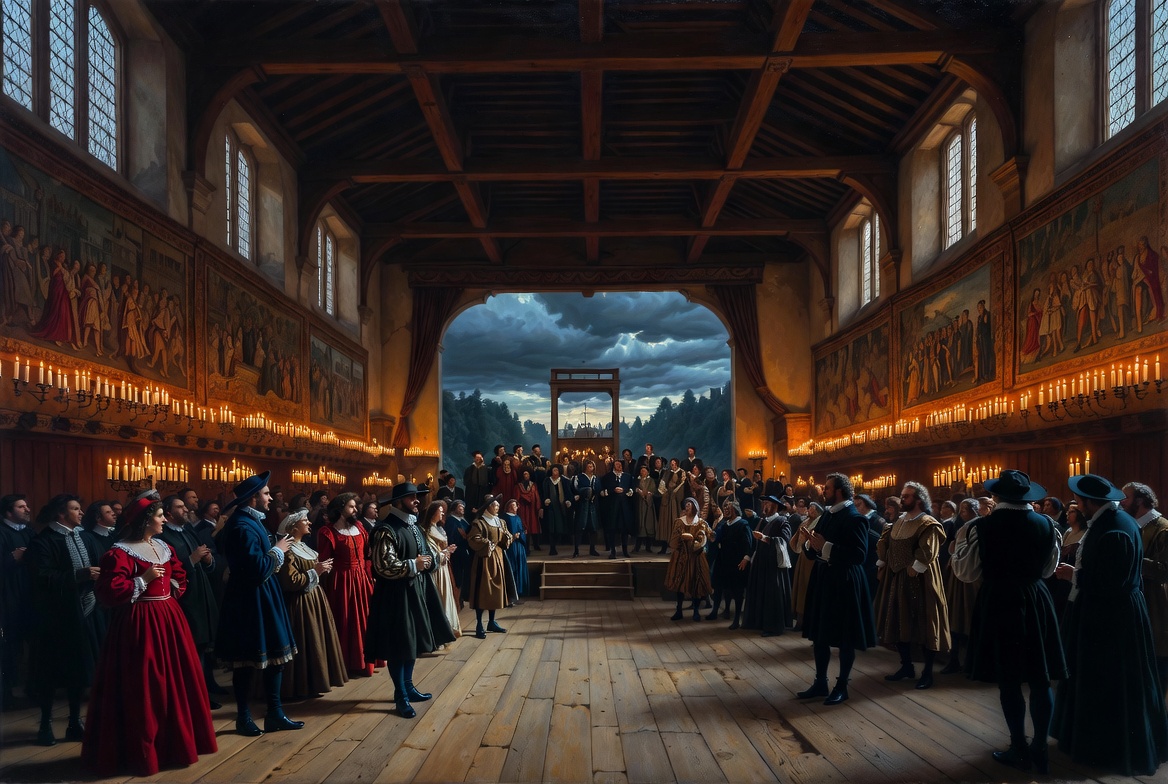
The play was first performed before the court at Whitehall on St. Stephen’s Night, 26 December 1606. Records show it was staged by the King’s Men, Shakespeare’s company. Notably, the earliest printed text—the 1608 Quarto—differs in significant ways from the 1623 First Folio version, suggesting Shakespeare may have revised the play. For centuries, audiences actually saw a very different King Lear: in 1681, poet Nahum Tate rewrote the ending with a happy marriage between Edgar and Cordelia and the survival of Lear and Gloucester. Tate’s version dominated English stages for nearly 150 years because theater managers believed Shakespeare’s original was simply too devastating for audiences. Only in the Romantic period did the authentic tragic ending return, and today it is universally regarded as one of Shakespeare’s supreme achievements.
Understanding this context helps readers see King Lear not as a timeless myth floating in a vacuum, but as a play deeply engaged with its own political moment—yet still speaking urgently to ours.
Complete Plot Summary of King Lear (With Scene-by-Scene Breakdown)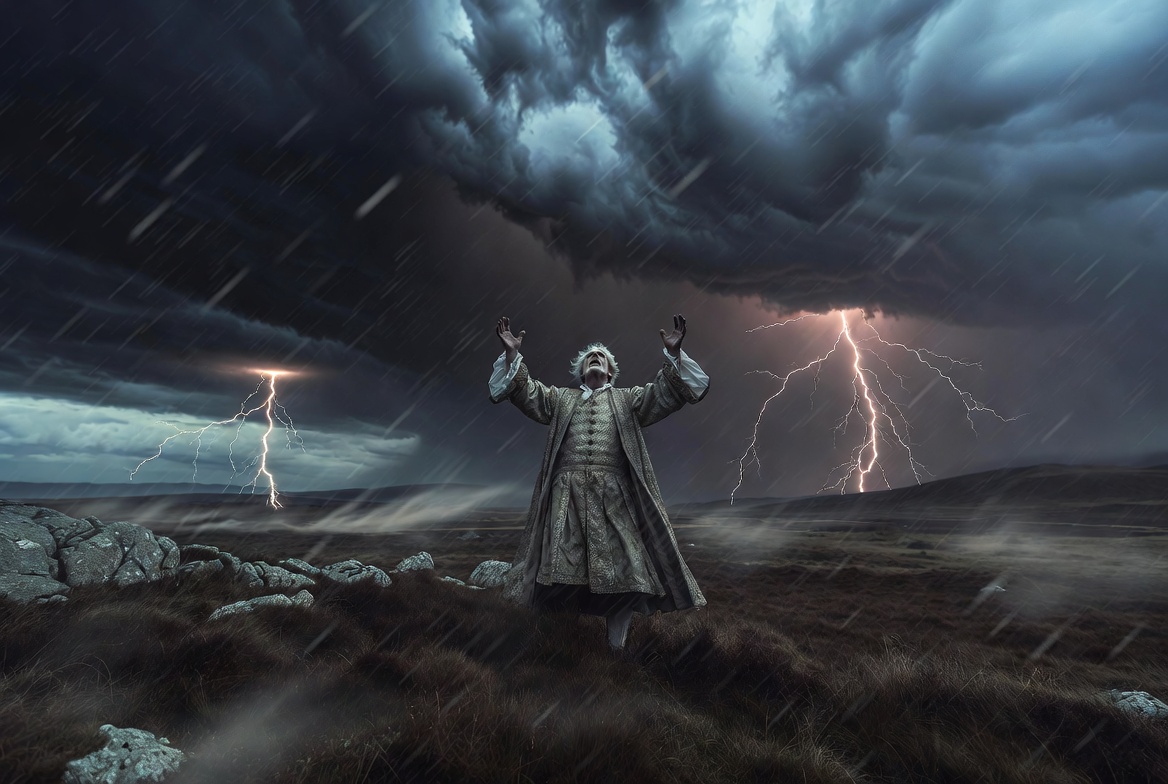
Spoiler Warning: This section reveals every major plot point. If you prefer to experience the play fresh, consider reading or watching it first, then returning here for analysis.
Act 1 — The Fatal Division of the Kingdom and the Love Test
The drama King Lear opens with a kingdom already on the brink. King Lear, an aging monarch, announces he will divide his realm among his three daughters—Goneril, Regan, and Cordelia—according to how much each claims to love him. Goneril and Regan deliver extravagant, insincere speeches of devotion and receive lavish portions of the kingdom. Cordelia, the youngest and most honest, refuses to flatter: “I love your Majesty / According to my bond; no more nor less.” Enraged by what he perceives as ingratitude, Lear disowns her and banishes the loyal Earl of Kent for defending her. He then awards Cordelia’s share to the Dukes of Albany (Goneril’s husband) and Cornwall (Regan’s husband).
In a parallel subplot, the Earl of Gloucester is deceived by his illegitimate son Edmund into believing his legitimate son Edgar is plotting patricide. Gloucester disinherits Edgar, who flees into disguise as the mad beggar “Poor Tom.”
Act 2 — Betrayal, Exile, and the Growing Storm
Lear’s troubles escalate rapidly. He arrives at Goneril’s castle only to find his retinue of 100 knights reduced and himself treated with contempt. Regan, arriving with Cornwall, proves equally cruel. Both daughters insist Lear dismiss half his followers and eventually all of them. Kent, now disguised, returns to serve Lear faithfully and is placed in the stocks for attacking Goneril’s steward Oswald. The act ends with Lear, rejected by both elder daughters, heading into the oncoming storm, uttering the prophetic line: “I have one part in my heart / That’s sorry yet for thee.”
Act 3 — The Tempest on the Heath and the Descent into Madness
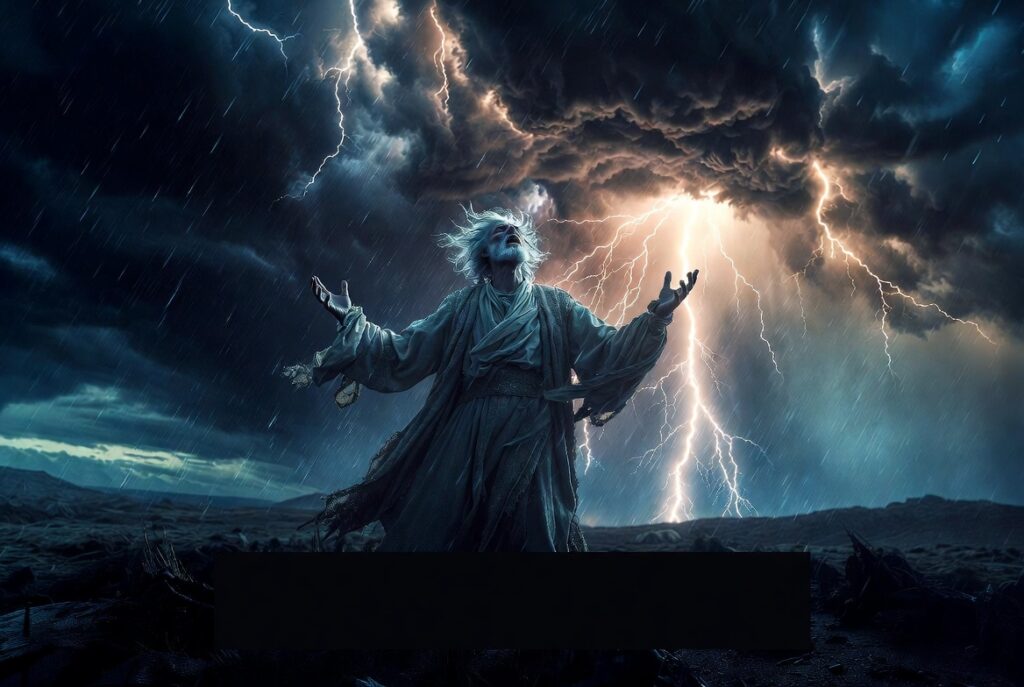
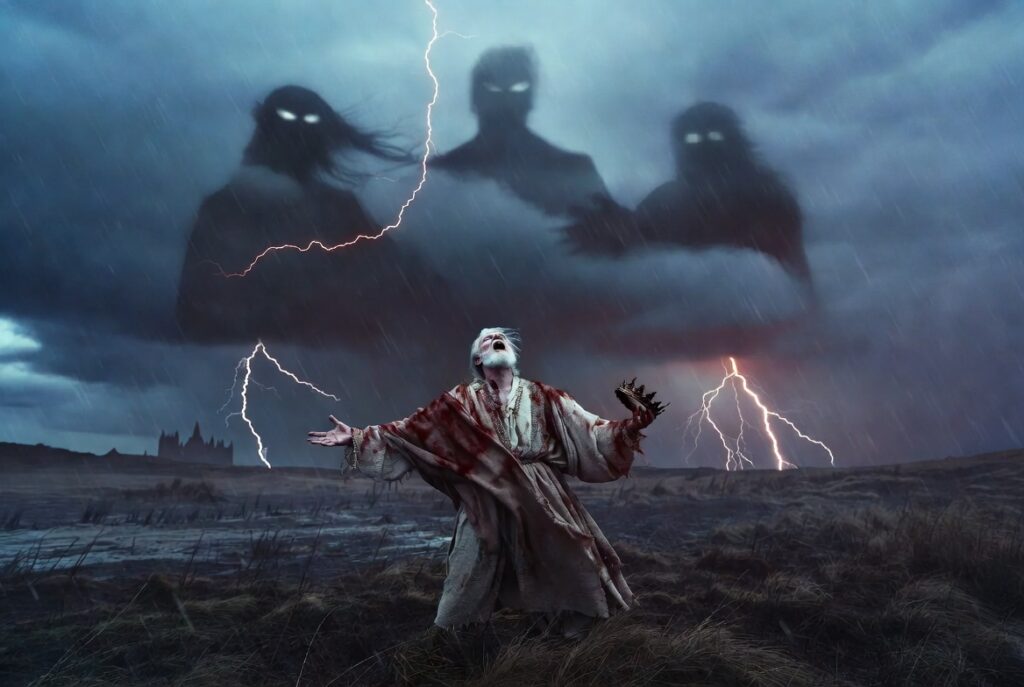
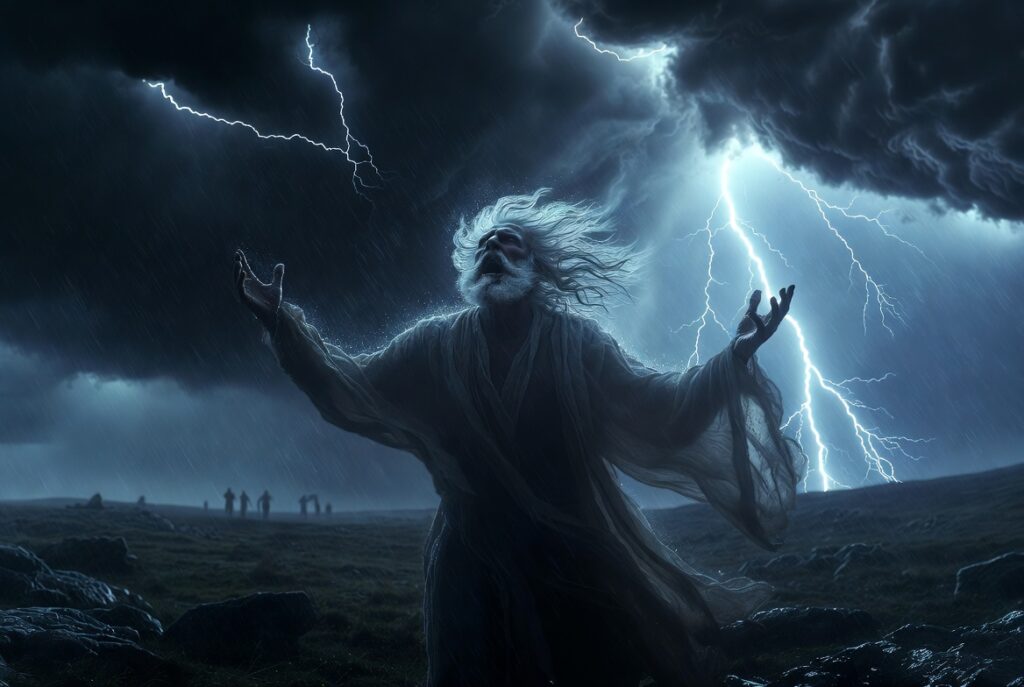
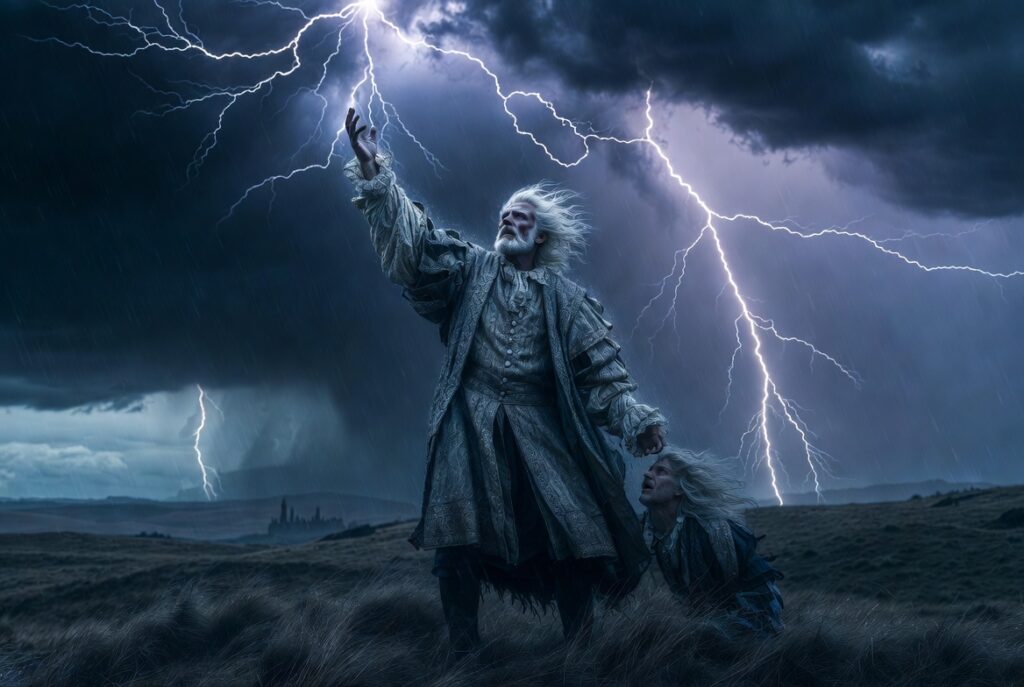
The heart of the drama King Lear unfolds on a wild heath during a ferocious storm that mirrors the chaos in Lear’s mind. Stripped of power and shelter, Lear rages against the elements and his daughters: “Blow, winds, and crack your cheeks! rage! blow!” He is joined by the disguised Kent, the Fool (whose witty yet poignant commentary provides the play’s moral center), and later Poor Tom (Edgar in disguise). In a parallel scene, Gloucester secretly aids the king but is betrayed by Edmund, captured by Cornwall and Regan, and brutally blinded onstage—an act so shocking that the original audience reportedly gasped.
Act 4 — Blindness, Disguise, and Recognition
Gloucester, now blind, is led by Edgar (still disguised) toward Dover. He famously declares, “I stumbled when I saw,” realizing too late his literal and metaphorical blindness to truth. Lear, now fully mad, is discovered by Cordelia’s invading French forces. Father and daughter are briefly reunited in a scene of heartbreaking tenderness. Meanwhile, Goneril and Regan both lust after the ambitious Edmund, setting up deadly rivalry between the sisters.
Act 5 — Catastrophe, Redemption, and the Final Silence
The final battle sees the French forces defeated. Cordelia is captured and, in the play’s most devastating stroke, hanged offstage on Edmund’s order. Lear carries her lifeless body onstage, uttering the five heart-wrenching repetitions of “Never, never, never, never, never.” Edmund is mortally wounded in a duel with Edgar and, in his dying moments, attempts to revoke his order against Cordelia—too late. Goneril poisons Regan and then kills herself. Albany, Gloucester, Kent, and Edgar survive, but the stage is littered with bodies. Lear dies of a broken heart over Cordelia’s corpse. The play ends not with hope but with Edgar’s somber closing lines: “The weight of this sad time we must obey, / Speak what we feel, not what we ought to say.”
In-Depth Character Analysis — The Heart of the Drama King Lear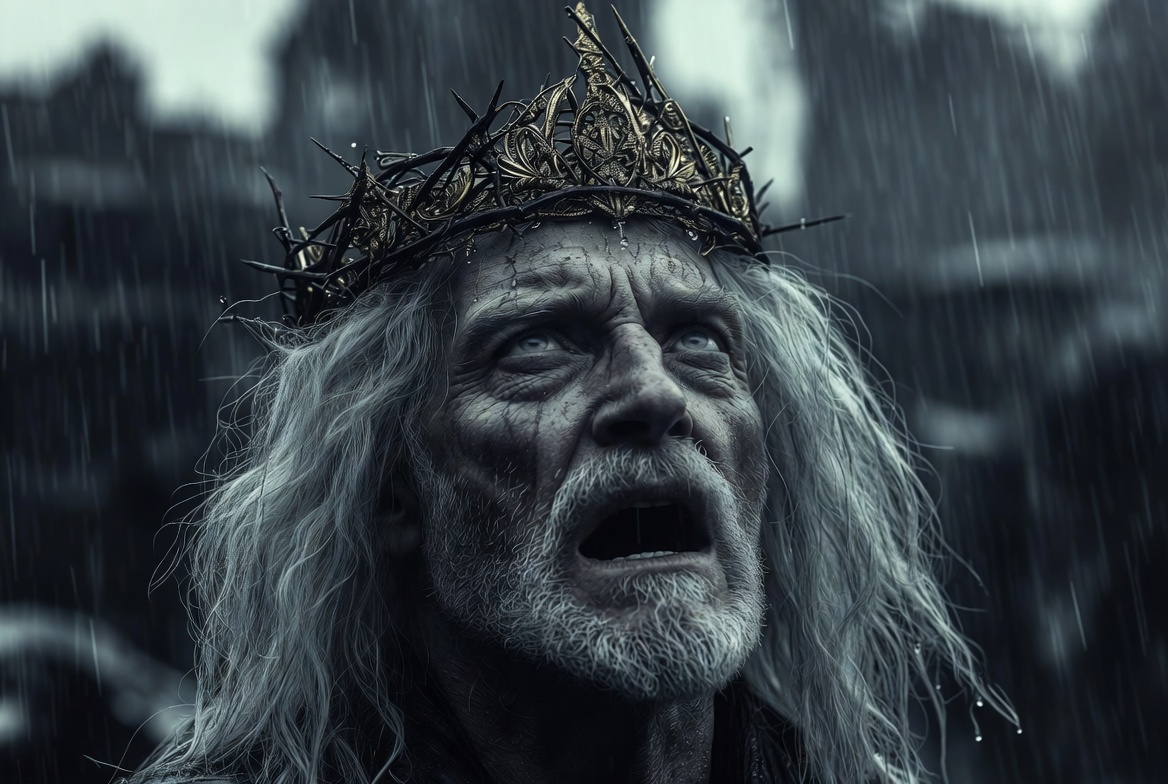
The power of the drama King Lear lies in its unforgettable characters, each crafted with psychological depth that feels startlingly modern.
King Lear — The Tragic Hero’s Journey from Hubris to Humility
Lear begins as the archetypal tyrannical patriarch—imperious, vain, and accustomed to absolute obedience. His “love test” is less about affection and more about public validation of his authority. Shakespeare traces his harrowing arc through humiliation, rage, madness, and finally a hard-won humility. By the storm scenes, Lear’s famous line “I am a man / More sinn’d against than sinning” marks the beginning of self-recognition. His reunion with Cordelia in Act 4 offers a fleeting vision of redemption before the final catastrophe. Critics often rank Lear among Shakespeare’s greatest tragic heroes because his suffering feels both cosmic and intimately human.
Cordelia, Goneril, and Regan — Three Daughters, Three Visions of Filial Duty
Cordelia is the moral compass—quiet, principled, and incapable of flattery. Her plain “Nothing” in the opening scene is not coldness but integrity. Goneril and Regan, by contrast, are masterpieces of calculated villainy. Shakespeare gives them distinct voices: Goneril is more politically ruthless, Regan more sadistically inventive (she urges the blinding of Gloucester). Their eventual rivalry over Edmund reveals the self-destructive nature of their ambition. The contrast between the three sisters illuminates one of the play’s central questions: what does genuine love look like when power is at stake?
The Gloucester Parallel Plot — Edgar, Edmund, and the Anatomy of Treachery
Running alongside Lear’s story is the Gloucester subplot, which Shakespeare uses to intensify and universalize the main action. The Earl of Gloucester mirrors Lear in his poor judgment and susceptibility to flattery. His illegitimate son Edmund is one of Shakespeare’s most chilling villains—charismatic, intellectually superior, and utterly amoral. Edmund’s opening soliloquy (“Thou, nature, art my goddess”) rejects social convention and embraces raw ambition, making him a proto-modern figure who feels dangerously contemporary.
By contrast, Edgar, the legitimate son, evolves from a naive young man into a resourceful survivor. Disguised as Poor Tom, he endures the heath with Lear and later guides his blinded father to Dover with quiet compassion. The duel between the two brothers in Act 5 provides a satisfying moral reckoning, yet even here Shakespeare refuses easy comfort—Edgar’s victory comes too late to save Cordelia or Gloucester.
The parallel plots reinforce each other brilliantly: both fathers misjudge their children, both suffer betrayal by the “unnatural” child, and both achieve painful insight only after catastrophic loss. This structural doubling is one reason the drama King Lear feels so richly layered and thematically dense.
The Fool — Wisdom in Folly and the Play’s Moral Compass
The Fool is perhaps the most enigmatic and poignant character in the play. He alone dares to speak truth to Lear’s face, using riddles, songs, and bitter jokes to highlight the king’s folly. Lines such as “All thy other titles thou hast given away; that thou wast born with” cut deeper than any courtier’s counsel. His disappearance after Act 3 (Shakespeare never explains why) has puzzled generations of critics and directors. Some see the Fool as an externalization of Lear’s conscience; others interpret him as a representation of the vanished Cordelia. Whatever the case, the Fool provides essential comic relief while delivering some of the play’s sharpest moral commentary.
Kent, Albany, Cornwall, and the Minor Characters — Their Crucial Dramatic Functions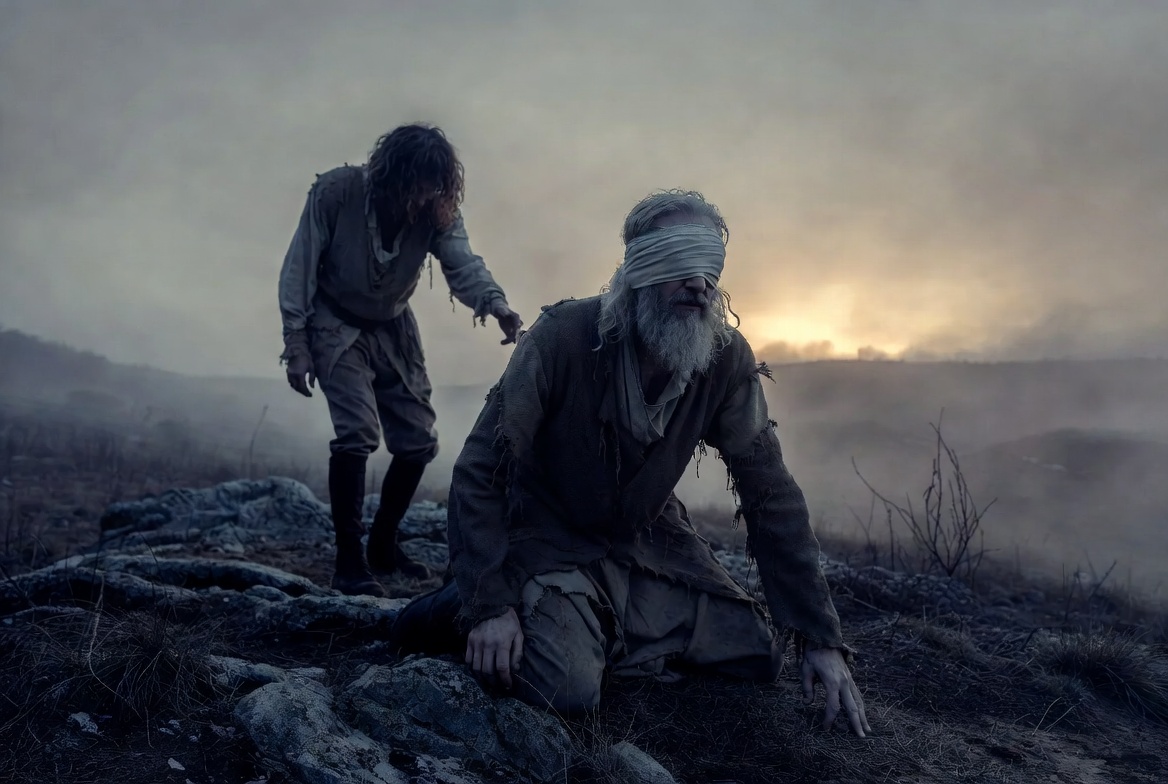
The Earl of Kent exemplifies unwavering loyalty. Banished for honesty, he returns in disguise to serve the king he still loves, enduring the stocks and risking death. The Duke of Albany begins as a weak, compliant husband but grows into a voice of conscience, ultimately rejecting Goneril’s cruelty. Cornwall, by contrast, is pure sadism—his onstage gouging of Gloucester’s eyes remains one of the most viscerally shocking moments in all of Shakespeare.
Minor characters such as Oswald (the obsequious steward) and the servants who rebel against Cornwall add texture and moral shading. Even the anonymous Gentleman who reports Cordelia’s grief in Act 4 delivers one of the play’s most moving descriptions of silent suffering.
Comparison Table: Main Plot vs. Subplot Parallels
| Element | Main Plot (Lear) | Subplot (Gloucester) |
|---|---|---|
| Father’s Flaw | Demands public declarations of love | Believes forged letter too easily |
| “Good” Child | Cordelia (disowned) | Edgar (exiled) |
| “Bad” Child | Goneril & Regan | Edmund |
| Form of Suffering | Madness and exposure to storm | Literal blindness |
| Moment of Insight | “I stumbled when I saw” (echoed) | “I stumbled when I saw” |
| Final Outcome | Dies holding Cordelia | Dies reconciled with Edgar |
This table highlights how Shakespeare uses structural mirroring to amplify the tragedy’s emotional and thematic impact.
Major Themes in the Drama King Lear — A Mirror to the Human Condition
The drama King Lear is thematically one of Shakespeare’s richest works. Its exploration of universal human experiences transcends its historical moment and continues to resonate powerfully in the 21st century.
Filial Ingratitude and the Fragility of Family Bonds
At its core, King Lear is a devastating study of how quickly familial love can dissolve when power and self-interest intervene. Lear’s cry, “How sharper than a serpent’s tooth it is / To have a thankless child!” captures a pain that feels timeless. The play forces us to confront uncomfortable questions: How do we measure love? What happens when gratitude is replaced by calculation? In an era of strained family relationships, inheritance disputes, and generational conflict, these questions remain painfully relevant.
Madness and the Thin Line Between Sanity and Insight
Lear’s descent into madness is not mere plot device—it is Shakespeare’s profound investigation into the nature of sanity itself. On the heath, stripped of his royal trappings, Lear gains a clarity he never possessed on the throne. His mad speeches reveal truths about social inequality (“Take physic, pomp”), justice, and human vulnerability. The drama King Lear suggests that true wisdom sometimes requires the shattering of conventional reason.
Literal and Metaphorical Blindness — “I stumbled when I saw”
Gloucester’s blinding is the play’s most brutal physical act, yet it catalyzes his deepest spiritual insight. His line, “I stumbled when I saw,” spoken after losing his eyes, stands as one of Shakespeare’s most quoted encapsulations of ironic self-knowledge. The theme extends to Lear, who “sees” his daughters clearly only when he has lost everything. Shakespeare repeatedly asks: What do we fail to see when we are most confident in our vision?
Power, Authority, and the Nature of Kingship
Written during the transition from Elizabethan to Jacobean rule, King Lear interrogates the foundations of authority. Lear’s division of the kingdom exposes the dangers of arbitrary power and the illusion that royal status is permanent. The play dramatizes how quickly authority evaporates without genuine loyalty and moral legitimacy. These concerns speak directly to contemporary debates about leadership, populism, and the responsibilities of those in power.
Nature, the Gods, and the Question of Cosmic Justice
One of the most haunting aspects of the drama King Lear is its refusal to offer easy religious or cosmic comfort. Characters repeatedly invoke the gods, only to face apparent silence or indifference. Gloucester’s despairing line, “As flies to wanton boys are we to th’ gods; / They kill us for their sport,” captures the play’s bleak vision. Yet Shakespeare balances this nihilism with moments of profound human compassion, suggesting that meaning must be created through acts of kindness rather than expected from heaven.
Old Age, Mortality, and the Fear of Irrelevance
Lear’s journey is also the tragedy of aging. The king who once commanded armies now fears becoming “an O without a figure”—nothing. His terror of dependency and loss of control mirrors very real anxieties many face in later life. The play’s unflinching portrayal of physical and mental decline gives it a raw emotional honesty that few works match.
Expert Insight Box: Twentieth-century critic Jan Kott, in his influential book Shakespeare Our Contemporary, described King Lear as a “tragedy of the grotesque” that anticipates the Theater of the Absurd. In contrast, traditional critic A.C. Bradley saw it as the pinnacle of Shakespearean tragedy, where suffering leads to spiritual purification. Modern ecocritical and feminist readings have further expanded our understanding, focusing on the storm as environmental metaphor and the marginalization of female voices. These diverse interpretations demonstrate why the drama King Lear remains endlessly teachable and stageable.
Shakespeare’s Dramatic Craftsmanship in King Lear
Shakespeare’s genius in the drama King Lear is evident not only in its themes and characters but in its masterful dramatic technique.
Language and Versification — Blank Verse, Prose, and the Storm’s Rhythmic Chaos
The play moves fluidly between stately blank verse for noble characters and raw, fragmented prose during moments of madness and crisis. In the storm scenes, Shakespeare’s language itself seems to fracture, mirroring Lear’s disintegrating mind. Short, jagged lines and relentless repetition (“Never, never, never, never, never”) create an almost unbearable emotional intensity.
Imagery and Symbolism — Eyes, Storms, Animals, Clothing, and the Wheel of Fortune
Recurring images give the play extraordinary poetic cohesion. The storm symbolizes both external chaos and internal turmoil. Eyes and sight dominate, culminating in Gloucester’s blinding. Animal imagery dehumanizes characters (“pelican daughters,” “toad-spotted traitor”), while clothing motifs underscore the theme of appearance versus reality—Lear tears off his clothes on the heath, declaring “Unaccommodated man is no more but such a poor, bare, forked animal.”
The wheel of fortune, a medieval concept, appears implicitly as characters rise and fall in a cruel cycle. These layered symbols reward close reading and give directors rich visual possibilities.
Dramatic Irony, Comic Relief, and the Role of the Fool
Shakespeare masterfully employs dramatic irony—readers and audience know truths that characters painfully discover too late. The Fool’s humor provides necessary breathing room amid the horror, preventing the tragedy from becoming unrelenting. His songs and riddles often contain the play’s deepest wisdom.
Structural Brilliance — The Double Plot and Its Thematic Reinforcement
The integration of the Lear and Gloucester stories is a structural triumph. Each plot comments on and intensifies the other, creating a panoramic vision of a society in moral collapse. This double structure prevents the play from feeling like a single character study and instead presents a comprehensive anatomy of human folly and suffering.
Critical Reception and Evolving Interpretations of the Drama King Lear
The drama King Lear has provoked some of the most passionate and contradictory responses in literary history. When it first appeared, it was admired but considered almost unstageable in its raw form. After Nahum Tate’s 1681 adaptation with its happy ending became standard, many audiences were shielded from the full tragic force until the early 19th century.
Romantic critics such as William Hazlitt and Charles Lamb praised its emotional sublimity, though Lamb famously argued it was too painful to be performed. A.C. Bradley’s seminal Shakespearean Tragedy (1904) placed King Lear at the pinnacle of Shakespeare’s achievement, interpreting Lear’s suffering as a path to spiritual redemption and moral purification. Bradley saw the play as ultimately affirming human goodness despite cosmic indifference.
The 20th century brought darker readings. Polish critic Jan Kott, in Shakespeare Our Contemporary (1964), reframed King Lear as a grotesque, absurdist work that anticipates Samuel Beckett. For Kott, the play depicts a cruel, mechanistic universe where human efforts at meaning are futile—a view that resonated powerfully in the post-Holocaust, post-atomic age. Directors like Peter Brook embraced this interpretation in his landmark 1962 RSC production and 1971 film, stripping away sentimentality to reveal a bleak, unforgiving world.
Contemporary scholarship has further diversified our understanding. Feminist critics examine the marginalization and demonization of Goneril and Regan, asking whether the play reinforces or critiques patriarchal structures. Marxist readings focus on class conflict and the exposure of “unaccommodated man.” Ecocritics interpret the storm as a reflection of humanity’s fractured relationship with nature. Postcolonial approaches explore the play’s British legendary roots and its use in global theater to comment on empire and power.
This evolution of interpretation demonstrates the extraordinary richness of the drama King Lear. It refuses to yield a single meaning, instead offering new insights with each generation—making it one of Shakespeare’s most living, relevant tragedies.
King Lear on Stage and Screen — Landmark Adaptations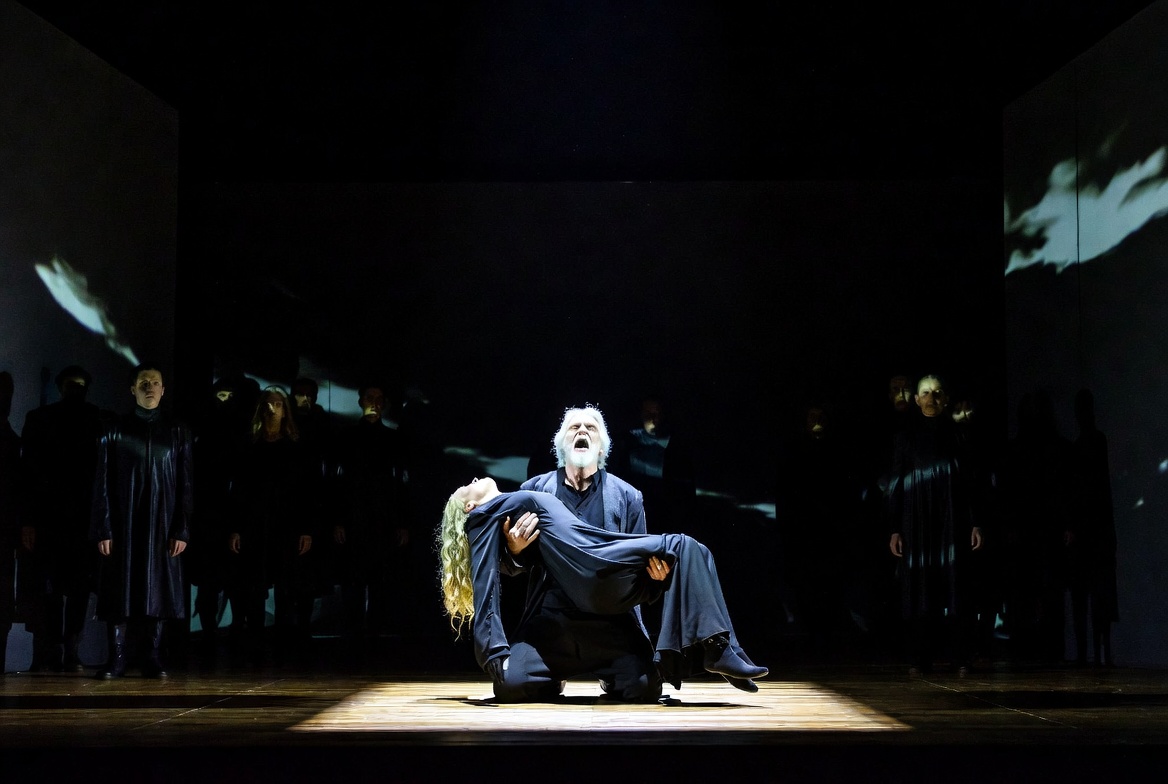
The drama King Lear has inspired some of the most memorable performances in theatrical history. On stage, Paul Scofield’s 1962 portrayal under Peter Brook remains legendary for its raw intensity and emotional restraint. Ian McKellen delivered a towering, physically commanding Lear in 2007 (and again in 2018), emphasizing the king’s declining strength and vulnerability. Anthony Hopkins brought a fierce, unpredictable energy to the role in a 2018 BBC production that highlighted Lear’s volatility.
Film adaptations have expanded the play’s reach. Peter Brook’s 1971 black-and-white film, shot in stark, wintry landscapes, captures the desolation of Kott’s absurdist vision. Akira Kurosawa’s Ran (1985) is widely regarded as one of the greatest Shakespeare adaptations ever made. Transplanting the story to feudal Japan with three sons instead of daughters, Kurosawa creates a visually stunning epic that rivals the original in emotional power while adding layers of Buddhist fatalism and samurai honor.
More recent versions include the 2018 Amazon Prime film starring Anthony Hopkins, which updates the setting to a modern corporate and military world, and various international productions that reimagine the play through non-Western cultural lenses—from Indian Kathakali dance-theater versions to African adaptations exploring tribal leadership and colonial legacies.
These adaptations prove that the drama King Lear is not locked in the past. Directors and filmmakers continue to find fresh, urgent ways to make its questions about power, family, and human endurance speak to contemporary audiences.
Timeless Lessons from the Drama King Lear for the 21st Century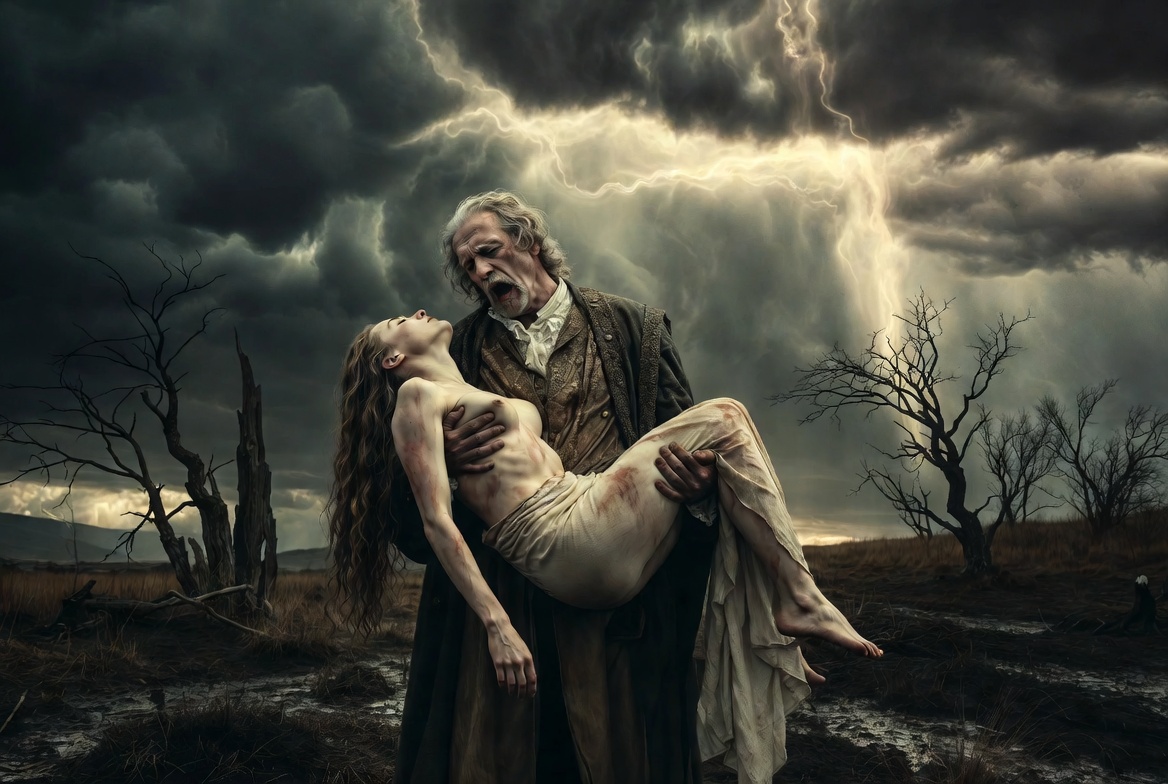
Beyond its literary brilliance, the drama King Lear offers profound, practical wisdom that can help us navigate modern life. Here are eight key lessons drawn from the play, presented with direct textual grounding and real-world application:
- Beware the Seduction of Flattery Lear’s demand for public declarations of love teaches that flattery is often a weapon of the ambitious. In business, politics, or personal relationships, learn to distinguish genuine loyalty from self-serving praise.
- True Loyalty Often Wears a Disguise Kent’s steadfast service despite banishment reminds us that real friends and allies may not always look or sound the way we expect. Value actions over words.
- Dividing Power Without Wisdom Invites Chaos Lear’s hasty division of his kingdom warns against impulsive delegation of authority. Whether in family inheritance, corporate restructuring, or political transitions, clarity, fairness, and foresight are essential.
- Aging Brings the Fear of Becoming Irrelevant—Prepare for It Lear’s terror of dependency highlights a universal anxiety. Cultivate humility, maintain meaningful relationships, and build inner resources before crisis strikes.
- Empathy Must Be Learned Through Suffering On the heath, Lear finally understands the plight of the poor: “O, I have ta’en / Too little care of this!” The play urges us to “feel what wretches feel” before misfortune forces the lesson upon us.
- Forgiveness and Reconciliation Can Arrive Too Late Lear’s reunion with Cordelia is brief and beautiful, but the final catastrophe underscores a painful truth: some regrets cannot be undone. Prioritize mending relationships while there is still time.
- Madness and Clarity Are Sometimes Twins In losing his reason, Lear gains insight. The play suggests that moments of personal crisis can strip away illusions and reveal deeper truths—if we are willing to listen.
- Speak What We Feel, Not What We Ought to Say Edgar’s closing lines call for honesty over social performance. In an age of curated personas and performative discourse, this remains powerful advice for authentic living.
These lessons make the drama King Lear far more than an academic text. They offer a moral and psychological framework for confronting power, family conflict, aging, and loss in our own lives.
How to Read, Teach, or Perform King Lear — Expert Study Guide
For students and general readers:
- Begin with a good annotated edition (Arden, Folger, or Oxford Shakespeare) to clarify archaic language.
- Read the play aloud—Shakespeare’s verse gains enormous power when spoken.
- Focus first on the major scenes: 1.1 (the love test), 3.2–4 (the storm), 4.7 (Lear-Cordelia reunion), and 5.3 (the catastrophe).
- Keep a notebook of recurring images (eyes, clothing, animals, storm) to track thematic development.
For teachers:
- Use the parallel plots as a gateway to discuss Shakespeare’s structural genius.
- Pair the play with modern texts such as Jane Smiley’s novel A Thousand Acres or the film Ran for comparative analysis.
- Encourage discussion of contemporary resonances without forcing simplistic political analogies.
For actors and directors:
- The role of Lear demands both vocal power and physical vulnerability. Explore the king’s journey from commanding presence to broken humanity.
- The storm scenes require creative sound and lighting design—the elements themselves become characters.
- Consider casting choices that illuminate themes of gender, age, and power.
Recommended free resources include the Internet Shakespeare Editions and MIT’s complete works online. For deeper study, consult the Arden Third Series edition, which offers excellent textual notes and performance history.
Frequently Asked Questions About the Drama King Lear
Is King Lear based on a true story? No, but it draws from ancient British legend recorded in Geoffrey of Monmouth and later chronicles. Shakespeare significantly darkened the original tale, which often ended happily, to create his tragic masterpiece.
Why is the ending so devastating? Shakespeare deliberately rejects the redemptive ending of his sources. By killing Cordelia—the one truly innocent and loving character—he emphasizes the play’s bleak vision of a world where goodness is not always rewarded and timing can be tragically cruel.
What is the significance of the storm? The storm externalizes Lear’s inner turmoil while symbolizing the breakdown of natural, social, and cosmic order. It also forces Lear into direct confrontation with his own humanity and the suffering of the dispossessed.
How does the Gloucester subplot mirror the main plot? Both fathers misjudge their children, suffer betrayal by the “bad” child, and gain painful wisdom only after great loss. The subplot intensifies the main action and universalizes the themes of blindness, ingratitude, and redemption.
Is Cordelia a believable character? Yes, when understood as a figure of uncompromising integrity rather than emotional coldness. Her refusal to flatter is not lack of love but a principled stand against hypocrisy—qualities Shakespeare clearly admires.
Which is the best modern film version for beginners? Many recommend the 2018 Anthony Hopkins version for its accessibility and modern setting. For a more traditional yet powerful experience, the 2008 Ian McKellen stage production (available on DVD) is excellent. Ran offers a brilliant cinematic reimagining.
How does King Lear compare to Hamlet or Macbeth? While Hamlet is philosophical and Macbeth is driven by ambition and guilt, King Lear is the most emotionally raw and socially panoramic. Many critics consider it Shakespeare’s greatest tragedy because of its breadth, depth of suffering, and refusal of easy consolation.
Why is it still relevant in 2026? Issues of family division, toxic leadership, generational conflict, the loneliness of aging, and the search for authenticity in a performative world make King Lear feel urgently contemporary. Its exploration of power’s fragility speaks to every era.
The drama King Lear stands as Shakespeare’s most profound and unflinching examination of what it means to be human. Through its towering central character, devastating plot, richly drawn supporting figures, and layered themes, the play forces us to confront our capacity for cruelty and compassion, our illusions of control, and the redemptive yet painful power of empathy.
Four hundred years after its first performance, King Lear continues to challenge, disturb, and ultimately enrich us. It warns against vanity and flattery, urges honesty in our closest relationships, and reminds us that true vision often comes only after profound loss. In a world still plagued by divided families, fragile authority, and personal storms, its lessons remain essential.
If you have not yet experienced the full play, I urge you to read it, watch a strong production, or listen to an audio version. Return to this guide afterward—you will discover new depths with every encounter.
What is your favorite scene or character in King Lear? Share in the comments below. For more explorations of Shakespeare’s greatest works, explore our guides to Hamlet, Macbeth, and Othello, or subscribe to our newsletter for regular insights into the Bard’s timeless drama.