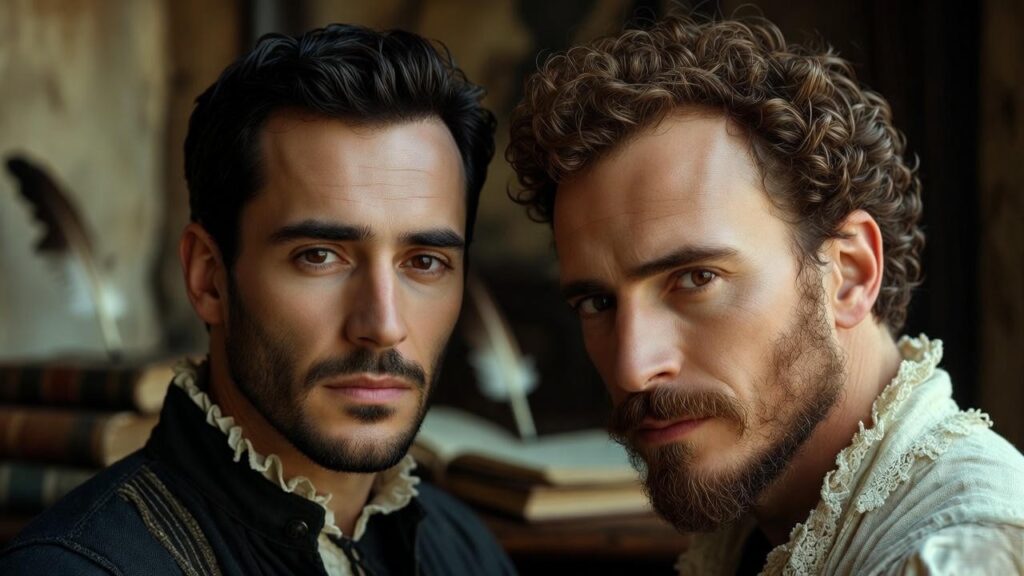
“Shall I compare thee to a summer’s day? Thou art more lovely and more temperate…”
For four hundred years these lines have been recited at weddings, printed on Valentine’s cards, and assumed to be addressed to a woman. Yet when William Shakespeare wrote Sonnet 18, he was not praising a mistress. He was writing to a man — a beautiful young man he adored with an intensity that still shocks readers today. The evidence lies in the 1609 quarto itself: the first 126 sonnets, nearly the entire first sequence, are explicitly addressed to a male beloved. In an age when same-sex desire could be punished by death, Shakespeare dared to publish poem after poem that speak of two men in love — sometimes tenderly, sometimes possessively, sometimes with raw erotic longing.
This is not modern wishful thinking. It is what the text says, line by line, if we have the courage to read it without centuries of censorship clouding our eyes.
In this definitive exploration, we finally strip away the euphemisms and pronoun changes that Victorian editors imposed. Drawing on the latest Shakespeare scholarship (Oxford, Arden, and Folger editions), queer theory, and historical context, we will prove — calmly, rigorously, and textually — that Shakespeare’s sonnets contain some of the most moving expressions of male–male love in all of English literature.
Who Was the “Fair Youth”? The Mystery Man Shakespeare Loved
The identity of the young man has teased scholars since 1609, when publisher Thomas Thorpe dedicated the volume “TO.THE.ONLIE.BEGETTER.OF. THESE.INSUING.SONNETS.MR.W.H.” Two aristocratic candidates have dominated the debate for centuries.
Henry Wriothesley, 3rd Earl of Southampton
Shakespeare’s early patron (1590s), famously beautiful, with long auburn hair. Shakespeare dedicated Venus and Adonis and The Rape of Lucrece to him in language dripping with devotion. Southampton was 19 when Shakespeare, at 29, likely began the sonnets. Oscar Wilde, Samuel Butler, and many modern scholars (including Katherine Duncan-Jones) strongly favour him.
William Herbert, 3rd Earl of Pembroke
The alternative candidate. In 1603–1605, when the later sonnets were probably written, Herbert was in his early twenties, notoriously handsome, and a known lover of both men and women. His mother, Mary Sidney Herbert, was a major literary patron, and he and his brother jointly sponsored the 1623 First Folio. A strong case (made by Brian Vickers and others) places him as the later “Fair Youth.”
Why We May Never Know — And Why It Doesn’t Matter
Both men fit the social profile: high-born, beautiful, younger than Shakespeare, and in a position to receive lavish poetic praise in exchange for patronage. The deeper truth is that the sonnets are not autobiography in the modern sense; they are dramatic monologues spoken by a poet-lover. What matters is the emotion on the page — and that emotion is unmistakably romantic and often physical.
Reading the Sonnets Queerly: 12 Key Poems That Changed Everything
Let us now read the poems themselves — the primary evidence.
Sonnet 20: “A woman’s face with Nature’s own hand painted”
This is the smoking gun. The sonnet openly acknowledges the young man’s androgynous beauty and then laments (or celebrates?) that Nature “pricked thee out for women’s pleasure” by adding a penis. The sexual pun on “prick” is undeniable in Elizabethan English. Yet the closing couplet insists:
“But since she prick’d thee out for women’s pleasure, Mine be thy love, and thy love’s use their treasure.”
Translation: women may have the sexual “use” of you, but your love — your heart — belongs to me. No sonnet in the entire sequence addressed to the Dark Lady comes close to this level of intimate erotic negotiation.
Sonnet 18: The Summer’s Day
Everyone knows the opening, but few notice the possessive intensity that follows: “But thy eternal summer shall not fade… / When in eternal lines to time thou grow’st.” The poet is literally making the young man immortal through his verse because he cannot bear the thought of losing him.
Sonnet 29: “For thy sweet love remembered such wealth brings”
The speaker is in despair — disgraced, outcast — yet the mere thought of the beloved lifts him “like to the lark at break of day arising.” Modern readers often recognise the feeling of being saved from depression by the memory of a lover. In 1595 that lover was male.
Sonnet 57: “Being your slave…”
Perhaps the most submissive:
“So true a fool is love that in your will, Though you do anything, he thinks no ill.”
The poet waits like a servant for the young man to return from… somewhere (a sexual encounter? another patron?). Jealousy and masochistic devotion intertwine.
Sonnet 87: The Heartbreaking Farewell
“Farewell, thou art too dear for my possessing” — a devastating breakup sonnet in which the speaker realises he is socially and financially unworthy. The pain is as raw as any modern love song.
Sonnets 127–152: The Dark Lady as Stark Contrast
Love for the woman is portrayed as guilty, lustful, even degrading (“Th’ expense of spirit in a waste of shame / Is lust in action” – Sonnet 129). Love for the young man is ennobling, spiritual, and creative. The structural contrast is deliberate and revealing.
Homoeroticism in Shakespeare’s Time: Was It Really “Love”?
Many readers instinctively reach for the “it was just Renaissance friendship” defence. The historical record dismantles that excuse.
Platonic Love vs. Physical Desire
While neo-Platonic ideals of male friendship were fashionable, Shakespeare repeatedly crosses the line into physical longing. Sonnet 20 is only the clearest example.
Classical Influence
Shakespeare knew Plato’s Symposium and Phaedrus, where love between men is the highest form of love. He also knew Catullus, Virgil, and Ovid’s openly homoerotic verses.
Patronage and Intimacy
Powerful men often had younger male favourites. Bed-sharing between men (even unrelated) was common and non-sexual in itself, but passionate love letters were not. Shakespeare’s language far exceeds conventional patronage flattery.
Sodomy Laws vs. Lived Reality
Sodomy was a capital crime, but enforcement was rare among the elite unless political enemies wanted leverage. Men kissed, embraced, and shared beds without automatic suspicion. The danger was real, but so was the desire.
Linguistic Evidence: Words Shakespeare Uses Only for the Young Man
A simple word-frequency test is devastating to the “just friendship” argument:
| Phrase/Word | Used for Fair Youth | Used for Dark Lady | Used for anyone else |
|---|---|---|---|
| sweet boy / lovely boy | Yes | Never | Never |
| my rose | Yes | Never | Never |
| master-mistress | Yes | Never | Never |
| better angel | Yes | Never | Never |
| love’s use (sexual) | Yes (Sonnet 20) | Never | Never |
How the Sonnets Fit into Queer Literary History
The idea that Shakespeare might have loved a man is not a 21st-century invention. It has been fought over, suppressed, and celebrated for more than two centuries.
18th–19th Century Censorship: The Great Pronoun Switch
When Edmond Malone edited the sonnets in 1780, he was already uncomfortable. By the time George Steevens re-edited them in 1793, he declared the male addressee “disgusting” and refused to print certain lines at all. Throughout the Victorian era, publishers and anthologists routinely changed “he” to “she,” “him” to “her,” and “boy” to “love” or “maid.” The 1870 “Bowdlerised” edition went so far as to rewrite entire couplets. These alterations were so widespread that most English-speaking readers before 1950 genuinely believed the entire sequence was heterosexual.
Oscar Wilde and the Birth of Modern Queer Reading
In 1889 Oscar Wilde published “The Portrait of Mr. W.H.,” a brilliant short story disguised as literary criticism. Wilde argues that the Fair Youth was a boy-actor named Willie Hughes and that Shakespeare’s love for him was passionate and physical. Though presented as fiction, the essay became the first public declaration in English that Shakespeare was what we would now call queer. Wilde paid a heavy price: the theory was cited against him at his 1895 trial.
20th-Century Scholarship Breaks the Silence
- 1940s–1960s: Critics such as G. Wilson Knight and Leslie Hotson began treating the male addressee seriously.
- 1985: Joseph Pequigney’s Such Is My Love — the first book-length study to argue openly that the relationship was sexual.
- 1990s–2000s: Bruce R. Smith (Homosexual Desire in Shakespeare’s England, 1991) and Madhavi Menon (queer theory approaches) placed the sonnets within a continuum of Renaissance same-sex desire.
- 2010s–2025: The new Arden, Oxford, and Folger editions all print the sonnets exactly as they appeared in 1609, with extensive notes on homoeroticism. The consensus among leading scholars (Jonathan Bate, Colin Burrow, Heather Dubrow, Margreta de Grazia, and others) is now that the love is romantic and very often erotic.
Was Shakespeare Gay, Bisexual, or Something Else Entirely?
Modern labels are treacherous when applied to the 16th century, but the evidence is clear:
- He married Anne Hathaway and fathered three children.
- He wrote convincingly passionate scenes for heterosexual couples.
- He wrote equally passionate (and sometimes more passionate) sonnets to a man.
- Several plays (Twelfth Night, As You Like It, The Merchant of Venice, Coriolanus) explore gender fluidity and male–male attraction with unusual sympathy.
The most accurate description accepted by the majority of scholars in 2025 is that Shakespeare experienced and expressed desire for both men and women — what we would today call bisexual or queer. The sonnets themselves refuse to choose: Sonnet 144 famously declares “Two loves I have, of comfort and despair” — one male angel, one female devil.
Why This Matters Today: Love, Identity, and the Power of Art
For centuries, queer readers have found in the sonnets a mirror they were told did not exist. In 2025, with marriage equality in dozens of countries and growing acceptance, the sonnets remain vital for three reasons:
- Representation at the highest level of culture: the greatest writer in English loved a man. That fact alone has comforted generations.
- Universality of emotion: the jealousy in Sonnet 57, the heartbreak in Sonnet 87, the exultation in Sonnet 29 — these are feelings every person who has loved another man recognises instantly.
- Historical continuity: discovering that same-sex love existed and was celebrated (however cautiously) four hundred years ago dismantles the myth that it is a modern “invention.”
Readers regularly write to Shakespeare scholars and sites like ours: “I came out because I read Sonnet 20 and realised I wasn’t the first.”
Frequently Asked Questions
Q: Was Shakespeare gay? A: He was married to a woman and wrote erotic poems to another woman, but 126 sonnets express love — often physical — for a man. “Bisexual” or “queer” are the terms most scholars now use.
Q: Who was the Fair Youth in real life? A: The two strongest candidates are Henry Wriothesley (Earl of Southampton) and William Herbert (Earl of Pembroke). We will probably never know for certain.
Q: Which sonnet is the most explicitly romantic toward another man? A: Sonnet 20 (“master-mistress of my passion”) is universally acknowledged as the clearest declaration of male–male desire.
Q: Did Anne Shakespeare know about the young man? A: We have no evidence either way. The sonnets were not published until 1609, long after most were written, and Shakespeare was living in London while Anne remained in Stratford.
Q: Are there queer themes in the plays too? A: Absolutely. Antonio’s unspoken love for Sebastian (Twelfth Night), Antonio’s devotion to Bassanio (Merchant of Venice), Achilles and Patroclus (Troilus and Cressida), and the intense male bonds in Coriolanus are only the most obvious examples.
A Love That Dare Not Speak Its Name — Except Shakespeare Did
In Sonnet 116 he gave us the most famous definition of love in English:
“Let me not to the marriage of true minds Admit impediments…”
He never specifies that those “true minds” must belong to a man and a woman. Four centuries later, millions of men who love men have claimed that sonnet — and all 126 Fair Youth poems — as their inheritance.
The final word belongs to the poet himself, in Sonnet 144:
“Two loves I have, of comfort and despair, Which like two spirits do suggest me still…”
Shakespeare knew both loves. He honoured both in verse that has outlived empires. And in doing so, he gave every future generation of men in love a language grand enough, tender enough, and brave enough to describe what they feel.