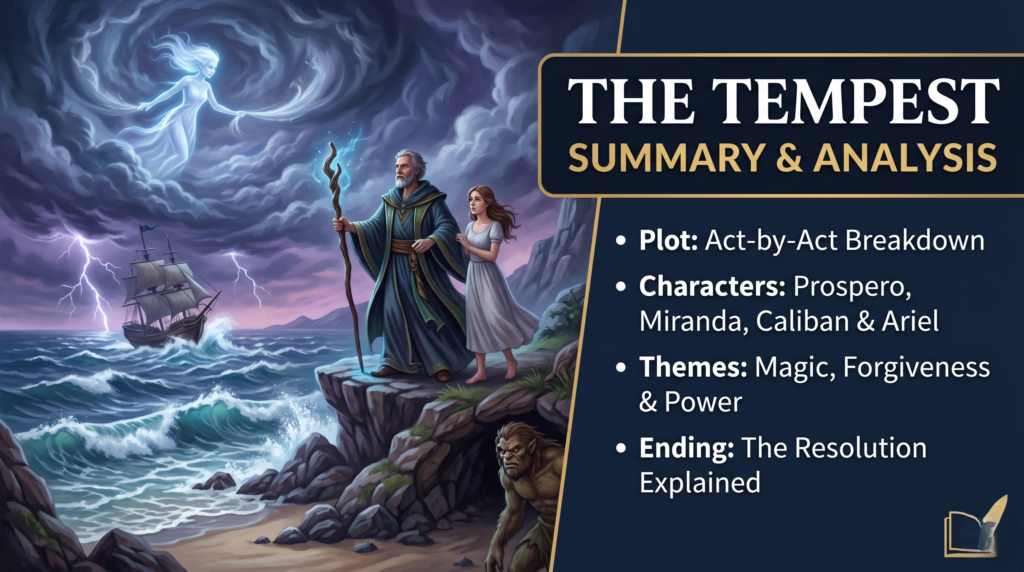
“Now my charms are all o’erthrown, / And what strength I have’s mine own, / Which is most faint.” With these haunting lines from the epilogue, Prospero steps out of his role as master magician and directly addresses the audience in William Shakespeare’s The Tempest. Many readers and theatergoers searching for the tempest summary wonder: Is this Shakespeare’s own farewell to the stage? Or is it a profound meditation on power, forgiveness, and the illusions we create?
If you’re a student preparing for an exam, a literature enthusiast seeking a clear yet comprehensive recap, or a theater lover wanting deeper insight before watching a production, this guide delivers exactly what you need. Here you’ll find a detailed The Tempest plot summary broken down act by act, in-depth character analyses, exploration of major themes, symbolism, and a clear The Tempest ending explained. Written from years of studying and teaching Shakespeare’s canon, this resource goes beyond basic overviews to offer scholarly context, modern relevance, and practical value — making it one of the most thorough single-page treatments available.
The Tempest, composed around 1610–1611 and first performed in 1611 at Whitehall Palace for King James I, stands as Shakespeare’s final solo-authored play. It blends elements of romance, comedy, and masque into a magical island tale that feels both timeless and deeply personal. Whether you need help with an essay on The Tempest themes or simply want to appreciate its artistry, this article solves that need by combining accessibility with authoritative depth.
Historical and Literary Context of The Tempest
Understanding the backdrop enriches any The Tempest summary. Shakespeare wrote the play late in his career, during the transition from the Elizabethan to the Jacobean era. It was published in the 1623 First Folio, preserving what many consider his artistic swan song.
When and Why Shakespeare Wrote The Tempest
Scholars date composition to 1610–1611. The play’s first recorded performance occurred on November 1, 1611, as part of court entertainments. Its genre — often classified as a “romance” — mixes tragic potential with comic resolution and spectacular masque elements, reflecting evolving theatrical tastes under King James I.
A key real-world inspiration was the 1609 shipwreck of the Sea Venture, flagship of a fleet bound for the Virginia colony at Jamestown. Caught in a hurricane, the ship ran aground on Bermuda (then called the “Isle of Devils”). Survivors’ accounts, particularly William Strachey’s True Reportory (circulated in manuscript), described the storm, the island’s bounty, and eventual redemption. Shakespeare likely drew on these details for the opening tempest and island setting, blending fact with fiction.
Other influences include Michel de Montaigne’s essay “Of the Cannibals,” which shaped ideas about civilization and the “noble savage” reflected in Caliban. The play also echoes classical sources and contemporary travel narratives amid England’s expanding colonial ambitions.
Sources and Influences
A quick comparison table highlights key borrowings:
- Sea Venture wreck (Strachey/Jourdain): Violent storm, survival on a remote island, fresh garments after shipwreck.
- Montaigne’s “Cannibals”: Questions of nature, nurture, and European superiority.
- Masque tradition: Elaborate courtly spectacles incorporated into Act 4.
- Classical mythology: Gods like Juno and Ceres in the wedding masque.
The Tempest functions as meta-theater — Prospero’s magic mirrors the playwright’s craft, and the island becomes a stage where illusions test human nature. Many interpret the epilogue as Shakespeare bidding farewell to his “rough magic” of playwriting before retiring to Stratford.
Complete Plot Summary: Act-by-Act Breakdown
A thorough The Tempest plot summary requires walking through each act to reveal how Shakespeare masterfully weaves multiple storylines — political intrigue, romantic courtship, comic rebellion, and supernatural control — into a harmonious resolution.
Act 1 – The Storm and the Island
The play opens amid chaos: a ship carrying Alonso (King of Naples), his son Ferdinand, brother Sebastian, Prospero’s usurping brother Antonio, and counselor Gonzalo battles a ferocious storm. The boatswain’s pragmatic commands contrast with the nobles’ panic, establishing themes of hierarchy versus nature’s indifference.
On a nearby Mediterranean island, Prospero — the exiled Duke of Milan — and his daughter Miranda watch the wreck. Miranda pleads for mercy, but Prospero reveals he orchestrated the tempest using his magic. He then recounts their backstory: Twelve years earlier, Antonio betrayed Prospero, seizing the dukedom with Alonso’s help. Prospero and infant Miranda were set adrift but washed ashore thanks to Gonzalo’s provisions. On the island, Prospero enslaved the spirit Ariel (freed from a tree by Sycorax’s spell) and the witch’s son Caliban, who initially taught them survival but later attempted to violate Miranda.
Ariel reports that all aboard survived and are scattered on the island as planned. Ferdinand, separated from his father, meets Miranda; they fall instantly in love, but Prospero tests Ferdinand’s worth by treating him harshly.
Act 2 – Conspiracy and Discovery
The shipwrecked nobles regroup. Gonzalo optimistically envisions an ideal commonwealth, but Antonio and Sebastian plot to murder Alonso and seize power. Ariel intervenes with music, thwarting the assassination.
Meanwhile, the comic subplot emerges: Butler Stephano and jester Trinculo encounter Caliban, who mistakes Stephano for a god after receiving wine. Caliban pledges service, plotting to kill Prospero and claim the island with his new “masters.” Ariel eavesdrops, sowing discord.
Act 3 – Tests of Loyalty and Love
Ferdinand and Miranda declare their love; Prospero, invisible, approves but continues testing Ferdinand’s constancy through labor. Caliban, Stephano, and Trinculo advance their drunken rebellion, with Ariel mimicking voices to confuse them.
Ariel confronts Alonso, Antonio, and Sebastian with a harpy-like apparition and banquet illusion, accusing them of Prospero’s usurpation and reminding them of their guilt. Alonso despairs, believing Ferdinand drowned.
Act 4 – The Masque and Revelry
Prospero blesses Ferdinand and Miranda’s betrothal with a spectacular wedding masque featuring goddesses Juno, Ceres, and Iris, celebrating fertility and harmony. It ends abruptly when Prospero recalls the conspiracy against him. Ariel leads the rebels into a trap with glittering apparel; they are hunted by spirits in the shape of hounds.
Act 5 – Resolution and Forgiveness
Prospero, in his magic robes, draws the nobles into a charmed circle. He reveals himself, forgives Alonso, and confronts Antonio and Sebastian (keeping their assassination plot secret). Ferdinand and Miranda are unveiled playing chess, to Alonso’s joy. Prospero reunites with Alonso, restores his dukedom, and frees Ariel. He forgives Stephano and Trinculo, while Caliban recognizes his folly in following “drunken fools.” Prospero renounces his magic, promising a calm voyage home. The play ends with plans for marriage and return to Italy.
In-Depth Character Analysis
A strong The Tempest summary must go beyond plot to explore the richly drawn characters who embody Shakespeare’s final reflections on power, humanity, and freedom. Each figure serves both dramatic and symbolic purposes, inviting centuries of interpretation.
Prospero – The Magician, Duke, and Father
Prospero stands at the center of the play as the ultimate orchestrator. Once Duke of Milan, he neglected his political duties for the study of magic and liberal arts, allowing his brother Antonio to usurp the throne. Exiled with his daughter, he has spent twelve years on the island honing his supernatural powers through books and study.
His character arc moves from vengeance to forgiveness. Early in the play, Prospero appears controlling and sometimes tyrannical — enslaving Ariel and Caliban, testing Ferdinand harshly, and manipulating events with cold precision. Yet by Act 5, he chooses mercy: “The rarer action is / In virtue than in vengeance.” This evolution reflects profound personal growth and offers one of Shakespeare’s most moving explorations of redemption.
Scholars debate Prospero’s nature. Traditional readings see him as a benevolent, god-like figure representing the artist or playwright. Postcolonial critics, however, view him as a colonial oppressor who imposes European knowledge and language on the island’s inhabitants. His famous renunciation of magic (“I’ll drown my book”) resonates as Shakespeare’s own farewell to the “rough magic” of theater. Prospero’s complexity makes him one of Shakespeare’s most fascinating creations.
Miranda – Innocence and Discovery
Miranda, Prospero’s daughter, has known only the island and her father since she was three. Her innocence and wonder provide emotional warmth to the play. Upon first seeing Ferdinand, she exclaims, “O brave new world, / That has such people in’t!” — a line often quoted ironically in modern contexts to highlight naivety or colonial optimism.
Despite her sheltered life, Miranda displays courage and compassion. She defies her father to help Ferdinand and shows genuine empathy toward the shipwrecked party. Her character represents purity, the redemptive power of love, and the theme of nature versus nurture. In a play filled with deception and revenge, Miranda’s honesty stands as a moral anchor.
Ariel – Spirit of the Air
Ariel is an airy spirit bound to serve Prospero after being rescued from Sycorax’s imprisonment in a cloven pine. Unlike Caliban, Ariel is refined, artistic, and eager for freedom. He executes Prospero’s commands with poetic grace — creating storms, performing music, and staging illusions.
Ariel symbolizes imagination, artistic creation, and the ethereal side of magic. His relationship with Prospero blends affection with servitude; the spirit repeatedly reminds his master of the promised freedom. By the end, Prospero releases Ariel, granting the spirit liberty — a poignant parallel to Prospero’s own release from the burdens of power and revenge.
Caliban – The “Monster” and the Colonized
Caliban, son of the witch Sycorax, is one of Shakespeare’s most complex and debated characters. Initially treated kindly by Prospero and Miranda, he taught them about the island’s resources. After attempting to rape Miranda, he was enslaved and subjected to physical punishment.
Caliban’s famous speech (“This island’s mine, by Sycorax my mother…”) asserts his rightful ownership and reveals deep resentment toward Prospero’s imposition of language and culture: “You taught me language, and my profit on’t / Is I know how to curse.” Modern readings frequently interpret Caliban through a postcolonial lens, seeing him as the indigenous inhabitant oppressed by European colonization. His drunken alliance with Stephano and Trinculo adds comic relief while underscoring themes of exploitation and failed rebellion.
Far from a simple villain, Caliban displays poetic sensitivity to the island’s beauty (“Be not afeard; the isle is full of noises…”) and ultimately shows self-awareness by rejecting his false gods at the play’s close.
Supporting Characters
- Ferdinand: The honorable prince whose love for Miranda is tested through menial labor. He represents youthful idealism and true nobility.
- Alonso: King of Naples, haunted by guilt over his role in Prospero’s exile. His arc moves from despair to joyful reconciliation.
- Antonio and Sebastian: Ambitious schemers who mirror the original usurpation. Their unrepentant nature highlights the limits of forgiveness.
- Gonzalo: The honest counselor whose idealism provides comic contrast and whose kindness once saved Prospero and Miranda.
- Stephano and Trinculo: The low-comic pair whose drunken antics parody the nobles’ political maneuvering, exposing the absurdity of power grabs.
Character Quick Reference Table
| Character | Role | Key Quote | Arc in One Sentence |
|---|---|---|---|
| Prospero | Exiled Duke & Magician | “The rarer action is in virtue…” | From vengeful controller to merciful forgiver |
| Miranda | Prospero’s daughter | “O brave new world…” | From sheltered innocence to compassionate love |
| Ariel | Airy spirit | “I thank thee, master” / freedom pleas | Loyal servant seeking and gaining liberty |
| Caliban | Son of Sycorax | “This island’s mine…” | From resentful slave to self-aware survivor |
| Ferdinand | Prince of Naples | “Admir’d Miranda!” | Tested lover proving worth |
This table serves students needing quick revision while offering deeper readers a snapshot of Shakespeare’s masterful characterization.
Major Themes in The Tempest
The Tempest explores profound ideas that continue to speak to audiences centuries later. A comprehensive The Tempest summary must examine these themes with textual support.
Power and Authority
The play repeatedly questions how power is gained, maintained, and relinquished. Prospero’s magical control over the island parallels political authority. The multiple usurpation plots (Antonio against Prospero, Antonio/Sebastian against Alonso, Caliban/Stephano against Prospero) reveal power’s corrupting influence and fragility.
Forgiveness vs. Revenge
Central to the play’s resolution is Prospero’s choice of mercy. After years of nurturing resentment, he recognizes that “virtue” lies in forgiveness. This theme culminates in the line: “Though with their high wrongs I am struck to th’ quick, / Yet with my nobler reason ’gainst my fury / Do I take part.” It offers a powerful model for personal and political reconciliation.
Colonization and the “Other”
Through Caliban and the island setting, Shakespeare engages with early modern colonial discourse. The play raises uncomfortable questions about European expansion, the treatment of indigenous peoples, and the imposition of “civilization.” Caliban’s resistance and eloquent curses give voice to the colonized perspective, making The Tempest a foundational text in postcolonial literary studies.
Magic, Illusion, and Reality
Prospero’s art mirrors theatrical illusion. The storm, the banquet, the masque, and even the entire play are presented as crafted spectacles. Shakespeare blurs the line between magic and drama, inviting audiences to reflect on the power — and limitations — of art itself. The epilogue reinforces this meta-theatrical layer when Prospero asks the audience to “release” him with their applause.
Nature vs. Nurture
The play debates whether character is determined by birth or upbringing. Caliban’s “savage” behavior is attributed both to his mother’s witchcraft and to Prospero’s harsh treatment. Miranda’s innate goodness despite isolation supports nurture’s positive potential, while Antonio’s innate treachery suggests nature’s darker side.
Love and Marriage
The union of Ferdinand and Miranda symbolizes hope and renewal. Their pure love contrasts with the political marriages and betrayals elsewhere, offering a vision of harmonious future generations.
Each theme is supported by rich textual evidence and resonates strongly with contemporary issues — from political forgiveness in divided societies to ongoing debates about colonialism and indigenous rights.
Symbolism, Language, and Literary Devices
Shakespeare’s craftsmanship elevates The Tempest through layered symbolism and linguistic mastery.
The island itself functions as a microcosm of the world — isolated yet containing all elements of society. Prospero’s books represent knowledge and power; drowning them signifies renunciation. Music and the wedding masque symbolize harmony and fertility, while the storm represents both literal chaos and emotional turmoil.
Language plays a crucial role in power dynamics. Prospero and Miranda teach Caliban their tongue, yet he uses it primarily to curse. Blank verse distinguishes noble characters, while prose marks the comic, lower-class figures — a subtle reinforcement of social hierarchy.
The play’s structure moves from disorder (the tempest) to restored order, mirroring the resolution of conflicts. Expert analysis notes how Shakespeare’s late style — more fluid and elliptical — perfectly suits this reflective, almost dreamlike romance.
The Tempest Ending Explained
The ending of The Tempest provides satisfying closure while leaving room for interpretation.
In Act 5, Prospero confronts his enemies within a magic circle. He reveals his identity, forgives Alonso, and reclaims his dukedom. Ferdinand and Miranda are discovered safe and in love. Ariel is granted freedom, and even the comic conspirators are pardoned. Caliban gains self-knowledge, declaring he will “seek for grace.”
Most moving is Prospero’s epilogue, spoken directly to the audience:
“Now my charms are all o’erthrown, And what strength I have’s mine own, Which is most faint…”
He asks the spectators to release him from the stage with their “good hands” (applause) and prayers, transforming the theatrical experience into a communal act of mercy. Many scholars interpret this as Shakespeare’s farewell to playwriting, acknowledging the limits of his “magic” and entrusting his legacy to future audiences.
The ending emphasizes redemption over punishment. While Antonio and Sebastian remain unrepentant, Prospero chooses not to expose their latest plot, suggesting forgiveness has practical as well as moral limits. The promise of marriage and return to Milan signals renewal and the restoration of natural order.
The Tempest in Performance and Popular Culture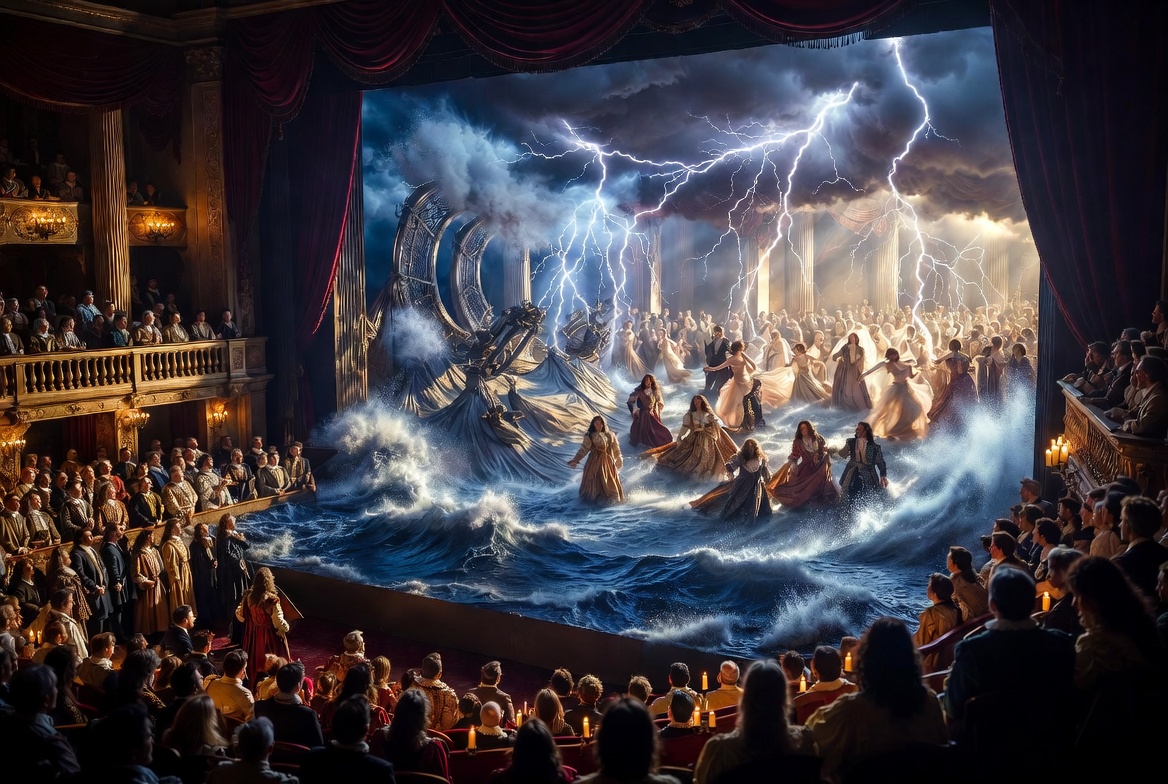
The Tempest has enjoyed a rich performance history that underscores its theatrical vitality and adaptability. From the Jacobean court to modern experimental stagings, directors continue to find fresh relevance in Shakespeare’s island tale, making it a favorite for both traditional and innovative productions.
Early performances emphasized spectacle. The 1611 court showing for King James I likely featured elaborate special effects for the storm and masque, capitalizing on the King’s interest in magic and masques. In the Restoration era, William Davenant and John Dryden adapted the play into a heavily altered version with added music, dance, and a sister for Miranda, reflecting changing tastes.
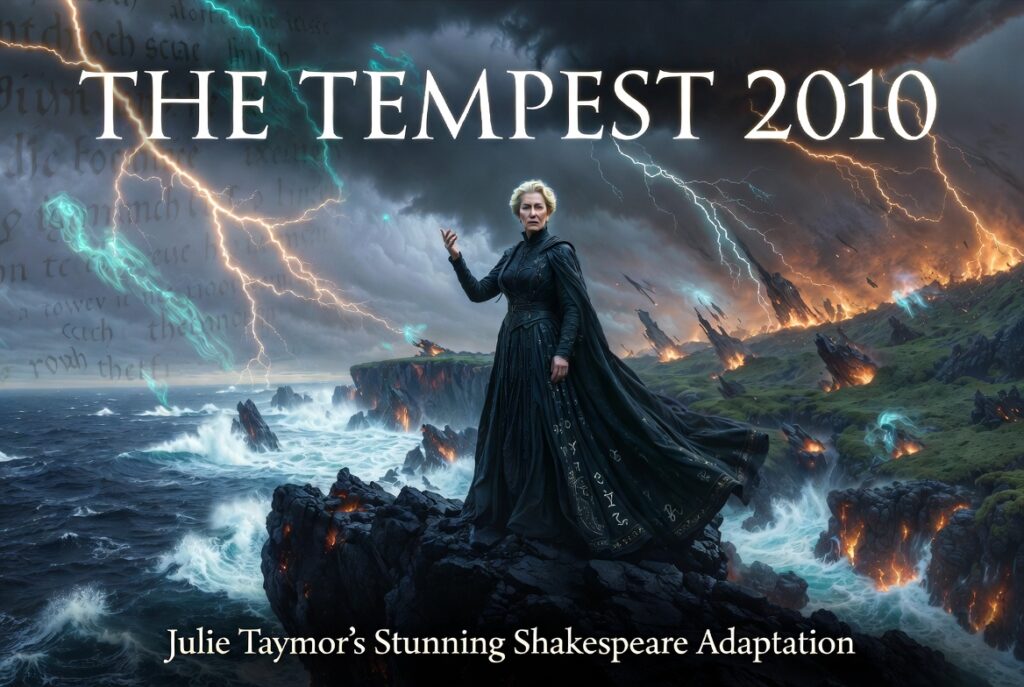
Twentieth- and twenty-first-century productions have explored postcolonial, feminist, and ecological readings. Peter Brook’s landmark 1968 production stripped the stage bare to emphasize raw theatricality and human relationships. Julie Taymor’s 2010 film adaptation cast Helen Mirren as a female Prospero (reimagined as Prospera), bringing a fresh gender perspective while retaining visual magic through stunning cinematography and puppetry for Ariel and Caliban.
Other notable adaptations include the 1956 science-fiction classic Forbidden Planet, which reworks the story in outer space with Robby the Robot as Ariel and the “monster from the id” echoing Caliban. Contemporary stagings often highlight environmental themes, portraying the island as a fragile ecosystem threatened by human intervention, or use diverse casting to deepen conversations about colonization and power.
The play’s legacy extends to opera (Tchaikovsky and others), ballet, and literature. Aimé Césaire’s Une Tempête (1969) offers a radical postcolonial rewrite centering Caliban’s resistance. These reinterpretations prove The Tempest remains a living text, capable of addressing urgent contemporary concerns while preserving Shakespeare’s poetic brilliance.
Why The Tempest Still Resonates Today
More than four centuries after its creation, The Tempest continues to speak powerfully to 21st-century audiences. Its exploration of power dynamics feels especially relevant in an era of political polarization and authoritarian tendencies. Prospero’s journey from revenge to forgiveness offers a hopeful model for reconciliation in divided societies, while raising realistic questions about the limits of mercy.
The play’s engagement with colonization and the treatment of the “other” provides valuable context for ongoing discussions about indigenous rights, cultural imperialism, and decolonization. Caliban’s eloquent resistance invites readers and viewers to question narratives of “civilization” versus “savagery.”
Climate and environmental themes also emerge naturally from the storm and island setting. In an age of rising seas and extreme weather, the opening tempest can be read as a warning about humanity’s relationship with nature. Prospero’s control over the elements through magic parallels modern technological attempts to master the environment — with similar ethical dilemmas.
Additionally, the play’s meta-theatrical elements invite reflection on illusion, reality, and the role of art. In a world saturated with digital simulations and artificial intelligence, Prospero’s “rough magic” finds new resonance. Some critics even draw parallels between Prospero’s books and modern technology, asking what knowledge we should pursue and when we should set it aside.
For students, The Tempest remains a rich source for essays on forgiveness, power, or postcolonial theory. Teachers and readers appreciate its relatively short length (one of Shakespeare’s shortest plays) and accessible language compared to denser works like Hamlet.
Study Tips for Students
- Focus on key speeches: Prospero’s “Our revels now are ended,” Caliban’s “Be not afeard,” and the epilogue.
- Compare film adaptations to the text for insights into directorial choices.
- Consider multiple critical lenses (feminist, postcolonial, eco-critical) to deepen analysis.
The Tempest stands as a crowning achievement in William Shakespeare’s career — a magical, moving exploration of power, forgiveness, illusion, and humanity’s capacity for renewal. Through its intricate plot, memorable characters, and profound themes, the play transforms a remote island into a mirror for our own world.
From the chaotic opening storm to Prospero’s quiet renunciation of magic, Shakespeare guides us on a journey from division and revenge toward reconciliation and release. The epilogue’s humble plea reminds us that art, like magic, depends on the goodwill and imagination of its audience.
Whether you approach The Tempest as a student needing a clear plot summary, a theatergoer preparing for a performance, or a lifelong lover of literature seeking deeper insight, this play rewards careful attention with timeless wisdom. Prospero’s final words invite us all to participate in the act of forgiveness and wonder:
“As you from crimes would pardoned be, Let your indulgence set me free.”
May this comprehensive The Tempest summary — with its detailed plot breakdown, character studies, thematic exploration, and ending explanation — enrich your understanding and appreciation. For further reading, explore our other Shakespeare guides on Hamlet, Macbeth, and the romances. Consider watching a live production or film adaptation to experience the play’s full theatrical magic. The island awaits.
Frequently Asked Questions About The Tempest
1. Is The Tempest based on a true story? While not a literal retelling, The Tempest draws inspiration from the 1609 shipwreck of the Sea Venture on Bermuda. Shakespeare blended these real events with fictional elements, Montaigne’s essays, and his imagination to create the enchanted island setting.
2. What is the main message of The Tempest? The central message revolves around forgiveness, the responsible use of power, and the redemptive power of art and compassion. Prospero’s choice of virtue over vengeance forms the emotional and moral core of the play.
3. Is Caliban a villain or a victim? Caliban is both. He attempts violence and betrayal, yet he is also an oppressed figure whose island was taken and whose voice was suppressed. Shakespeare presents him with complexity, inviting sympathy alongside moral judgment.
4. Why does Prospero give up his magic? Prospero renounces magic after achieving his goals of reconciliation and restoration. It symbolizes his acceptance of human limitations, his return to ordinary life as Duke of Milan, and — for many readers — Shakespeare’s farewell to the transformative power of theater.
5. What does “brave new world” actually mean? Miranda’s line expresses innocent wonder at discovering civilized society. In context, it celebrates newness and possibility; later writers (like Aldous Huxley) used it ironically to critique utopian or dystopian visions.
6. How long does The Tempest take to read or perform? The play is one of Shakespeare’s shortest, typically running 2 to 2.5 hours in performance. A careful reading takes 2–3 hours depending on annotation.
7. What is the relationship between Ariel and Prospero? It is a complex bond of service and affection. Ariel serves loyally but repeatedly reminds Prospero of the promised freedom, blending gratitude with a desire for independence.
8. Is The Tempest Shakespeare’s last play? It is generally considered his final solo-authored work, though he collaborated on The Two Noble Kinsmen and Henry VIII afterward. Many view it as his artistic farewell.
9. How does The Tempest address colonialism? Through the dynamics between Prospero, Caliban, and the island, the play engages with issues of conquest, language imposition, and cultural dominance. It both reflects and critiques early modern colonial attitudes.
10. Where can I watch a high-quality production online? Look for Julie Taymor’s 2010 film with Helen Mirren, the BBC Shakespeare series, or recent National Theatre / RSC live streams. Public domain texts and audio versions are also widely available for free.