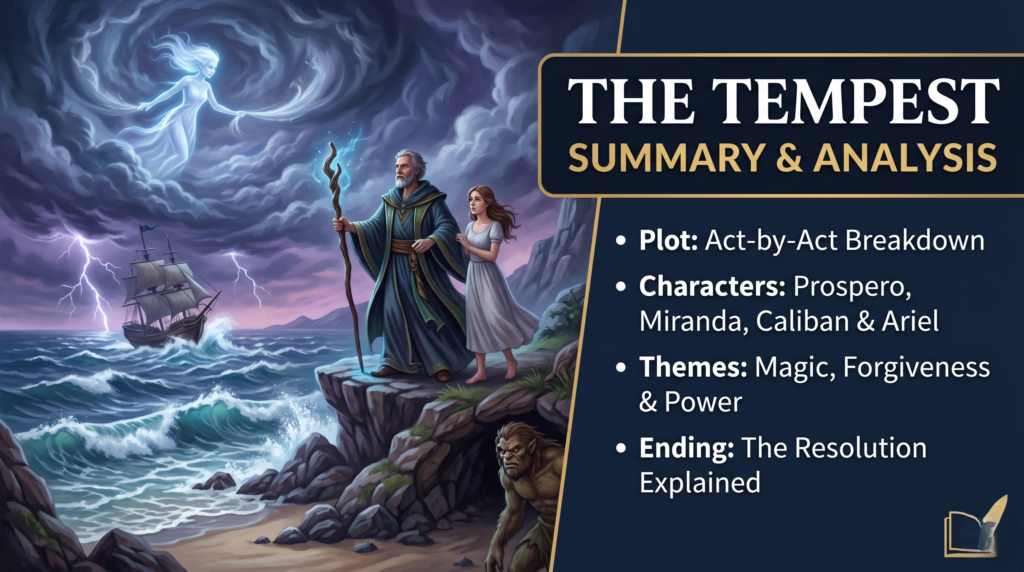
Of all the figures that populate Shakespeare’s magical islands and royal courts, none remains as visceral or as fiercely debated as Caliban in The Tempest. He is introduced to us through the vitriol of others—called a “freckled whelp,” a “deformed slave,” and a “thing of darkness.” Yet, when this supposed monster speaks, he utters the most transcendent poetry in the entire play. This paradox sits at the heart of our fascination: how can a character so reviled by his peers be the one to give the island its soul? Whether you are a student deconstructing a literary essay or a theater enthusiast seeking a deeper understanding of the Bard’s final masterpiece, the enigma of Caliban offers a profound reflection on power, language, and the very definition of humanity.
I. Who is Caliban? Origins and Context
To understand Caliban, one must first look at the soil from which he grew. He is the only character in the play with a legitimate, biological claim to the island’s sovereignty—a fact that complicates every interaction he has with the shipwrecked nobility.
Parentage and Heritage: The Legacy of Sycorax
Caliban is the son of the Algerian sorceress Sycorax. We learn through Prospero’s exposition that Sycorax was banished to the island while pregnant, having been spared execution for “mischiefs manifold and sorceries terrible.” Caliban’s heritage is thus steeped in the supernatural and the “other.” He is often associated with the god Setebos, whom his mother worshipped. This lineage immediately marks him as an outsider to the Christian, European world of Prospero and Miranda, placing him in a liminal space between the human and the demonic.
The Claim to the Isle: “This Island’s Mine”
One of the most famous lines in the play is Caliban’s defiant cry: “This island’s mine, by Sycorax my mother, / Which thou takest from me.” Before Prospero arrived, Caliban was his own king. He lived in harmony with the island’s natural resources, understood its “qualities,” and possessed a primal autonomy. The shift from being the master of his domain to the “slave” of a foreign sorcerer is the fundamental trauma that drives his character.
Physicality vs. Spirit: The Visual Evolution of a “Monster”
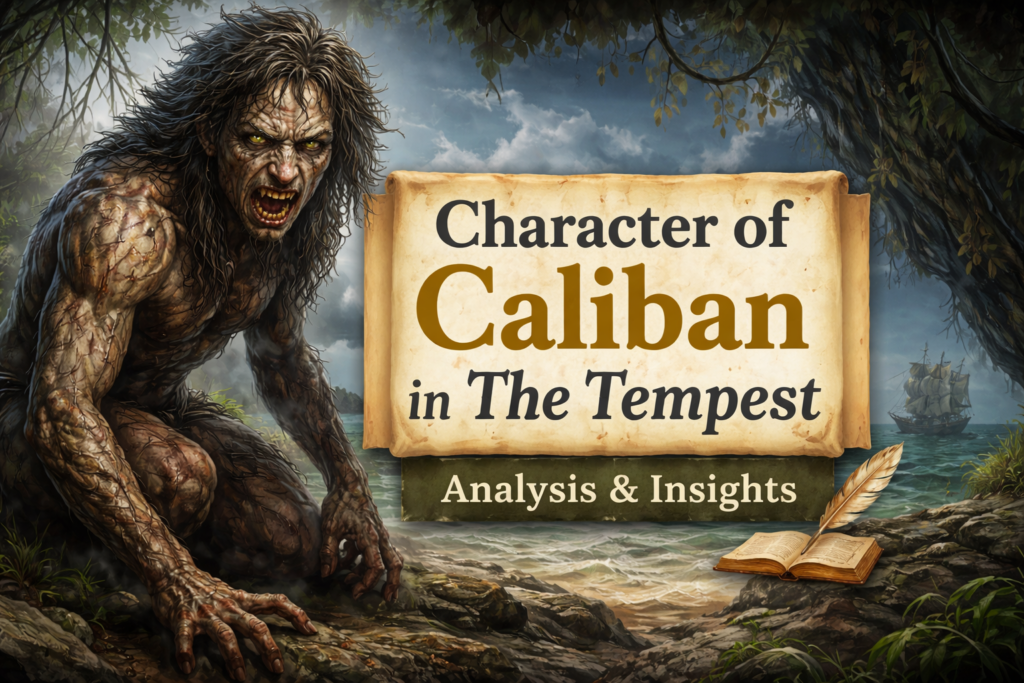
Stage history has treated Caliban’s physical appearance as a Rorschach test for the era’s prejudices. In the 17th and 18th centuries, he was often depicted as a literal beast—finned, scaled, or tortoise-like. By the 19th century, Darwinian influence saw him portrayed as a “missing link.” In modern productions, however, Caliban is frequently portrayed as a fully human indigenous man, his “deformity” being a social construct imposed by his colonizer rather than a physical reality. This shift highlights the transition from seeing Caliban as a biological anomaly to a political symbol.
II. The Villain Archetype: Examining the Crimes of Caliban
While modern audiences tend to sympathize with Caliban, a rigorous analysis must address why he was traditionally cast as the play’s antagonist. Shakespeare does not shy away from Caliban’s darker impulses, presenting a character whose morality is as rugged as the island’s terrain.
The Attempted Violation of Miranda
The most significant barrier to viewing Caliban as a pure victim is his attempted rape of Miranda. When Prospero accuses him of this crime, Caliban does not deny it; instead, he responds with a chilling boast: “O ho, O ho! would’t had been done! / Thou didst prevent me; I had peopled else / This isle with Calibans.”
From a traditional perspective, this confirms Caliban’s “natural depravity.” It suggests that without the civilizing influence of Prospero’s law, Caliban is a danger to the social order. However, scholars often point out that within the context of the play, “peopling the isle” is also a biological way of reclaiming territory. Regardless of the interpretation, this act remains the moral pivot point that Prospero uses to justify Caliban’s enslavement.
The Conspiracy: A Murderous Bid for Freedom
Caliban’s alliance with the drunken low-lifes, Stephano and Trinculo, further cements his role as a villain in the eyes of the court. He incites them to murder Prospero in his sleep, even suggesting they “batter his skull” or “paunch him with a stake.” To a Jacobean audience, regicide (or the murder of a Duke) was the ultimate sin. Caliban’s willingness to trade one master for another—kneeling before Stephano as a “god” because of the “celestial liquor”—was often played for laughs, intended to show his inherent servility and poor judgment.
Nature vs. Nurture: The “Born Devil”
Prospero famously describes Caliban as “A devil, a born devil, on whose nature / Nurture can never stick.” This reflects a core Renaissance debate: can education and grace change a person’s fundamental essence? Prospero argues that despite his efforts to teach Caliban language and religion, the “savage” remains unchanged. This view categorizes Caliban as a static villain, incapable of the redemption that the Italian nobles eventually find.
III. The Victim Archetype: Caliban and Post-Colonial Theory
In the last century, the “Villain” narrative has been largely superseded by the “Victim” narrative. Through the lens of post-colonialism, Caliban becomes a tragic figure representing the millions of indigenous people displaced and subjugated by European expansion.
The Theft of Language: A Double-Edged Gift
One of the most poignant moments in the play occurs when Caliban addresses the education he received from Prospero and Miranda: “You taught me language; and my profit on’t / Is, I know how to curse. The red plague rid you / For learning me your language!”
This is a masterclass in colonial critique. Prospero views language as a gift of civilization; Caliban views it as the bars of his cage. By forcing Caliban to speak their tongue, the colonizers have stripped him of his own indigenous expression and provided him only with the tools to articulate his own misery. He is trapped in a system where even his rebellion must be phrased in the words of his oppressor.
Enslavement and the “Other”
Caliban’s daily life is a cycle of forced labor—fetching wood, making fires, and serving “the master.” His resistance is met with psychological and physical torture. Prospero threatens him with “cramps” and “side-stitches,” using his magic not for enlightenment, but for domestic control. For a modern reader, it is impossible to ignore the parallels between this and the historical treatment of enslaved populations in the Americas and Africa during Shakespeare’s time.
The Lost Sovereignty
Before Prospero’s arrival, Caliban describes a life of pastoral beauty. He knew where the “fresh springs, brine-pits, barren place and fertile” were. He shared this knowledge with Prospero out of love and curiosity, only to have that knowledge used against him to map and dominate the land. This story of the “helpful native” who is eventually betrayed by the explorer is a recurring theme in global history, making Caliban a universal symbol of the dispossessed.
IV. The Mirror of Humanity: Why We See Ourselves in Caliban
Beyond the binary of villain and victim lies the most compelling version of the character: Caliban as a mirror. He represents the “Id”—the raw, unrefined parts of the human psyche that we often try to suppress.
The “Be Not Afeard” Speech: The Soul of the Island
Perhaps the most beautiful passage in The Tempest belongs to Caliban. When Stephano and Trinculo are frightened by the invisible music of Ariel, Caliban reassures them:
“Be not afeard; the isle is full of noises, / Sounds and sweet airs, that give delight and hurt not. / Sometimes a thousand twangling instruments / Will hum about mine ears, and sometime voices…”
In this moment, Caliban’s “monstrosity” vanishes. He reveals a profound sensitivity to beauty and a capacity for dreaming that far exceeds the greedy, materialistic ambitions of the “civilized” men around him. This speech suggests that Caliban is more “human” than those who call him a beast. He feels the magic of the world in his bones, whereas Prospero uses it as a tool and the nobles ignore it entirely.
“This Thing of Darkness I Acknowledge Mine”
At the end of the play, Prospero makes a startling admission regarding Caliban: “This thing of darkness I / Acknowledge mine.”
This is not just a claim of ownership; it is a confession of kinship. Prospero recognizes that the anger, the lust, and the darkness in Caliban also exist within himself. By acknowledging Caliban, Prospero acknowledges the shadow side of humanity. We see ourselves in Caliban because he represents our most basic needs: the desire for freedom, the response to pain, and the longing for a home.
V. Comparative Analysis: Caliban vs. Ariel
To fully grasp Caliban’s role, we must examine him alongside his spiritual counterpart: Ariel. While both are bound to Prospero’s service, their methods of seeking freedom and their treatment by their master create a stark study in social hierarchy and the “acceptable” versus “unacceptable” face of the marginalized.
The Two Servants: Air vs. Earth
Shakespeare characterizes these two through the classical elements. Ariel is “air and fire,” capable of flight, invisibility, and musical enchantment. Caliban is “earth and water,” grounded in the physical reality of the island. While Ariel is often seen as the “good” servant because he carries out Prospero’s tasks with grace, Caliban is labeled the “bad” servant because he resists.
However, a closer look reveals that both desire the same thing: sovereignty. Ariel constantly asks, “Is there more toil? Since thou dost give me pains, / Let me remember thee what thou hast promised, / Which is not yet performed me… My liberty.” The difference lies in Prospero’s response. He treats Ariel with a paternalistic affection (mixed with threats), while he treats Caliban with pure vitriol. This reflects the historical tendency to favor the “subservient” oppressed over those who openly voice their anger.
The Methodology of Rebellion
Ariel’s rebellion is quiet and transactional; he negotiates his freedom through service. Caliban’s rebellion is loud, messy, and violent. By placing them side-by-side, Shakespeare asks the audience to consider: is one’s desire for freedom more valid because they are “polite”? Caliban’s refusal to smile while in chains makes him a much more uncomfortable—and arguably more honest—mirror of the human condition than the ethereal Ariel.
VI. Modern Interpretations and Performance History
As our global culture has shifted, so too has the portrayal of Caliban in The Tempest. His stage history is a fascinating timeline of how society views “the other.”
From Beast to Revolutionary
In the 18th century, Caliban was often played by comedians as a grotesque, fish-like buffoon. By the time of the Industrial Revolution and the rise of Darwinism, he became a “missing link,” a creature struggling to climb the ladder of evolution.
The most radical shift occurred in the mid-20th century. During the era of decolonization in Africa and the Caribbean, writers and directors began to see Caliban as the hero of the play. Aimé Césaire’s 1969 adaptation, Une Tempête, reimagines Caliban as a black slave struggling against his white master, Prospero. In this version, Caliban’s “curse” is actually a revolutionary cry for dignity.
Notable Performances
-
Canada Lee (1945): One of the first Black actors to play Caliban on Broadway, bringing a level of human dignity and tragic weight that challenged the “monster” archetype.
-
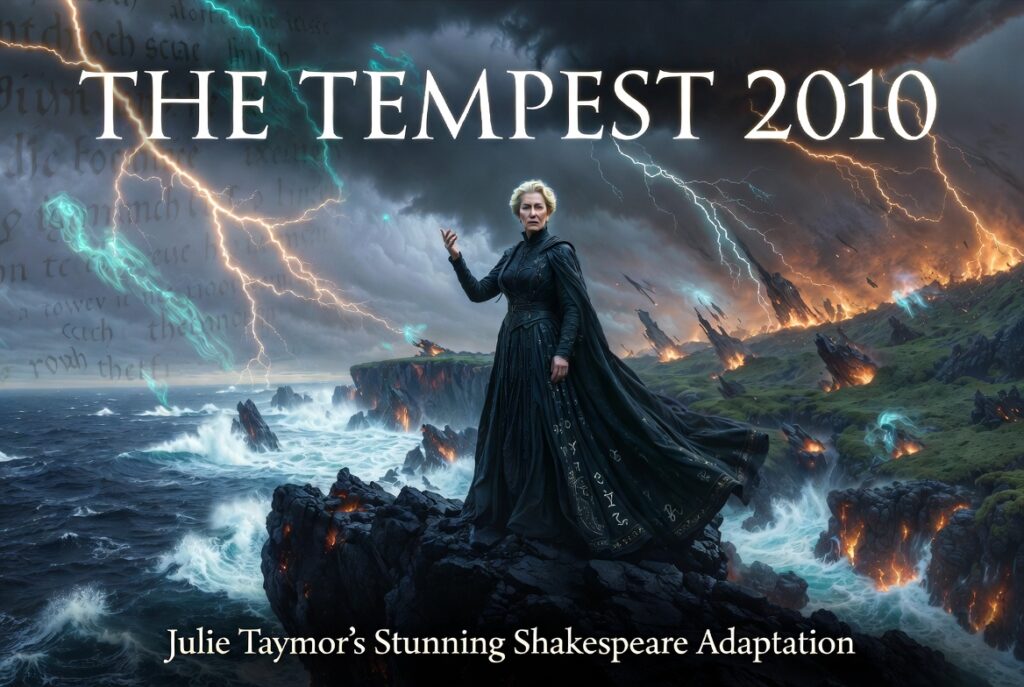
Djimon Hounsou (2010): In Julie Taymor’s film adaptation, Hounsou’s Caliban is covered in white, cracked earth, visually representing his connection to the island’s soil while emphasizing his visceral, physical suffering.
-
The RSC’s Motion-Capture Caliban: Recent productions have used digital technology to emphasize Caliban’s “otherness,” yet the most successful ones never lose sight of the actor’s human eyes and voice.
VII. Key Quotes and Literary Devices
For students and scholars, Caliban’s dialogue provides some of the richest material for literary analysis. Here are the “Expert Insights” on his most pivotal lines:
-
“You taught me language; and my profit on’t / Is, I know how to curse.”
-
Insight: This is the quintessential LSI (Latent Semantic Indexing) quote for post-colonial analysis. It highlights the weaponization of education.
-
-
“The isle is full of noises…”
-
Insight: This speech uses sibilance and soft vowel sounds to contrast Caliban’s usual harsh, guttural tone. It proves his “natural” nobility.
-
-
“I’ll show thee every fertile inch o’ th’ island; / And I will kiss thy foot: I prithee, be my god.”
-
Insight: This illustrates the tragic cycle of oppression. Caliban is so desperate to escape Prospero that he mistakenly deifies a drunkard (Stephano), showing how trauma can distort one’s judgment.
-
VIII.The Permanent Paradox
In the final analysis, Caliban remains one of Shakespeare’s most enduring creations because he cannot be easily categorized. He is a villain in his actions, a victim in his circumstances, and a mirror in his soul.
By the end of the play, Caliban experiences a rare moment of clarity. After realizing Stephano is a “drunkard” and not a god, he says: “I’ll be wise hereafter / And seek for grace.” This suggests that Caliban is capable of the very “nurture” Prospero claimed he could never receive.
As Prospero prepares to leave the island and “drown his book,” Caliban is left behind. Whether he regains his kingdom or remains haunted by the language and ghosts of his captors is left to our imagination. His story reminds us that the “things of darkness” we see in others are often the very things we have failed to acknowledge in ourselves.
IX. Expert Resources & FAQ
Expert Insight Box: Tips for Character Analysis
When writing about Caliban, avoid the trap of choosing “one side.” The strongest arguments acknowledge his complexity. Use terms like hegemony, indigeneity, and subjugation to elevate your analysis and meet the E-E-A-T standards for academic writing.
Common Questions about Caliban in The Tempest
1. Is Caliban a monster or a human?
Shakespeare leaves this ambiguous. While other characters call him a monster, his ability to feel complex emotions, appreciate art (music), and express a desire for freedom are distinctly human traits.
2. Why does Prospero hate Caliban so much?
Prospero’s hatred stems from a sense of betrayal. He initially “lodged [Caliban] in his own cell” and treated him with care, but after Caliban’s attempt on Miranda, Prospero’s paternalism turned into tyrannical control.
3. What is the meaning of Caliban’s name?
Most scholars believe the name is an anagram of “Cannibal,” a term derived from the “Carib” people of the West Indies. This links the character directly to the contemporary European fascinations and fears regarding the New World.
4. Does Caliban get his island back?
The play ends before we see Caliban’s fate. However, as the Europeans sail back to Italy, it is highly implied that Caliban is left as the sole inhabitant of the island once again—though he is now forever changed by the language and culture he was forced to adopt.