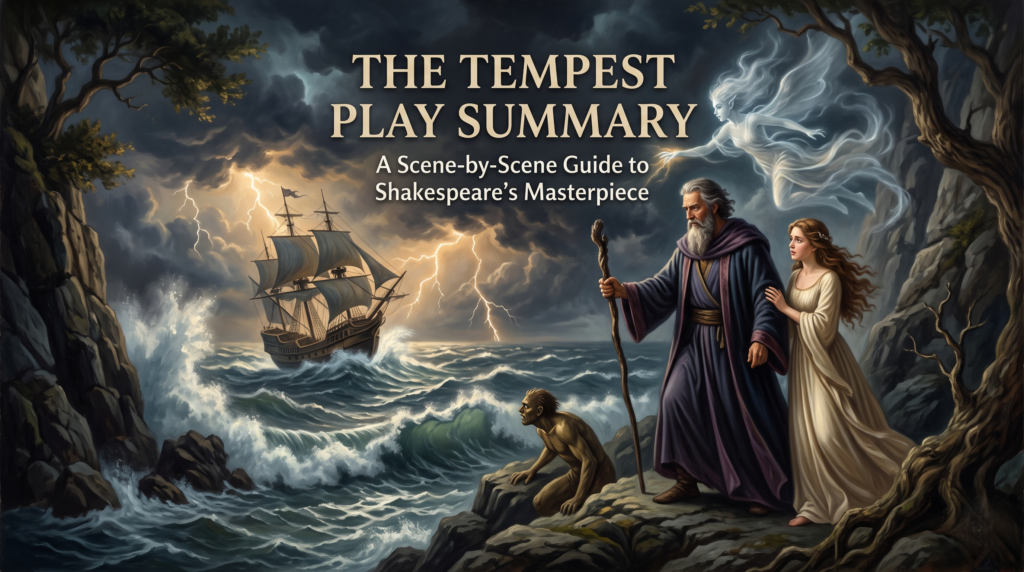
Imagine a ship tossed in a howling sea, the sky torn apart by lightning, and panicked sailors crying out as their vessel splits apart. But this is no natural disaster—it is an illusion, conjured by a wronged sorcerer seeking justice. Welcome to the magical, mysterious world of The Tempest, widely considered to be William Shakespeare’s farewell to the stage.
If you are struggling to untangle the magic, revenge, and intricate plots of this classic work, you have come to the right place. This comprehensive the tempest play summary is designed to give you a clear, scene-by-scene breakdown of the plot. Whether you are a student preparing for an essay, an actor deciphering your lines, or a theater enthusiast wanting to understand the lore of Prospero’s island, this guide cuts through the complex Elizabethan language to provide exactly what you need.
Let’s dive into the ultimate study guide and plot breakdown of Shakespeare’s great tragicomedy.
Before You Read: The Tempest Cheat Sheet
Before we break down the plot, it is essential to know who is who. The Tempest features three distinct groups of characters whose storylines eventually collide.
The Main Characters
| Character | Role in the Play | Key Trait |
| Prospero | The rightful Duke of Milan and a powerful sorcerer. | Vengeful but ultimately forgiving; deeply protective of his daughter. |
| Miranda | Prospero’s teenage daughter, raised in isolation. | Innocent, compassionate, and entirely unaware of the outside world. |
| Ariel | A spirit of the air, bound to serve Prospero. | Magical, musical, and desperate to earn his freedom. |
| Caliban | The enslaved native inhabitant of the island. | Resentful, complex, and claims rightful ownership of the island. |
The Royal Court (The Shipwreck Survivors)
| Character | Role in the Play | Key Trait |
| Alonso | King of Naples. | Grieving the supposed loss of his son in the storm. |
| Ferdinand | Son of Alonso, Prince of Naples. | Honorable, romantic, and instantly smitten with Miranda. |
| Antonio | Prospero’s treacherous brother. | Power-hungry and utterly unrepentant. |
| Sebastian | Alonso’s brother. | Easily manipulated and treacherous. |
The Comedic Relief
| Character | Role in the Play | Key Trait |
| Trinculo | The King’s jester. | Cowardly and foolish. |
| Stephano | The King’s drunken butler. | Opportunistic, often inebriated, and power-hungry. |
Setting the Scene: The entire play takes place over the course of a single afternoon on a remote, unnamed island in the Mediterranean Sea. It is a place suspended in time, steeped in natural beauty, and controlled entirely by magic.
The Tempest Play Summary: Scene-by-Scene Breakdown
Act 1: The Storm and the Survivors
Scene 1: The Shipwreck
The play opens in media res (in the middle of the action) during a terrifying tempest. A royal ship carrying the King of Naples and his entourage is caught in the storm. The working-class Boatswain frantically orders the aristocratic passengers to stay below deck so the crew can save the ship. The nobles, particularly Antonio and Sebastian, hurl insults at the crew. Despite their efforts, the ship appears to run aground and split, sending everyone into the turbulent sea.
Expert Insight: Notice how Shakespeare immediately flips the social hierarchy in this opening scene. In the face of nature’s wrath, the wealth and titles of the kings and dukes mean absolutely nothing. Power temporarily shifts to the commoners who actually know how to navigate the storm.
Scene 2: The Backstory & The Magic
We transition to the island, where Miranda, having watched the shipwreck, begs her father, Prospero, to use his magic to save the sailors. Prospero assures her that no one was harmed and reveals that he caused the storm. He finally tells her the truth about their past: Twelve years ago, he was the Duke of Milan. He became too engrossed in his magical studies, allowing his brother, Antonio, to manage the state. Antonio allied with King Alonso of Naples, usurped Prospero, and cast him and baby Miranda out to sea in a rotting boat. They survived only because a kind lord named Gonzalo secretly provided them with food, clothes, and Prospero’s precious magical books.
Prospero then puts Miranda to sleep and summons his spirit-servant, Ariel. Ariel reports that the storm went exactly as planned: the passengers are safely scattered in groups around the island, and the ship is hidden safely in a harbor. Ariel asks for his promised freedom, but Prospero angrily reminds him that he rescued Ariel from a pine tree where the witch Sycorax had trapped him. Prospero promises to free Ariel in two days if he obeys.
Next, we meet Caliban, the son of Sycorax and the island’s only native human inhabitant. Prospero has enslaved him, treating him harshly. Caliban curses Prospero, arguing that the island is rightfully his.
Finally, Ariel uses magical music to lead Prince Ferdinand to Prospero’s cell. Ferdinand and Miranda lay eyes on each other and fall instantly in love—precisely as Prospero planned. However, to make Ferdinand value the prize, Prospero pretends to accuse Ferdinand of being a spy and imprisons him, forcing him into hard labor.
Act 2: Plots, Murder, and Monsters
Scene 1: The Royal Conspiracy
On another part of the island, King Alonso is devastated, believing Ferdinand drowned. The optimistic Gonzalo tries to cheer him up by describing how he would rule the island as a utopian commonwealth, but Antonio and Sebastian mock him relentlessly.
Ariel plays a magical tune that puts everyone to sleep except Antonio and Sebastian. Seizing the opportunity, Antonio (who successfully usurped his own brother) convinces Sebastian to murder the sleeping King Alonso and take the crown of Naples. Just as they draw their swords, Ariel awakens the King and Gonzalo. Antonio and Sebastian poorly cover up their attempted treason by claiming they heard lions roaring and drew their swords to protect the King.
Scene 2: The Fools Meet the “Monster”
This scene introduces the play’s physical comedy. Caliban is carrying wood when he sees Trinculo, the jester, approaching. Thinking Trinculo is a spirit sent by Prospero to torture him, Caliban hides under his cloak. Trinculo, seeking shelter from an incoming storm, crawls under the cloak with Caliban.
Shortly after, Stephano, the drunken butler, stumbles upon what looks like a four-legged monster. He pulls Trinculo out, and the two friends rejoice at being reunited. Stephano gives Caliban alcohol. Having never tasted wine, Caliban is instantly intoxicated. He believes the “celestial liquor” makes Stephano a god, and he eagerly pledges his allegiance to the drunken butler, promising to show him all the island’s secrets.
Act 3: Love, Illusions, and the Banquet
Scene 1: The Log-Bearing Prince
Ferdinand is performing the exhausting manual labor Prospero assigned him, carrying heavy logs. Miranda sneaks out to see him, begging him to rest and even offering to carry the logs herself. Ferdinand refuses to let her suffer. They declare their profound love for one another and agree to marry. Unbeknownst to them, Prospero is secretly watching from a distance, deeply moved and pleased that his matchmaking plan is succeeding.
Scene 2: The Drunken Assassination Plot
Stephano, Trinculo, and Caliban are highly intoxicated. Caliban complains about the tyrant Prospero and pitches a violent assassination plot to Stephano: they will steal Prospero’s magical books, bash his skull in while he sleeps, and then Stephano can become King of the island with Miranda as his queen. Stephano loves the idea. However, the invisible Ariel is listening. Ariel mimics Trinculo’s voice to insult Caliban, causing the group to fight amongst themselves before Ariel uses eerie music to lead the bumbling trio off into a swamp.
Scene 3: The Harpy’s Warning
King Alonso and his royal entourage are exhausted and starving from searching for Ferdinand. Suddenly, strange spirits bring forth a massive, lavish banquet. Just as the starving men reach for the food, thunder claps, and the feast vanishes.
Ariel appears in the terrifying form of a Harpy (a mythical half-bird, half-woman monster). Ariel speaks with booming authority, declaring that Destiny has caused their shipwreck to punish them for their past crimes against Prospero and Miranda. Ariel warns them that they will suffer “lingering perdition” (endless ruin) unless they feel true remorse. Alonso is driven to the brink of madness by guilt, finally realizing his role in Prospero’s downfall, while Antonio and Sebastian defensively draw their swords against the invincible spirits.
Act 4: The Masque and the Trap
Scene 1: Blessings and Hounds Seeing that Ferdinand has proven his honor and devotion, Prospero finally releases the prince from his grueling labor. He formally gives Miranda to Ferdinand in marriage, though he sternly warns Ferdinand to respect Miranda’s purity until they are officially wed.
To celebrate the engagement, Prospero uses his magic to conjure a breathtaking “masque”—a spectacular theatrical pageant. The spirits take the forms of Roman goddesses: Iris (rainbows/messaging), Ceres (agriculture), and Juno (marriage/queen of gods). They sing beautiful blessings over the couple, wishing them fertility, harmony, and endless spring.
Study Tip: If you are writing an essay, note that the masque represents the restoration of order, civility, and harmony. It is a stark contrast to the chaotic storm that opened the play.
Suddenly, Prospero remembers the assassination plot hatched by Caliban, Stephano, and Trinculo. He abruptly ends the beautiful pageant, causing the spirits to vanish. To comfort the startled Ferdinand, Prospero delivers one of Shakespeare’s most famous and melancholic speeches, reminding the prince that all life is temporary and illusory: “We are such stuff / As dreams are made on, and our little life / Is rounded with a sleep.”
Prospero and Ariel then set a trap for the drunken conspirators. They hang flashy, expensive-looking royal clothing on a lime tree. When Stephano and Trinculo arrive, they are easily distracted by the shiny garments, completely forgetting their murder plot despite Caliban’s desperate pleas to focus on killing Prospero. As the thieves put on the stolen clothes, Prospero and Ariel unleash a pack of terrifying spirit-hounds to chase the screaming men through the bogs and briars.
Act 5: Forgiveness and Freedom
Scene 1: The Grand Reunion The climax of The Tempest is not a massive battle, but a profound moral choice. Ariel reports to Prospero that the King and his followers are currently paralyzed by guilt and sorrow. Ariel remarks that if he were human, his affections would “become tender” upon seeing their suffering. Struck by the empathy of a non-human spirit, Prospero makes a monumental decision. He chooses “virtue rather than vengeance,” deciding that since his enemies are genuinely repentant, he will forgive them.
Prospero traces a large magical circle on the ground. In a powerful soliloquy, he reflects on his spectacular magical feats but ultimately decides to renounce his supernatural powers, promising to break his staff and drown his magic book.
He orders Ariel to bring the spellbound nobles into the circle. Dressed once again in his rightful garments as the Duke of Milan, Prospero reveals himself. King Alonso is overwhelmed with remorse and immediately resigns any claim to Milan, begging for forgiveness. Prospero forgives Alonso and demands his dukedom back from the unrepentant Antonio.
To comfort Alonso, who still grieves the loss of his son, Prospero draws back a curtain to reveal a miraculous sight: Ferdinand and Miranda happily playing a game of chess. Alonso is overjoyed. Miranda, looking at the assembled crowd of nobles, utters her famous, deeply ironic line: “O brave new world, / That has such people in ‘t!” (She is amazed by humanity’s beauty, unaware that several of the men before her are murderers and traitors).
Ariel returns with the ship’s Master and Boatswain, revealing that the ship is miraculously undamaged and ready to sail back to Italy. Finally, Caliban, Stephano, and Trinculo are dragged in, covered in swamp mud. Prospero claims responsibility for Caliban, and Caliban realizes how foolish he was to worship a drunken butler, vowing to “seek for grace” moving forward.
His grand design complete, Prospero promises the group safe, calm seas for their voyage home to Naples for the wedding. For his final magical act, he grants Ariel his long-awaited freedom to the elements.
Epilogue: Prospero’s Plea In the play’s epilogue, Prospero steps forward to address the audience directly. Stripped of his magic, he is now just an old man who wishes to return home to Naples. He asks the audience to release him from the island—and the stage—through the power of their applause. Many scholars view this touching farewell as William Shakespeare’s own goodbye to the theater world before his retirement.
Deep Dive: Key Themes You Need to Know for Essays
Understanding the plot is only half the battle. To truly master the tempest play summary, you must understand the underlying themes driving the characters’ actions. If you are studying for an exam or writing a term paper, focus on these three core concepts:
1. Illusion vs. Reality
Prospero is, in many ways, a stand-in for a playwright. He directs the action, writes the “script” of the romance between Ferdinand and Miranda, and uses special effects (magic) to manipulate his audience. The Tempest constantly blurs the line between what is real and what is a dream. The play asks a profound question: is the magic of theater and art simply an illusion, or does it have the power to create real-world change?
2. Revenge vs. Forgiveness
For the first four acts, Prospero seems entirely focused on retribution. He has the power to destroy his enemies, and for a time, he tortures them with madness and physical labor. However, the play pivots dramatically in Act 5. Shakespeare suggests that true power does not lie in magical dominance or revenge, but in the difficult, human act of forgiveness and reconciliation.
3. Colonialism and Power Dynamics
Modern literary criticism of The Tempest heavily focuses on the relationship between Prospero and Caliban. Prospero arrives on a foreign island, takes its resources, teaches the native inhabitant his language, and then enslaves him when he rebels. Caliban’s famous retort—“You taught me language, and my profit on’t / Is, I know how to curse”—highlights the destructive, oppressive nature of colonization. Exploring whether Caliban is a victim of imperialism or a dangerous monster is a staple of modern Shakespearean analysis.
The Magic of The Tempest: Historical Context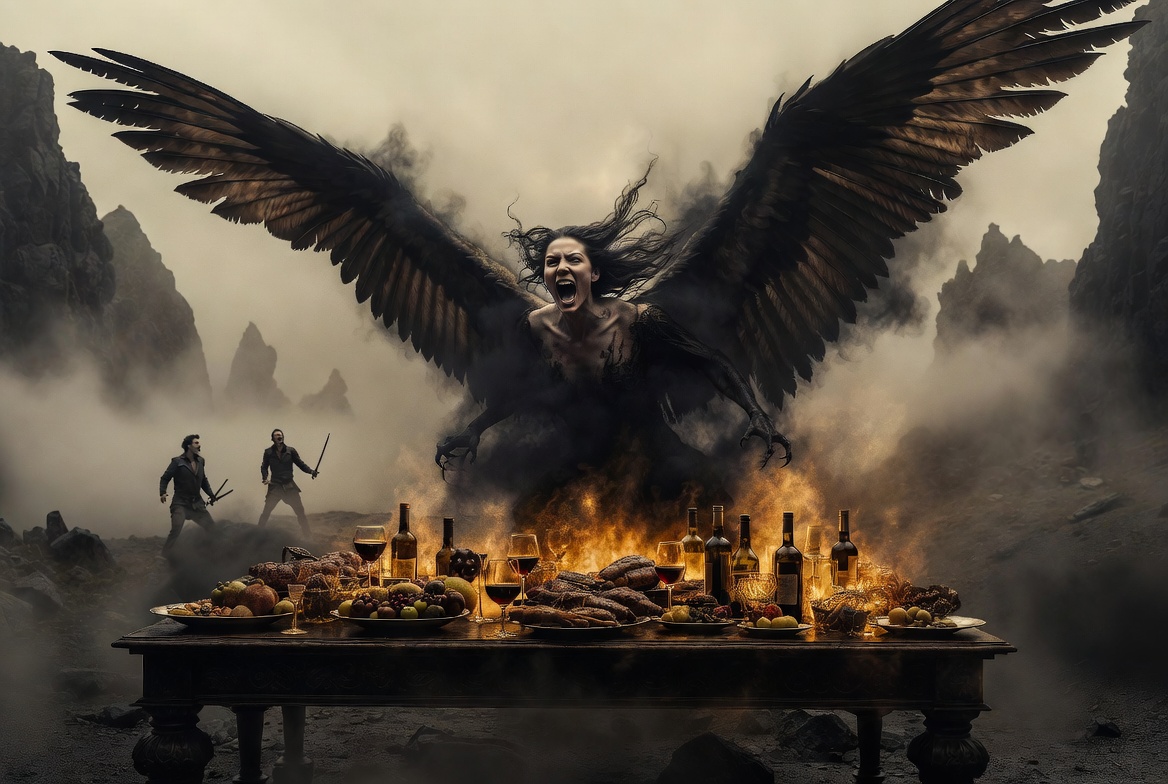
To fully appreciate the narrative, it helps to understand the world in which Shakespeare was writing in 1611:
-
King James I and Witchcraft: The reigning monarch at the time, King James I, was famously obsessed with witchcraft and the supernatural. Shakespeare carefully distinguished Prospero’s magic—which is largely categorized as scholarly, intellectual “white magic”—from the dark, demonic “black magic” practiced by the deceased witch Sycorax.
-
The Sea Venture Shipwreck (1609): The play was heavily inspired by a real-world event. A fleet of English ships bound for the Jamestown colony in Virginia was caught in a hurricane. The flagship, the Sea Venture, was wrecked on the shores of Bermuda. Miraculously, all the passengers survived, lived on the island for months, and eventually built new boats to reach Virginia. Pamphlets detailing this harrowing survival story were circulating in London just as Shakespeare was writing the play.
Frequently Asked Questions (FAQs)
What is the main message of The Tempest?
The overarching message of The Tempest is the triumph of forgiveness, compassion, and reconciliation over vengeance. It teaches that while it is human nature to desire revenge when wronged, releasing that anger and granting mercy is a higher, nobler display of power and humanity.
Is The Tempest a tragedy or a comedy?
Historically, it was grouped with comedies because it has a happy ending (a wedding and no major character deaths). Today, scholars classify it as one of Shakespeare’s “Romances” or “Tragicomedies”—plays written late in his career that feature elements of both tragedy (betrayal, murder plots, loss) and comedy (slapstick humor, magical intervention, reconciliation).
Why does Prospero give up his magic?
Prospero’s magic is what alienated him from humanity in the first place (losing his dukedom because he was buried in his spellbooks). To truly rejoin society, reclaim his political leadership, and return to the natural order of the world, he must shed his supernatural powers and accept his mortality.
Is Prospero a hero or a villain?
Prospero is famously ambiguous. To an Elizabethan audience, he was largely seen as a wise, wronged nobleman restoring order. However, modern audiences often view him critically as a controlling, tyrannical figure who easily subjugates Caliban and Ariel. He is best described as a deeply flawed protagonist who ultimately redeems himself through mercy.
Shakespeare’s Final Bow
The Tempest stands apart from the rest of Shakespeare’s canon. It is a deeply philosophical play that strips away massive armies and sprawling royal courts, focusing instead on a single island where humanity’s worst impulses and highest virtues are put to the test.
By using this the tempest play summary, you now have a firm grasp of the complex intertwining plots, the rich thematic depths, and the historical influences that shaped the narrative. Whether you are reading the text for a university literature class, preparing for a theatrical audition, or simply looking to understand the genius of William Shakespeare, The Tempest remains a brilliant, magical exploration of what it means to be truly human.