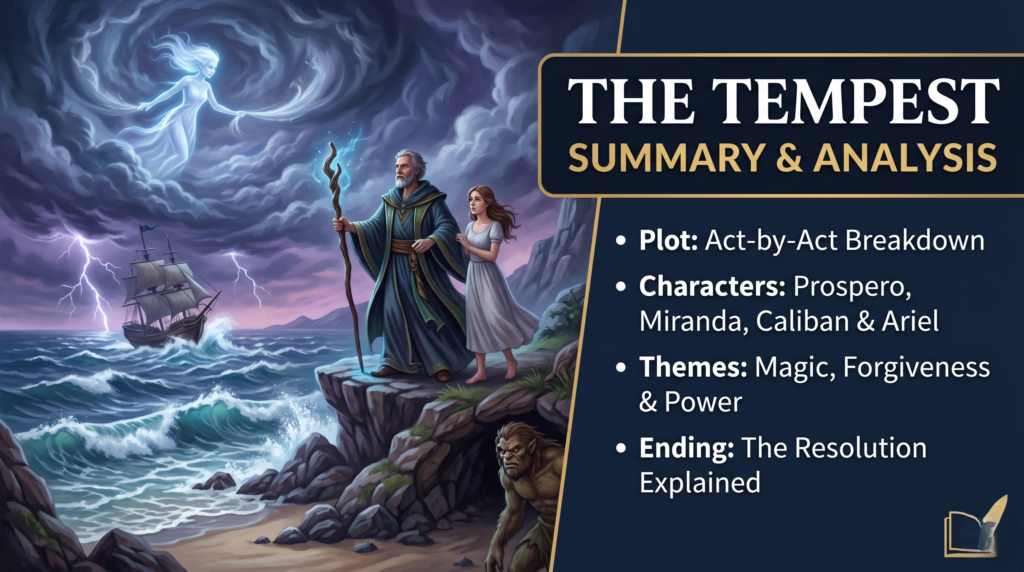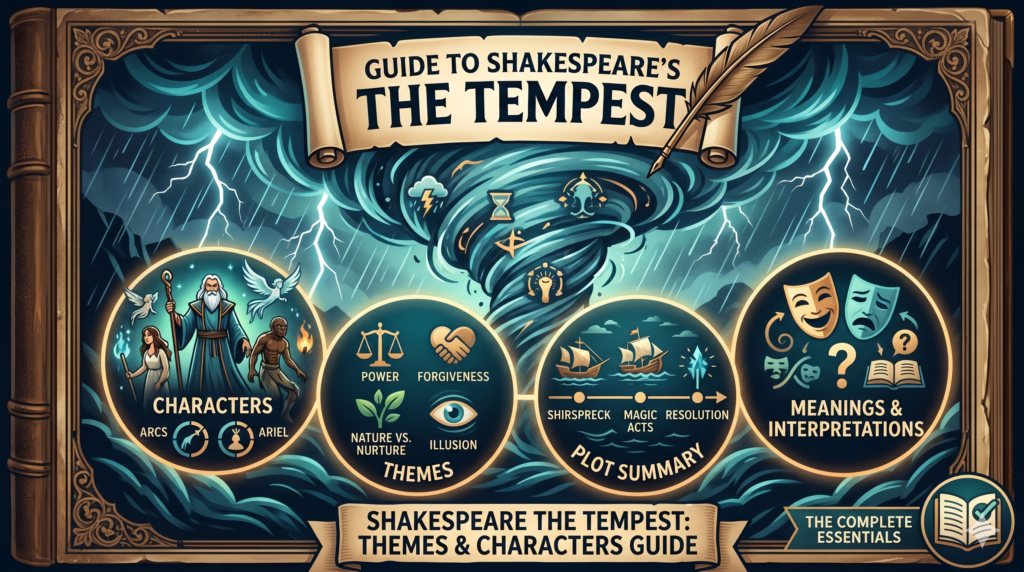
Imagine a violent storm conjured by magic, a remote enchanted island where spirits roam and a betrayed duke plots revenge. In one of William Shakespeare’s most enchanting and profound plays, these elements come together in a story of power, forgiveness, and redemption that continues to captivate audiences more than 400 years later.
The Tempest book summary reveals why this late romance is often considered Shakespeare’s farewell to the theater. Written around 1610–1611, The Tempest blends comedy, drama, and masque-like spectacle into a tightly structured masterpiece. Whether you’re a student seeking a clear plot overview, a teacher preparing lessons, or a literature lover exploring Shakespeare’s final solo work, this comprehensive guide delivers everything you need: a detailed scene-by-scene summary, rich character analysis, major themes, historical context, and modern relevance.
Historical and Literary Context
To fully appreciate The Tempest, it helps to understand its place in Shakespeare’s career and the world of early 17th-century England. By 1610–1611, Shakespeare had largely moved away from the blood-soaked tragedies that defined his earlier years (Hamlet, King Lear, Macbeth) toward a new genre often called “romances” or tragicomedies. These plays, including Pericles, Cymbeline, The Winter’s Tale, and The Tempest, feature miraculous reunions, forgiveness, and harmonious resolutions rather than unrelenting doom.
The Tempest stands out as possibly the last play Shakespeare wrote alone. Many scholars view it as semi-autobiographical, with the magician Prospero representing the playwright himself preparing to lay down his pen. The play’s first recorded performance was at court in 1611 for King James I, and it appeared in print in the First Folio of 1623.
Real-world inspirations add depth. A major influence appears to be the 1609 shipwreck of the Sea Venture, part of a fleet heading to the Jamestown colony in Virginia. The ship was caught in a hurricane, and survivors washed up on Bermuda, where they found unexpected resources and eventually built new vessels to continue their journey. Accounts of this event, particularly William Strachey’s letter, reached London around 1610 and likely inspired Shakespeare’s opening storm.
Other influences include Michel de Montaigne’s essays on “cannibals” and the New World, Jacobean court masques with their elaborate music and spectacle, and contemporary debates about colonialism and human nature. Shakespeare sets the action on a Mediterranean island (not the Americas), allowing him to explore these ideas with artistic freedom.
Detailed Plot Summary
The Tempest observes classical unities of time, place, and action more closely than most Shakespeare plays. The entire story unfolds over a single afternoon on a remote island.
Act 1: The Storm and the Island
The play opens with a raging tempest at sea. A ship carrying Alonso, King of Naples, his son Ferdinand, his brother Sebastian, Prospero’s treacherous brother Antonio (now Duke of Milan), and the loyal counselor Gonzalo is caught in the storm. Sailors shout orders while nobles panic. The ship apparently splits apart.
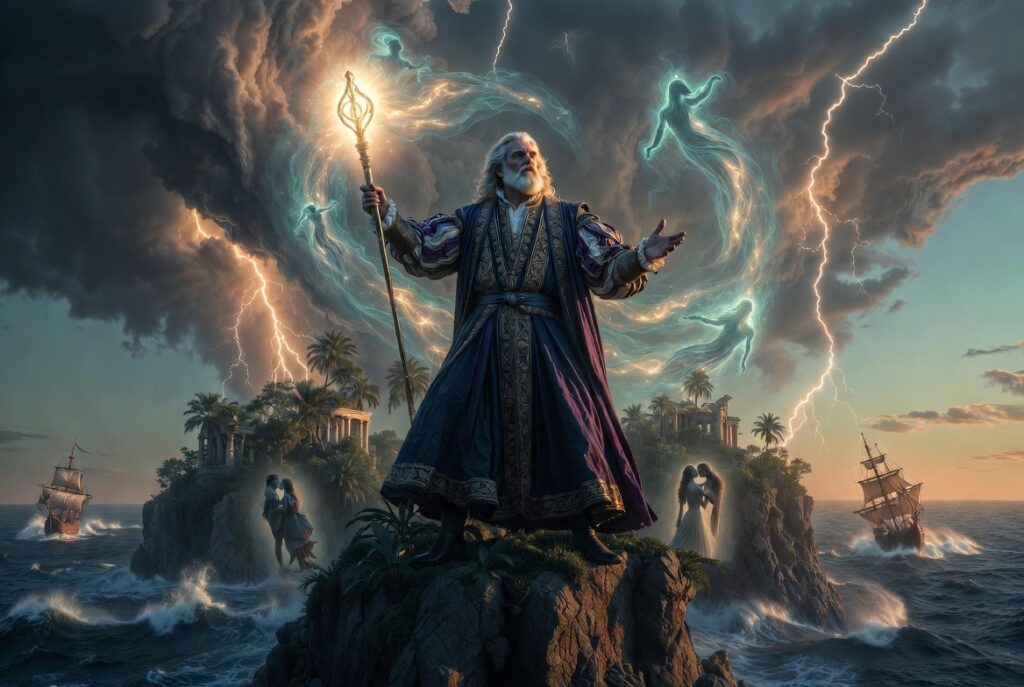
On a nearby island, Prospero’s daughter Miranda begs her father to calm the storm, fearing the passengers have drowned. Prospero reassures her that no one has died and reveals their backstory for the first time in full. Twelve years earlier, Prospero was the Duke of Milan. Deeply absorbed in his magical studies, he allowed his brother Antonio to manage state affairs. Antonio, conspiring with King Alonso, usurped the dukedom. Prospero and the infant Miranda were set adrift in a rotten boat but survived thanks to Gonzalo’s kindness—he provided food, water, and Prospero’s prized books. They washed ashore on this magical island.
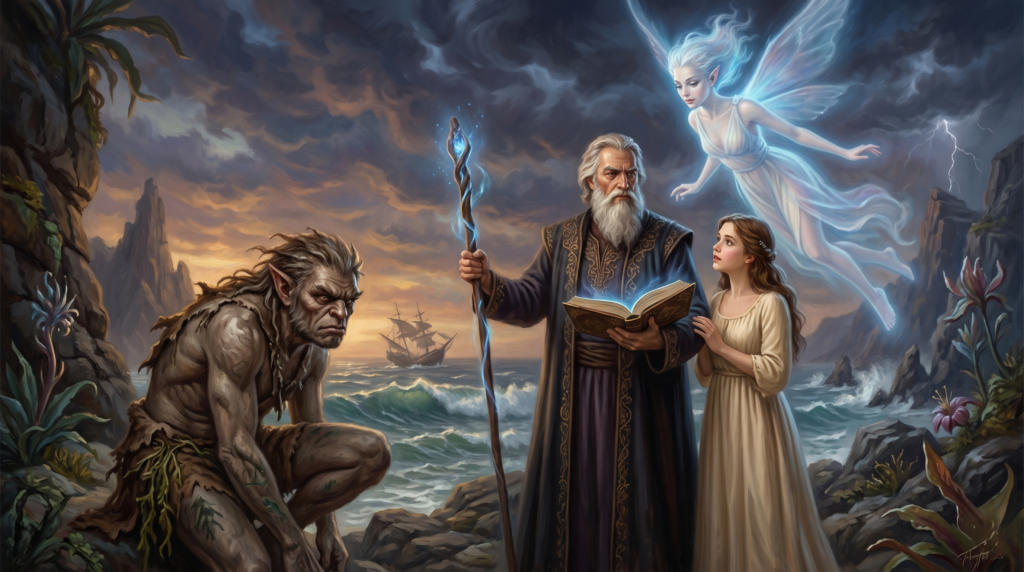
There, Prospero used his magic to free the spirit Ariel from imprisonment by the witch Sycorax (Caliban’s mother) and subjugated Caliban, Sycorax’s son, who was the island’s original inhabitant. Ariel now serves Prospero in exchange for eventual freedom, while Caliban serves as a resentful slave. Prospero orchestrated the storm to bring his enemies to the island for a final reckoning.
Act 2: Plots and Subplots
The survivors wash ashore in separate groups, believing others have perished. King Alonso mourns the apparent death of his son Ferdinand. Ariel lulls some to sleep, allowing Sebastian and Antonio to plot the murder of Alonso so Sebastian can seize the throne of Naples. Ariel wakes the sleepers just in time to foil the plot.
Meanwhile, the comic subplot begins. The jester Trinculo and the drunken butler Stephano encounter Caliban. Caliban, who hates Prospero, sees an opportunity in the drunken pair and plots to kill his master so Stephano can rule the island. They sing and drink, forming a ridiculous rebellion.
Act 3: Love, Magic, and Intrigue
Ferdinand, who survived, meets Miranda. They fall instantly in love—a meeting Prospero has engineered but pretends to oppose, testing Ferdinand’s worth by making him perform menial labor. Miranda, who has seen few humans besides her father and Caliban, is enchanted by Ferdinand.
Ariel continues to invisibly torment the courtiers. Caliban’s drunken conspiracy advances but remains comically inept. Prospero watches over events with growing satisfaction mixed with moments of doubt.
Act 4: The Masque and Climax
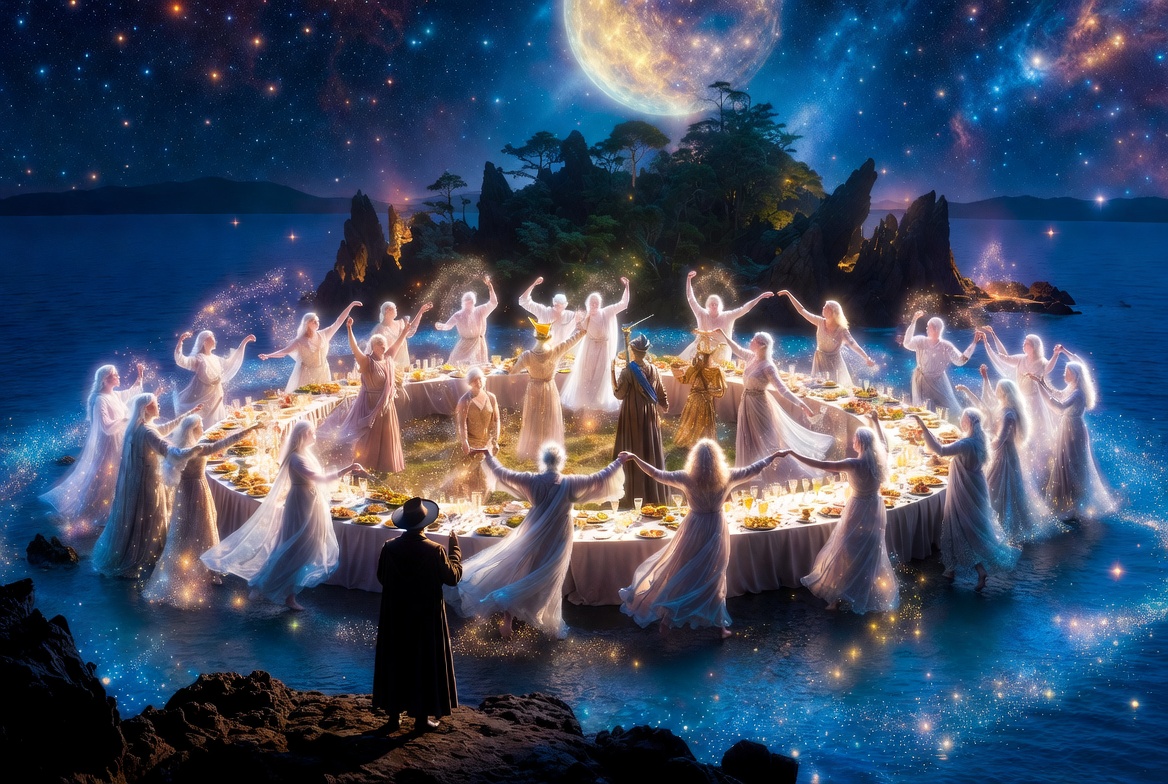
Prospero stages a lavish wedding masque for Ferdinand and Miranda, featuring goddesses and spirits celebrating purity, fertility, and harmony. The entertainment is interrupted when Prospero remembers Caliban’s plot. Enraged, he ends the masque abruptly. Ariel reports on the conspiracy’s progress, and Prospero sends spirits in the shape of hounds to hunt down Stephano, Trinculo, and Caliban.
Act 5: Resolution and Reconciliation
Prospero confronts his enemies, reveals himself, and renounces revenge. He forgives Alonso (who helped usurp him), exposes Antonio’s treachery (though Antonio remains unrepentant), and reunites Alonso with Ferdinand. Ariel is granted freedom. Prospero breaks and buries his staff and drowns his books, symbolizing his return to ordinary humanity.
In a moving epilogue, Prospero steps out of character to address the audience directly, asking for their applause and prayers to set him free from the stage—widely interpreted as Shakespeare’s own farewell.
Quick Plot Overview Table (for easy reference):
- Setup: Prospero’s revenge via magical storm.
- Main Plot: Reconciliation with Milan/Naples enemies + Ferdinand & Miranda romance.
- Comic Subplot: Caliban, Stephano, Trinculo’s failed rebellion.
- Resolution: Forgiveness, marriages, return to civilization, freedom for Ariel.
This tight structure makes The Tempest highly stageable and thematically unified.
In-Depth Character Analysis
The Tempest features a relatively small but richly drawn cast, each serving both dramatic and symbolic functions. Shakespeare masterfully uses these characters to explore human nature, power dynamics, and morality.
Prospero: The Magician-Duke and Shakespeare’s Alter Ego Prospero is the play’s central figure — a complex protagonist who defies simple categorization. As the rightful Duke of Milan, he was betrayed by his brother Antonio and King Alonso. Exiled to the island, he transforms from a negligent ruler into a powerful magician who commands nature itself.
His character arc moves from vengeance to forgiveness. Early in the play, Prospero is authoritarian, controlling, and sometimes cruel toward Ariel and especially Caliban. Yet his love for Miranda is tender and protective. By the final act, he chooses mercy over retribution, renouncing his magic in one of Shakespeare’s most poignant speeches. Many critics see Prospero as a stand-in for Shakespeare himself: a master artist who, at the end of his career, decides to break his staff and retire from the stage. His epilogue is both personal and universal.
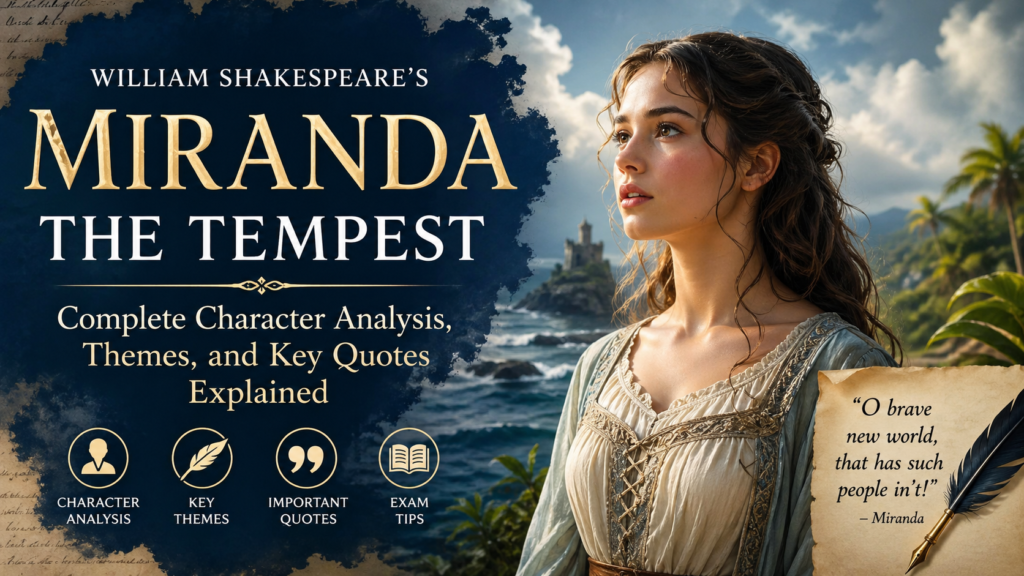
Miranda: Innocence and Wonder Miranda, Prospero’s 15-year-old daughter, embodies purity and compassion. Having grown up isolated on the island with only her father and Caliban for company, she has never seen another human until the shipwreck. Her famous line, “O brave new world, that has such people in’t!” captures genuine wonder mixed with dramatic irony — the “brave new world” is filled with betrayal and imperfection. Her instant love for Ferdinand highlights themes of natural affection and renewal.
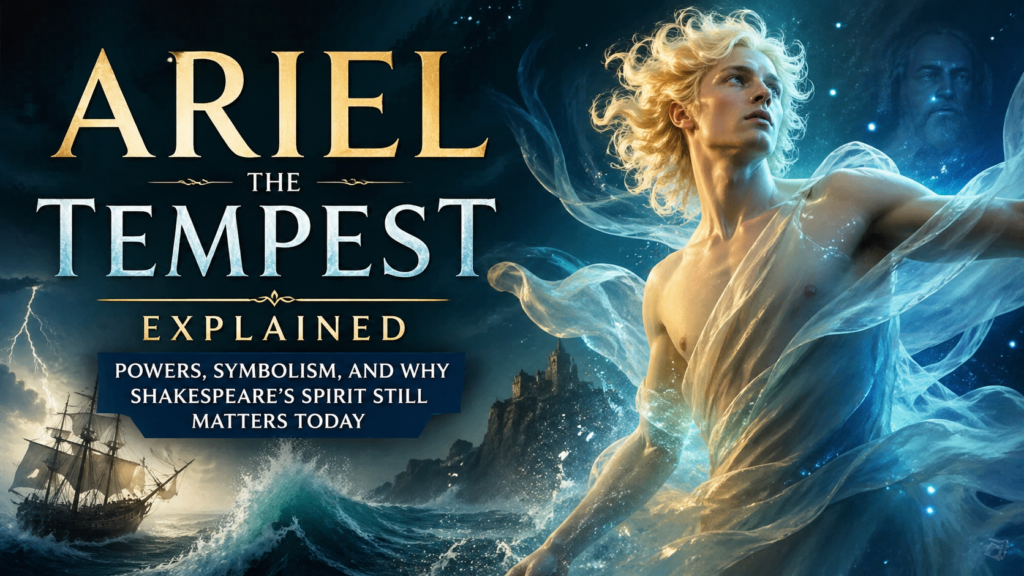
Ariel: Spirit of Freedom Ariel is an airy, ethereal spirit of indeterminate gender in most productions. Bound to serve Prospero after being rescued from Sycorax’s pine tree prison, Ariel performs magical tasks with grace and efficiency. Unlike Caliban, Ariel is obedient but constantly reminds Prospero of the promise of freedom. The spirit’s songs and illusions add musical beauty and spectacle to the play. Ariel represents intellect, art, and the desire for liberty.
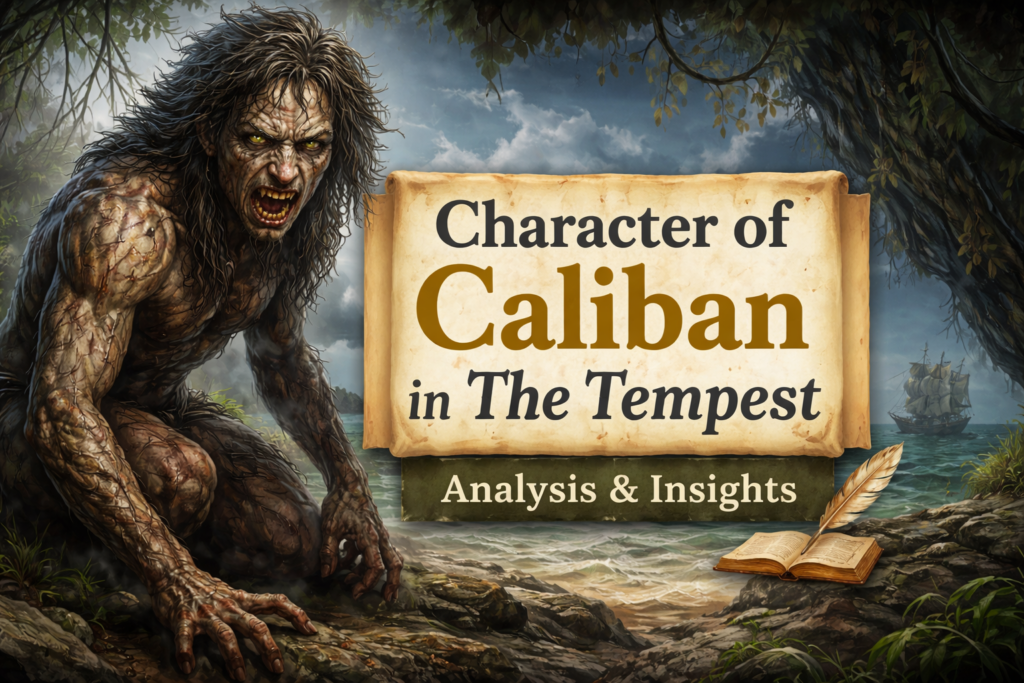
Caliban: Victim, Villain, or Colonized Figure? Caliban is one of Shakespeare’s most fascinating and debated creations. The son of the witch Sycorax, he was the island’s original inhabitant. Prospero initially treated him kindly and attempted to educate him, but after Caliban attempted to violate Miranda, their relationship turned to master-slave antagonism.
Caliban’s eloquent speeches about the island’s beauty (“Be not afeard; the isle is full of noises…”) reveal sensitivity and deep connection to nature. Yet his alliance with Stephano and Trinculo shows base instincts and a thirst for revenge. Postcolonial critics often view Caliban as a symbol of the indigenous “other” subjugated by European colonizers. Others see him as a cautionary figure about the limits of nurture over nature. Shakespeare leaves the interpretation deliberately open.
Ferdinand and Supporting Characters Ferdinand represents the ideal young lover — noble, obedient, and devoted. His willingness to carry logs for Prospero proves his worthiness.
Among the courtiers, Gonzalo stands out as the honest, optimistic counselor whose idealism provides comic relief and moral grounding. Antonio and Sebastian embody unrepentant ambition and treachery, while Stephano and Trinculo supply low humor through drunkenness and foolishness, mirroring the more serious plots in a comic key.
Major Themes and Symbolism
The Tempest is thematically dense, offering layers that reward multiple readings and productions.
Power and Authority The play examines different forms of power — political, magical, paternal, and colonial. Prospero’s magical control parallels a playwright’s command over characters and audience. Questions of legitimate versus illegitimate rule run throughout.
Forgiveness vs. Revenge The central moral journey is Prospero’s choice to forgive those who wronged him. This theme resonates deeply in a world still recovering from political betrayals and personal grievances. Shakespeare suggests true power lies in mercy.
Colonialism and the “Other” Written during the height of European exploration, The Tempest engages with New World encounters. Prospero’s treatment of Caliban raises uncomfortable questions about civilization, savagery, education, and exploitation that remain relevant in discussions of empire and cultural clash.
Illusion vs. Reality and the Nature of Art Magic in the play mirrors theatrical illusion. Prospero’s spectacles and the play itself blur boundaries between reality and performance. The famous speech “We are such stuff as dreams are made on” reflects on the transient nature of life and art.
Freedom and Servitude Almost every character is bound in some way — Ariel to Prospero, Caliban to his resentment, the courtiers to their ambitions, and even Prospero to his quest for justice. The play’s resolution brings freedom to most, but not all.
Nature vs. Nurture Through Caliban and Miranda, Shakespeare explores whether character is determined by birth or upbringing — a debate that fascinated Renaissance thinkers.
Aging, Legacy, and Letting Go Prospero’s renunciation of magic poignantly addresses the need to release control as one approaches life’s end.
Language, Style, and Dramatic Techniques
Shakespeare’s language in The Tempest is among his most refined and musical. The play makes extensive use of blank verse, with songs and masque elements adding lyrical variety. Ariel’s songs (“Full fathom five thy father lies…”) are particularly haunting and memorable.
Notable quotes include:
- “Hell is empty, and all the devils are here.” (Act 1)
- “We are such stuff as dreams are made on, and our little life is rounded with a sleep.” (Act 4)
- “O brave new world, that has such people in’t!” (Act 5)
The structure follows classical unities more strictly than most of Shakespeare’s works, creating a sense of concentrated dramatic power. Music, dance, and visual spectacle were clearly important, making The Tempest especially suitable for court performance.
The Tempest’s Legacy and Modern Relevance
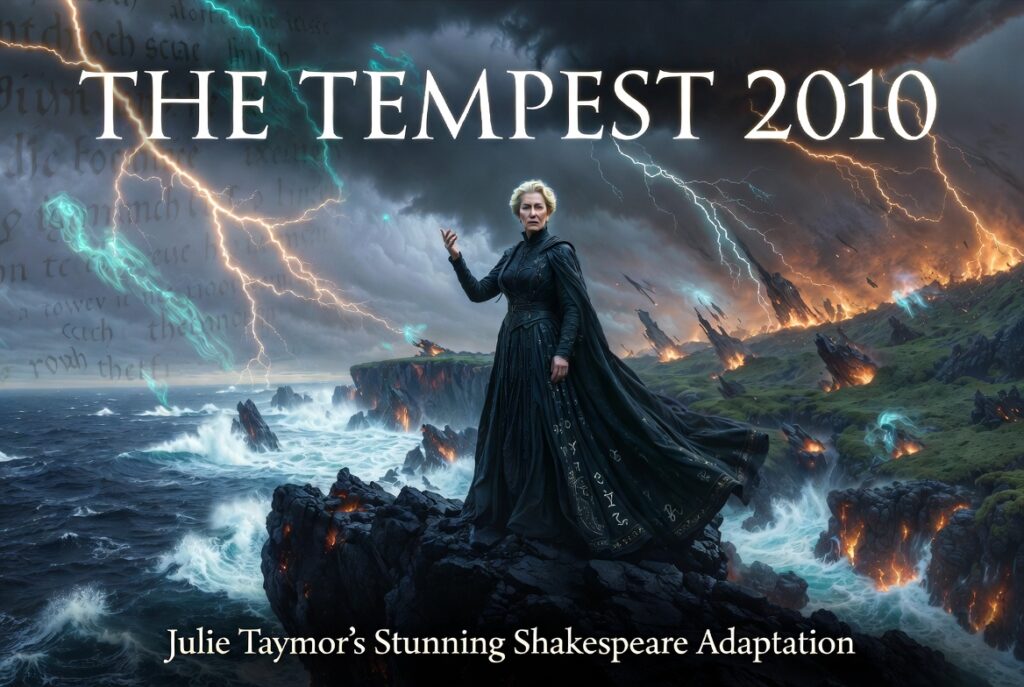
The Tempest has enjoyed a rich afterlife. It inspired operas (including by Tchaikovsky), films like Forbidden Planet (1956), and Julie Taymor’s visually stunning 2010 adaptation starring Helen Mirren as Prospera. Modern productions frequently reinterpret Caliban through lenses of race, disability, or environmentalism.
In today’s world, the play speaks to climate-related storms, debates over immigration and belonging, forgiveness in divided societies, and questions about the ethics of power. Prospero’s island can represent everything from a literal climate refuge to a psychological landscape.
Tips for Students and Teachers
Essay Writing Guidance Strong thesis examples:
- “Prospero’s journey from revenge to forgiveness illustrates Shakespeare’s belief in the redemptive power of mercy.”
- “Through Caliban, Shakespeare both reinforces and challenges colonial attitudes of his time.”
Key Quotations to Memorize Focus on Prospero’s renunciation speech and Miranda’s “brave new world” line.
Classroom Discussion Questions
- Is Prospero a sympathetic character?
- How should modern productions handle Caliban?
- What does the play suggest about the role of art and magic?
Compare The Tempest with A Midsummer Night’s Dream for magical elements or The Winter’s Tale for similar romance structure.
Frequently Asked Questions (FAQ)
Is The Tempest based on a true story? Not directly, but it draws heavy inspiration from the 1609 Sea Venture shipwreck and contemporary travel narratives.
What is the significance of Prospero’s final speech? The epilogue is widely seen as Shakespeare’s farewell to playwriting, asking the audience for applause to “release” him from the stage.
Is Caliban a villain or a victim? He is both — a nuanced character who elicits sympathy and condemnation simultaneously.
Why is The Tempest considered Shakespeare’s last play? Stylistic evidence, its position in the First Folio, and the autobiographical elements in Prospero strongly suggest it was his final solo work.
What is the best edition for reading? The Arden Shakespeare, Folger Shakespeare Library, or Oxford Shakespeare editions are highly recommended for students.
The Tempest remains one of Shakespeare’s most magical and moving achievements. Through its enchanting island, complex characters, and profound exploration of forgiveness and freedom, it offers wisdom that transcends its time. As Prospero says farewell to his art, Shakespeare invites us all to reflect on power, mercy, and the fleeting nature of human life.
Whether you are reading The Tempest for the first time or returning to it as an old friend, this masterpiece continues to reward attention. Its call for understanding and humanity feels as urgent today as it did in 1611.