Imagine possessing the power to command the weather, bend elemental spirits to your will, and orchestrate the ultimate revenge against those who betrayed you—all from the shores of a remote, uncharted island.
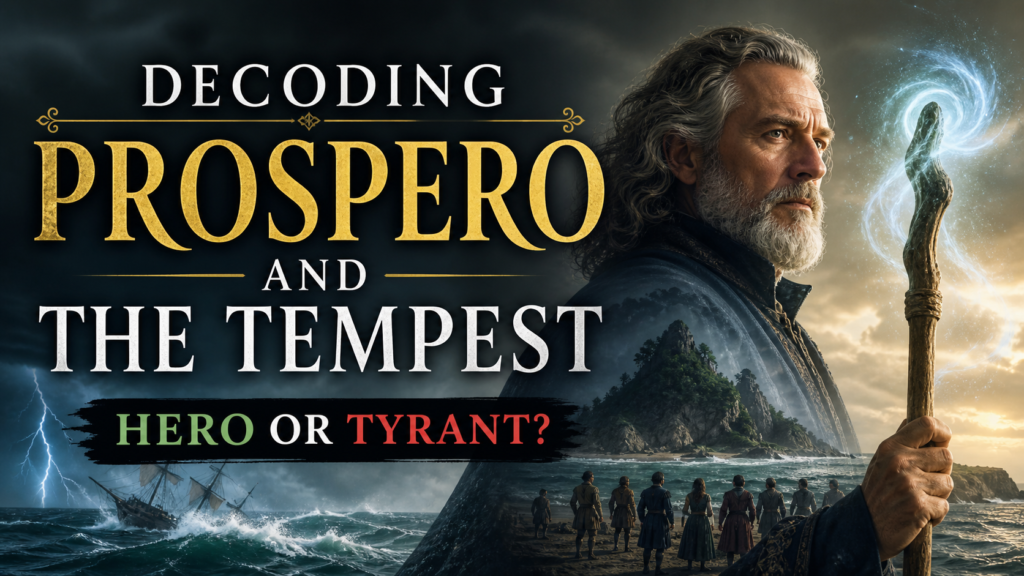
When diving into the later works of William Shakespeare, few character studies are as richly rewarding, or as fiercely debated, as the dynamic between Prospero and The Tempest. Is he a benevolent patriarch righting historical wrongs, a tyrannical colonizer subjugating native populations, or a meta-theatrical stand-in for Shakespeare himself, bidding a poignant farewell to the stage?
For centuries, literary scholars, theater directors, and students have grappled with the true nature of the former Duke of Milan. Understanding Prospero is the master key to unlocking the entire play. This comprehensive guide will decode the layers of Shakespeare’s most enigmatic protagonist, exploring the intersection of magic, power, colonialism, and forgiveness that defines his character.
Whether you are an actor preparing for a monologue, a literature student writing a thesis, or simply a Shakespeare enthusiast looking to deepen your understanding of this Jacobean masterpiece, this deep-dive analysis will provide the definitive insights you need.
The Usurped Duke: A Study in Power and Negligence
To understand the man who conjures the titular tempest, we must first examine the ruler he used to be. Prospero’s narrative begins long before he washes up on the shores of his magical island.
The Burden of the Liberal Arts
Before his exile, Prospero was the rightful Duke of Milan. However, by his own admission to his daughter Miranda in Act I, Scene II, he was a ruler who preferred the quiet solitude of his library over the bustling halls of court:
“Me, poor man, my library was dukedom large enough.”
Prospero’s fatal flaw was his obsession with the “liberal arts” and esoteric studies. By delegating the actual governance of Milan to his brother, Antonio, Prospero created a power vacuum. This political negligence highlights a recurring Renaissance theme: the delicate balance between the contemplative life (the scholar) and the active life (the ruler).
The Anatomy of Betrayal
Antonio, having tasted the power of the dukedom, conspired with Alonso, the King of Naples, to usurp Prospero. Sent out to sea in a decaying, unseaworthy vessel with his infant daughter, Prospero is left to die.
This backstory is crucial because it establishes the engine of the play: a deep, festering desire for justice and restoration. Prospero is not merely a wizard playing with mortals; he is a deeply traumatized political exile seeking to reclaim his stolen birthright. Every action he takes on the island is a calculated move on a grand chessboard to force his enemies into a state of repentance and to secure a royal future for Miranda.
The Sorcerer: Magic as Control and Artifice
Upon arriving on the island, Prospero transitions from a failed political ruler to an absolute magical monarch. His authority is no longer derived from a political title, but from his mastery of Art—a term heavily loaded with meaning in the early 17th century.
The Instruments of Power
Prospero’s magic is not innate; it is learned and requires physical conduits. Three specific items represent his authority:
-
The Books: Provided by the kind counselor Gonzalo during his exile, these texts are the source of his arcane knowledge. Without them, Caliban notes, Prospero is “but a sot.”
-
The Staff: The physical instrument of his will, used to direct the elements and spirits.
-
The Magic Garment (The Mantle): When Prospero wears his cloak, he is the omnipotent sorcerer. When he takes it off, he symbolically returns to being “Prospero the man.”
White Magic vs. Dark Magic (The Sycorax Contrast)
Shakespeare brilliantly defines Prospero’s magic through contrast. Before Prospero arrived, the island was ruled by the Algerian witch, Sycorax.
Sycorax represents goetia (dark, earthly magic driven by malice and demonic pacts). She imprisoned the spirit Ariel in a cloven pine because he refused to execute her “earthy and abhorr’d commands.”
Prospero, conversely, represents theurgia (high, intellectual magic derived from rigorous study and celestial alignment). By freeing Ariel, Prospero positions himself as a savior and a purveyor of order. However, this dichotomy is fragile. Prospero frequently uses threats of physical torment—often echoing the exact punishments Sycorax used—to keep Ariel and Caliban in line. This blurs the moral lines of his supposedly “white” magic, revealing it as a sophisticated tool for absolute authoritarian control.
The Colonial Master: Post-Colonial Perspectives on the Island
In modern literary criticism, it is impossible to analyze Prospero without confronting the post-colonial implications of his rule. The Tempest was written around 1610-1611, during the dawn of the British Empire’s expansion into the New World (evidenced by Shakespeare’s likely inspiration from the real-life Sea Venture shipwreck in Bermuda).
Prospero and Caliban: The Blueprint of Colonization
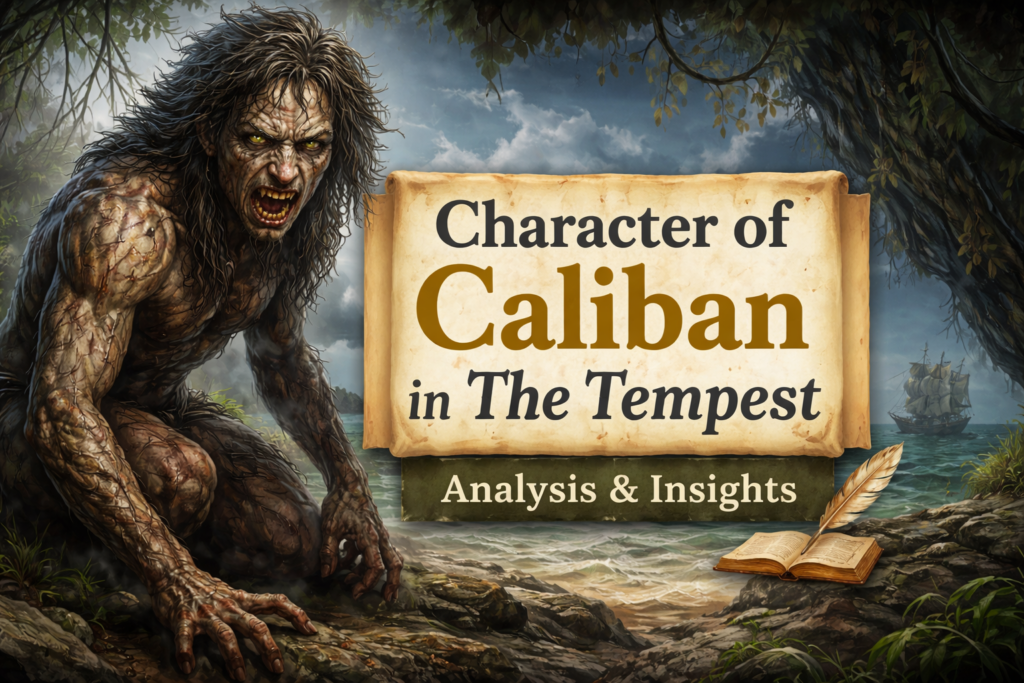
Caliban, the deformed son of Sycorax and the only native inhabitant of the island, is the ultimate foil to Prospero. Their relationship perfectly encapsulates the tragic trajectory of historical colonialism:
-
Initial Benevolence: Upon arrival, Prospero treats Caliban kindly, teaching him language and the names of the “bigger light, and how the less.”
-
Resource Extraction: In return, Caliban shows Prospero the island’s secrets—its fresh springs, brine pits, and fertile lands.
-
Subjugation: Following Caliban’s attempted assault on Miranda, Prospero strips him of his humanity, enslaving him and claiming the island as his own property.
Prospero views Caliban as a “born devil” whose nature cannot be nurtured. He uses language and education not to uplift Caliban, but to assert cultural dominance. Caliban’s famous retort brilliantly dismantles this imperialistic justification:
“You taught me language, and my profit on’t / Is I know how to curse.”
Prospero and Ariel: The Indentured Servant
While Caliban represents the enslaved indigenous body, Ariel represents the subjugated indigenous spirit. Ariel is bound to Prospero by a debt of gratitude for being rescued from Sycorax’s pine tree.
Prospero acts as a demanding employer, constantly promising Ariel his liberty but repeatedly delaying it. He uses Ariel as his secret police, his eyes and ears on the island, and the direct instrument of his psychological warfare against the shipwrecked nobles. Prospero’s relationship with Ariel exposes a different facet of tyranny—one masked by paternalistic affection but ultimately rooted in exploitation.
The Patriarch: Controlling Miranda and the Future
While Prospero exercises political and magical dominance over the island’s inhabitants, his role as a father adds yet another layer of complexity. His relationship with Miranda is the emotional core of his existence, but it is also characterized by a rigid, patriarchal control typical of the Jacobean era.
Orchestrating the Perfect Match
Prospero’s love for Miranda is undeniable; he states that she was the “cherubin” that gave him the will to survive their treacherous exile. However, his method of parenting is highly manipulative. He does not merely introduce Miranda to Ferdinand, the Prince of Naples; he orchestrates their entire romance with the precision of a master tactician.
By initially acting as a tyrant toward Ferdinand—accusing him of being a spy and forcing him into hard labor—Prospero utilizes reverse psychology. He explains this strategy to the audience:
“They are both in either’s powers; but this swift business / I must uneasy make, lest too light winning / Make the prize light.”
Prospero understands human nature and political necessity. By uniting his daughter with the heir of his former enemy, Alonso, Prospero guarantees that Miranda will eventually become Queen of Naples. This is not just a love match; it is a calculated dynastic triumph that secures his family’s legacy and definitively reverses the political defeat he suffered in Milan.
The Masque and Renaissance Morality
In Act IV, Prospero summons spirits to perform a breathtaking masque for the young couple, featuring the goddesses Iris, Ceres, and Juno. On the surface, this is a beautiful wedding blessing, celebrating fertility, agriculture, and heavenly harmony.
Beneath the surface, however, it is a formidable display of patriarchal power designed to enforce chastity before marriage. Prospero repeatedly warns Ferdinand against breaking Miranda’s “virgin-knot” before the holy ceremonies are performed, threatening them with barrenness and “sour-eyed disdain.” Prospero’s magic, therefore, acts as a policing force over his daughter’s sexuality, reflecting the intense anxieties surrounding female virtue and inheritance in 17th-century Europe.
The Master Playwright: Prospero as Shakespeare’s Alter Ego
One of the most enduring and beloved interpretations in literary criticism is the meta-theatrical reading: the idea that Prospero serves as an allegory for William Shakespeare himself. The Tempest, widely believed to be the last play Shakespeare wrote entirely on his own, is frequently viewed as his grand farewell to the theater.
Directing the Island’s Stage
Throughout the play, Prospero functions exactly like a theater director. He sets the scenes, dictates the entrances and exits of the “actors” (the shipwrecked nobles, Caliban, and the spirits), and manages the special effects (the tempest, the disappearing banquet). Ariel acts as his stage manager, executing the illusions that manipulate the audience’s (the nobles’) perceptions.
“Our Revels Now Are Ended”
The most compelling evidence for this biographical interpretation occurs in Act IV. After abruptly halting the wedding masque because he remembers Caliban’s plot against his life, Prospero delivers what is arguably the most poignant speech in the Shakespearean canon:
“Our revels now are ended. These our actors, / As I foretold you, were all spirits and / Are melted into air, into thin air… / We are such stuff / As dreams are made on, and our little life / Is rounded with a sleep.”
This speech transcends the narrative of the play. It reads as a playwright’s melancholic reflection on the ephemeral nature of theater and, ultimately, of human life. The “great globe itself” is a deliberate double entendre, referencing both the earth and Shakespeare’s own Globe Theatre.
The Renunciation of Art
When Prospero vows to break his staff and drown his magical book, it mirrors Shakespeare putting down his quill and retiring to Stratford-upon-Avon. He realizes that his “Art,” while powerful enough to raise the dead and command the weather, is ultimately just an illusion. It cannot fundamentally alter human nature.
The Climax: Vengeance vs. Virtue
For four acts, the audience watches a meticulously crafted revenge plot unfold. Prospero has his enemies exactly where he wants them: driven mad by illusions, starving, and trapped in a spell. He possesses the absolute power to destroy them.
Yet, The Tempest is a romance, a genre that demands reconciliation rather than tragedy. The turning point of the play—and the defining moment of Prospero’s character—hinges on a profound realization prompted by an inhuman spirit.
Ariel’s Empathy and Prospero’s Epiphany
Ariel reports to Prospero on the pitiful state of the nobles, particularly the sorrow of the old counselor Gonzalo. Ariel states that if Prospero were to see them now, his affections would become tender:
Ariel: “Mine would, sir, were I human.”
Prospero: “And mine shall. / Hast thou, which art but air, a touch, a feeling / Of their afflictions, and shall not myself, / One of their kind, that relish all as sharply, / Passion as they, be kindlier moved than thou art?”
This exchange is revolutionary. Prospero, a man who has played at being a god, is reminded of his shared humanity by a spirit composed of pure air. He chooses the path of grace over retribution, famously concluding:
“The rarer action is / In virtue than in vengeance.”
The Limits of Magic and the Reality of Forgiveness
Prospero’s forgiveness, however, is complex. He pardons his brother Antonio, but the pardon is chillingly stern, and Antonio notably remains silent, offering no apology in return. Shakespeare acknowledges a harsh reality here: magic can manipulate physical circumstances, but it cannot magically purify a corrupt heart. Prospero must return to the real world, accepting the flaws of humanity, including his own.
The Enduring Enigma of Prospero
When analyzing Prospero and The Tempest, we are forced to confront a character who defies simplistic categorization. He is an amalgamation of profound contradictions:
-
A victim of treason who becomes an absolute dictator.
-
A loving father who manipulates his daughter’s heart.
-
A “white” magician who uses psychological torture.
-
A vengeful god who ultimately chooses human mercy.
In his final act, the famous Epilogue, Prospero steps out of the illusion entirely. Stripped of his magic, his robes, and his spirits, he stands vulnerable before the audience, begging for their applause to release him from the island:
“As you from crimes would pardon’d be, / Let your indulgence set me free.”
Ultimately, Prospero is neither pure hero nor pure tyrant. He is a deeply flawed, highly intelligent man wrestling with the intoxicating nature of power and the painful necessity of letting it go. By decoding his journey from an usurped duke to an omnipotent sorcerer, and finally to a mortal man seeking redemption, we unlock the timeless genius of William Shakespeare’s final masterpiece.