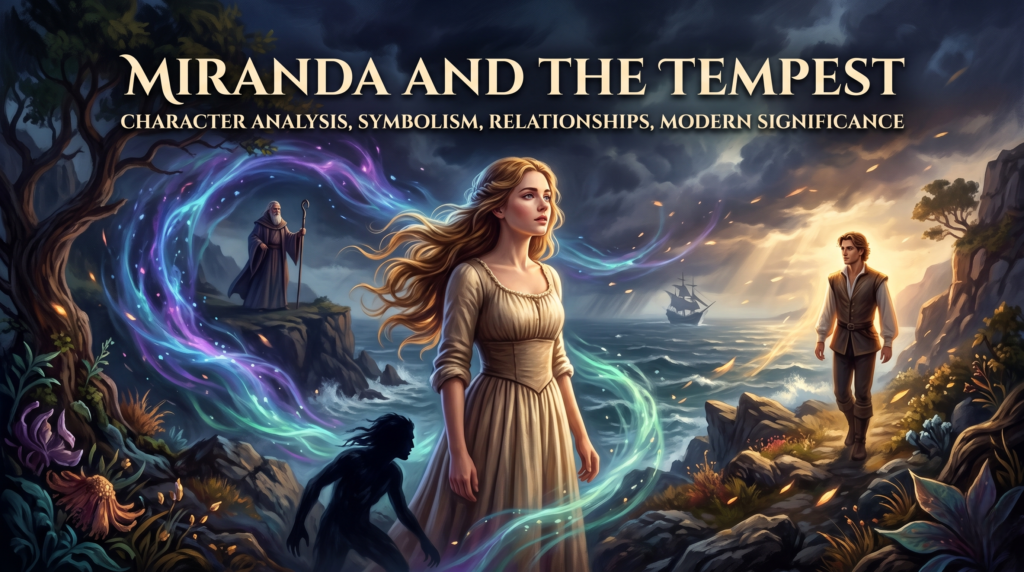
Imagine a young woman who has spent nearly her entire life on a remote, enchanted island, knowing only her powerful father, a monstrous servant, and the spirits that dance at his command. When she finally encounters other human beings—shipwrecked nobles from a world she has never known—her reaction is one of pure wonder: “O brave new world, / That has such people in’t!”
This is Miranda in William Shakespeare’s The Tempest. Far from a simple supporting character, Miranda stands at the heart of Shakespeare’s final solo play, embodying innocence, compassion, resilience, and the promise of renewal. In this comprehensive guide, we delve deeply into Miranda and The Tempest, exploring her character development, symbolic importance, key relationships, and enduring relevance. Whether you are a student preparing for exams, a literature enthusiast seeking deeper insight, or a theater lover analyzing Shakespeare’s last great work, this analysis provides the detailed textual evidence, historical context, and modern perspectives you need.
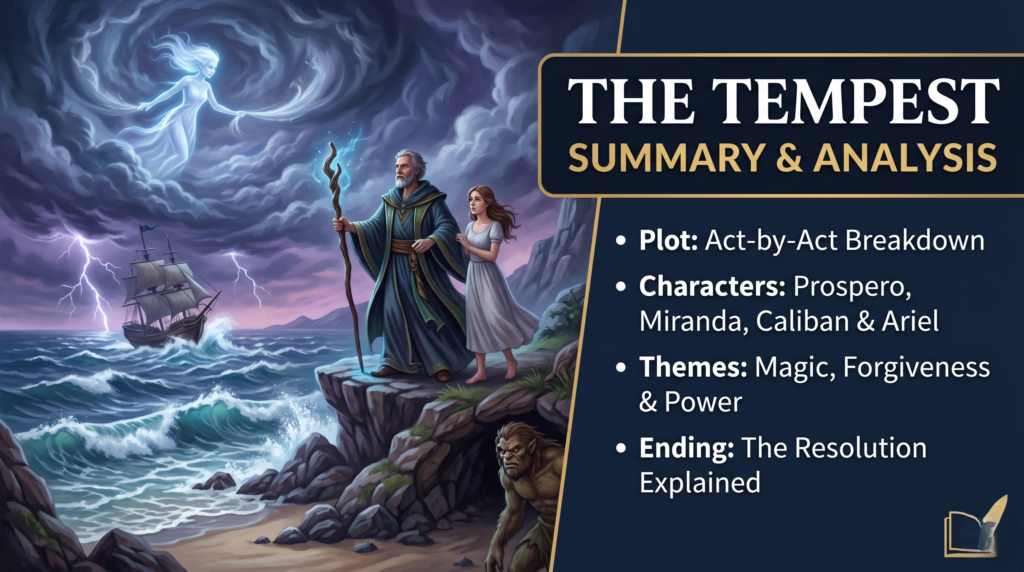
The Tempest, written around 1610–1611, is often regarded as Shakespeare’s farewell to the stage. Classified as a romance or tragicomedy, it blends elements of magic, forgiveness, revenge, and reconciliation. Set on a mysterious island, the play follows Prospero, the deposed Duke of Milan, as he orchestrates a tempest to bring his enemies to justice—and perhaps redemption. Miranda, his fifteen-year-old daughter, serves as both witness and catalyst in this grand design.
The Tempest – A Quick Plot Summary and Context
To fully appreciate Miranda’s role, a brief orientation with the play is essential. Prospero and the infant Miranda were exiled twelve years earlier by his treacherous brother Antonio, who seized the dukedom of Milan with help from the King of Naples. Washed ashore on a Mediterranean island (with echoes of the New World), Prospero uses his magic—derived from books and the spirit Ariel—to dominate the island and its native inhabitant, Caliban.
The play opens with a violent storm that Prospero conjures to wreck a ship carrying his enemies: Antonio, King Alonso, and others. Unharmed, they arrive on the island, where Prospero’s intricate plans unfold, including the meeting of Miranda and Alonso’s son, Ferdinand. Through magic, tests of character, and eventual forgiveness, Prospero regains his position while securing a dynastic future for his daughter.
The Tempest draws from contemporary sources, including William Strachey’s account of the 1609 Sea Venture shipwreck in Bermuda and Michel de Montaigne’s essays on New World inhabitants. These influences infuse the play with timely explorations of colonialism, power, and human nature.
Who Is Miranda? Character Introduction and First Impressions
Miranda’s name derives from the Latin mirari, meaning “to wonder at” or “admire.” She is literally “she who is to be wondered at”—a name that perfectly encapsulates her function in the play. Approximately fifteen years old, she was only three when exiled with her father. Her life has been one of isolation, tutelage under Prospero, and limited interaction with Caliban before his betrayal.
From her first appearance, Miranda reveals core traits of compassion and empathy. Witnessing the storm she believes has killed the sailors, she pleads with her father:
“If by your art, my dearest father, you have Put the wild waters in this roar, allay them. … O, I have suffered With those that I saw suffer!” (Act 1, Scene 2)
This immediate display of pity establishes Miranda as a moral compass amid Prospero’s calculated schemes. Her innocence is profound—she has seen no other women and only a handful of men—yet Shakespeare subtly hints at an inner strength that belies her sheltered existence.
In-Depth Character Analysis of Miranda
Miranda’s Personality Traits and Psychological Depth
Miranda is gentle, compassionate, and curious, yet far from purely passive. Traditional readings emphasize her as the epitome of feminine virtue: obedient, modest, and pure. However, a closer examination reveals complexity. She displays emotional intelligence and moral clarity, as when she condemns her uncle’s betrayal with the insightful line, “Good wombs have borne bad sons” (Act 1, Scene 2).
Her curiosity drives her to question Prospero about their past, and her resilience emerges in moments of defiance. Despite her isolation, she retains an optimistic view of humanity, a trait that contrasts sharply with the cynicism or ambition of the court characters.
Miranda’s Relationship with Prospero
The father-daughter bond is central and multifaceted. Prospero is both loving protector and controlling magician. He has educated Miranda thoroughly (“I have given you a thread of all my fortunes”), yet withheld key truths until the play’s action begins. His orchestration of events, including her meeting with Ferdinand, raises ethical questions about parental authority and manipulation.
Miranda shows deference but also pushes back, as when she defends Ferdinand against Prospero’s harsh tests. This dynamic explores themes of control versus autonomy, with Miranda’s growing awareness symbolizing a broader awakening. Prospero’s famous line, “We are such stuff / As dreams are made on,” reflects his philosophical depth, yet it is Miranda who embodies the hopeful future beyond his magic.
Miranda and Ferdinand – Love, Courtship, and Chastity
Miranda’s instant attraction to Ferdinand represents idealized first love. Upon seeing him, she exclaims he is “a thing divine.” Ferdinand, in turn, idealizes her as “perfect and so peerless… created / Of every creature’s best.”
Prospero deliberately tests their love by assigning Ferdinand menial labor, ensuring their affection is genuine rather than superficial. Miranda offers to carry logs herself, declaring boldly:
“I am your wife, if you will marry me; If not, I’ll die your maid. To be your fellow You may deny me; but I’ll be your servant, Whether you will or no.” (Act 3, Scene 1)
This scene highlights her agency and purity. Their chaste courtship contrasts with Caliban’s earlier attempted violation, underscoring themes of civilized love versus base desire. Their union promises political reconciliation and generational renewal.
Miranda’s Interactions with Caliban
Miranda’s relationship with Caliban provides one of the play’s sharpest contrasts. She once pitied and educated him, teaching him language:
“I pitied thee, Took pains to make thee speak, taught thee each hour One thing or other…”
Yet after Caliban’s attempt to rape her, she recoils in disgust: “Abhorrèd slave, / Which any print of goodness wilt not take.” This interaction fuels post-colonial readings, positioning Miranda within the civilizing mission while highlighting the failures and power imbalances of that project. Her rejection of Caliban affirms her alignment with Prospero’s order, yet it also humanizes the “savage” through her initial compassion.
Symbolism of Miranda in The Tempest
Miranda functions as far more than a romantic interest or dutiful daughter; she is one of Shakespeare’s most layered symbolic creations. Her very name and sheltered existence make her a living emblem of wonder, purity, and the potential for a renewed human order.
Miranda as Symbol of Innocence and Purity
In a play filled with betrayal, political intrigue, and moral ambiguity, Miranda represents untainted innocence. Raised away from the corruption of court life, she has never witnessed the “vild” (vile) nature of humanity until the shipwrecked courtiers arrive. Her instinctive compassion during the tempest scene establishes her as a moral center, echoing biblical figures like Eve before the Fall. Critics often describe her as a “New World Eve,” bringing hope and virtue to a fallen society.
This purity is not naive fragility but a powerful ethical force. While Prospero seeks revenge and control, Miranda consistently advocates for mercy and human connection.
Miranda as Embodiment of Nature vs. Nurture
One of the play’s central philosophical questions—how much of human behavior is innate and how much is learned—finds its clearest expression through Miranda. Prospero has meticulously nurtured her education with his precious books, yet her core goodness appears instinctive. Her horrified reaction to Caliban’s attempted assault and her immediate empathy for the strangers both suggest an innate moral compass.
Shakespeare uses Miranda to probe Renaissance debates on human nature, influenced by Montaigne’s essays questioning European superiority over “noble savages.” Miranda’s isolation creates a controlled experiment: what kind of person emerges when exposed only to selective knowledge and limited society?
Fertility, Renewal, and the “Brave New World”
Miranda’s union with Ferdinand symbolizes dynastic renewal and the promise of a better future. Their marriage will join Milan and Naples, ending the cycle of political betrayal that began with Prospero’s exile. Her famous exclamation in Act 5, Scene 1 — “O brave new world, / That has such people in’t!” — captures youthful optimism, though Prospero’s wry reply (“’Tis new to thee”) adds ironic depth. The phrase has since entered cultural lexicon as a symbol of discovery and hope, often cited in discussions of exploration and utopian ideals.
Miranda thus embodies fertility—both literal (future heirs) and metaphorical (spiritual and societal regeneration). Her role concludes Shakespeare’s recurring theme of young women as agents of reconciliation, seen also in The Winter’s Tale (Perdita) and Cymbeline (Imogen).
Miranda and the Theme of Wonder
Renaissance philosophy prized admiratio (wonder) as the beginning of knowledge. Miranda personifies this capacity. Her repeated expressions of awe (“What is’t? A spirit?” “O wonder!”) remind the audience—and the cynical courtiers—to view the world with fresh eyes. In this sense, she serves as Shakespeare’s surrogate for the ideal spectator, modeling the emotional and intellectual response the playwright hoped to evoke.
Historical and Literary Context
Understanding Miranda requires placing her within the cultural moment of early Jacobean England. Written around 1610–1611, The Tempest was performed for King James I, whose court was fascinated by masques, magic, and New World ventures. The play draws heavily from William Strachey’s 1610 letter describing the Sea Venture shipwreck in Bermuda, which provided realistic details of storms and island survival.
Michel de Montaigne’s “Of the Cannibals” (translated 1603) influenced Shakespeare’s portrayal of Caliban and, by extension, Miranda’s civilizing role. Jacobean anxieties about absolutism, succession, and colonial expansion find subtle echoes in Prospero’s island rule and Miranda’s betrothal.
Gender expectations of the period positioned young noblewomen as pawns in political marriages, yet also as symbols of virtue. Miranda’s chastity and obedience align with these ideals, while her moments of quiet defiance gently question absolute patriarchal control.
Performance History
From the Restoration adaptations (which added spectacles and even altered endings) to 20th-century productions, Miranda’s portrayal has evolved. Victorian actresses emphasized her ethereal innocence, while modern interpretations often highlight her strength and agency. Notable productions include Julie Taymor’s 2010 film (with Felicity Jones as Miranda) and various postcolonial stagings that re-examine her relationship to Caliban and the island.
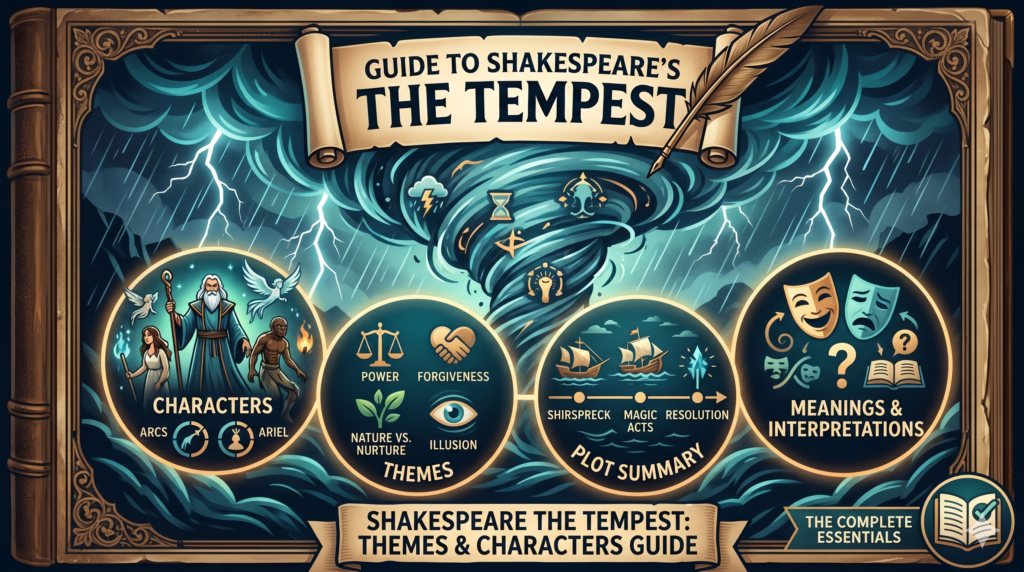
Key Themes Explored Through Miranda
Miranda serves as a lens for several of The Tempest’s major themes:
- Forgiveness and Reconciliation: Her presence softens Prospero’s anger and enables the play’s harmonious resolution.
- Power and Authority: The father-daughter relationship mirrors Prospero’s lost dukedom, exploring legitimate versus usurped power on both political and domestic levels.
- Education and Civilization: Miranda’s teaching of Caliban and her own rigorous education raise questions about whether knowledge truly civilizes.
- Magic, Illusion, and Reality: As Prospero’s magic dissolves in the final act, Miranda represents the enduring human reality beyond enchantment.
- Colonialism and the “Other”: Her interactions with Caliban and the shipwrecked Europeans reflect early modern encounters with new peoples and territories.
Literary Devices and Language in Miranda’s Scenes
Shakespeare crafts Miranda’s speech with delicate blank verse that reflects her gentle yet articulate nature. Her language is rich in emotional directness and vivid imagery. Key passages reward close reading:
The log-bearing scene with Ferdinand showcases rhetorical balance and sincere passion. Miranda’s willingness to share labor (“I’ll carry your logs the while”) inverts gender expectations subtly, using simple, heartfelt language that contrasts with the courtiers’ more ornate speech.
Imagery associated with Miranda frequently draws from nature—light, water, and growth—reinforcing her symbolic connection to renewal. Prospero’s descriptions of her as his “cherubin” further elevate her almost angelic status.
Modern Interpretations and Critical Perspectives
Feminist Readings of Miranda
Contemporary feminist scholars examine the limitations and strengths of Miranda’s agency. While she operates within a patriarchal framework (controlled first by Prospero, then promised to Ferdinand), she actively chooses her love and speaks with notable boldness. Critics like Ania Loomba and others explore how her voice is both amplified and contained by male figures.
Post-Colonial Perspectives
Postcolonial theory often views Miranda as complicit in the colonial project. Her education of Caliban and subsequent rejection of him mirror European “civilizing” missions. Some adaptations re-center the narrative to give Caliban and the island’s indigenous perspective greater weight, sometimes diminishing or complicating Miranda’s traditional sympathetic role.
Psychoanalytic and Ecological Approaches
Psychoanalytic readings focus on the father-daughter separation anxiety and Miranda’s sexual awakening. Ecological critics see the island—and Miranda’s harmonious relationship with it—as a model for sustainable coexistence with nature, contrasting Prospero’s manipulative magic.
Miranda in Popular Culture and Adaptations
Miranda’s influence extends beyond the stage. She appears reimagined in John Fowles’ novel The Collector, various films, television episodes, and even science fiction (the name’s association with wonder makes it popular in space-themed works). The phrase “brave new world” famously titles Aldous Huxley’s dystopian novel, demonstrating the enduring power of her words.
Why Miranda Still Matters Today
In an age of political division, digital isolation, and rapid technological change, Miranda offers timeless lessons. Her empathy in the face of suffering models emotional intelligence. Her curiosity encourages lifelong learning, while her moral courage reminds us to question authority when necessary. For young readers, particularly young women, she represents the possibility of finding one’s voice amid controlling environments and discovering a “brave new world” through genuine human connection.
Her story addresses contemporary concerns around consent (contrasted with Caliban’s actions), parental expectations, and cross-cultural understanding—making The Tempest remarkably relevant for 21st-century audiences.
Expert Insights and Study Tips
For students and educators:
Recommended Resources:
- Arden Shakespeare, Folger Shakespeare Library, and Norton Critical Editions for excellent annotations.
- Key critical works: Stephen Greenblatt’s Will in the World, and postcolonial studies by Paul Brown or Ania Loomba.
Discussion Questions:
- To what extent is Miranda truly innocent, or has Prospero shaped her worldview?
- Does Miranda’s “brave new world” speech reflect optimism or irony?
- How does Miranda challenge or reinforce Elizabethan gender norms?
Comparison Table: Miranda and Other Shakespearean Heroines
| Character | Play | Key Traits | Role in Resolution |
|---|---|---|---|
| Miranda | The Tempest | Innocent, compassionate | Reconciliation & renewal |
| Juliet | Romeo & Juliet | Passionate, defiant | Tragic |
| Cordelia | King Lear | Honest, loyal | Redemption (failed) |
| Perdita | The Winter’s Tale | Natural, virtuous | Restoration |
Essay Writing Tip: Always anchor arguments in specific quotations and consider multiple critical lenses for higher marks.
Miranda in The Tempest is a masterpiece of Shakespearean characterization—seemingly simple yet profoundly symbolic. Through her innocence, wonder, and capacity for love, she embodies the play’s ultimate message: that forgiveness, compassion, and human connection can redeem even the darkest betrayals and most enchanted illusions.
As Prospero lays down his magic and prepares to return to Milan, it is Miranda who carries the hope of the future. Shakespeare’s final solo play ends not with cynicism but with cautious optimism, personified in this remarkable young woman who teaches us to see the world with fresh eyes.
In studying Miranda and The Tempest, we do more than analyze a literary character—we engage with Shakespeare’s mature reflections on power, humanity, and the possibility of a braver, kinder world.
FAQs
What is Miranda’s role in The Tempest? Miranda serves as moral compass, romantic lead, and symbol of renewal. She humanizes Prospero’s revenge plot and represents hope for future generations.
Why does Miranda say “O brave new world”? She expresses genuine wonder upon seeing other civilized people for the first time, highlighting her isolation and optimistic nature.
Is Miranda a weak or strong character? While sheltered, Miranda demonstrates moral strength, empathy, and quiet defiance, making her more resilient than traditional readings suggest.
What is the relationship between Miranda and Caliban? Initially compassionate, it turns to revulsion after his attempted assault, highlighting themes of civilization versus savagery and failed education.
How does Miranda symbolize innocence? Her isolation from corrupt society preserves her purity, allowing her to function as an ethical standard within the play.