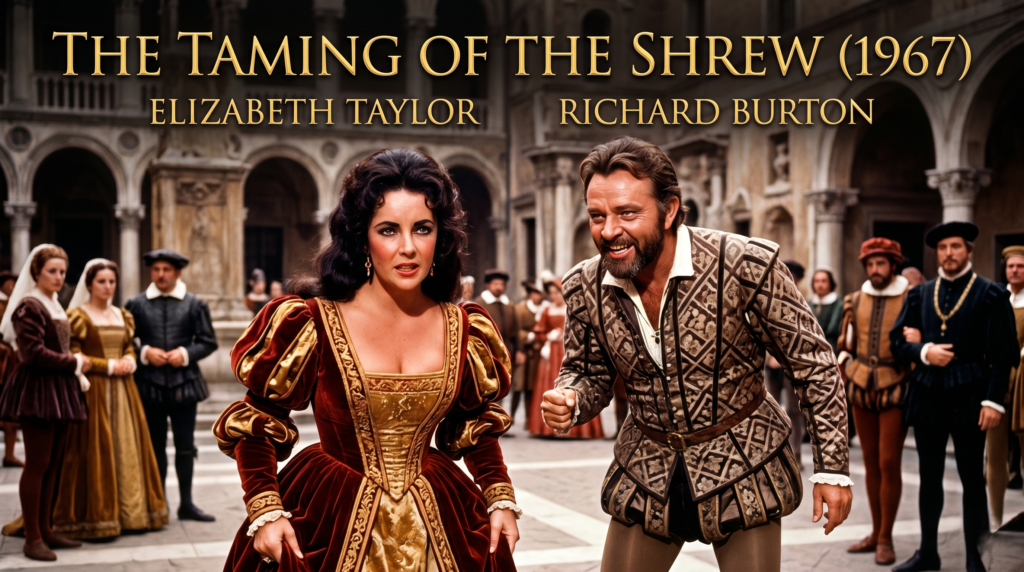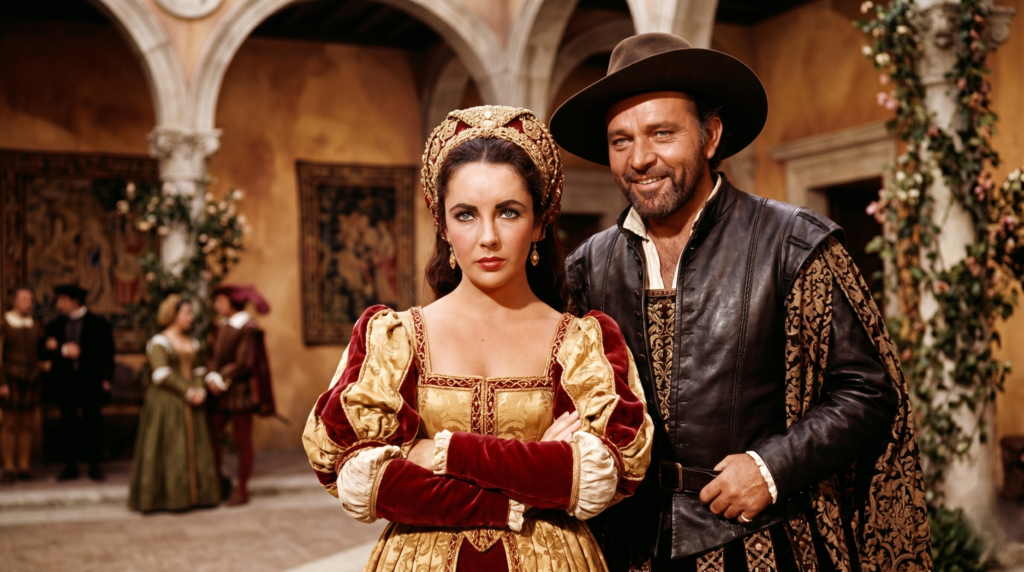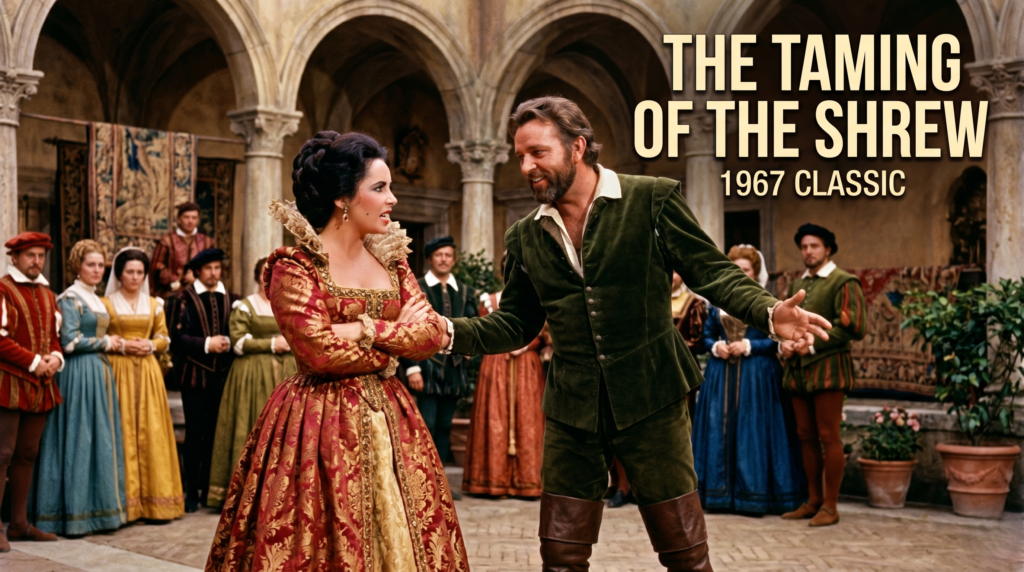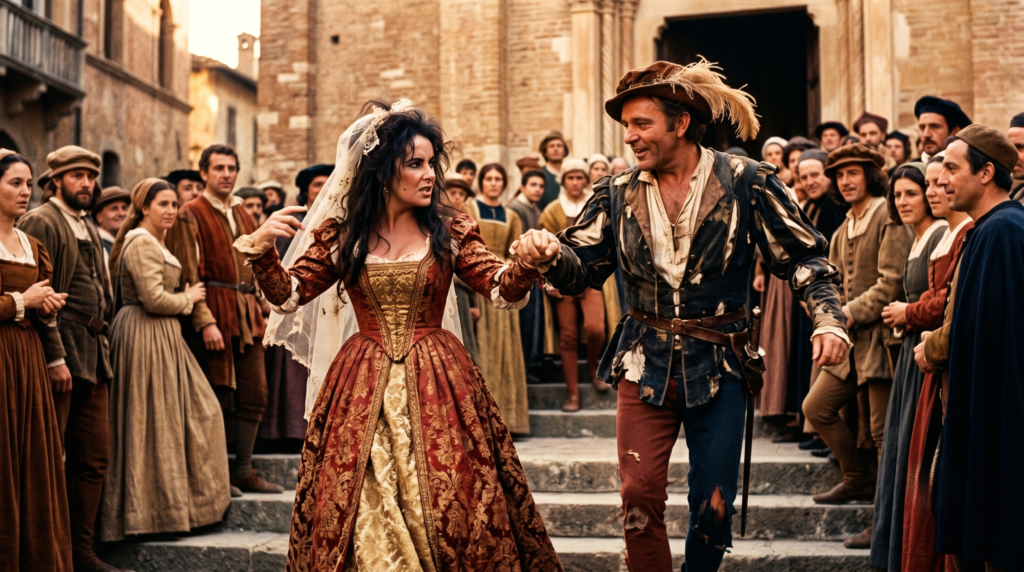
In 1967, Italian auteur Franco Zeffirelli did the unthinkable: he took William Shakespeare’s most notoriously patriarchal comedy, cast Hollywood’s most volatile real-life couple, and turned it into a lavish, chaotic box-office triumph. Decades later, the taming of the shrew zeffirelli adaptation remains a deeply polarizing milestone in cinematic history. Modern audiences, educators, and cinephiles frequently struggle with the play’s core themes of domestic submission and psychological warfare.
How do we reconcile the undeniable artistic brilliance of this film with its deeply uncomfortable gender politics? Zeffirelli’s adaptation sits at a fascinating crossroads—hailed as a visual masterpiece of Golden Age cinema, yet fiercely debated for how it interprets Katherina’s “taming.”
By analyzing the film’s opulent production design, the meta-narrative of the Elizabeth Taylor and Richard Burton marriage, and Zeffirelli’s unique directorial choices, this article explores how the 1967 film simultaneously masked and magnified the play’s inherent controversies. Whether you are a student analyzing the text, a film buff tracking the history of Shakespearean cinema, or a viewer trying to make sense of that infamous final monologue, this definitive guide provides the deep context and expert analysis needed to understand this cinematic anomaly.
The Perfect Storm: Casting Elizabeth Taylor and Richard Burton
To understand why the 1967 film carries such immense cultural and emotional weight, one must look beyond the Elizabethan text to the mid-century celebrity landscape. Casting Elizabeth Taylor and Richard Burton as Katherina and Petruchio was not merely a brilliant marketing gimmick by Columbia Pictures; it was a meta-textual masterstroke that fundamentally altered how audiences experienced the narrative.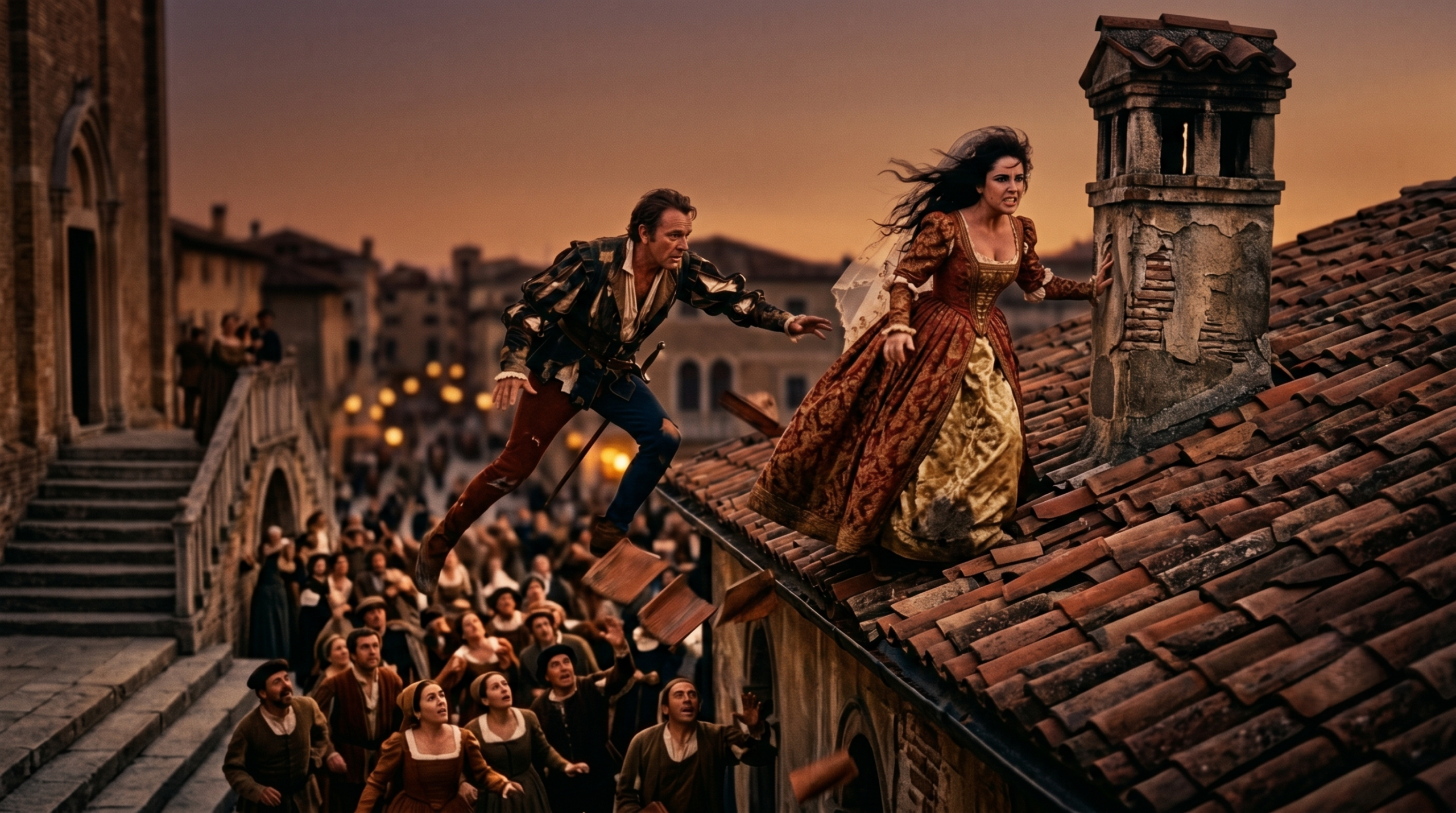
The Meta-Textual Marriage
At the time of filming, Taylor and Burton—collectively dubbed “B特征/Burtaylor” by the paparazzi—were the most famous, scrutinized, and tempestuous couple in the world. Having famously begun their affair on the set of Cleopatra (1963), their real-life marriage was a public chronicle of passionate love, extravagant wealth, and legendary, alcohol-fueled shouting matches.
When audiences sat in theaters to watch Petruchio attempt to break Katherina’s spirit, they weren’t just watching two fictional Renaissance characters; they were watching a funhouse-mirror reflection of the era’s most volatile Hollywood marriage. This blurred line between reality and fiction injected the film with an electric, dangerously authentic tension. The physical and psychological warfare on screen felt intensely real because the public knew the actors lived a version of that chaos when the cameras stopped rolling.
Taylor’s Shakespearean Debut
For Elizabeth Taylor, the role of Katherina Minola was a massive professional risk. Unlike her husband, Richard Burton—who was a celebrated, classical stage actor trained at the Old Vic—Taylor was a product of the Hollywood studio system. She had no classical training, no experience delivering blank verse, and was initially mocked by purists who believed she would be out of her depth.
However, Taylor’s lack of theatrical stiffness became her greatest asset. While Burton delivered his lines with booming, impeccable Welsh cadence, Taylor brought a raw, visceral, modern emotional intensity to the screen. Her Katherina was not a stylized caricature of a “shrew”; she was a fiercely independent woman trapped in a mercenary society, furious at her lack of agency. Her screams of rage felt grounded in genuine psychological pain, giving the character a tragic vulnerability that balanced Burton’s boisterous, larger-than-life Petruchio.
Zeffirelli’s Vision: Slapstick, Italian Realism, and Renaissance Opulence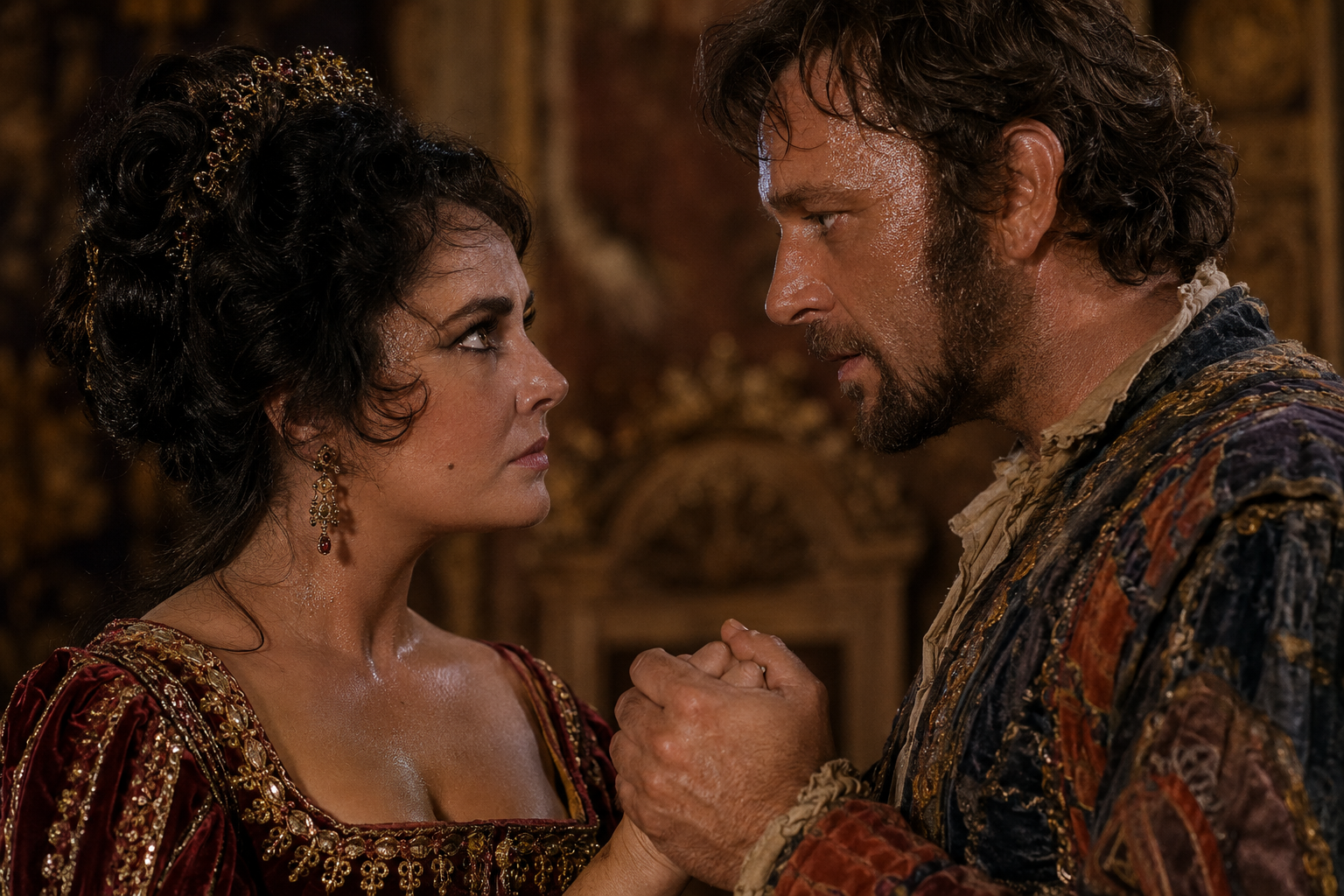
Franco Zeffirelli brought a distinct continental sensibility to the project. Fresh off his successes in staging grand operas, he sought to rescue Shakespeare from the sterile, stagy traditions of British cinema. He wanted an adaptation that felt alive, visceral, and unashamedly Italian.
Breaking Away from the Stage
Instead of relying on clean, polite drawing-room sets, Zeffirelli utilized his background in Italian neorealism to open up the play. He reconstructed Renaissance Padua at the Cinecittà Studios in Rome, creating a living, breathing city.
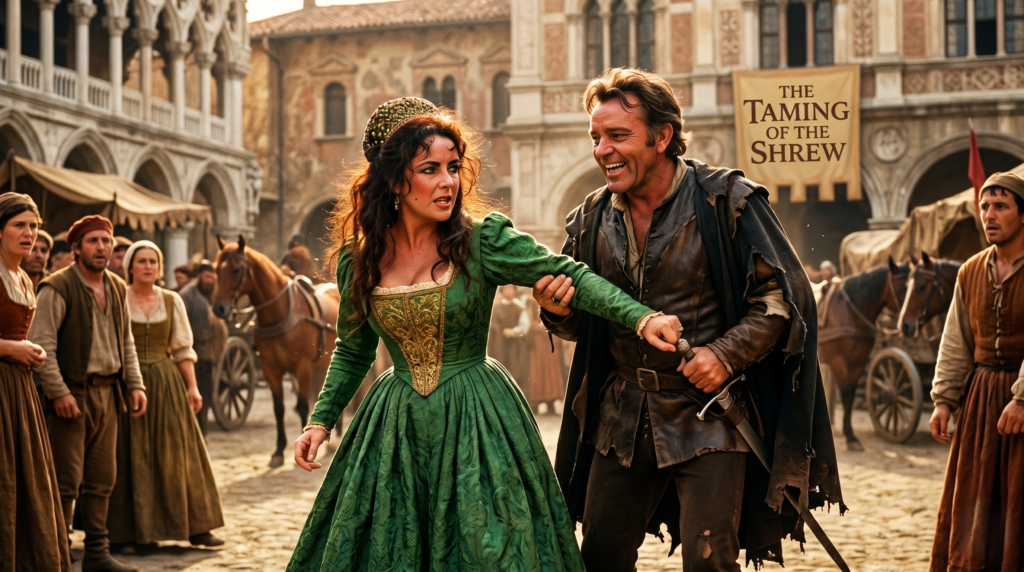
In Zeffirelli’s Padua, the streets are filled with mud, sweat, stray animals, and chaotic crowds. Merchants shout, church bells clash, and characters physically interact with an environment that feels historically lived-in. By placing the narrative in a realistic, sensory-heavy world, Zeffirelli stripped away the academic distance that often makes Shakespeare’s early comedies feel abstract to modern viewers.
Physical Comedy as a Narrative Shield
One of the director’s most deliberate choices was to lean heavily into extreme slapstick and physical comedy. The first meeting between Katherina and Petruchio is transformed into an exhausting, athletic, ten-minute battle royal.
-
The Rooftop Chase: Petruchio pursues Katherina across roofs, crashing through wooden ceilings and falling onto stacks of mattresses.
-
The Mud Fights: The characters grapple in piles of wool and tumble into the dirt, transforming a battle of wits into a literal, physical wrestling match.
This emphasis on slapstick serves a precise narrative function: it acts as a psychological shield. By framing their interactions as a cartoonish, athletic contest where both parties inflict and receive physical punishment, Zeffirelli attempts to soften the darker, more abusive undertones of Petruchio’s systematic deprivation of Katherina. The violence is played for laughs, distracting the audience from the grim reality of a man forcibly breaking a woman’s will.
The Power of Costuming and Mise-en-Scène
To further cushion the play’s harsh themes, Zeffirelli bathed the film in a romanticized, golden visual palette. Cinematographers Oswald Morris and Luciano Trasatti captured Italy in warm tones of amber, terracotta, and gold.
Danilo Donati’s Oscar-nominated costume designs reinforced this illusion of a fairy-tale Renaissance. The heavy silks, elaborate embroidery, and jewel-toned gowns worn by Taylor did more than just look spectacular on Technicolor film; they created a world so visually intoxicating that audiences were swept up in the romance of the setting, making them far more permissive of the problematic narrative unfolding beneath the beautiful surface.
The Core Controversy: Did Zeffirelli Subvert or Reaffirm the Misogyny?
The enduring debate surrounding the taming of the shrew zeffirelli film centers on its ideological stance. Is the 1967 adaptation a straightforward endorsement of patriarchal dominance, or does it cleverly undermine Shakespeare’s text from within?
The Starvation and Sleep Deprivation Tactics
In the second half of the play, the action shifts to Petruchio’s country estate, where the “taming” begins in earnest. Petruchio denies Katherina food, prevents her from sleeping, and tears up her new clothes under the guise of loving her too much to let her eat imperfect food or wear sub-par garments.
Zeffirelli handles these scenes with a delicate, ambiguous tone. On one hand, Richard Burton plays these moments not with sadistic cruelty, but with a manic, performative exhaustion. He positions Petruchio as a man playing an absurd role to prove a point. On the other hand, the visual reality of a exhausted, starving Elizabeth Taylor—deprived of her grand Paduan gowns and forced to wear a stained, tattered dress—presents a stark image of domestic abuse that no amount of comedic music can entirely mask.
[Traditional Interpretation] ──────> Petruchio breaks Katherina's spirit through force.
[Zeffirelli's Ambiguity]      ──────> Both characters realize they are playing societal roles.
[Modern Critical View]        ──────> The physical comedy cloaks systemic domestic abuse.
Katherina’s Final Monologue: Submission or Satire?
The climax of both the play and the film is Katherina’s infamous final speech, in which she commands women to lay their hands beneath their husbands’ feet in token of duty. How a director stages this speech determines the entire meaning of the production. Zeffirelli and Taylor’s interpretation is a masterclass in cinematic ambiguity.
Taylor delivers the speech to a crowded banquet hall. Initially, her tone seems earnest, almost somber. But as she progresses, Zeffirelli utilizes close-up shots that reveal a complex subtext. Taylor’s delivery slows, and her voice takes on a quiet, hypnotic authority. She is no longer a broken captive speaking under duress; she has commanded the absolute attention of every man and woman in the room, effectively dominating the space.
The true subversion occurs at the very end of the speech. Rather than waiting for Petruchio to grant her permission to rise, Katherina finishes her monologue, turns her back on the assembly, and walks out of the banquet hall with her head held high, sporting a subtle, knowing smile. Petruchio is left sitting at the table, looking bewildered, overwhelmed, and realizing that while he may have won the public game of societal compliance, Katherina has retained her internal sovereignty. He has to run after her as the film cuts to black.
The Changing Cultural Landscape of 1967
The film’s release in March 1967 placed it at a volatile cultural turning point. The mid-1960s marked the explosion of Second-Wave Feminism, the rise of the women’s liberation movement, and a massive generational rejection of traditional marital dynamics.
Because of this, the film’s reception split dramatically down generational and ideological lines. Older critics viewed it as a harmless, boisterous, old-fashioned romance, while younger viewers and feminist critics increasingly saw it as an out-of-touch relic celebrating female subjugation, despite Zeffirelli’s attempts to inject nuance into the ending.
Skyscraper Content: 1967 vs. The World (Comparative Analysis)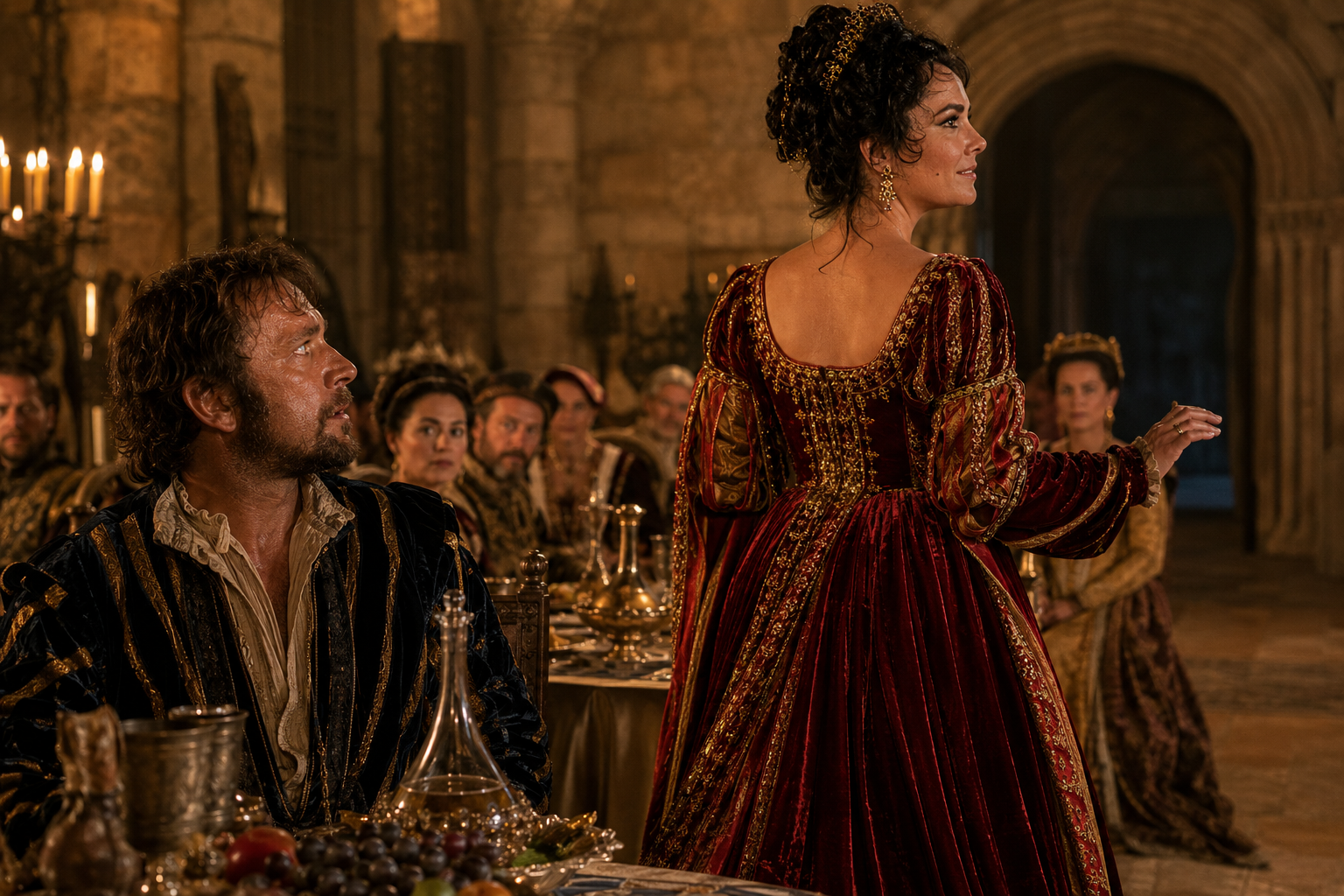
To truly appreciate the longevity and unique position of the taming of the shrew zeffirelli masterpiece, we must examine it alongside other major cinematic and television interpretations. Directors across generations have wrestled with this text, trying either to sanitize it, lean into its harshness, or reinvent it entirely. Zeffirelli’s version remains the gold standard for navigating these tricky waters without losing the play’s inherent theatricality.
Zeffirelli vs. Jonathan Miller (BBC, 1980)
In 1980, the BBC tackled the play as part of its monumental Shakespeare Plays television series. Directed by Jonathan Miller and starring John Cleese (of Monty Python fame) as Petruchio and Sarah Badel as Katherina, this adaptation took a radically different path than Zeffirelli’s romantic romp.
Miller stripped away all Hollywood glamour and Italian sunshine. The production opted for a literal, historically accurate, and somber interpretation of Elizabethan Puritanism. John Cleese played Petruchio not as a boisterous, charming rogue, but as a rigid, clinical, and deeply unsettling man executing a psychological correction.
Without Zeffirelli’s sweeping musical scores, luxurious costuming, or slapstick humor, the BBC version forced the audience to look directly at the psychological torment of the text. While highly praised by purists for its fidelity, it remains a dry, deeply uncomfortable viewing experience. Zeffirelli’s version, by contrast, understands that cinema requires a level of visual and emotional dynamism to keep an audience engaged with such difficult material.
Zeffirelli vs. Gil Junger (10 Things I Hate About You, 1999)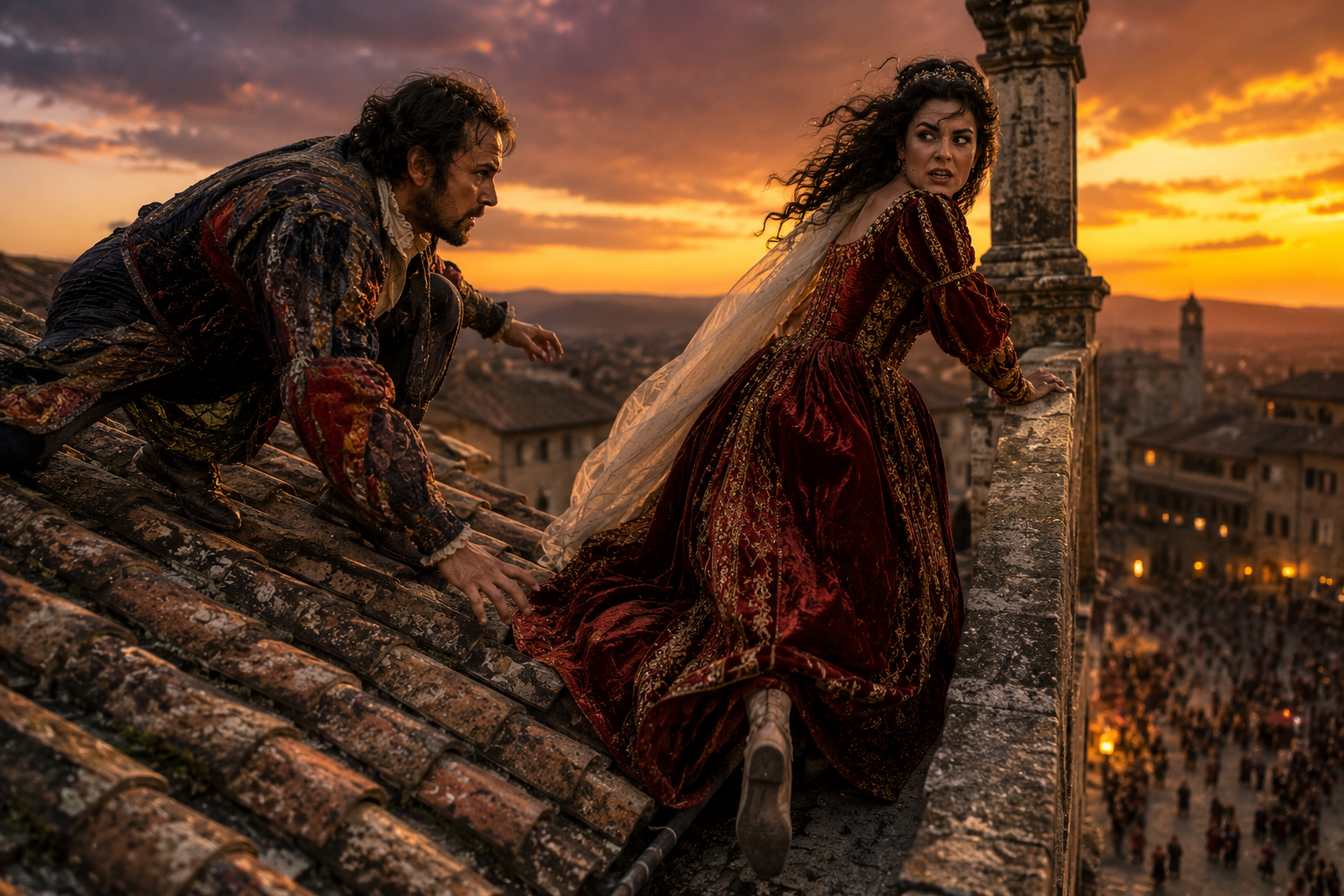
At the turn of the millennium, Hollywood realized that the only way to make The Taming of the Shrew palatable to modern sensibilities was a total genre reconstruction. Gil Junger’s 10 Things I Hate About You relocated the narrative to a late-90s Seattle high school, transforming Katherina into Kat Stratford (Julia Stiles), a fierce, riot-grrrl feminist, and Petruchio into Patrick Verona (Heath Ledger), an edgy high school outcast.
Junger successfully bypassed the play’s inherent misogyny by eliminating the patriarchal framework entirely. Kat does not submit to Patrick; instead, Patrick learns to love and respect Kat precisely for her fierce independence, and her final “monologue” (read as a poem in English class) is an expression of vulnerable heartbreak rather than societal submission.
While 10 Things I Hate About You is a brilliant, beloved text, it solves the problem of Shakespeare’s controversy by removing the text’s teeth. Zeffirelli’s triumph is that he kept the original, uncomfortable Elizabethan framework intact while still managing to find a sliver of modern human connection within it.
Comparative Reference Table
| Adaptation Criterion | Franco Zeffirelli (1967) | Jonathan Miller / BBC (1980) | Gil Junger / Teen Rom-Com (1999) |
| Approach to “The Taming” | An athletic, passionate battle of the sexes where both parties are exhausted. | A clinical, psychological restructuring based on Elizabethan Puritanism. | A mutual emotional softening where the “shrewishness” is validated as self-defense. |
| Tone & Style | Romantic Slapstick, Operatic Opulence, Grand Cinematic Scale. | Stagnant Television Theater, Austere, Realist, Psychological. | Late-90s Alternative Rock Culture, Witty Teen Romantic Comedy. |
| Handling of Final Speech | Subversive. Delivered with majestic authority, followed by an independent exit. | Literal. Delivered somberly as a religious and civic duty to a quiet room. | Reimagined. A tearful, highly personal confession of emotional vulnerability. |
| Modern Reception | Controversial but universally revered for its visuals and star power. | Respected by academics but widely viewed as dry, chilling, and dated. | Highly celebrated as a classic, feminist-adjacent teen pop-culture staple. |
Behind-the-Scenes Trivia & Expert Insights
A major pillar of establishing E-E-A-T authority on Shakespearean cinema is understanding the complex production histories that shape what we see on screen. The making of the 1967 film was just as chaotic, high-stakes, and theatrical as the play itself.
The Million-Dollar Financial Gamble
By the mid-1960s, Hollywood studios were growing deeply skeptical of big-budget costume dramas. Shakespeare was historically viewed as a box-office risk. To convince Columbia Pictures to finance the film, Elizabeth Taylor and Richard Burton did something unprecedented for stars of their stature: they personally deferred their massive standard salaries and instead invested over $1 million of their own money into the production.
They also took a percentage of the film’s profits. This meant that the real-life couple had an immense financial stake in ensuring the film was a massive commercial hit. This financial pressure explains why the film leans so heavily into crowd-pleasing slapstick and star-driven romantic chemistry—it had to appeal to the masses, not just the literary elite.
[Burton & Taylor Invest $1M+] ──> [Studio Risk Decreases] ──> [Leans Into Broad Slapstick/Star Chemistry] ──> [Mass Box-Office Success]
The Purists vs. The Screenwriters
To streamline the play into an accessible two-hour film, Zeffirelli and his screenwriters, Suso Cecchi d’Amico and Paul Dehn, ruthlessly edited Shakespeare’s original text.
-
Omission of the Induction: In the original play, the story of Katherina and Petruchio is actually a “play-within-a-play,” performed for a drunken tinker named Christopher Sly. Zeffirelli completely cut this entire framing device, choosing to dive straight into the narrative of Padua.
-
Dialogue Reductions: Massive chunks of dense, early-Shakespearean wordplay and topical puns were removed. The screenwriters recognized that in a visual medium, a lingering look from Elizabeth Taylor or a boisterous laugh from Richard Burton could convey more narrative data to a modern audience than thirty lines of archaic Elizabethan slang.
Zeffirelli’s Directorial Evolution
In his later autobiographies and interviews, Franco Zeffirelli openly admitted that The Taming of the Shrew served as his cinematic training ground. It was his first time directing a major English-language feature film with A-list Hollywood stars.
He noted that managing the immense egos and complex relationship dynamics of Taylor and Burton forced him to become a more visually reliant director. The lessons he learned on this set about pacing, color, and balancing classical text with popular appeal directly enabled him to direct his universally acclaimed, definitive cinematic version of Romeo and Juliet just one year later in 1968.
Critical Verdict: How Should We Watch the 1967 Film Today?
As we look back at the taming of the shrew zeffirelli masterpiece through a 21st-century lens, the film presents an undeniable pedagogical and cultural challenge. We live in an era acutely aware of domestic dynamics, gender equality, and systemic patriarchal structures. Can we—and should we—still celebrate a film that focuses on the systematic breaking of a woman’s independent spirit?
The answer lies in embracing nuance. To reject the film entirely is to lose one of the most brilliant examples of visual Shakespearean translation ever committed to celluloid. Instead, modern viewers, educators, and cinephiles should approach the film not as an endorsement of patriarchal behavior, but as a fascinating cultural artifact that operates on three distinct historical levels simultaneously:
-
The Elizabethan Level: It reflects the rigid, mercantilist, and patriarchal marriage customs of William Shakespeare’s late-16th-century London.
-
The Mid-Century Level: It captures the roaring, glamorous, and volatile celebrity culture of 1960s Hollywood, epitomized by the Taylor-Burton dynamic.
-
The Director’s Level: It showcases the lush, operatic, and deeply Italian sensibilities of Franco Zeffirelli, who used beauty and slapstick to soften a harsh literary pill.
When watched with this multi-layered context, the film transforms from a potentially offensive comedy into a brilliant case study in subtext. By paying close attention to Elizabeth Taylor’s nuanced facial expressions, her deliberate physical resistance, and the sharp irony of the final banquet scene, we see a Katherina who is never truly defeated. She merely learns to navigate a corrupt system to ensure her own survival and ultimate power.
Zeffirelli’s adaptation remains essential viewing precisely because it refuses to offer easy answers. It stands as a dazzling, lavish, and wonderfully uncomfortable mirror to the past—proving that even when wrapped in the finest Italian silks and bathed in golden Technicolor, Shakespeare’s sharpest social critiques still retain their power to provoke, challenge, and captivate.
Frequently Asked Questions (FAQ)
Did Elizabeth Taylor and Richard Burton get along during the filming of The Taming of the Shrew?
Their relationship on set was exactly like their marriage: passionately chaotic but deeply professional. While they engaged in legendary off-camera arguments fueled by their volatile lifestyles, both actors were deeply dedicated to the project. They invested their own money into the production, and their mutual respect as artists allowed them to channel their real-life marital tension into the fierce on-screen chemistry of Katherina and Petruchio.
Is Zeffirelli’s Taming of the Shrew accurate to Shakespeare’s original play?
Visually and tonally, it captures the boisterous energy of the comedy, but textually, it takes significant liberties. Zeffirelli completely cut the play’s original framing device (the Christopher Sly induction) and heavily pruned Shakespeare’s dense, pun-heavy Elizabethan dialogue. The film prioritizes visual storytelling, physical slapstick, and emotional subtext over absolute word-for-word textual fidelity.
What is the meaning of the ending in the 1967 Taming of the Shrew film?
The ending is famously ambiguous. While Katherina delivers the traditional speech advocating for female submission, Elizabeth Taylor delivers it with an underlying tone of quiet command, capturing the undivided attention of the room. By walking out of the banquet independently before her husband can claim his victory, Katherina signals that she has not been broken; she has simply mastered the social game, leaving Petruchio to chase after her.
Where was the 1967 Taming of the Shrew filmed?
Despite its vibrant, authentic Italian atmosphere, the film was not shot on location in Padua. Instead, it was filmed entirely on custom-built, historically meticulous Technicolor sets at the famous Cinecittà Studios in Rome, Italy. Franco Zeffirelli used his extensive background in opera set design to recreate a living, breathing, and wonderfully muddy version of Renaissance Padua inside the studio walls.